


FedEx Freight Says Self-Driving Trucks Are Ready, Uber Bets on Europe, and AUKUS Goes Underwater
Executive Summary
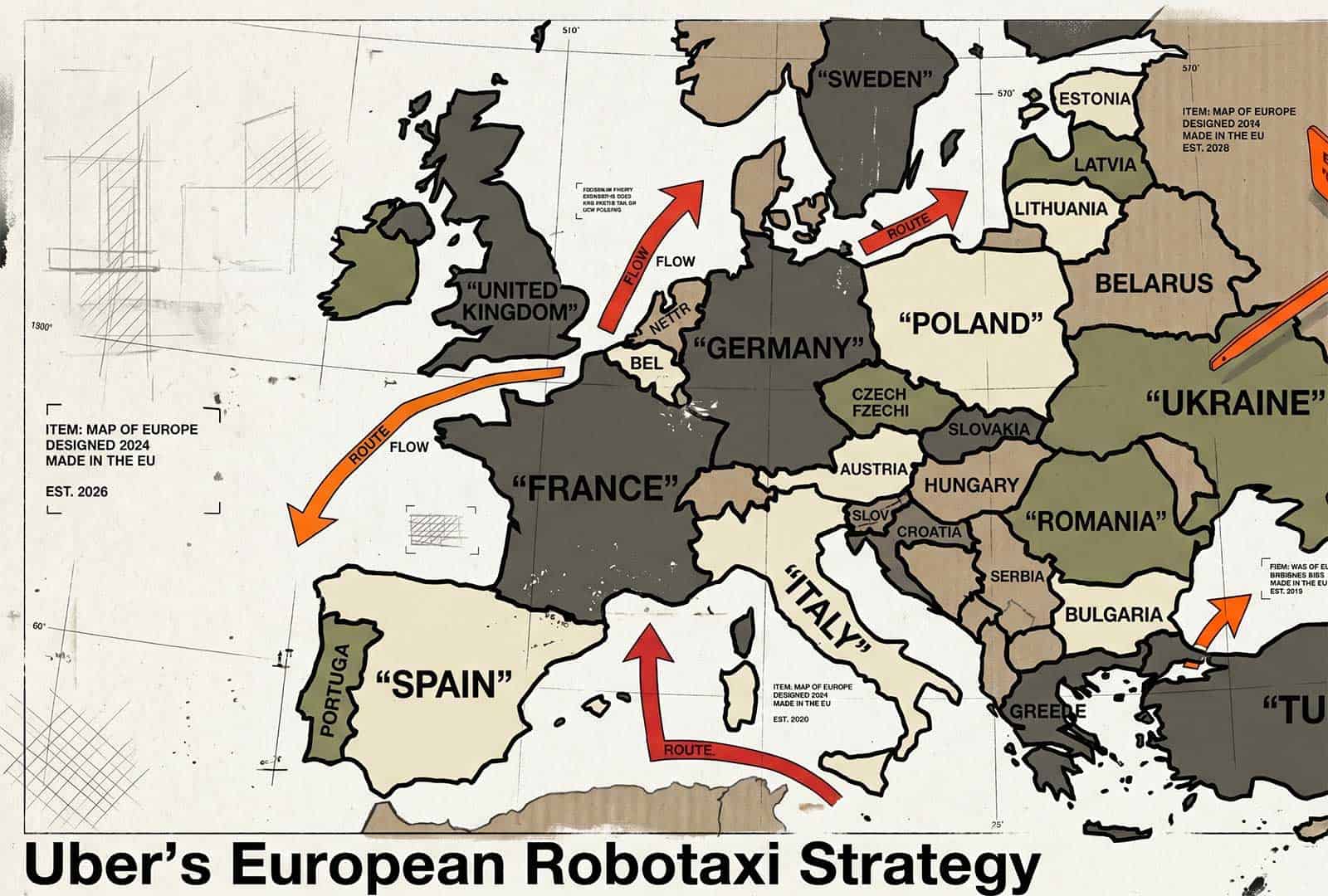
FedEx Freight CEO John Smith declared autonomous tractor-trailers ready for prime time, stating the primary barrier to commercialization is regulatory rather than technical, a major signal for the autonomous trucking industry. Uber is executing an asset-light, OEM-agnostic platform strategy across Europe by partnering with Autobrains and NVIDIA for a Munich robotaxi program and WeRide for Madrid, while mirroring its early ride-hailing land-grab playbook internationally.
Australia, the UK, and the US formalized a trilateral AUKUS project to develop unmanned undersea vehicles by 2027, targeting reconnaissance, strike, anti-submarine warfare, and protection of critical underwater cable infrastructure. Across all three signals, NVIDIA emerges as the dominant picks-and-shovels provider in the autonomy economy.
Key Autonomy Signals Episode Questions Answered
Why did Uber choose Munich for its Autobrains robotaxi launch and what does the OEM-agnostic model mean financially for Uber?
Munich was selected in part because Germany has an established national regulatory framework for L4 vehicles, making deployment stages achievable. Financially, Uber’s OEM-agnostic model keeps vehicle acquisition CapEx entirely off its balance sheet, forcing Autobrains, NVIDIA, fleet operators, and the eventual OEM partner to absorb hardware costs while Uber captures high-margin autonomous supply through its demand network.
What did FedEx Freight’s CEO say about autonomous trucks and why does it matter for the industry?
CEO John Smith stated that autonomous tractor-trailers are capable of navigating from yard to interstate to the next facility with 99.9% autonomy and declared the technology ‘ready for prime time,’ identifying regulation rather than technology as the primary barrier to commercialization. This is significant because it shifts the industry narrative from technical readiness debates to regulatory and policy action, and signals that a major logistics operator is prepared to accelerate adoption once a federal framework is in place.
What are the biggest risks Omega identified in the AUKUS unmanned undersea vehicle program?
Omega flagged three primary risks: an aggressive 2027 delivery target that pressures supply chains not yet scaled for production-grade deep-sea autonomy, complex trilateral interoperability requirements across US, UK, and Australian defense networks, and the geopolitical escalation risk that strike-capable UUVs in contested waters could provoke rivals and if a classified AI-driven UUV is lost or captured, adversaries could reverse-engineer the alliance’s autonomy stack.
Autonomy Signals Topics & Timestamps
[00:00] Signal 1: Uber’s European Robotaxi Strategy
Uber, Autobrains, and NVIDIA have announced a strategic collaboration to launch a robotaxi program in Munich, Germany, pending regulatory approval. The deployment relies on Autobrain’s agentic AI and NVIDIA’s compute platform to create an OEM-agnostic architecture that automakers can directly integrate into production vehicles.
This partnership highlights Uber’s deliberate shift toward an asset-light commercialization model, as the company aims to standardize deployment while forcing third-party operators or OEM partners to absorb the heavy hardware capital expenditures.
[33:19] Signal 2: AUKUS Accelerates Unmanned Undersea Autonomy
Australia, the United Kingdom, and the United States have initiated a joint defense project to develop unmanned undersea vehicles (UUVs) with an aggressive delivery target of 2027. These autonomous systems are designed for multi-mission payloads, specifically targeting reconnaissance, strike capabilities, anti-submarine warfare, and the protection of critical underwater infrastructure like data cables and pipelines.
This development signals that the autonomy economy is expanding well beyond commercial endeavors to become a core pillar of global national security.
[56:16] Signal 3: FedEx Freight CEO Flips the Script
John Smith, CEO of the newly independent FedEx Freight, explicitly stated that autonomous tractor-trailers are “ready for prime time” and capable of navigating from yard to interstate with 99.9% autonomy. He noted that the primary barrier to commercialization is no longer a technical issue, but rather a hurdle of regulatory frameworks and public acceptance. This bold statement from a major logistics leader fundamentally shifts the industry narrative from questioning the technology’s capability to waiting for legal permission to deploy fleet operations without safety drivers.
[01:09:26] AUTNMY AI
AUTNMY AI is an applied intelligence firm whose mission is to develop a field-tested, ground-truth understanding of how the Autonomy Economy is being built and translate that understanding into the intelligence, foresight, and counsel that help the world’s leading institutional investors navigate the most consequential industrial transition of this century.
Full Episode Transcript
Episode Overview and Three Core Signals
Grayson Brulte: Rob, we had a really big signal this week. The CEO of FedEx Freight, the, the newly publicly traded FedEx Freight came out and said, “Self-driving trucks are ready for prime time.” That was a major signal. And then Uber continues to put signals into the market as they expand deeper and deeper into autonomy. And then the United States, Britain, and Australia have come together for underwater drones, so signals are a- above water and below water. And a huge thank you to KPMG for the, the new fancy hat, which I’m rocking here on Autonomy Signals, and for being a really great sponsor. So Rob, let’s get into the signals that Omega has uncovered this week. First signal, Uber pairs up with Autobrains and sets the stage towards an OEM-agnostic software-defined ecosystem designed for rapid asset-light commercial scaling. Signal two, Australia, Britain, and the United States joint project to develop unmanned undersea vehicles, signaling that the autonomy economy is no longer just a commercial endeavor, it’s now a core pillar of national security. And the third signal, FedEx Freight CEO says self-driving trucks are ready for prime time. Lot of great stuff to break down. Let’s start with signal one here, Rob. Uber pairs up with Autobrains. What do we know? It’s an interesting signal there.
Uber, Autobrains, and NVIDIA Announce Munich Robotaxi Collaboration
Rob Grant: And this, this is a great signal. so this week at GTC Taipei, Uber, Autobrains, who by the way, we recently had their CEO on The Road to Autonomy, and you had a great conversation with him, and NVIDIA announced a strategic collaboration to launch a robi- robotaxi program in Munich, Germany, pending regulatory approval. So the deployment will utilize Autobrain’s agentic AI, which decomposes driving tasks into specialized reasoning agents rather than relying on monolithic end-to-end models, allowing it to run on standard automotive sensors. System is being built on the NVIDIA DRIVE Hyperion Level 4 compute platform, and it establishes an OEM-agnostic architecture that automakers can integrate directly into production vehicles. I find it really interesting that they chose Munich as the launch setty– the launch setting one, because there is no German OEM involved in this partnership right now. but secondly, Munich is starting to become a little bit of a, a Eastern European center for L4 testing and deployment, and I think that’s in large part owed to Germany’s established national regulatory framework which is a difficult thing to get through, but does allow you to get to deployment stages, which is unique in some senses for Eastern Europe
Grayson Brulte: The thing I think about a lot is if you look at the voting structure and the management structure of VW, the way that the power is, is divided there, when does nationalism start to push back on this and say, “You know what? We’re Germany. We invented the automobile. This is, this is our culture.” When does that start to push back or does that never happen?
Rob Grant: It’ll be really interesting. Look, I mean, as I, as I mentioned in your raising in Omega, you know, we asked Omega this question, right? If, if, if you’re launching in Germany but you have no German OEM, who is a potential partner here in terms of an OEM? And, you know, using our brains and Omega’s brains, all signs point to Stellantis. And so I think one of the reasons you don’t see a German OEM here, by the way, is that they’re high friction in terms of their proprietary software cycles. and it is not been hidden from the public that it’s often difficult to work with German OEMs as a kind of fast-moving software developer like Autobrains is. And then you go back to October of last year, and Stellantis committed to an L4 robotaxi collaboration with NVIDIA and Uber, as well as Foxconn. But two of the other partners in this relationship, NVIDIA and Uber, and Autobrains, now Stellantis has a commitment to provide L4 robotaxis based vehicles to NVIDIA and Uber. So what I’m anticipating is that Stellantis is going to fulfill its commitment for its Drive-powered L4 vehicles. and what Omega’s anticipating is that this will likely be the OEM provider here. And one of the things to, you know, watch out going forward is you know, Autobrains, if they go out and raise a Series D, do they have one of the OEM’s venture arms participate in that? Or, you know, do we see any movement from what you’re calling kind of this nationalistic pride sense do, do BMW and Mercedes start to throw in their hat to be the production platform for integration here? I think all signs point to Stellantis, but we’ll see
Grayson Brulte: I agree with the signals and the signs pointed to Stellantis, and for the BMW folks, they’re gonna choke me when I’m saying this. It goes from the world’s ultimate driving machine to the world’s ultimate riding machine. I’m not sure that the culture inside of BMW or their customers would like that. And we saw a few months ago where BMW canceled their L3 program. They cited cost. We don’t know the real reason why. But it’s interesting that Uber, as they expand deeper and deeper into Europe with autonomy, are taking this platform-agnostic approach. What is that approach unlocking for Uber? What does Omega uncover there?
Uber’s Asset-Light, OEM-Agnostic European Expansion Strategy
Rob Grant: Yeah. So the, I mean, I think the immediate operational takeaway here is that, that Uber is continuing its deliberate shift toward an asset-light, OEM-agnostic commercialization model. And so in this instance, by combining Autobrain’s software and NVIDIA’s compute, Uber is attempting to standardize a deployment playbook that avoids the massive capital expenditures associated with bespoke robotaxi builds. And I think, you know, Uber is deliberately commoditizing the hardware layer here by architecting this OEM-agnostic integration model where the vehicle acquisition CapEx will sit entirely off of Uber’s balance sheet. So it’s really contributing its demand network and routing platform, and Uber is forcing Autobrains, NVIDIA, third-party fleet operators, and whatever OEM partner eventually is named here to absorb these hardware costs. And so, you know, the allocation strategy here minimizes that hardware ownership risk while capturing that high-margin autonomous supply. and I think, you know, Uber is, is continuing to build this type of model in many other places. Just, just yesterday, which was the day after Uber announced this partnership, they said they were going into Madrid with WeRide. And so, you know, you’re starting to see Uber really expand its, its platform or vehicle manufacturer and software developer agnosticism widely throughout Europe, throughout the Middle East, really trying to you know, take advantage of making hardware and software kind of subservient to the demand generation need model of its current platform.
Grayson Brulte: The one thing that you and I have noticed and we’ve, we’ve discussed quite a bit is if you look at the data and you look at the partnerships, and Megan does a really good job of surfacing this, a majority of Uber’s press releases and public statements and announcements as it relates to autonomy have been overseas. And it seems to me like there’s this huge shift overseas, and they’re invoking the post-2019 strategy of getting rid of ATG and it’s becoming the div- demand platform. It seems to me that Uber’s almost running two separate strategies where here in the US, okay, we’re gonna own some assets and we’re gonna deploy it, and overseas, no, we’re, we’re gonna deploy the original strategy. What are you thinking about, if you wanna call it the divergent strategies Uber seems to be running around the globe?
Rob Grant: I think it’s some lessons learned from the early ride-hailing days. you know, one of the things that Uber was able to do with its additional capital compared to Lyft and some of the other folks that were still competing in that space back then, they went and captured as many markets as soon as possible overseas, and ultimately nobody really contested them. You had some regional contestation, such as Careem in the Middle East. You still have Grab, which is a, I think, more of a dominant player in Southeast Asia, and you have, you know, what everyone has to eventually capitulate to in China. But if you look at Europe as a whole, I mean, that is an Uber-centric, Uber-dominant area. And, you know, they battle the local taxis in each region, but there really isn’t a platform that’s anywhere near the size, the, the, the man volume, the, the brand name, the reputation, the permits as Uber. So I think what you’re seeing here is, is again a recognition that, yeah, I may have a domestic battle going on. Back 2015 it was Uber and Lyft, now it may be Uber and Waymo maybe Uber, Waymo, and Tesla. but internationally, I am gobbling up as much of these markets and putting my imprint on them first before anyone else can come, and I think that was a very successful strategy then, and I think it’s, it’s leaning towards being a very successful strategy now. And I think that is what is driving this kind of dual nature of Uber’s efforts, which is different here in the United States than it is from what they’re doing overseas.
Grayson Brulte: So if you and I were playing the board game Risk, is it control Europe and then fan out to North America, fan out to Asia and use that as your, they call it your base of operations or your plan of attack? Is that, is, is that, putting that in Risk terms, is that kind of what we see evolving here with Uber?
Rob Grant: Yeah, I, I think, and this may be oversimplifying it ’cause there are a lot of things that will get in the, in the way or, or appear to be obstacles, but Uber basically sees greenfield, white space, whatever you wanna call it in Europe. There is nobody competing with them directly to generate an AV platform and to compete as a pure play player like Waymo competes in the US or WeRide competes with Pony in China. And so it’s looking around and saying, “I can kinda sweep this market,” right? “I can kinda put my armies there my little red characters or blue characters, depending on what you prefer in Risk all throughout Europe and build this kind of Maginot Line, so to speak,” right? Which is, “I will own this. You will have to fight me to take and recede what I already have captured.” whereas in the US, it’s very much up for grabs which markets are, you’re allowed to participate in who’s gonna compete in those markets, where that capital is flowing from. and in the overseas kind of Asian markets outside of China, I think you see another opportunity for Uber to expand its growth, particularly in places like Japan, Korea Southeast Asia, you know, Singapore, Thailand, places like that because you’re not seeing a regional dominant player in AV in those markets right now. And so I think what it’s trying to do is let’s sweep those kind of lower-hanging fruit areas in terms of competition, not in terms of low-hanging fruit because it’s necessarily easier markets to enter or easier regulatory-wise or easier to certify my vehicle but because there’s a lack of competition. I mean, what’s really interesting is, and when does Waymo start to go overseas in a more aggressive manner? It’s been in London and we see certainly the Chinese players, WeRide and Pony and others aggressively moving into Europe, but you’re not really seeing many of the US players be as aggressive in Europe and the Middle East as you’re seeing Uber
Grayson Brulte: I think it’s just a matter of time, and Omega uncovered this a few months ago, where Waymo’s registered in the European EU transparency database and they are taking meetings. They’re hiring regulatory counsel to look at Europe. Interesting, the EU regulatory council is based in London, but has to be admitted to practice law in the, in the EU. So to me, there’s the signals there that we, we’ve talked about on past episodes. But when I really think about this is, Waymo, for simplified terms, is the de facto leader, the benchmark in America. They, they are dominating the market. They’re, they’re adding cities at a very healthy pace, and I’m putting on the risk hat again. Could Uber say, “Okay, we’re gonna cede America to Waymo. We’re gonna go build a, a front in Europe, and then look to potentially reenter the market”? Is, could that p- potentially happen? I, I say that because this goes back to your history where Lyft never w- went into Europe. They barely went into Canada. They just focused on this one market of trying to build market share, now that they’re, they’re starting to expand. Any thoughts on that potential strategy?
Rob Grant: Yeah, I, I think, I think it’s more coordinated, and it touches on something that we talked about a couple weeks ago, right? Uber is trying to slow down with its policy paper that we talked about, slow down the acceleration and deployment of pure play Level 4 operators, meaning those that are kind of vertically integrated like Waymo and Tesla, that, that are not going to use a driver-based platform at all, that their, their intent is to, you know, maybe use safety drivers through a third-party contractor to validate a couple things as they enter new markets, but then ultimately move strictly to fully driverless operations. Uber is, as we talked about a couple weeks ago, has been going, and stated publicly in this policy paper, and then going into state capital and, and the national- nation’s capital saying, “No, no, no.” And even today in Axios, in their mobility letter, they had a big thing, “Hey, this is all moving too fast. You need kind of this hybrid platform for all sorts of reasons.” And I think they have a very receptive audience to that in Europe. It’s already a little bit more skeptical and regulation-heavy and reluctant to move into that L4 full adoption as quickly as the United States. And many would argue with the United States is not moving very fast, and Europe is deliberately moving slower. And so, I think it is both a recognition that they have the opportunity to win in these markets first, but it also very much fits with what they want to happen, which is they want a hybrid platform that maintains drivers so they can continue their growth on the driver-side platform, but also gives them the leading edge for that transition, that slow transition that they want into L4 technology, and, and, and that becoming the dominant vehicle type on its platform. So, I think all of this dovetails really well, and I think Europe in particular plays very much into what Uber is trying to do in the United States, which is, “Let’s take this very slowly. Let’s take it cautiously. Let’s you know, rely on a hybrid platform for a while and then trust those operators that have been there for a long while to work with the local governments,” who they’ve taken 10, 15 years now to establish these relationships with to determine the pace at which L4 technology becomes the dominant technology. All of which Waymo should oppose- Mm. or would oppose, I would imagine, or Tesla would oppose But the Chinese folks, they don’t wanna, they don’t wanna oppose it. They’re happy to get their technology in because the, the world’s biggest market is their home market. So anything that gets their technology out in front of US technology and more embedded into the, the European nations continues to feed this dominant narrative that China is the ascending superpower and the US is the descending superpower, and that when you think of innovation, when you think of new technology, when you think of where ideas are generating from and where they should be deployed, it should be, “Let’s see what China’s doing,” and then hope China brings that technology here where it used to be, “Let’s see what the US is doing and hope they bring it there.”
Chinese AV Technology Growing on Uber’s European Platform
Grayson Brulte: You said the keyword, slow. And it’s becoming more and more obvious, and Joanne’s wonderful mobility letter in Axios today was pretty obvious with, with the two ads and, and how they were staggered there. And China’s saying, “Okay, well, this is happening over here. Oh, well, guess what? We’re gonna, we’re gonna push and accelerate.” And it seems to me, based on every public statement and press release out there, that Uber’s enabling China to accelerate this because in, in Germany, they have Momentus testing on, on the Uber platform, and they’re, they’re getting ready to test Baidu in London over in the UK. They’re gonna have WeRide in Madrid. So there’s a lot of Chinese technology on the Uber platform in the EU, which raises the question, okay, what happens to AutoBrain? What does this all mean to AutoBrain? AutoBrain is an Israeli-based company. They- they’re, and they now have a deal with Uber. Where do they fit into this mix?
Rob Grant: I think, I think Autobrain’s is really interesting because their technology is a little bit different than a lot of the technologies that we’ve talked about here, right? You hear us and, and there’s great debate about, you know, W- Waymo and its multimodal technology and sensor fusion between lidar and mapping and cameras, right? And, and is that the right way to go for safety purposes versus just your pure vision only, your neural kind of end-to-end world models. And now we have Autobrain’s kind of agentic AI, which they talked about, and please go back and everyone I suggest to watch the, the, the interview you did with Yigal a, a couple of weeks ago. But basically, their agentic AI model decomposes driving into context-specific reasoning modules, which solves the black box unpredictability of these monolithic end-to-end world models while maintaining a, a computational efficiency on standard sensors that allows the overall cost to remain very low. And so I think what Autobrains is getting out of this is, is two things. One, it’s a validation in some senses that, yeah, there’s there’s many ways to solve this issue, and ultimately, they believe that their model is going to be more efficient, least, least costly, and OEM-agnostic, so you can kinda take it and put it on different vehicles. Which even though they seem kind of smaller and lesser known, may ultimately, they think, prove them to be the model that everyone will want to go with when mass adoption of L4 technology starts to take place. Secondly, look, Autobrains, you know, has a big competitor right in its own backyard in Mobileye, right? And so I think this is a part of a realization that the European OEMs really have ingrained Mobileye into a lot of their technology at the L2 level and, and, and more so as they move up the scale to L2++ and L4. And so, you know, Mobileye is, is really deep in with the VW Group, you know, obviously a, a German manufacturer. And so Autobrains here, and I think going back to our discussion, why aren’t you seeing any other German OEMs here, I think Autobrains is, is recognizing that it’s not going to get a lot of help from the European OEMs because they are already partnered with somebody right down the street from them in Israel in Mobileye. And so Autobrains is taking a tract where they’re looking beyond Europe and to partner with NVIDIA and Uber, two US companies, right? also mention simultaneous on this same day Autobrains announced further integration with VinFast, a Vietnamese manufacturer. So I think Autobrains is doing a lot of good work, but it’s kind of in the shadow of the bigger bo- you know, bigger battler in its backyard. That’s a lot of Bs. in Mobileye. And so I think for them, this is an attempt to show that, you know, we can compete with Mobileye in an, in a way that perhaps Mobileye didn’t anticipate
Grayson Brulte: Yeah, it’s gonna be very interesting to watch. The VinFast relationship is interesting to watch because the Vietnam market, but the common denominator and throughout the majority of this conversation and all this conversation is Nvidia. They pop up everywhere. Before, before we get to risks, is Nvidia in autonomy emerging as too big to fail?
Rob Grant: Look, I mean, NVIDIA is absolute dominance as the picks and shovels providers of the autonomy economy right now. I mean, it, it seems no matter what vertical in the autonomy economy we’re talking about, NVIDIA is involved. and that, that’s a testament to, to the products they build, the chips they build and the efficacy of what they build, right? If, if this stuff didn’t work, people wouldn’t turn to it over and over again. So yeah, I, I, I kind of see them almost as a utility at this point. I mean, everybody is relying on them and in, and in that sense, there is a part of too, too big to fail with them. similarly, right, with, with, with with, with TSMC as well, right? They, there are just only a few places that you can go that can do this stuff at the volumes, at the price, and with the results that you want, and NVIDIA is just the compute platform of choice right now
Grayson Brulte: And let’s not forget ASML in the Netherlands, which was spun out of Philips, which in the old days was a competitor of GE. I mean, we could do a whole episode on, on conglomerates and technologies that were, were dominant at one point, but it’s something to always be aware of because yes, they, they always said, “Oh, too big to fail, too big to fail,” but truly how big is too big to fail? That’s something that history could teach a lot, something that, that you and I often do watch. But you are right. Right now they are the dominant player in this industry, which brings us to Omega’s risks. Omega has some really great risk takes here. Let’s start with this one. AutoBrain’s selective agent activ- activation architecture is architecturally plausible as a compute reducer, but both its efficiency and real world safety claims remain unproven. This is a thing that keeps coming up. How do you prove safety? How do you prove safety? To me, I, I did an interview with a gentleman today. He said, “How do you prove safety for autonomy?” I said, “A very. Two simple things.” And he said, “What’s that?” I said, “One, it doesn’t have a cellphone that it’s staring at, so it doesn’t get distracted.” And I said, “Two, when you as a parent are willing to put your child in th- in that car with no driver. That’s how you prove safety.” But that’s just me being simple. Wh- what was Omega’s takes on these risks?
Rob Grant: Yeah, so Omega has a really interesting take, really, really salient points here. It, it, it, it states that while agentic AI on standard sensors promises cost efficiency, it remains unproven at commercial robotaxi scale compared to LIDAR-heavy redundancy of Waymo’s proven architecture. And it, it says that, you know, Autobrain is executing a deliberate bet that software-level efficiency, activating only scenario-relevant driving agents, can substitute for the hardware redundancy that Waymo uses. And if and until independent safety audits or third-party compute benchmarks emerge, the efficiency claims rest entirely on Autobrain’s own marketing materials and patent filings. and then secondly, you know, as we’ll get into you’re dealing here, even though we’d mentioned that, that Munich is becoming a really good place for testing because of German’s federal L4 laws, they have some stringent safety validation. And that, that I think is going to really presuppose an additional risk, is how, how can you prove this agentic AI system, which is new is as safe as some of the things that, that they’ve seen before? But also, you know, does it raise new concerns? does it raise issues of first impression that, you know, regulators in Europe take their time with? The- these are not quick approvals, even when you’re building a car that’s the same as any other car that’s been built for 100 years. no less when you’re talking about a, a kind of new way, at least from their perspective, for decision-making to occur within a fully driverless vehicle.
Grayson Brulte: And, and let’s not forget at the EU level, you have the TUV SUD certifications that are mandatory. That’s gonna create also a complex environment for companies looking to deploy robotaxis, especially complex on the asset ownership side. So that’s something to watch there. Brings us to our next risk here. German regulations w- will with great certainty pose a challenge. I think Omega just made that very simple for, for you to be Mr. Policy, ’cause I, I agree with that
Rob Grant: Yeah, I, I, I think look, I don’t think we needed an AI brain to tell us this, but I’m glad it did. so while the AFGBV which are all shorthand for German words that I’m not even gonna attempt to pronounce, the AFGBV is the German federal ordinance that establishes the f- legal framework and technical requirements for operating L4 vehicles on public roads in Germany. It, it doesn’t block agentic AI architecturally. However, the KBA, which is Germany’s federal motor transport authority, who implements the AFGBV, they have set out performance-based minimal risk condition validation scenarios that I think will enforce what I, I referenced before. It’s like a de facto precedent penalty that will likely delay Autobrain’s permit beyond their suggested timeline in the announcement, which was the end of this year. And so the, the, the KBA, for folks who haven’t dealt with them their approval regime is, is outcome-focused, so it’s not architecture-prescriptive, and so there’s no explicit prohibition on multi-agent or agentic AI systems here. However, it is a three-stage approval process that demands exhaustive vehicle-specific safety case evidence for minimal risk condition achievement. And, you know, there’s no doubt that novel AI architectures like the system that, that Eagle and Autobrains have built they don’t have a regulatory precedent. And so they will face, and I’m not saying this unfairly, but it will be a disproportionate kind of validation burden. And I think that just means it will take a longer time than 2026 for the KBA to approve the system here. And so the, the, you know, things to monitor will be the public permit registry and German state authority operating area for any Autobrains Uber filing as well as, you know, what is Autobrains itself publishing in terms of maybe it does go for the, the, the TUV stamp of approval that, that you referenced just now, or will it put out that it’s ISO 262-262 or SOTIF safety case compliant, right? So these are things to, to look out for, but I do think the timeline here is going to be longer than what’s stated in the press release just because th- this is really novel, on-the-cutting-edge stuff and it will just take longer to, to validate.
Grayson Brulte: The one great thing for Omega to analyze is that the EU makes this data publicly available, so it gives us a lot of government data to go through and analyze. So to the EU for making the data available for, for us to analyze it, thank you for that. But please don’t slow down innovation, because if you slow down innovation, it’s going to hurt the EU economy. Which brings us on to Omega’s take here. Well, Omega has a very pointed take here. “The Uber Auto Brains NVIDIA Munich announcement is a coordinated marketing stage positioning event, not a commercial deployment. Every answer converges on the same structural reality. No independent validation, no German OEM anchor, no driverless permit, and no Uber CapEx commitment.” Good take. What are your thoughts?
Rob Grant: Look, I mean, I think we’ve put people to their paces when they make these announcements. They’re, they’re great signals. There’s a lot to be read into them. There’s a lot that Omega uncovered here that I think is very valuable for our listening audience. But ultimately, what we hope we can bring to our audience is what is the difference between marketing and reality? And in here, there is a lot of kind of marketing going on in terms of positioning people as, you know, OEM-agnostic software licensing layer. If you’re Autobrains, if you’re Uber positioning yourself as kind of the lead operator, demand generator AV platform leader in Europe, and then you have your continued NVIDIA excellence and dominance. And so I think all of this are good things to read into it, but there’s a lot, a lot of things that, that we have to see play out here, right? The fact that there is no OEM anchor the fact that, you know, they still have to get regulatory approval, that there is no Uber CapEx commitment, all lean towards this is of little commercial value right now. And I think what Omega really points out is that the highest value signal in all this according to Omega, is, is not the Munich announcements itself, but the simultaneous VinFast announcement that Autobrains made, which really is showing that it’s, it’s, it’s a multi-market software licensing sprint before a potential funding event. And so I think what, what Omega is telling us is watch out for Autobrains. They, they, they are positioning themselves in a way to become a player, and this is the first step towards that, which is partnering with some very serious players, some very serious leaders in this space. And we’ll see if the capital flows their way as a result of this partnership. And then from there, it’s okay, will this partnership become reality? When will we see, is it that Stellantis vehicle powered by Autobrains running the NVIDIA chip, and then we can open the app when you and I land in Munich and go see a, a, a football match there and take it to the stadium
Grayson Brulte: I like that idea, and we’ll do a field report while we’re there. If you look at it from a strategic standpoint from AutoBrains, the licensing route, which I believe personally will become very profitable down the line. But if you look at the markets, you take Southeast Asia and you take Europe, you have two underserved markets for autonomy. The European market, you have regulatory hurdles. Southeast Asia, you have weather challenges. Eagle on the podcast talked about the weather challenges. I like how they’re not saying, “Okay, we wanna go into America,” and they’re saying, “No, we’re, we’re gonna go to less developed markets.” So I give AutoBrains a lot of credit there, and I can tell you one thing, we’re gonna continue to watch AutoBrains to see where it goes. Which brings us to signal number two. I gotta say, this one is cool. And at some point, if there’s a government official listening, ’cause I know you listen, I will volunteer Rob for this. I, Grayson, and, and I will volunteer Rob, would love to go on a, on a military submarine to do a field report on how we do nuclear submarines and how much autonomy is there. So just, just putting it out there for our, our folks in the Navy or there at the Department of War. The signal two, Rob. Australia, Britain, and the US announced a project to jointly develop unmanned undersea vehicles. I know those are unmanned, but I still like to go under the sea with you and see what autonomy’s like. What do we know about this signal?
AUKUS Announces Trilateral Unmanned Undersea Vehicle Program
Rob Grant: I can’t wait to get on a submarine. I’ve, I’ve, you know, seen them as they came into port in Virginia and in other places around the world, and I, I, I always just marvel at the folks who were able to create these beasts of the water and, and just marvel at just the power and the brains behind it all. But here, the, the, the, the, the announcement is Australia, the US, and the UK often referred to as AUKUS, have formally initiated a trilateral project between all of their defense ministries to develop unmanned undersea vehicles, or UUVs. the interesting thing here is the delivery timeline is really quick, for 2027, and these UUVs are designed for multi-mission payloads, specifically targeting reconnaissance, strike capabilities, anti-submarine warfare, and I think really importantly, the protection of critical infrastructure, like underwater cables and pipelines. We’ve seen these underwater cables and pipelines be attacked before, s- specifically in the Black Sea. and so, you know, I think what we saw here as part of the announcement when Pete Hegseth and the UK Defense Secretary John Healey were up there U- UK Defense Secretary John Healey explicitly signaled a shift in operational tempo, stating that this alliance must move beyond rhetoric to focus on the delivery of advanced battlefield technologies. And look, whether we talked about it with regards to U- what’s going on in the Ukraine and the Brave One program that’s there, what we’re seeing as folks plan for potential regional conflicts in other places, the nature of national security and warfare is absolutely in a critical evolutionary stage right now, and autonomy is at the center of that evolution.
Grayson Brulte: It is. And y- you’d say anti-submarine warfare, the first thing that goes through m- my head is, I mean, he, he’s passed away, but one of the greatest actors of all time, Sean Connery. The Hunt for Red October was brilliant. Who’s going to make The Hunt for Red October 2.0? No, you can’t ruin that movie, so come up with a new idea. Or you, you have Ramius, the, the submarine captain, and you have the, the autonomous attack drone. That’s gonna be really interesting, ’cause some- at some point, it’s something, maybe it’s AI, somebody’s gonna make that movie, and we’re going to watch it. How important is the, the global cooperation among governments for this u- undersea autonomy as it relates to the autonomy economy?
Rob Grant: I think it’s critically important, as we just talked about, for, for two reasons, right? Th- th- this is not only important because of the technology that it’s using, but where this technology is centered, right? And what I mean by that is we’ve seen efforts, particularly with drone programs to advance that technology in a multi polar world with different folks coming together. Whether it’s, you know Iran and where it’s getting its drone technology from Russia and from the United States in its efforts with Ukraine or other places like that, particularly on the drone side. But here on the underwater side maritime side, it just goes to show that the nature of warfare is, and, and defense, is changing everywhere, in the skies, on the ground, on and underwater. And so, you know, some of the things that, that, that are really interesting here is that, you know, again, we’re talking about contested maritime environments where reliability and stealth are primary performance metrics. and the, the. By explicitly citing the need to protect underwater cables and pipelines the alliance here, AUKUS, is formalizing a new operational design domain for autonomous systems. And so this creates a kind of non-commercial revenue stream for autonomy developers. That is because of how important this is to the future of warfare and defense, it’s kind of insulated from the volatility of consumer-facing markets. And, you know, what we will see, I believe, is just this heightened scrutiny on things like cybersecurity and supply chain hardening with autonomous systems as a result of their criticalness to warfare and defense and national security, both in the air and on the seas and underwater. And so I think there’s a tremendous opportunity here for developers and the ecosystem around autonomy both in the cybersecurity and the supply chain and the AI driven navigation and resilient communication centers communication systems and advanced sensors. So all of this is super important because you have three of the world’s leading democracies saying autonomy is something we have to come together on and get right in order to keep our underwater import or our underwater kind of security critical infrastructure safe
Grayson Brulte: It’s a positive step for global national security. It’s a positive step for the autonomy economy. And as this emerges, are there regulatory risks in maritime law? Are there unwritten rules of the sea that could potentially slow this down? Or is when the government, you get the, the world’s most powerful government, United States, to team up with the UK and Australia say, “Okay, guess what?” Do the rules go out the, the road book and when they can deploy this anywhere, is there anything to worry about from a regulatory standpoint?
Rob Grant: Well, I mean, given that it’s, it’s three governments, I think you have an underwater kind of contestation. There are concerns, specifically more so on the geopolitical ends in terms of what does this mean for geopolitical rivals? How do you use this technology in a way that doesn’t perhaps escalate a situation, right? That doesn’t put somebody in a position to think that they’re under attack or should be further concerned about some of the treaties and things that we have going about how you navigate the seas and, and how you deploy products in the seas. Now, th- you know, this is a little bit different because this is on the defense side, so there’s a little bit less of a commercial structure playbook, so to speak, right? But I think what, what you see here more so is gonna be really interesting on how this develops between your newer entrants into the autonomy space with your defense primes. And one of the reasons I, I, I say that is we have three different ecosystems here, right? you will have to demonstrate that you can work across all of the interoperability and different requirements for cybersecurity, for things like that, across three different governments. And this is not something that a lot of newer players will have experience in, right? AUKUS is not new. This has been around for a while, and so you have your defense primes that have done things like build submarines across naval assets for each of these countries. And so they will have kind of an advantage here. And so, you know, will they defense primes kind of freeze out the innovative firms in this area because of the high barrier to entry for these specialized military applications across multi-country requirements. And so I, I think it’s less regulatory and more how does a smaller, newer player that might have the latest in underwater, unmanned underwater vehicles, how are they going to participate in this super sophisticated realm of three countries working together across three different ecosystems, across three different defense networks? I think that’s gonna be a real challenge for some of the newer players in this space. But I don’t, I don’t– That’s not to say I think there’s gonna be a winner-take-all. I do think there’s a, a potential for, for these newer folks particularly on the software side, but I think it’s gonna be extraordinarily difficult on the hardware side. I would look towards, you know, maybe an, an Admiral owning the software layer for these systems and then somebody like a Lockheed Martin or a BAE Systems really owning the hardware side of it because they, they just have so much experience on that end
Grayson Brulte: Oh, that’s fascinating. So if you look at it for the Anduril, the software layer, and Palmer Luck and the team have done an incredible job building low cost and building a great company, I might add at that. Do you see them– But they’re also doing hardware, or do they have enough sophistication, which they have an incredible amount of sophistication. Can they potentially upset the market and not have to use your, your typical Prime, and they’re able to, to do it themselves? Could that potentially emerge?
Defense Primes vs. Innovative Startups in the UUV Market
Rob Grant: I think that could very well potentially merge. I mean, right? Like what we’ve seen Nuro has a, a, a contract with Australia already in the Defense Department there. it, it, you know, it was just I think last year or 2024, I wanna say, it was 2024, 2025, they awarded Nuro a, a $1.7 billion contract for its Ghost Shark autonomous UUV program. And Australia is also looking at, you know, it, it’s, it’s put a big investment into cloud infrastructure and data center capacity in Western Australia, and it’s used AWS for that, but it also looked at other smaller players. So I think there is. You know, we’re seeing it in the US with more of an openness for newer players innovative players, perhaps smaller, less sophisticated in terms of all the geopolitics and things of that nature an appetite for their participation in these types of programs because technology is just moving so swiftly and changing the nature of defense, national security, and warfare that it’s kind of forcing a system that has always been very conservative and reliance heavy on the primes, the defense primes to move faster. And so I think you will see some opportunity for some of these new players to get in, but I, I still think, and Omega backs this up with its research, that you’re much more likely to see the newer innovative players here integrate on the software side before they integrate on the hardware side
Grayson Brulte: No matter what path, and your path is probably correct, occurs is that when you have three governments, you have three different agendas, and a lot of personalities in the room that like to do things a certain way, which brings us to the risks. Omega’s uncovered quite a few risks, and we’ll, we’ll break them down, but we’ll start with the general synopsis here. Omega assesses that the AUKUS Pillar 2 autonomous undersea vehicle, UUV, project faces significant execution and geopolitical risks driven by an aggressive 2027 delivery target, complex, there it is, trilateral interoperability requirements, and the vulnerability of advanced autonomous systems in contested deep sea environments. Deep sea’s a key there. How deep are they gonna go, and how complex is this gonna be?
Rob Grant: Yeah, look, I mean, this integration hurdle in particular is just a massive one. the systems right here, you must not only operate autonomously, but must seamlessly integrate with the legacy assets of three different navies, right? You have your US Virginia class submarines, your UK Astute class submarines, and the future AUKUS class submarine, which hasn’t even been built yet. And so that integration hurdle is going to be very difficult to overcome in a very short timeline, which also touches upon the execution risk here that Omega has identified. The, the 2027 delivery target creates this massive pressure on supply chains that, that may not yet be scaled for production-grade deep sea autonomy. And, and there could be potential bottlenecks for critical components. And so I get it. I, I, I think AUKUS has been a little bit slower to move than I think either of the, or any of the three countries have wanted it to, and hence the, the quote that I read from the UK defense minister earlier. so they’ve put an aggressive timeline. This reminds me of my time at many of the startups I’ve been, which is, “Hey, man, we’re. I know it might take you 48 months, but I’m gonna tell you, you got 24 months, and you know what? You may just come in at 23 months because I put that pressure on you.” Will that work here? We’ll find out. but look, I think, I think lots of great leaders and lots of cultures, particularly on the innovative company side, do this all the time. They say, “We’re frustrated with the pace of things. I’m going to put out an, an objective and a timeline that seems grossly unfair. but you know what? You guys are talented. You’re smart. If I push you hard enough, you may just hit that.” and I think that’s what we’re seeing here, and this is, this is really interesting ’cause it is a cultural shift. It is, it is let. we, we have to move faster. And I think that is just what the learnings from the conflicts that are currently going on in the different regions around the world are telling folks, is we have to move faster. All of us have to move faster because the nature of these wars that we’re facing are so asymmetric from what they were just 15 years ago when, you know, or 20 years ago, when you and I were, you know, young bucks and President Bush was out there talking about the global war on terror, right? Things have changed drastically, and they are changing at an even faster pace over the last kinda three to four years, as we’ve seen in the, in the regional conflicts that are currently occurring
Grayson Brulte: I remember the W days. This brings us to the geopolitical escalation risk that Omega has uncovered. Deploying strike-capable UUVs in contested waters risk provoking geopolitical rivals. If a highly classified AI-driven UUV is lost or captured, adverse, a- adversaries could reverse engineer the alliance’s autonomy stack. To me, that is a huge risk. Could you imagine, this is a hypothetical scenario, that one of these gets deployed in the Strait of Hormuz, starts taking out a bunch of mines, something happens, it gets blown up, goes to the bottom. Iran recaptures it, give it to China. Holy wowsers, Lan, we got geopolitical problems. And I’ll use the holy wowsers, Lan. I’m gonna channel Phil Rizzuto the Scooter. God bless him, man. We miss him every day. What do you make of that risk?
Rob Grant: Look, I think, I think that’s a very real risk which is why some of the things that we talked about earlier in terms of folks that are working on cybersecurity and other things of that nature that could serve as a potential defense in these worst case scenarios so that things can’t be reverse engineered are going to be super important and see, you know perhaps more investment and more capital flow their way as defense architectures continue to change and move towards more autonomy. I also think it’s a bit overstated. I think anytime you deploy new technology, whether it’s, it’s autonomous or not, you have that risk, right? It’s why we’ve seen in occasions just like in Venezuela when, you know, one of the helicopters went down, they blew it up. Or when we had the capture of Osama bin Laden, i- i- one of the helicopters went down, we destroy it before anyone else can kind of reverse engineer what’s going on. So there are kind of policies in place that I think also take care of this known risk, which is we’d rather destroy it before it gets into the hands of anybody else. and actually it goes all the way back to the movie you referenced at the beginning. I mean, that is literally what the Russians are trying to do in The Hunt for Red October, destroy it before it gets into American’s hands.
Grayson Brulte: Yeah, or if you, if you wanna go back to when we were little kids, Inspector Gadget.
Rob Grant: Now don’t. Are you gonna pull up the hat now?
Grayson Brulte: Listen, you know I like hats. I, got the KPMG hat now, but at some point we can get the In- Inspector Gadget hat. So anybody listening that wants to send it, I will wear it if you can find it. And the la- the last risk is, this is a quick one here, is market consolidation. The demand for immediate interoperability favors massive entrenched prime contractors risking the exclusion of innovative commercial autonomy startups. You and I could write a book just on that alone of what we’ve seen in our careers. That’s something that we’ve really gotta watch, and hopefully it doesn’t happen
Rob Grant: I hope not. I, I, I think, you know, like I said, necessity is often the, the mother of change, and what we’re seeing now is a recognition by, I think, many defense ministers around the world that this. What we’re seeing on the battlefields necessitates a change and they need to move quickly because speed in this area matters. It, it matters greatly. Speed and, and production capability, which is what we touched on in that execution risk. Like, yeah, you can move fast, but you may be constrained by some of the supply chain bottlenecks that you’re seeing. So again, I also think if we see that bottleneck occur, it will necessitate kind of a reaction to how do we unblock that supply chain issue. And so I always think things that are out of necessity often drive change faster than things that we don’t seem or at least don’t understand to be necessary at first.
Grayson Brulte: You just have to look at what’s going on in the war now for the Department of War’s budget for autonomy as a clear indicator that you’re right on that, which brings us to Omega’s take. Omega expects to see an immediate increase in R&D capital allocation towards AI-driven perception and autonomous decision-making software, specifically optimized for deep sea environments. Companies that can prove their technology and AUKUS ready will gain a significant long-term moat as the integration of these systems into national defense architectures creates high switching costs and deep multi-decade partnerships. The key there, high switching costs, but Omega keeps going back to this deep sea thing. I’m like, “Okay, what’s going on in these government documents Omega’s ingesting that keeps going back to deep sea?”
Rob Grant: Hey, you know, what’s going on down there is fascinating, just fascinat- I mean, you know, the, there are transmission lines in particular that the world’s data is flowing across right now. and whether that’s something that, that is a strategic target, not necessarily from, you know, I’m gonna listen in, which would be great, but it’s more like, if I can cut people off from that information flow, how much does that hurt them, right? And so these cables and, and lines and tr- I mean, they traverse great distances across ocean depths that are just unimaginable. and it’s very difficult to build them, it’s very difficult to repair them, and it’s very, very difficult should you have something adverse like an explosion, to go down there and put it all back together. It’s not like Humpty Dumpty. I don’t know if, if they’re, if they can put it all back together again. And so, you know, protecting these strategic assets are, are part of this kind of unseen, in the dark war. We talk a lot about it in space, right? The darkness of space. But similarly, things are happening in the darkness and the depths of the ocean that are equally important to preserving national security, economic security and the flow of, free flow of information and data that powers so much of our financial markets, of our innovation markets, of our utility markets. So I think for those that are in this space, they understand the importance of what’s going on down there in the depths where most people don’t even think about or can’t even imagine what’s happening.
Grayson Brulte: You can’t even imagine what’s swimming down there. But to me, and I did an interview years ago with the founder of Frightened Submarines, which actually now Ray Diallo, of all people, is the largest shareholder in. And he, and he talked about everybody looks at space, but nobody looks into the water, and he broke it down very elegantly what’s down there. And now we’re starting to see governments realize potential, ’cause you’re right. The world’s information flows on those, on those maritime cables under there, and if a bad actor was to cut it off, there could be a very good chance you and I aren’t having a conversation right now if one of those cables was to get cut off. So we gotta pay attention to understand. Something we’ll continue to cover here on Autonomy Signals. Which brings us to signal number three, which I just wanna, first of all, I just wanna, let’s start with an applause. new CEO of FedEx Freight says, “Self-driving trucks are ready for prime time.” Yippie-i-ay-ee-oh, here we go. What do we know about this signal?
FedEx Freight CEO Declares Autonomous Trucks Ready for Prime Time
Rob Grant: Yeah, this is great. So on, on Monday, June 1st, FedEx Freight officially began trading as an independent standalone company, and it’s, it’s with the priorities of capital efficiency and strategic autonomy in its equipment and back office investments. And so its CEO, John Smith, no relation to FedEx founder Fred Smith, stated that the autonomous tractor-trailers are capable of navigating from yard to interstate and to the next facility with 99.9% autonomy, requiring no human intervention for the vast majority of the trip. He said, to your point, “Ready for prime time.” Now, FedEx, for those that, that have followed the conversations on the road to autonomy and otherwise, they’ve been conducting autonomous testing for multiple years, and particularly for many years with Aurora Innovation, and specifically running retail loads between Dallas and El Paso. Though, to be fair, these operations currently maintain a safety driver in the cab. But the fact that this FedEx CEO, right, the, the, the king of logistics shipping states that the primary barrier to commercialization is not technical but regulatory is huge. This has s- true significance about the technical capabilities and preparedness of what is going on in the autonomous vehicle trucking space. And it dovetails really well with what we talked about last week in terms of the US government and the Congress potentially adding a federal framework to address some of the concerns that are blocking true coast-to-coast autonomous vehicle trucking. And so here you have the FedEx or FedEx Freight CEO saying, “Look, guys, this is not a technical issue. This is a regulatory issue,” and he does touch upon a public acceptance issue as well. but that’s really saying something because, you know, FedEx, potentially a massive consumer of the technology that you and I are so invested in both personally and, and maybe financially. I don’t know. We don’t talk about our finances that much. But I think it is a great signal for folks to understand kind of the commercial readiness of the technology
Grayson Brulte: It’s brilliant what Mr. Smith did. He took the narrative and put it on its head. To all the, the, the Negative Nellies, the naysayers, you have Mr. Smith, the CEO of FedEx Freight. FedEx is an iconic company. Yes, I know it’s not FedEx delivery, it’s FedEx Freight, but it has the words FedEx in there. The narrative got turned on its head. He’s saying this technology’s here and it’s ready. And I, and, and mark my word, with all certainty, at, when there is a national framework, I guarantee you FedEx accelerates the, the adoption, the implementation of autonomous trucks into their supply chain. And when that happens, then UPS is gonna have to go play catcher. Everybody else is gonna have to play catch up. FedEx could become the y- leader in the United States for the adoption and the implementation of autonomous trucking. They could become the forefront of the leader. For a long time, individuals looked at Uber Freight as the, as the leader of implementing this technology. Well, along comes Mr. Smith with the FedEx brand, says, “Oh, guess what, we’re here.” Brilliant move, sir, of changing the narrative. Brilliant, brilliant move. And if you ever wanna come on The Road to Autonomy, Mr. Smith, we’d love to have you on to talk about FedEx’s autonomous trucking strategy. This is a brilliant move, Rob. Brilliant statement
Rob Grant: I think it’s great. I think it’s great. And, and, and you’re right, right? It changes the narrative from this it, it’s a technology-ready narrative, which is decoupled from deployment-ready reality, right? and so what we’re talking about really from a competitive and structural perspective, it creates this interesting wait-and-see dynamic for the entire logistics stack, so well beyond just FedEx. But you think about the companies that have invested heavily in autonomous trucking, they now have to effectively subsidize the cost of safety drivers while waiting for a federal framework that permits driverless operations. And so for the folks that are, that are, are, are listening, you know, the way that, that Omega reads this is it, this is shifting the competitive advantage within the autonomous vehicle trucking ecosystem towards operators and firms that can maintain the lowest cost of capital while navigating this extended regulatory limbo. So as the picks-and-shovels providers, compute and sensor manufacturers continue to iterate on hardware while the fleet operators wait for the green light. And so I think what this tends to do is favor those that either, A, have a lot of capital, or B, can draw out their capital for a longer time, because it is not a technology question, it is, “When do we get the green light to go?” And so this political risk is really, has to be papered over with a capital allocation strategy that allows you to kind of wait out this interim period until you get the green light to say, “All right, let’s go out and let’s compete on who can provide the best service at the best price.”
Grayson Brulte: As Mr. Smith said, that it’s not the technology. And, and as you said, it’s the regulatory political environment. And, and you’re right to highlight that risk, which I’m gonna break down this other risk that Omega has here. Institutional pat- patience. This is a, an important one which dovetails to what you said. As an independent public company, FedEx Freight now answers directly to shareholders on a quarterly cadence rather than operating under the shelter of a diversified parent. If the regulatory horizon for true autonomous, that’s no safety driver, no safety attendant, extends further in the CEO’s own public acknowledgement of social acceptance bearers, barriers suggest it will, shareholder pressure to cut long-term autonomous R&D spending becomes a genuine strategic threat. Yes. However, if you have to go back in the way back machine, Sundar Pichai got bulldozed by TCI Fund Management with a very stern letter demanding that they shut down Waymo. Mr. Pichai, to his benefit, and thank you sir, well, stayed silent, continued to invest in Waymo, and look what happened with Waymo. Obviously, the FedEx Freight balance sheet is not the Alphabet balance sheet. But I’m really looking to see if, if Mr. Smith follows Mr. Pichai’s lead and, and leans in and believes in this technology, because at some point you will get, “Oh, do more buybacks. Do, do more of this.” No. He’s saying, “No.” Mr. Smith’s saying, “This is the future of freight. We’re gonna invest in this.” So that’s something to really watch there
Rob Grant: Absolutely. And look, like I, like we said, we, we have the most serious conversation about establishing that federal framework that removes this regulatory limbo happening right now than we’ve ever had before. And so if there’s any time at which to stress to both Congress and the general public and others that trucking and AV trucking is a good bet to make, it’s right now because the technology is there. That’s what the FedEx Freight CEO is saying. and we believe, as we’ve discussed before, that there is a very good chance, not a certainty, but a very good chance that the regulatory limbo that has been holding this industry in stasis is going to be lifted within the next, I would say, what, six months
Grayson Brulte: If that happens, then in, in, in my opinion, the investor interest in autonomous trucking hopefully picks up. ‘Cause I speak to a lot of trucking executives, as you know, and the common denominator, “Why do investors not like trucking? Why do they look at robotaxi and, and all my friends trucking?” Look at the TAM, look at the TAM. I just think the market caps are too small. That’s just my opinion. But I think when you get regulatory certainty, all suddenly it becomes a very interesting compelling, because the use case is there. We see the crackdown going on on foreign drivers. You’re seeing the CDL shortage. Yes, there’s a shortage. There is independent data that verifies that. And not to mention, if you look at the Commercial Vehicle Safety Alliance, these trucks are going to make our, our roads safer, and you just turn on ABC or CBS or CNN and you can see exactly what I mean by that. Which brings us to Omega’s take here, Rob. Omega says that, “The autonomous trucking industry’s core narrative has officially transitioned from can we build it to will we be allowed to use it? Because the technology is ready, but regulations require a human to remain in the cab in certain states and by certain OEMs. F- fleet operators are trapped in a commercially unviable holding pattern. They must subsidize the cost of an expensive autonomous hardware and software stack while simultaneously paying for a human driver under certain circumstances. This double cost trap completely nullifies the primary economic benefit of autonomy, which is eliminating labor costs and hours of service restrictions. Consequently, the new competitive moat in the autonomous trucking sector is capital endurance, not technical superiority. The timeline of profitability is now dictated by the slow, unpredictable pace of state and federal regulators rather than software iteration cycles.” It’s a very good take Omega has there. Obviously, you and I know you can go driver-out in Texas. We were there to witness Bot make history when they took the first commercial paid load there. But the Texas market, I know it’s a big freight market, but it’s only so large. I think investors wanna see all 50 states. What are your thoughts on Omega’s take there?
Rob Grant: Look, I think Omega has hit on something that has held true in many innovative spaces, which is it’s not always the best technology that wins. Sometimes it’s the best balance sheet that wins. And here, Omega is saying those who can allocate their capital wisely until this limbo of regulation and uncertainty goes away, they may be the ultimate winners. It, it may not ultimately matter who has the best technology. It’s who can outwait the regulations that are coming. And I think i- in this sense, right regulations provide clarity. And so you know, this is just a little bit of a personal soapbox, like a lot of people are like, “Regulations are bad.” I don’t think regulations are bad. In fact, in many industries, regulation provides the certainty to investment and that’s what we’re seeing here. It is once that certainty comes, I think the investment will follow to your point, and I think we’re seeing that here. And if folks want just another, just to look across the the, the, the, the meeting rooms in the Capitol, you’re seeing the same debate play out in the crypto world. They’re about to pass what’s called the Clarity Act to provide regulatory certainty here in the US, and I think what you’re gonna see from that is a really bullish run in the crypto world. however you wanna interpret that, but I think it’s gonna be a bullish sign for crypto once they get that regulatory certainty, just as it will be a bullish sign for AV trucking when we get that regulatory certainty as well
Grayson Brulte: Regulatory uncertainty unlocks industries. Can you imagine if the traditional automobile industry had no regulations around it? “Oh, you can’t buy a car. That’s not safe. You can’t buy this. You can’t do that. That’s not safe. You cannot do this.” It, it, it would be a hodgepodge, and nobody would touch it, and you wouldn’t have a- advanced manufacturing at the end of the day. Regulations are good because it sets a, it sets a framework where you know what you can and cannot do to build a business and to scale a business and to increase your free cash flow. And that was a great show this week. And each and every week, Rob and I will be here breaking down the signals using our proprietary AI algorithm, Omega. And if you’re interested in either using Omega or having Rob and I assist you, we have an advisory practice. Please send an email to [email protected]. That’s [email protected]. And to KPMG, thank you for being a great sponsor here for Autonomy Signals. The future is bright. The future autonomous. The future is the autonomy economy. Rob, another week, another great show
Rob Grant: Loved every minute of it. this is my passion, so thank you all for listening and, and sharing in my passion
AUTNMY AI: Billions and soon trillions in value will be created in the autonomy economy. By the time a trend becomes consensus, the alpha is already gone. The gap between uncovering signals and reading headlines is widening fast. When it’s a headline, it’s no longer a signal. Enter AUTNMY AI. We decode signals Before they move markets, giving you conviction in the autonomy Economy. AUTNMY AI, your models, our intelligence. Visit AUTNMY.ai.
The future is bright. The future is autonomous. The future is The Road to Autonomy.
Subscribe to This Week in The Autonomy Economy™
Join institutional investors and industry leaders who read This Week in The Autonomy Economy every Sunday. Each edition delivers exclusive insight and commentary on the autonomy economy, helping you stay ahead of what's next.