


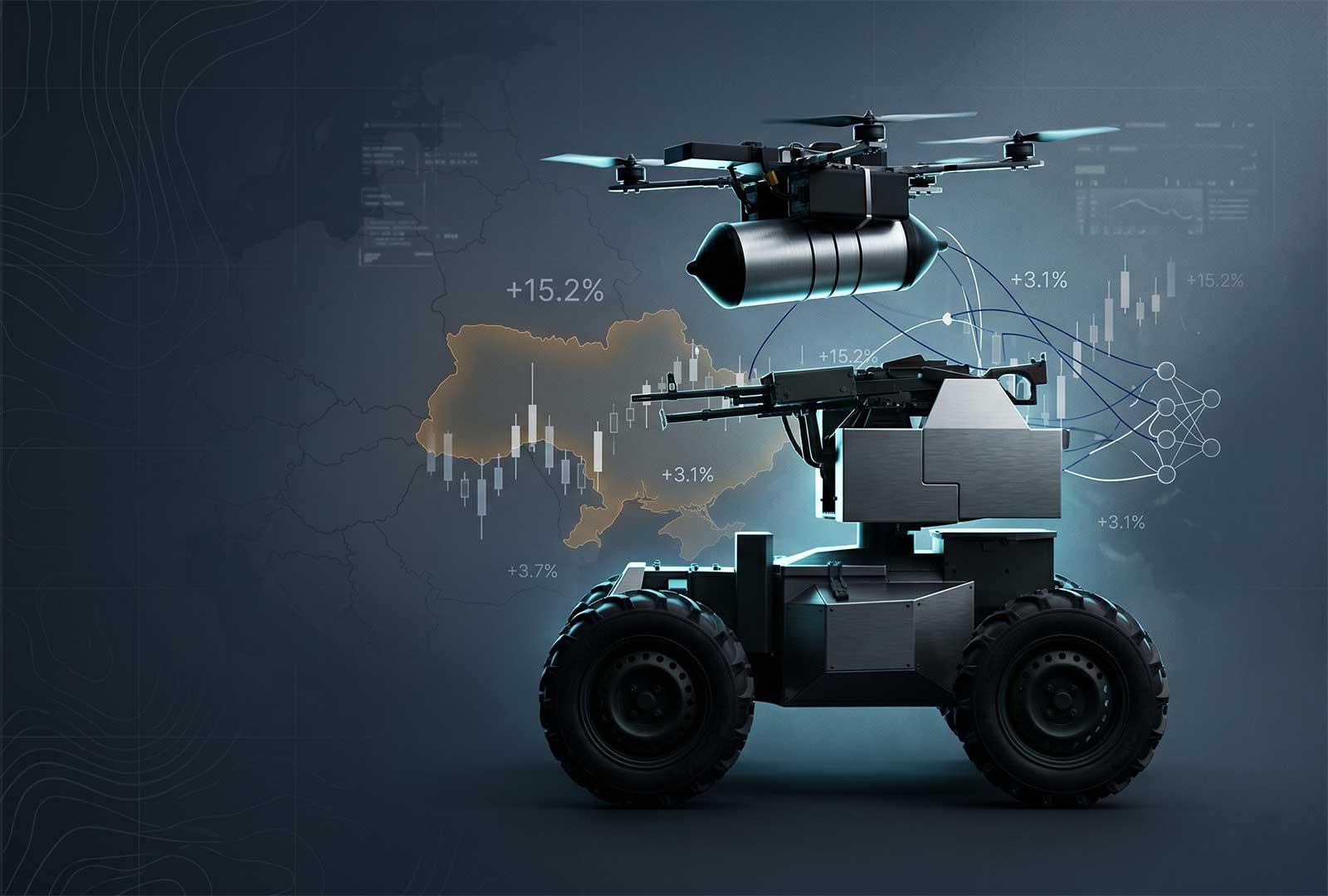
Ukraine Exports Autonomy as Combat Data Fuels Growth of Physical AI
Executive Summary
This week on Autonomy Signals, Grayson Brulte and Rob Grant discuss the deployment of autonomous systems in Ukraine’s defense sector, which acts as the largest real-world stress test in history for automation in combat.
Meanwhile, the macroeconomic environment for Physical AI is strengthening due to rising labor costs and falling hardware prices. As automation scales across industries such as rail and commercial warehouses, significant risks are emerging including potential union pushback, grid power constraints, and geopolitical supply chain vulnerabilities.
Key Autonomy Signals Episode Questions Answered
How is Ukraine impacting the commercial autonomy sector?
Ukraine has launched a combat data-sharing initiative giving allied governments and tech companies access to real-world battlefield data. This dataset, derived from the large-scale stress testing of unmanned systems in active combat, is expected to drive measurable performance step-changes in GPS-denied navigation solutions within 18 months.
What is the main macroeconomic driver for physical AI today?
The return on investment (ROI) for physical AI is primarily driven by labor economics, such as rising skilled labor costs and worker shortages, rather than just technology capability. For instance, the cost of mobile warehouse robots has dropped to $20,000–$30,000, while warehouse labor costs have continually risen 4% to 5% annually.
Does the recent Union Pacific agreement with ATDA mean rail unions now accept automation?
No, the agreement between Union Pacific and the 1,300-member ATDA union is a very specific, merger-contingent deal providing lifetime employment in exchange for not opposing the Norfolk Southern merger or automation deployment. Larger unions, inculding the 125,000-member SMART-TD, continue to explicitly exclude automation concessions from their agreements.
Autonomy Signals Topics & Timestamps
[00:00] AUTNMY AI
Autonomy Signals, is a show co-hosted by Grayson Brute and Rob Grant. Each week they cut through the noise and deliver the most important signals in the autonomy economy.
[01:18] Signal 1: Ukraine’s Emerging Role in the Autonomy Economy
Ukraine is using the current conflict as the largest real-world stress test for autonomous systems. By sharing this combat data, Ukraine aims to advance both military and commercial applications, despite potential risks of data weaponization and IP fragmentation.
[30:57] Signal 2: The Macro Environment for Physical AI
The physical AI market is expanding rapidly due to rising labor costs and compressed 18-month ROI timelines. While hardware costs decline, value capture is shifting to agentic AI platforms, though the sector faces severe risks from strict EU regulations and potential Taiwan semiconductor disruptions.
[55:25] Signal 3: Train Automation Gains Steam in the U.S. (Or So it Appears)
Union Pacific secured a labor agreement accepting automation in exchange for lifetime employment for 1,300 dispatchers. However, OMEGA identifies this as a false market signal designed to de-risk a proposed merger, rather than a reliable precedent for larger rail unions.
[1:18:41] Signal 4: Warehouse Automation Accelerates
Demand for automation-ready logistics real estate is surging, driving a 10% premium in rent. As mobile robot costs drop and labor expenses rise, this rapid adoption is shifting the industry’s primary bottleneck from acquiring physical space to securing adequate electrical grid capacity.
Full Episode Transcript
AUTNMY AI
AUTNMY AI AD: Right now somewhere a company is making a move in plain sight. The street reads the headline autonomy. AI sees the signal, we deliver it before the market catches up. Autonomy, ai, your models, our intelligence. Request a private strategic briefing at AUTNMY.ai.
Grayson Brulte: Rob this, the autonomy economy continues to evolve. The signals we’re getting are interesting and they’re compounding. We’re starting to see a lot of signals around dual use automation and autonomy. Perhaps that’s why China’s saying, well, wait a second. We’re gonna put export controls there. We’re getting some remnants of 2017/2018 when you had the. Physical AI push originally, which they called Industrial 4.0. So we’re gonna get into that today. Oh, and we got a new segment we haven’t covered yet. We got signals in of all places. Railroads. Let’s give a breakdown. The signals that we’re gonna cover this week.
Signal 1: Ukraine’s Emerging Role in the Autonomy Economy
Grayson Brulte: Ukraine’s, emerging role in the economy. Economy. Ukraine’s in the news, not for the recent, you think for a very interesting reason, which we, Rob and I will break down the macroeconomic environment for Physical AI, train automation, gain steam in the US or so it appears, and warehouse automation accelerates. Rob, let’s start with Ukraine. What are the signals that we’re getting out of Ukraine as it relates to the autonomy economy?
Rob Grant: look, it’s, pretty fascinating what OMEGA has been able to uncover. What we have is the Ukraine’s defense tech sector has, achieved something that they announced this week. The president himself, Volodymyr Zelenskyyy did it. Is is the real world stress testing of autonomous systems in terms of. It’s direct use in the conflict in Ukraine. And so this week the president of Ukraine went and had a, a well developed video, very, formal and well done. And he talked about how Ukrainian ground robotic systems combined with the Ukrainian autonomous aerial systems have carried out more than 22,000 missions, in this conflict in the last three months. And that in April, he even announced that Ukraine took a Russian position in the war exclusively by unmanned platforms between their ground autonomous systems and their drones. Not a single soldier put in harm’s way. And what we’re seeing emerge is that the, this deployment of autonomous systems in this conflict is the largest real world stress test of autonomous systems in recorded history.
Grayson Brulte: It’s truly remarkable. If you think about that unmanned systems took on human soldiers in the, in the Russian Ukraine war and won the unmanned one, not, not the man, the unmanned one. That’s a really interesting signal there. And the other interesting signal in all of this is the cost. We’re seeing the cost for unmanned applications in war. Go down and they’re plummeting. We have the stuff going on in Iran, which we’ll probably get into in other weeks, but on the unmanned stuff, Ukraine’s saying, okay, so we have air, we have drones, and then we have unmanned ground. Oh, by the way, we have unmanned maritime drones and they’re looking to export those as well. It seems to me reading the singles that’ll make our proprietary algorithm has uncovered is that Ukraine wants to be an exporter of automation and autonomy to the world for wartime applications.
Rob Grant: A hundred percent. I, I, and I think, you know, this is not unusual to see technology that is tested. Developed and proven in defense areas translate over into commercial uses. And Ukraine is taking it one step further, right? It’s not only about their individual achievements using unmanned systems in this conflict, they are going so far as to launch a first of its kind combat data sharing initiative, which is designed to give allied governments international defense companies, tech startups, access to its vast trove of real world battlefield data, right? These are not synthetic data sets. This is not a simulation environment, right? And no existing commercial deployment is going to contain the adversarial density of this corpus of data. And so I think this is huge. In the sense that this data, which is gonna cover things like terminal guidance, lock on sequences, GPS denied navigation solutions, swarm coordination, right? They are sharing this data. You can go to the Ukraine’s Ministry of Defense’s website and apply to get access to this data set. And I think they’re really hoping that by sharing this data set, by announcing their accomplishments, in the war over the past three months, using unmanned systems, they’re hoping to develop not only their military use of autonomous systems, but eventually the commercial use of autonomous systems as well.
Grayson Brulte: it goes back to the signal that OMEGA has uncovered for the past few weeks here, dual use applications. And just today, a matter of fact, Zelenskyy was in Germany doing a press announcement where Germany is now going to start using some of the data for their military applications. And I’ll say Germany military applications. To clarify from a training perspective, I’m not saying Germany’s deploying troops. I’m saying they’re using the, the data to train their algorithms for wartime potential engagements. And let’s add some context here. ’cause OMEGA uncovered the numbers because the, there’s the same, and then there’s the numbers. Ukraine’s, domestic, unmanned ground vehicle market grew by 488% in 2025, reaching an estimated value of 252 million. While, yes, 252 million in the, in the, in the global scheme of things is a small market. A 488% growth is extraordinary. But let’s not remember. They’re in a military footing now. And to grow a market that fast during war time is impressive. And now you’re starting to see the government say, okay, at some time the war’s gonna end and we’re gonna go into peace time. They have a very potential valuable industry that you just elegantly described. They could export to the world and they could take a a bad situation and turn it into a positive situation potentially for the outcome.
Rob Grant: Absolutely right. Their program, called Brave One. It’s the kind of Ukrainian government led defense tech cluster, which functions as a sort of compressed venture ecosystem with a procurement pipeline. They’re actively positioning. Brave One is their drone and robotics ecosystem that is being developed through the use of this technology in real time kinetic conflict. For a post-conflict world where this technology, the information that it’s learned, the dataset that’s there can be repurposed for things like civilian reconstruction applications for agriculture. And, and this is not aspirational, right? It this, as we mentioned, it is a, the same technology transfer dynamic that we’ve seen produced, in commercial GPS, the internet and drone delivery, right? The autonomy platforms. I believe that establish early integration or access to this combat proven, data set that Ukraine is offering, I think we’ll get a real advantage in understanding and navigating the future of, of, of. Navigation and perception systems under duress in unstructured environments, and they will carry a certification by fire credential that is unequal. There’s no regulatory sandbox that is going to be able to replicate the data that is coming out of Ukraine and that Ukraine is making available from the military conflict and their learnings, in it.
Grayson Brulte: The data becomes very valuable, and I’m going to simplify the the situation and put it to context for the audience. This potentially, and I have to say the word potentially, this potentially could emerge into Ukraine’s version of DARPA defense advanced research projects. It, it, it, it truly could. And you, we don’t even know what’s going to be built on it. But yet, and, and you might sit here and say, oh, why is Grayson in talking about DARPA? Because the, the Ukrainian government led tech, defense tech cluster has distributed over 60 million in grants to 600 plus companies in 2025. So they’re, they’re clearly putting the money out there. There’s a lot of good that can come from this bad, horrible situation, and you have to give the Ukrainians a lot of credit for investing in this technology and then looking to commercialize it now, not, not even at the end of the world, but commercializing it now.
Rob Grant: Agreed. And, and some of this is by necessity, correct? I mean, unfortunately this, this conflict is in year four. It has, been devastating, both to the people, of Ukraine, as well as to the economy of Ukraine. And so as Zelenskyy and the leaders in Ukraine look forward, I believe they’re seeing that the learnings as horrible as they are to have to go through that is the situation they face. So we, meaning the Ukrainian government should find a way to turn those learnings. Into real commercial opportunity. And I believe that is what they’re attempting to do here with the Brave One program, both not only for the potential reconstruction, but also of Ukraine post conflict, but also for the redefinition of what the Ukrainian economy can offer and what Ukrainian innovation can offer. And, and, and that I believe is something that is both, wonderful to hear from a moral standpoint that it, you know, we are positive and hopeful from the Ukrainian standpoint that this conflict end and that will come out better for it, once a peaceful resolution is achieved. But it’s also a positive signal for autonomy generally, is that we’re seeing the development of autonomous systems, the trust in autonomous systems, the efficacy of autonomous systems are such out of this conflict. A new economy, potentially could be based on autonomy as a result. And I think what that shows to me, again, as we’ve talked about as a, as a constant theme in many places, less and less of this conversation is really focused on is the technology advancing? Is the technology there? And it’s more on what political, regulatory economics, supply chain infrastructure, operational issues are the hindrances, or risks. And potential opportunities to really build the next, economic revolution on, whether it’s at the country level or, for anybody else that’s looking to, to, to invest, see where their capital, returns are gonna lay. Try to beat the market, find alpha, whatever it is that, you’re looking to see out of the investment in autonomous systems.
Grayson Brulte: It is. And Ukraine now is an active participant in the autonomy economy. And as the autonomy economy evolved, defense will be a very big application. There’s, we saw from President Trump’s budget in the United States, over a hundred billion dollars is committed to unmanned vehicle systems and the budget, which, which is part of the autonomy economy. And before we move on to the risk factors, ’cause there are risks when you embrace new technology and you look to commercialize, I wanna highlight a quote here from the Ukrainian defense Minister, which I think is very important for the audience. The future of warfare belongs to autonomous systems. I’m gonna read that quote again. The future of warfare belongs to autonomous systems. Let that sink in. And now I’m gonna go onto the rest of the quote here. Our objective is to increase the level of autonomy in drones and other combat platforms so they can detect targets faster, analyze battlefield conditions, and support real-time decision making. What the Ukrainian Defense Minister summed up here is everything the Palmer Lucky is saying at Andrew. The defense startups here in the United States are saying the messaging is converging, the technology is being deployed. As we’ve seen with the United States War in Iran. A lot of that is being done there autonomously with drones. So this future is coming and as this future comes, when it gets commercialized from the dual factors perspective, we do have risks and the risks that OMEGA highlights here. I want to go through each one of these risks. You one by one, the first risk data weaponization risk international partners accessing Ukraine’s combat AI corpus, and, and as of March include state adjacent actors who downstream use of terminal guidance training data creates a proliferate exposure that could trigger us export control responses within 12 months. Export control is becoming a theme here on automat singles. What do you make of that first wrist OMEGA uncovered?
Rob Grant: Look, I mean, I think this is a real potential, technology control. The technology, whether it’s a state actor, state adjacent actor, you know, who is accessing this is very important. Who has the ability to source the materials behind it? Thi this is not necessarily a new risk, meaning it’s not unique. To autonomous systems. It has been there for other advances in technology, but I believe this risk is certainly, one that I would put some credible weight towards, whether or not it’s 12 months or longer. I do think export controls, understanding who has access to this technology, who’s using it, if it’s not identifiable, what the end purpose is, then controlling who has access to the resources, the materials, the training data. I think those things are likely to be very front and center. And I will say this is even more credible given the geopolitics of the fraying relationship between the US and its NATO allies. As that relationship potentially. Unravels, or, even unwinds where the NATO allies seek to find advanced weapon systems to ensure their protection from Russia, to be honest, right? That is the big, actor, at least from the NATO perspective, that they’re more concerned about, we’re talking about Ukraine. They have good reason to be concerned given what we saw. Russian actions in Ukraine and the Crimea before that, where they go to source their technology, who then has access to that technology once the US via nato perhaps loses a relationship or intelligence about where that sourcing is going from, who they’re selling to, how are they generating. Their protection systems, whether autonomous or not. You could see the United States extending its influence via export controls as opposed to perhaps what we see now, which is us influence directly through how NATO sources those contracts. And so I believe this is a real risk and only rises as the continued renegotiation, reevaluation of the US NATO relationship, evolves. At first, it was evolving over what has happened in Ukraine directly, but now it continues to evolve over the European response to the Iranian conflict as well.
Grayson Brulte: The end of the day. A lot of this goes back to maritime from the conflict. And what you, you elegantly pointed out with NATO is interesting ’cause you see President Trump, his public remarks around nato, which we don’t have to reiterate here, but it is a fraying relationship. Ukraine is building, you used the term a sandbox for autonomy for, for unmanned applications. If the fraying of the NATO relationship between the United States and NATO continues and or accelerates and the US puts export controls not knowing where that data’s going. Could we see? And we are starting to see early signs of this from a relationship funding standpoint where. Ukraine blocks the US potentially from having access to the data and then funnels it into NATO countries because as we’ve all seen, Ukraine really wants NATO membership. And perhaps saying they offer that as a carrot because if the US pulls back is what we’re seeing, what’s happening with the straight of MOUs and the president has threatened that, that we’re not gonna be the world’s savior. Europe’s gonna have to figure out automation and autonomy from a a militaristic standpoint, which they do not have the weapons the US has. You say, look, we have all the tools, we have all the supplies, oh, and we have the data. Do you wanna do a deal? Could that ever potentially emerge?
Rob Grant: very possible. And I would say, you know, maritime is one aspect, but the most kind of salient aspect of this is through the drone technology, right? As we’ve seen, the most effective change that we’ve seen in the kinetic, use of autonomous systems in kinetic warfare is with the ability of Ukraine to pose, as an active, opponent to Russia via its dominance in the use of drones. Both in terms of an asymmetric use, you know, one-off bombings of. Warehouses and Russian depots and Russian supply chains, as well as what we’ve seen in terms of, in the theater of actual conflict with use of drones to target specific Russian soldiers. But then also the anti drone technology, right? Because Russia is developing these as well. And, you’re seeing the use and advancement of anti drone technology, in terms of being a protection against the same type of systems that Ukraine was using on the offensive now using, a defensive position. And, you know, what we’re seeing is that a lot of these drones and as the, an interconnected place, they’re coming from place, the Shahi drone in Iran, and we’re seeing the use of those drones in the Iranian conflict as well. And so, you know, these learnings are valuable in so many respects in terms of not only how do you fight this war, how do you fight the next potential war? Where are. You sourcing this materials, who’s benefiting from this? Who are the major suppliers? What are the potential, new logistical and infrastructure challenges around supplying? What does that mean for new potential alliances? And the trading of this information for protection, things of that nature? It is all evolving, in a way that warfare perhaps hasn’t evolved since, you and I have been alive. And, you could see that in the quote that, that, that proceeded our discussion of risk factors, right? The Ukrainian, defense minister is very rare, right? The future of warfare belongs to autonomous systems. I think if anybody takes anything away from this podcast today, it is that quote, because it is more true than ever.
Grayson Brulte: If you look, go back to World War ii, where you had General George S. Patton and the brilliant tank strategy that he implemented on the European continent. It’s being implemented today in the European continent, but it’s not tank. It’s autonomous systems and what you elegantly described with NATO is a big risk. And OMEGA’s done a really good job uncovering this. That was a data weaponization risk. And there’s, there’s more risks, unfortunately. Then there’s the, there’s the ceasefire disruption risk when this, this is really interesting because the, the brilliant thing about the OMEGA algorithm that you and I coded and developed is that it’s looking at it from all different angles and what ifs, what ifs trying to uncover those signals and the ceasefire disruption. OMEGA says any negotiated settlement before mid 2026 halts the live fire iteration cycle that is generating the data advantage, freezing the Ukraine autonomy ecosystem at its current capability level in removing the primary catalyst for continued technology transfer. Unfortunately, and this is just me, I don’t think we’re gonna get a ceasefire, but OMEGA it says, but OMEGA’s right in the sense that the real world data is extremely valuable and you can’t simulate. The harsh, brutal environments of combat.
Rob Grant: That’s right. Look, I mean, I think we would all agree here as you know. On a moral basis that a peaceful resolution to this conflict is the highest goal, regardless of any risk that OMEGA hasn’t uncovered. But to your point, the lessons and learnings from this conflict, particularly through the use of autonomous ground systems, autonomous air systems, autonomous marytown systems, is a result of the conflict itself. And so if the conflict resolves those learnings, that data flywheel as those out where I live in Silicon Valley would say, cease. Do I think that means the technology transfer still can happen? No, I think that’s, it will accelerate the technology transfer that we talked about to commercial purposes, particularly for reconstruction and agricultural purposes. But. The more data that we learn, the more that it’s, it’s move and counter move in terms of, drone defense systems versus active drone systems versus, you know, new weapons to, attack each. And how do you produce those weapons, efficiently cost effectively, and most importantly from military per perspective, so that they work so they achieve the missions that they’re sent on. There is nothing quite like having that primary catalyst of direct conflict to force those learnings in real time and accelerate the development and deployment of the technology.
Grayson Brulte: When, hopefully sooner rather than later. The conflict between Russia and Ukraine comes to an end and hopefully a peaceful resolution and individuals can, can can move on. From this horrific situation. The tech transfer issue will only accelerate and OMEGA highlights that risk. Here. OMEGA highlights the risk of decentralized IP fragmentation because a significant share, if you creating defense tech output flows through non-institutional channels. IP ownership of the most operation operationally validated systems is legally and viewers, nobody knows creating the title risk for any western company attempting to commercialize Ukrainian derived. Autonomy ip. That’s a good point because if, if you’re a lawyer at a publicly traded company or you’re at a lawyer at a very valuable startup, you’re looking for risks every, every which way. And once again, OMEGA hits a home run, uncovers the IP risk, which we’ve seen with China is a very big thing. We’re starting to see even more now with humanoids and the magically a tech appears one place and doesn’t appear another. What do you think of that risk? How does that get mitigated? ’cause to me, the risk that OMEGA uncovered, they’re all intertwined here.
Rob Grant: The legal risk here is concrete, but given the advances, we’ve seen the use of the technology, it is an after the fact risk. And so I tend to discount those in the sense that we have legal procedures, legal process while slow, that do eventually provide clarity on these circumstances. So I would use this as more of a, a discount waiting. Factor in terms of the future of autonomous systems in the ip, being developed out of Ukraine. I don’t think it stops the development of the technology. I don’t think it stops the progression of the technology. It may stop the ultimate or pause. It won’t stop. It will only pause, who perhaps finds the most value from this technology. But in the end, I think it will not prevent the valuable technology from being, produced. So I, I see it as a downstream risk, that, perhaps limits. The return on the investment in the near term and extends it as the legal process plays out. But I don’t think it necessarily poses a risk to the rate of advancement or the, use of the technology, particularly for military purposes.
Grayson Brulte: For an audience that doesn’t know your, your background’s a lawyer, so I’m gonna play honorary lawyer and I didn’t stay at a Holiday Inn last night, but I’m gonna play honorary lawyer here. Could there be something called like, such as a, a blanket waiver because the IP was created during war time, and if you wanna call out the origins of the IP might not be readily available. They could put a, a blanket waiver, perhaps open source it, where companies then could have a blanket waiver to build on top of that and some blanket waiver that is, I would say, recognized by, in international standard bodies.
Rob Grant: I find that unlikely. I think something more likely, and now I’m. Extrapolating, I have no basis other than to, to, thoughts in my head as a good lawyer, how you might spot an issue and resolve an issue. I would say in, in areas of ambiguity for defense systems that were perhaps funded by the Ukrainian program that we talked about, the cluster, the Brave one program, things of that nature that you’re more likely to see the Ukrainian government claim a stake in its ip rather than renounce a stake in its IP and open source it to claim a stake and then say, Hey, individual companies in the Ukraine that are fighting over who owns this ip, we’ll fight over that within Ukraine, but we can, as the government claim ownership to it, you can challenge us. For ownership, and then we’ll license the IP and we’ll all make money. In the meantime, while we figure out which one of you actually owns the ip, if any of you own the ip, because the government might just claim it as the road.
Grayson Brulte: That is a very real probability. Let’s, let’s move on to OMEGA’s take here. ’cause OMEGA, again, a proprietary AI algorithm has a really great take here and OMEGA says this for her. Take OMEGA assesses that Ukraine’s combat data sharing initiative is the most underpriced event in the global autonomy economy. And the consensus, which is treating it as a geopolitical footnote is structurally wrong. Where the autonomy capability, frontier moves next conviction is high. That Western AI navigation and perception companies with confirmed access to this corpus will demonstrate measurable performance step changes in GPS denied in environment operations within the next 18 months. That’s a good take. It’s very plausible. What are your thoughts?
Rob Grant: I think it’s, it’s spot on. I, I do think that this event should not go unnoted. I think. What we’re seeing in all of these conflicts, where autonomous systems continue to be used and relied upon and ultimately start to become even central to determining, who’s winning the conflict or who’s not losing it, at least so to speak. In, in, in Ukraine that the technology transfer, the dataset, that are coming out are of tremendous utility and will only advance the technology on a faster rate than we’ve seen, prior to today. I think it will also validate continued government investment around the world into the technology, and then ultimately, as we mentioned earlier, that transition from defense uses to, civilian uses only accelerates as well.
Signal 2: The Macro Environment for Physical AI
Grayson Brulte: At the end of the day, it’s a positive signal for the autonomy economy E. Each week we continue to uncover. Different signals and you never know where the autonomy economy is going each week. Which brings us to our next signal signal. Two, the macro environment for Physical AI. This is interesting here. The macro environment for Physical AI and industrial automation is more supportive than at any point since the 20 17 20 18 industry 4.0 investment cycle for reasons that are structurally different than prior cycles and therefore more durable. I remember the hype then in 27, 20 18, 2 letters, Rob ge, they, they were, they were driving that and pushing it, but now it’s a lot bigger than these, these two letters. What are you making? This macro environment, Physical AI today.
Rob Grant: What we’re seeing is that incumbents are recognizing, that the, there’s a hardware margin compression involved with this. And that’s coming from Chinese competitors. And it’s who are accelerating their programs, commercialization programs, to the state backed investment. And that it’s not necessarily in the building of the robot themselves, that it’s not like a hardware competition. So, so to speak, that it’s going to be the differentiated here. I really think it’s the agentic AI behind, these platforms, that’s gonna sit above the hardware and, that’s gonna capture kind of the durable software economics.
Grayson Brulte: The economics for this technology is, is, is getting impressive. Before we get into the economics, let’s give the audience here some numbers. So OMEGA does a really good job of surfacing these numbers for us here. Apptronik. The, the humanoid maker, they recently secured a $520 million series, A extension, not series A, that’s an extension to their preexisting series, A Bedrock robotics who their co-founder has been on the Road to Autonomy podcast recently raised 270 million outta $1.75 billion valuation for autonomous construction equipment. So we’re seeing humanoid, we’re we’re seeing autonomous construction equipment, we’re seeing heavy manufacturing. We’re soft banks investing the investments in Physical AI, as I said earlier, not the two letters, they’re widespread. What impact is this going to have on the ROI.
Rob Grant: Look, I mean, if you take for instance, you know, Bedrock Robotics, I mean, they, they do construction equipment, right? And it’s, it’s a sector where the R-O-K-R-O-I case I should say, is driven by $180,000 per year skilled labor costs in North America, right? And so if you’re able to automate, this function. And the payback period for a $250,000 autonomous constriction construction system is then 18 months. If you assume the $180,000 a year skilled construction operator, a fuel, a full utilization. I mean, that is not necessarily a technology story driven by capability. It, it’s the cost arbitrage story driven by the labor economics. And that labor economic story is immune to the interest rate cycles because the ROI is so compressed, if it is only taking you 18 months to cover the cost of your skilled human operator through a autonomous construction system, you’re, you’re pretty immune to the ebbs and flows of the interest rate. And so I, I, I think what we’re seeing here is that the, the, the labor cost driver is the most important kind of variable in all this. And so I, I really think the environment driven by the advancements in hardware, but as I said, I don’t necessarily think it’s a hardware competition story. It’s a, it’s a labor, inflation story, a labor cost story. And, it is a who can build the, platforms behind it. The actual value capture is in the, a agent AI and simulation platforms that are behind it. And so I think that’s. What I find most interesting about this next kind of positive, movement in Physical AI is that it’s kind of driven by different factors than what we saw in in 17 and 18. And this one, it’s, it’s driven more by your quick return on ROI, your labor costs and, on your ability to, have an orchestration and simulation platform that trains and validates and deploy these systems at scale. All of which I don’t think were present in 2017 and 18.
Grayson Brulte: No they weren’t. And then the labor cost is up 18% since. 2021. So you’re having a, a, a rising labor cost. And then the, the cost to build this technology are, are plummeting. And as you highlighted, the return is getting faster and faster for, for companies to deploy this. And let’s not for forget the other aspect that we haven’t discussed, Noah, this some of the way is this technology is being deployed, is being de deployed in remote operations where individuals don’t want to go. The most well-known one is Perth Australia, two weeks on, two weeks off. And if you talk to the mining companies there, why, why are you investing in automation? Well, the, the workers came for two weeks. They didn’t come back. Oh. Oh, we still have, we still have to mine, which, so we’re, we’re seeing the, the payback periods go down. We’re seeing the rising cost of, of labor continue. But we’re also seeing a divergence in the market where the private sector and, and, and the companies that are billing this technology and the venture capital. Are investing in it. But from a public market perspective, it’s, it’s not capturing the headlines on CNBC and Bloomberg or in print media, I’ll call it the Financial Times here, for example, the Wall Street Journal. It’s kind of flowing below the radar when there’s this big, I’ll say a tsunami of a trend happening. Why do you think this is not getting picked up?
Rob Grant: It’s a fascinating question. I think some of it has to do with the conflation of concerns, political, regulatory, and otherwise with other Physical AI. And so if you are only focused on kind of the narratives around robo taxis and the development of, agent AI systems via the larges language models, open AI and anthropic, this kind of, you, you don’t think of it asymmetrically from that. This kind of naturally, I think to most people fits in those categories where I think what OMEGA’s covering is that it really is something. Completely different. The, economics that are behind it, the root causes for the ROI are a little bit different. The risks that lay in front of it are a little less apparent, and so it’s a little bit of a harder not to one uncover and two, even harder not to really understand what are the underlying forces that are driving the private market resurgence here. It’s also, you know, some of the bigger companies, In this space have actually kind of divested themselves out of robotics and automation, right? I mean, we’re looking at, abbs divesture of its robotics and discreet automation division to SoftBank. And so I think that retrenchment from some of the big four combined with some of the nuances that are actually pushing the private market, belief here, just, just as harder to rise above the noise that we see in the very open political and regulatory battles and societal concerns that people have over, things that are much more omnipresent in the consumer’s mind, which is, you know, transportation and robot taxis or, agent AI via the large language models.
Grayson Brulte: And you, you and I know and the audience knows large language models and robotaxis generate click, which generate average, although there’s a reason why it’s covered there. But what we, we like to go is go with the multiple levels below what what’s occurring in the autonomy economy and. You brought up this Let, let’s get to the risk. ’cause the risks on this one are, are fascinating. We’re, we’re gonna start with the EU AI Act, which we covered in depth last week. OMEGA says, high risk system provisions expected to be enforced beginning Q4 2027 through the eus AI Act, determined that no current hybrid validation approach is compliant. Big concern there. Physical AI deployment in European industrial facilities would face a 24 to 36 month delay. That’s two to three year delay at the rate this technology is going. I I, I don’t mean to be that guy, but you would once again be behind.
Rob Grant: Yeah, I mean this is a, a, a constant theme that, we’ve come back to a few times just in the last month. The regulation in Europe, I don’t think is unwarranted. We’ve, we’ve, we’ve talked about this a little bit. I think it is not necessarily a bad prescriptive attempt to innovate out innovation, so to speak. It does though, present real hurdles, particularly since their regulations are not developed in terms of how do you program your systems, your architecture, your stack, your supply chains, your infrastructure to be in compliance. And the reason that you mentioned Q4 2027. Is that they had to delay enforcement of compliance because they don’t have these regulations in detail set. And so again, I, I don’t necessarily ascribe a Luddite type perspective to Europe. Though I think in practice what you’re going to see is not unintentional kind of hardship. I do think they mean to be quite intentional about how pres, how restrictive they are and the pace at which things move. But I don’t, I don’t think their intent was to delay European industrial facilities to be on a two to three year lag between everybody else. However, I think this risk is quite real. It’s, it’s literally written into the legislation they just passed, which is they don’t have the rules, they’re not ready, and so everything’s gotta be delayed because of it.
Grayson Brulte: Europe’s not ready. China’s, as you know, is chugging along, which brings us to our next risk here. Chinese hardware, cost parity acceleration. China’s 400 billion robotics investment program could lead to margin compression for the big four robotics manufacturers, which are NUC. This one, sorry for saying your company name wrong. I respect it, but I’m sorry. Ska Waha. Motoman. A B, B and KUKA, which combined, this is amazing. Have a 62% market share, and if China gets to cost parody, OMEGA is predicting that their market share combined could go down to 50% by 2029. Thoughts on that?
Rob Grant: We’ve come back to China many times and there’s a reason for it. China is determined to lead the world in the production of autonomous technologies. Including in Physical AI, right. They’re, they have seen that it has vast commercial implications. It has vast military applications and the future of global leadership, whether through force or through commerce resides with accelerating autonomous adoption and autonomous systems. And so do I think that the big four manu robot manufacturers are, are under pressure from China? Absolutely. Do I think that China is intentional in that? Absolutely. And do I think China is putting its, monetary might to achieve those goals? 100%. And the thing is, these are not hidden. It’s not like you and I have uncovered some secret trove of CCP documents. This is their intent. I think it is their intent in many of the fields that we talk about, Physical AI in all senses, from drones to maritime, to space, to logistics, to transportation, and to, robotics as well.
Grayson Brulte: it’s not just their intent. They’re broadcasting it in public speeches and in state-owned media. It is out there and anytime they get a chance, they, they talk about it. Not to mention President Xi, Chuck talked about automation and autonomy and Taiwan on his New Year’s day speech. So it’s, it, it’s widely there, but it’s not necessarily followed or picked up. And this picked us to our next risk. And this one is something that I have not seen discussed. The media yet, which is a very big potential risk. Nvidia NVIDIA’s Isaac Sim competitive displacement. If Google’s DeepMind Robotics Simulation Platform, or Amazon’s AWS, robo Maker Achieves feature parody with Isaac Sim before Nvidia establishes Enterprise Lock-in which it is not yet. The simulation layer economics fragment across three platforms rather than consolidating around Nvidia. That’s an interesting one.
Rob Grant: Yeah. And I think what OMEGA is inferencing here is that consolidation in this sense will speed development. And well, I think that could be true. Is that necessarily, a risk in of itself? A little bit, but I think there’s also risk and if we only have one manufacturer to turn to, now granted Nvidia, is a US company and would be, hopefully advantageous to providing, some preference for other US companies in this, field of Physical AI. But I think consolidation also comes with risks. So this, this risk, I think is, is valid in the sense that, consolidation. Could speed up development and could speed up, and continue to, blow wind behind the sales of development of Physical AI. But I also think it comes with potential other risks, particularly given that the company that we keep mentioning, in this, in the stacks of many autonomous systems is Nvidia.
Grayson Brulte: No matter which way you slice it, it’s something to watch. Is, is how it would, would some of, there’s definitely something to watch. Which brings us to our, our next key risk, which is something that should be paid really close attention to the A BB Divesture execution risk. The SoftBank A BB robotics transaction, which you discussed. If it encounters regulatory opposition from the European competition, authorities who have historically scrutinized Japanese conglomerate acquisitions of European industrial assets could delay closing into the first half of 2027, extending the period during which a BB trades at a blended conglomerate multiples rather than the software focused multiples. Not asking a comment here on, on the A, BB from a price performance standpoint ’cause we do not give investment advice, but the fact that Europe could potentially uphold this is, is something to watch there. And then if they do. Where does SoftBank go? Because I say that Lionel Barber, the former editor in chief of the Financial Times, wrote in a fantastic book on Massa called Gambling Man, Masa likes to gamble and he likes to gamble big, so this doesn’t go well. This masa double or triple down potentially and say, oh, SoftBank’s the humanoid company now.
Rob Grant: I think it’s fascinating to see what the European regulators will do. I think this goes to kind of the dual headed nature of what we see in Europe, which is I, I I think. A potential reason for European competition authorities to scrutinize this is are we kind of relinquishing leadership in a key area to the Japanese? And if so, what does that mean for competition within Europe? What does it mean for prices for within Europe? things of that nature. And so this is kind of the other side of the regulatory actions, which is you’re seeing Europe concerned that this may slow down or be harmful to their consumers. This potential acquisition, slow down their access to this technology, slow down, the use of this technology to build products and services and things like that in, in Europe. But at the same time, they have a very heavy handed sense of regulation that may actually serve to slow down things. And so you, you see that kind of duality, really brought to life by this risk. And in terms of, of, of SoftBank, Masa will find a way to invest and, be a part of something he firmly believes could have value now and 300 years from now. Right? We’re talking about somebody who’s notoriously been known to suggest he has a 300 year plan for SoftBank. So. I think it goes back to an old, saying, that my parents used to tell me where there’s a will, there’s a way. And so if this avenue is blocked, I have little concern that in the long run, SoftBank will not be able to find a way into the human way ecosystem.
Grayson Brulte: Let’s not forget Pepper. They did have pepper back in the day. I remember I got to play with Pepper at the LAX Los Angeles Air Force. So they, they do have robotics ambitions and they do have robotics programs inside of the SoftBank. Pretty big conglomerate there. When this brings us to our last risk, which you could potentially say is the most important risk, Taiwan is the potential for the geopolitical escalation that will bring Taiwan semiconductor supply under un, under scrutiny. It was interesting. I, I had the opportunity, I had lunch with Gordon Chang this week and he was talking about that there’s all these studies there. If China was to seize Taiwan, Taiwan semi would not be touched there. There are military plans that, that are out there publicly available in war colleges of what it would look like because me speaking for myself, it’s very obvious if, if, if China does reunification. They want Taiwan Semi, and they’ll probably rename it China Semi to redo that there. Which brings us to the risk. Any military escalation in the Taiwan Strait disrupting TSMCs Taiwan semis production of the advanced Semicon required physical fairness strips would create at least a 12 to 18th month supply constraint. That delays Physical AI deployment timelines and all verticals simultaneously. Th this one’s right, I think maybe it could be a lot longer disruption than that. Thoughts.
Rob Grant: Agree. Look, I think this is the most critical central, potentially devastating risk there is in the Physical AI deployment timelines. If Taiwan semiconductor production is halted, delayed, otherwise interfered with whether directly or indirectly from China or any sort of military escalation or blockade or anything like that, the industry undoubtedly is setback and it’s not a day for day setback. It is a long term or medium term setback depending on how fast fabrication, manufacturing can happen in the United States. And what we’ve seen is those timelines are years out from today. So if this action were to occur anytime in the next couple of years, you’re looking, I think at a much longer. Delay of Physical AI deployment as a result, and I think this is a real pressure point on the geopolitical stage. I don’t think world leaders are unaware. I can guarantee you that everybody from open AI to the newest, Physical AI firm that may have raised its pre-seed round this morning are aware that this particular risk is the mother of all risks right now for Physical AI.
Grayson Brulte: You’re right about Taiwan. It comes up in casual conversations that I have with, with friends all the time. So it is, it’s top of mind for my friend circle and it is my belief. I do not know for certain that, I’m pretty sure though that the US has plans if China tries to take Taiwan and do reunification. And I’m sure that there’s o other governments that have plans in place. And you’re starting to see some really interesting tightening in the supply chain, ASML that’s trying to hire all these people in the Netherlands. Very strict controls there. So it’s something that we’re gonna continue to watch and we’ll probably bring up Taiwan in multiple issues, which, putting the, the bow on on this signal. This brings us to OMEGA’s. Take OMEGA assesses that the autonomous robotics funding surge is the most important capital allocation signal and the autonomy economy. Since Waymo’s commercialization announcement and the markets fail to reprice public industrial automation software, equities, in response to this capital velocity represents mispricing. That’s a bold take there from OMEGA.
Rob Grant: We programmed her to, to take its inputs and its discoveries and give us its real analysis of the potential repercussions. And if it’s a bold finding, it will tell us. It’s bold finding. It doesn’t pull any punches. And that’s one of the reasons that, I’ve come to really appreciate what we’ve built. It doesn’t lead you in any particular way. It takes the facts into consideration, takes our expertise into consideration, takes other expertise into consideration, and delivers you the real truth.
Signal 3: Train Automation Gains Steam in the U.S.
Grayson Brulte: It delivers the real truth and uncovers signals that you and I necessarily want to look for. Which brings us to signal number three, train automation gains steam in the US or, so it appears we had a, I’ll say, a compromise perhaps, or a a business deal, any term you want to use between the unions and Union Pacific on April 2nd. An agreement between Union Pacific and the American Trained Dispatchers Association. Came to a deal where? Where Union Pacific guaranteed lifetime employment to the 1300 active dispatchers contingent on the proposed union Pacific North Fork Southern merger. Interesting. Because in the official language there was a clause two clauses. One, the union will not oppose the merger with Norfolk Southern, and two, the union will not oppose the implementation of automation. That’s interesting.
Rob Grant: To give folks who are kind of less ingrained in what’s happening in the, railroad, industry. Union Pacific and Norfolk Southern are proposing a merger, and these are two very large, providers in the United States. And this transaction, this transcontinental merger, would create a railroad controlling roughly 50,000 miles, route miles, in the United States and generating an estimate 35 to $40 billion in combined avenue annual revenue. And so what is happening in here in order to gain support for this merger from the various unions? Union Pacific is going out as well as Norfolk Southern and trying to reach these contingent agreements. Cont So there are agreements that are contingent upon the merger being approved. And what they’re trying to do is ensure that there’s union support for this merger as the government reviews the merger. And so this particular agreement is one in a series of, of potential agreements. I think there have been five other agreements that are, are of this nature with various different unions. And there there are merger contingent kind of job protection deals, to simplify it. And so in this particular one, right, what we have here is a agreement that guarantees job protection. Regardless of kind of automation, adoption and the potential automation driven displacement of those operators. And so it’s only applicable to the 1300 or so members who are currently in this union. So it is not in any sense, the largest rail union that the rails, rail y companies have to deal with isn’t quite a very small one. Right. For instance, there’s, another rail union out there, that’s called the International Association of Sheet Metal Air Rail and Transportation Workers, acronym SMART td. I will tell you, I did not know that acronym before yesterday. But Smart TD has union membership of 125,000 people, so much larger. So this is a, a, a. Deal with a smaller union to garner support for this larger merger that Union Pacific, has with Norfolk Southern. But what the signal here is, and, and why we kind of entitled this more as a question than anything, is that this is sort of a, I think I will call it a false signal. It’s, it’s, it’s, it’s OMEGA flagging that there may be a false signal in the market, right? And so what people are, are seeing and reporting, the labor press and others, is that, what we have here is kind of a union agreeing to automation, for, the concession of kind of guaranteed income and jobs for these, union members and. That is not all false, but it’s not all true either, right? The this is being done in order to gain support for a larger merger. And so it is really a merger driven, specific, agreement. I find it unlikely, and I think OMEGA finds it unlikely that this particular agreement with the small union becomes a template through which the union’s writ large in the rail industry can find acceptance of automation in the future. And I think that’s really the interesting thing that’s happening here is that, OMEGA is saying, Hey, don’t get led astray by this agreement. Yes. You know, there is value in that agreement. Right. And what it, the fact that they’re talking about automation and that even in this specific circumstance that they were able to find. A common ground that allows for automation to proceed, but it’s under very specific kind of context, which is a small union, that is the Union Pacific is trying to gain the support of in order for this larger merger. It is not kind of a coming together as a result of automation. It’s not like they said, let’s come together and make an agreement on automation. They said, let’s come together to talk about how we can win the union support for a merger.
Grayson Brulte: You can look at it where the union’s saying, we do not want any uncertainty. The merger for our members of the 1200 active members. Guarantee ’em jobs and then Union Pacific’s saying, okay, until they retire. But I’ll buy. We’re gonna slip in automation and you gotta love the fine print that OMEGA uncovers. The job guarantee is only guaranteed for individuals with the employee of employees. The union members that join prior to the closing of the transaction AF individual joins a day after that transaction is closed. They are not subject to that agreement, however, they’re subject to automation. It seems that the union potentially traded the automation leverage for the job guarantee for the current base, which, as my wife says, that opens up a can of worms for the individual to join after the transaction closes.
Rob Grant: It certainly does. But, I don’t think these type of provisions. Are necessarily any different than if you’re out here in Silicon Valley and you’re in the process of getting hired as an engineer, or in my case as a lawyer for a promising young startup. And you start that process October 15th, and then October 20th, they announce a raise and the valuation goes up and your strike price is now just your strike price is whenever you sign after that. So if it was $1 on August 14th, and now it’s $4 and August 17th, and my term doesn’t start till August 19th, well guess what? I’m subject to the higher strike price. You know what, it’s it, anytime you kind of put a date certain in something, there are people that are gonna come after that date that might necessarily get the same benefits. And so here for a small union. To be able to go back to its current membership and say, Hey, if this merger goes through, and contingent on our support for the merger, we’re hopeful it will go through. You’re in a good spot. I think that’s a pretty big win if you’re a union member or a union leadership. And so you worry about the membership you have as opposed to the membership that you might have. Given that the trend in rail is for more automation. And there are other signals, in that, that we can talk about in future days, particularly. There’s a, a recent, Federal Rail authority waiver for inspection, that required human inspection, but now they’re, allowing for auto automation to do the inspection because they can do it faster and, quite frankly, better in many circumstances. So I think that the writing is on the wall here a little bit, but. To OMEGA’s point, let’s not read too much into this agreement. It is very context dependent, disagreement.
Grayson Brulte: can’t read too, too much into it. ’cause there, there’s a, there’s a lot of risk and OMEGA for you. And I produced 120 page report on European rail automation, which is happening. So we have to digest that before we, we can talk here. Let’s get to the risk because there is the big, if the transaction closes and you have to say if ’cause no, no transaction or deal, subject to regulatory approval is guaranteed. So we will use if, and OMEGA rightly so highlighted the risk here you the merger rejection risk. The Surface Transportation Board has historically required substantial divestitures and conditions for major class one combinations. A rejection of the up, central Union Pacific North Fork Southern. Application possibly given the combined entity’s dominant transcontinental market vision would void all merger contingent job protection agreements, and it would trigger a union renegotiation. A timeline for the expected decision is between 2027 and 2028. OMEGA’s getting down into the, into the, I’ll say to the rob weeds here of looking at all these little nuances. A lot’s gonna change before then. That’s a really good catch. Thoughts.
Rob Grant: And this is what we mean by context driven, right? That in order to get the Surface Transportation Board on board, it helps to have many of the parties affected by this, particularly unions and the jobs that are, represented by the unions in the rail yards, supportive of the agreement. And so what Union Pacific is trying to do is to de-risk the potential merger rejection. Now, I, I cannot tell you that I’m a Surface transportation Board expert when it comes to determining the likelihood that this particular deal is rejected. But what I can tell you is that I’ve definitely been in circumstances, where you try to de-risk decisions in front of governmental bodies, and having union support in particular is often very helpful. So I see this as a kind of real risk, not knowing all the factors that the Surface Transportation Board will come in to play, but if union support is not there, common sense in my experience tells me that the risk of rejection is much higher. And so if, if the unions are supportive and there are a lot more unions, like I said, this is a small union, 1300 members, but every, every voice counts. And so if if this is rejected, all these deals are contingent and they go out out the window. And one of the conditions for potential approval could be we need a larger agreement on automation. And can one be struck, I don’t know, 1300 members here. Have found a way forward on a deal with automation, but will 125,000 member workforce that we’ll talk about as one of the next risks agree that that’s the way to go forward? And can that agreement then also be financially viable for the, rail lines, the class one operators, in this case, union Pacific and Norfolk Southern.
Grayson Brulte: That agreement potentially for the 1300 workers could have opened Pandora’s Box, not just in railroads, but across all issues where unions are fighting automation. They could make it the new standard of the new benchmark they want to achieve. That’s something to watch and you’re right, which brings us to the, to the nest risk here, the Smart TD National Bargaining escalation, the Smart td, as you discussed, was the International Association of Sheet Metal, air and Transport Workers 125,000. That’s a big number, 125,000 member workforce. Who has historically not made automation concessions in the national bargaining context? If smart TD interprets the A TDA merger agreement as evidence that Union Pacific will pay for automation there it is a combination. Smart TDS price for similar concessions will be the next national bargaining issue where that cycle is starting in between 2029 and 2030. ’cause the agreement expires in 2030, it will be substantially higher and potentially requiring employment guarantees for a workforce 96 times larger than at das 1300 dispatchers at a cost that no single class one operator can absorb. That’s the risk that’s, that has to be highlighted right there that no single class one railroad can absorb. We’re seeing what’s happening when the big three in Detroit overpaid and then the potential issue could hit adhere at the railroads. And if that happens. You’ve got a problem, not just in ro, you’ve got an economic problem. How do you wanna break down this risk?
Rob Grant: Yeah, look, we have many examples. You, you, you included in the list that you mentioned was we, we had a similar kind of discussion, when the port workers went on strike. You remember that a couple years ago. And we had the long lines all backed up at the LA port and, you know, in, out of New Orleans and Houston and other places across United States. And one of the main arguments there, which the union didn’t even entertain bargaining on was automation. And so this risk is, is real. I think it actually undercuts it. This assumes that smart TD will even want to bargain or make any concession, even if that’s the concession of full-time jobs on automation in the port case of a couple years back. Automation was prohibited. There’s a, they, they, they literally wrote it into the agreement, right? We are not allowing certain things to be automated during the course of this union agreement. And so, the precedent here is that the unions have been very reluctant to even entertain discussion of allowing automation in. And so I think the risk highlighted here is very real, very costly, probably unworkable from many perspectives unless there’s, some kind of government intervention in the discussions. I’m not talking about government money, but, you know, government forces their hand in a certain respect. But otherwise, I, I I think this risk is somewhat under underdeveloped in the sense that. Smart TD may just say no automation. That’s the basis for my bargaining agreement in 2030. And so I think it will be really interesting as we see in other contexts how all of these unions begin to position themselves on automation. Does the, at das, even though it’s small and it’s, it’s quite a, a victory, many people would, would think to be guaranteed lifetime income. Right. As you and I talked earlier before the show, the only folks I know that get lifetime income are the nine folks that are sitting on the Supreme Court right now. So they’re joining this number will make it 1,309 folks, who are guaranteed pay. Is that even a starting point? I don’t know. Because the unions have been so adamant in many contexts about not allowing automation, right? From automated trucking. We’re seeing the, rejection by New York City and New York state due to the pressure of automation of Waymo’s there. In the commercial robotaxis context, we saw a port automation. It’ll be interesting to see if perhaps rail automation becomes the next focal point for a real discussion on how are unions and autonomous system developers going to move forward, or is it going to be all or nothing? Still.
Grayson Brulte: Well, if you look historically, the unions will want all or nothing, but I, I think a bigger and bigger emerging trend that has to be watched is the US consumer. And if unions try and slow down automation, it causes inflationary pressures, which could happen. You’ll get the US consumers start to put a lot of pressure on elected officials and said, if you do not support automation, which allow me to have more money in my pocket, I’m gonna vote you outta office. And I say that because you are starting to see older individuals. And when I classify older individuals in their, in their mid to late sixties, early seventies, which do classify as older individuals are getting hooked on automation, they like the mobility freedom that robo taxis are given. They like the deliveries coming to their doors. We’re seeing studies out of MIT where the, the automation, the robot that’s sitting on their counter says, okay, take this pill today, take take this medicine today. A lot of good there and you’re gonna take it away and cause inflation and everything. So that’s something to watch there. I think the US consumer is more in tune with automation today. Especially for the inflationary periods that, that, that the US economy has gone through than never before. And that could be the ultimate deciding factor which forces the unions to cave on automation. You never know, but I believe that headwind is, is brewing there. Which brings us to OMEGA’s. Take, OMEGA’s got, I mean, she’s been spot on on fire. She’s got some really great takes. This this is her take here on the Union Pacific issue, OMEGA assesses that the A TDA job for life clause will not become the standard template for other transportation unions facing automation. And that the market’s consultation of merger contingent job protection with automation deployment accommodation is a misunderstanding of labor politics. The A TDA agreement accelerates near term automation deployment by neutralizing a TDA opposition, while simultaneously creating a deferred and more structural complex labor conflict as the merger continued protection framework. Applicable to the broader automation challenge. The proprietary edge here is the OMEGA divergence finding that the smart tds October 22, 25 national agreement exp explicitly excluded automation concessions, as you rightly highlighted, despite the current Union Pacific Merchant Pacific Agreement. A signal the two frameworks are being deliberately kept separate by union leadership. A distinction that consensus analysis has failed to identify.
Rob Grant: Look, I think we’re going to spend a lot of time talking about unions. I think unions play a large role in the acceleration or the frustration of deployment and adoption of autonomous technologies. Now, there are factors well beyond just. Politics and the power of unions, that could determine the outcome here. And one of them is where we began this conversation, right? If we are put on wartime footing because of what we see, similar to what we mentioned with Ukraine in signal one, and because of the risks that we potentially mentioned in Signal two, which is China and Taiwan, where automation and union politics could be overridden, right? But until then the ballot box will have to be where this discussion plays out. And right now we see a big divide. You just look at, for instance, where Waymo is deploying, it is in very. Southern red states. And that is for a reason. And I think what I would hate to see continue, whether it’s for robot taxis, AV trucking, humanoids, warehouse automation, rail automation is for us to wind up in two Americas, one where, you can experience the benefits and see the, the efficiency gains, the safety gains, the national security and economic gains of automation. And one that says, we’re closed, to business here. And I think that that to me feels a little bit like the status quo right now. And I’m hopeful that, without, I don’t think. Framing it as one side caving or the other side caving is the right frame. I do think there is a way forward for both sides here, but I think it may require an external force, the government, if there’s a potential wartime situation, the consumer to your point. But I think there will have to be external forces that drive concessions from both the autonomous developer and, and the union. Labor politics end.
Grayson Brulte: at the end of the day, no matter which way it slices, automation is good for the US economy and everybody benefits because if the United States does not embrace automation and allow it to deploy across all 50 states, the United States will be become beholden to China. At the end of the day, standing up against automation is only empowering our adversaries and I’ll leave it at that.
Signal 4: Warehouse Automation Accelerates
Grayson Brulte: Which brings us to signal four. Warehouse automation. A recent report came out from Prologis this week where warehouses that are optimized and built for automation are getting a 10% increase in rents. That’s a big step there. That’s a big step. What do you think?
Rob Grant: I found this amazing, that automation is reinforcing. Rather than reducing demand for modern logistics real estate. Right. I, I was pleasantly surprised. And so I think what this portends is that, as hardware gets cheaper and labor gets more expensive, the financial barrier to entry for the median, tenant is dropping. And, tenant demand is accelerating for automation ready facilities. Right. And directly expanding the adjustable market for these turnkey equipment leases and deployment services are only going to increase, as we just mentioned. Right. Automation can help businesses stay afloat by increasing margins or reducing costs. It can achieve real economic gains for whether you’re a small business, a large business. I think a lot of people forget that, you know, a lot of the use cases for automation are not just for large, large cap companies or for a lot of the companies that get attention, but there are very real use cases for autonomous mobile robots and, fully automated, specific systems for many small manufacturers or small businesses. And if the real estate market. Begins to see that they can charge more for some of the upgrades and the, the, automation ready facilities. I think what you see is a, a really positive cycle for, business leasing, opportunities. And I think there are certain companies, that are really, ready to jump on that. And, you know, a lot of the information that we received about this particular signal came from a report done by Prologis and, and they are certainly one of those companies that can see benefits from the demand, the increasing demand for automation ready facilities.
Grayson Brulte: The demands only grown in the report highlighted that as of 2025, 30% of modern logistic facilities incorporate at least one type of automation. Up from 20 to 25%, five years ago with Prologis projects. Does this number reach 50% by 2035? What that says, automation scaling,
Rob Grant: Yes. And it’s, it’s, it’s scaling not just for the ultra large manufacturers, right. It is scaling for many businesses that folks would not even, I think, associate with the need and the benefit of automation.
Grayson Brulte: and we can’t talk about automation with, with, without the cost here because the, the automation being deployed in warehouse from a mobile unit that moves around the cost of are down to roughly 35,000. Sorry. okay. We, we can’t talk about automation without, without talking about the cost. The mobile robots that move around the warehouses, their costs are going, they’re declining. They’re down from 35,000 in recent years to an average of 20 to 30,000. That’s a five to $10,000 decline. That’s huge. Now, here’s the kicker here. While warehouse labor costs continue to rise at four to 5% annually, five years, that’s 25% you’ve, you’ve paid for this. It seems that we’re at this really interesting point in the autonomy economy. As labor costs rise, automation costs go down. The, the, the owner or the lease of this property, they’re shifting more and more to automation be because of the costs.
Rob Grant: And, and, and they’re seeing a demand for it, right? It’s, it’s not only, their own cost, but they’re seeing a reciprocal demand, for, for either new construction, but also for retrofitted, buildings that, can, be updated, with flexible technologies, particularly autonomous mobile robots and automated guide vehicles and things of that sort that can help, you know, replace a forklift operator or, the need for a, person to sort through packaging or things of that nature or, or things that have been automated traditionally that are getting even more advanced in their automation, like quality control, things of that nature. That being said, you know, this transition, which is, being powered by demand side and supply side economics. Also comes with some, some risks. Uh, and I think, I think OMEGA has highlighted a few here, if you want to raise them for folks. There are operational risks that come with this transition as well. You know, as they say, there’s no free lunch,
Grayson Brulte: There’s no free lunch, and it goes back to a common thing that we talk about a lot is, is energy and OO OMEGA highlights this risk. The immediate operational risk centers on power density and grid constraints as warehouses transition into high velocity processing engines. The critical bottleneck shifts from acquiring physical space to securing adequate electrical capacity. Industrial real estate, lacking the necessary power for tructure to support dense automation fleets will face valuation risks, forcing operations to deploy capital intensive micrograde or face utility driven deployment delays. That’s spot on because we’re seeing that in the deployment of Robotaxis now, where you have some very large institutional funds that are buying land with energy. We’re seeing that in data centers as well. Energy is the, I don’t wanna say the glue, but it’s, it’s what’s making all of this work because in order to deploy robots, you need lots of energy.
Rob Grant: A hundred percent that, that’s my takeaway, right, is either you see grid constraints and power density. You think my word, this is a common risk across many different sectors in the emerging technology space, whether it’s, you know, algorithmic large language models to Physical AI. And, you know, I’m always a positive person, so I certainly appreciate the risks, but I can also appreciate the opportunity here. And I think you and I have talked to enough folks that are in the startup world that are in, the energy infrastructure world to know that where there is a risk, there’s an opportunity. And so OMEGA is right to call out this warehouse transition, to more automated, forward design spaces. Energy constrain is a risk, but it’s also an opportunity. It’s an opportunity for folks that understand that there are partnerships available, that there are opportunities to, develop advanced technologies that will manage the grid in more efficient ways that will generate electricity without the grid behind the meter in front of the meter, wherever you wanna go. There’s plenty of opportunity here, but there is a growing kind of bottleneck that we see coming as well. As much as we’ve talked about the kind of geopolitics ultimate mother of all risks in terms of what happens with, with China and Taiwan, what happens with kind of the grid bottleneck and energy access is a potential bottleneck that. I think will be solved, but is one that needs to be called out as kind of omnipresent in in all fields of Physical AI right now.
Grayson Brulte: we have to watch it, and we’re gonna have to do this on another episode, but yard automation, it’s not just in inside the warehouse, it’s outside the warehouse, but yard automation is taking off on The Road to Autonomy podcast. We’ve covered that in depth, and we’ll continue to do it, and let’s get on to the the next risk here. OMEGA says, the most overlooked vulnerabilities are systematic, fra, fragility, and labor backlash. Fully automated facilities remove the ability to default to manual labor during emergencies. Making them sensitive to network latency or cyber attacks that can paralyze supply chain throughput. Additionally, the rapid penetration of robotics was triggering pushback from labor unions, potentially materializing as localized deployment restrictions or new automation taxes, the automation taxes are something. Going way back to when I served in a political role that I was always afraid of where cities, counties, states, wanna know how many miles you drive and they wanted all these different data points. And I argued and we gave speeches all around, and I still stand by this, do not share your data with the government. You don’t have to never say, oh, why, why, why? It’s, it’s good to build safety. It’s safety tax. I said, no, there’s a budget shortfall. They’re gonna find a way to, oh, look at all this data you own. Oh, your company’s truly got, let’s go tax it. And, and, and it’ll be weaponized. And OMEGA’s picking up on, on this trend that I talked about, I don’t even know how many years ago.
Rob Grant: I mean, I think in a sense though, if you’re on a discussion with some of the blue cities that we mentioned before, and that we just highlighted with the growing divide. There has to be at least a consideration within some of the bigger technology groups that, stand to on the precipice of deployment in these areas about if money is the solution to this issue, we can negotiate here. Right. And I was always in my roles, and granted, I I, I don’t start out from the default position, any different than you do. I don’t, I don’t wanna share, data that’s not necessary to, the government. But if you could get a government, a city, a state, a municipality, depending on the size and importance to your business, to even entertain discussions about an automation tax to let you move forward. You have to consider that. I think, that’s my kind of public policy bent on it doesn’t mean you accept it, but if you’re looking for entry into a market, and that market is super important and it’s a, what I call a lighthouse market. It’s not only important because it’s important to your business, but it’s important to what it signals to other cities, to other governments. And you can entertain the possibility of paying a tax for entry into the market. I think it’s something that you have to consider. And it’s not, it’s not new. Again, like, we saw this in the ride share industry to enter into some of the cities, like Chicago or New York City, you have to pay a per ride, disability tax if you don’t provide disability services, right? So there’s a 25 cent tax on that. You have. In California to you to operate in the city of, San Francisco. We had, negotiated for, an ev Like if you were an ev you had a per ride tax on your Waymo. That was reduced. If you didn’t have an ev it was a higher per ride tax. So I, I, I think actually automation taxes is a way potentially to enter these markets. That provides a solution to some of the conflicts that we’re seeing in terms of you are allowed, you’re not allowed, but each individual company or each individual industry has to determine at what point does that become a bargain you’re willing to make.
Grayson Brulte: And those are signals that each week OMEGA is gonna look to uncover for us, which brings us to the final OMEGA take. For, for this one, OMEGA assesses that the convergence of logistics real estate in applied robotics is accelerating the 2026 Prologis data invalidates older models that assumed automation would cannibalize real estate demand. Instead, automation expands real estate utility turning premium power, dents industrial properties into the foundational infrastructure layer of the global autonomy economy. With Prologis forecasting up to 50% of modern warehouses will incorporate automation. I don’t mean to go to the TV show. I was on it years ago. MythBusters myth busted with data. Which brings us to the close, Rob. Again, sir. Incredible show. And to our audience that’s really curious. Rob and I built OMEGA. She’s a proprietary algorithm and she’s available for institutional and commercial use. And if you’re interested in learning more about OMEGA and the algorithm that we built and how we surface these signals and how they could help your business, send an email to alpha [at] autnmy.ai. That’s alpha [at] autnmy.ai The future is bright, the future is autonomous. The future is uncovering signals with OMEGA Rob. Until next week,
Rob Grant: Same bad time, same bad place.
The future is bright. The future is autonomous. The future is The Road to Autonomy.
Subscribe to This Week in The Autonomy Economy™
Join institutional investors and industry leaders who read This Week in The Autonomy Economy every Sunday. Each edition delivers exclusive insight and commentary on the autonomy economy, helping you stay ahead of what's next.