


Europe’s First Robotaxi Launches on Uber as NYC Stalls Waymo
Executive Summary
Grayson Brulte and Walter Piecyk discuss the latest developments in the autonomous vehicle industry, exploring Waymo’s bold decision to manually gather data on the streets of New York City. They also review Tesla’s FSD v14.3 update, discuss Volkswagen’s ID Buzz validation testing in Los Angeles with Uber, and analyze Waymo’s new 60-square-mile Nashville deployment alongside Lyft’s Flexdrive strategy.
Key Autonomy Markets Episode Questions Answered
Why is Waymo still driving in New York City despite their autonomous permit expiring?
Waymo is operating their vehicles manually to gather immense amounts of data. Furthermore, their continued presence serves to build a political pressure campaign, demonstrating to New Yorkers and lawmakers that they are committed to deploying in the city.
What is the status of Uber’s robotaxi rollout in Europe?
Uber is expanding its European presence through a partnership with Verne and Pony.ai. This alliance recently achieved a milestone by launching paid autonomous rides in Zagreb on April 8th, which currently still utilize a safety driver.
What was the primary improvement noticed in Tesla’s FSD v14.3 update?
A standout improvement in Tesla’s FSD v14.3 is its ability to successfully navigate up steep driveways, solving a previously noted hurdle for the system. Additionally, the software’s parking maneuvers have become much more decisive, though the overall driving smoothness feels largely comparable to the previous version and to Waymo.
Autonomy Markets Topics & Timestamps
[00:00] Sidewalk Robots in Philadelphia Go Overboard
Grayson and Walt joke about Philadelphia’s hostility toward robots, noting that small sidewalk bots were thrown into the water. They wonder how Waymo’s vehicles will survive in a city famous for greasing its light poles after Super Bowl wins.
[01:33] Uber and MOIA Begin On-Road Validation Testing
Uber, Volkswagen, and MOIA are beginning on-road validation testing of the ID Buzz in Los Angeles. The hosts question if these vehicles were relocated from Austin and note that a public launch with a safety driver is targeted for 2026.
[08:35] Uber/Verne/Pony AI Launch First Europe Robotaxi Service
Powered by Pony.ai, Verne launched Europe’s first commercial robotaxi service in Zagreb on April 8th. This paid service currently utilizes a safety driver and will soon be integrated into the Uber app.
[14:46] Waymo Open Nashville Market with Lyft
Waymo has opened a 60-square-mile service area in Nashville. Lyft is absent from this initial rollout because they are actively building out their Flexdrive depot infrastructure from the ground up, with an expected launch in the fourth quarter.
[22:20] New York Says, No Autonomy For You!
New York City officials ended autonomous vehicle testing for Waymo over political and job-related concerns. However, Waymo is pushing back by keeping manually driven vehicles on the road to gather sensor data and build public pressure.
[30:47] Walt’s Take on Tesla FSD 14.3
Walt reviews Tesla’s FSD v14.3, stating that its overall smoothness feels similar to previous versions and to riding in a Waymo. However, he highlights significant improvements, particularly more decisive parking maneuvers and the system’s new ability to successfully navigate his steep driveway.
[38:34] PlusAI’s Revenue Projections
Ahead of their planned SPAC, PlusAI is projecting a substantial $40 to $50 million in revenue for 2026. This revenue is primarily driven by selling driving data, collected from fleets like Amazon trucks, to OEMs developing advanced driver-assistance systems.
[40:29] Next Week
Looking ahead, Walt speculates on whether Waymo will announce a new OEM partnership, potentially with Stellantis. Grayson teases special upcoming field trips for the podcast to cover autonomous operations scaling without safety drivers.
Full Episode Transcript
Sidewalk Robots in Philadelphia Go Overboard
Grayson Brulte: Walt, another week. And no surprise Uber’s keeping the printing press hot while Uber’s keeping the printing press hot. Waymo’s back. Join the action making news. Across the pond in Europe, there’s debate about what classifies a robotaxis deployment on the European continent. Down in Austin, Elon and company released Tesla 14.3. But I gotta ask you, the city of brotherly love, they’re throwing robots in the water. What’s going on? I thought it was the city of brotherly love, not the city of raging against the robots.
Walter Piecyk: can a robot climb a greased telephone, or excuse me, a light pole because that’s, you know, when the Eagles win the Super Bowl. Two in recent years, Grayson, they had to grease the light poles for people climbing. So it doesn’t surprise me that maybe some, maybe rides that were bump bumping into people or maybe not bumping into people might have been, had something happen to them, but. Let’s hope that doesn’t continue. ’cause we obviously want the robots and the autonomy cars to continue to proliferate. But yeah, Philly, you know, you talk about Grayson, you’re always talking about like, what are the weather conditions like, can Waymo, you know, work in the snow or this, that, the other thing. Can, can an autonomous vehicles survive the streets of Philadelphia?
Grayson Brulte: Well, we saw what happened with the little sidewalk bots and soon we’re gonna find out when Waymo deploys in Philadelphia. So give me an over under. How’s that gonna go?
Walter Piecyk: well, we’ll get to New York later, but you might have some similar, similar situations there.
Uber and MOIA Begin On-Road Validation Testing
Walter Piecyk: Why don’t we go to our first topic, which is our good friends at Uber. And what is it, how do you pronounce this? MOIA, MOIA. Whatever it is. It’s a, it’s Volkswagen, it’s mobile. I, it’s the ID buzz. And I guess we’ve got some on-road validation testing in Los Angeles. Not an easy market to drive around, but obviously great need for, for driving there. What, what, what’s, what do you make of this latest development? ’cause you know, with Mobilize one, we’ve kind of. Haven’t said much about, it seems like more of a ADAS type system and, and, or that’s their target. So what does this mean for, for Mobileye and VW?
Grayson Brulte: To me, I’m going right back to where I always go, a asking questions. The last couple times that you and I were in Austin, not this time but the, the times before we saw the ID Buzz vans driving around Austin, safety drivers, safety engineers. The question that I have on this deployment that the validation beginning in Los Angeles, are these the vehicles that were in Austin, where they shipped to LA because there’s going to be a hundred vehicles and then will Austin become a another market? So I know I’m putting on the honorary inspector hat here, but I’m really curious of how this is gonna roll out since they were testing in Austin for a very long time, very publicly.
Walter Piecyk: Well, maybe we should have some of our LA listeners try and spot them on the road. Look for these ID buzzes. Look for the license plates ’cause I’m not sure that that you would see a license plate switch there. You’ll look for a Texas license plate on those cars.
Grayson Brulte: If we see a Texas license plate, that’s a really good sign. I mean, there is precedent in the market when Tesla deploys the, the Model Ys for Robax validation. You look very closely. They do have Texas plate, so something we’re gonna be able to watch. I also wanna see in the validation area in Los Angeles, where, where is VW MOIA Uber going to test? I was the co-chair of the Autonomous Vehicle Task Force City, Beverly Hills. So I know the city Beverly Hills very, very well. And lo and behold, when they announced this, not this time, the original announcement, they did a Photoshop version of a VW MOIA bus in Beverly Hills. So ho hopefully they test there in Beverly Hills too. My old hometown, but I’d be really curious to see, will they go all the way from downtown? Will they go to Beverly Hills, will they go to Brentwood? Will they go to the ocean? And perhaps they’ll take a detour and go north of Malibu. So we really need to watch where these vehicles start to get spotted.
Walter Piecyk: Yeah, and I think on the uber angle side of this, you know, this is a launch or it’s expected to be a launch with public rides for 2026, and to define what launch means, that does mean a safety driver. So, you know, no different than the, you know, the quote unquote launch of AV ride in Dallas . you know, where we had some issues with some ducks, I guess, this past week. But, you know, this is, this is a good step and we, we’d love to get these milestones, but what you really wanna see is one of these, AV partners that, that Uber has, you know, progressing to the next step. Because I think the only one, only partner that they have so far that has actually taken the, the driver out other than Waymo, which we’ve talked about before, is WeRide. Everyone else is, is still in this phase of, of a safety driver behind the wheel.
Grayson Brulte: We can’t forget about Zoox that was originally announced partnership. They’re operating their prototype in Vegas. Limited circumstances.
Walter Piecyk: not paying for a ride there, Grayson not paying for a ride. There’s no paid rides on Zoox.
Grayson Brulte: That is a very, very valid point. There, there, there’s a lot of details and that’s why the, I love this show. What we do. ’cause we dive into the details and for the audience in Los Angeles, if you happen to see a please post it on X, if you see a VW MOIA testing above sunset, going through Benedict Canyon, going through Laurel Canyon into the valley, that would be a really interesting tell sign and, and, and diving into the press release. And you know me well. I tend to read a lot of the small print. In the official Uber press release, not one mention of mobile who is very publicly the self-driving partner. I thought that was interesting.
Walter Piecyk: I don’t even understand what that would mean. I, I just, I, I assume that there’s no chance VW just like swaps anything out there. Is there, I mean, this is, this is mobile, right? So this is theoretically a positive for, for that company.
Grayson Brulte: Theoretically this, we do not have any concrete data. We do not have official press announcement from Mobileye about this. We do not have something for us to look at. It’s, it’s merely. What’s going on? That’s, that’s how I’ll summarize it.
Walter Piecyk: Yeah, I don’t, I, I have no idea. Maybe given all their, their, you know, buddy buddy relationship with Nvidia. It doesn’t look great to have. Something come out that quickly with mobile. I, but I mean, who knows? Like Uber’s got so many different relationships, they tend to be a little squirrely on the dollar amounts that they’re in and who’s in this or who’s in that. But look, they’re spreading their bets all over the place as well. They should, to make sure autonomy. So, you know, we want this to succeed. And, and for anyone that’s, on our podcast listener that is from b VW or Mobileye, and once it’s put, put us in one of those cars, I’ve said this. But I will say at every episode, ’cause I’m sure that maybe not everyone relists to every one of our episodes. I’ll fly out to LA tomorrow to get into one of those Id buzzes and do a test ride, even with the safety driver though. So you let me know. I’ll hop on that plane. I love la there’s lots of stuff to do out there . you know, and, and I’d love to test it ’cause that is one, one of the few cars, that I have not yet been in. Have you been in any of those? Grayson?
Grayson Brulte: I have not, I have not been in an ID buzz. I will publicly disclose to you and to the audience. I have asked VW for over two and a half years now to get in. No. And so this is Walt’s very public thing. Ask and I will follow on Walt’s ask, and I will go to LA with him to ride in an ID bus, dear VW, if you want us to talk about it, please put us in the ID buzz.
Walter Piecyk: No, hold on for a second. Let me, let me correct you there. We’re gonna talk about it anyway. So whether you want, whether you want us to have a real life experience or not is yours, but you know, whatever. With the uncertainty of not trying it, we can only assume certain things and you know, we’ll verbalize this. Should we move on to the next topic?
Grayson Brulte: can only assume things, but what we can assume is if you put us in the buzz, perhaps it will get a little more buzz.
Walter Piecyk: That is definitely, for sure, for sure. True. Let’s go. Well, you know, look, at the end of the day, they said end of 2026, they’ll, they’ll have rides. So once you open up the rides, you can’t, I guess you could stop us. I mean, there were times in the, I know there’s things in the earlier days of ride share that they did with identifying certain rider. Let’s assume that they wouldn’t necessarily block us. I, we were able to get, obviously, into the AV rides in, in Dallas. So, you know, we’ll, we’ll get to you one, we’ll get to you one of these days and we will come back with our honest opinions, as we will do later in this podcast on some of the new software that came out of Tesla. Can we move on to the next topic now?
Grayson Brulte: Yes, and we don’t have to queue up. Why can’t we be friends? Let’s go to Europe.
Uber/Verne/Pony AI Launch First Europe Robotaxi Service
Walter Piecyk: So the first Euro, robotaxi I mean, that is, that’s kind of a milestone, right? And who is it? It’s, Verne who launched paid fully autonomous rides in Zagreb on April 8th. This is powered by Pony ai. It’s the first commercial, meaning you’re paying for the rides robotaxi service. It’s, those rides will also soon be available on the Uber app. ’cause they, I guess, I don’t know how long ago was very recently announced this relationship Uber did with Verne and Pony ai. Does this one have a safety driver or not? Grayson.
Grayson Brulte: It does have a safety driver, and it’s a, I’ll say a complicated. Relationship, which I’ve documented in the this week in the Economy newsletter and how, how this unfolds. I’m gonna reserve judgment until we get a public statement from the EU regarding the entire operation.
Walter Piecyk: So here in the United States, man, we got all kinds of technology and launches with paid rides in Europe. This is like their milestone to get their first one that’s paid, but there’s still a safety driver there. So again, congrats. And look the technology partner here, we care most about the technology level layer here on autonomy markets. Obviously Uber’s important and Verne’s important and the OEMs and all these people, but the technology level is what we care about the most. Hey Pony, WeRide’s already driver out with Uber. So you might want to, you know, try and move on along with that development to keep up with your, with your peer in China.
Grayson Brulte: yeah, I mean, WeRide is making strides. There’s no denying that. If you look at company making strides and the the clear leader, despite the bows and arrows, everybody send them now ’cause I’m ready for em, is Waymo. They’re the only company in the world operating at the scale. They are with Drum roll please. No safety driver. The No safety driver is the global benchmark. There it is.
Walter Piecyk: So that’s fine. But Verne and Pony and Uber beat them in terms of paid ride. But you’re right, they can leapfrog ’em by being the first to launch in Europe, let’s say, with driver out. And look, maybe WeRide will be next. Like I think WeRide would, you know, Germany would be a good market for them to go, and do their own paid rides with, with, you know, obviously initially with, you know, with someone behind the wheel as they kind of test those markets. What’s the one name that I haven’t mentioned? Grayson, that’s actually located in Europe. That doesn’t even seem to be a part of this conversation that we’re having on who’s next and who has commercial rides in Europe.
Grayson Brulte: Well, there’s a thing called Brexit Walt. So the E, the EU and the UK are no longer together. Sorry.
Walter Piecyk: oh man, yes, I’m an idiot. Yes, that is true. It doesn’t count as Europe. Okay. What technology provider who you might think could get into Europe, is not there. It’s Wayve is. Wayve is the answer. Wayve is the answer. Where is Wayve? And their level four progress, even with a, a safety driver in taking commercial rides. When should we expect Wayve to be in a market? Grayson.
Grayson Brulte: Europe do not know based on statements from Uber and from Wayve. It looks to be Q4, 2026 in London, which is the uk, not Europe. Getting into Europe require a two suit certification and there is a a laundry list of regulations that you have to go through that companies have to be prepared for it. I don’t mean to jump over here, but I do have to say this thing. In my opinion, it’s very important. One of the biggest beneficiaries of the European Union regulatory environment for the deployment of autonomous vehicles could be Lyft. Their acquisition of free now and their deploy and their deployment of Flexdrive to the EU could actually serve as a massive competitive advantage for Lyft in that market.
Walter Piecyk: I like the way you think. It’s like a Trojan horse. You’re using these service functions to help you and, and, and your progress. Anything it takes, like when you, I’ve talked to a lot of these companies in terms of what they think their limitations are. It’s less about maybe cars initially and just some of the regulatory things that still exist in all these markets around the world. So I have this note here on getting back to, to, you know, pony and Verne and Newburn, that there’s, they’re already in permit discussions with 11 additional eu. They put UK in there as well, so let’s kind of roll them in there. I wish I could say it’s like attached. Remember that, what was it, Goldie Hone or something like that? It’s Canada, it’s attached. It’s, it doesn’t count that I traveled there. It’s not attached. who, who has these permit discussions? Like who is, who is doing the lead there? Is it Verne? Is it pony? Like where, where are these, how do the permit discussions work as far as, you know?
Grayson Brulte: So on the, on the Verne stuff, I’ll give you data from this. I’m citing this data to the EU Transparency Registry, which is public data that any, anybody can go through to look at it. Verne has been leading the negotiations with the European Union because they, the company took a COVID stimulus to build out the Verne program. Whether they got an extension for a milestone, I’m not going to comment on, because again, we do not have a statement, but ev every dialogue between Verne and the EU as it relates to deploying robotaxis building software and building in the eu, all the documentation has been Verne leading those discussions. However, that could have changed when Uber entered the picture. I do not know, but all the available day that we have says that it was Verne.
Waymo Open Nashville Market with Lyft
Walter Piecyk: Well, that’s a good heads up. Let’s head back to the us Let’s go from the, the nice streets of Europe to Nashville, Tennessee. The musical, the, I don’t wanna say the music capital, right? ’cause I think maybe Austin. ‘Cause since there’s so much more autonomy going on in Austin, I think that will take the, to take the, take the the, the leadership on music capital. But in Nashville, Huma opened a 60 mile, square, square mile service. This is the market that their partner with Lyft, but this initial launch doesn’t include Lyft. It’s just the Waymo one. And why is that? The reason is Flexdrive, which Grayson was just talking about this service component, which is a reminder. It was more of like a rental car thing. Like you bring your car back once a week and then that’s how you’re servicing. So changing that. To being like a daily thing as a whole, that’s a different thing. And then they’re building this as I, I believe from the ground up. There wasn’t like an existing Flexdrive there. Flexdrive, ground up building. And I think they were just like, you know, whatever, starting the shovel dig or whatever a couple weeks ago. So like, we’re not gonna see Lyft, I don’t believe in this market until the fourth quarter. At the earliest. It is, I think, a pretty critical part of the Lyft autonomy story to get this going. It’s way, it’s Waymo, right? You know, you’re, you’re, you’re getting Waymo cars on there. You’re, you’re, you know, proving out Flexdrive. We will go there as soon as this thing is live and see, you know, how much better it is than the handful of depots that only you and I, have visited. So we have this, you know, for, from a visible comparison standpoint to see how much more efficient it’s ’cause. This is what Lyft pitches. To investors on what, you know, the differentiation will be in terms of how Flexdrive operates so much more, efficiently. So, you know, great for Waymo, another market, right? It’s almost like old hat to these guys, like, you know, just cranking out markets, cranking out cars . early signal for, for Lyft, but not, not the best signal for Lyft because it’s not, it’s not, they’re not live yet. You know, and like I I, if I was Lyft, I don’t know, understand why they’re not putting. Huh, I shouldn’t criticize. Like it takes time to build these things. We’ve seen how these, these, the time it takes for these things go up. But you know, Grayson, we’ve seen some quick ones get slapped together from Waymo in terms of these service depots. Have we not?
Grayson Brulte: We have, I am under the assumption based on this tweet that I’m gonna read to you from David Risher the CEO of Lyft. When Mr. Richard said Lyfts, Flexdrive cars is already on the ground in Nashville. Prepping to manage Waymo fleet as they scale charging, cleaning, maintenance and more. The infrastructure required is amazing. More on that soon. So based on on that statement on X, it appears that the depot is not built. So I am under the assumption that Waymo, very similar to what we discovered in Dallas, is operating out of a temporary depot. So I say, okay, why? So then I start going in my wonky head, think of things. Is it, is it permitting? Is it energy? w wa was it acquiring the real estate? And why was this not planned 18 months before or so I think about that. Then I say, well, wait a second. Maybe the Lyft Waymo deal came together quicker than Lyft was initially anticipating. So I think about that because if you’re launching a market in a 60 square mile, that’s a pretty big radius. You would think that you would have a permanent depot set up. You wanted to start necessarily with, with a temporary depot.
Walter Piecyk: I think you’re right. I think what you read is exactly probably what happened, which is. They signed a deal with Wayman, like, okay, now we gotta figure it out. Right. So they didn’t really start quote unquote digging, you know, until months after they’re there in the permitting process. And there’s no way, ’cause they know we and maybe others maybe not are gonna be there, like, filming this stuff and, and taking taking a look at it. They’re not gonna like roll in a, a truck of, of, diesel fuel. To fuel a generator to charge these cars. That’s the last thing that Dave richer would like anyone to be seeing. That’s the reality of how a lot of these initial depots get rolled out. You got the fuel with the generator, then the generator to the natural gas line, and then ultimately you finally get the electric company to show up and do this thing, which, which you know, and that takes time and like, look, I don’t even know. Like given how long we, these it takes to do these things, like maybe they can’t hit the Q4 timeline and maybe if we do go there in Q4, we will see a generator hooked up to a Natty gas line as opposed to, you know, a, the charging that’s gonna be required to get this thing to move. So we’ll see. We’ll see how that plays out. But you’re right, these are, they, these are natural things, but the point is like Lyft wasn’t going in there pitching to Waymo like, Hey, we’re already building Flexdrive in Nashville. Again, speculation, but you know. But it probably wasn’t in process. It started in process after they effectively awarded them that market with this new structure of relationship that, that Lyft has with Waymo, which is obviously very different, than the type of relationship that Uber, Uber, excuse me, has with Waymo.
Grayson Brulte: Which I think about, we do not have a timeline of when the depot will be completed. We do have a timeline of when it could be on Lyft, which is Q4. Let’s say the Waymo app. This all hypothetical becomes wildly successful in the Nashville region. Does Waymo perhaps approach Lyft and say, okay, we’re just gonna stay in the Wayman lap. We just want you to man manage the depots. And then perhaps we see Flexdrive go to other markets with, with Waymo without the Lyft app. Could that happen potentially?
Walter Piecyk: I mean, this is like an very important market for on two on two fronts, the Flexdrive. And so if Flexdrive is. Great. And, but Lyft for whatever reason, doesn’t provide that incremental demand that they were looking for then sure. Then that can be something that plays out. But I think that, again, this is a new type of market where, as a reminder for those that don’t listen to every episode, the Waymo, the Waymo fleet will, it’ll be one fleet that, Waymo will use on the Waymo One app and Lyft will use in the, in the in, you know, for their app. You’re like, okay, what? What’s the big deal? Why? Why is that like something special? Because in Phoenix, you know where Uber and Waymo are together, there’s literally two separate fleets. Like there’s a Waymo fleet for the Waymo One app, and there’s a Waymo fleet for the Uber app. And obviously you’re not gonna get the same efficiencies on maximizing the use of the cars. Not even sure why that market hasn’t modified one way or another. Like, okay, just give Uber the entire market or not. Like, I don’t understand what the point of that they’ve had enough time to test that out. Maybe we’ll see that play out in, in the coming months in terms of Phoenix. So I think that Grayson, maybe if it’s a complete botch, then you’re right, then maybe they just move forward with Flexdrive. But my guess is they might, it’ll give Lyft an opportunity to try and test additional markets. And look, maybe this is a narrative changer for Lyft where. As you know, Uber’s is playing around with all these autonomy, companies with safety drivers in them and potentially losing or not gaining additional markets with Waymo that Lyft becomes the kind of quiet second partner for Waymo in more and more markets. We’ll see. Only time will tell. It ain’t gonna ha we’re not gonna get any signal on that. In 2026, that is a 2027 event, and there’s about 20 or 30 additional catalysts that were gonna happen one way or another for Lyft before we get any signal and, and, and Waymo and Uber for that matter . before we get to the point where we, where we can be decisive or more decisive, at least on the future for Flexdrive and the future for Lyft in autonomy with Waymo.
Grayson Brulte: the best part about all of this for me and you, there’s lots of signals for us to look to uncover in trying decipher, so I, I absolutely love it. We’ll continue to watch the national market. We’ll get there. I’ll probably before Q4 ’cause it’s it’s simple and they got really great food there. And listen to some music and check out some depots so that market’s humming along. But a market that’s not humming along, that’s come to a grinding halt. Your hometown, New York City. I mean, come on. There is no other way to say it, but come on.
New York Says, No Autonomy For You!
Walter Piecyk: On the LightShed podcast, we have something called the Disgrace of the Week. And this week’s Disgrace of the week was, we couldn’t decide whether it was the goVerneor or the mayor, but ending the autonomous vehicle testing for Waymo, in New York. And I think it, you know, I think it’s more so the Governor , but like there were, there was some stuff that I saw on x. Where it was like someone at, at one of the, like one of the federal agencies was like, yeah, you know, we’re, we’re, we’re evaluating based on safety. And then they quote Ami like talking about, jobs. Like, so the same people that were like fighting Uber. For the job issue are now basically fighting the autonomy companies ’cause they’re afraid of the jobs that they didn’t want them to be paid, what they’re paid. Even though that ultimately happened, you know, with obviously some differences in, in some cities it’s like beyond whatever. But the key thing here as long time listeners know is like, you know, obviously we’re huge believers in autonomy and what it can do for safety and creating jobs and industries and, and economic growth. So it’s disgraceful. The, the state of New York, the city of New York, however you want to, whoever’s ultimately responsible for this is holding back ultimately, like it will thrive elsewhere. And the populace will put pressure on these politicians. And, and it will happen. But it’s it’s, it’s just a disgraceful, you know, situation for, for New York. By the way, Grayson, and, you know, you, you said that this permit expired on March 31st, but. Rich Greenfield of LightShed, , saw a Waymo on the streets of New York last night, and it is, April 10th. So that was April 9th. So that would be nine days after the deadline. Should I rat ’em out to the, to the mayor of New York, rat Waymo out to the mayor of New York. Hey, those Waymo cars are still in your roads. What’s up?
Grayson Brulte: So, yes, Rich’s photo is real. His vision is real. It’s not AI generated. He didn’t pull out his snaps, toles, and, and, and see something. Yes, it is. It is real. Waymo can legally drive and I want to clarify. Drive manually driven. Two hands on the wheel per New York. So the vehicle that Rich saw was manually driven. They can no longer activate autonomous mode with a safety driver, but they can manually gather data. And I gotta say, I give Waymo a a lot, a lot of credit for not saying, you know what, we’re gonna fold up shop and go home and say, you know what, no, we’re gonna show a sign of strength. That’s what we’re gonna do. We are gonna show New Yorkers that we wanna be a part of this city. And as Frank Sinatra once Famous is saying, if you can make it here, you can make it anywhere. That’s right. And why is Waymo doing this? Because we got data outta Emerson College that a majority of New Yorkers think New York City’s on the wrong track. Well, trying to ban Waymo for politics to protect your political beliefs is another example of way of New York being on the wrong track.
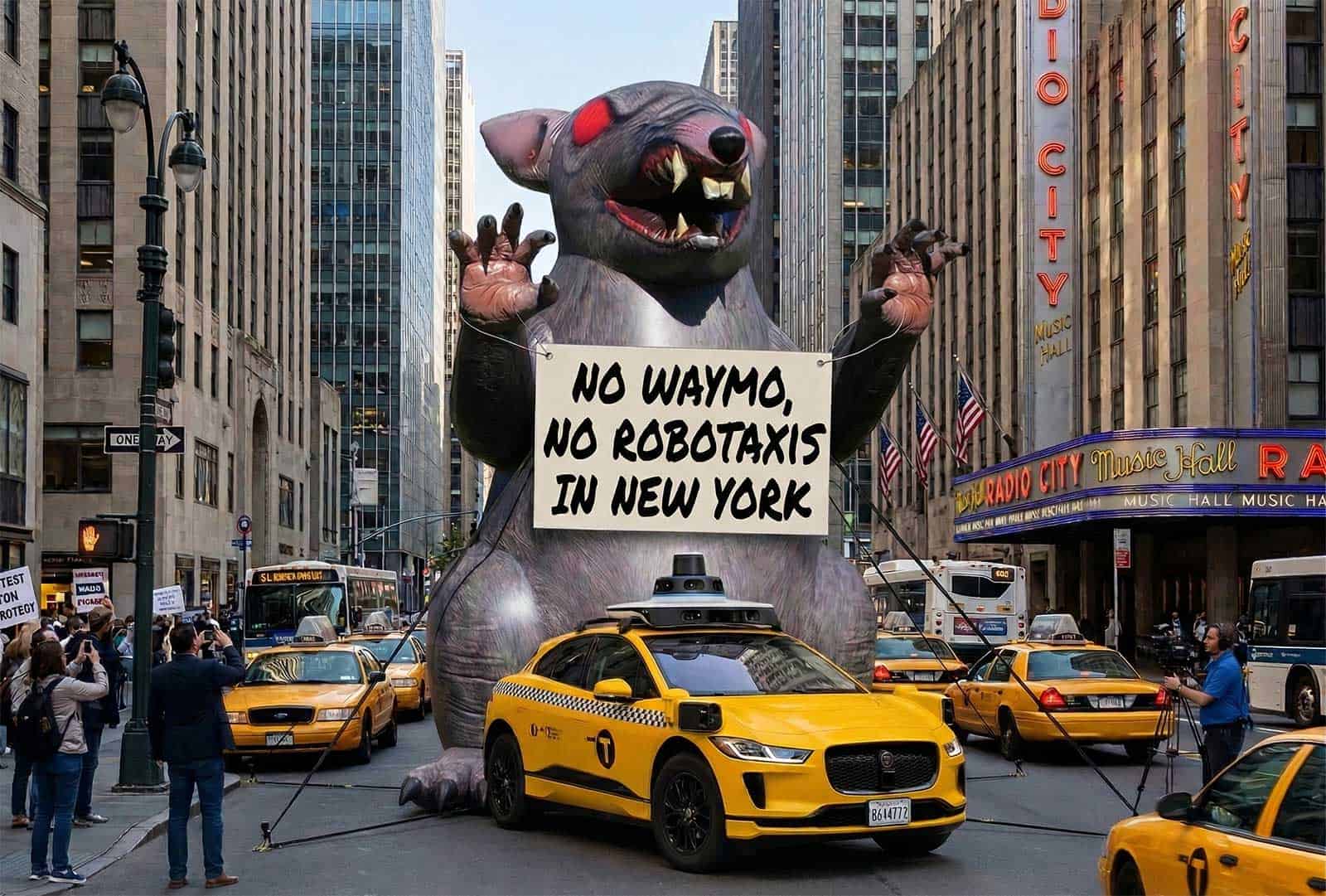
Walter Piecyk: I love, I really appreciate that rant, from Florida, man about my home state and home city . but I guess the point is, what, what is, what do you get out of driving the car? Like can you get the same data if someone’s actually driving this vehicle there or are they just basically driving this? It’s like putting up that gigantic rat in front of like, I dunno if anyone’s been to New York and if, if the unions are going against something though, there’s this giant inflatable rat. So is this like they’re gonna just drive these Waymo’s back and forth in front of the mayor’s residence to say, Hey, we’re still here.
Grayson Brulte: No, that’s a great idea. Yeah. The, in the, in the inflatable rat. Oh God. There’s, I could tell you stories about that thing. It, it’s pretty, distasteful is the words that I’ll use when they roll out this rat to try and put pressure on people. If I, if I was running Waymo, if I was to Kera, I was Dmitri, I’m putting that thing in Soho. I’m putting that thing in Times Square. I’m putting it up by Central Park. I’m going with a tour star. I’m starting to to, to build a buzz a around this thing to build a political pressure campaign. And why do I say that? ’cause Waymo has spent millions of dollars lobbying New York City and New York State to change this. That’s what I would do. But from a data collecting standpoint, Waymo is gathering an immense amount of data from those sensors. So it’s not a matter of if Waymo will deploy New York City, it’s a matter of when Waymo will deploy New York City. Their timeline when the regulatory catches up from, from continuing to drive and gather this data. And I want to clarify, the vehicle fleet is roughly eight vehicles, is what’s been publicly reported. Their timeline to accelerate to deploy will only accelerate.
Walter Piecyk: All right. So that was a long way of saying that yes, they are getting data with the driver in there as long, even, even though they’re driving the wheel or no, or, or, or they’re not getting the data and you’re basically just like a, like a billboard that’s gonna be driving around the city, to somehow, I’m not sure how that builds any adoption of the car. ’cause those cars can only create more traffic and they’re not actually taking anyone in them. So how’s that? Positive for the citizens to happen to see, you know, a Waymo driving around the city.
Grayson Brulte: It is positive because if you think about it, a child sees a child. Asks a question to the parents. They talk about it in school. They talk about it in the diners, they talk about it in the cafes. It starts to build a buzz that the future’s being built in New York, and we are seeing some movements from local city council members and from state assembly members that they want innovation to be built in New York. So it’s positive there. On the data collection standpoint, we are seeing the same thing happen in Washington dc which is another. I would say cluster fuck from a, from a deployment standpoint of politics and they’re driving and gathering data. So what Waymo’s doing said, okay, we are going to figure out the policy. And oh, by the way, when the policy says it’s legal, we’re gonna be able to deploy these much faster. So I give Waymo a lot of credit on not backing down.
Walter Piecyk: so it’s data. It is data. And it’s a mobile, it’s a mobile billboard. That’s fine . you know, if I twi, if I put a, a picture of this and, and, and just play dumb and be like, oh, I thought, I thought these things were banned. What do you think? What kind of response am I gonna get? Should I try that later? Try that over the weekend. I, I, I saw this way more in the city. I thought these, I thought this test was banned. And like, tag the mayor. And see what happens. Should I do that or no?
Grayson Brulte: My X account has been getting a lot of interesting inbounds since I’ve been in talking about this, and there are several individuals there that have tagged the mayor. Crickets. Crickets, crickets. So I’m under the assumption based on the several tweets of, of tagging the mayor, crickets. If you can break through, you can do it.
Walter Piecyk: I’ll do my best. Okay. So Waymo, the other stuff that’s going on with them is, is, the zeer that they now call the Ojai. This is Geely Chinese, electric vehicle, you know, looks like a nice kind of custom made for them. This, this nice van, is, is gonna be entered in service in San Fran. The vehicle’s been showing up in user app, so we’re definitely looking for people’s opinion on, on how that ride feels. They’re gonna supplement rather than obviously replace the I pace. Those I paces still can, I think, go on for several more years. They’re, you know, obviously a decent car other than the times when San Francisco residents, you know, burn them. So yes, it will, they will supplement. And in the case of those that get burned, replace, so we still have about, I think 500 I-PACES, left. That are yet to be upfitted. So we’re almost through that inventory. Then we start the Zeekrs and then, you know, the one I’m looking forward and I’m most optimistic for is, you know, those, Hyundai coming off the line. So we hope to get an update on that at some point. on, on when those things will be cranking out.
Grayson Brulte: Hopefully we, we’ll, we’ll get an update sooner rather than later on the Hyundai stuff. What we do know Kia, which is the division of Hyundai, hosted in an investor day and they were talking about robo taxis. So the Hyundai Corporation is out there actively, talking about. So hopefully we do get an update and something that we did get an update. You got the update. I didn’t. You got Tesla 14.3. What is it? Magic, I mean, what is it?
Walt’s Take on Tesla FSD 14.3
Walter Piecyk: I can’t remember what Elon said exactly about 14.3, but I think there was some. Of hype on, oh, once we get to 14 three, you know, I dunno if the skies were gonna open, but something magical was gonna happen and to, to listen to some YouTubers that did happen that did not happen. Always. Truth, man. like, again, and I said this on our, I’ve said this before, like, you know, if you have like a 4K television and you go to eight k, like, or whatever the numbers are, 2K, 4K, whatever the numbers are. Honestly, like unless you’re like literally in the best buy and looking at them right next to each other, I’m not sure you can tell the difference. And I would say the same thing about this, like, you know, the 14.2 point, whatever the, the thing before this felt pretty smooth and pretty good. So I’m not sure that there’s much of a change there. So. You know, I’m gonna, I’m gonna do a both sides on this one, right? I, I’m gonna challenge those that like claim that there’s like some magical, smoother change that, this is awesome. On the flip side, I read on, on the, on the Twitter or the x, someone that said, specifically Ross Gerber, I think it was. I take Waymo and just marvel at how much better it is than Tesla FSD. I wish my Tesla drove like a Waymo, but it doesn’t. I’m like, okay. Everyone’s entitled to their own opinion, but like, that’s just bullshit. That literally is just bullshit. Like if you get into a Tesla and then get into a Waymo, it is really hard to tell the difference. I mean, it, it’s just like, I, I get that maybe, you know, you can believe that Tesla is not. At whatever, you know, the level four to, you know, to have all the safety cases or the drop offs or whatever. But to say that the, that the driving feel of that car, you know, feels any different than Waymo. It’s just, bullshit. Like, it just, I mean, again, my opinion and just like it’s bullshit for someone, in my opinion to say that 14.3 is some major step up from 14.2 in terms of the field. Okay. With that? No. Let’s take that. Put it in a box, put it away. Have fun with it if you want. What did get better or worse?. It finally went up to my fucking driveway, which is like, yeah, I’ve been bitching about on this . on this podcast. Where’s my clappy hat Grayson? And I need a clap hat for this. Like, that is an annoying daily thing that I have. And I think, look, at the end of the day, the, the issue with autonomy, I, I increasingly is like, I’m, I’m, I’m almost, you know, I’m surprised by this. It’s the pickups and the drop-offs. You know, take WeRide and, you know, which is obviously very successful. They have a limited number of drop offs in Beijing. What Waymo does is, is exceptional in terms of having so many different drop offs in, in their service areas and like. That is, I think, gonna be the key unlock for a lot of these companies is is that pickup and drop offs. And, and that’s obviously been a key challenge for Tesla. It is a step in the right direction here. In the same token, like this car does take circuitous routes around things more so than before. So I think that sometimes changes. There was one time I’m coming up to a stoplight and there was like a, like a box where you’re supposed to like not go into to allow people in, but there was no one, there was room on the other side of the box that it could, so it does. Weird things as it, as it tends to do, but generally speaking, the parking is more decisive. It’s a definitely a step forward. It’s not like other softwares where it’s like it got so cautious where like they’re not gonna go full release. It will go full release ’cause it feels smooth. And again, the smoothness of the, of the car, in my opinion. So like, put my, my bullshits in in context. It’s one man’s opinion. It’s basically the same as it was before, and it’s basically how it feels when you’re in a Waymo. Thank you. End of diatribe.
Grayson Brulte: I’m not clapping you for the end of the diatribe. I am giving you the clappy hat because it went up the driveway. Okay, so that’s, that’s select. We got Walt test. That’s Walt test one. Walt Test two is the fish. Moner has it conquered The, fish monger successfully.
Walter Piecyk: Yes, it, the pulling out of the fish of the fish store in, in Bedford Hills . my mom gave me, gave me some crap because she listens to the podcast and I mentioned that, you know, Martha Stewart does sometimes shop in this fish store, so I’ll say it again. She thinks that’s a humble brag. It’s not meant to be a humble brag. It’s, it’s, it’s better. it’s It’s not like life changing. And I might, I don’t remember enough what Elon said. It’s about 14 three. But look, he’s now on the tape on 15, like, well, once we get for 15, he says, Elon says, we’ll far exceed human levels of safety. Even in completely unsupervised and complex situations, who knows what the timeline is for, for V 15, again, all of this is F In the FSD privately owned world, what we care about much more so is like getting Austin more cars with no drivers in there and building a business and getting some of those cheap cyber ca, excuse me, less expensive value. The cheap cyber cabs on the road delivering rides, at a good contribution margin.
Grayson Brulte: Clappy hat for the fish store. See, you got two clappy hats today, and your humble brag was not humble. It was Very good and very elegant. How’s that? Very elegant.
Walter Piecyk: Hi, mom.
Grayson Brulte: See, you got a hi mom in there. Well on Robotaxis, the, the fascinating part with Robotaxis is that we’re seeing they’re popping up in more cities across the United States. We’re seeing all these photos pop up on x.
Walter Piecyk: Yeah, I mean, they’re getting ready, but like, you know, they still gotta get the technology and the driver’s out. Let’s build a, a model on this. So, anyway, I’m happy with, I’m happy with my FSD. I use it every day. It’s great . you know level two plus plus as a, as a business, by the way, I don’t know if we want to cover this on autonomy markets, but like, that will be a large business in and of itself, right? ’cause it is just, it’s a pleasure to drive. I don’t understand. You know, I think Tesla has done a horrible job at advertising . forget about level four and FSD, just like how it just makes your, the comfort of your ride more safe. And just a lot easier, you know, to drive that way when you’re, when you’re basically supervising this thing as opposed to having to be behind the wheel.
Grayson Brulte: It’s night and day. This is my humble opinion. I believe that every manufacturer around the world not named Tesla secretly, or you use the word desperately, wants the wrong version of FSD, and you were right. It will become a big business over time and over time, it’ll become dis a differentiating factor of. What vehicle a consumer will choose to buy, and that just, that’s just the way it’s gonna go, and that’s how it’s gonna work.
Walter Piecyk: And it’s a different market. I think you’re a hundred percent right grace. And I think underneath the surface, I don’t know if there’s panic, but there’s a lot of of push forward even on the level two plus plus side of things that some may claim can never, those systems can never take you to level four. I don’t really care like, but it is a business model. That, that it’s gonna accentuate the consumer’s willingness to basically let the car, take control because again, it’s it’s just more comfortable. And It’s safer.
Grayson Brulte: That’s all built on a model by Tesla ai and as we’re seeing world models are evolving, pony now announced a world model. I believe it’s called Pony World Am Am I right on this?. Everybody’s got their own world these days.
Walter Piecyk: yes, I, I saw the world. I don’t know why the world, this is like in media land when everything was like plus or max . but I guess this is like, this is all like in the self-training world and. You know what our simulations and, and this is a big thing, I mean, you know.
PlusAI’s Revenue Projections & Next Week
Walter Piecyk: let me pivot a little bit. Plus ai, who’s trying to go public through a SPAC this week, talks about a revenue number in 2026. Of like 40 to 50 million. I’m like, wow, that’s fucking big. Oh God, I’m, I’m dropping too many f-bombs this week. That is big . compared to like what Aurora or Kodiak, which they’re talking like, what, 15 million in revenue. But, you know, you, you scratch ’em, the surface what is plus AI generating that revenue, it’s selling the data, right?. They have these Amazon trucks that are, that have historically at least been driving around and, and, and getting data. As well as their, you know, a lot of the other stuff and and that they can sell this, I think into the OEM space of people that are trying to develop level two plus plus systems. But bottom line, that’s a real number, 40 to 50 million in 26. Ultimately, you know, they want to get to like miles driven type of number, which is a billion, which requires whatever, 25,000 trucks or so. But it’s nice to have some, some revenue on the board, especially relative to your peers, which are at 15 million.
Grayson Brulte: So would you consider this very similar to a nexar dash cam model? Where they’re selling that data or how would you classify this data and who’s buying it? Do we know?
Walter Piecyk: I don’t know. Yeah, I don’t know enough about next, next, whatever the, whatever that come next. Car, Nexar, whatever. I don’t think, I think it’s more than just dash cam data, right? ’cause they have the systems, you know, that, that are in there. So. I think it’s probably higher level data on the routes that are important with, you know, a variety of weather conditions. So maybe it is like that. I mean, is is that company getting 40 or $50 million for their data? And I think it’s, it’s obviously repeatable to the extent that these systems ex continue to exist in these trucks.
Grayson Brulte: With Nexar. We, we, we have no insights into their financial ’cause. They’re private. What we do know, they have a partnership with Lyft and Lyft that they’re going to use it for self-driving cars. What the numbers look like, we don’t know. It’s something. That we’re gonna have to watch. So we, we will see, and we’ll watch what Plus does, but what do we need to watch for in the autonomy markets next week?
Walter Piecyk: I got nothing on the calendar, so, you know, it’s the typical stuff, like what is, does Wavo get another OEM and, and who is it like, I’m hearing Stellantis, Grayson in terms of the top of the list of, of maybe someone that Waymo, would, would want a new relationship, both. What do you think about that?
Grayson Brulte: Well, they’ve historically had a relationship. Let’s not forget STIs. Chrysler was the original partner for the minivans in the Phoenix Metro region. So it’s very possible, but. Solanus also has a partnership with Foxconn, Uber, and Nvidia to deploy autonomous vehicles. If they do go that route, perhaps the Lantus wants to open up a contract manufacturing line for robotaxis. Very similar to what we’re seeing with Hyundai do down in Savannah.
Walter Piecyk: Yeah, I don’t know. I don’t know. But you know, that’s, we always look for that for Waymo. You never know what can come out of Tesla . you know, obviously last week I said you didn’t, you know, Uber seems like they’re outta press releases, but congrats on at least moving the ball forward with VW and, and. Again, mobile. I, even though they didn’t put it in the press release. So here’s what I can be rest assured. We always have something to talk about every week on autonomy markets.
Grayson Brulte: Yes, we do, and I will give a tease to the audience. I have a few field trips coming up where we will be going live on the ground and we’ll be breaking it down here on autonomy markets. Can’t tell you where I’m going or who I’m going with. All I can tell you, we’ve got some really special content. Coming your way soon. The future is bright. The future autonomous. The future is scaling without safety drivers. There’s a hint there, Walt, until next week.
The future is bright. The future is autonomous. The future is The Road to Autonomy.
Subscribe to This Week in The Autonomy Economy™
Join institutional investors and industry leaders who read This Week in The Autonomy Economy every Sunday. Each edition delivers exclusive insight and commentary on the autonomy economy, helping you stay ahead of what's next.