


This Week in The Autonomy Economy™
Waymo’s German Expansion Started Months Before Anyone Noticed
This Week in the Autonomy Economy, Waymo’s German expansion plans came to light as its relationship with Uber appears to be unwinding and May Mobility announced European expansion plans.
There was no press announcement and no text to digest, but Uber’s autonomous vehicle page was updated to simply state; “Autonomous Uber rides are not yet available in Phoenix.”
Before this update, Uber riders had a chance of being paired with a Waymo vehicle, as the companies have had a partnership in place since May 23, 2023. That was 1,132 days ago.
Is this a sign that the Uber and Waymo partnership is coming to an end? Perhaps Austin and Atlanta are next? We understand why Uber would not want to publicize this, as it would raise the exact question we are raising; Is the partnership with Waymo over?
On Uber’s Q2 2026 earnings call, we would encourage an analyst to ask the question directly. Be bold, do not hide behind a word salad. Ask point blank why Waymo is no longer available on Uber in Phoenix and whether this is a sign of things to come. Yes, you will most likely get a non-answer, but it plants an important flag.
Sometimes in life you have to be bold and take risks, and that is exactly what Waymo is doing with its UK and European expansions. They are going bold, and they are about to compete head-to-head with a former partner on a new continent.
This will be something to watch and pay close attention to, as this will be the first time we can benchmark the Uber and Waymo strategies against each other in multiple international markets, beginning in earnest later this year in the UK.
📰 Need to Know: This Week in the Autonomy Economy
Is the partnership between Uber and Waymo coming to an end?
Recent updates to Uber’s autonomous vehicle page plainly state that “Autonomous Uber rides are not yet available in Phoenix,” effectively removing the option for riders to be paired with a Waymo vehicle. This unannounced change, occurring over 1,100 days into their partnership, alongside Waymo’s aggressive international expansion plans, has sparked industry speculation that their domestic alliance is unwinding as Waymo prepares to compete directly with Uber in new global markets.
What are Waymo’s expansion plans for Germany?
Waymo has actively initiated a highly calculated expansion into Germany, officially entering the Munich commercial register as Waymo Germany GmbH in mid-June. The corporate structure is explicitly designed for maximum execution velocity, granting designated California-based directors the unilateral authority to sign binding operator agreements and infrastructure contracts without waiting for parent-company board approvals. Furthermore, Munich-based job postings from Transdev, a long-standing Waymo fleet management partner in the U.S. suggest the groundwork for deploying and managing autonomous fleets in Europe is already in motion.
How is the NHTSA updating regulations for autonomous vehicles?
The National Highway Traffic Safety Administration (NHTSA) has commenced rulemaking on its fifth update to the Federal Motor Vehicle Safety Standards (FMVSS) to eliminate the mandate for manual brake pedals in vehicles designed exclusively for automated driving systems. NHTSA Administrator Jonathan Morrison emphasized that reimagining this regulatory framework is vital to successfully scaling robotaxis in America and ensuring the United States maintains its competitive leadership in vehicle technology.
What new safety protocols did Tesla release for the Cybercab?
Tesla recently published an official First Responder Interaction Plan specifically tailored for its autonomous Cybercab. This comprehensive document details critical emergency protocols, proper vehicle immobilization techniques, and necessary de-powering procedures to ensure that emergency personnel and first responders can safely and effectively interact with the vehicle during an accident or crisis.
Are other autonomous vehicle companies expanding into Europe?
Yes, Waymo is not the only mobility company looking overseas; May Mobility and Geely’s CaoCao have also announced joint plans for an international expansion that begins squarely in the European market. This highlights a broader trend across the autonomy economy, as multiple global operators and manufacturers shift their focus toward establishing operational footholds and scaling their driverless technologies on a new continent.
What’s Moving the Markets
Waymo’s German Expansion Started Months Before Anyone Noticed
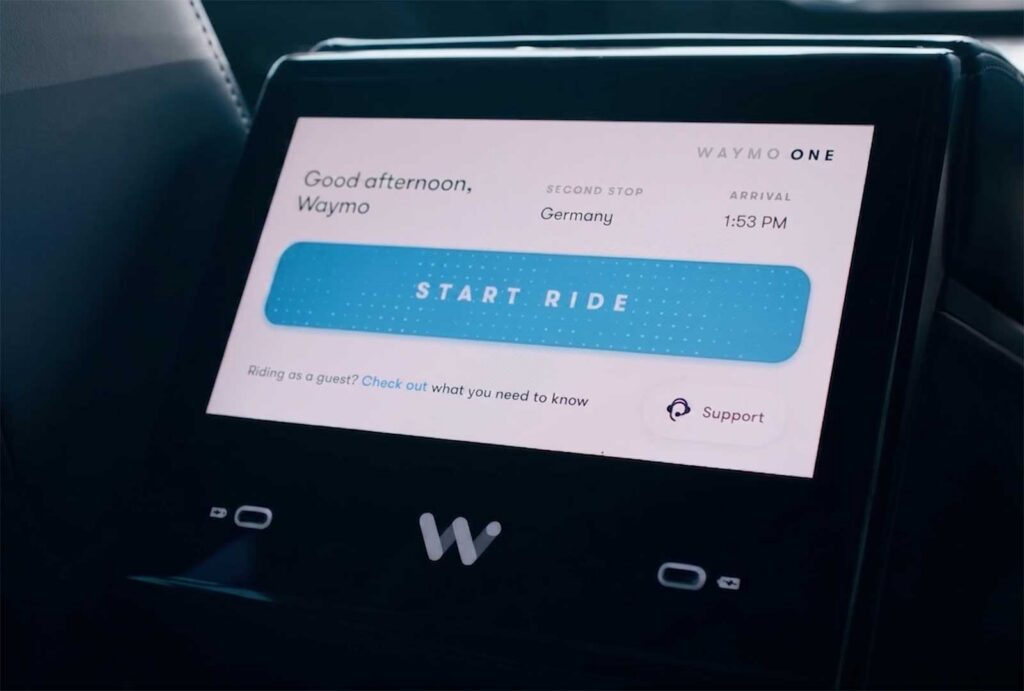
Waymo’s German expansion plans date back to April 28th, when Waymo CFO Steve Fieler signed a power of attorney in California that authorized a slate of agents in Frankfurt to incorporate Waymo Germany GmbH on behalf of the company.
A secretary’s certificate signed the exact same day by company secretary Amar Mehta confirmed that Fieler retained sole authority to bind the firm. Both instruments were apostilled in Sacramento on May 6th, and the formal notarial deed was executed before a Frankfurt notary on May 13th.
Following a rapid chain of compliance, the shareholder list was finalized on May 28th, the directors’ registration application was apostilled in California on June 4th, and the subsidiary officially entered the Munich commercial register on June 15th as HRB 313499. By the time German media caught wind of the registration in late June, Waymo’s European entity had been planned, signed, and fully funded for nearly two months.
The structural blueprint of this filing reveals a corporate entity built entirely for execution velocity. Waymo’s governance structure cuts straight through standard international red tape. Kelly Francis (Controller) and Steven Hahn (Director and Assistant General Counsel), both California residents, are each authorized to represent the German entity individually and have been explicitly released from the self-dealing restrictions of Section 181 of the German Civil Code.
This move allows either director to unilaterally execute binding operator agreements, vehicle leases, and depot infrastructure contracts on the ground without waiting for a corporate co-signature or a parent-company board delay.
Furthermore, the entity’s object clause lays out a highly scalable, multi-city deployment strategy designed around ecosystem partnerships. The charter authorizes Waymo Germany GmbH to provide autonomous ride-hailing services directly, alongside an intentional secondary authorization to provide services that support the commercial offering of such operations by third parties. In theory, this is the Waymo U.S. playbook being exported overseas.
This is already playing out in Munich. Transdev Autonome Services Deutschland GmbH, the autonomous-services arm of Germany’s largest private mobility operator, has posted a Munich job opening for an Operations Manager for Autonomous Driving to start as soon as possible.
The individual hired for this role will be responsible for overseeing daily autonomous fleet deployment, optimizing depots, leading operational supervisors, and reporting to the client on performance. If this sounds familiar, it is, as it reads a lot like similar job postings for Waymo partners in the U.S.
Waymo has a long-standing relationship with Transdev that dates back to 2019, and Transdev already operates Waymo’s robotaxi fleets across several U.S. markets. Perhaps Transdev is Waymo’s German fleet management partner? Only time will tell, but one thing is certain today. Waymo is actively planning a German expansion.
Our Take: First Munich, next perhaps Berlin? Then which EU member state is next as Waymo clearly has grand ambitions for Europe.
Waymo Germany GMBH Formation Sequence
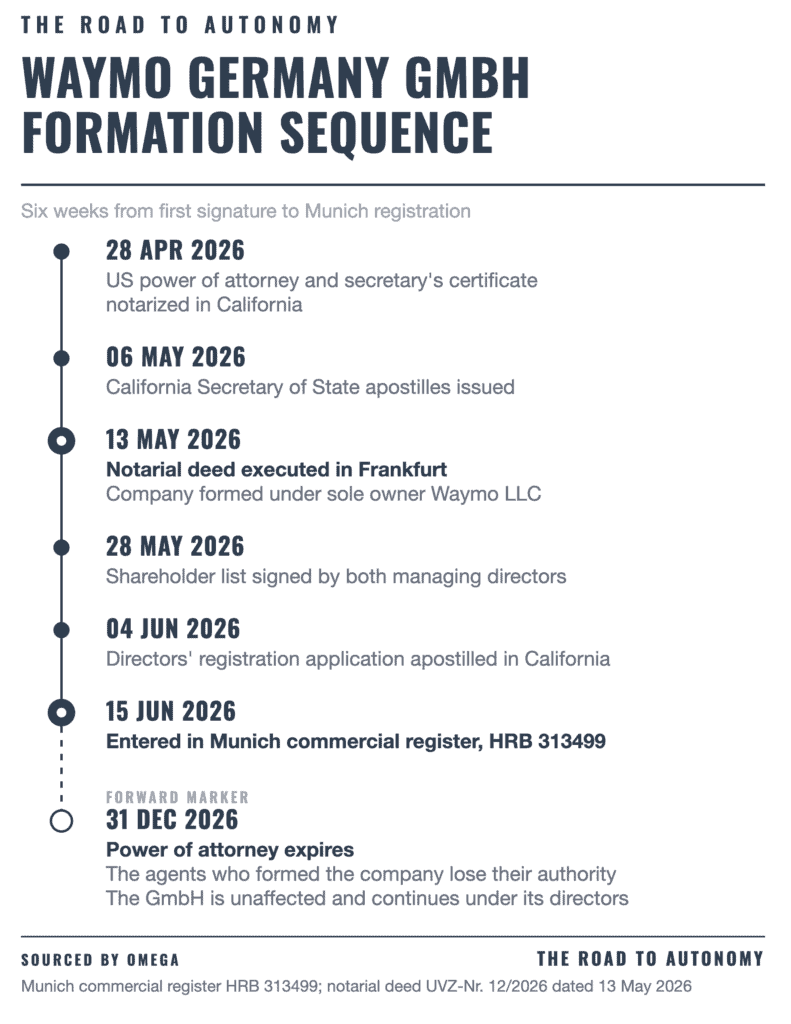
If you find the graphic to be useful, please feel free to share it with credit to The Road to Autonomy.
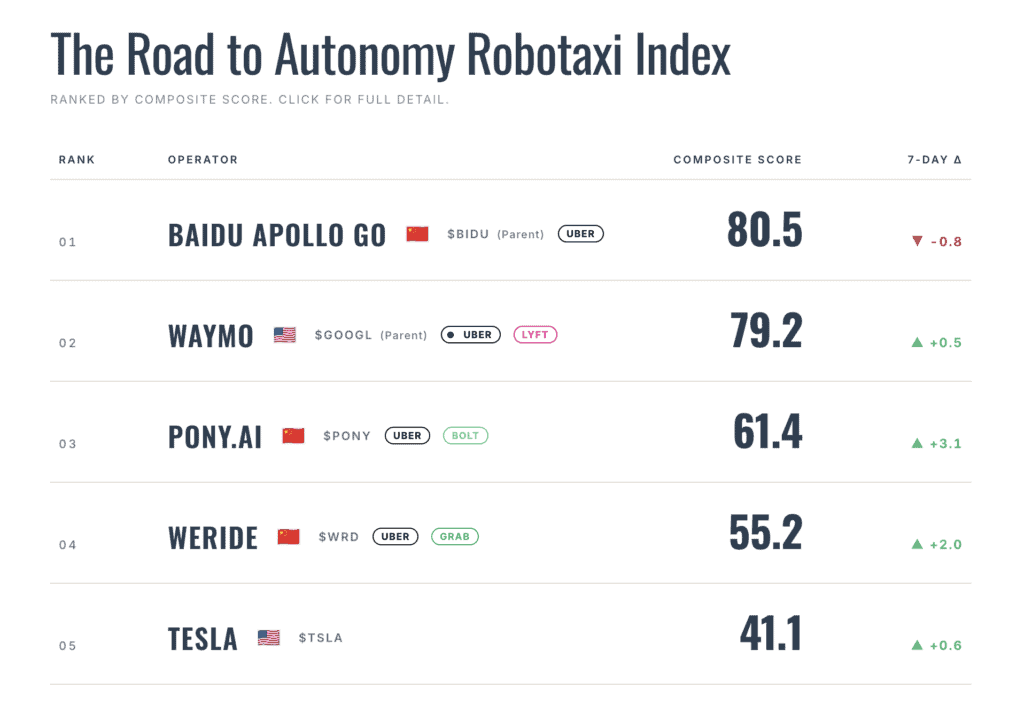
The Road to Autonomy Robotaxi Index
Piquing Our Interest
Has the Uber / Waymo Partnership Begun to Wind Down? That is the question many are asking, as Uber has removed Waymo from the Uber app in the Phoenix market.
Tesla Releases First Responder Interaction Plan for Cybercab Tesla has published an official interaction plan detailing emergency protocols, immobilization techniques, and de-powering procedures for first responders interacting with Cybercab.
Wayve Bets on Licensing Wayve is betting that licensing its autonomous driving system (ADS) to automakers and partners is a bigger market than operating a robotaxi fleet. Interested in the autonomous driving licensing market? Follow The Road to Autonomy Autonomous Driving Licensing Index.
Approve Autonomous Vehicles or Fall Behind That is the Chicago Tribune editorial board’s take on state legislators’ apprehension to move forward on legalizing autonomous vehicles in the Land of Lincoln.
NHTSA Names New Deputy Administrator Autonomous trucking industry veteranLee White was appointed this week as NHTSA Deputy Administrator.
Geely’s CaoCao and May Mobility Announce Europe Expansion CaoCao and May Mobility are planning an international expansion that begins with the European market.
Pony AI Opens Its Singapore Robotaxi to the Public Pony AI and ComfortDelGro transitioned their Punggol autonomous service from an invite-only community pilot to public booking on the Zig app on June 22nd.
WeRide Is Jointly-Developing a Right-Hand-Drive Robotaxi WeRide, Geely Farizon, and Hong Kong operator Kwoon Chung Bus Holdings will jointly build a purpose-built right-hand-drive robotaxi on the production-ready GXR platform,
Xiaomi’s YU7 GT Completes Nürburgring Lap Autonomously A Xiaomi YU7 GT completed a lap at Nürburgring in 10 minutes and 29 seconds fully autonomously, with no human in the vehicle. Lei Jun, Founder and CEO of Xiaomi, explained why they did it in a Weibo post.
📰 Follow @RoadToAutonomy on X for our latest thoughts and insights on the autonomy economy.
Trending on X
NHTSA Moves to Remove Brake Pedal Mandate from Autonomous Vehicles
NHTSA has commenced rulemaking on its fifth update to the Federal Motor Vehicle Safety Standards (FMVSS), a measure that would eliminate the mandate for manual brake pedals in vehicles designed to be operated exclusively by automated driving systems (ADS).
“We are at the cusp of the greatest technological revolution in vehicle technology since the innovation of the Model T,” NHTSA Administrator Jonathan Morrison said. “If we want America to lead the way, we have to reimagine our regulatory framework.”
Our take: Administrator Morrison is taking the right steps to ensure that robotaxis can scale in America, while benefiting the U.S. Economy.
Parallel Systems Is Building the Internet of Freight
Matt Soule, Founder and CEO of Parallel Systems, joined Grayson Brulte on The Road to Autonomy podcast to discuss how Parallel Systems is building the internet of freight by combing autonomy and rail.
Tesla FSD Goes Coast to Coast in Canada With a Little Help
This week on Autonomy Signals, Grayson Brulte and Rob Grant are joined by David Moss, Devin Olsen, and Spencer to break down the first-ever FSD coast-to-coast drive across Canada with no interventions and what 3,782 miles exposed the limits of the Tesla’s current consumer hardware.
Qualcomm Sells the Chip While Mobileye Eyes the Fleet
This week on Autonomy Markets, Grayson Brulte and Walter Piecyk discuss Qualcomm and Mobileye‘s differing robotaxi strategies, NHTSA removing the physical brake requirement for autonomous vehicles and the New York State Legislature failing to advance an autonomous driving bill.