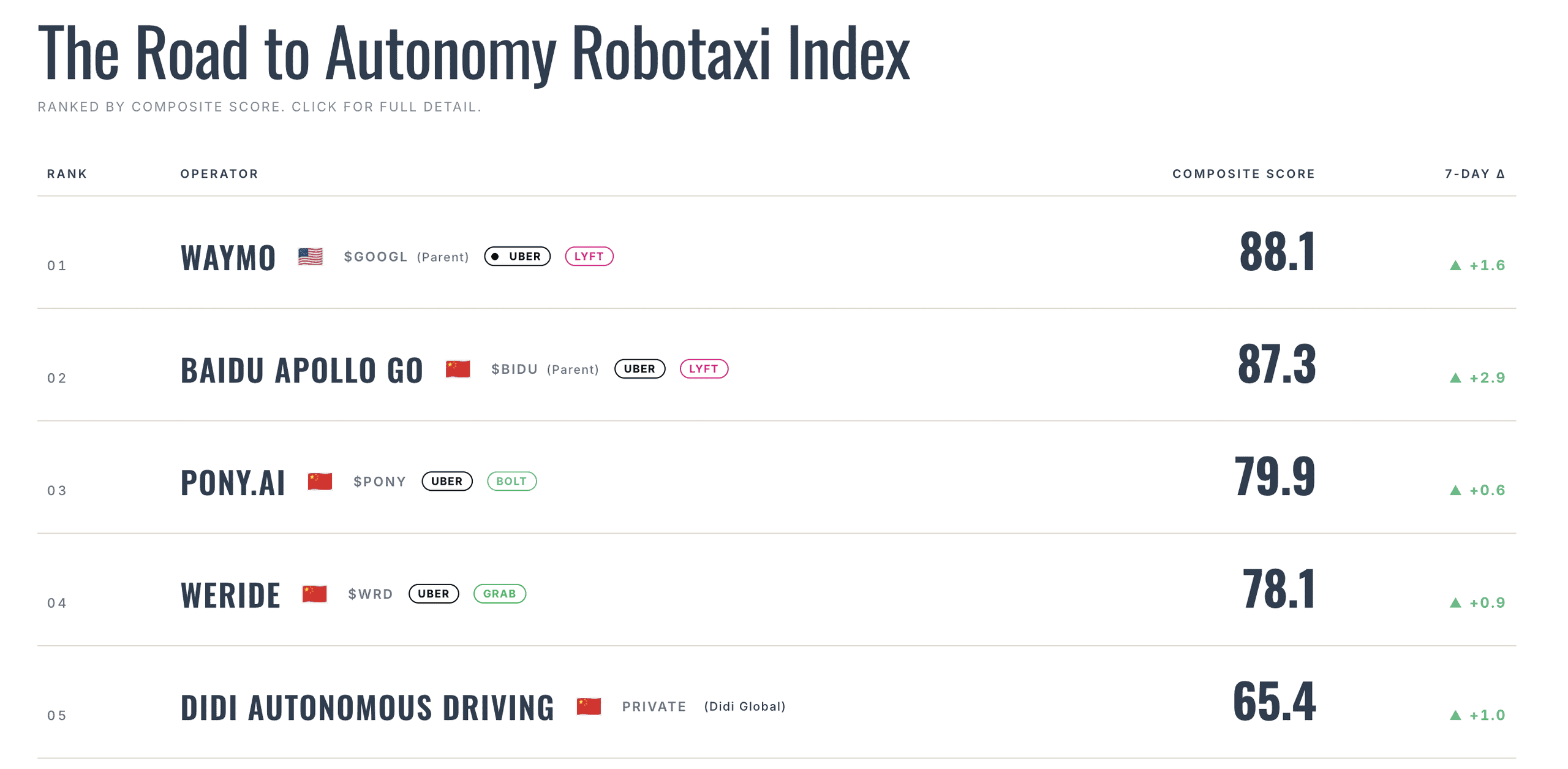
This Week in The Autonomy Economy presented by Koop Insurance, our track record of being ahead was once again validated when Waymo co-CEO Tekedra Mawakana confirmed to Bloomberg that Waymo and Uber are getting divorced, Baidu Apollo Go surpassed 250,000 weekly rides, and Elon Musk announced that Tesla is shutting down the Cybertruck.
To the dismay of many, it appears that there will be no Cyber SUV. While there will be no Cyber SUV, we are getting a liquid silver Cybercab and an improved 40 kWh Cybercab pack. From the Tesla perspective, the company is all-in on autonomy and robotics as the company shifts its business model ahead of a potential merger with SpaceX.
While Tesla is busy preparing to shut down the Cybertruck line and Tekedra is channeling Iron Mike Tyson, we have been on the road documenting the road to autonomy. This week, we released field reports from Nashville, Orlando, and Fort Worth.
Next week, the entire Field team is out in the field producing a series of field reports from around the world. From the mountains, to the slot machines, to the Middle Kingdom. Autonomy is global and we will be there to document the growth of the Autonomy Economy.
The Field Reports are released publicly and the data that we gather from the field is released exclusively to OMEGA subscribers and clients. If you are interested in learning more about OMEGA or becoming a client, please send an email to alpha [at] autnmy.ai.
📰 Need to Know: This Week in the Autonomy Economy
What is driving Waymo to end its exclusive partnership with Uber?
Waymo co-CEO Tekedra Mawakana confirmed the company is terminating its exclusive Austin and Atlanta arrangement by January 2028 to launch its own consumer app in both markets. The decision comes down to customer consistency. Riders on Uber have had to play autonomy roulette with no guarantee of getting matched with an autonomous vehicle. The split deals a major blow to Uber’s near-term AV narrative, given that 500 of the 700 robotaxis Uber targets on its platform by year-end (71.4%) are Waymo vehicles.
Why is Tesla shutting down Cybertruck production?
Tesla is winding down Cybertruck assembly to reallocate factory floor capacity and resources toward ramping Cybercab production. There will be no Cyber SUV. Instead, Tesla is moving forward with a liquid silver Cybercab sporting an upgraded 40 kWh pack. The pivot underscores Tesla’s complete transition away from traditional automotive manufacturing into an autonomous robotics firm ahead of a potential SpaceX merger.
How do the 2026 Midterm Election results alter autonomous vehicle regulation?
The Democratic wave has effectively ended hopes for a unified federal regulatory framework like the stalled SELF DRIVE Act. Instead of federal preemption opening up lucrative East Coast markets, operators now face a fractured regulatory map. Operators in Sunbelt testing bastions like Texas, Georgia, and Arizona will have to navigate increased municipal pushback, mandatory data disclosure mandates, heightened insurance requirements, and organized labor scrutiny around driver displacement.
What milestones did international robotaxi operators reach this week?
In China, Baidu’s Apollo Go officially surpassed 250,000 paid weekly robotaxi rides as it accelerates global expansion. Concurrently, cross-border technology transfers gained traction: Chinese autonomous provider CalmCar partnered with Turkish mobility giant Marti to begin testing autonomous vehicles in Istanbul, while WeRide deployed a fleet of 20 autonomous vehicles insured by Mutua Madrileña for an Uber pilot in Madrid.
Where does the commercial autonomous trucking market stand heading into year-end?
Autonomous trucking and drone delivery are moving into scaled commercialization. Kodiak reported transporting over 396,000 tons of freight in Q3 2026 (more than double the previous quarter) ahead of launching unsupervised commercial runs with five trucks by year-end. Meanwhile, Daimler Truck subsidiary Torc is tracking toward driver-out operations by the close of 2026.
📈 Follow @AutonomyIndices on X for the latest updates on The Road to Autonomy Indices. Updates every 12 hours.
The Impact of Democratic Victories on Autonomous Vehicle Policy
This week’s Democratic wave is neither a red light nor a green light for autonomous vehicles, but it undeniably introduces a far more complex regulatory roadmap. While commercial deployment remains commercially viable and established authorizations aren’t vanishing overnight, the political center of gravity has shifted. With Democrats taking control of Capitol Hill and making key gains in state capitals, the industry’s long-sought prize: a clean, comprehensive federal framework that preempts a patchwork of local rules, just became a pipe dream.
In Washington, expect a noticeable pivot toward transparency and labor protection. Any movement on federal standards like the stalled SELF DRIVE Act will now face sharp questions around incident reporting, NHTSA enforcement teeth, and worker displacement in commercial trucking and ridesharing.
The real friction, however, will be felt on the ground in key Sunbelt deployment hubs. The emergence of Democratic executive and legislative power in testing and deployment bastions like Texas, Georgia, and Arizona means operational flexibility can no longer be taken for granted.
While existing state statutes won’t dissolve immediately, the push for local municipal control, emergency responder coordination, mandatory data disclosures, and tighter insurance requirements will force operators to spend far more time navigating city halls and statehouses to keep their wheels turning and prevent rollbacks of long held lighter touch regulatory gains.
For states that hadn’t already rolled out the red carpet to autonomous vehicles, the door just got much heavier. Rather than watching a federal standard force these lucrative mainly East Coast markets open, autonomous vehicle companies will have to mountain climb even higher, as Democrats will feel emboldened by the larger anti-tech sentiment that surely helped them grow the breadth of the Blue Tsunami seen last night.
The regulatory environment is now far more complicated as the path for a national framework has all but dissipated. Our advisory practice is well equipped to handle the changing environment and if you would like to discuss the impact on your business, please reach out to alpha [at] autnmy.ai.
Tesla Robotaxi Dallas-Fort Worth Field Report
Special Field Correspondent Spencer traveled across the Dallas-Fort Worth metroplex to map where Tesla is building its robotaxi infrastructure, from Dallas Love Field to the Fort Worth Stockyards. This is the Field Report.
Waymo Orlando Field Report
Grayson Brulte traveled to Orlando to ride the newly expanded Waymo service area, from the theme parks to the depot, spending four and a half hours in Waymo vehicles. This is the Field Report.
Waymo Roulette on Lyft in Nashville Field Report
In Nashville, Grayson Brulte played autonomy roulette on Lyft, spending more than 25 minutes trying to get paired with a Waymo. This is the Field Report.
Piquing Our Interest
Waymo/Uber Divorce is Happening In what can only be described as a scene from HBO’s War, Waymo co-CEO Tekedra Mawakana said the company is ending its exclusive robotaxi partnership with Uber in Austin and Atlanta by January 2028 because customers want the consistency of booking directly through the Waymo app rather than playing autonomy roulette. We first spoke about the potential of a divorce during an episode of Autonomy Markets on May 31, 2025 (526 days ago), and we coined the divorce term for Uber and Waymo on November 1, 2025. That was 372 days ago.
Way’mo Cars on Lyft Soon, Lyft riders in Nashville will be able to get matched with an Ojai, in addition to being picked up at the airport. Interested in how airport pickups work at BNA, read The Field Report.
Waymo Expands LA Service Area to the Beverly Hills Hotel and South Bay Waymo’s Los Angeles service area now covers roughly 210 square miles. While rides can now reach the Beverly Hills Hotel, service still does not extend north of Sunset Boulevard to the Hotel Bel-Air.
Waymo Expands Las Vegas Service Area Waymo has expanded its Las Vegas service area by 24 square miles, bringing its total service area to 47 square miles.
Waymo Will Not Be Expanding San Antonio Service Area Anytime Soon Waymo’s 60-square-mile San Antonio service area will not be expanding anytime soon, but the company plans to add more vehicles. We were in San Antonio a few weeks ago and rode in a Waymo from the airport. Read The Field Report.
Waymo is Mapping Cincinnati While the days of the Big Red Machine have long passed in Cincinnati, Waymo is looking to usher in the era of the Big Autonomous Machine when robotaxis can legally be deployed in Ohio.
Waymo Eyes Raleigh, Durham Expansion Waymo has begun laying the groundwork for an expansion to the Raleigh, Durham region as the company is in talk with local cities.
Tesla Opened Fort Worth Robotaxi Service Tesla opened Robotaxi service in Fort Worth this week and Special Field Correspondent Spencer took the first ride.
Zoox Plans to Start Testing in UK, Europe and AsiaZoox is eyeing an overseas expansion as the company is planning to send its Toyota Highlanders to the UK, Europe, and Asia for testing.
Uber Expects 700 Robotaxis on Platform by the End of the Year While Uber is aiming to have 700 robotaxis on its platform by the end of the year, 500 (71.4%) of those are Waymo vehicles, which will be coming off the platform by 2028.
Kodiak Doubles Quarterly Freight Volume Ahead of Fully Autonomous Commercial Launch Kodiak reported a surge in Q3 2026 freight volume, transporting over 396,000 tons of freight, more than double the previous quarter as the company prepares to launch unsupervised commercial operations with five autonomous trucks by the end of the year.
Torc Aims for Driver-Out Launch by the End of the YearTorc, majority owned by Daimler Truck is aiming to launch driver-out autonomous trucking operations by the end of the year.
Zipline Raises $1.5 Billion to Build Nationwide Autonomous Drone Delivery Network Zipline has raised $1.5 billion at a $21.5 billion to accelerate the growth of its nationwide autonomous drone delivery network.
Mutua Madrileña Insures Spain’s First Fleet of 20 WeRide Autonomous Vehicles Spanish insurance company Mutua Madrileña is insuring a fleet of 20 WeRide autonomous vehicles for a pilot program by Uber in Madrid.
Marti Partners with CalmCar to Bring Robotaxis to Türkiye Turkish mobility platform Marti has partnered with CalmCar to begin testing autonomous vehicles in Istanbul. Interested in Marti, watch our podcast with Cankut Durgun, Co-Founder, President & COO.
Baidu Apollo Go Surpasses 250,000 Paid Weekly Robotaxi RidesBaidu Apollo Go, has surpassed 250,000 fully autonomous weekly rides as the company expands globally.
📰 Follow @RoadToAutonomy on X for our latest thoughts and insights on the autonomy economy.
Trending on X
Cybertruck is now Cybercab
Tesla will be winding down production of the Cybertruck at Gigafactory Texas around the middle of next year to make room for increased Cybercab production
In a move that you could call the end of an era, even though it was not an era, Tesla is winding down the production of Cybertruck as they plan to ramp Cybercab production. This is another clear signal that Tesla is not a car company, it’s an autonomous robotics company with a potential galactic merger on the horizon.
Our take: Even though Cybertruck did not sell very well, it was a great piece of engineering. We are somewhat surprised that a Cyber SUV was not built on the Cybertruck platform.
U.S. Dark Money Tries to Stop Robotaxis as Japan Says Yes to Full Autonomy
This week on Autonomy Signals presented by KPMG, Grayson Brulte and Rob Grant discuss the dark money campaign trying to stop robotaxis in the United States, Japan’s new certification framework for vehicles without steering wheels or pedals, and Reliable Robotics autonomous regional cargo aircraft.
Waymo Just Blew Up Uber’s Robotaxi Growth Story
This week on Autonomy Markets, Grayson Brulte and Walter Piecyk discuss Waymo’s co-CEO Tekedra Mawakana dropping a Mike Tyson-like right hook on Uber during a Bloomberg interview, exposing the reality of their pending divorce just as Uber reported earnings.