


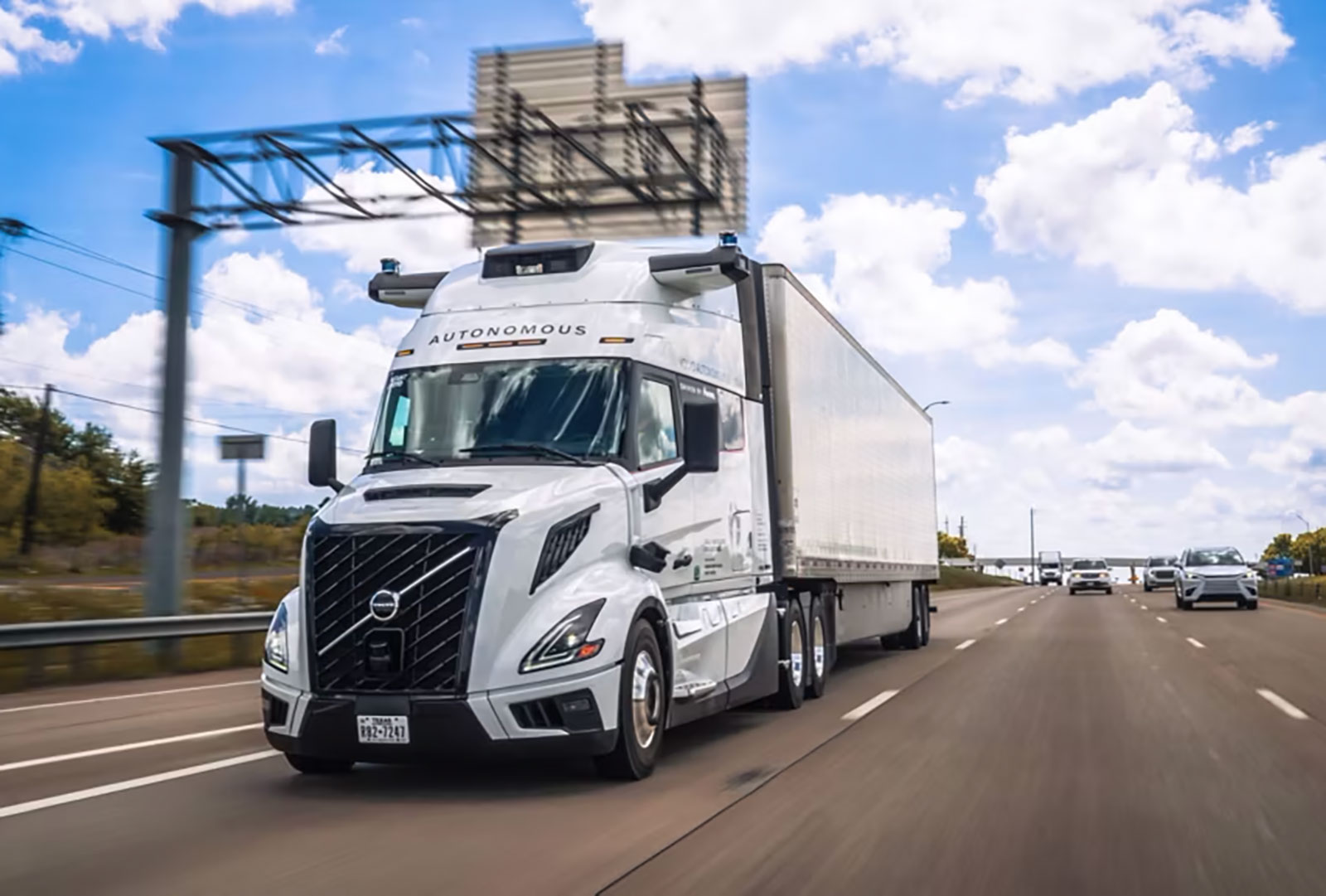
Robotaxis Get the Hype, Autonomous Trucks May Get the Profits
Executive Summary
Autonomous trucking reaches an inflection point as Gatik deploys 40 trucks on real customer routes with Pepsi, while Volvo targets $3 billion in autonomous transport revenue within five years using Aurora’s autonomous driving system.
On the robotaxi side of things, Tesla files for a Clark County permit requesting up to 5,000 vehicles in Las Vegas, which the hosts characterize as marketing hype. Waymo acquired Apple’s 5,500-acre proving ground in Arizona for $220 million, and Chinese autonomy companies WeRide and Pony continue their European expansion into Slovakia and Luxembourg respectively.
Key Autonomy Markets Episode Questions Answered
What is Volvo’s autonomous trucking revenue target and which technology partner is enabling it?
Volvo is targeting $3 billion in autonomous transport revenue within five years. The trucks use Aurora’s autonomous driving system, with Volvo planning deployments starting in Q1 2027.
Why does Grayson Brulte call Tesla’s Las Vegas robotaxi permit marketing hype?
Grayson points out that roughly 6,500 Uber drivers already operate in the Las Vegas market, making a request for up to 5,000 robotaxis an outsized claim. He suggests a realistic comfortable deployment would be closer to 500 to 600 vehicles depending on the operational design domain.
Why are insurance rates rising for ADAS-equipped vehicles?
According to Grayson Brulte, insurance companies say the advanced technology makes vehicles more expensive to replace after a crash. He also believes insurers do not yet know how to properly underwrite these vehicles.
Autonomy Markets Topics & Timestamps
[00:00] Gatik Goes Driver-Out with PepsiCo
Gatik is running driver-out middle mile freight on real customer routes across Texas, Arizona and Arkansas with PepsiCo, a signal that the trucking side of autonomy has reached an inflection point. Grayson asks the questions the market wants answered: where is Walmart, and when does Costco, the holy grail every trucking executive wants, finally engage.
[02:51] Volvo Targets $3 Billion in Autonomous Transport Revenue
At its investor day, Volvo committed to its transport-as-a-service model and told investors it is targeting $3 billion in autonomous transport revenue within five years, running on Aurora’s Level 4 system. Grayson and Walt weigh the tension of an OEM competing with its own truck buyers and ask whether Daimler Truck and Torc try to grab a slice of the same pie.
[06:54] Einride Goes Public
Einride hits the public market under the ticker ENRD at roughly a billion-dollar SPAC valuation, combining electric trucks, autonomous vehicles and logistics software. Grayson argues the GenLogs data tells the real story: with no public road operations in Texas over the last 90 days and activity concentrated in California, Einride is signaling electrification, not autonomy.
[08:58] Tesla Files for Clark County Robotaxi Permit
Tesla filed for a Clark County permit requesting up to 5,000 robotaxis in a Las Vegas market served by roughly 6,500 Uber drivers. Grayson reads it as marketing hype and narrative control, pegging a realistic deployment closer to 500 to 600 vehicles, while the duo notes Tesla’s 11 billion FSD miles against a still-small Austin fleet.
[11:52] Waymo Acquires Apple’s Arizona Proving Ground
Waymo bought Apple’s former 5,500-acre proving ground in Wittmann, Arizona for $220 million, a secretive facility with a high-speed oval roughly an hour from its Mesa upfitting plant. Grayson sees a corridor for testing new OEMs at highway speeds away from prying eyes, while Walt counters that satellite imagery sees everything.
[13:39] Wayve and Uber Open the UK Interest List
Uber opened an in-app interest list for Wayve’s supervised autonomous rides in the UK, running on Ford Mustang Mach-Es. Grayson pushes back hard on the waitlist gimmick and argues Uber avoids a dedicated autonomy tier for political reasons to keep from ruffling its drivers, a read Walt challenges him to put on the record.
[16:20] Baidu Added to the Pentagon’s Designation List
Baidu landed on the Pentagon’s designation list of companies tied to the Chinese military. Grayson and Walt assess the fallout for Uber and Lyft’s overseas Baidu, WeRide and Pony partnerships, agreeing the impact is more political than financial and that geopolitics can flip one Truth post at a time.
[18:31] Foreign Autonomy Desk
Chinese autonomy keeps accelerating into Europe: Bolt, Pony.ai and Stellantis prepare to test robotaxis in Luxembourg while WeRide deploys its L4 vehicles in Slovakia. The duo gives WeRide credit for selling its narrative, then turns to ADAS Corner as Rivian begins R2 deliveries and Lucid’s Gravity adds a Level 2 system, with Grayson flagging rising insurance rates as the trend to watch.
[27:13] Nebius Launches a Physical AI Lab
Nebius, the data center company behind Avride, is launching a physical AI living lab for UK and European robotics startups built on NVIDIA technology. The “labs” branding is catching on fast, prompting Grayson to tease that AUTNMY AI has built something in its own lab that goes public in the media next week.
[28:14] Next Week
Walt heads to Denmark for field work as FSD Supervised gets approved there, with the SpaceX IPO looming as the week’s big event. Grayson and Walt debate how SpaceX and Tesla are interconnected on funding and synergies, and whether the timing of Tesla’s good news lines up with the offering.
Full Episode Transcript
Gatik and Pepsi: Middle Mile Autonomous Trucking
Grayson Brulte: Walt, the market’s finally paying attention to autonomous trucking. Wall Street Journal highlights Gatik and their partnership with Pepsi. Volvo comes out at Investor Day and says, ” We wanna haul autonomous freight as a service.” And then you can’t. We can’t go by if we don’t talk about Waymo. Waymo buys Apple’s whole proving ground. We’ll get into that. And then Tesla’s trying to hit the jackpot in Vegas while Imride goes public. But first, let’s start with Gatik and Pepsi. What do you know about this?
Walter Piecyk: That’s a hell of a mouthful, so we have a lot to cover today, so let’s get at it. I mean, Gatik is not a company that we’ve spent a lot of time with. Y- it seems like while Aurora and others are focused on long haul, which makes a lot of economic sense to me and certainly tremendous opportunity there, Gatik, I think, is, you know, m- maybe more in that del- ending delivery. But this is obviously still autonomous, 40 trucks, Texas, Arizona, Arkansas. this is middle mile freight. This– Those are the words I was trying to come up with it. Now, but these are real customer routes. so this is great. This is positive, and it just kinda underscores, I think, what I’ve been talking about for the last couple of podcasts, which is that the trucking side of autonomy seems to be in an inflection point
Grayson Brulte: It is, and maybe the market’s gonna pay attention. While this is great news for Gatik, I’ve gotta ask the question the market wants to know: where’s Walmart? We haven’t heard much about that partnership lately. Pepsi’s great, but where’s Walmart?
Walter Piecyk: I feel like when sometimes when a lot of these legacy companies, whether it’s J– like on the, on the actual transportation side, JB Hunt or the retailers themselves you know, they’re slow and then they’re, and then they’re fast. I mean, Walmart and others should have a lot and be tech forward, but they’ve had such a good run in recent years that sometimes, you know, you get a little, a little slow and, and lethargic in some of these things. But I think, you know, as these opportunities arise, as OEMs and transportation providers are, are, I think, pressured to embrace autonomy faster than they are today, I think you’ll see a lot of that stuff happen pretty quickly. Walmart’s not gonna be left out on this.
Grayson Brulte: No, Walmart’s been investing in innovation. They were or are still a partner of CATIC. We haven’t heard anything. I’d be curious to see that. But you know the holy grail that everybody in autonomy wants? There’s one company, you talk to any executive in, in trucking, they want Costco. Everybody wants to haul for Costco, and Costco has not engaged with anybody. That’s the, that’s the one to watch. If Costco works with somebody, that’s a big signal
Walter Piecyk: Well, the, the question though is why don’t these large companies maybe put some development dollars ahead? It’s only gonna benefit them in the long term. You’ve got trucking companies that have– still have financial needs until they can hit scale, right? It’s still an open market in that regard. It’s a challenge, right? You will find obviously some of these companies will fall by the wayside, so capital becomes a, a critical issue there. So if they want this to in fact succeed, maybe, you know, put up some of their dollars to help this ecosystem.
Volvo VASS: Autonomous Transport as a Service
Grayson Brulte: We’ll see. Then Volvo is putting some dollars into their autonomous systems, what they call VASS. What did we learn about that at their investor day?
Walter Piecyk: First of all, we, to you and I and to our listeners, this is not necessarily something new, right? We’ve talked about Volvo autonomous, you know, we’ve referenced Sasco, friend of the pod in terms of this kind of, I don’t wanna call it a pivot, but basically rather than just selling trucks, being autonomous transport. Now there has been some questions within the industry if you’re like, “Hey, you’re gonna compete with me and, and you want me to buy your trucks?” So we’ll see how that goes over. But at some point, like, if that industry is not willing to quickly embrace autonomy, you know, by all means, and Volvo, by the way, sees this as huge. They’re, they’re targeting what they think is a $3 billion of autonomous transport revenue within five years, then kind of damn the r- torpedoes and, and full speed ahead. And like, and for those other companies, if you decide not to use Volvo in the future, like good luck. You have to find an alternative for trucks. What’s your alternative? PACCAR, who’s, who’s kicking the drivers, you know, the, the or forcing Aurora to put drivers back in the truck. you know, so I think this is, this is a, a good m- I- it’s good to see this kind of manifested. Like we don’t know what the internal politics are at Volvo, but certainly if they’re, they’re, if they’re delivering this to invest- investors and Sasco and team certainly have momentum in pushing this, this this opportunity forward.
Grayson Brulte: I think VaaS is a great idea. They call it transportation as a service. I know there’s certain friends in trucking who will, will murder me for this comment, but I think it’s a really good positive for Volvo, and frankly, I think it’s something that more companies should follow. And as Volvo goes down this path, depending on where the politics land, you gotta watch Daimler Truck. What do they do? They have the deal with Torc that they’re the majority investor in, but the question is, do they try and get some of this pie? It’s something to watch
Walter Piecyk: Competition breeds innovation. Like I’ve, I’ve said, you know, I’ve lived this for 20, 30 years now. I’ve seen this in telco. That’s, that’s exactly, I think, what you want. again, some of that competition may fall by the wayside if they can’t get the financing that, that’s required before they hit scale. Volvo obviously has the, the, the means, as does Daimler. the other thing to kind of h- you know, highlight here is, you know, Volvo’s using Aurora’s Level 4 system. So this, these trucks that they’re talking about in Q1, this is just yet another positive for for Aurora and their kind of step forward here. And, and, you know, it’s just a heads-up. I mean, they will be hosting, Aurora that is, investors down in Dallas come this fall, presumably to kind of profile some of these new systems that the, that they’re working on, whether it’s with the international trucks that they’re upfitting or Volvo, we don’t know. But certainly, like, you know, there is a, a certain amount of momentum that’s occurring at Aurora
Grayson Brulte: Yeah, and I think it’d be, over time, it’d be really great to get a true understanding of how the relationships works with the virtual driver. Is Aurora getting a per mile fee? Are they getting a general monthly licensing fee? It’d be really interesting to get some of those insights.
Uber Freight and Aurora: Missed Opportunity?
Walter Piecyk: I also wonder, I don’t know if we talked about this last week, but Uber exiting some of its stake in Aurora. You know, Uber Freight doesn’t really get asked about on earnings call, calls. Like, again, it’s a small portion of the opportunity that Uber has in terms of Uber Eats and, and, you know, on the ride side of things. But, like, are they gonna look back on this and kind of regret maybe like they regret punting the, the, the autonomy technology ownership to Aurora in the first place by exiting that company and, like, not embracing trucking more? This is still a sizable opportunity, not only in the US but obviously globally. It just, it seems a little odd given the amount of free cash flow that Uber generates to maybe not lean in on, you know, Uber Freight a bit more. I don’t, I don’t even heard any negative, negatives about that other than it’s just relative size to the overall entity.
Grayson Brulte: Uber Freight, in, in my opinion, just kinda seems to live outside of the Uber ecosystem. And when you talk about Uber with folks, Uber Freight never comes up unless you talk to, to trucking folks. I’ve always thought, and Bloomberg reported this, I think it was roughly two years ago, 18 months ago, that Uber was looking at spinning out Uber Freight, so perhaps that comes to fruition at some point.
Einride Goes Public via SPAC
Walter Piecyk: We’ll see. What else do we have in, in the world of, of trucking autonomy? V- is it Einride? Einride? I’m not sure how you pronounce this. We’ve met, we’ve met them before. solid team. Ticker now is ENRD. Another one of these SPACs r- valued again in this ballpark, a billion dollars. and they combine electric trucks, autonomous vehicles, and logistics software. Thoughts on the role that Einride plays in the market?
Grayson Brulte: I don’t know. I don’t know, and I’m saying this very nicely, I’m not saying this to be derogatory, I don’t understand the type of company Einride is. I view Einride as a platform company. They have the charging infrastructure, th- they have the electric trucks, they have the autonomous. I view them more as a platform. I don’t necessarily view them as an autonomous trucking company. I view them as a platform company
Walter Piecyk: I mean, when I first met someone from Einride a couple years ago now at, at forward Fort Worth I just– my takeaway was they were primarily electric truck, right? I mean, that’s, that, that was the shtick as opposed to logistics software or autonomy. So, you know, we need to do more work and learn more, more about what the opportunity there is. But again, comp– another competitor in the market. Everyone fighting, right, for investment dollars and, you know, not many of them having runway, you know, beyond a year or so. So like that again, becomes a challenge. You can have good product, but you need to continue to fund until you can get to free cash flow positive, which for many of these companies is years off
Grayson Brulte: It seems to me, and, and to give a shout-out to our, our good friend Ryan Joyce, who runs GenLogs, he’s the gentleman that, that tracks highways, so you cannot misbehave on the highway ’cause Ryan will find you in the GenLog software. Over the last 90 days, OnRide has not operated on public roads in Texas. Where have they primarily operated? California. What does that signal? Electrification, not autonomy
Tesla Files for 5,000-Vehicle Robotaxi Permit in Las Vegas
Walter Piecyk: I guess. I, I think we’ll have to give them the benefit of the doubt until we, till, until we learn some more. obviously they’re gonna wanna have to talk up a, you know, a good narrative, you know, for their, for their entry into the, into the public markets, which tend to be a little bit more you know, discerning than maybe private market investing. In any event, let’s move on to out of trucking, huge opportunity, inflection point, back into the world of, you know, moving this all around in terms of robotaxis. We have Tesla now filing for a Clark County robotaxi permit. this is Las Vegas, for those that don’t know where Clark County is. This includes the airports requesting up to 5,000 vehicles. So look, this is like, to me, this is like the signal that we’ve gotten before. You know, you and I were both at Texas, the Texas plant, Giga. We saw the number of Cybercabs that were coming off the manufacturing line. We heard about the plans to add additional manufacturing line. Like, all of the things, you’re like, “Why would you do all this unless you believed, you know, you were getting closer to actually rolling this stuff out?” Now, you know, critic- critics would be like, “Okay, well, there’s a lot of, you know, Cybertrucks in, in, in in parking lots. They made a lot of Cybertrucks that weren’t necessarily sold based on the production that was, that was created.” But, like, I don’t know. What, what was your, what was your kind of takeaway from this Vegas news?
Grayson Brulte: The Vegas news to me, it, it marketing hype and trying to control the narrative. If you look at it, there’s roughly 6,500 Uber drivers operating in the Vegas market, and you’re gonna put 5,000 robotaxis in it? Th- th- and that’s if it’s app- approved up to that number. To me, it’s a marketing message as let Vegas emerges into a robotaxi hub with Waymo getting ready to deploy their Motional deploying their– To put this in perspective, Motional’s fleet currently is 100 vehicles. So to me, I view it as, as marketing hype, and it worked very well, so Teslaarti ran with it on X
Walter Piecyk: I mean, they do have the Boring tunnel that’s in Vegas, so there’s, there’s some, you know, relevance I think to that. But you’re right, maybe it doesn’t take much to file a permit and to run the, the other company you mentioned is Zoox. Zoox, this– Zoox being one of their home markets where we’ve had spotty you know, performance there. But I don’t know. can you run 5,000 vehicles through that tunnel? Probably not. This is probably something for a bit broader than the, than the tunnel
Grayson Brulte: Realistically, I th- this is just an assumption, you could probably operate 500 just, just to 600 Tesla robotaxis in that market very comfortably, depending on how you restrain the ODD
Walter Piecyk: And in other news, they, you know, they talked about hitting 11 billion miles driven, so they keep tacking on miles. But, you know, on the same token, you have another press report profiling the limited number of cars that exist in Austin, so I think 59 was the number that was used. Again, not new information really to, to our listeners as we continue to wait to see when they’re gonna ramp that to, you know, a more meaningful number in Austin, and, and, and also the ODD in terms of the unsupervised cars.
Grayson Brulte: Yeah, we need to look at Dallas as well. Our good friend David Moss and his friend Spencer, that went on the, the cross Canada trip with him, has been posting that for several days unsupervised robotaxi in Dallas has been down, and those numbers that have been publicly reported in Dallas are small. So we’re looking to see density in, in the Tesla robotaxi fleet. That’s what I’m looking for
Waymo Acquires Apple’s 5,500-Acre Arizona Proving Ground
Walter Piecyk: Now let’s go to the market leader, Waymo. news to, news that I thought for me was particularly interesting ’cause it underscores kind of Apple’s lack of ability to deliver new products in the market. Waymo acquired the, what was formerly the ar- the on- autonomy test site in Arizona that Apple did. Well, you have like a city there and great, you know, a, a test track, whatever it is, a bunch of different stuff. It was huge, 5,500 acres. They bought it for 220 million. You know, whatever. Like, we expect Waymo is gonna continue to do their thing, right? but just underscores more so Apple is not even under the new CEO
Grayson Brulte: No, and there’s a couple interesting things to point out. Originally, this was a Daimler Chrysler proving ground. It’s in Whitman, Arizona, roughly about an hour, hour and a half from the Mesa Magna plant where they’re upfitted, so you can have a direct corridor between those two facilities. The other thing to point out, which you’ve covered Apple very well over years, it is a highly secretive environment. So perhaps they’re gonna start testing something out there, and they have a big oval lap loop where, drum roll please, they can test at highway speeds. So you got secretive highway speeds and a d- a potential direct connection to the Mesa upfitting factory
Walter Piecyk: I mean, that would be good if you wanna test new OEMs, which we’ve always encouraged them to try and move to the next step and and increase their volume. But does that really gonna prevent someone from, from flying a drone over there and checking it out? Or do satellite-type photography, which is readily available to investors, let alone competitors?
Grayson Brulte: See? That’s why we have Walt here. He thinks outside the box. Drones will be difficult, I believe, but satellite, yes, you win on that one
Walter Piecyk: Yeah, you can’t stop my, my satellite imagery unless you wrap the car, and even then you can just look at the shapes. Easily analyzable. Anyway, let’s move on to another autonomy company, Wayve which we’ve talked about a lot. You know, the UK-based con- company. I guess Uber’s basically opening for the in-app interest list. People are getting on, I guess, waiting lists to start using this thing. So just some sign that one of Uber’s partner is making progress in the UK w- with Ford Mustang Mach-Es. Grayson, you’ve kinda knocked down you know, this, this concept of the the Zoox box and because, you know, who wants to be in there and you’re facing each other. If anyone’s been to London, you know that’s a similar kinda setup in a London taxi, which I like. Lots of leg room, lots of room. What I really wanna get into, a Ford Mustang Mach-E versus one of those spacious, comfortable London taxis with a driver that knows everywhere they can go.
Grayson Brulte: Th- th- that Transport for London test is impossible. I watched that 60 Minutes segment on it. That was absolutely fascinating. It is not a robotaxi because it is being supervised, and I’ve got a, I’ve got a bone to pick here. So you have to sign up for a wait list in order to, to get this. Now, here’s the thing. I’m gonna read this to you. This is a, a direct quote from the, from the Uber wait list here. “The interest list is the best way to stay informed and get ahead of the curve. By joining, you’ll receive the latest updates and get the opportunity for early access to trips before the general public. Once the program is live, being on the list also boosts your chances of getting matched with a Wayve autonomous vehicle when you request a ride in the service area.” Why does Uber continue to play this Russian roulette game? Why not just say, “Okay, we’re doing an autonomy tier,” even if it’s supervised. Why not just do an autonomy tier instead of playing these games?
Walter Piecyk: Well, Uber has indicated to me that decision whether you want your own tier is based on the technology company. That is not Uber’s decision. So maybe you should ask Wayve that. and I gue- and I’m guessing in this case it’s to build additional interest in their vehicles
Grayson Brulte: Okay pushback. I don’t buy that. To me, I’ll give you the answer and I’ll give you the very bl- I think it’s political not to, to ruffle feathers with the drivers. That’s just my opinion
Walter Piecyk: Okay, well, we– I invite any autonomy company to go on the record and say, “No, in fact, Uber is, is forcing us to be part of their tier as opposed to in, in– as opposed to having this, you know, a separate tier.” and until that happens, I’m, I am believing Uber’s description of the situation. So there you have it. Put up or shut up in this case, Grayson
Grayson Brulte: I don’t buy it, and I’ll say this, something smells. I don’t buy it
Walter Piecyk: Okay. Well, I know it’s very warm and sticky in Florida this, these days, so I, I don’t know, maybe there’s a solution to that. Shall we move on to the US government and Baidu, which got added to Pentagon’s, the Pentagon’s, excuse me, designation list. This is, you know, this list of, of companies that the US government says are effectively military companies, so obviously there’s greater hurdles there. I didn’t s- Was WeRide on that list in any form or shape, or would this only be the, the car companies that they’d be dealing with?
Grayson Brulte: The way that I interpreted the list, and I didn’t read it in depth, it was Baidu is the only one on the list. But I do wanna point out a very important caveat. Based on the research that I’ve done, it appears, this is not a fact, it appears that both Lyft and Uber do not have a contractual rideshare relationship with the Department of War. So if that’s true, which again, I’m, I’m making an assumption, that it wouldn’t really have a impact outside of political. It would have no meaningful financial impact, but politically it would have an impact
Walter Piecyk: Okay. So, and I, I don’t think that just because we’re not allowing Baidu in this country, this is gonna complicate Uber and Lyft’s Baidu partnerships. I mean, I think you and I both have discussed like, “Hey, should an American company and Uber really be, you know, supporting Chinese vendors internationally?” Yeah, there’s potential risk there. It feels like it’s pretty low on the priority list right now. I don’t think the government’s reach. You never know. Could change over time. Could also change the other way, where Trump allows Chinese vehicles in this country. I, I just don’t think that, like, Uber or Lyft is gonna get any stick from the government, US government, in terms of partnering with Baidu or WeRide or Pony or others outside of the United States
Grayson Brulte: I still think it’s a risk. It just really just depends on geopolitics, and as we know, geopolitics are one Truth post away from changing as they, as it does rapidly. All it takes is for President Trump to put one Truth post out blasting it, and then you’ve got a very big problem. So we’ll leave it at that
Walter Piecyk: Until 10 minutes later and the next Truthpost comes out and all of a sudden you’re seeing Chinese vehicles electric vehicles on the streets of the United States
Grayson Brulte: Well now, you know the best post that I wanna see? “Walt is my friend.” That’s the truth post I wanna see. I’d frame that in my office if President Trump said, “Walt is my friend.”
Walter Piecyk: All right, Grayson, speaking of non-US, give us what’s going on in the foreign autonomy desk
Chinese Autonomy Expands in Europe: Pony in Luxembourg and WeRide in Slovakia
Grayson Brulte: Bolt, Pony and Stellantis are getting ready to test robotaxis powered by Pony in Luxembourg. So as we’ve talked about on many episodes, Chinese autonomy is slowly creeping into Europe and now it’s accelerating
Walter Piecyk: Not exactly the, you know, the three brand names that I would, I would put at the top of my list, but okay, good luck in Luxembourg. How big is Luxembourg again? Is it as big as Maryland?
Grayson Brulte: I don’t know. I’ve heard all sorts of things. It’s the size of a stamp. I’ve heard that one before. It’s very, very small. And oh, and by the way, and I do know this for a fact, they actually have a, a walking trail that you can walk from one side of the country to the other. So that I do Know.
Walter Piecyk: I’m sure it’s not that, it’s not that hard given the size. what else is happening in the foreign auton- on the foreign Autonomy desk?
Grayson Brulte: WeRide, who continues their push into Europe, and this time they’re going to Slovakia. They’re getting ready to deploy their L4 vehicles. The vehicles are due to arrive this month. So again, two Chinese companies, two European countries. It’s moving along
Walter Piecyk: It feels like WeRide is, like, overtaking. We used to, like, in prior episodes have, like, constant news flow from, from Waymo and Tesla. It seems like WeRide and trucking has, has taken the, taken the lead, at least in terms of new news over the past month or so
Grayson Brulte: Yeah. It’s, it’s, I’ll give WeRide credit where credit is due. Their team is doing a fantastic job of selling the narrative of what WeRide is building. So kudos to them for a great job from a messaging standpoint
ADAS Corner: Rivian R2, Lucid Gravity, and Tesla FSD in Denmark
Walter Piecyk: Okay. I’d like to introduce something new to the Autonomy Markets podcast. My first attempt at a, at a title for this is gonna be called ADAS Corner. That’s very unimaginative, so, you know, for our listeners, give us some suggestions on what to call this. ADAS obviously requires you to, to be in the driver’s seat, but life-changing in terms of anyone that’s that’s used Tesla’s system. You know, this last week I got invited to attend this thing, but I just couldn’t make it happen. It was out in California, but Rivian started their R2 deliveries. Again, thanks to the Rivian team. Sorry I couldn’t make it. you know, this is, this is The platform, right? The next version of the R2s, which will have LIDAR, will be the kinda move to, to level four. You know, so, like, you gotta start somewhere, and I think there is a revenue opportunity for ADAS alone in terms of driving sales, driving incremental revenue, maybe on a monthly subscription basis. but I guess the bigger question I have for you, Grayson, is, like, where do you, where do you put Rivian’s ability to ultimately get to a level four? Or even frankly, to get to an ADAS performance level that they claim is gonna be matching what I’m experiencing my- in my Model Y, you know, within the next year or so
Grayson Brulte: Uncertain. We, we do not have enough data to, to look at. I have not been for a ride in an L2 Rivian vehicle. I do not know anybody that’s actually experienced it, so I think it’s still early. it’s a it’s a bold statement. I, I mean, it took Tesla a long time to get here. Yes, with the AI and all the tools you can accelerate faster, but it’s going to be a long slog. It, it’s not going to be easy to achieve that system. Just look what GM’s gone through with Super Cruise, and it’s gonna be a long, long throg.
Walter Piecyk: The big difference I think between GM and Rivian is just culture, right? And, and I think Rivian has a more like a Tesla-like culture. You can go end-to-end. You’re not relying on OEM partnerships, not that GM is, but you’re not a big behemoth like GM. you know, where, where our buddy Sterling is, is trying to like change that. Like we thought he would be CEO at some point. I don’t know. I haven’t heard much news of that recently. but I think Rivian has that culture, whether they have the, the capital to get to L4, which we know level four, you know, full autonomy, which we know has been, you know, a challenge. And, and there’s a lot of people out there asking for money. Now look, over time, you know, these companies are gonna fall by the wayside. There’ll be fewer people asking for money, but it might be tougher to get. So I don’t know, like Rivian, again, happy to be en- now engaging with that team and, and you know, like always, you know, as a, as an American company, you certainly want them to Succeed
Grayson Brulte: Oh, totally. Th- there’s no doubt we want them to succeed. I just think it’s gonna be a lot harder than they realize. And then perhaps at some point, I would not be surprised if you see a major pivot where Rivian licenses the stack. Would not be surprised if that happened
Walter Piecyk: Sure. Not surprised. We’ll see what happens. Meanwhile, in terms of Tesla FSD there’s some people in Denmark that are gonna be you know, enjoying what you and I have been enjoying for quite some time. Their FSD Supervised got approved in Denmark. So Grayson, you know, we’re all about field work, so I decided I’m gonna fly to Denmark. So I will be in Denmark in a week, so we’ll, we’ll– I’m gonna try and maybe educate people there. I don’t know if I’ll be able to get into a Tesla in Denmark, but hey, any listeners in Copenhagen, you know, let’s get together, have a, have a coffee, have a Danish perhaps. you know, and good luck to Tesla in, in, in getting some, some penetration of, of full self-driver users in that country.
Grayson Brulte: But you’re going to Denmark, and I can’t help but bring it up. David Moss. You gotta pull a David Moss. You gotta go from one side of Denmark to the other without touching the wheel and videotape it. That, that’s what you gotta do. Come on, you gotta live up to the Moss hype
Walter Piecyk: I definitely do not have the same type of, of what’s the word that I, that I’m using? I don’t know. tenacity, I guess, as, as David or his, or his, his peers. Maybe Luxembourg, when they launch in Luxembourg, I’ll hop in a Tesla to go across Luxembourg, which I guess is like a five-minute ride, but nah, I think I’ll just hang out and, and have some Danish instead.
Grayson Brulte: He takes the easy way out. Nah, no, no, no. I, David, I’ll go with you over to Denmark and we’ll do it together. See? That’s how you do things. Let’s move on to Lucid. What do we know about Lucid and their new ADAS system?
Walter Piecyk: So they added Gravity I’m sorry, the Gravity, which is the new car and the future for the Ur- Uber Nuro platform, which again, to restate Nuro hopes will be driver-out and commercial with with Uber by the end of this year in California. but the update from Lucid is like, you know, they’ll have a Level 2 ADAS system. Again, ADAS gaining some momentum, and I think, again, I understand why. Like, those people that experienced it with Tesla understand the value, and it’s a good kind of entry-level drug into Level 4 and why that’s gonna be important. So I think you’re just gonna see this popping up on, on more and more cars. It’ll be, you know, kinda newer for Americans that, you know, maybe don’t have access to the Chinese markets where you’ve had some ADAS proliferation, you know, quite robust there Already.
ADAS as a Revenue Source and the Insurance Rate Problem
Grayson Brulte: It’s my belief that ADAS will become a gigantic revenue source for auto companies. I think it’s very good. However, and this is, we’re starting to get some emerging data on this, something to watch. As you introduce higher versions of ADAS, L2, L2 plus plus, watch the insurance rates are starting to go higher and higher, and that’s something to watch
Walter Piecyk: Why would insurance rates go higher with, with the advent of ADAS?
Grayson Brulte: Because the, the, this is when, this is a conversation I’ve had with insurance companies. They say because of all the technology in the car, it’s more expensive to replace in the event o- of a crash. My opinion, they don’t properly know how to underwrite it. That’s just my humble opinion
Walter Piecyk: Well, I mean, that’s not a positive for the space if you’re saying that the, that the, you know, underlying safety benefits don’t offset the incremental cost of these Cars
Grayson Brulte: What I believe you’re going to see, you will see either a new insurance company pop up or you’ll see companies such as what Tesla’s doing, trying to get insurance license in all 50 states to do this. I would not be Surprised
Walter Piecyk: Didn’t, we already have a company that claim that they’re gonna, you know, you’re gonna get half off your, your insurance rates if you’re driving a full self-driving for, With with Tesla
Grayson Brulte: Lemonade. Only available in certain states, Though
Walter Piecyk: I don’t know. That that sounds counterintuitive to me, so we’ll see what happens. I just wanted to throw one last thing in here after our, our ADAS thing just ’cause we had so much fun with, with Uber Labs last week. There is one in the mail to me. I don’t think it c- You know, I ended up, we had to record this a little bit earlier ’cause I gotta head to, to Denmark for some field work, as you know, as I already stated. So next week maybe, or the week after, you’ll see me in my Uber Lab shirt. Thank you, Uber, for sending that. And maybe we should just shout out more companies to get more merch. Happy to wear it, free advertising for, for whatever company. Mer- Well, I don’t wanna say whatever company. I will be discerning. I just won’t wear whatever shirt gets sent to me. In any event, this is a long way of saying we have another lab, Neibus, which is the owner of AVride, you know. And on the autonomy side, Neibus is like a CoreWeave company, data centers, right? They have, they’re launching a physical AI living lab for UK and European robotic startups built with NVIDIA technology. So this lab thing, man, is catching on, and I think we really need to start up an autonomy labs. You know, I know you have what’s the name of your, your AI thing? That, that’s Omega? Maybe you should call it Omega Labs
Grayson Brulte: We’ve kicked that around. It’s Autonomy AI. We’ve kicked it around. We call it Autonomy AI Labs, and all suddenly we’ve got a massive valuation. That’s what it seems like it’s going
Walter Piecyk: Labs is definitely the new thing, Grayson. Get on board. You know, road to autonomy labs, omega labs, something to, something labs
Grayson Brulte: Well, we do have a lab and we do have something cooking that will be coming out next week, so stay tuned for that. It’s coming out in the media. We built something in our lab, so stay tuned for that. That’s a little tease That was the tease. Now what’s on deck for next week besides you having danishes in Denmark while you do not go across the country without trying to touch the wheel
Walter Piecyk: I looked at my calendar, I don’t see much. I hope it stays that way since, you know, aside from checking out FSD in, in Denmark, have some other good plans. You know, SpaceX is launching their IPO tomorrow, so for me, that’s obviously a big issue. And, and, you know, for those that are, that are following Tesla, obviously there’s a lot of speculation on, you know, what, what kinda comes forward from there. So I think if you’re, if you’re Tesla, you probably want SpaceX. If you’re a Tesla, you know, kind of believer in their autonomy, you want SpaceX to do well. I think these things are interconnected in terms of their ability to help fund each other in one way or another and realize some synergies, TerraFab being a major part of that. So I think that’s, you know, it’s not, it’s not a make or break for Tesla, but it’s important. I also wonder, not to go into conspiracy theory land, but like, you know, does it, does it make sense for all the good news of Tesla to be out, you know, in this kind of period while, while, where SpaceX is trying to figure out whether they’re gonna roll them in or not?
Grayson Brulte: You don’t know. Only time will tell, and we’ll keep watching the headlines each week and breaking them down here on Autonomy Markets. The future is bright, the future autonomous, the future is revenue. Walt, have a great time. I’m gonna push you to go across that country without touching the wheel, and then we’ll talk about it next week when you get back
The future is bright. The future is autonomous. The future is The Road to Autonomy.
Subscribe to This Week in The Autonomy Economy™
Join institutional investors and industry leaders who read This Week in The Autonomy Economy every Sunday. Each edition delivers exclusive insight and commentary on the autonomy economy, helping you stay ahead of what's next.