Presented ByInsurance for robotics and autonomous vehicles
This Week in the Autonomy Economy, Uber kept the printing press hot while continuing to raise more questions about their autonomous vehicle strategy, China’s robotaxi industry continued to grow, and we launched a new podcast called Autonomy Signals.
Autonomy Signals is co-hosted by AUTNMY AI co-founders Grayson Brulte and Rob Grant. Released every Thursday, Autonomy Signals aims to uncover the signals in the noise using AUTNMY AI’s proprietary OMEGA platform.
If you are interested in learning more, please send a note to alpha [at] autnmy.ai.
On last week’s inaugural episode, Grayson and Rob discussed the potential Tesla Optimus delays driven by China’s newly proposed rare earth export controls, the EU’s push to slow AI regulation and what it means for autonomous vehicles, and Waymo’s potential expansion into Canada.
All signals with direct implications for the Autonomy Economy.
That same platform informed this week’s featured analysis on the Verne, Pony AI, and Uber European robotaxi deal. The headlines tell one story. What we uncovered using the OMEGA platform tells a completely different one.
A story that has not been reported outside of a handful of local Croatian media outlets, yet was hiding in plain sight inside of EU grant documents, EU regulatory filings, and historical press releases.
Verne is up against an EU funding deadline that is set to expire March 31, 2026. If the company does not secure an extension, it could face a clawback of €90 million or more in public funds.
Which raises the question of why Pony AI and Uber. The EU grant documents state the project must include an autonomous driving technology, that would be Pony AI, and a mobility platform, that would be Uber. But why would Uber and Pony AI take the risk of offering Verne a lifeline?
Depending on how you interpret the EU grant documents, Uber could potentially be offering Verne exactly that. This could be a marriage of convenience. But what Uber stands to gain still remains to be seen. Pony AI, on the other hand, we have some ideas.
📰 Need to Know: This Week in the Autonomy Economy
Why did Verne, Uber, and Pony AI suddenly announce a European robotaxi partnership?
It appears to be a strategic marriage of convenience driven by a looming EU funding deadline. Verne secured €179.5 million in EU grants but has failed to deliver a working service. With a March 31, 2026 deadline approaching, and a potential clawback of up to €90 million on the line—Verne partnered with Pony AI (for the autonomous system) and Uber (for the mobility platform) to theoretically meet the grant’s requirements just in time.
What happened to Verne’s promise of a “homegrown” European robotaxi?
The bespoke, European-built Level 5 vehicle originally pitched to secure the EU funds has quietly vanished from their announcements. Instead, the vehicle featured in the latest press release is the Arcfox Alpha T5, which is built by a Chinese state-owned enterprise. This pivot raises major questions about whether EU taxpayer funds will ultimately be used to purchase Chinese vehicles.
What is the newly launched “Autonomy Signals” podcast?
It is a new weekly podcast released every Thursday, co-hosted by AUTNMY AI founders Grayson Brulte and Rob Grant. Powered by the proprietary OMEGA platform, the show aims to cut through industry noise to find actionable signals. The first episode covered Tesla Optimus delays tied to China’s rare earth export controls, the EU’s push to slow AI regulation, and Waymo’s expansion plans.
Just how fast is Waymo scaling its commercial operations right now?
Waymo is moving aggressively, having just announced they are conducting over 500,000 fully autonomous rides per week. Looking beyond the U.S., they are actively lobbying officials in British Columbia to establish a legal framework for commercial robotaxis in Canada.
Are consumers actually trusting and using advanced autonomous driving systems?
Yes, and the data proves it. According to Lemonade Insurance, 50% of their Tesla Full Self-Driving (FSD) customers use the feature 90% to 100% of the time. This validates a massive shift in consumer behavior: once drivers learn to trust the system, they willingly transition from active drivers to passive supervisors.
What’s Moving the Markets
Verne, Pony AI and Uber, A Marriage of Convenience?
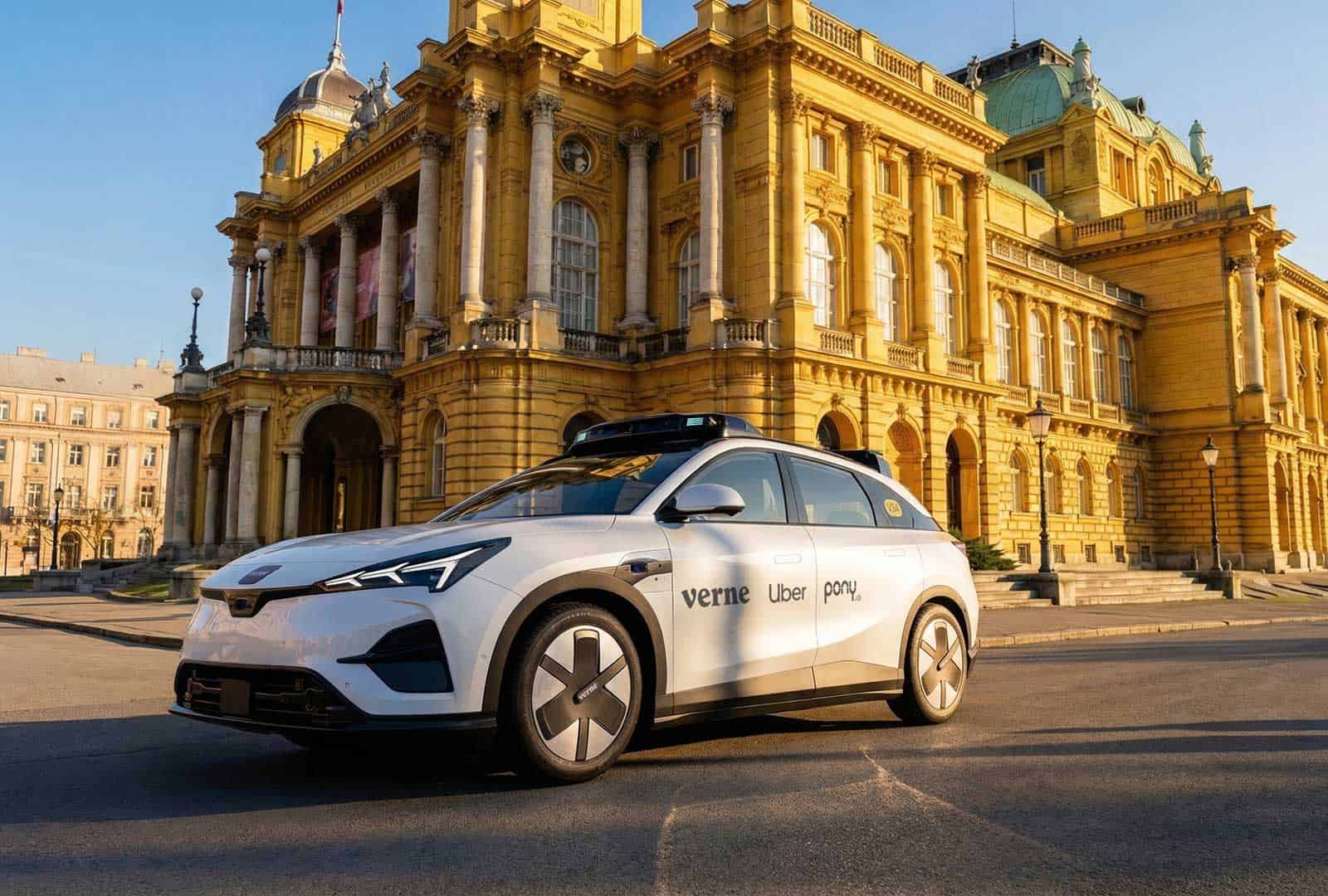
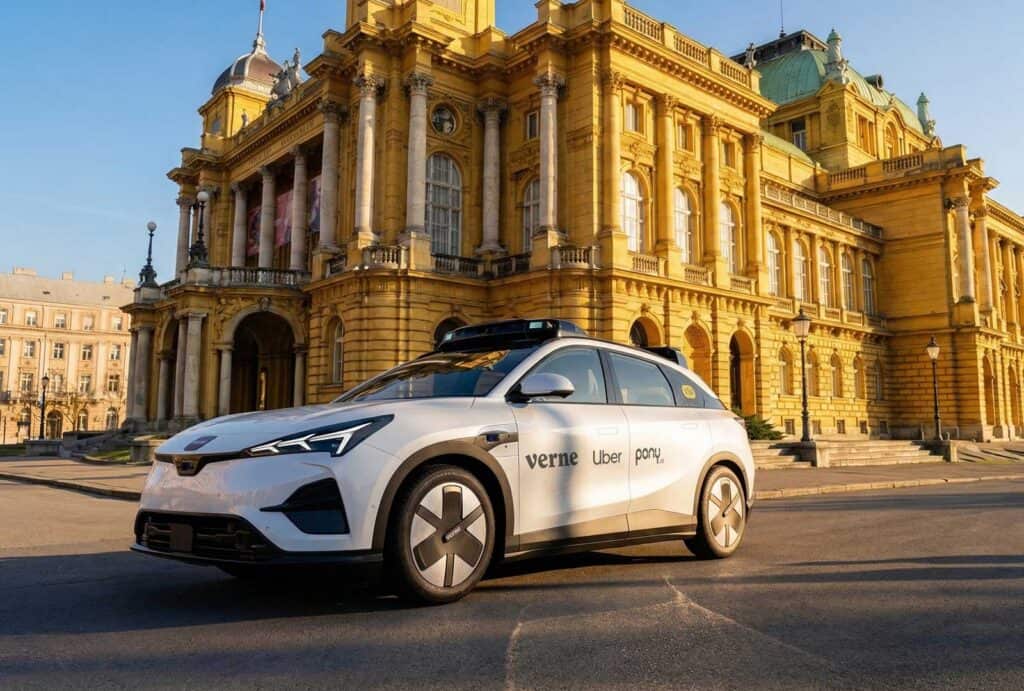
Verne, Uber, Pony AI Robotaxi | Source: Uber
New day, new partners and the same old story. Once again, the headline got ahead of the story and buried the lead.
The headline reads: Verne, Pony AI, and Uber Partner to Launch Europe’s First Commercial Robotaxi Service.
But when you put on your inspector hat and dig past the press release, what you actually find is a company racing against an EU funding deadline, a timeline that has slipped repeatedly, and a deal structure that raises more questions than the announcement answers.
To understand why this announcement happened when it did, you have to go back to where it all started. In 2021, Mate Rimac stood at his campus in Zagreb alongside EU President Ursula von der Leyen and made a bold promise; a fleet of fully autonomous Level 5 robotaxis, no steering wheel, no pedals, roaming the streets of Zagreb by 2024.
On the strength of that pitch, the company, then called Project 3 Mobility, secured €179.5 million in grants from the EU’s National Recovery and Resilience Plan. A central condition of that taxpayer money was that the autonomous driving system would be a homegrown European invention. The Croatian government even doubled down, labeling it a matter of strategic national interest.
2023 came and went, 2024 arrived with no infrastructure in sight, no bespoke vehicles on the road, then on February 13, 2024 Project 3 Mobility announced they were developing a new mobility service leveraging Mobileye Drive and a unique electric vehicle platform. The very thing that secured the EU funds in the first place for the company, was no longer homegrown.
Then on June 26, 2024 Project 3 Mobility was rebranded Verne and the launch event did not go off without a hitch, instead there was a significant hiccup. The car didn’t move, it froze and did not come out on stage. Perhaps it had stage fright?
Which brings us to March 31, 2026, the EU funding deadline. On March 25th Croatian media outlet Dnevnik HR reported; “that a major contract amendment was underway and that an extension of implementation was being proposed“ for the Verne project.
That report came exactly one day before the official Uber press release on March 26th announcing the partnership.
The partnership announcement and the deadline extension request arrived all within 24 hours. Verne has since filed for an extension targeting August 31, 2026 to justify the EU funds already spent.
As of 2024, €89 million of the €179.5 million has been paid out with no commercial service to show for it. If that figure still holds, roughly €90 million in public funds remains available for Verne. We suspect that the funding deadline in addition to the possible claw-back is the forcing function behind this joint-announcement with Uber and Pony AI.
Now look at the deal structure with that context in mind. The release states each company’s role as follows:
Pony AI to provide the autonomous driving system
Uber to provide the platform
Verne to act as fleet owner and service operator
Why are these roles important? The way they are structured, it could potentially meet the terms of the agreement of which we highlighted a key section below:
The main objective of the urban mobility project is the provision of autonomous mobility services, including the development of an innovative fully autonomous level 5 electric vehicle (covered by the present R&D measure) and a new urban public transport ecosystem. The project will create a new mobility service in the wider Zagreb area (and potentially in other EU regions and cities in the future) based on the concept of “Mobility as a Service” (MaaS). This concept enables users to plan their trips combining multiple modes of transport while using a single mobility service platform.
In theory, with the Uber and Pony AI partnership in hand, Verne will have met the goal of creating a new mobility service. But, there is a lot more than just this language in the 48 page grant EU document.
Even if this is clear, why would Uber potentially want the risk? Could Uber have potentially made the case to the EU that they are saving the project and are going to create new jobs in the Zagreb region by investing? Again, unsure, just more questions then answers.
Which brings us to the car. Where is the Verne two-passenger bespoke robotaxi? It was not shown as the official vehicle image, nor was it mentioned in the press release. The vehicle that was mentioned and featured in the press release is an Arcfox Alpha T5, built by Beijing Automotive Group, a Chinese state-owned enterprise.
Furthermore, there is no mention of Mobileye anywhere in the release, the company that was supposed to power Verne’s bespoke two-passenger vehicle.
Then there is the issue of national pride. Will EU public funds potentially be used to purchase Chinese vehicles? If not, who is going to fund the purchase of the Arcfox Alpha T5 fleet, given that the release states Verne will act as fleet owner and service operator? Again, more questions.
But after all, we are getting used to asking lots of questions as Uber continues to keep the printing press hot, fragmenting the autonomous vehicle market with announcement after announcement.
Is this a marriage of strategic convenience or is a bigger strategy at play? That is our last question for today.
Our Take: We are watching to see if the EU grants Verne an extension. No extension, more questions and perhaps even a claw-back?
Piquing Our Interest
Waymo: 500k Rides a Week and Counting This week, Waymo announced they are now conducting over 500,000 fully autonomous rides per week.
Waymo Eyes British Columbia Expansion Waymo is lobbying British Columbia officials as part of an effort to change provincial law to allow for the commercial operation of fully autonomous robotaxis.
Utah Lawmakers Approve Autonomous Vehicle Framework, Awaiting Governor’s Signature Utah lawmakers have approved a legal framework for autonomous vehicles, as the state looks to attract AV companies.
Zoox Expands Service in San Francisco, with Austin and Miami Up Next Zoox is preparing to deploy their purpose-built robotaxi in Austin and Miami while expanding the service area in San Francisco and adding new destinations in Las Vegas.
The Great LiDAR vs Vision Debate Continues Nuro co-founder and Co-CEO Jiajun Zhu penned a blog post on his thoughts on the LiDAR vs. vision debate, while detailing the approach Nuro has taken in building its autonomous driving system.
Nissan Is Betting on Autonomous Driving Nissan doesn’t want to be a contract manufacturer for robotaxis, instead the company wants to be a partner and service provider for autonomous driving companies, according to CEO Ivan Espinosa.
GM Begins Public Road Testing of Its Next-Generation Autonomous Driving System GM has started testing its next-generation autonomous driving technology on limited-access highways in California and Michigan with more than 200 vehicles.
General Dynamics, Epirus, and Kodiak AI Unveil Autonomous Counter-Drone Truck Epirus, GDLS, and Kodiak AI have unveiled a fully autonomous truck that uses high-power microwave technology to neutralize drone swarms without a soldier behind the wheel.
Deploying Autonomous Underwater Vehicles Through Submarine Torpedo Tubes L3Harris has been awarded a Defense Innovation Unit (DIU) contract to develop a Torpedo Tube Launch and Recovery system that deploys and retrieves autonomous underwater vehicles through submarine torpedo tubes.
DeepRoute.ai Is Considering a Hong Kong IPO DeepRoute.ai, a Chinese autonomous driving company backed by Alibaba is considering a Hong Kong IPO to raise several hundred million dollars as it targets one million vehicles equipped with its autonomous driving platform by year end.
BYD’s God’s Eye Is Not Living Up to The Hype BYD’s God’s Eye autonomous driving feature, now standard across its entire lineup, is generating widespread complaints in China over steering malfunctions, unintended acceleration, and navigational failures.
WeRide’s Robotaxi Fleet in China Surpasses 800 WeRide’s robotaxi fleet in China, including both commercial and testing vehicles, has surpassed 800.
Pony.ai’s Robotaxi Fleet Grows to 1,446 With a growing fleet of robotaxis, Pony AI is now targeting deploying 3,000 robotaxis in more than 20 cities by year end.
📰 Follow @RoadToAutonomy on X for our latest thoughts and insights on the autonomy economy.
Trending on X
50% of Lemonade Tesla FSD Customers Use FSD 90–100% of the Time
Our data shows that 50% of @Tesla FSD + @Lemonade_Inc users let it drive autonomously 90-100% of the time.
50% of Tesla FSD Lemonade insurance customers are using FSD 90–100% of the time. This data validates what we have been discussing for over a year on Autonomy Markets. Once you learn to trust FSD, you use it almost exclusively. You are now a supervisor, not a driver.
Our take: What the Lemonade data shows us today is only going to accelerate. As more consumers opt to use FSD Supervised almost exclusively, traditional OEMs will be forced to introduce a comparable solution that actually works. The days of highway-only and over restrictive ODDs are over. Tesla changed the game.
From Segment Anything (Virtual AI) to Autonomous Trucks (Physical AI)
Tete Xiao, VP of Engineering and AI, Bot Auto joined Grayson Brulte on The Road to Autonomy to discuss the fundamental shift from virtual AI to the physical AI required for commercial autonomous trucking.
Tesla Optimus Delayed as China Holds the Magnets
This week on Autonomy Signals, Grayson Brulte and Rob Grant discuss Tesla Optimus delays driven by China’s rare earth export controls, the EU’s push to slow AI regulation and what it means for autonomous vehicles, and Waymo’s potential expansion into Canada.
We Rode With Uber’s AV Partners in Dallas, Took Several Waymo Rides and Uncovered Two Waymo Depots
This week on Autonomy Markets, Grayson Brulte and Walter Piecyk headed to Dallas to attend Forward Fort Worth. While in town, they rode in several Waymos and in Uber’s autonomous vehicle partners Avride and May Mobility, and discovered two Waymo depots in Dallas.
Subscribe — Free, Every Sunday
Join institutional investors and industry leaders who receive our exclusive market intelligence and analysis every Sunday, complementary.
No spam. Unsubscribe anytime.
{% if featuredImage and featuredImage != "" %}
{% endif %}
{% if excerpt %}