


How the Permian Basin is Accelerating Kodiak’s Commercialization Plans
Executive Summary
In this episode of The Road to Autonomy podcast, Pete Bigelow, formerly a journalist and now part of the Kodiak communications team, joined Grayson Brulte to discuss the reality of autonomous operations in West Texas.
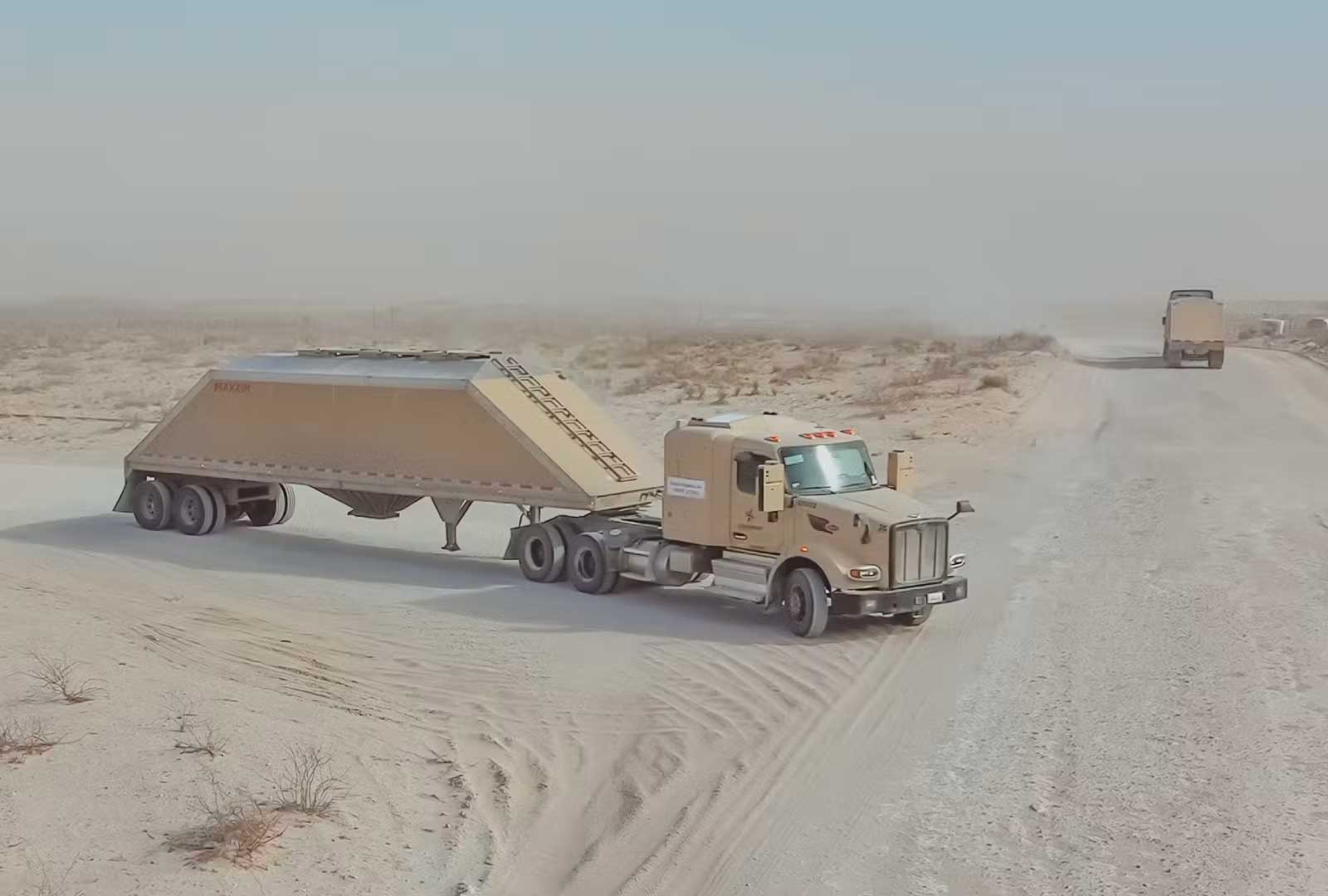
Pete shares firsthand insights from the Permian Basin, describing the “unforgiving environment” of potholes, dust storms, and flash floods that Kodiak trucks navigate daily while hauling frac sand for Atlas Energy Solutions. They discuss how these off-road industrial applications are hardening the technology for over-the-road driverless deployments, which Kodiak projects to begin in the second half of 2026.
Key The Road to Autonomy Episode Questions Answered
What specific challenges do Kodiak trucks face in the Permian Basin?
Kodiak trucks operate in an “unforgiving environment” characterized by blowing sand, dust storms, and flash floods that can render roads inoperable. The private roads contain massive potholes, sometimes several feet deep, requiring the trucks to handle top-heavy double trailers with extreme delicacy.
How does Atlas Energy Solutions utilize Kodiak’s technology?
Atlas Energy Solutions owns the physical trucks while Kodiak provides the technology and operations support. These driverless trucks (with no human in the cab) are integrated into Atlas’s daily operations, hauling frac sand to various wellheads and silos across the Permian Basin.
When does Kodiak expect to launch driverless long-haul operations?
Kodiak expects to begin driverless long-haul operations on highways in the second half of 2026. The company views the Permian Basin operations as a “sandbox” that accelerates their readiness for this milestone by stress-testing both the technology and the operational model.
Key The Road to Autonomy Topics & Timestamps
[00:00] Permian Pete
Grayson Brulte welcomes Pete Bigelow back to the show, highlighting his recent career transition from an automotive journalist to a member of the communications team at Kodiak Robotics. Pete jokingly clarifies that the “Bigelow Battles” of his journalism days are over as he settles into his new corporate role.
[02:47] First Impressions of the Permian Basin
Pete recounts his first trip to the Permian Basin, noting that while he expected the vast, empty landscapes depicted in the show Landman, he actually found a “beehive of industrial activity”. He describes seeing Kodiak driverless trucks actively integrated into this environment, from loading fracking sand at silos to hauling double trailers toward wellheads.
[05:22] The Operating Environment
The conversation turns to the “unforgiving” nature of the roads in West Texas, which range from dirt and gravel to paved roads riddled with potholes several feet deep . Pete explains that the trucks must handle top-heavy loads of fracking sand delicately while contending with environmental hazards like blowing sand, dust storms, and flash floods.
[11:14] The Permian Sandbox
Pete explains why CEO Don Burnette refers to the Permian as a “literal and figurative sandbox” for the company. The region allows Kodiak to stress-test their hardware against harsh weather and refine operational details, such as launch checklists and sensor cleaning, while gathering critical data on interacting with oncoming traffic on two-way roads.
[15:00] The Atlas Energy Solutions Partnership
Pete details the business structure where Atlas Energy Solutions owns the physical trucks, and Kodiak provides the autonomous driver technology and operations support. These driverless trucks are fully integrated into Atlas’s existing fleet and daily logistics, running routes to various silos and job sites.
[19:00] Kodiak NASCAR
Grayson and Pete discuss the modularity of Kodiak’s hardware, specifically the sensor pods located at the side-view mirror mounts. Pete confirms the maintenance process is “NASCAR-like,” allowing technicians to quickly swap out sensor pods on the side of the road to minimize downtime, ensuring trucks get back to work as fast as possible.
[26:00] Reindustrialization
Pete views the “reindustrialization of America” as a major tailwind for Kodiak, citing the company’s dual-use technology strategy which includes a recent $30 million contract with the U.S. Army. He also highlights regulatory progress, specifically the FMCSA waiver allowing autonomous trucks to use flashing beacons instead of placing physical warning triangles during roadside stops.
[36:00] 2026 Autonomy Markets Outlook
Looking toward the future, Pete confirms Kodiak’s plan to launch driverless operations on highways in the second half of 2026. He notes that the industry is moving out of the “early innings,” with clear market leaders emerging in both the trucking and robotaxi sectors as autonomy transitions from a science project to a scalable business.
Full Episode Transcript
Grayson Brulte: Today’s Road to Autonomy. We got a special guest, Permian Pete, I’m doing my best. Yosemite Sam impersonation. See I got the hat because I love Ask. And we got Permian Pete here. The famous host of the Bigelow Battle, who now has joined Kodiak’s, no more Bigelow battles. Pete went out and he pulled out his best Billy Bob Thornton and headed to the Permian Basin. Pete, did you stop at the bar? Did you have a beer? How is life in the Permian?
Pete Bigelow: When you say stop at the bar, there’s probably one bar to stop at Grayson. It’s not like metaphorically that, you know, the bar in quotation marks. It is the, the one bar that is out there in Kermit, Texas. Um, you know, I would say I, I probably did have a pop after work, uh, once we were all done and back at the hotel. Uh. On my maiden trip to the, to the Permian Basin in the last, uh, last week or so.
Grayson Brulte: One pop after work. You’re on corporate rules. Now. I, I need free flowing, Pete back.
Pete Bigelow: Well, I mean, I guess we should probably note for the audience, Grayson, that, uh, since my last appearance here, uh, I’ve made a big, a big career change, as you mentioned. Uh, you know, I’ve. I am, uh, on the Kodiak comms team now. Uh, so no, no Bigelow battles, that’s for sure that that would probably be a curve ball if we, uh, jumped back in time to, uh, January of 25, back at CES, uh, when that, when that battle perhaps occurred. And I was a, you know, innocent bystander to it, really. I’m not sure how my name got attached to it, but, uh, the, the unexpected leg of that, uh, self-driving truck stool was that. I am now working for a self-driving truck company and, and Sterling Anderson is, uh, gone to the more traditional auto industry. Who would’ve, would’ve seen those two things happening?
Grayson Brulte: It’s musical chairs. Then lo and behold, you go and do that and then your competitor, Aurora, they go to the Permian Basin were, they were trying to do their best impersonation to Permian, Pete.
Pete Bigelow: you know, I probably cannot speak to our competitors’, uh, motives, but, but nice to have them join us down in the Permian. It’s a, uh, challenging environment as I’m sure they, uh, they will soon find out, and, uh, I can certainly tell you more about that from a Kodiak perspective over the course of the next several minutes or or hour here on the podcast.
Grayson Brulte: overall thoughts, what did you think of the Permian first time there? Was it like the TV show, landman, or what was it like,
Pete Bigelow: Yeah. You know, Grayson, I think that I, I expected kind of landman, right? Like that’s what I was expecting, uh, going down, uh, big fan of the book, Friday Night Lights growing up. Uh, big fan, uh, a bit of landman, uh, these days more recently. So I kind of expected this vast expanse. Punctuated by the occasional pump jack on, on the landscape. You look closer at it though, uh, and you see this beehive of industrial activity, right? This is the heart of America’s oil and gas industry. And, and, uh, like lo and behold, you look out and there are Kodiak driverless trucks, uh, doing, doing God’s work out there on the, in the Permian and, uh. You know, I, that was, that was something, ’cause like you look around and there’s one at the, you know, launch zone, going through its final checks before it gets launched. There’s one in the, uh, Atlas sand silo, uh, getting its load of, uh, frack sand put in. And then, you know, you look down the road and there’s one, one hauling doubles, turning the corner, going off to a wellhead. So like, uh, it, it is interesting out there, uh, that, that industrial aspect, and it’s busy. I’ll, I’ll tell you, it’s. It’s, uh, there’s a lot going on in the Permian would be the 10,000 foot view here.
Grayson Brulte: Yeah. Then you had the announcement yesterday where Eric Schmidt with a Texas Land Corporation, they’re gonna start putting data centers out there. But you said something really interesting. Going to the wellhead, going to different sites. So these trucks then, if I’m hearing you right, they’re, they’re going to different job sites about the Permian. These are, these are not fixed routes, going to the same ones every time. They’re going to different ones.
Pete Bigelow: I mean, we have routes that we’re running. And, uh, you know, trucks running on them. So it’s not, it’s not a single fixed route, but, uh, but there’s, let’s just say there’s lots of activity down there. Uh, and we’re, we’re going to different silos, different places, uh, on behalf of our customer, Atlas Energy Solutions.
Grayson Brulte: You and I, I’m gonna put the old automotive noose hat on you and I had breakfast. We talked about, uh, breakfast when we were in Detroit. Weather conditions, road conditions of who’s gonna deploy where, when you and I were trying to figure out robotaxis, so how are these trucks, uh, deployed? Are they on dirt roads, gravel roads, paved roads? What’s the, the, if you wanna call it the operating environment, like, ’cause I studied the weather there. It gets windy, it gets dusty, and it gets inclement at times.
Pete Bigelow: Totally. And I would say it’s hard to describe those roads. ’cause some of them are dirt roads, some of them are gravel, some of them are like the, like I was thinking in my mind like the old Oregon trail, like where this is like barely a road. Um, I would say overall these are. Unforgiving environments. Um, Grayson you may remember from, from our breakfast in Michigan, like, you know, everybody in Michigan thinks that the roads are bad here. So much so that it was probably like the primary campaign issue. And our last two, uh, gubernatorial elections, uh, Gretchen Witmer’s slogan is fixed the damn roads. Well, I can tell you that everything is bigger in Texas, as they say, including the potholes. And man, like I’m talking like potholes of several feet, uh, distance, several feet deep. And when you are, you know, top heavy hauling frack sand in a double trailer, you need to handle those, those types of roads delicately. Like I’m really, and I’m not just saying this right, like, uh, I’m impressed with, uh, what we can handle in the Permian, like. You need to be on your game and, and we are developing those chops and, and showcasing what physical AI looks like in the real unforgiving world on an everyday basis here.
Grayson Brulte: What causes those potholes because if you look at Detroit or you look at the Northeast, they’re caused by the, the, the salt and the plows are, are digging in and over time, you know, they get bigger and bigger and bigger over time. But in the Permian, is it just because the amount of truck traffic, what’s causing these? If you want call, use the term ginormous potholes to emerge.
Pete Bigelow: Yeah, I mean I think there’s probably a couple things. One is, as you just said, there’s a ton of truck traffic on these roads, uh, and I think that’s. You know, you probably would have to ask, uh, either someone who manages these private roads or, um, someone from like Texas DOT, who manages the public road aspect, uh, specifics. But I do think it, you know, most likely reason from a, you know, layman’s perspective here is probably there’s an intense amount of truck traffic. Uh, the weather conditions as you mentioned are, are also tough. There’s, there’s blowing sands all over the place. All the time. Um, you know, there’s dust storms, there are flash floods, uh, that probably render these roads inoperable at, at various times. So there’s a lot that these roads endure. Like that’s the other aspect that I kind of maybe should go back on a little bit is like I was expecting that like big openness that you see in Landman, but. There’s parts of the Permian that are, that are the deserts, like this is the literal desert. Like you turn this way or that way. And it’s like Aladdin and there’s these big, uh, sand dunes. Uh, you know, I have expected to see a pyramid around some of the corners. Like it, it is out there. It is not just, um, well I guess the oil and gas is drilled in that, in the desert, but it is, is also a desert environment in places.
Grayson Brulte: it’s a harsh environment. There’s, there’s no way to say it. Otherwise, it is a harsh environment, but it’s also a very profitable environment and it is environment that needs automation. If you look at public filings, for example, Chevron, and they’re investing billions of dollars in the Permian Basin with a big focus on automation, putting on your Bigelow reporter hat ’cause you still guide in your jeans once reporter, always reporter. Did you notice of any of the other oil and gas companies look looking to embrace automation, perhaps over a beer. You had a conversation with an engineer at an oil and gas company. Any, any signs of, of emerging automation that you were able to pick up on when you were down there?
Pete Bigelow: you know, I would say this, and I don’t wanna speak too much for our partner Atlas out there. They’d probably be a great, uh, guest to have on for you sometime. Uh, but like they’ve said publicly, that that automation is a big part of their strategy, uh, in the Permian and elsewhere, like in many different ways, right? It’s not just driverless trucks, that’s our particular, um. Aspect that we bring to the table for Atlas, but, uh, they, they are automating every process that they can, and I think that’s a big part of their strategy. As you mentioned, obviously others in the oil and gas industry looking to go that direction now. So, um, what I put on my, uh, you know, reporter hat or 30,000 foot view hat, I think that fits into, uh, what we see across America right now. And it’s, uh, this broader strategy to infuse. Robotics and automation into, into many different industries, right? Like I think that’s a matter of national competitiveness right now. And, uh, what’s going on in, in the Permian with oil and gases is one flavor of that.
Grayson Brulte: And I wanna highlight, Atlas has one of the coolest things I’ve ever seen. I haven’t seen it in person, but I’ve seen it in magazines, the 42 Mile. Dune Express, a moving fracking sand fully automated on a giant conveyor belt.
Pete Bigelow: Yes,
Grayson Brulte: Did you see it? Did you see it?
Pete Bigelow: Yes, I saw the conveyor belt. It, it almost from the distance looks like you’re going up to an amusement park and you see like the rollercoaster off in the distance. Like this is the industrial version of that. Uh, that’s kind of what it looked like, uh, in action. It’s really cool. You see it at night from a distance too, like even further, like, you know, you’re out there and it, it’s, it’s lit up a little bit. So I did see the conveyor belt and uh, man, what a cool piece of machinery. Like, again, put my reporter hat back on, like, I just want to know more. I wanna know more about the conveyor belts, how they, how they engineered that and, uh, what makes it work on a daily basis. But it’s, it’s, it’s impressive. Um, you know. Great. So we need to have you out to the Permian to see that firsthand as well. I think, I think you and others would enjoy seeing that for sure. It’s, uh, you know, one more way, like there’s, there’s work getting done out there, uh, and Atlas has found numerous ways to, to get tough jobs done and. As we like to say at Kodiak, uh, that’s what we do with our, um, AI powered autonomous drivers. Do, do the tough jobs out there and, uh, and obviously the Permian is an ideal location for, for finding tough jobs.
Grayson Brulte: Yes. And, and as you know, and this is well documented, multiple public data sources, the, the job turnover in the Permian is higher than than most industries. Just watch Landman, you, you can figure it out. Why, from a, a, a testing, deployment, commercialization standpoint, do you view the Permian as a really great learning environment where you’re operating in hostile weather? So when Kodiak eventually transitions to. More over the road operation. She’ll take all these learnings from the Permian with you.
Pete Bigelow: No question, Grayson. I think that you’re, you’re spot on with that. And you may have even heard our CEO Don Burnette say that the, uh, the Permian is a literal and figurative sandbox, uh, for us to, to learn in. Uh, and that is. That is across, uh, technology, across our, our safety case and across our product too. Like, I think that’s, you know, I’ve seen the, the technology working before. I’ve seen the, the safety case and got a better understanding of our safety case, uh, in my, in my three months now at, at Kodiak. Uh, but what I really got out of the visit to the Permian that, um, you know, I hadn’t gleaned that. I think you probably need a firsthand visit to truly understand. Is the operation, like, uh, and that’s what we’re co-developing with Atlas too. Like where do these trucks launch from? Where do they land at? Um, you know, who runs the checklists before the truck goes out on the road to make sure that that everything is, is ready? Um, you know, what’s the, what is the fleet management like, um, you know, who goes and cleans a sensor? How does that notification get done? Like. Working with a customer to ensure that their needs are met is, is not to be underestimated. And, uh, Atlas has a great, great partner for us in the Permian that, that is allowing us to get those learnings and like we’re going to bring that into the, the long haul, um, operation as well. Like how, how does this product actually work with a customer? Um, that those are invaluable learnings that we’re getting in the Permian now. And we’re also getting learnings on the safety and technology side too. Like I don’t wanna discount that either. Like one example for you, like obviously if you’re out testing on highways, doing the long haul stuff, like you’ll occasionally slash rarely see a wrong way driver. Right? Um, so it’s a rare scenario but that you damn well better be sure you can handle that when you see that. So, uh, the unstructured roads that we’re running in the Permian are two-way roads. So we’re gathering a ton of data on, on what it looks like to have oncoming traffic in, you know, on the same swath of pavement. Uh, so that, that’s like one concrete example of how, uh, you know, how the Permian is also informing our, our technology to, to prepare us for long haul operations, which we. Expect to begin in the second half of 2026. I almost said this year, but I was getting ahead of myself. We’re still in 2025. Uh, we’ve got just a little bit, uh, of ways to go, but, uh, but yeah, I, I, I think there’s just a ton of positive things that come out of the Permian that accelerate our readiness on the, on the long haul side of things. Those are, um, not just parallel developments, but, but one very much feeding the other as well.
Grayson Brulte: What have you learned from a technical standpoint? Because if you look at a route that it was in your Q3 filing, you’re going from DFW to Atlanta, you’re going through. If you want to call, uh, thunderstorm alley, ’cause you get a lot of thunderstorms on that route. And obviously the Permian, you get flash flooding, you get dust, you get rocks, you get pebbles. All sorts of, you want to call fun things that are flying all, all over the place. Have, has the team, since you’re based on sensor bots, have you looked into two techniques to harden the sensor pods just based on the environment and then potentially taking that to the over the road when you start going into more Inc. Climate weather.
Pete Bigelow: You know, I would say that, um. No question. No question, right? Like we’ve talked about how we’ve experienced numerous dust storms in the Permian, that’s just sort of a way of life, or these, you know, big storms that produce flash floods. So I think that, um, it, it has not only like given us an opportunity to see how our hardware performs in those environments, but uh, again, back to the operation. Okay. What do you do when, when a flash flood occurs? Who, who is responsible for sensing that? How does that get communicated throughout the fleet? Uh, so yes, it has, it has stress test our technology, but it has also stress test our product as well. Uh, and I think that’s, uh, again, back to like, it’s so important to learn these things and we feel like we’re going to be, um, that much more ready to, to hit the pavement running, uh, no pun intended, as we start driverless, uh, long haul operations here in the second half of 26.
Grayson Brulte: Which to me, you could use the term an accelerant and the business model and the Permian. So as of as of your Q3 SEC filing there, there is 10 trucks currently off. Operating and those trucks are owned by Atlas. Is Atlas operating those trucks? Are you operating them together? What does that look like from an operational standpoint? Since Atlas owns the physical assets.
Pete Bigelow: That’s right. Um, Atlas does own the physical asset, which I think is a differentiation in our business model, right? Like we don’t own the truck, we provide the tech. And operations. So, uh, we are, you know, our command center in DFW area is, is watching these trucks and we have our assisted autonomy capabilities that, uh, that can also operate these trucks. But right now Atlas is the owner and operator of these trucks.
Grayson Brulte: So the, the, the trucks then, just to put it in layman’s terms, are integrated into atlas’s day-to-day operations.
Pete Bigelow: Yes, they have a, they have a large fleet that is obviously, uh, bigger than our, uh, you know, current fleet with them or, or their fleet that contains cognac’s technology. And that will, that will continue to increase over time, right? We have a hundred truck binding order with Atlas that we continue to fulfill. Uh, so, so our presence as part of their fleet continues to, continues to grow.
Grayson Brulte: From a day-to-day operational standpoint, obviously the, the Permian Basin is vast. If you read Atlas Energy’s filings, they own hundreds of acres. They have multiple sites with within their property. Is it Atlas making the decision? Okay, Kodiak truck’s gonna go to Site A. It’s gonna go to site B. Is that decision being made by Atlas of where these trucks are gonna be deployed into the overall operational plan?
Pete Bigelow: You know, we do, we do test them first to make sure that those routes are okay for autonomy, obviously. And uh, and then kind of back to what I was saying about, you know, putting a product in customer’s hands, these are things that we’re working on on an ongoing basis together with Atlas. Um, so they are operating them on the driverless side. Uh, but we do have, we have a whole maintenance fleet. Uh, we have a maintenance facility in Midlands, uh, where, where when these trucks need work or the, you know, the autonomy hardware needs work, they can, they can be, uh, you know, quickly taken care of. That was one of the, um, one of the aspects of something we learned working with a customer was just how. How quickly trucks need to, you know, get the maintenance done that’s required and get them back out on the road. Right. Downtime is, is a killer. So we’ve designed our, our sensor pod hardware to be easily, uh, swapped in and out on the, you know. Ostensibly on the side of the road. So right now we have Kodiak field technicians who would go do something like that. Should, should an event occur. And if something, if a truck, uh, needs more extensive maintenance, we can bring it to the facility in Midland.
Grayson Brulte: I. Don Jordan and Dan host to meet your DFW facility years ago. And Don says You could do a pull up on this. And I said to Don, bullshit, I don’t wanna break your truck. And lo and behold, I was able to do a pull up on it and I was amazed at how strong they were. And then Don was showing me the, uh, I don’t remember the exact, but I’ll just call it a few connectors. And how simple, basically it’s almost NASCAR like, is that still happening?
Pete Bigelow: Yes. I mean, to the extent that it needs to happen, that is exactly what’s happening. And we’re, um, you know, really pleased with how that aspect has, has helped customer. Right. Like you’re right. And maybe we should describe for listeners. What exactly we’re talking about. But, uh, Kodiak has its, uh, camera lidar radar in a, in a sensor pod that attaches where a class eight truck’s side view mirror would typically attach. And we have the side view mirrors are also part of that assembly, but, uh, that is where the bulk of our sensors are housed. And, uh, you know, if a sensor is an operative for whatever reason, if it’s. If it’s dusty, um, if it’s dusty, just clean it off. But, um, if they need to be swapped out, you can easily take off this, this mirror-like assembly, uh, and integrate a new one back on with, with minimal effort. I don’t know if we’ve said what, what, how, how much or how little time that takes. Maybe that’d be an interesting thing for, for us to consider in the year ahead. But you’re right, it is, it’s nascar like where, uh, you know, we hope to get a field technician out there to. You know, uninstall a bad one and put the new one back on in, in a, again, a minimal amount of time to, uh, you know, minimize the, the downtime for our customers.
Grayson Brulte: Years ago, you and I had a, we did a podcast on this. We had a lot of private conversations. We did a podcast on, it was Toyota and how they have parts at certain strategic locations and they’re able to pull those parts very quickly. And then you and I went at great length about the, in efficiencies that unlocks. As we look to this, the second half of 2026, is it fair for me to start thinking, okay, let’s just say you have a facility in Atlanta, you have the the DFW facility, you have one say, Oklahoma City. You have one in San Antonio. Is it fair to start thinking, okay, there’ll be sensor pods stored at those locations in case something’s needed, and then you could put the, we call Kodiak NASCAR to work. Is that a fair way to start thinking about this?
Pete Bigelow: Yeah, I mean, absolutely. I think, you know, it is public record. We’ve. Out facilities in, uh, Dallas Fort Worth area and Lancaster, uh, specifically, uh, Atlanta, and we’re running routes up to Oklahoma City. So, uh, yes, I think that’s, that we would, we have the, you know, parts needed for maintenance at those facilities. Absolutely.
Grayson Brulte: And how should we start to think about it from, ’cause there’s all the, the hours of service everybody’s familiar with, and obviously when, when you go driverless and the regulation changes, that’s all gonna change. But how do we think about it from a parts standpoint is, has the company made any data public on how long a sensor pod lasts before it has to be swapped out depending on the environment. Any, any insights that we can look into that.
Pete Bigelow: Probably nothing I could share with you as to, you know, our expected, uh, lifetimes. But, but again, like, you know, just kind of going back to what we previously said, like we have stress test and, and hardened our hardware, uh, by working in the Permian. So, uh, that is definitely something we’re conscientious of. And. Uh, you know, hoping to, to minimize downtime, uh, if any is needed at all.
Grayson Brulte: Do you feel that what you saw. In the Permian from the operational standpoint, the partnership standpoint, the weather standpoint could be transitioning into other similar areas. So you have the North Dakota oil fields, you have the Canadian oil sands. You have, well, you and I did a podcast on this about Caterpillar years ago, Western Australia, and then obviously we had the big announcement the other day with Vail and Caterpillar going into Brazil. Do you see those potential en environments as growth markets for autonomous trucks?
Pete Bigelow: Broadly speaking. Absolutely right. I think that’s what we’re proving every day in the Permian is that, uh, many of these, uh, environments are. Are ideally suited for autonomy, right? Uh, I think we have to look at, um, you know, is there the right environment? Is there the right partner? Is there the right business case ultimately, right? Like we think there’s a $65 billion total addressable market in what we call these industrial applications, which I think, uh, summarizes what the type of, type of deployments that you’re talking about. But, um. I guess I would just be careful in saying like, just because the, that environment exists, like we wanna make sure that the business case is there behind it, uh, before just going, deploying anywhere. So I, that, that’s what we evaluate as, as we look at opportunities to, to perhaps replicate this elsewhere.
Grayson Brulte: I like that and I said this to to Don and he did a podcast on it where I compare Kodiak to ABC capital cities from a capital efficiency. Standpoint. I like the fact that the company has, if you wanna call it off-road business, which is not traditional trucking in the on-road business. Do you see those two businesses continuing to compliment each other, especially when you start to begin on highway? Or if you wanna use the term on-road operations in the second half of 2026.
Pete Bigelow: Absolutely. I think that, uh. You know, again, there’s a 65 billion TAM in industrial applications. That’s, uh, you know, the tam on the long haul side is, is certainly greater, but, uh, I, I certainly see the, the op opportunity on the industrial side as well. And I would tell you Grayson like that too is something that back to like, you know, why did I, you know, leave my job as a journalist and go. Go inside somewhere like, and why Kodiak? Like the fact that they, they had this industrial business that we have this defense business, that we have this long haul business where we’re already working with like Warner Enterprises, JB Hunt, and others, like the fact that we play all three of those verticals. I thought, I thought on the outside, like I was like, what Kodiak is doing there is really smart. So that’s one of those reasons why I, I wanted to join Kodiak in particular. You know, I, I thought that this diversification of your business is a very smart strategic play, and, and now I’m seeing that, uh, firsthand.
Grayson Brulte: It rolled your sleeves up. You got dirty and, and you went to the Permian. It was, I was reading a a piece today from Andreesen Horowitz, and this has been well documented for several outlets probably going on. Remember the last 12 months now, the Reindustrialization. Of America is you view that as a tailwind to the Kodiak business model because it’s not just the venture side now. Now it’s the PE side and JP Morgan has that multi-trillion dollar fund that Todd comes from the Berkshires running. It just seems like there’s giant, if you wanna call it financial momentum in the financial markets are saying, okay, we, we want America to build again. Do you view that as a catalyst for Kodiak?
Pete Bigelow: short answer, yes. Long, uh, unequivocally longer answer. I went to the re industrialized conference in Detroit last summer, I think it was July. Uh, it really, it was probably like at, at the beginning of this early innings period that you identified here as, uh, there’s all sorts of tailwinds now for re industrializing in America in a way that we were not before. So I think, uh, I think this re industrialized push is definitely. Uh, helped Kodiak from a, maybe specifically a defense perspective, right? The, the White House is looking for dual use technologies, uh, that, that are being commercialized, um, in, in regular business every day. That can also be applied to defense. Uh, so we have a defense division, uh, that’s participated. You know, we just completed a $30 million contract with the, the US Army, uh, earlier in 2025. I think that, uh, there’s a lot of growth opportunity there. Uh, and then I’d say like also along the lines of industrializing again in America, yes, we’re seeing those, tailwinds from the White House in terms of, of action on the, on the AV front specifically, like, uh, you saw the U-S-D-O-T just a couple of weeks ago, uh, granted waivers to the, the orange triangle problem, right? Um. Which was very real, that, uh, there was federal regulation that a, a truck that’s disabled and pulls to the side of the road, uh, the, um, the driver has to put out either an orange warning triangle or flares or, you know, some sort of hazard identification within 10 minutes of that truck being pulled over. So, uh, in the case of, you know, autonomous trucking, there is no driver to do that. So. Um, really big tailwinds from, uh, F-F-M-C-S-A and U-S-D-O-T to say, uh, you can use a flashing warning beacon that’s, you know, affixed to the cab, uh, in lieu of that as long as you apply for the waiver and our, our grant to that waiver so that, that, that’s a. Definitely a big, big step in the right direction. So I am seeing that that push for automation and innovation and industrialization all kind of converging, uh, and you know, we’re grateful for that support, uh, from the federal level.
Grayson Brulte: I. Resident signed the exec, the AI Executive order, which has done really well. And then Neils leadership of Secretary Duffy at DOT and well-documented, we don’t have to get into specific, specific cases or incidents, but the crackdown on undocumented drivers with 18 wheelers. We saw, unfortunately, horrific incidents there and now JB Hunt actually came out with a report. Who’s one of your partners in saying. There’s gonna be a shortage of drivers. When do you think that we see movement from the federal level to, to backfill that with automation in autonomous trucking? Because it’s a, it’s a Made in America technology that traces its roots back to the US military. With darpa, it’s solving a problem that is widespread and rampant bigger than I think any of us really thought. And oh, by the way, it’s a heck lot safer than the alternative, which was out there before Secretary Duffy started this crackdown.
Pete Bigelow: Grayson, I think as you know, uh, we’re seeing some, some coalescing of support for a, a federal AV bill. That, that may address autonomous vehicles overall and, and trucking in particular right now. And, uh, while, you know, we’ve seen this kind of push happen in previous sessions of Congress over the last six or seven years, I think there’s real hope right now that, that the momentum is legitimate and, and hopefully bipartisan and that, you know, caution that we, you know, the details remain. Um, you know, we, we haven’t read the, you know, line item provisions here just yet, but I think directionally there’s hope that we’re moving in the right direction and that we’ll see action in congress in support of an AV bill next year. Um, and if I can take this in a, in a side direction for, for a moment, and, you know, you mentioned some of the, the terrible incidents that we’ve seen on the road and, and I don’t wanna, you know, comment on, on the immigration issue, but. I will say something else that stood out in the Permian was, you know, you can’t go very far without seeing a roadside memorial. Uh, it’s a dangerous place to operate. Cars, trucks, uh, you know, whatever vehicle you’re operating is. It’s a, I don’t have the figures in front of me, but we, you know, we all know that. Uh, you know, there’s about 5,000 fatalities per year, uh, overall from crashes involving large trucks in America. Uh, Texas itself has, I think, gone like 20 street years having a fatality every day on, on Texas roads somewhere. Uh, and I, I guess again, anecdotally, I’d be willing to bet that like there’s a greater than average. Um, number of those crashes, like in and around the Permian. Like I, it, it just struck me anecdotally that, uh, this is dangerous. This is dangerous driving. Um, in part because like it’s these vast stretches that I, you know, I’ve talking to people at, you know, at various locations. I guess, like, you know, you imagine you’re an oil worker, you just got off shift. From, you know, working two weeks on 15 hours a day, and now you’re driving home across the desert where there’s nothing to see. Like, speaking for myself, like I know, I know just doing, doing 15 minutes down these straight roads for me was enough to kind of be lulled into a, uh, you know, state of complacency a little bit. So I, I only got to get this little, little taste of like, why these roads are dangerous, but, um. Unequivocally, like the safety benefits that automation will bring. Like that was something else that was just apparent in a firsthand visit.
Grayson Brulte: Were there traffic patterns that you noticed in the Permian? Okay, 4:00 AM going to the job site, 2:00 PM going home, that you know, or is it just consistent all day? LA like traffic? What was the traffic patterns like?
Pete Bigelow: I, I can’t say it was LA like traffic, but it wasn’t nothing like these are busy roads. Um. Are they busier at certain times? Another, like, I think our shift change was at like 6:00 PM we had people oncoming and going outta the facility. Um, yeah, so I, you know, I think that there is traffic to contend with. Um, and once you get on the main drag and go to Midland, there’s definitely certain times a day where like you see the stream of headlights all going in one direction. And that probably aligns with, you know, typical. Again, like, I don’t want, I don’t want my like four day experience there to speak, uh, as, as gospel on, on traffic patterns in Western Texas, but like, that’s kind of what I, I saw lots of traffic and, you know, headlights or taillights all lit up against the, the sunset would probably be like five, six o’clock at night in particular.
Grayson Brulte: And I’ve been fortunate enough to spend, uh, quality time in Montana, in Wyoming. These roads go straight as narrow as far as you can see, basically to the horizon line. Is that, is that, is that a similar thing that when I think about this, what you think from, from the Permian roads, that they just go long and straight for long periods of time? Or they, they, they windy, do they have, uh, water canals on the side for the flies? Flooding how, how? Give us some more details on the roads.
Pete Bigelow: Yeah, I’d say like mostly, mostly straight roads. Um, not windy. I would not, it didn’t remind me of, you know, Montana or Wyoming or Colorado necessarily because, ’cause there’s no mountains. Like I always, if I envision what you’re talking about, I kind of see the mountain off in the distance as I’m driving. But, uh, you know, I saw, I saw the pump jacks off in the distance and that was about it in the Permian. It’s, it’s more, I don’t wanna say it’s totally flat. There is some like Rolling Hill aspect to it. Uh, but those roads are mostly straight for long periods of time. Uh, definitely, you know, anywhere off the main highway is, is probably a dirt road. Um, wind, you know, kind of classic Texas tumbleweed going across the road. Again, more desert than I would’ve thought. Um. Reminded me in some ways of, and this is like adjacent to New Mexico, right? Or part of the Permian Basin, I think if I looked at the map actually is in New Mexico. So I think that’s, that’s probably the best comparison. Uh, where, you know, I can remember days like going back years like, all right, I, I’ve moved outta Albuquerque and, and drive South, or, or maybe north up to Durango. Uh, that’s more the environment where it’s, it’s deserty, uh, desert rock. Sand, um, in lot of most cases, gravel road. Uh, and this is just where I’m driving my rental car, right? This is before I get in the truck itself and, and go for a ride on, uh, some of the roads that where we, where we operate, uh, which, you know, again, by the way, like I, I should emphasize if I haven’t yet. We have a driverless operation, like the driverless trucks that we talk about in the Permian do not have a human in the cab. Uh, so this is, this is important. Uh, you know, when we talk about what, what is, what constitute driverless service to us, uh, no driver in the cab is, is what you see here. So that’s what, what our trucks are contending with on a, on a daily basis as they work for Atlas.
Grayson Brulte: And I’m gonna base this off of your, your SEC filings in, in your filing that went along from your IR department. You had no human observer in the vehicle as well. These things are operating total humanless, which is pretty amazing. And you’re the only company in the United States that’s doing that for trucking as of today. Did you get to go for a ride with no, with no, no supervisor, nothing. Did you sit in the back and buckle up and say, Perian, Pete, let’s go.
Pete Bigelow: I, I did not go for a ride with no. So we do have development routes that we do have drivers, you know, testing and preparing for Atlas, right? So I, when I rode in the trucks, those are the, the routes that I did. ’cause our, the trucks that are truly driverless, like right, those are an atlas’s hands. So like me coming to visit, I don’t wanna, like, I don’t wanna mess with their operation, like they’re busy running a business. Um. So the, the rides that I did were on our development routes with, uh, you know, with our safety driver team. And that was, that was eyeopening enough. Man, that was incredible to see, uh, how, you know, again, like I was seeing how, how our trucks handled these potholes firsthand. Um, got to see how our assisted autonomy capabilities work. That’s with our. Remote support team in the Dallas area. Um, that was really eye-opening and interesting. Uh, you know, got to see how we hauled doubles and what that feels like. Um, that was interesting. And, you know, I’m not, I’m not the most experienced guy in, in trucks hauling double trailers. But, uh, you know, as, as we did this on the dev routes, our, our, our drivers were kind of telling me about. The complexities involved in hauling doubles and like you do take these wider turns, right? So on a real practical level, what, what does that look like out here in the Permian? I got, got to experience that firsthand and it’s really, um, you know, again, like, I know I’m coming from a certain vantage point here, but, but impressive to see, you know, how we’re, we’re spooling up this service, how we’re answering customer needs in the real world.
Grayson Brulte: Just, just for the audience, just to, just to clarify for doubles, is that what we’ve, we’ve seen the UPS trucks on the highway where you have trailer. In here, trailer here too. And, and this is not technical, so please don’t send technical notes. Uh, basically a trailer hitch con connecting. And is that a way to, and then you have the Kodiak driver in the front. Is that a way to think about doubles or are they, or they look different than that? How do we, how should we picture that?
Pete Bigelow: No, more or less, I think you’re, you’re spot on. And I’m not enough of a. Uh, you know, a trucking guy to, to know the differences. But I believe what they call that connector between the two is a, is the dolly. Um, so that connects trailer one to trailer two. And uh, the other notes that would be more subtle when I’m, if you’re making a comparison to something like the one you just made, um, like these are frack sand trailers and that is a very specific looking trailer out there that’s almost, uh. A Pentagon type shape. So it’s not a, it’s not a box. It’s more, it’s more specialized. And that, that was interesting. Just, you know, being someone who’s like, has not visited the Permian Basin before, like, you know, you don’t see those, those types of trailers on, uh, on the roads up here in Michigan or, or in Florida, you know, like, but they’re, they’re everywhere. And, and out there it’s just like interesting, like, oh, this is like an ordinary part of the landscape there that as a visitor, I am not used to.
Grayson Brulte: You have been many times on over the road trucks as as a journalist and passenger. How was the experience different from offroad? Was it, was it bumpier? Was it just more, okay. I’ve been on a hundred of these over the road things. Okay. Yep. You kind of know what to look for. Were you just a little kid in a candy tour when you were on the offroad? Just trying to, to learn all the little nuances.
Pete Bigelow: No question. Um, you know, and I’d say part of it is like, are drivers designed to handle these tough roads? Which does not necessarily mean it’s designed for human comfort. Those are, those are different things that you’re optimizing for, right. So in a, in a truly driverless sense, like, uh, you know, that’s not what we’re, we’re aiming for. So definitely a bumpy ride, but, um. You know, it almost reminded me of being in a Jeep in Moab where you’re like, all right, we’re coming up on this giant pothole or, uh, climbing out of one and like, how are we gonna handle this? Uh, you know, you know, it reminded me of going up like a giant rock in a, in a Jeep, four by four, like off on some offroad trail in Moab. And that’s probably like the most apt comparison I can make as to what it was like. Driving in these except, you know, you’re hauling track sand for a customer in the back and it’s, um, it’s a delicate thing to do, Grayson, like, I, I think that’s the like, word I keep coming back to. Um, you know, that’s, that’s just what it’s like out there and it’s unlike anything I’ve ever done. Like the other aspect I would say is, um. You know, for all trucks out there, like everybody in Atlas’s fleet or, um, you know, I guess other private companies that are out there too, operating on these private roads, um, like the speed limit is lower because of the fact that they’re so terrible. I, I wanna say in most cases, if not all that I saw, it’s 25 miles an hour or lower. So, uh, that aspect is different than going for a ride, you know, on the highway.
Grayson Brulte: a lot of differences, but the bottom, at the end of the day, both onroad and offroad are a business. We’re we’re days away. 2026. I can’t believe it. We’re just merely days away. Taking off the Kodiak hat, putting on the, the Pete hats, what’s your outlook for the autonomy market? We’re seeing a lot of interest from investors. We’re seeing things heed up. When was about to raise a big rounds report by Bloomberg and you have the other chatter going around, do you think that 26 becomes this huge, huge momentum year where autonomy. Starts to become more and more business and accelerates as we go into into 2027, if you want to call it the golden year than everybody’s been talking about for a decade now.
Pete Bigelow: Everybody has been about 20, 27 as the golden year. Yes. Um, all right, so taking off my, my Kodiak hat and putting on, on my, my Pete hat. I think that you’re on the right track. I think. What I see in 2026 and, and obviously front and center for me, is the fact that we intend to launch driverless on highways, uh, in the second half of the year. But, but generically, 30,000 foot view across the industry, whe whether we’re talking roboto, taxii or trucks, what I see is leaders starting to merge. Um, I think that, you know, we keep talking like in recent years about the early, we’re in the early innings of autonomy, like, well. Maybe we’re moving out of that first inning a little bit. ’cause I, I think, you know, I’ll, I’ll say on the Robo taxi side, I, you know, clearly Waymo is, has emerged and, and maybe Baidu in China. Um, like I, and, and I, I certainly think we’re, we’re the leader on the, uh, trucking side as well. I, I’d be remiss if I didn’t say that. But I, I, I think generically, I, I, I see leaders starting to emerge, um, in, in various sectors of autonomy right now. And I, I would think that storyline is going to continue in 2026, and maybe that gets us to 2027 and we see, all right, like, who’s gonna, who’s gonna start to, to ramp up from there?
Grayson Brulte: I’ll say it. Point blank. 2026 is gonna be a big year for autonomy. Autonomy is no longer a science project. Autonomy is a business. Kodiak. In your last Q3, you generated roughly 900,000 of revenue. You, if you look at the numbers in Q4, you’re projected. This is a projection. Based on analysis, you’re gonna generate over a million dollars in revenue. Aurora is generating revenue, Waymo generating a ton of revenue. Autonomy is becoming a business. And as autonomy scales, the roads get safer, logistics get more enhanced, and I can’t wait to see off-road Pete building and scaling. And in the second half of 2026. Drive her out. I said, holy wow. ’cause you know what that means you’re coming back because we got a lot more conversations to have. And I do have one request before we sign off. We gotta get matching Permian, Pete outfits and head to the Permian Basin and record a podcast inside the Kodiak truck dressed as Permian Petes, and the Permian Basin. What do you think?
Pete Bigelow: I mean, I envy your, your cowboy hat that you have on right now. Grace and I I would have to say that, um, would absolutely love to have you out in the Permian before, before we get to the second half of 2026. I think I’m gonna make, make that my resolution to make that happen. Right. Um, let’s do that. And I think there’s many more people who are far more interesting than me for you to talk to out there. But, um. I would love to, uh, get you out there and, and kind of see what I just described as my firsthand experience. I think, I think it would be awesome to, uh, to have you out to, to experience that as well.
Grayson Brulte: The road to autonomy is going on a field trip. We’re going on the Permian Basin, and Pete has always been one of my favorite guests. This time was different because he is now an employee of Kodiak, but don’t worry, we’re still gonna have Pete back for wonderful, great conversations. The future is bright. The future to autonomous the future is Kodiak. Pete is always Sir, thanks for coming onto the road to autonomy.
Pete Bigelow: Thank you so much for having me, Grayson. Look forward to doing this again.
The future is bright. The future is autonomous. The future is The Road to Autonomy.
Subscribe to This Week in The Autonomy Economy™
Join institutional investors and industry leaders who read This Week in The Autonomy Economy every Sunday. Each edition delivers exclusive insight and commentary on the autonomy economy, helping you stay ahead of what's next.