


Inside Kodiak’s Autonomous Trucking Operation in the Permian Basin Field Report
Field Report · Permian Basin · Kodiak · Infrastructure & Depots · Autonomous Trucking Operations · Unstructured Environment
Filed By: Grayson Brulte on May 18, 2026
Field Verified
Key Kodiak Permian Basin Field Report Findings
How is Kodiak’s deployment with Atlas Energy Solutions structured?
Atlas Energy Solutions owns the Kodiak autonomous trucks, not Kodiak. Kodiak operates the trucks as a Driver-as-a-Service business, supplying the Kodiak Driver and hardware while Atlas owns the asset and pays for the service. This is the inverse of the robotaxi model, where the autonomous vehicle company typically owns the fleet.
As of the end of Q1 2026, Atlas is operating 28 customer-owned driverless trucks, up from 10 at the end of Q3 2025, with the deployment on track to scale to a binding 100-truck initial order. In Q1 2026 alone, Kodiak Driver-powered trucks accumulated over 23,500 cumulative hours of paid driverless operations, a 120% increase over the end of Q4 2025, and delivered more than 15,600 cumulative loads.
How do Kodiak’s Permian depots compare to robotaxi depots in major markets?
They are not depots in the conventional sense. The facility we visited, referred to internally as Depot 6, is a modular, customer-owned operation built around portable trailers and a gravel pad, not a building. Atlas designed the entire footprint to be strippable and relocatable so the operation can chase the well sites as drilling activity shifts across the basin.
Compare that to the Zoox Las Vegas depot, a 100,000+ square foot industrial facility behind concealed fencing in a fixed location, or Motional’s facility near the Las Vegas Airport. The Permian model is the operational opposite. The infrastructure is light, mobile, and shared with the human-driven fleet running right alongside it.
Did the Kodiak trucks operate fully driverless during the field visit?
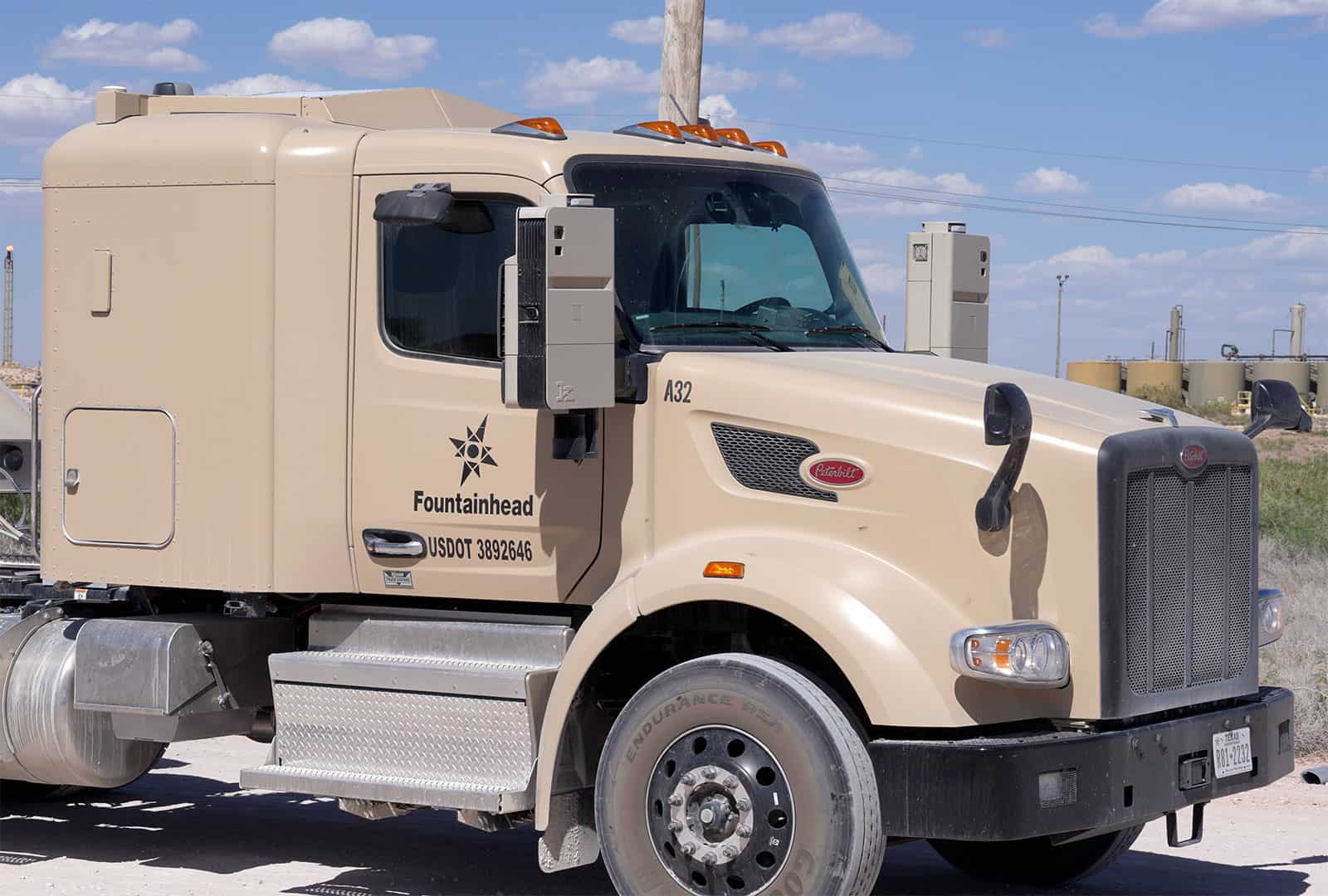
Yes. Every Kodiak Driver-powered truck observed during the field visit was operating with no human in the cab, hauling frac sand from the end of Atlas’s Dune Express conveyor system to dynamic well sites across the basin.
The trucks transition from paved road to unpaved, gravel-packed access roads on the way to the well site, often through mixed traffic and active dust storms, without a safety driver onboard.
Kodiak Permian Basin Field Report
After spending two days in the Permian Basin visiting Kodiak’s operations and partner Atlas Energy Solutions, conducting depot reconnaissance, visiting the Dune Express and meeting with Kodiak’s operational team, we identified several realities that distinguish autonomous trucking in the Permian from every autonomous trucking operation we have covered to date.
The Dune Express and the Handoff to Kodiak Autonomous Trucks
Before a single Kodiak autonomous truck moves a grain of sand, that sand has already traveled 42 miles on the Dune Express, Atlas Energy Solutions’ 36-inch-wide fully electrified conveyor belt running from the company’s sand mine in West Texas to a transfer point in eastern New Mexico. The belt moves at 10.2 miles per hour, with an elevation change of over 320 feet across the route, and is capable of moving the equivalent of 72 truckloads of sand per hour.
When the sand arrives at the end of the Dune Express, it is autonomously loaded into Kodiak autonomous trucks that haul it dynamically to the wellhead. Sand demand cycles flow in three to five-week intervals. The routing is not fixed and it’s always changing based on demand. This is the operational reality of deploying autonomous trucks in the Permian Basin.
Depot Reconnaissance: A Mobile Operation
When we visited one of Atlas Energy’s Kodiak depots, we expected something resembling a traditional autonomous trucking depot. Instead, what we found was closer to a construction site. The depot is a gravel pad with portable trailers, skid tanks and no permanent buildings. It is situated in an environment where the nearest parts dealer is hours away and everything has to be planned and scheduled. Kodiak’s product support presence on site is one trailer.
This environment is by design. Atlas Energy Solutions owns the depot and built it to be relocatable as the demand at wellheads changes. In a similar fashion, Kodiak built the Kodiak Driver around modular, swappable SensorPods and a dynamic routing system that does not depend on pre-built HD maps.
The depot we visited (Depot 6) is a hybrid operation with both Atlas Energy owned Kodiak autonomous trucks and human-driven trucks operating out of the same environment. There is no clean separation between the autonomous and manual operations; they overlap to increase the efficiency of the operation.
Environmental Conditions: Operating Through the Dust
During our visit, we observed active dust storms with winds approaching 30 miles per hour and heat close to 100 Fahrenheit. Even during the heat and the wind, the Kodiak autonomous trucks kept hauling frac sand through it without the slightest hiccup.
Even maintenance personnel worked in the middle of these harsh conditions. Life on the Permian is harsh, there is no air conditioning in the bay and there is no pause for weather, the only pause is to drink water and uptime is key to operations.
The Commercial Model: Driver-as-a-Service
During our visit we were able to get a better understanding of how Kodiak’s Driver-as-a-Service model works in the field. It’s a difficult model to deploy in the Permian Basin purely based on the logistical and environmental conditions. Since Atlas Energy owns the asset (the Kodiak autonomous truck), Atlas dictates the product roadmap in the Permian Basin. When Atlas needs a feature, Kodiak prioritizes it against the customer’s operational impact and delivers against the customer’s timeline.
This was clearly demonstrable in Kodiak’s Q1 2026 earnings release, as the company’s revenue grew 74% quarter-over-quarter to $1.8 million, driven by the expansion of Driver-as-a-Service revenue. The Permian Basin fleet grew from 20 trucks at the end of Q4 2025 to 28 at the end of Q1 2026.
When we were there in the Permian Basin, the growth was noticeable.
Strategic Outlook
The Permian Basin is the first market in the United States where customer-owned fully autonomous Class 8 trucks (no safety observer onboard) are operating commercially at scale. Atlas owns the trucks, owns the depots, dictates the product roadmap, and runs a vertically integrated sand supply chain that requires the fleet to adapt with wellhead demand.
As Kodiak works toward fulfilling the binding 100-truck order from Atlas, with 28 trucks deployed at the end of Q1 2026, the signals to watch are whether the order expands beyond 100 trucks, whether the Driver-as-a-Service revenue line continues to compound quarter-over-quarter as the fleet scales, and whether the model is adaptable to other markets.
The West Fraser timber pilot in Alberta is the first real test of that last question, as it puts Kodiak autonomous trucks into the hands of a second customer in a completely different environment with its own unique set of challenges. If the Driver-as-a-Service model scales in Alberta with Timber, it validates Kodiak’s approach to deploying autonomous trucks in unstructured environments.
The future is bright. The future is autonomous. The future is field reports.
Subscribe to This Week in The Autonomy Economy™
Join institutional investors and industry leaders who read This Week in The Autonomy Economy every Sunday. Each edition delivers exclusive insight and commentary on the autonomy economy, helping you stay ahead of what's next.