


From Tracking Terrorists to Tracking Trucks: How a Former CIA Officer Built the Ground Truth Layer
Executive Summary
Ryan Joyce, a former CIA counterterrorism operations officer, founded GenLogs after recognizing that the same pattern-recognition and all-source intelligence methods used at CIA could expose fraud in the trucking industry. GenLogs built a nationwide camera network collecting nearly twenty million truck images per day, enabling insurance companies, freight brokers, and law enforcement to verify what carriers claim digitally against what is actually happening on the roads.
The platform has expanded beyond cargo theft into human trafficking investigations, autonomous trucking fleet monitoring, and shipper lane intelligence. GenLogs is now scaling across five verticals and internationally, with ambitions to extend its verification layer to rail, sea, air, and beyond.
Key The Road to Autonomy Episode Questions Answered
How does GenLogs collect ground truth data on trucks operating across the United States?
GenLogs built a nationwide network of cameras, placed one at a time at warehouses and other sites along highways, using a three-headed system that captures the front, side, and rear of every commercial vehicle. The network now collects nearly twenty million truck images per day, filters out private vehicles at the edge, and blurs truck windows before storing data.
How is GenLogs being used by insurance companies to combat fraud?
GenLogs allows insurance carriers to verify whether a trucking company’s physical footprint on the roads matches what it reports digitally, catching carriers that claim one truck but operate dozens. Reinsurers are using GenLogs as a ground truth layer to price policies accurately, rewarding safe compliant carriers with lower premiums while ensuring higher-risk operators bear appropriate costs.
What does GenLogs data reveal about autonomous trucking companies currently operating on U.S. roads?
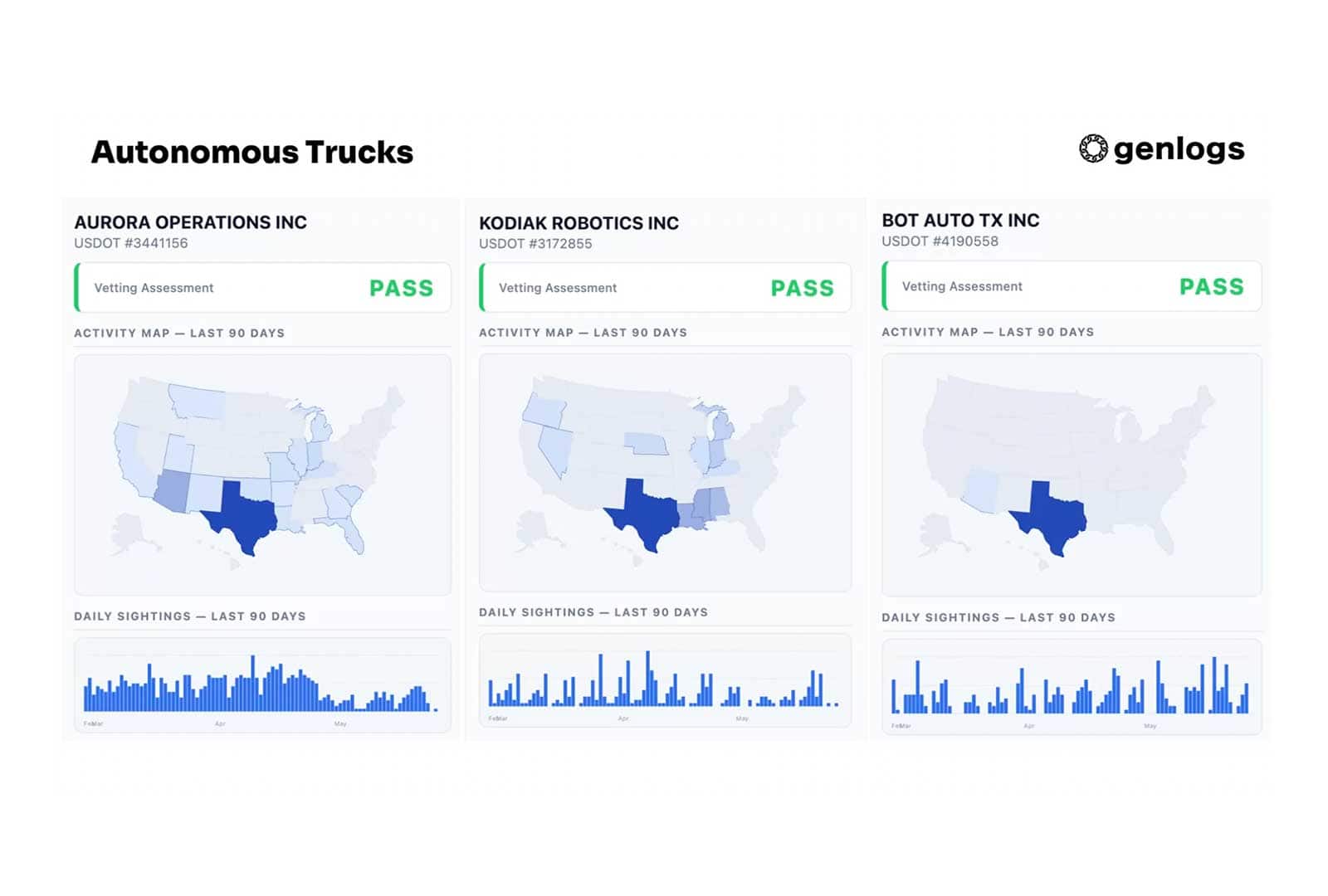
GenLogs tracks the observed DOT activity of autonomous trucking companies including Aurora, Kodiak, Bot Auto, Waabi, Einride, and Gatik over rolling ninety-day windows. Aurora shows the broadest footprint with heavy Texas activity plus corridors through Chicago, Michigan, California, and Florida, while Gatik shows consistent volumes similar to Aurora, and Einride appears to have no observed Texas operations during the period reviewed.
Autonomy Markets Topics & Timestamps
[00:00] From Tracking Terrorists to Tracking Trucks
Ryan Joyce spent two decades in the CIA recruiting assets inside Al-Qaeda and ISIS. He brought the same all-source intelligence playbook to the trucking industry.
[04:10] Building the Ground Truth Camera Network
GenLogs built a nationwide camera network one warehouse at a time, using only US or allied-made equipment to keep adversaries out. It now captures close to 20 million truck images a day.
[07:32] The Verification Layer for Insurance
Chameleon carriers claim one truck and quietly run dozens. GenLogs catches the gap before an inspection ever does, letting insurers price risk on ground truth instead of self-reported data.
[11:01] The Scale of Cargo Theft and Fraud
One large brokerage loses roughly a truckload a day, with values reaching $250,000 each. Multiply that across the top 200 brokerages and the number turns astronomical.
[14:16] Anomaly Detection and the Intelligence Playbook
The same correlation analysis that once protected CIA officers now flags the truck trailing every theft. When the pattern repeats three times, it stops being coincidence.
[18:34] Combating Human Trafficking
With only partial trailer data, one agency used GenLogs to track down a truck and recover an abducted young woman. GenLogs gives the software to anti-trafficking nonprofits for free.
[21:41] Fingerprinting Every Truck in America
Thieves swap DOT numbers, lettering, and plates to vanish and resurface under a fresh carrier name. GenLogs fingerprints each truck so it stays tracked through every change.
[26:22] 90-Day Snapshot of Six Autonomous Trucking Companies
Camera-verified data on Aurora, Kodiak, Bot Auto, Waabi, Einride, and Gatik shows where these trucks actually run, not where the press releases say. Aurora peaked in April then fell into May, and Einride stays out of Texas.
[34:48] Protecting High-Value Loads
A clean motor carrier number sold to fraudsters is how a $3.8 million load disappears. A bid 40 percent under market should be an automatic red flag.
[41:13] The Future of GenLogs in an Autonomous World
Autonomous trucks are not required to report their locations anywhere, leaving insurers and brokers blind. GenLogs becomes the visual verification layer across rails, roads, rivers, sea, sky, and space.
[45:04] AUTNMY AI
AUTNMY AI is an applied intelligence firm whose mission is to develop a field-tested, ground-truth understanding of how the Autonomy Economy is being built and translate that understanding into the intelligence, foresight, and counsel that help the world’s leading institutional investors navigate the most consequential industrial transition of this century.
Full The Road to Autonomy Episode Transcript
Ryan Joyce’s Career Path: From CIA to Trucking
Grayson Brulte: Ryan, sir, you’ve had one heck of an interesting journey. You used to track terrorists, yes, the bad guys, and now you track trucks. What the heck is that journey looking like going from terrorist to trucks? I know they both start with the letter T, but w- how does that journey look?
Ryan Joyce: Yeah, I felt that that was just a pithy way to kind of get, “Hey, here’s what my former career was. Here’s what I’m doing now.” And I’ve really only done two things in my professional life. that was work in the U.S. intelligence community. So I did that for almost two decades. a lot of that was spent at CIA conducting counterterrorism operations as an, as an ops officer, case officer, as, as we say. So my job was to recruit assets within terrorist networks, so, like, foreigners that were inside of Al-Qaeda and ISIS in order to provide us information about their plans and intentions so that we could stop the next September 11th from happening. So that is what I did for all the way up really until 2020 through 2023 was kind of a transition period as I went into the private sector and was looking for, “Hey, what do I do next?” And and I stumbled across trucking and and there was something That stood out about, this, like, light bulb went off for me
Grayson Brulte: Okay, so we gotta go Tom Clancy here. So were you the real life Jack Ryan?
Ryan Joyce: You know Hollywood doesn’t nail it per se, and if CIA does their operations really, really well, no one hears about it, and a gun never needs to be drawn. And so that’s not to say that I wasn’t packing with you know, a gun on me when I was on these high-risk missions. But when we do our jobs really well, you’re kind of operating out there in the shadows. No one knows what you’re doing, but you’re still getting the, the critical information that you need to, to make sure that policymakers can do their jobs
Grayson Brulte: One of the key things that your colleagues in the intelligence community do, they look for patterns, they look for trends, they look for an- anomalies, things that, that aren’t right. And you’re taking that, I’ll say, that same skill set and applying it to trucking. Was it a lot more overlap than you initially thought as you started to build GenLogs?
CIA Digital Intelligence Methods and the Parallel to Trucking Fraud
Ryan Joyce: Yeah, if you kind of go back to my CIA days I, I joined right around the time that the CIA was kinda coming into the digital era. And actually, for whoever’s, whoever’s listening right now, if you go to cia.gov right now, in the upper right-hand corner, there’s a button that says, “Report Information.” If you click it, the CIA’s gonna walk you through how to contact them securely. And that is amazing to get access to, to sources all over the world in some of the areas that traditionally are hard for us to get data information from, whether that’s North Korea, China, Iran. The problem is, is it now presents an issue where we’re getting a lot of cranks, a lot of crazy people reaching out to us, and then you get some people that it seems like the, the information they’re trying to share is super juicy and something that we would want. But what if they’re trying to lure you out? What if they’re trying to uncover the identities of CIA officers? Or even worse, what if they’re trying to harm CIA officers, trying to literally injure or kill us? And it was a real issue that we had to grapple with at CIA. And the way that we kind of overcame that was say, ” Hey, what can I ask a person in the digital realm?” Basically, this online relationship that we have, that we can validate in the physical realm, that we can observe. And how do you observe that? Well, you know, we were the CIA. We had access to sensors and satellites and drones and all these other sources of data. We called it all source intelligence that we could look at. And so that’s really where the parallels were stronger than I would’ve thought when I got into the trucking industry, is there were a lot of fraudsters and thieves that were claiming things in the digital world that were not actually true in the physical world. they would say that they had trucks that they could run from Dallas to Chicago, but if you actually looked at what was happening out there on the roads, they weren’t there. They didn’t have trucks out there. It’s just the problem is no one was able to prove that. No one could collect the data. So we kind of went back to the CIA days, said, “Okay, sensors, satellites, other sources of data, how do we get that here at Genlogs?” And the answer for us was to build a nationwide network of cameras that could collect all of the data about the physical trucks that operate on the roads
Grayson Brulte: That’s impressive because to me, you’re, you’re getting the ground truth or you’re putting your operative hat, and I think that’s, that’s super cool. And there’s a movie here. I’m not gonna give away the plot here, but as you build out this, call this ground truth network for, for verification, how did you get the rights to put the cameras? How did you know what cameras not to get? And most importantly, since going on into your old days of the CIA, to make sure adversaries cannot get access to these cameras, perhaps it’s on a microchip embedded in. How did you go through that process?
Building the Nationwide Camera Network One Camera at a Time
Ryan Joyce: Yeah, that was really important for us. I think coming out of CIA, you know how vulnerable supply chains can be and how you can insert kind of malware along the way that allows backdoor access. So we wanted to make sure any of the equipment that we were using was either US or allied made, and that those supply chains were pretty well controlled. And that’s what we did setting out there is said, “Hey, we’re gonna make sure we’re using the right type of equipment so that we’re not giving China and Russia full access to what’s happening on US roads.” that was really important. And then we’re gonna lock that down with a series of encryption and, and other capabilities that would make sure that no one could actually access this data too. But with regards to what you were asking about in terms of like, so how do you build this network? Well, the answer is you build it like one camera at a time, and we had to go out and painstakingly look at the entire map of the United States, figure out where all of the truck patterns and daily volumes were, and then go knock on doors and literally ask people that might own a warehouse on the side of a highway, “Hey, could we put some cameras on your warehouse? They’ll look like security cameras, so you get the added benefit of potentially keeping your own thieves and robbers out from your yard while we are gonna use that to look at trucks and only trucks.” So Genlogs actually filters out all private vehicles. At the edge, we delete that data. We then blur out all windows on the trucks when we bring that in to our, our data warehouse. But that’s what we did. One, one camera at a time, one camera at a time, all the way until we were finally collecting you know, just shy of twenty million images now a day of that’s coming off our camera network. But it happens one at a time
Grayson Brulte: You’ve called this the sniper rifle approach, which, which I like. How did you set the camera up, th- the angles to know where you wanted to snipe the truck?
Ryan Joyce: Yeah. Yeah, it was a lot of like trial and error. we had a– One of my good friends from college owns a truck sales and service center in Virginia, and as we were discussing this concept with him, he was like, “Man, this would be a great idea. I don’t even know who the, the trucks are that literally drive right on the highway in front of my truck sales and service center. They could all be potential customers. I’d love to know who’s driving there.” So we said, “Well, can you let us put up some cameras?” And we fiddled with, is it gonna be one, a few cameras? What we ended up deciding on is a three-headed camera system that allows us to collect on the front, the side, and the rear of every truck as it passes by. And we use some really cool computer vision models to say, “Hey, is it a truck or computer vi- or, or a commercial vehicle?” If it is, then we collect that, that frame, and then we stitch all three of those frames together so you get kind of a comprehensive view of that front, side, and rear, a 360 collection on that truck before we then start to pull out all of the unique identifiers that you can see on a truck
Grayson Brulte: To me, if an insurance underwriter said, “Okay, I’ve got p- I got proof if, if what you’re saying is true or what you’re not saying is true,” do you see any of those use cases where, do you wanna call, I’ll say Genlogs is the verification layer for somebody says something, what they’re actually doing?
Insurance Verification and Chameleon Carriers
Ryan Joyce: Oh, yeah, 100%. In fact we’ve really seen that take off in recent weeks, especially after the Supreme Court ruling most recently about negligence in unsafe carriers. you know, we’ve all heard the term before, a chameleon carrier, and what that really means is a, an unscrupulous carrier that gets out there on the road, racks up a lot of unsafe points when it comes to either their inspection selection scores or their, their different FMCSA scores that, that look at safety. And then when it gets so high that no one will work with them, well, then they just burn down the, the whole carrier and spin a new one up, and they start all over again. Well, what Genlogs is able to do is see when someone is claiming that they only have one truck out there on the roads, yet we’re seeing them run dozens of power units out there. Our cameras will pick that up immediately way before they ever get inspected or way before anyone else ever sees it. So from an insurance perspective, that is really critical. If you’re an insurance carrier and you’re trying to understand what is the risk and what are the premiums that I should be charging on this policy, and someone’s claiming that they only have one truck, but they’re operating dozens of trucks out there, you wanna know that up front, and you want to address that, either to not insure them or to insure them at a higher premium. But the important part is that you shoulder the risk on that carrier. That allows you to therefore, for those other carriers that are following the rules, being safe, only operating one truck and claiming one truck, then you can give them a lower premium on their policies, and that’s really where the insurance customers that we have are really excited about what this means for better pricing for good customers
Grayson Brulte: It also mitigates risk because the old days, stuff was self-reported. Telematics could be modified, so the insurance, I’m assuming, has to say, “Okay, we, we can get proper pricing, e- enough of this baloney.” Do you, have you seen any scenario, let’s say a large AAA underwriter says, “Okay, you have to get your data verified by Genlust before we’ll underwrite you”? Have you seen any of that emerge yet?
Ryan Joyce: It’s starting to emerge right now. And in fact, we’re working with a few of the largest insurance carriers out there. Their reinsurers are really interested on, “Hey, where is the risk? Have you looked at all of these policies through the prism of GenLogs?” I think it’s that ground truth to kind of verify what is being self-reported or reported in the digital realm that is really starting to catch on, especially when you realize that the most egregious issues on the roads are where you know, a thief or a fraudster is going to go to great lengths to manipulate the digital records. It seems like every week we see FMCSA removing more and more ELDs from the approved list, and that’s because they’re finding more and more examples where people are manipulating their hours of service or manipulating where those GPS coordinates are pinging out. And when GenLogs can now check that, can say, “Hey, you’re saying that this is where you drove and that your hours of service represented this, but GenLogs actually saw you driving this, and we’re gonna trust the actual images more than this digital ELD device,” that’s starting to catch on more and more and more so that the point that the ground truth data, as seen by GenLogs, becomes the ultimate source of truth.
Grayson Brulte: And that’s great for the roads, makes the roads safer. It’s, it’s great for the economics of the business. I’m, I’m curious, obviously we had the 60 Minutes piece, we had the s- the Supreme Court ruling. How large of a problem is fraud in the trucking industry?
The Scale of Cargo Theft in Trucking
Ryan Joyce: I mean, it, it blew my mind and continues to this day how prevalent it is out there. I’ll tell– I’ll give you an example. We have a a large brokerage who’s not yet a Genlog’s customer. They’ve been holding on, and yet when we visited them on site a few weeks ago we asked, ” Hey, how many critical incidents do you guys have to deal with on a daily basis where something’s escalated to your team that’s supposed to dig into these details of potential fraud or theft and resolve them?” They said, “We get about 15 of those that happen a day.” And I said, “Well, then how many of those are actually resulting in theft?” And they kind of sheepishly said, “Look, about one in that 15 is an actual theft, and rarely do we recover it.” So you’re looking at one of the largest freight brokerages out there having a theft per day of a truckload that could average in the, you know, upwards of even 250,000. But let’s say we just assume $100,000 is what they’re dealing with on a daily basis, and you multiply that by 365. Like it is astronomical, and this is just one freight brokerage in the industry. And then you multiply that across the 27,000 that are operating there. Even if it’s just the top 200 that deal with, with these issues because they’re moving so much volume, that’s 200 thefts a day that’s happening across the US. That’s 200 thefts too many
Grayson Brulte: Well, it’s, and then I look at it from an economic standpoint. That, that’s a lot of cash and a l- a lot of bad actors are targeting that. I’m curious from a recovery standpoint, is that highway patrol going out? I- is that a, an alphabet letter that we don’t, I’m not familiar with from a law enforcement perspective? Who, who goes out to confront the bad guys and say, “No, no, no, no. You’re under arrest. You, you’re a bad actor.” Who, who, who does the recovery efforts?
Ryan Joyce: And I think, Grayson, this is the issue, is that there is no single entity that’s on the hook for that. And it is really frustrating if you are a freight broker or shipper or a carrier that’s kind of been duped or had your, your trailer stolen or whatnot to, to figure out who is the entity that should deal with this. Is it where the theft occurred or is it where GenLog saw that trailer last? And we had another example of this over the weekend where law enforcement in the Shenandoah County area in Virginia reached out. There was a full truck that was stolen, truck and trailer. We put an alert in our system, and we systematically watched as that trailer went from Tennessee to Kentucky down to, to Texas, presumably headed towards the Mexican border. And and, you know, is it the Shenandoah law enforcement that should be tracking it all the way down to the border? Is it Texas Department of Public Safety? Is it Customs and Border Protection? I think a lot of people kind of shrug and say, “Is it really our problem?” And this is where one of the, the, the laws that’s going through Congress right now, the Corker bill, finally puts an entity that’s gonna be tasked with that, and that is named as the, as DHS. The specifically their HSI which is their really their investigations arm, is gonna be on the hook by Congress to deal with this. And I think it’s finally a good thing that we’ll have an entity tasked with tackling this cargo theft and fraud
Grayson Brulte: It’s a good thing ’cause on the federal level’s preemption, they can go over state lines and they can stop the, the bad actor. Because once the, the bad actors know, if you wanna use the term, the heat’s getting turned up on them, they’re going to potentially stop that and, and move to other illicit activities. I’m just saying, historically that’s what it’s done. So let me ask you this hype- hypothetical scenario. Let’s say there’s an autonomous truck going down the highway, and they s- the bad actor in front ba- and then they block it and, and they steal all of it. Do you get all, all of that data and then in the future DHS will come in and catch those folks? Or what does that look like?
Ryan Joyce: Yeah. Well, you know, it’s interesting. If you’re looking at an autonomous vehicle that’s kind of stopped and they’re gonna have to move that load that’s in the back into something else. So presu- presumably, they’re gonna be trailing an autonomous truck with some type of truck that they’re gonna use to cross load right in the middle of the street or, you know, maybe at a truck stop or whatever it might be. Well, Genlogs is gonna see those patterns. We’re gonna see that, huh, every time this truck’s out there, we’re seeing something following it. And so we can look at those correlations over time to say, “Hey we don’t, we can’t tell you for sure, but this truck was right behind that autonomous truck,” and it would be at least a lead to go start in that investigation.
Grayson Brulte: Wow. So then this goes back to, okay, there’s anomaly here. There’s a pattern. Let’s just say I’m gonna be very kind here. There’s blue Acme truck, and every time this truck goes and has a problem, this same truck’s behind it. You f- you, you flag that exact scenario and you alert the company
Ryan Joyce: Yeah, that’s exactly it. I mean, if you go back to the, the CIA days as well, it was something that we were concerned about when we were going to meet our, our own human sources outside of other countries. you were worried about these correlations that a foreign counterintelligence service would look at to say, “That’s interesting. Every time Ryan Joyce leaves the country this, you know, official in our military leaves the country.” And you didn’t want to show those those anomalies, those correlations. And so that’s similarly what we’re looking at in Genlogs. We’re looking at what does normal look like out there across all of our cameras, and then what’s popping as anomalous or trending. And that could go across– Think about it from a perspective of, hey, every time a shipment of fentanyl hits the street in Baltimore, maybe it was the same truck that we saw cross the border in Mexico and ended up in Baltimore. And then it happens a month later, and you’re like, “Lo and behold, the same exact truck crossed the border in Mexico, ended up in Baltimore.” When that happens three times, you start to realize maybe this is a trend. Maybe this is something we should actually investigate
Grayson Brulte: And as your system gets smarter, gets more wise, but gets more adopted, I’ll, I’ll say, bad actors are always trying to stay two and three steps ahead. How do you, from a software perspective, because you’re powering this thing with AI and, and I don’t really care how good of a criminal you are, AI is gonna move faster than the world’s best criminal, the the cat napper, if you wanna use that term. How do you c- it see- I- is this, is there a cat and mouse game going on today? And if so, how are you and your, and your partners, I’ll call them partners in law enforcement, staying a- ahead of this?
Ryan Joyce: I think the cat and mouse game might have been a year ago when we didn’t really have comprehensive coverage on the highways and nor did we on the secondary roads. So there was kind of a way that if you had full visibility into where entire network are– was, you could kind of say, “Great, I can drive 50 miles on this highway, but then get off on a secondary road for a little bit, hop on later, and just kind of avoid the network.” Now our network is such that it is really difficult to find how you go from point A to B anywhere in the country without going past our cameras on roads that trucks are allowed to drive on. So there’s a lot of roads that they can’t from a, a weight perspective and otherwise. So you’re either gonna take the risk as a criminal that you’re gonna get pulled over and inspected because you shouldn’t be on this, this tertiary road, or you’re gonna be on a road that Genlogs has a camera. And by the way, we do not advertise how many cameras we have or where they are or what they even look like. And I guarantee most people have driven by locations where it looks like security cameras, and those are actually our cameras. Or they don’t even see them because they’re blended in, and that’s by design. So we are definitely trying to stay ahead by being protective of this network that we built and deployed
Grayson Brulte: Which is smart, and to me another really good thing on your, your network is that it seems to me that this could slow down or reduce human trafficking. Because you can go to your partners in law enforcement and say, you know, “Here you are, officer. Here you are, officer.” Are, are your partners in law enforcement using this to crack down on the unfortunate issue of human trafficking?
Human Trafficking Recovery and Law Enforcement Use Cases
Ryan Joyce: They certainly are. And you know, they, they, they’re using it for any type of crime that involves a truck. a-and, and I say that as in, like, whether I’m alluded to fentanyl trafficking before, it could be human trafficking, it could be weapons trafficking. If it’s being if anything is being transported in a truck that it shouldn’t be, then Genlogs becomes that source of ground truth to look at that. And we’ve had instances in fact, one that happened last year was when one of our customers on the West Coast, th- and this was early when law enforcement was just getting access. They happened to have access. They were our narcotics agency. they got contacted by a law enforcement entity on the East Coast saying, “Hey, we heard you have this Gemlog software. We have a current kidnapping or human trafficking a-act in progress. Can you help us out?” And they said, “Yeah, we’re, we’re here to help. Give us the information.” So they passed this limited information. they didn’t even know what the truck was. They had partial data on the trailer that someone had seen a young female get pulled into this truck. They only had a partial information on the trailer. Well, in Genlogs, you can go in and search partial information, trailer, find all of the trucks seen hauling trailers with that partial information, and then kind of splinter out from that. And sure enough, this East Coast law enforcement agency, using the software from this West Coast agency, was able to track down where this truck was and successfully recover this underage female with this act in progress. And thank God that happened. and we are all in favor of using our software to that end. In fact, we’ve given our software away to nonprofits that work in the human trafficking space or the counter-human trafficking space so that they can use this to crack that down. I, I don’t think it happens an insane amount when it comes to, to trucks, but as I always say, like, one is one too many. And so when we do give our software away, we love to know that it is helping crack down there. It really energizes the employees at Genlogs to know, hey, it’s not about profit solely. It’s a lot about purpose, and that’s why a lot of them were attracted to Ge
Grayson Brulte: A lot of good. About a year ago, I attended a dinner with Senator Moody and we had a long talk about human trafficking, and she’s the proponent of autonomous trucking because she said from the data that can gather could help to stop the unfortunate issue of human trafficking. So there’s a lot of, there’s a lot of good there with data. One of the cool things about your system I have to highlight is that you have predictive abilities where you have the ability to alert your customers. You put a really great LinkedIn post on this about the way cargo theft ring in operation, and you’re alerting your customers. How are you getting that predictive analytics to alert your customers, “Okay the bad actor ring, okay, they’re operating in this area. You might wanna be careful.” How are you gathering that data?
Uniquely Fingerprinting Every Truck and Tracking Cargo Theft Rings
Ryan Joyce: Yeah. Well, this is one of the just incredible data science breakthroughs that I have to credit the team at Genlogs led by Said Yimer. They, they have found a way to uniquely fingerprint every truck in America and track that truck even if the, the bad actors try to change their USDOT numbers, different lettering on the truck, different license plates, all of that. It resiliently tracks that truck across the, those different changes. Now, that’s been important because these cargo theft rings, and we’ve been tracking a few of them, will will pop up as one carrier name one day and then steal a lot from different customers after they’ve booked loads through the, the load boards in order to get access to those, that freight. And then they’ll go underground. And then we’ll see them pop up a few weeks later with a completely different carrier name and different decals and everything on their trucks. But because we have that resilient ability, we’re able to see them pop back up on the network and alert all of our customers that, “Hey, today they are Acme Freight,” where before they were John’s Trucking, and we’re seeing them make those changes, and we’re able to alert our customers quick. And unfortunately, those that aren’t getting alert by Genlogs are kinda left at the whims of what the load boards provide in terms of defenses, which isn’t much.
Grayson Brulte: So you’re doing a, a, a lot of good there. That’s for the traditional trucking industry, and obviously trucking’s moving autonomous. How is the autonomous trucking industry using your data, and w- what are you seeing in it? ‘Cause to me this seems like there’s a lot of really interesting from an investor standpoint and a lot of really interesting uses. What are you seeing in that data?
Ryan Joyce: Well, I would say one of the, the coolest breakthroughs we’ve had beyond uniquely fingerprinting every truck in America, although it relates, is that we’ve been able to use a multi-data source algorithm that actually unlocks or unveils all of the shipping lanes for every shipper in America. So truly, you can look at if you’re an autonomous truck saying like, “Hey, we run Dallas to Houston, and that is, like, what we are doing every single day,” you can now query Genlog’s data to say, “Well, who are the other shippers that run Dallas to Houston and have significant volumes?” Whether they’re dry vans or reefers or whatever you’re running as that autonomous truck trucking company. Well, now we can give you basically all of the leads that you want to go out and source the shippers directly who you can work with to haul their freight along those lanes. And so as these autonomous trucking companies go into new markets, they have new footprints, new lanes that they’re kind of their power lanes, that maybe they’re doing drop-and-hooks on either side they can now query Genlog’s data to say, ” Well, who should we be approaching to talk about dropping their costs and increasing their safety along the way?” Because I think what we will find is just like the Teslas of the world out there that, you know, it is, I think, inarguable now that a Tesla in full self-driving mode is safer on a, like, per million miles basis than a human driver. And if that is true in, in autonomous trucking, well then, based on this Supreme Court ruling, I would think that there are a lot of shippers that are now saying, “Well, hey, maybe inching into this autonomous trucking thing isn’t a bad thing. If that’s generally accepted as factual, then we are actually protecting ourselves more while also potentially dropping our, our costs.” So that lane data for all shippers in America is being used by whether it’s freight brokers manned carriers or autonomous carriers as well, all looking at what freight needs to be moved and how can they get involved.
Grayson Brulte: And then can you act as the, the truth layer where some companies say, “Oh, we’re driverless,” but then there’s still a supervisor in there? Or does it, can, can individuals get that, and companies get that data, that granular in there to actually, if you wanna call it the verification layer again?
Ryan Joyce: This is something that, like, we can in- investigate looking at can we sense if there’s a human in there while not portraying who that human is? So I think it’s a delicate balance for us, and this is why, like, early on, we decided we were gonna be privacy-enabled artificial intelligence. So we’re not only filtering out private vehicles, we’re applying blurring to the windshields and such. And yet, you know, you can kinda see even with a blur on a windshield, is there a human behind the, the wheel or not? and so for that way, we can kind of do that check of, hey, is this really being done in an autonomous way or not? I think the real cool thing is to just frankly track what are the volumes of the different autonomous trucking companies out there on the roads. Are we seeing them? Where are we seeing them operate? Is their volume going up or down? And I’m happy to share a little bit of kind of what the last 90-day snapshots look like when it comes to some of those companies.
Grayson Brulte: Yeah, let’s see it. Let’s see what, let’s see what Gen
Live Data: 90-Day Autonomous Trucking Fleet Activity for Aurora, Kodiak, Bot, Waabi, Einride, and Gatik
Ryan Joyce: Sure. Let’s go I’m gonna go ahead and share my screen here. and so what I’m gonna show you is I just kind of, before we hopped on the call, I took the took six companies. We have Aurora, Kodiak, Bot, and then Waabi, and Ride, and Gatik. And what we’re looking at is essentially, hey, where have we observed their DOTs on the roads over the last ninety days? So that’s kind of those map views. And then what’s that histogram below of what the daily volumes look like for them on the roads. So interestingly enough, we’ll look at Aurora right now on the left-hand side. we see them operating pretty much in more states than anyone else. really heavy in Texas, but also up through that kind of Chicago into Michigan corridor over towards California and even down into Florida. So we’ve seen them operating in all of those areas. But if you look at their volume, their daily volume, it kind of peaked in the, the mid-April to late April timeframe. We’ve actually seen quite a volume drop off here into late April and into May compared to what those trailing two months were. and just kind of moving through to Kodiak and Bot Auto have very similar profiles with regards to those daily observations on the roads. You can clearly see here they tend to operate Monday through Friday, and then certainly Bot Auto seems to take most weekends off ’cause there’s just kind of that, a little bit of daily activity in the Texas area, and then they’re off Texas and then off. kind of moving ahead to Waabi and Nride a little bit more sporadic. It sounds like they’re, you know, looks like they’re really starting to find their footing. and, and I did not dig deeper to say, hey, what if this is truly autonomous versus not? we’re just looking at where are they operating and how frequently are they operating. But then Gatik has really been consistent out there on the roads. We see them quite a bit, kind of resembles Aurora without the drop off. and they’re also starting to look in those, having those similar lane patterns. So again, that Texas, really heavy in Texas, up through that Chicago area, and then over towards the West Coast in California. So kind of like if you had Gatik and then Aurora side by side, they’re both the lanes that they run and what those patterns look like look a lot similar. And then Kodiak and Bot Auto look pretty similar with regards to footprint and frequency. And then Waabi and Nride still seem to be finding their footing there too
Grayson Brulte: And this data is super helpful because it’s validated with ground data, which is phenomenal. The a trend that I saw there, and I’m gonna, I’ll put on my wannabe inspector hat. I have an inspector on here ’cause I know you were coming on today, Is the anomaly in all that data you said, Einride was the only one not operating in Texas. And so immediately I say, “Okay, why? W- what’s going on?” It seems, I mean, I know that’s, it’s, it’s out there, but it’s a question why? It’s just fascinating, those little pieces of data, if you correlate it with another data set, can get very, very interesting over time.
Ryan Joyce: Yeah, I don’t disagree, and this is something that you and I have chatted about, and definitely it’s on Genlog’s roadmap is how do we make some of this consumable as data feeds so that if you are sitting on part B of what you might be able to put together with part A, the Genlog’s data, and get really deeper insights and gr- and granular. You know, the other thing I showed you before the show, and I’m not gonna pull it up now, but it’s really cool that our, our system can also see what are the trailers that these autonomous trucks are pulling on the roads. So we do see Aurora pulling Werner trailers. We do see Aurora pulling Hirschbach trailers. And and we’ve been able to look at, okay, who’s hauling for who out there on the roads, and how is that changing over time? Are there more volumes going up from certain customers or, or down? And at what point do we see those Aurora trucks become actually under the USDOTs of Werner or Hirschbach in the future? That’ll be something that’s interesting to, to, to check
Grayson Brulte: The fascinating thing is that I’ll use it. It’s an early warning signal system that you have there. So if you go look at the FMSCC for data, all due respect, it’s outdated. And I look at your system, okay, so I’m getting that, that real early ground truth moment from your camera So you have the, the, camera layer. Now I’m gonna have to perhaps you to put your CIA hat back on. Obviously, you had field officers and, and men and women that then went in the field. Do you do similar things for gen logs or is it all camera only?
Ryan Joyce: We take a lot of data in addition to the cameras. So we will go out and bring in factoring and fuel card data that we get from some partners. We’ll bring in ELD and telematics data that we get in, as well as some TMS data. We bring a very holistic view to, to what we’re observing out there on the roads with our ground truth cameras, and then comparing that to some of these other data sources. Sometimes that helps us surface anomalies. Sometimes it helps us surface deeper most of the times deeper and richer insights. I will say that Genlogs has an investigations team. These are former intelligence community folks that when there is, like, a theft network out there we will do a deep dive and really get– I mean, this is like CIA targeting level packages here of images and where they’re, you know, they’re cross– with looking at their driver’s license and, and property records and all of that to totally blow out what a cargo theft network looks like. And, and we do that when we’re seeing a correlation of multiple either customers or prospects of ours all reporting similar trucks or similar carriers that are involved in illicit activity. and, and I’d be remiss if I didn’t say, Grayson, that anyone who’s listening, if you are experiencing a missing or stolen load or asset, if you go to Genlogs website, G-E-N-L-O-G-S.io, in the upper right-hand corner, we have a button that says, “Find lost assets.” All you need to do is click it and report the details, and that investigations team will look into it for you and try to get that back in your hands, and we will not charge you. It is a free service that we pro- provide to the entire industry, and we do that for two reasons. One, we think it’s the right thing to do. It’s our give back to the industry. Number two, it allows us to see those trends. How is theft happening over time? What are the unique entry points that these thieves are prying at or prodding at that they’re, where they’re finding success? And how do we then shut that, those loopholes down for our customers? So it’s provided us probably the most unique insight into theft that’s happening across any other company
Grayson Brulte: It’s good for the industry, obviously. It, it helps the data you’re getting. I’m curious, what causes freight theft to go up and go down? Is there any patterns that you’ve seen historically in the data where, I don’t know, Christmastime, Thanksgiving, where okay, we know bad actor season’s here. Have you seen any any patterns in the data like that?
Ryan Joyce: Yeah, I would say there’s kinda three reasons why freight w– theft would ever go up or down. two is risk and reward, and then number three is just o-opportunity. frankly, the problem, and we discussed this earlier, is the risk these days continues to be very low to be a cargo thief. i-if you’re, if you’re successful at making it happen, the chances that any law enforcement agency’s actually gonna track you down and, and hunt you to the ends of the world to get that back or to put you behind bars is unfortunately very low. So very low risk, and then we’re increasingly seeing because the risk is low, the reward’s rather high. You can grab whether it’s drinks that you can sell to convenience stores in Manhattan that will buy from you. You can buy s- you know, you get semiconductors, and there’s definitely a black market to sell stolen semiconductors out there. So the reward’s high, risk is low, but then this gets to what you were hinting at, is the opportunity then increases around those holiday seasons when people have their guards down or they’re just trying to get those last few loads moved before they go on a few days’ break with their families. and they’re willing to, to kind of like squint and look at potential issues in the data that’s being flagged, these red flags, and saying, ” you know, I’m just gonna do it and pray and hope that it works well.” So when people’s guards are down, that’s the opportunity. The risk is rather r-ro-low, the reward’s high. You’re gonna have cargo theft
Grayson Brulte: I’m curious now because you opened the door and I have to go through it ’cause that’s what I do. Let’s hypo- this is hypothetical, okay? This is hypothetical and I have no data and this is all hypothetical. Let’s say there is a truckload with a lot of Nvidia Blackwell chips on there, for example. Do you have armed guards or does it, do they, does somebody alert you from a digital monitoring system? ‘Cause obviously the value of that stuff in the black market is astronomical, and unfortunately it’s very easy to move. How do those, if you wanna call it high-value targets or high-value loads, how are those protected?
Ryan Joyce: Well, there are certainly companies that will you can hire that will trail with, you know, ex-special forces or ex-cops that will sit there and just have eyes on, physical human eyes on that shipment from point A to point B. a-and I think that’s a great system. in fact, I, I doubt that there’s been many actual thefts that have occurred when that is the case. But that’s often when you know that that shipment is now leaving and you’re, you’re assigning those people to it, and it is worth that that additional cost to make sure that that gets there safely. You know, so often I think people think, “Hey, we’re gonna go the opposite way,” which is, “We’re gonna just be low-key about moving this really, really expensive item.” Well, y- and, you know, we’ll just hire someone that won’t know exactly what they’re moving but it’ll be pretty expensive inside of there and, and if we use the right freight broker that finds the right carrier we shouldn’t have an issue. there’s two issues with that. Number one is too many freight brokerages don’t use Genlogs to understand, hey, is that physical footprint on the roads still representative of what the digital footprint claims? And in fact I wrote a blog post about this last year where there was a $3.8 million load that was stolen. and when we went back and looked at what had actually happened you saw that this carrier that they had hired was very active in Genlogs data until two months before the theft in terms of o-on the roads, and then they completely disappeared. Completely. Never to be seen again. And and sure enough, what ended up happening is that carrier had sold their motor carrier number their email and their telephone number to these, these fraudsters, these thieves, and then they used that to get access to the load. Now, those thieves, they’re gonna bide their time. Once they’re sitting on that clean motor carrier number, they’re gonna sit there and they know who are the high-value shippers and what are the lanes that they likely need. So when they see a post on on a load board that has this really, like small town where there happens to be a, a Samsung or a Microsun chip, you know, shipper, and it’s going to some other place where they know that there’s a need for that, it’s a really, really, like, strong signal that that’s where they should bid and they should bid low. They should make it juicy for that, that freight broker to wanna assign it, ’cause that freight broker’s gonna make some great margin on that. and then they can use that to get access to the load and steal it
Grayson Brulte: So if somebody bids too low on a board, should that be a flag? Or if it’s, if it’s so low it’s an anomaly, should that be a flag, automatic red flag?
Ryan Joyce: Should absolutely be an automatic red flag. I mean, carriers the, the legitimate carriers there are gonna wanna make the most money that they can on these with fuel costs being up and insurance costs being up. and so if someone takes the first offer that you give them that was low to begin with to me, that’s kind of like a, “What’s going on here?” It’s either they desperately need a backhaul, and they’re just, like, ready to do it, in which case Genlogs should be showing that they had trucks on the roads down near your origin, and they likely need to get back to your destination. and we, we do show that. We show what likely backhaul needs are for carriers. If you’re dealing with a carrier that hasn’t been seen, like Genlogs, on the roads for a month, and yet they’re, like, willing to accept a low rate to run a lane if, if red flags and alarms aren’t going off in your head you probably are in the wrong industry
Grayson Brulte: On, on a load board historically, is it, let’s say, a 10 to 15% divergence where you have a, a pack of companies that are all within 10 to 15% and okay, that’s normal, and then you get a guy that’s 40% low? Oh. Is that kind of w- patterns that you would see there?
Ryan Joyce: Yeah, that’s exactly like where I think you’re, you’re gonna see like the, the market rate is the market rate because that’s generally where everyone’s gonna come in around. You’re gonna see maybe that 10 to 15% variance. If someone’s just willing to move it and it’s, by the way, you as the freight broker know who the customer is, you know it’s a high-value load. Like, you could, should be able to piece two and two together of this is a $3.8 million load that someone’s willing to move it for 40% under market? Mm-mm.
Grayson Brulte: Then where did the, where do the trailers go when they’re stolen? Do they go to a chop shop? I mean, where do they go, and what does the recovery look like?
Ryan Joyce: Yeah. So we’ve seen it a, a, a few ways. Number one, sometimes you just never see that trailer ever appear on the roads again. So you gotta assume, went to a chop, chop shop maybe was brought over the border into Mexico, and that’s it. Like, you’re never gonna see it on the roads in the US. because we can set an alert forever, in perpetuity in our, in our software to basically say, “If this thing is ever seen, please alert me.” And I have had in the other cases, where it was nine months ago that something was reported stolen, and then nine months later we get an alert. And I’m like, “Wow, that– Where did this come from?” And when law enforcement actually gets involved or the shipper gets involved and they track down this carrier, turns out that they bought a used trailer from someone that bought it from someone else. And so that was, you know, stripped, the VIN was stripped. It was recycled back in. And it, and most of the times that carrier unknowingly bought a hot trailer that they shouldn’t have. but I would say most often when something fully loaded disappears, either one of thing, two things happen. Either we do find the trailer or law enforcement try and finds the trailer abandoned within the first 24 hours and all of the contents are removed, or they just never find it, and that usually it’s either a chop shop or in Mexico
Grayson Brulte: And there’s a lot of, I mean, there’s a lot of storylines that are, that are going here. The one that I’m fascinated about is like, let’s, let’s fast-forward to the future, say a decade from now, decade and, and a half from now, autonomous trucks are, are going coast to coast, California to New York, California to Florida, coast to coast. What does the future of Genlogs look like when we start to introduce more and more autonomous trucks into the system?
Ryan Joyce: Yeah, I don’t think it’s gonna look materially different than it is right now in the sense that even though there might not be a driver in the actual truck, you’re still gonna have some type of dispatcher owner capability that’s gonna say, “Hey, where do you need capacity? Do I have trucks there or not?” I think it’s gonna be a while where we’re gonna have this hybrid system out there. You’re gonna have human drivers, you’re gonna have autonomous trucks coexisting for a while. But even as that tilt goes to autonomous, like right now, Kodiak and Aurora and all the others are not required to share the locations of all their trucks at all times in any central repository. And this is what, you know, we’re seeing with Teslas out there on the road. Like a Tesla in full self-driving mode or a, a Waymo doesn’t need to share the locations of those trucks in any public database, which means the same issues are gonna occur for freight brokers and for insurance companies or for shippers to say, “Where is their capacity? Like, who should I be reaching out to, to try to make sure that I can lock in capacity before others do? and then where are these trucks operating?” You know, if you’re an insurance company, even if you’re given the telematics from Kodiak or Aurora trucks out there on the roads, knowing whether they’re hauling dry vans or flatbeds in the future is really important for underwriting. And are those flatbeds, do they have the correct strapping? Do they have the correct distance from the headboard and whatnot? that’s something a telematic or an ELD is not gonna tell you. It is something that Genlog’s visual verification can tell you and then put you at ease if you’re an insurance company about the risk that you’re taking on.
Grayson Brulte: I would summarize it this way. You’re the, You’re the, truth layer. And when you’re the truth layer and you’re getting that ground truth as technology scales, that you will be there to inform insurance underwriting of really what’s happening. And the best part about that is, not the Big Brother standpoint, is that by you giving the actual data to, let’s just call it Acme Underwriting, they can properly price it, and then we can start to see the positive economic benefits of autonomous trucking when they’re, they’re getting the real data. Putting this whole conversation together, what’s the future of Genlogs?
GenLogs Expansion: Five Verticals, International Growth, and Multi-Modal Ambitions
Ryan Joyce: I think we’re already seeing the future start to play out where we started with just freight brokerages, and they were the first customers that we started to, to engage. We also limited how many of them would get access to this platform as we learned from what are they gonna do with it? How can we truly help their operations? We have now scaled to five major verticals right now. So outside of freight brokerages, we now are doing we have products that are being built directly for carriers themselves. We have for shippers, for insurance, and for kind of government and law enforcement, the regulators, those that are gonna track down the cargo theft. So those are the five major verticals that we’ve expanded to. we’ve also expanded outside of the borders of the United States. And so when we look at expansion, there’s both the verticals there’s geographic, and then there’s the modes. And we’re looking at, hey trucking is but one of many modes that, that things, that items get delivered from point A to point B. You have trains and ships and planes, and I think over time you’re gonna find that Genlogs expands to say, like, we’ve tackled the toughest part, the very fragmented nature that is trucking, both middle mile, first and last mile. now we can attach that to what are we seeing on rails, roads, rivers, the sp- sea, sky, and space. Like, that’s where we can go in the future
Grayson Brulte: Well, I’ll summarize it this way. Genlogs is building the verification layer for the future. The future is bright, the future is autonomous, the future is Genlogs. Ryan, thank you so much for coming on “The Road to Autonomy” today, and when you bring out the next vertical, sir, you’re coming back to talk about it and show us all that wonderful data that you gather
Ryan Joyce: Sounds great, Grayson. Thanks for having me
AUTNMY AI: Billions and soon trillions in value will be created in the autonomy economy. By the time a trend becomes consensus, the alpha is already gone. The gap between uncovering signals and reading headlines is widening fast. When it’s a headline, it’s no longer a signal. Enter AUTNMY AI. We decode signals before they move markets, giving you conviction in the autonomy economy. AUTNMY AI your models, our intelligence. Visit AUTNMY.AI.
The future is bright. The future is autonomous. The future is The Road to Autonomy.
Subscribe to This Week in The Autonomy Economy™
Join institutional investors and industry leaders who read This Week in The Autonomy Economy every Sunday. Each edition delivers exclusive insight and commentary on the autonomy economy, helping you stay ahead of what's next.