


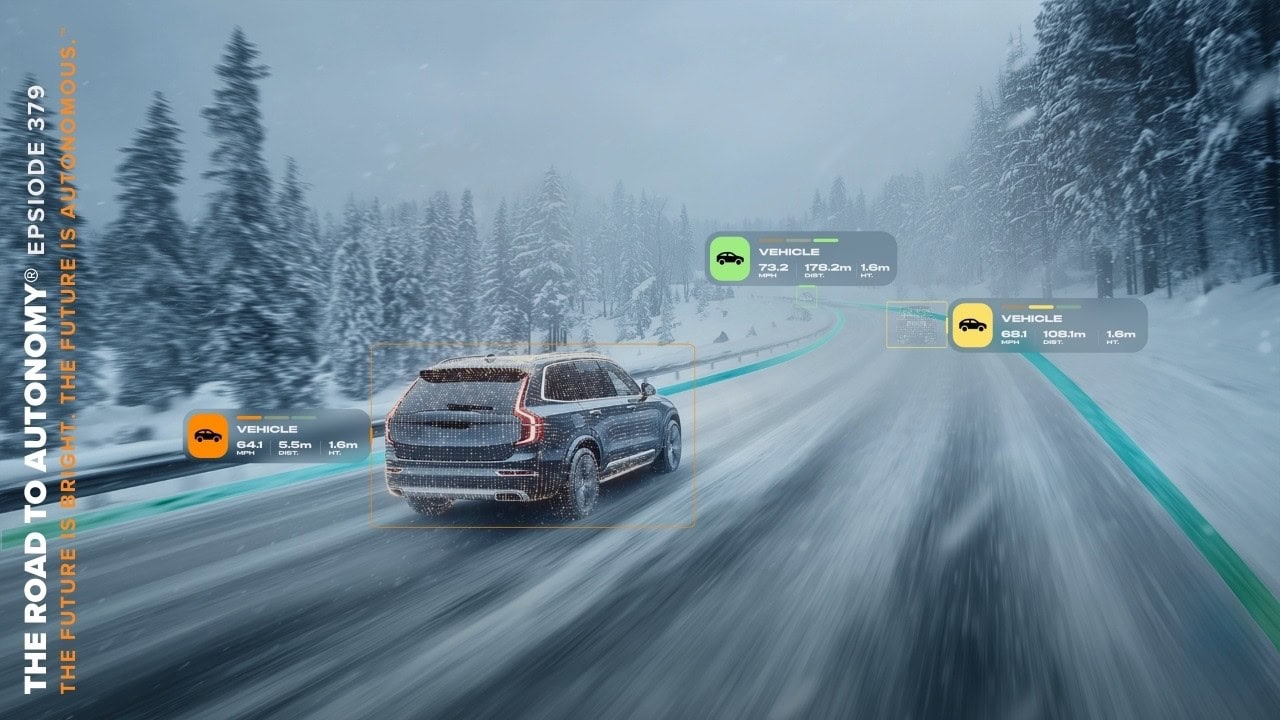
Merging LiDAR Performance with Radar Robustness
Matthew Carey, Co-Founder & CEO, Teradar joined Grayson Brulte on The Road to Autonomy podcast to discuss the company’s emergence from stealth with $150 million in funding and the creation of a brand-new category of terahertz (THz) sensors.
The operational backbone of Teradar’s strategy is a Terahertz Detection and Ranging (Rad-AR) approach that fills the gap between LiDAR and radar on the electromagnetic spectrum. By utilizing a modular architecture of Lego-like transmitter and receiver chips, the system provides the high-resolution point cloud typically associated with lidar while maintaining the all-weather robustness and velocity-sensing Doppler capabilities of radar. This solid-state design allows the sensor to be hidden behind vehicle bumpers or polymers, eliminating the need for bulky roof-mounted hardware.
In the field, Teradar is rigorously applying its technology to solve the weather casino problem, proving the system’s robustness in the heavy rain, snow, and dense fog of Boston. Unlike traditional vision or LiDAR systems that struggle with atmospheric particulates, Teradar’s longer wavelengths can bend around rain and dust, ensuring consistent performance in environments where humans or other sensors might fail.
Teradar’s Physical AI ecosystem also includes a defense-grade application that provides situational awareness in combat environments without being easily detected. The atmosphere effectively blocks the sensor’s signal beyond its intended range, allowing it to operate in dense traffic or military zones without jamming other sensors or revealing a vehicle’s position to hostile actors.
Looking ahead, Matt envisions a future where high-performance sensing reaches a mass-market inflection point by becoming affordable enough for every vehicle, from a Mercedes S-Class to a Ford Focus. By partnering with Tier 1 suppliers rather than vertically integrating, Teradar aims to scale to millions of units, fundamentally transforming the industry by delivering a sensor stack that costs hundreds, not thousands of dollars.
Episode Chapters
- 00:00 Teradar Emerges from Stealth
- 03:01 Limitations of Existing Sensor Technologies
- 05:54 Introducing Terahertz Sensing
- 08:00 Defense and Battlefield Applications
- 11:11 Modular Sensor Architecture
- 17:00 Early Development and Startup Challenges
- 26:54 Why Teradar Chose Boston
- 36:11 Autonomous Vehicles and Weather
- 46:06 Scaling Teradar
The future is bright. The future is autonomous. The future is The Road to Autonomy.
Subscribe to This Week in The Autonomy Economy™
Join institutional investors and industry leaders who read This Week in The Autonomy Economy every Sunday. Each edition delivers exclusive insight and commentary on the autonomy economy, helping you stay ahead of what's next.