


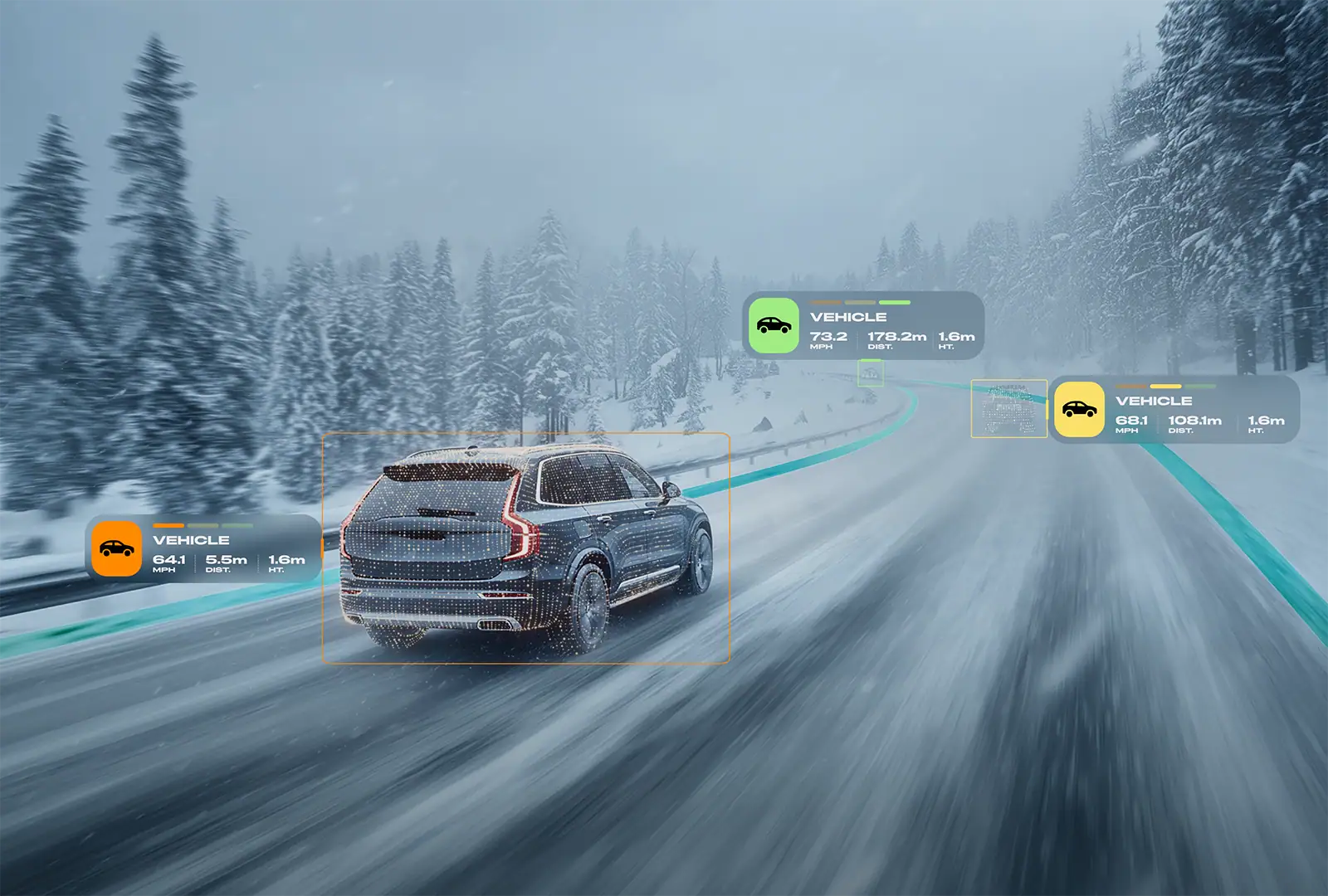
Merging LiDAR Performance with Radar Robustness
Executive Summary
Matthew Carey, Co-Founder & CEO, Teradar joined Grayson Brulte on The Road to Autonomy podcast to discuss the company’s emergence from stealth with $150 million in funding to introduce a new category of terahertz sensors. By operating in the terahertz spectrum, Teradar combines the high resolution of LiDAR with the all-weather robustness and Doppler capabilities of radar. This solid-state, modular technology is designed to be affordable enough for mass-market vehicles while offering stealth advantages for defense applications.
Key The Road to Autonomy Episode Questions Answered
What makes terahertz sensors unique compared to LiDAR and radar?
Terahertz sensors occupy a part of the electromagnetic spectrum that allows them to combine the high resolution of LiDAR with the robust, all-weather performance and Doppler (velocity) sensing of radar. Unlike LiDAR, they have no moving parts and can “see” through materials like bumpers.
Why is Teradar’s technology considered stealthy for defense?
The atmosphere blocks terahertz signals effectively over long distances, meaning the signal drops below the noise floor within about seven to eight meters. This makes it extremely difficult for adversaries to detect or jam the sensor, which is critical for protecting troops in combat environments.
How does Teradar achieve low-cost scalability for mass-market cars?
The sensors use a modular architecture consisting of standard transmitter and receiver chips that can be added or removed based on the specific needs of an OEM. By using a common manufacturing process and custom power-efficient silicon, the sensors can be priced appropriately for entry-level vehicles such as a Ford Focus.
The Road to Autonomy Topics & Timestamps
[00:00] Teradar Emerges from Stealth
Teradar came out of stealth after raising a $150 million round to build public and regulator trust as they begin delivering samples to OEMs and bidding on major vehicle programs. The company aims to move beyond serving only industry experts to earning the trust of the broader public as their sensors scale to millions of vehicles.
[03:01] Limitations of Existing Sensor Technologies
Current sensors face a trade-off: LiDAR offers high resolution but is costly, uses moving parts, and fails in bad weather, while radar is robust and detects velocity (Doppler) but is severely limited in resolution by its wavelength and physical size.
[05:54] Introducing Terahertz Sensing
Teradar created a new category of “terahertz detection and ranging” (Teradar) that bridges the gap between LiDAR and radar. It provides LiDAR-level performance with radar’s all-weather robustness in a solid-state package affordable enough for mass-market cars such as a Ford Focus.
[08:00] Defense and Battlefield Applications
The technology is highly effective for defense because terahertz signals are naturally blocked by the atmosphere at long distances, making them nearly impossible for enemies to detect or jam. A key use case is providing situational awareness to prevent vehicles from accidentally running over friendly troops in smoke-filled combat environments.
[11:11] Modular Sensor Architecture
Teradar uses a Lego brick approach, where standard transmitter and receiver chips can be added or removed to meet an OEM’s specific requirements. This modularity allows the same core technology to serve as a high-end LiDAR replacement or a low-cost, ultra-efficient sensor for automated parking.
[17:00] Early Development and Startup Challenges
The early days involved “dumpster diving” for components and buying half their equipment on eBay to build a $500,000 prototype. Their first imager was so slow it took 45 minutes to produce a single image, requiring the team to take lunch breaks while investors waited for results.
[26:54] Why Teradar Chose Boston
Teradar is headquartered in Boston to leverage the city’s unique ecosystem of “hard tech” talent, particularly in materials science and hardware engineering. While Silicon Valley excels in software and AI, Boston provides the deep specialized expertise in semiconductors and electromagnetic physics required to build a new category of physical sensors from scratch.
[36:11] Autonomous Vehicles and Weather
Terahertz sensing solves the “all-weather” challenge that has plagued autonomous vehicle development. Because its wavelength is longer than that of visible light used by LiDAR and cameras, it can penetrate fog, heavy rain, and snow conditions that typically “blind” other high-resolution sensors. This allows autonomous systems to maintain high-definition situational awareness regardless of environmental conditions.
[46:06] Scaling Teradar
To scale for the mass market, Teradar is focusing on manufacturing simplicity and strategic partnerships with Tier 1 automotive suppliers. By using standard semiconductor manufacturing processes (CMOS) and a modular design, the company can produce sensors at the high volumes and low price points necessary to move beyond luxury vehicles and into every standard consumer car. Their roadmap includes expanding from automotive into broader industrial and defense markets once the initial vehicle deployments are established.
Full Episode Transcript
Grayson Brulte: Matt, Teradar recently came outta stealth with $150 million round. Impressive. Why was it time to come outta stealth now?
Matthew Carey: We’ve been working on it for a while. It’s a, it’s a great question because, uh, you know, I’ve gotten that question of why are, why are we now reading about your name in the past couple of years? So the shortest answer is, we’re now delivering our B samples to OEM. And we’re gonna be bidding on programs this year. And it got to the point where you’re like, okay, um, if you’re not able to read about us in the news, then frankly, why should an OEM trust us with a contract? Right? And so at the end of the day, um, everything we do as a company is focused around how do we save lives by putting our sensors on automobiles. Um, and it comes down to winning vehicle programs. And the best way to do that, we’ve finally reached that point, is like, all right, now we need to tell more people about what we’re working on. Earn the trust of more than just the experts at OEMs. So that way, um, you know, when this gets on hundreds of thousands, millions, tens of millions of cars, people aren’t like, what the heck is this, this terror thing? So, um, yeah, that’s why we came outta stealth and it’s been fun.
Grayson Brulte: When you build the trust, are you trying to build it with the engineers that are at the OEMs? Are you trying to build the public? Are you trying to build it with the regulators, or is it a combination of all those parties?
Matthew Carey: It’s a combination. Um, I mean, first and foremost, you, you know, you build the the trust by building an excellent product. You start there, right? And then when we were in stealth, it was mostly convincing engineers at OEMs who are incredibly smart, have worked very, very hard. And we’re talking about California, Germany, Detroit, all these, they’ve seen a lot and we’re coming up to them and saying, Hey, we have a brand new category of sensor and all those limitations that you’ve been having with Lidar or with radar or with cameras, we’ve got you. Right? And that’s like not an easy story for them to believe to their credit, right? You have to prove that to them. You know, you wind the clock five or six years ago, you could kind of win a vehicle program based on a PowerPoint. And there are companies that did that, and it’s very difficult to deliver those. That is not the case anymore. Um, these OEMs have, have rightfully have some scar tissue, and so you have to prove to them and keep your promises of, yes, we, we deliver, uh, what we promised we’re going to deliver. So first the OEMs have to believe in you. Working with the regulators is a bit more straightforward because there is just direct measurement. Like number one, is it safe? Yes. Cool. And number two, are you gonna interfere with anything or anyone around you? Of course the answer to that is no as well. Um, but you have to prove that to them, and you can kind of do that with, with proper measurements. So you work with labs and that kind of deal. And then the last one is, is in order to do this, you need to raise significant capital. And so it’s convincing investors and the the public that what you have fundamentally changes the game from a, a sensor automotive perspective. And so we attack it from those three things and, and it made sense now to come out of stealth and to announce not only our funding, but also this new type of sensor that we’re able to show the world really for the first time.
Grayson Brulte: If you’re building a new category, which you’re building individuals, one, wanna be able to touch your product, and two, they want to be able to openly discuss their product, especially if they’re an investor at a dinner party. They wanna be able to talk about it and that could you’re, ’cause you’re going to need more capital over time as you grow manufacturing and scale. But let’s say in the category, why did you see the need to create a, a new category of sensors, plural? Because looking at all the material, there’s a clear path from multiple versions of the sensor.
Matthew Carey: The reason why we had to build a new sensor, so let’s say that you didn’t know what a radar was or a lidar was, right? Or you knew what a camera was, of course, and you were like, I need to design a sensor that, you know, makes a, an automobile safe. It gives me the best capability to, to not only be autonomous, but, but also, you know, not, not hit things around me. Where would you put that on the electromagnetic spectrum? And I promise I won’t use that word too many times. Right? And, and, uh, the, well, okay, so you look at the spectrum and you’re like, well, um, I want to be up high, relatively high near where a camera is because you get really, really good resolution. And that’s of course where Lidar is. And we love lidar. It’s a fantastic, uh, technical tour de force and, and the point cloud is beautiful and all that stuff, right? The downside of course is you have moving parts, rotating mirrors, mems, it’s costly, doesn’t work in weather. There’s a bunch of pieces we can get into. So then you’re like, well, I really also want to be low on the spectrum where you and I would know a radar is. What’s the downside of that? Well, it’s very robust. It gives you doppler so you know the velocity of the things that are in front of you. You’re limited on resolution, right? And there’s this physics limit called the Rayleigh criteria that basically says the size of your sensor is tied to how much resolution you can get. And we kind of inherently know this, right? When NASA is like, we’re putting up a telescope that’s five times larger than the last telescope, we’re like, well, that must be a lot better. And, and that’s correct. Um, the other piece to that equation, of course, is your wavelength. And so radar is limited by just the size of the sensor and the wavelength that it’s at, and you can’t cover an entire front of the car as a giant radar. For some reason, the designers and the public really don’t like the look of that vehicle. And so again, if you were to start from scratch and say, well, where would be the perfect point where I would make a sensor for automotive from scratch? The answer would be lying somewhere in between where you can get the best of both worlds where you can capture—I really like the low cost, I like the solid state, I like the doppler, and I like being able to go through weather, but I also really like that high resolution that Lidar brings. How about we get both of those things, and that’s why we created a new category of sensor. We’ve done this by going to the last part of the spectrum that no one’s been able to build a sensor at before. It’s terahertz. And so we do terahertz detection and ranging (TRadar), and that’s where the term comes from. And our promise to automakers, this is one of the examples of the sensors here, is, um, we can give you the performance of a lidar, but all the advantages of a radar and combine those two things to give you a sensor that you can not only put on, say, a Mercedes S Class and a Volvo XC 90, but also, you know, I drive a Ford focus like it could go on a Ford focus. There’s no chance you’re gonna put a LIDAR on a Ford focus.
Grayson Brulte: So to me, it seems that you’re taking the best of all worlds, and I wanna highlight to the audience the really interesting thing about yours. From a design perspective, your Teradar system can go behind the bumper. So you don’t have to cut holes or redesign it. How, how does that work from behind the bumper? Because if you’re looking at it, you take a Ford focus, you take the Mercedes S class, you take a different type of vehicle to me, from an engineering standpoint, okay, not a major engineering lift. And then I’m gonna put on my design aesthetic hat. Okay, there’s not a big, bulky, ugly object dangling on there.
Matthew Carey: Exactly. You don’t have to do the roof thing, you don’t have to. Behind the windshield sounds good. But then when you actually sit in it, you’re like, oh, there’s like a whole chunk of the field of view that’s obliterated. Um, and cooling it becomes a nightmare because like your power goes down. You can’t evade fans ’cause people don’t like the sound. Uh, so you’re absolutely right. And, and the beautiful thing about this frequency is you are low enough—typically the lower you are, the more you can go through materials—you are low enough that you can go through polymers, right? Uh, you can go through that rubbery plastic very, very similarly to the way a standard radar does today. And so, um, yeah, when we’re talking with OEMs, the vehicle designers are like instantly on board ’cause they’re like, wait a minute, I don’t have to change anything? I’m on board. I can remove the hump, I can do all these other things. And then, you know, the final advantage, that’s actually better than both radar and lidar, and the reason why folks haven’t done this is the atmosphere itself blocks our signal really effectively. It’s why it’s been so hard to do, and we’ll go out to 300 meters. We can actually see quite a bit further depending on the amount of power that you want. Um, but you’re not gonna use this out to like 10 or 15 kilometers, right? It’s just like the atmosphere blocks it. Well, the nice thing about the atmosphere blocking is we go below the noise floor within seven, eight meters. And so when you look at some of the defense applications, you don’t have to worry about being detected either. Right? And that’s super important. So we actually have a defense segment and the main use case there is actually preventing vehicles from running over our own troops. Right? We got really strong feedback that mixed combat arms exercises are very, very dangerous because you got smoke, you’re deliberately obfuscating the entire training battlefield, and you have troops that are crawling in the ground next to tanks and vehicles and these other things. And so giving them situational awareness—but of course, if you were to put a lidar or a radar, you know, the bad guys, they might not know what it is, but you know, an eight watt laser is not made by trees, right? They know that something is coming from there. Um, and, and that will end poorly when it’s detected. So trying to give the best of both worlds and then also being able to be very, very difficult to detect. Um, which works well on the DOD side, but also on the commercial side. It means you could put six or seven of these in different configurations in the densest traffic jam in India, for instance, and they wouldn’t hear each other, you wouldn’t have to worry about them jamming each other, nor could a hostile actor try and jam us if they wanted to disrupt some of the autonomy features.
Grayson Brulte: The DOD stuff is fascinating. I recently did a podcast with Stuart Young, the program manager for the Racer Program, and one of the things that we talked about was deploying autonomy into theater, and I had to ask Mr. Young, I said, what about the heat element? And he is telling me all the things that DARPA’s working on and the Department of War is working on regarding heat so the enemy doesn’t know where it is and all these great innovations that are happening in combat. What type of heat elements does your sensor give off when you’re deploying it in a hostile environment, say combat?
Matthew Carey: It’s no different than any other sensor in that regard, right? So you can shield the front and that way you’re not showing a thermal signature. Um, it’s funny, the power and therefore the thermal requirements are more driven from commercial automotive because every watt that you’re sucking from the vehicle is like an extra three or four miles that you can’t drive over time. Um, and so they’re pretty upfront with us. I would love to have 50 watts. You don’t get 50 watts on a car, right? You get 25, you get 20. Depending on where you’re at, you get less than that. Um, and so that’s what we’re building the sensor to from our commercial side. So low power, 15, 20 watts, uh, depending on the configuration and the abilities that you want. And of course everything is solid state. So that’s the beauty of that—shock and vibe and water and all this other stuff that you would normally have to worry about as a lidar, you really can capture that advantage for radar as well.
Grayson Brulte: The whole market for autonomy is shifting to low power. Tim Kenley, Clay’s got a startup by San Francisco Hyper Labs. They’re working on low power. Everything is going low power. So if you take your approach to low power and solid state, do you envision one of your sensors on a commercial vehicle—one sensor, multiple sensors? How do you envision that, and do you envision it differently for larger DOD applications? Let’s say a Textron tank, for example, perhaps two on there, three on there. How do you envision that?
Matthew Carey: The beauty of how this sensor works actually is that it’s built as a function of transmitter chips and receive chips, and then we have one chip in the center called the Terra Core that processes it all. I am not an expert in designing a car or exactly what each OEM needs, and I don’t wanna be. That’s their job. They’re really, really good at it. They can actually specify a sensor to the exact requirements they want. And then we just put on the number of transmitter and receive chips, right? So if they want something that replaces a lidar, we put on a bunch more receive chips and transmit chips. Fantastic. It’s all theirs. And we work with tier ones to build it. It goes on a standard PCB, put it inside a $5,000 reflow oven. Bam. You have a sensor; it’s very, very simple. Um, on the other hand, if you wanna be in the corner of the car and you still wanna get a factor of 20 or 30 times more resolution than a corner radar, that’s fine. We’ll remove the radar. We’ll remove some of the receive chips and the transmit chips because you wanna be lower power and lower cost. Put it in there. Voila, you’re good to go. And then on the rear—’cause we get a bunch of questions of like helping out with automated parking—can we remove ultrasonics? You can get it down to where only two or three chips are used, and now you’re getting something very, very tiny and very, very power efficient, but with the resolutions in millimeters in order to be able to help you park safely. So by just adding or removing our standard transmitters and receivers, you can tailor each sensor to exactly what the OEM wants, which honestly is what their designers and their autonomous crews are looking for. Because they each have different requirements and they approach the problem differently. On the defense side, power is less of an issue. So some of the radars out there are 500 watts, right? You can literally stack those transmitters. You can see further, you can have widening amounts of bandwidth—there’s a whole bunch of things you can do when you take that off and they’re like, we don’t care, as long as you’re under 400 watts, you’re an improvement. And you’re like, I don’t even know what to do with 400 watts. So, yeah. So, you know, it depends on the customer, but the idea is it’s built modularly with transmitters and receivers to tailor not just to where we’re at on a car, but specific to that OEM. So if Ford says, well, I want a lidar replacement, and they define a lidar slightly differently than say GM does—we’re okay with that, right? It’s like, cool. Then GM would have an extra receive chip on there to meet their definition than Ford would, and Ford has a little bit less power, a little bit less cost, still meeting the requirements. So it’s—you can think of it as little Lego bricks that you can stack together. It works really well in that way.
Grayson Brulte: I mean, you look at Lego bricks, all the stuff that was done in the MIT design lab around that with the Lego experiments were fascinating. And Legos, as you know, are highly modular where everybody has to fight as a kid to get the green board that you can build on top of. And if you take your sensor and let’s call it the green board, how did you design the architecture to be so customizable? Was it—were you taking an MIT Lego block mentality saying, okay, we’re gonna architect this sort of like Lego blocks? How did you get that architecture to be so adaptable?
Matthew Carey: Yeah, so this is where I credit—so I started the company with two really fantastic co-founders, Greg and Nick. Um, we didn’t discover terahertz, right? Like it’s been known since the sixties and seventies, and a lot of people have tried to build sensors up there in the nineties and early two thousands. They’ve lost all their money and they’ve long since gone away. And the reason why that happened was because they tried to build their terahertz sensor like a high-frequency radar or a low-frequency lidar. Neither way works. You have to design the sensor from scratch. It would almost be like me telling you, “Hey, I want you to build an X-ray machine, but you’re only allowed to use the parts of a camera.” You’re like, great, not only do I not have the parts I need, but I need to architect this thing differently. If you want this to have a shot at working, TRadar is very similar. It is not built like a radar or a lidar. There are pros and cons to it, and Greg was the one that came up with the architecture of, “Hey, this is a way that we could build it to get the power levels that we need.” And then Nick was the one to take that and then start putting it onto the chips. And through evolution and iteration, we’re like, okay, here’s the number of channels we should put. We can stack them and get them close together. And so it was a couple of years of iterating before we finally got to the point where—you obviously don’t wanna make a chip absolutely massive—we’ll break it up into pieces, we’ll make it modular. Um, and then we just kept working on it. So what you’re looking at is something that is seven years in the making, um, you know, including metal spins, 25 tape-outs that go out every quarter. A team of chip designers works incredibly hard nights and weekends in order to be able to keep that pace because all the designs that we’re doing operate above sort of what the foundry expects us to be at. They’re the ones who make the chip. And so you kind of have to make your own recipes and models and all this other stuff in order to make sure it works. So yeah, credit to Greg and Nick for coming up with an amazing architecture and then also being able to implement it on a common process that you can order hundreds of thousands of wafers and ultimately make this thing very low cost.
Grayson Brulte: What were the early days like? Was it just a lot of Dunkin’ Donuts and a lot of whiteboarding starting, “oh no, let’s start over, go back to it”? What were those early days like when you’re starting to collectively design this architecture?
Matthew Carey: Uh, you’re not wrong. Um, yeah, so I mean, our first—we built a prototype just off-the-shelf parts, and it kind of did what it was supposed to do. Um, we invested a lot of our own dollars in it; probably we scrapped for a bunch of things and it probably cost like 400, 500 grand in order to be like, “all right, this thing might actually work.” Um, and then it was like we raised a little bit of seed money to try and tape out our first chip. And taping out chips is so expensive. And so we’re like negotiating with these chip design software houses and we’d be like, “can you please let us just borrow a license for a week and a half?” We’re going around dumpster diving for components and buying half the equipment at this company from eBay, I swear. And, um, yeah, so I mean the early days were—you always kind of reminisce ’cause it was less complicated back then. You always made faster progress, but of course not at all sustainable for automotive. So there’s that trade-off. Um, but it was a lot of fun and we iterated very, very quickly in order to get to the point that we had a working imager. And the very first imager probably took 45 minutes to make an image. And so we had to do this funky thing where, you know, we would have an investor plant different things around for the image and then we’d start it, and then we’d be like, “wow, you know, I’m really hungry for lunch right now. Why don’t we just break for lunch and come back?” Yeah, so it worked well. Um, and we were able to raise our Series A, but it was a fun time.
Grayson Brulte: Indeed it did work well. Let’s look back because I’ve been playing with four or five o’clock almost every night as Opus 4.6 and today Gemini 3.1 Pro dropped that outsmarted Opus 4.6. If you had access when you started the companies to these large language models that are frankly impressive—and I haven’t written code in months now, thanks to the breakthrough in these LLMs—where would you have gone and how much faster could you have gotten?
Matthew Carey: That’s an interesting question. There are some areas that we would’ve moved a lot faster, especially in the early prototyping software that we wrote ourselves. That part all would’ve been done. That being said, because there are no models and there are no kind of experiments that you can point to on the actual chip design side, the AI tools that are just coming out now we probably couldn’t have used and we still can’t quite use because we’re literally inventing it. Um, and then still waiting on a good AI that can write low-level VHDL. So this is stuff where it has to be incredibly efficient, and you only really get a couple of shots at it, and then you have to build it and it takes five or six hours. So, um, I haven’t seen the progress that I would like to see on the AI side for low-level VHDL, but anything higher than that—tremendous, right? And now that we’re capturing data and we’re able to drive useful things from it, whether it would be, “Hey, you know, what does this environment look like?” or “What does a stop sign look like at terahertz?” or “What does a person look like at terahertz?” all these other things—now it’s like automatically done for you. It’s pretty fantastic. Of course we’re developing our own processor chip, which means we have processing built in on the edge that’s just allocated for some of these amazing machine learning applications that we don’t even have to write ourselves. Um, so that part’s super exciting. Um, so yeah, mixed—qualified code still, like automotive-qualified code, has not really been AI’ed yet. Let me know when that happens; I would love to mess around with that. And then low-level VHDL is a work in progress, but about everything else, I think we really could have hired fewer people and also just move faster on the middle-level software stack.
Grayson Brulte: I was talking to a series of automotive engineers at the big three in Detroit about Opus. I’ll summarize it this way: the reactions were mixed, and I’ll go on the record and I’ll state this: it’s just a matter of time until LLMs write automated automotive-grade code. It’s just a matter of when. I’m not gonna get in the business of predicting when, but it is going to come. Chips are fascinating; I’ve been studying a lot about processing chips. How did you go about building that and what were you looking to unlock in your chip design that you couldn’t get in a TPU, GPU, or CPU?
Matthew Carey: Frequencies—like if you have a wire that’s half a centimeter long, that’s a massive antenna, so you can’t even get the energy from one place to another. You don’t have a choice; you have to be on-chip. Um, so that kind of made that decision early. It was a big company decision: should we build our own processing chip or can we use something off the shelf? Honestly, it came down to power. So, um, we use, you know, for some of our B-sample work, we use the Orin platform. Um, fantastic, right? A fantastic chip. The downside of it is that it can do so much, which means it’s not super, super efficient at one particular thing, right? We need to do a million FFTs a second, and we need that to take less than a watt and a half. And so, you know that, as good as Nvidia is, they just don’t have that functionality because only two idiots in the world would ever wanna do that. It doesn’t make sense to put it on their tape-out. Right? Whereas like, that’s all we do. Um, and so what led us down to do our own chip really comes down to power—like you’ve gotta fit all your processing in a certain bucket of power. And then the second is, you know, going back to my Ford focus, the sensor budget on a Ford focus is minuscule, right? You’re talking about hundreds of dollars for the entire sensor stack, including processing. So if you were to incorporate even a $50 processing unit, you’ve just blown the bank account on a particular sensor and you can’t do that. So in order to get to the cost point that you really want to get to, to be deployed on every vehicle, you’re kind of forced into that decision as well. But it’s not one we took lightly. And, as you know, chip development is time-intensive and expensive. It was not my most favorite day, let’s put it that way.
Grayson Brulte: It’s tough to achieve the low power. Did you build it on an ARM architecture?
Matthew Carey: So it’s funny, but a processor actually is not efficient enough either. You have to do direct hardware acceleration. Um, so yeah, all of our FFTs are in hardware. Um, otherwise you’re not gonna get there. Um, so you obviously try and put as few things directly in hardware as possible because if you screw it up, you’re done. Uh, but that being said, it’s by far the most power-efficient, right? So certain things where we’re like, “we know exactly what we’re doing here,” that’s directly in hardware. We could not hand that off to an ARM processor or, frankly, a GPU if we wanted to; we wouldn’t hit the power numbers. But some of the higher-level processing we do hand off to a series of embedded cores as well as GPUs that we put on board.
Grayson Brulte: To achieve this, what did you have to look for regarding talent on the hardware team? Because you’ve got one shot, and if you shit the bed, it’s like “uhoh, we’re in trouble.”
Matthew Carey: Well, one of the mantras of the company is that we are very aggressive, but we do take multiple shots. And so on the system-on-chip, for instance, we’re actually doing it in two iterations in order to lower the risk just because—it’s funny, you get to the point, not dissimilar to rocketry actually, where you can pay so much in simulation and verification and validation and spend so much time that it’s actually faster and cheaper just to tape the damn chip out, get it back, test, and then implement those changes. It’s crazy. Uh, but the software’s finally gotten to the place where, you know, you talk to some of these companies and they’re like, “well, it’s a half a million bucks to have a month of licensing.” You’re like, “you’re killing me right now.” So, we do multiple iterations. That being said, the hardware team is a very diverse set of folks. So I—you and I spoke a little bit earlier about how we source talent: very senior talent that’s exceptional at what they do, but we also bring in lower-level talent that’s coming out of undergrad or has a couple years’ experience because they challenge us. They challenge me in certain ways to think differently, but also they pick things up really fast and they’re able to come alongside and help with new paradigms. So it’s a weird mixture of system engineers, software engineers, RF engineers, hardware engineers, chip engineers, and design engineers—and crunching them really, really close in time and space in order to get the innovation.
Grayson Brulte: The best part about that culture is that new ideas come out of it. You’re going to have spontaneous meetings at the Dunkin’ Donuts or over coffee in the office; you’re going to have lobster. You have really great lobster there in Boston.
Matthew Carey: Yeah…
Grayson Brulte: It was great. You got great Chatta I, new New England clam chatter, not Manhattan, new England. We gotta get that there for the record.
Matthew Carey: You gimme a heads up. I know, like literally I know some, some fisher like, some, some lobstermen, uh, on the boats, like, not like 500 yards from here. We’ll, we’ll get you some fresh lobster
Grayson Brulte: Okay, great. So we’re gonna come to Boston and we’re, we’re gonna experience your technology and have some great lobster with Chatta. So you went to school at MIT and unlike a lot of your peers, you stayed in Boston. You didn’t go to San Francisco. Why stay? Because right now, 21 of the 50 Forbes top AI company founders, they left. They were educated in Boston and left. It’s like, whoa, massive brain drain.
Matthew Carey: Yeah. I can’t, I mean, um, I can’t speak to them different, to me different geographies carry different advantages. Right. Um, I think there’s no doubt on the pure AI side that, um, the capital is fantastic in California for those types of companies right now. And there’s some, also some fantastic talent. Um, contrary to what we read in the news, there’s more to, uh, startups than than ai. Um, and so when I look at Boston, just a fantastic environment for, um, hardware companies and, and robotics companies, right? You have, uh, you know, right hand robotics, you have symbolic, you have iRobot back in the day was a, was a huge heavy hitter. Um, you have a bunch of medical device. Uh, robotics companies and startups, and of course you have Boston Dynamics who, um, you know, just every time you see a demo there, you’re just amazed, right? And, and from my point of view, when you look at Figure or Tesla, in many ways, Boston Dynamics is, is ahead of them on, on many factors. So, uh, when I look at Boston, you know, uh, is it the right place to, you know, build a open ai? I, I can’t speak to that. Um, but when it comes to building a startup that, uh, is very efficient and is doing hardware. Um, it’s a, it’s a really great place both from a funding side and from a talent side, and you’re able to get people with innovative ideas out of an, an amazing educational, uh, ecosystem, right? Not just MIT by the way, but, uh, my undergrad was at WPI, some great colleges in, uh, Connecticut, uh, Maine, uh, Rhode Island, um, and New Hampshire. And you get these engineers that come from slightly different perspectives. You push them hard and it’s amazing what they come up with, uh, when they almost don’t know another way. So we have, uh, designers at Teradar fresh out of undergrad that actually are responsible for large chunks of the subsystem. Um, and then on top of that, they’ve never designed a non ter Hertz PC or like, like, uh, board. And so, um, they’ll, you know, we get a little bit of crap because they’ll talk to someone who like isn’t with the company and they’ll be like, well, what do you think about this parasitic and. They’re like, well, why would I ever think about that if you are not designing a ertz board? And of course, they’ve never designed a normal board in their lives. So it’s kind of a fun, uh, way to build a company of like, look, when I look at Teradar , it, it’s not about what happens over the next year. It’s what happens over the next five years of getting this on every vehicle in the world. And, uh, you have to invest in people in the long term and make them not only want to be here, but also. Uh, bring them up in terms of the tech, their technical skillset. So I feel really good about not only where the company is now, but also uh, the talent that will be here and, and the amount of brain energy that will be around, uh, in five years too.
Grayson Brulte: Say anybody wants to experience it and you know this very well, go to Boston on Parents weekend. Holy Wowser, you, Utah.
Matthew Carey: Yes. Stay off the roads if you’re trying to get to work. That’s exactly right. Parents Weekend in Boston, parents weekend. And then, uh, uh, move in day, uh, move in day in Boston is, is, uh, yeah, it’s, it’s a, it’s an aggressive time. So, uh, those are the two who I would, I would, stay away.
Grayson Brulte: You put the point, I bring that up. ’cause you had the great talent pool. You have BC you have BU in Rhode Island, you have Dartmouth, you have Brown. I mean there’s just, there’s, it’s a whole ecosystem. Then you have ucon in stores and, and you have all the, the, the world class boarding schools that are their Exeter and we can go down. You got Mrs. Borders. So you have this really great, you wanna call diversify talent pool. And then the other thing is you’ve got a weather casino in Boston. The weather’s unpredictable. You get 162 days a year of rain and snow. And if you’re developing a sensor to work in, I’ll use the term inclimate weather, there’s no better place to do it than Boston just based on the weather patterns.
Matthew Carey: Yeah, you’re absolutely right. You know, for the longest time, uh, OEMs would be like, now we’re a little bit more advanced, but for the longest time, OEMs would be like, so you’ve done weather testing? We’re like, yeah, we opened the garage door set targets out there like every other week. Uh, and it was like, it was true. Like, you want heavy snow, you want rain? Just wait a second. Right? So, uh, yeah, you’re, you’re absolutely right. I, if you’re looking, if you’re optimizing for sunny days, I would, well, I love to talk up Boston. I would say we probably, uh, uh, let California take the cake on that one. But, um, uh, uh, from a weather perspective, especially when we’re testing in really gnarly environments, of course. The office here is on the harbor, and so you get 60, 70 mile an hour winds that hit every so often. And like we put the lidar out there, we put the radar out there, we put cameras out there. Um, and you have to be careful putting people out there. And it’s, it’s an awesome comparison. It’s, um, you kind of look at different moments in the company’s history of like when you’re like, wow, this thing is gonna work really well. And it was when an OEM visitor mixed up. Earlier in the day, couldn’t figure out the difference between our sensor and a lidar. Like, got them confused and then the weather came and uh, uh, like you couldn’t see anything with the lidar, so it was, it was a really special moment. And you’re like, cool. This is, we’re we are doing something special
Grayson Brulte: And you, you have the neighbors. You have Vermont, you have New Hampshire, you have Maine and Vermont, New Hampshire. You have the, the icy snow, not the powdery snow. You have the icy snow. And then in Maine you have really hostile weather rustic environments. To go test what type of testing with, if you wanna call it your neighborhood, have you put this sensor through? ’cause you can go two hours this way, two hours that way, and all of suddenly you’re in a completely different terrain. And then the other thing that I want to get into salt. There’s a lot of salt in the air in that region.
Matthew Carey: Yes. Yeah. So, uh, we test in everything just due to the environment. So if you want heavy fog where like you can’t see someone 20 feet from you, we’ve got it right. We just got, uh, I don’t know, 28 inches of snow dumped on us a couple weeks ago. We got to go out in that snowstorm with hail, freezing rain, all that stuff, and then, uh, the salt adds up, right? So we have test vehicles that go around, drive around. They collect data. You have to clean off. Like anyone in New England knows anyone around Boston knows if you don’t clean off your, your backup camera, which is shielded by the way, but if you don’t clean that off every, like, you know, three or four days, you’re not gonna be able to see when you back up. It’s just like a fact of life, right? Um, that doesn’t change. It gets worse when the cameras on the front of the car. And then lidars are obviously exposed to that very same thing. So, uh, and then I haven’t even brought up dust, right? So we do testing and dust environments. Dust gets in the air like it cakes. Um, and that’s something that like a radar we’re able to see through without an issue. But if you, you can easily block a camera or a lidar or frankly even you driving, right? Like it’s difficult to see through. So, um, I don’t know if you can call it a master plan, but, uh, having the company, uh, headquartered in Boston, uh, has worked out, uh, rather well from a weather time.
Grayson Brulte: You, you mentioned the snow. You can’t forget, you gotta go through the car wash to clean the under part of your car where it’s gonna rot. You gotta have that in there as well.
Matthew Carey: That’s right. Yep. Yep. And every two years you gotta put the coating, especially if it’s a truck. You really wanna put that anti rests coating on the bottom. And, uh, yeah, spoken like a, a true New Englander over here. You’re absolutely right.
Grayson Brulte: Yeah. So I, yeah, a little bit, A little bit of, out of a lot if you could say that. So do you, when you’re meeting with, you know, wem. Is one of the competitive advantages that you have in your back pocket when you’re going in there weather, because when the OEM is going to sell a vehicle, you and I know they’re gonna sell ’em in all 50 states. Unless, now I’m gonna go way back in New England history, when the Jeep Wranglers came out, they had special versions only for the West, where it doesn’t associate, you don’t have to put the roof on top, but for the majority of the vehicles, the Camry, the, the, the focus, they’re gonna be sold in all 50 states. And not to mention they’re gonna be sold around the world. So weather’s gonna play a role no matter where you are.
Matthew Carey: you, you’re absolutely right. Um, it, it depends what they’re having it for, right? So if they’re trying to do level three, then it really has to deal with, you know, what environments can I enable level three and be able to offer that to my customers. Um, and then from a safety perspective, of course, they’re like, look, like we can’t, like if you drive with some of the vehicles. Today, I won’t, I won’t name names, but like on your dashboard, it will show when it’s snowing out, like, Hey, your a s is no longer functional. Right. Um, and so I would say it’s, it’s the combination of it really, it depends on which team you’re talking to. At, at an OEM, if you’re talking to a radar team, they kind of take that for granted and they’re wowed by the fact that they all of a sudden get this lidar resolution. Right. If you’re talking with the Lidar team, then they’re like, this is great. My designer doesn’t hate me anymore. The purchasing doesn’t hate me anymore, and I can still get this data. And on top of it you’re giving me doppler. Beautiful. Right? So it depends which team at the OEM that you’re talking with, uh, is to kind of how you give the message because they’re each used to like different kind of status quos. Um, but yeah. And then Tesla, of course is its own beast, So it’s always a fun time.
Grayson Brulte: when you envision the market for your sensor, do you envision an an an L two plus an L two plus plus system? Do you envision this going all the way to an L four system for robotaxis?
Matthew Carey: Uh, yeah, so all the above, right? Anywhere where you use a radar or a lidar, we’re essentially a super set of both. And so we have, uh, active, uh, work underway with OEMs for kind of the level two plus plus. Um, and then we work with AV companies. Again, I’m, I’m under NDA, so I can’t name, uh, folks, but I was very familiar with some of the past folks that you’ve had on the podcast. Um, and, and looking at what they’re doing. Tremendous progress, of course. Uh, but weather is still an issue, right? Uh, with their sensors and being able to have more redundancy and being able to have better uptime. I think it was a, a Waymo. A couple days ago was they, they shut it down in the rain in the road, which might have been the exact right choice from a safety perspective, but it’s awkward, right? You want to be able to have sensors, uh, that are redundant, that can see through really difficult environments like that. Not that that was easy to drive in for a human, but, but that’s, that’s something that we have to be able to. Um, so yeah, we do have, uh, a full stack AV companies, uh, that, that we work with that are like, Hey. Some of them are like, we want you to replace the radar. Others, they wanna replace the lidar, others will bring you in additionally. So it depends on what their individual strategy
Grayson Brulte: The robotaxis, I’m not singling one company out here, to be very clear, is that it has to work in rainy environments because unfortunately throughout history we’ve seen flash flood events around the world. Where vehicles get sucked away and unfortunately those individuals perish or gets really hurt. So we, we, we have to deal with rain. This is hypothetical. If a scenario where a flash flood happens, can your sensor basically operate to help the vehicle get to safety? Or, or how do, where do you see that, that critical safety element coming in? Because we’ve seen the documented things with the Waymo. They just stopped and then in some cases, that’s not a very good solution.
Matthew Carey: Agreed. Um, I think they’re, my guess is their safety case is that the passenger would remove themselves from the vehicle if it, if it got hairy. Um, I, I don’t know. I, I don’t wanna speak for them. Um, but you’re absolutely right. The vehicle isn’t moving ’cause it can’t, you know, have enough confidence, uh, in the sensory information around it and that that’s where we can help. And so, thick rain actually really doesn’t affect our sensor. Very, very much at all. Um, fog is a very similar thing where like heavy fog rolls in very quickly. You don’t want to just stop on the road because you can’t see, right? So, um, you know, it’s much easier to build a autonomous car, uh, when the sun is shining and everything is perfect, but like, that’s also when driving as a human is the easiest thing of all. What I want out of a system is to know that at the very minimum it’s gonna keep me safe in the environments that I have trouble driving in, which is the sun is directly in my eyes, which can blind a radar, sorry, a lidar or a camera, or in heavy weather environments where, you know, we’ve all been there where you’re kind of like you’re holding onto the wheel, you’re at the bottom of the windshield, you’re trying to squint to see through, like that’s the time when you need sensors to work the most. That’s not the corner case that you wanna set. If you’re using one of the other sensors, right? And so that, that’s, that’s why we’re here.
Grayson Brulte: How about, I mean, I’m gonna go to the extreme here. A monsoon, let’s say. Were in Singapore or worse, Southeast Asia. How would your sensor hypothetically react in a monsoon environment?
Matthew Carey: We’ve tested in very, very heavy rain. Um, we have not tested in a classified monsoon. So, uh, you know, I always like to caveat my answers and, and, uh, we wont promise. Under promise and, and over deliver. Uh, we have not yet found a rain heavy enough that it affects our sensor. Um, and so I’m, I’m very confident about going into a monsoon. Um, I think the, you know, we’re still not gonna break physics. So if you dunk the car into like a pool and there was no air gaps, well then we would be in trouble. Right? Uh, you know, also, if you took a giant lead plate and put it up in front of our sensor, we’re not gonna go through that either or, or frankly, any kind of metal. And so, uh, we still obey physics. We haven’t raised enough money that we can, we can pretend to, uh, not obey physics, but when it comes to particulates in the air, very thick dust, um, hail, uh, rain, even if it’s very thick, uh, because our wavelength is actually pretty long, it can kind of bend around.
Grayson Brulte: Wonderful. So you, I’ll summarize this way. You have a very robust sensor that can go in har harsh environments, and it’s scalable from a power perspective, from a, but how is it from a cost perspective?
Matthew Carey: So this is the beauty of having every single piece of your technology being both solid state and using common technologies like bulk CMOs that has been, uh, subsidized. $60 trillion by the purchase of your phone and your computer. So we appreciate that. Um, and that’s where we can get aggressive to the cost points of not just putting this on a CDs class, but also on my Ford Focus. So we aren’t releasing the exact cost points because it, you know, it differs depending on the, the types of, the amount of chip counts and, and IP and that kind of thing. But let’s put it this way, if you’re, if you’re over $500, you don’t have a sensor period. You need to be much, much less than that for even your most premium sensor. And if you’re gonna be on the corner of a car and like you’re in three figures, like, I wish you the best of luck, good luck. Right? Like, unless you’re an autonomous car, of course. Right. So that’s the kind of price pressure that automobiles have to, you know, ascribe to, um, building an automobile. I have so much respect for the different OEMs and tier ones, the margins. Minuscule and everything is so well cost optimized. It’s amazing what you can actually get, um, for, for not that much money in the grand scheme of things, right? Like, it seems like a lot of money when you buy a car, but it’s, it’s, uh, in the words of a tier one that I met with, they were like, we would, uh, trying to remember the quote he said, um, uh, we were talking about costs and I said, I’d be willing to give up my grandmother to save three pennies on this. And you’re like, okay, this is where we’re at, right? So. You’ve gotta get at low cost if you’re gonna meet kind of those lower classes of cars in order to keep that safe. And, and like I said, for my Ford focus, all the sensors including processing, you’re talking a couple hundred bucks, that’s all you’ve got. Um, for all the sensors combined. And, and that’s where Teradar comes.
Grayson Brulte: Qasar Younis has, has told me privately instead on the podcast that he’s the co-founder, CEO of Applied Intuition. He goes, it’s pinching pennies. He goes, everything comes down to the penny when you’re looking at. The automotive industry. Looking at the industry, let’s look at this from the market perspective. How big of a market do you see for Teradar ?
Matthew Carey: It’s, it’s almost like in some ways, uh, uh, uh, too, too big to, to easily estimate, and I’ll explain why I said that in a second. So, the, the most obvious piece is your radar and your lidar markets. You’re talking about $20 billion a year that’s spent on that a little bit over, uh, combined. And so just from an automotive sense, like it’s, it’s, it’s a very healthy growing market, especially with advanced sensing and all the value that OEMs want to provide. The other piece to this, and, and while we’re not, um, super focused on this for at least the next year or so, is that it is a fundamentally new type of sensing modality. It’s at a chunk of the spectrum that no one has been to before. It produces a new type of data, and that actually helps you in a whole host of industries, not just defense, right? So it’s actually very tangential to the automotive market. But also you have security with airport scanners, you now can have something that someone can walk through without doing the awkward hands raise kind of deal. You just walk through, you’re able to, uh, uh, see with much higher resolution. From a manufacturing side, you can do some very amazing inspection because you can determine, uh, uh, essentially, uh, small cracks. Especially with metal, um, and determine different material types that are passing through. Um, and then on the healthcare side, again, this is very, very early and I want to caveat that, but, um, you can identify cavities, um, so you can remove a lot of the uses of x-rays and then it, it looks like you can actually do a fantastic job, uh, detecting certain types of skin cancer. Um, but the best part is you don’t need to ask the patient to dero, which is a massive barrier right now, right? So when you, you go to the doctor’s office, like there’s, we naturally have this instinct of like, I’d rather keep my clothes on. And so a lot of melanomas go undetected because, um, like, you know, you’re wearing your shirt or it might be in your hair or something like that. Um, and because of the frequency return, it looks like that falls within the frequencies we operate at. Uh, we could do some really amazing stuff there. That’s just the tip of the iceberg. So you can kind of look at it to akin to the x-ray of like, we started out looking at broken bones. That was super cool. But now we use x-rays for many, many things, very, very similar, uh, to terrhertz imaging, and we’re excited to get started on this journey.
Grayson Brulte: Well, now it’s very clear why you didn’t go to California and stayed in Boston from what you explained from the use cases and the opportunities because that ecosystem is in Boston. I know you alluded to it, but I’ll just go on the record and say Boston has one of the best med tech environments in the world. The, the, the technology. The talent. And not to mention you have, you have world-class research hospitals, so you have, you have all the pieces of the ingredients to do there. Plus you got really great food. God, I love New England, uh, food. So you, you have the, the pieces, you have the price figured out, you have the technology. Now, how do you manufacture at scale when, say, Acme, OEM calls you up and says, okay Matt, I need a hundred thousand units. Okay, away we go. How do you get ready for that scale?
Matthew Carey: Yeah. And honestly, a hundred thousand is just the beginning of it, right? So we’re gonna be bidding on one program later this year. That’s 2 million units. Um, so, um. This is where we’re a little bit different than some of the other sensor companies that you might have worked with before, and there are reasons why they made the decisions they did, but particularly a lot of LIDAR companies chose to vertically integrate. Right? They are the tier one. They’re responsible for delivering the sensor. Some radar companies went down this path. We are not right. We are a tier two supplier, and so our deliverable while. Still very difficult is, uh, essentially a system of these three chips, the transmitter, the receiver, and the terra core that we give to the tier two. And then what they do is they use their existing supply chain. There’s some off the shelf components that they’re very used to purchasing, um, similar to a radar camera ish combination. Uh, they put them on the PCB, they put them to a reflow oven, they put the casing on, and then they supply that to the OEM because we’re getting our stuff from foundries. It really de-risks the bid from a manufacturing standpoint. This is what OEMs like, ’cause they do have that scar tissue that we brought up earlier in the episode where they’re like, okay, radR, your stuff is cool. I like the price, love the capability. Where’s my 2 million units? And also if something breaks, who do I hold liable. Right? And like as wonderful as you are, like you saw our announcement of $150 million. You can look at some of these recalls that OEMs have done and like the damage of that is, is measured in the billions, right? And so this is where we’ve chosen to work with the existing automotive industry and say we wanna partner with tier once, which we are, we’re partnered with four of them. Um, and I think, uh, uh, publicly we’re gonna come out with one very soon for an upcoming bid. And that’s where they do, uh, the end production of it. We obviously help. We can use those existing supply chains that they spent billions of dollars building and uh, we don’t have to rebuild from scratch and we can focus on what we do best, which is, you know, making really good terah hertz sensors. And there’s a full roadmap. One of my main jobs, unfortunately, is saying no to things. Um, ’cause to your point, when you get all those smart engineers in a room, they’re like, oh my gosh, we can do this and this and this and this. You’re like, let’s get on a car first. Uh, but there’s a whole roadmap of just amazing applications and advances in sensing that we can’t wait to get to, uh, once we get these first sensors on
Grayson Brulte: Now that we’ve put all the pieces of the puzzle together, what is the future of Teradar ?
Matthew Carey: Yeah. So the future of of Teradar is that we are, uh, the company that unlocks and leads the market when it comes to rah hertz sensing. Um. Starting obviously in vehicles and, and going to other markets. But that’s, that’s, that’s where our secret sauce lies. And, and that’s where we’re going to maintain our, our, our, our lead in, um, fantastic group of people that work very, very hard every single day. And, uh, we’re just getting started in terms of, of what we can do at Ter Herz. So it’s very exciting to be a part of a privilege to to be among a team that, uh, that’s so incredibly smart and works hard.
Grayson Brulte: Teradar is building a new category of sensor that’s going to have a profound impact, not just on the automotive industry, but also on defense. The future is bright. The future is autonomous. Future is Teradar Matt, thank you so much for. Are coming on the road to autonomy today.
Matthew Carey: Appreciate you. Thank you, Grayson
The future is bright. The future is autonomous. The future is The Road to Autonomy.
Subscribe to This Week in The Autonomy Economy™
Join institutional investors and industry leaders who read This Week in The Autonomy Economy every Sunday. Each edition delivers exclusive insight and commentary on the autonomy economy, helping you stay ahead of what's next.