



This Week in The Autonomy Economy™
The End of Geopolitical Arbitrage: Why Uber and Lyft Can No Longer Straddle the Divide
This Week in the Autonomy Economy, geopolitics stood front and center, ZYT which was spun out of DJI announced plans to expand into autonomous trucking, while the Miami-Dade Sheriff’s Office deployed an autonomous patrol vehicle for the first time.
There is never a dull moment in the autonomy economy. While the last seven days were defined by statecraft, the coming week’s news flow should be dominated by CES, though the unfolding situation in Venezuela may continue to overshadow the convention floor.
The autonomy economy is global and interconnected in ways that are often overlooked. The common denominator is one that isn’t discussed enough in the tech community, oil. Oil powers over 90% of global transportation and nearly all of shipping.
It underpins entire economies. When a nation dependent on oil imports at an effective discount of $8–$12 barrel suddenly loses that lifeline overnight, the result is an economic shock that can trigger social unrest.
The autonomy supply chain is powered by oil, which is why Dr. Dean Foreman, Chief Economist of the Texas Oil & Gas Association joins us each and every quarter on The Road to Autonomy podcast. He will once again join us in a few weeks to unpack the impact of non-sanctioned Venezuelan heavy crude entering the market.
As we head to Las Vegas next week, keep this context in mind. The shiny demos at CES will show us what is technicallypossible, but the geopolitical shifts in Caracas remind us what is economically sustainable.
The Autonomy Economy does not exist in a vacuum; it floats on a sea of commodities, capital, and treaties. When those tides turn, the entire stack moves with them. See you at CES.
📰 Need to Know: This Week in the Autonomy Economy
How does the recent geopolitical shift in Venezuela impact the global autonomy economy?
The capture of Nicolás Maduro on January 3rd has severe economic implications for China’s Autonomous Belt & Road Initiative. China previously purchased ~76% of Venezuela’s oil at a significant discount ($8–$12 per barrel). The loss of this discounted oil, combined with recent setbacks in Iran, has evaporated the “discount buffer” China used to subsidize its global expansion of autonomous technologies such as robotaxis.
What is the “London Loophole” and why is it closing?
The London Loophole refers to a strategy used by companies like Uber and Lyft to deploy Chinese autonomous technology (specifically Baidu’s RT6 robotaxis) in Western markets like the UK to bypass U.S. geopolitical friction. However, this strategy is becoming a liability. Regulatory bodies are increasingly focusing on the origin of the technology rather than just where a company is legally headquartered, meaning London-based fleets using Chinese hardware may soon face the same security scrutiny and bans as they would in the U.S.
Why is the “neutral ground” strategy for startups failing?
The era of startups serving both Chinese and Western markets simultaneously is ending. The collapse of Manus, a Chinese AI startup that tried to “Singapore-wash” (move HQ to Singapore) to access U.S. capital, proves that investors and governments now force a binary choice. Manus eventually had to sever all ties with China to be acquired by Meta. The consensus is that capital and code now have a nationality, and companies can no longer decouple their supply chains from ideology.
What major milestones were recently achieved in autonomous driving capabilities?
Two significant milestones this week were:
Tesla FSD: A Tesla Model 3 reportedly completed a 2,734-mile “coast-to-coast” trip from Los Angeles to Myrtle Beach, SC, with zero interventions using FSD (Full Self-Driving), signaling that Unsupervised FSD may be approaching faster than the market expects.
Public Sector Deployment: The Miami-Dade Sheriff’s Office deployed an autonomous patrol vehicle (with a safety driver) for the first time, aiming to transition to fully autonomous patrol vehicles in the future.
How is the autonomous trucking sector expanding?
The sector is seeing both new entrants and strategic regional growth:
New Players: ZYT, a spin-out from drone giant DJI, announced plans to expand into autonomous trucking in China, moving beyond just low-power AV technology.
Strategic Hubs: The Permian Basin is acting as a “sandbox” for companies like Kodiak ($KDK) to accelerate commercialization, proving that regions with heavy industrial transport needs are key early adopters.
What’s Moving the Markets
China’s Changing Autonomy Narrative

Nicolás Maduro’s capture on January 3rd didn’t just redraft the map of South America, it severed a critical artery of the Chinese economy. Until yesterday, China purchased roughly 76% of Venezuela’s oil output in 2025 at discounts averaging $8–12 per barrel below market rates according to CNBC.
That arbitrage didn’t just insulate China from global energy volatility; it effectively underwrote the aggressive subsidization behind their Autonomous Belt & Road Initiative. Combined with U.S. strikes on Iran’s nuclear facilities in June 2025, which set Tehran’s program back years and left the regime facing economic paralysis, China now faces a two-front energy crisis.
The discount buffer financing the country’s global autonomy economy expansion, including robotaxis has now evaporated. But while the economic decoupling is driven by oil, the ideological decoupling is being driven by a much faster, sharper phenomenon, the collapse of the neutral ground startup strategy.
The most vivid proof that the middle path is closed isn’t found in a policy paper, but in an empty office in Beijing. As most recently as August, the Beijing headquarters of Manus, the AI agent startup once hailed as “China’s answer to DeepSeek” was quiet, according to reporting from The Financial Times.
Its desks were empty, its local staff largely laid off, and its Chinese social media presence wiped clean. Just months prior, Manus AI was the breakout star of China’s AI boom, with access codes selling for thousands of yuan on Alibaba’s Xianyu platform.
But behind the scenes, the founders made a binary choice, they abandoned China for Singapore to secure a $75 million investment led by U.S. venture firm Benchmark. The move was intended to bypass restrictions in a move commonly known as a Singapore-wash to access Western capital.
Instead, it sparked a firestorm. In China, reactions ranged from celebration to accusations of defection, while in Washington, the deal triggered a review by the U.S. Treasury Department. As one former security official noted to TheFinancial Times: “The signal is that the door will close.”
Ultimately, Manus found it’s exit, when Meta acquired the company for $2 billion for the team and technology in late December, but the price of that success was total severance from China. Operations were discontinued, ownership interests eliminated, and social media footprints erased.
The casualty wasn’t the company. It was the idea that startups can serve both markets simultaneously. The driver for this exodus is simple math. As Manus co-founder Xiao Hong admitted on a podcast earlier in the year, the willingness to pay for software is “five times higher overseas.”
Combined with the currency exchange rate, he calculated a “35-times larger market” outside China. “It used to be that you could build for both China and the world,” one Beijing investor lamented. “That’s increasingly no longer possible. You have to choose one.”
This brings us to the strategic dilemma currently facing Uber and Lyft in the UK and Europe. Their plan to deploy Baidu’s RT6 robotaxis in London this year parallels the Manus strategy by attempting to leverage a third-party jurisdiction to commercially deploy Chinese technology while insulating it from U.S. geopolitical friction.
The Manus precedent suggests regulatory bodies are increasingly looking past legal domiciles to the origin of the technology itself. If relocating a software headquarters to Singapore was insufficient to shield a startup from U.S. scrutiny, a London-based fleet relying on Chinese hardware will face similar headwinds. The distinction between a corporate base and technological origin is eroding.
For U.S. platforms Uber and Lyft, this creates profound risk. As Alex Ferrara of Bessemer Venture Partners noted in the Financial Times recently, “these cars are essentially mobile AI supercomputers. Under the control of an adversarial government, they are surveillance assets first, transport second.”
The relevant historical parallel is Huawei. Like Baidu today, Huawei was once a cost-effective, widely used supplier in Western infrastructure, until the security consensus shifted overnight.
Lyft’s current assurances regarding data privacy mirror the arguments European telecom carriers made prior to the exclusion of Chinese 5G gear. As the Manus case illustrates, even proactive compliance efforts may not shield platforms from regulatory pressure.
The London Loophole as we are calling it, is closing. With Waymo planning its own London launch in the same 2026 window, the market is presenting a stark contrast between Western-aligned and China-dependent approaches to deploying robotaxis.
The fall of Maduro raised the economic cost of China’s Autonomous Belt & Road Initiative, the Manus incident reveals the political cost of trying to bridge the divide.
Uber and Lyft are going to have choices to make as the geopolitics ramp up globally. There is no longer a neutral lane and soon companies will be forced to pick sides.
Our Take: The era of geopolitical neutrality is officially over. For a decade, tech companies operated under the assumption that they could decouple their supply chains from ideology. The fall of Maduro and the Manus exit prove that capital and code now have a nationality. The London Loophole is no longer a strategy, but a liability.
Piquing Our Interest
Miami-Dade Sheriff’s Office Deploys Autonomous Vehicle Miami-Dade’s Sheriff’s Department has deployed an autonomous police vehicle with a safety driver, with the goal of transitioning to fully autonomous patrol vehicle in the future.
DJI Spin-Out, ZYT Expands into Autonomous Trucking ZYT is planning to develop autonomous trucks in China as the company expands from purely developing low-power autonomous vehicle technology.
📰 Before these stories were featured here, they were available on X. Follow @RoadToAutonomy today to stay up-to-date on the latest news and developments shaping the autonomy economy.
Social Buzz
David Moss, a Tesla owner and LiDAR salesman, left the Tesla diner in Los Angeles on December 29th and completed a 2,734-mile journey in a Tesla Model 3 to Myrtle Beach, SC without once touching the wheel.
While we do not have independent data to verify the claim, you can view David’s FSD stats here and they do confirm the journey was completed without any interventions.
Our take: This journey validates our thesis that Tesla will crack Unsupervised FSD sooner rather than later. After extensive testing of FSD 14.2.2.2 over the past week, the trajectory is unmistakable. The gap between supervised and unsupervised is narrowing faster than the non-Tesla fan market appreciates.
Tesla is currently ranked #1 with a bullish outlook on the AUTONOMY LEADERBOARD in the personally owned autonomous vehicles category.
Latest The Road to Autonomy Podcast
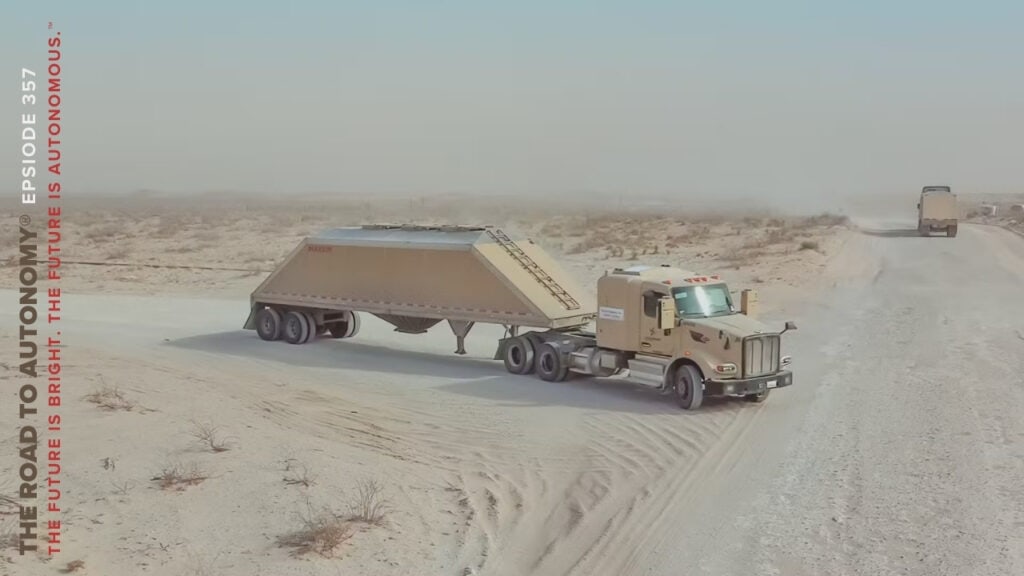
Pete Bigelow, Public Relations Manager, Kodiak joined Grayson Brulte on The Road to Autonomy podcast to discuss his firsthand experience in the Permian Basin and how the region acts as a “literal and figurative sandbox” for autonomous trucking.
Watch on YouTube | Spotify | X
Listen on Apple Podcasts
December 30, 2025