


This Week in The Autonomy Economy™
Zoox Is No Longer an Amazon Rounding Error
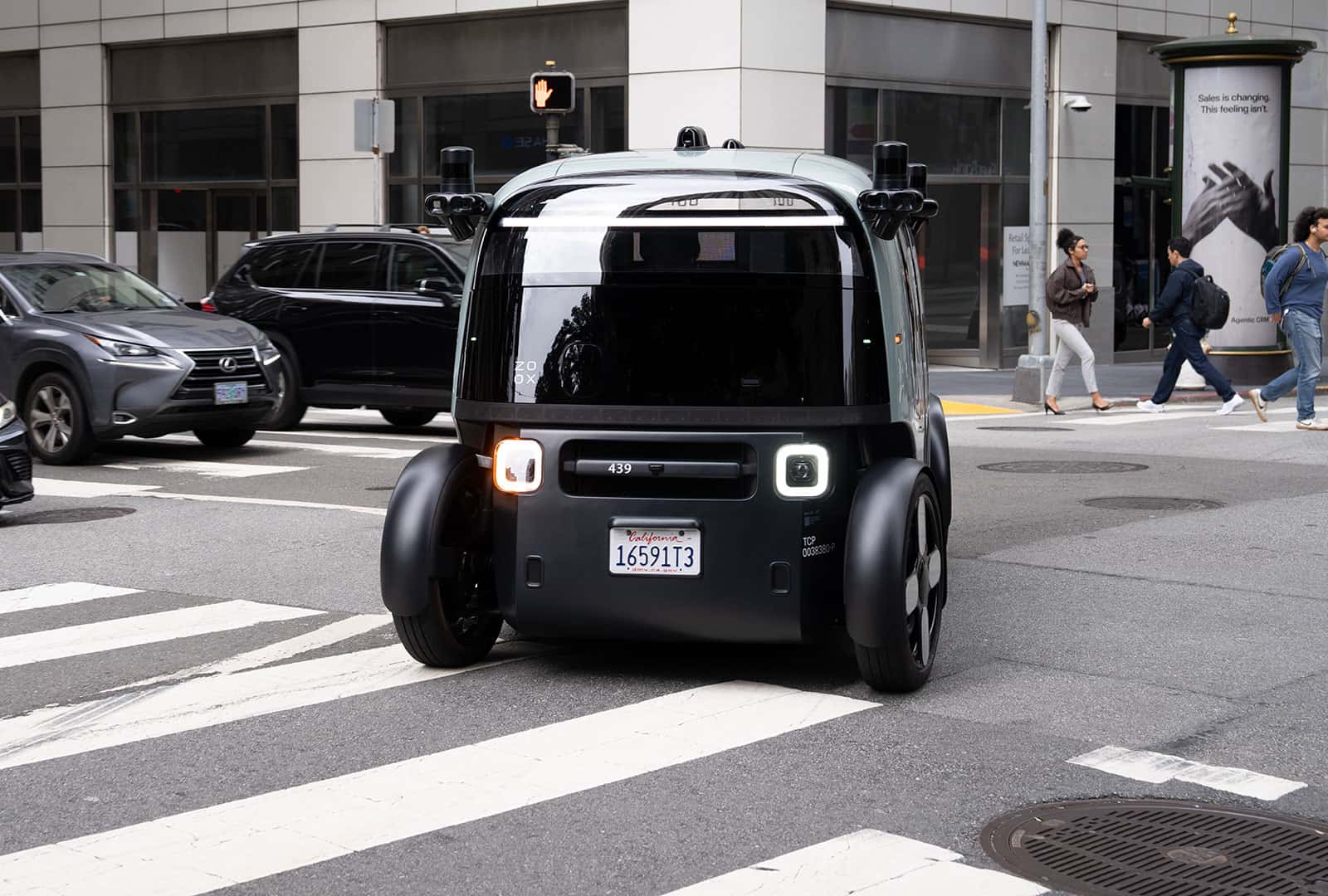
This Week in the Autonomy Economy, we spent time in the Bay Area visiting companies and putting on our trusty inspector hats. What we uncovered shines a light on just how grand Amazon’s plans appear to be for Zoox.
Despite the extremely limited number of Zoox vehicles on the road today, the company has an extraordinarily large inventory of vehicles at all stages of the assembly process. That’s right, the assembly process. The Zoox supply chain is far more complex than one would think, to the point where a significant portion of their burn rate could be tied up in managing their global supply chain.
While questions remain about their business model, one thing is certain. Their ambitions are grand. Whether those ambitions come to fruition is ultimately up to Amazon. Based on what we saw, we are even more dumbfounded by why investors aren’t asking tougher questions about Zoox, as the company’s burn rate appears to be far more than “just a rounding error.”
We may never fully know why Zoox operates the way it does, or why Amazon allows them to do it. But we do know that Zoox’s plans are larger than we previously thought, and their cash burn is much higher than we initially assumed.
While Amazon and Zoox figure out the long-term unit economics of their business, Waymo is quietly putting the pieces in place to capture a significant chunk of the Bay Area ride-share market.
Despite recent public data showing a slight temporary dip in Waymo ridership in California, largely due to highways being shut down for an extended period, we expect Waymo’s numbers to increase when they next report to the CPUC.
While the future remains unwritten, Waymo is executing in the present. Today, they are methodically laying the groundwork for a robust infrastructure network capable of sub-5-minute pickup times. This phase of deployment isn’t sexy, and it requires in-depth field work. But that is precisely the kind of work that we do.
It’s the work we enjoy, and it gives us a better sense than most of where this market is heading. As Waymo builds out their infrastructure and adds more automation to their depots, Elon is doing what Elon does, vertically integrating.
In the Bay Area, Tesla is following Waymo’s lead and securing infrastructure to power their robotaxi network. Securing the infrastructure, getting the site energized all takes time.
When a company begins making large investments in real estate across specific parts of a region, it tells you exactly where that company is heading. On this trip, we learned where both Zoox and Waymo are heading, and what Wayve’s commercialization plans look like.
We will leave you with this, Wayve is operating a disciplined playbook, and it’s not necessarily the playbook you might suspect.
Next week, The Road to Autonomy podcast returns with Frank Reig, CEO of Voltera, followed by Friday’s Autonomy Signals presented by KPMG and Autonomy Markets on Saturday as well as our weekly written analysis.
📰 Need to Know: This Week in the Autonomy Economy
What is happening with Zoox’s assembly process and burn rate?
Despite having a very limited number of vehicles on the road, Zoox maintains an unexpectedly large inventory of vehicles at various assembly stages. Its global supply chain is far more complex and capital-intensive than generally assumed, driving a burn rate high enough to raise questions about why investors aren’t pressing Amazon harder on long-term unit economics.
How are Waymo and Tesla preparing their physical footprints in the Bay Area?
Waymo is methodically expanding real estate and automated depot infrastructure to support sub-5-minute pickup times across the Bay Area. Following suit, Tesla is actively acquiring and securing local real estate sites to power its planned robotaxi network and get them energized.
What is the status of Waymo’s geographical expansion plans?
Waymo is expanding internationally to Munich, Germany (scheduled for 2027), while expanding its U.S. footprint. In Denver, it will launch with a 50-square-mile service area, and in Las Vegas, it secured regulatory approval for employee testing at Harry Reid International Airport alongside a venue partnership with The Venetian Resort.
How are global regulations shaping up for autonomous vehicles?
Regulation is moving at starkly different speeds globally: China has proposed a national autonomous vehicle framework establishing strict legal accountability for manufacturers, and Buenos Aires authorized testing for robotaxis and delivery bots. Conversely, Transport for London (TfL) is intentionally slow-walking robotaxi deployment in the UK.
What major updates were reported for autonomous trucking and the middle-mile?
Gatik closed a $200 million funding round led by QIA and Koch Disruptive Technologies to scale fully autonomous commercial operations, Kodiak integrated AMD EPYC CPUs into its 7th-generation hardware platform, and Bot Auto committed to keeping all remote assistance operators based strictly within the U.S.
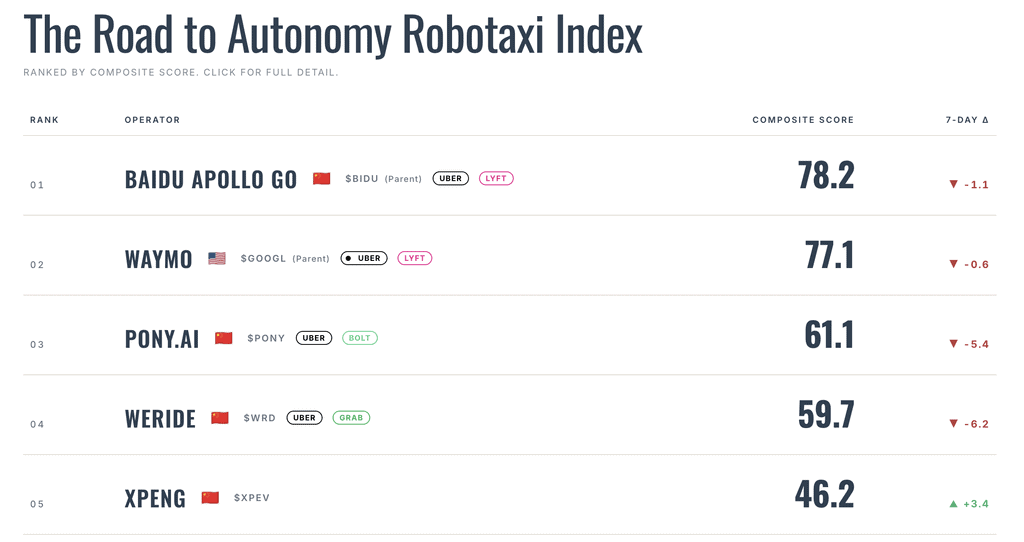
The Road to Autonomy Robotaxi Index
Piquing Our Interest
Waymo to Expand to Germany Waymo announced this week that it is expanding to Munich, Germany, with service scheduled for 2027. The Road to Autonomy subscribers were not surprised by the news, as our OMEGA model uncovered a Waymo German entity on June 28th, 58 days prior to the official announcement.
Waymo’s Denver Launch Service Area When Waymo opens public service later this year in Denver, the company is going to operate in a 50-square-mile area that covers most of downtown.
Waymo’s 10 AI Lessons Read the report and you realize it’s an indirect attack on Tesla’s vision-only approach to autonomous driving. The timing and the post were strategic, as it was released eight days before Tesla is set to launch the Cybercab.
Viva La Drop-Fees If there is one thing that Vegas casinos are addicted to, it’s fees. Waymo is now the official ride-hailing partner of The Venetian Resort. With the partnership in place, the question now becomes what will the drop fee be?
Waymo Begins Airport Testing in Las Vegas Waymo has received regulatory approval to operate fully autonomous robotaxis with employees at Harry Reid International Airport, bringing the service one step closer to a public launch.
Tesla Expands Dallas Robotaxi Service Area Tesla has expanded its Robotaxi service area in Dallas from 31 to 81 square miles.
Bot Auto Commits to U.S.-Based Remote Assistance Operators As the debate around remote operators heats up, Bot Auto put a stake in the ground, vowing to keep all remote-based operators in the United States.
Kodiak Integrates AMD into 7th Generation Platform AMD EPYC CPUs enable Kodiak AI’s seventh-generation autonomous truck hardware to process data loads more quickly.
Gatik Raises $200m Gatik recently closed a $200 million round led by Qatar Investment Authority (QIA) and Koch Disruptive Technologies, as the company works on scaling commercial fully autonomous operations.
TfL is Slow Walking Robotaxis in London Those hoping to ride in an unsupervised robotaxi this year are unfortunately in for some bad news. It won’t happen, because TfL (Transport for London) has decided to slow walk the process in line with Prime Minister Andy Burnham’s desire to slow down the deployment of robotaxis.
The Times: London Must Embrace the Driverless Car Revolution The Times editorial board penned an August 27th editorial calling for London not to be asleep at the wheel as robotaxis scale globally, but not in the UK.
Buenos Aires Authorizes Robotaxi and Delivery Bots Tests Could Buenos Aires become the first major metropolitan city in South America to deploy robotaxis? It’s starting to look that way as the city opens the path to testing.
China Proposes National Autonomous Vehicle Framework China submitted a draft amendment to its Road Traffic Safety Law featuring a dedicated chapter on self-driving technology, which defines operating conditions, establishes legal insurance requirements, and holds manufacturers or importers accountable for traffic violations that occur while a vehicle is actively operating in autonomous mode.
CaoCao Mobility Reports 140 Deployed Robotaxis As part of its RoboX strategy, CaoCao Mobility recently reported that the company currently operates a fleet of 140 robotaxis.
📰 Follow @RoadToAutonomy on X for our latest thoughts and insights on the autonomy economy.
Trending on X
As Avride’s fleet in Texas continues to grow, the company is making strides toward launching driver-out commercial service in the Lone Star State. The fleet currently stands at 344 vehicles as of August 29th, second only to Waymo in Texas.
Our take: Avride coud be a sleeper. Only time will tell.