


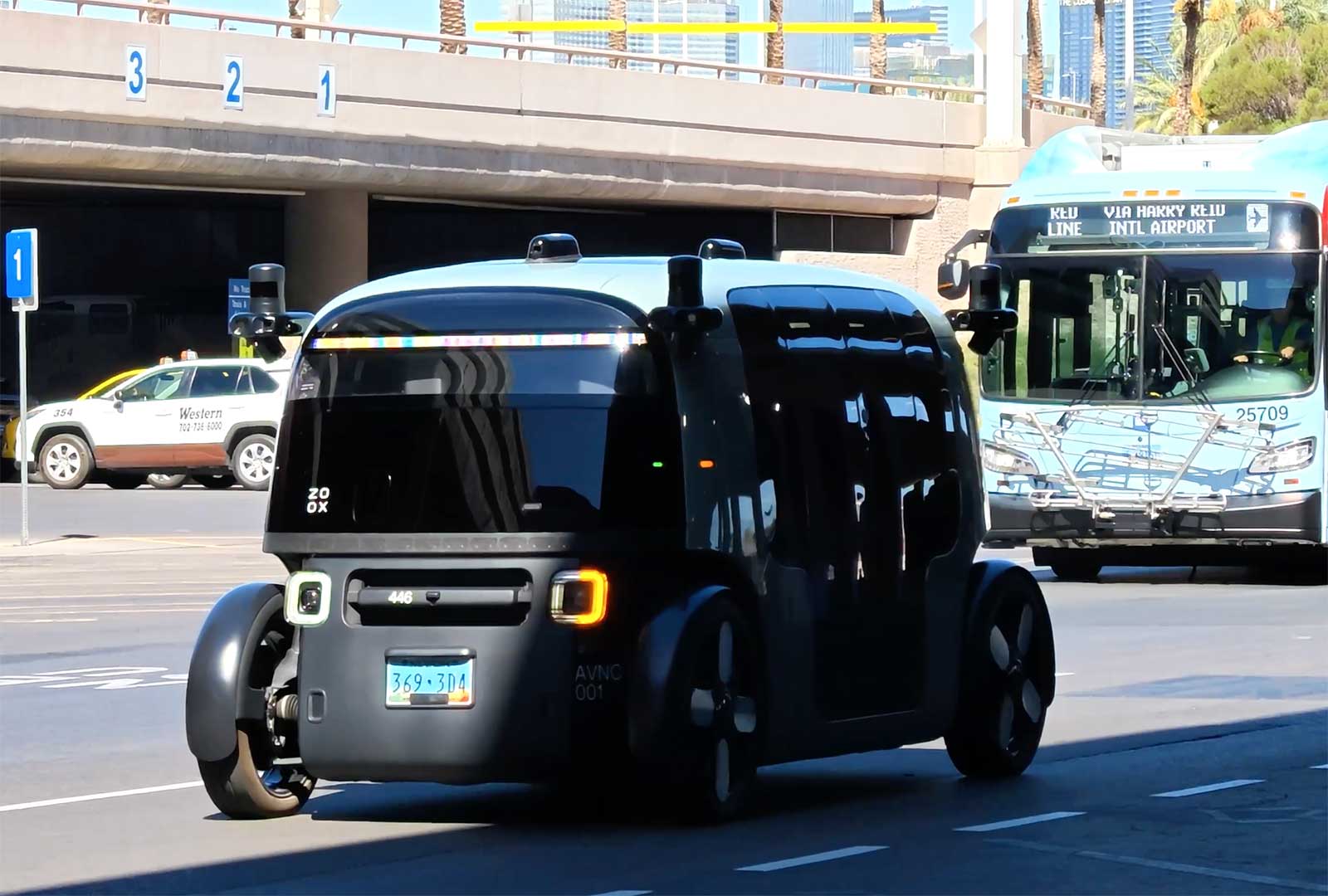
Zoox Las Vegas Airport Field Report
Filed By: David Moss on October 22, 2026
Field Verified
Key Zoox Las Vegas Airport Field Report Findings
How was the route for Zoox’s airport service conducted in Las Vegas?
The test ride took place between Resorts World (Hilton / Conrad side) in Las Vegas, Nevada, and Harry Reid International Airport (Terminal 1). The route avoided direct transit down Las Vegas Boulevard, instead executing a wide loop (“L” shaped route) across I-15 and back-roads to reach the airport.
What operational rules and features govern Zoox’s autonomous ride-hailing service?
Zoox operates as a fully driverless, custom-built robotaxi (purpose-built vehicle with no steering wheel or pedals, bidirectional driving, and face-to-face seating). Operational hours were recently expanded to 8:00 AM – 1:00 AM (previously 11:00 AM – 1:00 AM). Passengers interact via the Zoox mobile app and in-cabin touchpads for door operation, climate control, media connectivity, and passenger support.
How did Zoox perform and where do the challenges lie?
While Zoox offered a quiet, comfortable, and highly preferable private cabin experience over traditional rideshares, performance varied significantly across the round trip. Key challenges included inaccurate wait-time estimates (wait times ballooning up to 45+ minutes), false seatbelt sensor triggers caused by loose items like backpacks, phantom braking events (such as hesitations near construction cones/trucks or road dips), and occasional erratic lane-change decisions during complex highway/intersection maneuvers.
Zoox Las Vegas Airport Field Report
In Las Vegas, Nevada, Special Field Correspondent David Moss evaluated Zoox’s robotaxi service during a round-trip test ride between Resorts World and Harry Reid International Airport. The evaluation covered both outbound and return legs, observing vehicle behavior, route selection, and passenger interactions.
Testing Environment and Route Selection
Zoox recently expanded its service hours in Las Vegas to run from 8:00 AM to 1:00 AM. The test ride commenced at Resorts World (Hilton side) heading toward Terminal 1 at Harry Reid International Airport for a fare of $30. Instead of driving down busy Las Vegas Boulevard, the vehicle executed an alternative route, taking back streets and making a large “L” shaped detour across I-15 to reach the terminal. On the return journey, designated pick-up zones at Level 0 of the airport were exceptionally well-marked with dedicated signage and escalators leading directly to the pick-up area.
System Hardware and Driver Oversight Requirements
Zoox utilizes a fully autonomous, custom purpose-built vehicle with face-to-face seating and no traditional driver controls (steering wheel or pedals). The passenger experience is supervised remotely via support dispatchers reachable through touchpads. Cabin safety mechanisms enforce mandatory seatbelt engagement for all passengers; if weight sensors detect an unbelted object (or falsely detect a backpack), automated voice prompts chime and remote support personnel contact the vehicle to verify passenger safety before continuing the trip.
Driving Performance in Urban Las Vegas Traffic
During smooth segments of the trip, Zoox demonstrated confident urban driving, reaching speeds up to 43 mph in a 45 mph zone. It seamlessly handled highway-adjacent traffic, navigated construction zones with road markers and nearby crew members without disengagement, and rendered real-time movement cues on internal passenger displays to announce upcoming turns. On the return trip to Resorts World, the vehicle smoothly maneuvered around stopped buses and complex road configurations.
Challenges and Auto-Parking Performance
Significant performance disparities were noted between the two legs of the journey:
- Wait Time Predictability: On the return leg, initial wait time predictions expanded rapidly from 28 minutes up to a 45+ minute wait, highlighting ongoing dispatch prediction issues.
- In-Cabin Sensors: Seatbelt occupancy sensors triggered repeated false alarms due to a light backpack placed on the seat, prompting automated threat-to-cancel warnings and a intervention call from Zoox Support.
- Routing & Braking Instabilities: The outbound trip experienced multiple phantom braking events (one near a concrete truck and another over road transitions). Additionally, after missing a recommended left turn to the terminal, the vehicle looped around three right turns and cut across an intersection from a straight lane to make a late left turn through construction cones.
The Rider Experience
Despite technical friction, the inside experience was rated as quiet, highly comfortable, and far superior to traditional ride-hailing services due to complete cabin privacy. Riders enjoyed custom dual-zone climate controls, wireless and USB-C charging ports, and cabin lighting. The vehicle also drew positive public engagement from surrounding drivers and pedestrians.
Outlook
Zoox’s dedicated airport route deployment in Las Vegas demonstrates clear viability for custom driverless shuttles in high-demand tourist corridors. However, resolving dispatch wait-time accuracy, refining seatbelt weight-sensor thresholds, and smoothing out phantom braking near complex intersections and construction zones remain critical focus areas before scaling operations further.
The future is bright. The future is autonomous. The future is field reports.
Subscribe to This Week in The Autonomy Economy™
Join institutional investors and industry leaders who read This Week in The Autonomy Economy every Sunday. Each edition delivers exclusive insight and commentary on the autonomy economy, helping you stay ahead of what's next.