


XPENG Next Generation Pilot (NGP) Field Report
Field Report · Paris, France · XPENG · Level 2+ ADS
Filed By: Spencer on October 21, 2026
Field Verified
Key XPENG Next Generation Pilot (NGP) Field Report Findings
How was the test route for XPENG’s NGP conducted in Paris?
The demo ride took place during the 2026 Paris Motor Show on a predetermined urban loop through Paris. The test route was not chosen by XPENG or Tesla, but rather assigned by the event organizers. XPENG and Tesla were the only two ADAS systems authorized to conduct test rides on this designated route.
What hardware and operational rules govern XPENG’s NGP system?
The XPENG NGP system powered by VLA 2.0 operates as a vision-centric setup using seven cameras. As a supervised system, a safety driver must remain behind the wheel and touch the capacitive steering wheel at least once every 30 seconds to maintain engagement.
How did XPENG perform and where do the challenges lie?
XPENG NGP delivered an exceptionally smooth ride, handling complex urban traffic, roundabouts, narrow streets, pedestrians, cyclists, and tram lanes without driver intervention. The primary challenge was automated parking on irregular infrastructure, where the vision system struggled to distinguish between a two-inch curb transition and the primary curb.
XPENG Next Generation Pilot (NGP) Field Report
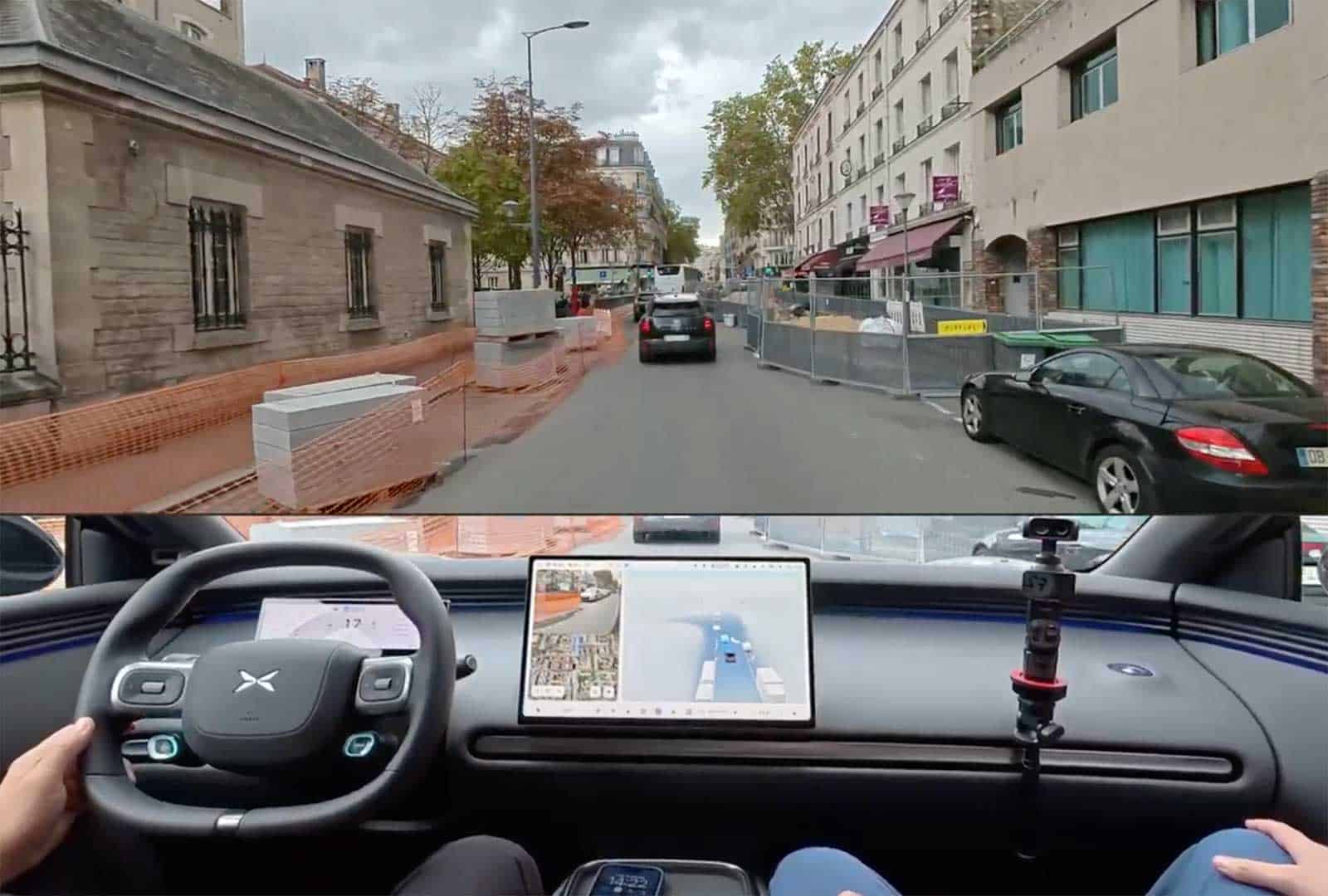
At the 2026 Paris Motor Show, Special Field Correspondent Spencer evaluated XPENG’s Next Generation Pilot (NGP) powered by VLA 2.0 during a live test ride on the streets of Paris. Our test covered a roughly 30-minute urban driving loop accompanied by an XPENG safety driver.
Testing Environment and Route Selection
XPENG’s road tests were strictly confined to a predetermined loop in Paris. This route was not created by XPENG, but was instead set by the Paris Motor Show event organizers. XPENG and Tesla were the only two automakers permitted to operate ADAS test rides along this official route.
System Hardware and Driver Oversight Requirements
The NGP system powered by VLA 2.0 relies on a vision-based architecture utilizing seven cameras. Because the software operates as a supervised driver-assistance system, the vehicle continuously monitors driver attention. The system requires the driver to keep their eyes on the road and touch the capacitive steering wheel at least once every 30 seconds. If steering input is applied manually, the system shifts into a “co-drive” mode rather than fully disengaging.
Driving Performance in Urban Paris Traffic
Throughout the 30-minute test loop, XPENG NGP navigated dense, complex European driving conditions. It seamlessly negotiated roundabouts, tight lanes, pedestrian crosswalks, traffic light intersections, and shared tramways. The vehicle demonstrated smooth steering, acceleration, and braking inputs while accurately rendering cyclists, pedestrians, traffic cones, and emergency vehicles on the center display.
Challenges and Auto-Parking Performance
While the main driving loop required zero driver interventions, automated parking presented minor friction. Attempting to auto-park near the end of the test required multiple forward and reverse adjustments. The vehicle’s vision system hesitated due to a complex double-curb setup, a two-inch lower curb step leading to the main sidewalk, though it ultimately completed the parking maneuver successfully.
The Rider Experience
Inside the cabin, the ride felt refined, quiet, and human-like in its decision-making. The system confidently yielded to aggressive traffic, allowed proper spacing for motorbikes at forward stop boxes, and absorbed rough cobblestone streets and potholes smoothly.
Outlook
XPENG’s deployment of NGP powered by VLA 2.0 demonstrates that its physical AI driving stack generalizes well to unfamiliar European road layouts. As XPENG pursues UNECE UN Regulation No. 171 certification to expand its software globally, refining auto-parking edge cases on unique regional infrastructure will remain a key focus.
The future is bright. The future is autonomous. The future is field reports.
Subscribe to This Week in The Autonomy Economy™
Join institutional investors and industry leaders who read This Week in The Autonomy Economy every Sunday. Each edition delivers exclusive insight and commentary on the autonomy economy, helping you stay ahead of what's next.