


Waymo Las Vegas Field Report
Filed By: David Moss on October 29, 2026
Field Verified
Key Waymo Las Vegas Report Findings
How is Waymo operating its robotaxi service in Las Vegas?
Waymo is operating its Ojai vehicle in Las Vegas through an early access program, serving surface streets only with no freeway driving at launch. Waymo has two location partnerships in the city, Allegiant Stadium and The Venetian, while pickups at Resorts World run through the traditional rideshare area with none of the preferential treatment Zoox receives as the resort’s official partner.
What is the current state of the Waymo Las Vegas rider experience?
The Ojai cabin is a clear step up from the Jaguar I‑PACE. It is extremely spacious, the rear screen can be repositioned, the windows roll all the way down, and Gemini is built in as a voice assistant. Booking was straightforward, with a two stop ride priced at $32 and a third stop added mid ride for roughly $10 more without a second payment prompt.
Where do the challenges lie for Waymo in Las Vegas?
The driving itself is the weak point. We observed repeated phantom braking, jerky and robotic braking, a lane change without a turn signal, a last second lane change out of a left turn lane, and a near miss with traffic cones. The Allegiant Stadium partnership dropped us on a street well short of the stadium, and Gemini gave answers on USB‑C ports and emergency door releases that conflicted with what we found in the vehicle and with Waymo’s own onboarding audio.
Waymo Las Vegas Field Report
The Road to Autonomy special field correspondent David Moss rode in a Waymo Ojai from Resorts World to Waymo’s two partner locations, Allegiant Stadium and The Venetian in Las Vegas, before looping back to the Conrad at Resorts World. This report covers booking and pickup, the Ojai cabin, driving performance, and how Waymo’s local partnerships hold up on the ground.
Booking and Pickup
The Waymo app is currently available in Las Vegas through early access, with a public launch expected. We booked from Resorts World, where Waymo pickups use the Dayclub rideshare area alongside traditional rideshare options. Unlike Zoox, the official partner of Resorts World, Waymo receives no special pickup treatment at the property.
A two stop trip to Allegiant Stadium and The Venetian was quoted at $32, roughly half that per stop. The app showed an Apple Live Activity preview and an estimated wait of three to four minutes at 11:39 in the morning. The Ojai arrived within that window, pulled into the middle of the pickup lot rather than a curb, and the doors opened automatically.
Mid ride, we added a third stop back at Resorts World. The app added roughly $10 to the fare and did not prompt for payment a second time. As with Zoox, pickup and drop off points at the same property are different.
The Ojai Cabin
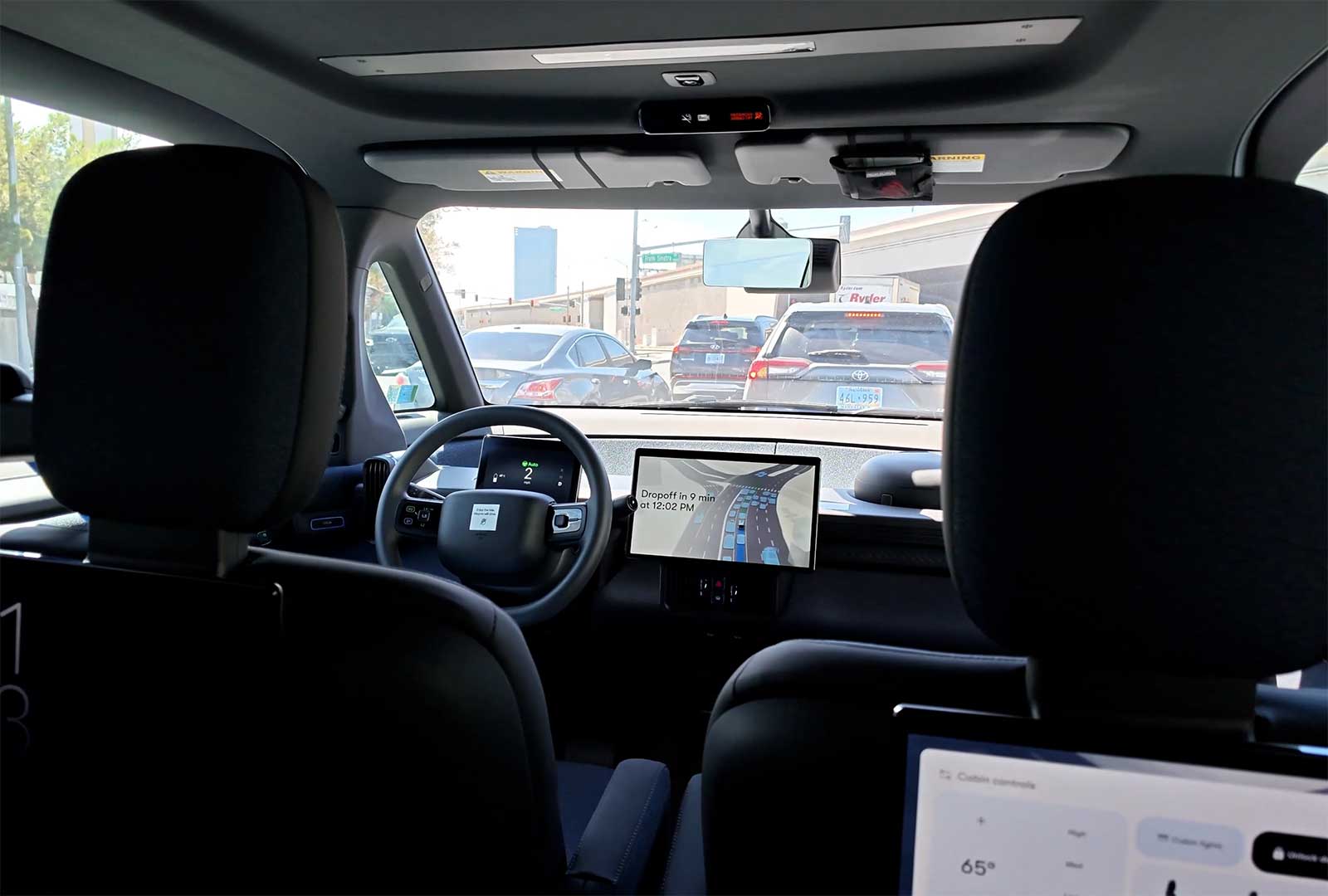
The Ojai cabin is the standout of the experience. At roughly six feet tall, our correspondent had room to spare in both the rear and front seats, and the overall experience was significantly better than the Jaguar I‑PACE.
The passenger screen runs a new interface and can be moved between rear and front leg room positions, something the Jaguar did not allow. Riders can set climate to auto, switch to dark mode, play Spotify or YouTube Music, and open a route view showing the full planned path and arrival time, a feature not available in Tesla Robotaxi or Zoox. Cabin lighting is touch controlled, and the windows roll all the way down, which is also not possible in a Zoox or a Tesla Robotaxi. The windows are lightly tinted and the trunk is large.
Other details stood out. The vehicle has multiple cabin cameras, a window breaker tool, insurance documents and a vehicle number on board, and an unusually large rearview mirror, presumably to support validation drivers. The front passenger seat moves forward, back and down but cannot recline, which Cybercab and Model Y both allow. The turn signal sound is present but very faint. The screen displayed battery level, which fell from 48% to 41% over the trip, but unlike the Jaguar there is no visible odometer.
Gemini and In Cabin Information
Gemini is built into the Ojai and responds to voice prompts. It correctly described The Road to Autonomy, AUTNMY AI and OMEGA when asked. However, its answers on the vehicle itself were unreliable.
Gemini said the Ojai has four USB‑C ports, including two for rear riders below the passenger screens. We could not find any rear ports. When asked about emergency exits, Gemini said the Ojai has no mechanical door handles or separate emergency releases. That conflicts with Waymo’s own onboarding audio, which instructs riders to remove an emergency cover in the roof lining, pull a strap, and then pull latches behind covers at the bottom of each door in the event of a power loss. We were unable to locate an obvious emergency release in the cabin, and this warrants further examination.
Driving Performance
Waymo is not operating on the freeway in Las Vegas at launch, and our route stayed on surface streets west of I‑15 before crossing via Spring Mountain Road.
Driving quality was mixed. The vehicle exhibited repeated phantom braking with nothing around it, along with robotic, hesitant braking that our correspondent compared to an Uber driver struggling with regenerative braking. It was not intimidating, but it was noticeably less smooth than the Jaguar and the Cybercab in Austin.
Specific issues observed included a last second lane change after sitting in a left turn lane, failing to move over for traffic cones and passing them on the left edge of the lane, a lane change with no turn signal, lightly running over a fallen construction item in its lane, confused trajectory planning while merging on Las Vegas Boulevard, and a hard brake during a difficult drop off at The Venetian, where it also took a tight angle close to a pole and another car.
There were strong moments as well. The vehicle made an assertive, clean left turn followed by a well executed merge, handled a yellow light properly, managed pedestrians crossing at a red light without issue, and its perception visualization showed an impressive number of surrounding vehicles.
Partner Locations
The Allegiant Stadium stop was a disappointment. The vehicle pulled over on a street well away from the stadium rather than at the venue. This may reflect a game day only arrangement, but on a non event day the partnership delivered no practical benefit.
The Venetian drop off reached the correct destination. We did not see any Waymo partnership signage at the drop off point, although signage may be located at the pickup area, which we plan to retest.
Competitive Landscape
During the ride we observed additional Ojai vehicles in service, as well as Motional vehicles. A Tesla Cybercab was also spotted mapping Las Vegas streets. Our understanding is that Tesla holds the same permit as Waymo and other operators and could launch at any time, but has chosen not to yet. Earlier the same day, our first Zoox ride was a rougher experience than this Waymo ride.
Outlook
The Ojai gives Waymo a meaningfully better rider product in Las Vegas, with a cabin that outclasses the Jaguar and its robotaxi competitors on space, screen flexibility and rider controls. The driving stack is the gap. As Waymo moves from early access to a public launch, smoothing out braking behavior, tightening lane discipline, and turning venue partnerships like Allegiant Stadium into true curbside access will determine whether the vehicle’s hardware advantage translates into a lasting share of the Las Vegas ride hailing market. Waymo should also ensure Gemini’s vehicle answers, particularly on emergency egress, match its own safety guidance.
The future is bright. The future is autonomous. The future is field reports.
Subscribe to This Week in The Autonomy Economy™
Join institutional investors and industry leaders who read This Week in The Autonomy Economy every Sunday. Each edition delivers exclusive insight and commentary on the Autonomy Economy, helping you stay ahead of what's next.