


This Week in The Autonomy Economy™
Uber Is the Elizabeth Taylor of the Autonomy Economy
This Week in the Autonomy Economy, Moove raised a $250 million Series C led by Mubadala, WeRide expanded to Denmark, and Zoox is preparing to launch commercial service on Monday.
After 12 years, Zoox becomes a business on Monday when it launches commercial service in Las Vegas with paying passengers. While Zoox works on lowering wait times, Waymo opened service in Dallas to the public.
As we head into the fall, competition in the robotaxi industry is increasing as Uber is becoming the Elizabeth Taylor of the Autonomy Economy.
📰 Need to Know: This Week in the Autonomy Economy
How is Uber’s Elizabeth Taylor strategy playing out in the autonomy economy, and why are its key partnerships unraveling?
Uber mimics Elizabeth Taylor’s famous multi-marriage lifestyle by entering high-profile, non-monogamous partnerships with over 20 autonomous vehicle (AV) operators, backing these deals with a $10 billion commitment across equity, infrastructure, and vehicle off-take. However, the initial “honeymoon phases” are giving way to high-profile breakups. The partnership with Waymo is fraying as Waymo expands directly into new markets, builds corporate entities across Europe without Uber, and leaves future operations in Austin and Atlanta uncertain. At the same time, sidewalk delivery partner Serve Robotics cited fundamental disputes over fleet coordination and merchant integration, choosing not to renew its commercial contract when it expires in 2027 and shifting its delivery growth toward Uber rival DoorDash.
Why does Uber hold asymmetrical power over its autonomous vehicle partners, and what lesson does this teach young operators?
In nearly all of its relationships outside of Waymo, Uber acts as the alpha partner, using its massive demand aggregation to dictate terms, dispatch rules, and merchant placement. If an AV partner struggles with low utilization or experiences operational misalignment, Uber can simply severance ties and route its millions of users to a competitor. The institutional takeaway for emerging operators highlighted by the Serve Robotics split—is that Uber holding equity (such as Postmates’ 14.3% stake in Serve) does not guarantee commercial exclusivity or operational alignment. While Uber’s platform provides vital early scale, relying on it long-term can turn into a “demand toll tax,” prompting scaling operators to build direct relationships with customers and businesses instead.
What major commercial milestones and expansion plans did Zoox, Waymo, and WeRide achieve this week?
After 12 years of development, Zoox is launching its commercial robotaxi service with paying passengers in Las Vegas on Monday, putting pressure on the company to maintain sub-10-minute wait times to effectively compete with Waymo and Tesla’s upcoming offerings. Meanwhile, Waymo opened its service to the general public in Dallas, initiated fully autonomous employee rides in Denver, conducted emergency response training signaling a North Bay expansion in California, and secured a Lyft integration in Nashville. Internationally, WeRide partnered with GreenMobility to expand its robotaxi fleet to Denmark, targeting a commercial deployment in the first half of 2027.
How are key capital raises, acquisitions, and fleet scaling metrics shifting across the Autonomous Vehicle landscape?
Capital deployment and market targets are recalibrating across the sector. Moove closed a $250 million Series C led by Mubadala, a notable downshift from the $1.2 billion debt round reported in mid-2025 to finance its fleet rollouts. In hardware and semiconductor developments, NXP Semiconductors is in talks to acquire Ambarella to strengthen its autonomous vehicle market footprint, while NVIDIA launched its open-source Alpamayo 2 model to serve as an AI backbone for the autonomy stack. On the commercial fleet side, Pony AI scaled back its long-term commercial truck deployment goals in China from 10,000 down to 500–1,000 units over the next two to three years, while London approved Wayve for a supervised ride-hailing trial on Uber with up to 15 vehicles.
What regulatory, legal, and operational hurdles are impacting autonomous trucking and robotaxi timelines?
Regulatory friction remains prominent as the Teamsters union filed a lawsuit against California challenging autonomous trucking regulations, citing public safety concerns. In the robotaxi sector, Uber is holding to a 144-day timeline to launch a driverless service with Lucid in San Francisco, though industry analysts emphasize that a true commercial launch must be both unsupervised and paid. Meanwhile, regulatory shifts surrounding vehicle safety continue to create broader industry precedents; for instance, regulatory exemptions granted to custom vehicles like Zoox’s custom pod are expected to streamline the path for Tesla to self-certify its steering-wheel-less Cybercabs.
What’s Moving the Markets
Uber Is the Elizabeth Taylor of the Autonomy Economy
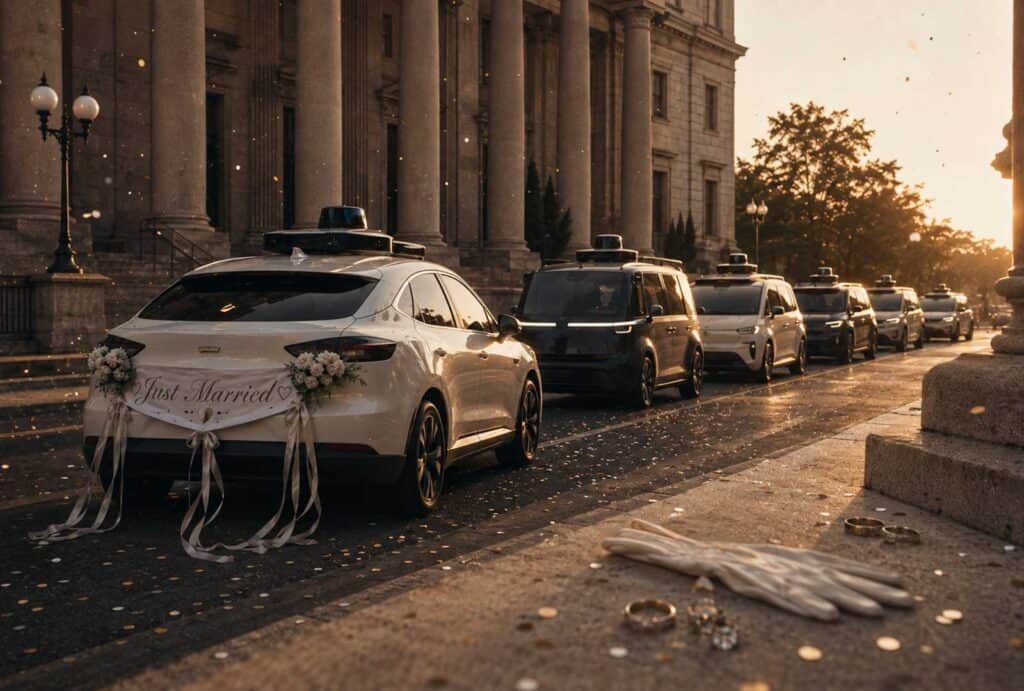
Elizabeth Taylor married eight times to seven husbands. Every wedding was a global event, every divorce a bigger one, and through all of it she remained the most famous woman in the world. Uber is running the same playbook in the Autonomy Economy.
Autonomous vehicles (both supervised and unsupervised) are live on Uber in seven cities, and are on track for as many as fifteen by the end of the year. All of this costs money, and Uber has committed to spend over $10 billion across equity investments, infrastructure, and vehicle offtake commitments to grow its autonomy business.
While Uber’s partners have committed approximately 120,000 vehicles to the network over the coming years, this is still just the honeymoon phase. The weddings are lavish and everyone is happy. The dowries are enormous, but the security that a dowry historically provides isn’t there because Uber is not monogamous, they are polygamous and forthright about it, too.
What happens when a marriage does not work out? It ends in divorce, and Uber is starting to pile up divorces almost as fast as Elizabeth Taylor.
The Divorces
Waymo Waymo and Uber have traded barbs in the press and battled a trade secrets lawsuit settled five days into trial before entering a polygamous marriage that started in Phoenix in October 2023 and later added monogamous vows in Austin and Atlanta. Now the marriage is coming apart.
On the Uber Q2 2026 earnings call, Uber CEO Dara Khosrowshahi called Waymo a very important partner and said: “As it relates to Waymo, listen, Waymo is a very, very important partner of ours, and we continue to operate in Austin and Atlanta. We believe we’ll continue to operate next year in those marketplaces.”
Believe is the keyword, not will. Believe and will have two distinct meanings: believe is hope, while will implies certainty. Following those remarks, Mr. Khosrowshahi stressed that Uber wants to ensure it is not dependent on one partner, reminding analysts that autonomous vehicles represent less than 0.5% of Uber’s overall trip volume.
This language is meant to bolster the narrative: I am better off without this partner; they weren’t that important to me anyway. After all, we are polygamous.
Waymo, for its part, has gone direct in every new market since announcing Austin and Atlanta with Uber on September 13, 2024. Yes, in Nashville you can get paired with a Waymo on Lyft, but you can still use the Waymo app directly so you do not get stuck playing a game of autonomous roulette.
Before The Financial Times reported the terms of the divorce on July 24, 2026, AUTNMY AI’s OMEGA discovered that Waymo was busy standing up corporate entities across Germany, France, Spain, and The Netherlands. When one spouse starts opening bank accounts in four countries, the marriage counselor can go home.
Serve Robotics On Tuesday, August 5, 2026, during Uber’s Q2 earnings call, Mr. Khosrowshahi named Serve Robotics as one of Uber’s sidewalk delivery partners. On Wednesday, August 6, Serve effectively filed for divorce on their own earnings call when co-founder and CEO Ali Kashani disclosed that delivery volume through Uber declined for the first time after 17 consecutive quarters of growth, breaking a streak that stretched back to Q1 2022 and forcing a full-year revenue guidance cut from $26 million to a range of $9 million to $10 million.
Mr. Kashani cited fundamental disagreements over fleet coordination and merchant integration, stating that Serve does not currently expect it would make sense to renew the agreement when it expires in early 2027. It is a divorce on the operating side, while the equity marriage remains intact for now.
While headlines covered the delivery volume decline, Schedule 13D filings continue to show Postmates (Uber) owning roughly 14.3% of Serve, about 5.3 million shares. Uber and Serve are heading for divorce, but finances keep them entangled for now.
Serve is not crying over the breakup; instead, they are moving on with Uber’s arch delivery rival, DoorDash. Serve’s DoorDash volume grew roughly 50% sequentially in Q2 with further acceleration into late summer as the company builds Beacon to connect directly with restaurants and skip the marketplace “demand toll tax” altogether.
Now the question becomes: which partner and Uber get divorced next? After all, Elizabeth Taylor divorced seven times across eight marriages. Uber has more than 20 autonomous vehicle partners, the runway to five more divorces is well paved. Now it’s just a matter of who’s up next to say goodbye.
The Three-Way Vow & The Ghost of Autonomous Technologies Group (ATG)
Then there is the three-way marriage that cannot fail: Uber, Lucid, and Nuro. Uber is providing the demand, Nuro supplying the autonomous driving system, and Lucid manufacturing the vehicle platform. All three need each other, but Lucid is hemorrhaging cash, raising questions about how long Saudi Arabia’s Public Investment Fund (PIF) will remain patient.
If LIV Golf is any indication, the answer is a long time, until it’s not. If that patience were ever to run out, it would validate what Uber co-founder and former CEO Travis Kalanick recently said on the a16z podcast: “anyone serious about the specialized robotics game has to own their autonomy.”
Uber sold ATG to Aurora in December 2020. Was that a mistake? At the time, it was viewed as a strategic decision as Uber avoided spending billions developing their own autonomous driving stack while leveraging its platform instead. Today, that decision looks less strategic as Uber racks up divorces on pace to surpass Elizabeth Taylor’s record.
The Asymmetrical Power Dynamic
In all of these relationships outside of Waymo, Uber holds significantly more control, decision-making authority, and influence. Uber is the alpha partner. For example, if a sidewalk delivery partner’s autonomous robots suffer from low utilization, or if operational visions misalign, Uber can simply sever ties and route its millions of users to the next suitor in line.
Serve Robotics just learned this the hard way, and every operator on the 2026 launch slate should study the lesson closely: Uber can make or break your business at any moment.
Uber is not pretending otherwise. The company’s Q2 2026 prepared remarks lay out the thesis explicitly. Uber compares the autonomous vehicle industry to foundation models, where multiple frontier systems emerged rather than a single winner, and argues that the long-term prize goes to whoever solves the “go-to-market puzzle.” The ambition, in Uber’s own words, is to become the world’s leading commercialization platform for autonomous mobility.
In other words, Uber wants to control it all, marriage partners included. This is not a marriage of equals; it is a one-sided relationship where Uber is Elizabeth Taylor, calling the shots and deciding when it’s the partner’s turn to shine.
The Pattern
Uber calls this a platform strategy; partners increasingly treat it as a starter marriage. Uber’s demand aggregation is invaluable when an autonomous operator is young, unproven, and capital-hungry. Once the operator scales, Uber’s take rate becomes a toll, and the partner files the paperwork. Serve said it out loud one day after Uber’s earnings call, and Waymo has been saying it by opening new markets for years without Uber.
The institutional lesson from the Serve unwind is that equity does not buy exclusivity. Uber can hold 14.3% of a partner and still lose the commercial relationship over dispatch integration and merchant placement. Ownership on the cap table and alignment in the depot are two very different things, and in the Autonomy Economy, only one keeps the marriage together.
While Elizabeth Taylor’s marriages ended, her stardom never did. Uber’s bet is that it is the ultimate star of the Autonomy Economy, the platform every operator needs. The partners’ bet is that Uber is merely the chapel: useful for the ceremony, forgettable after the honeymoon.
Taylor once joked, “I am a very committed wife. And I should be committed, too, for being married so many times.” Uber might not be committed to any single autonomous vehicle company, but it is fully committed to owning the network. In the end, while husbands came and went, Taylor always kept the diamonds, and Uber is betting that customer demand is the ultimate rock that outlasts every individual partner.
Our Take: Elizabeth Taylor famously declared, “Big girls need big diamonds.” Uber had the big diamond with their Waymo marriage, now they don’t. Partnerships are Uber’s best friend, until the marriage ends in divorce.
The Road to Autonomy Robotaxi Index
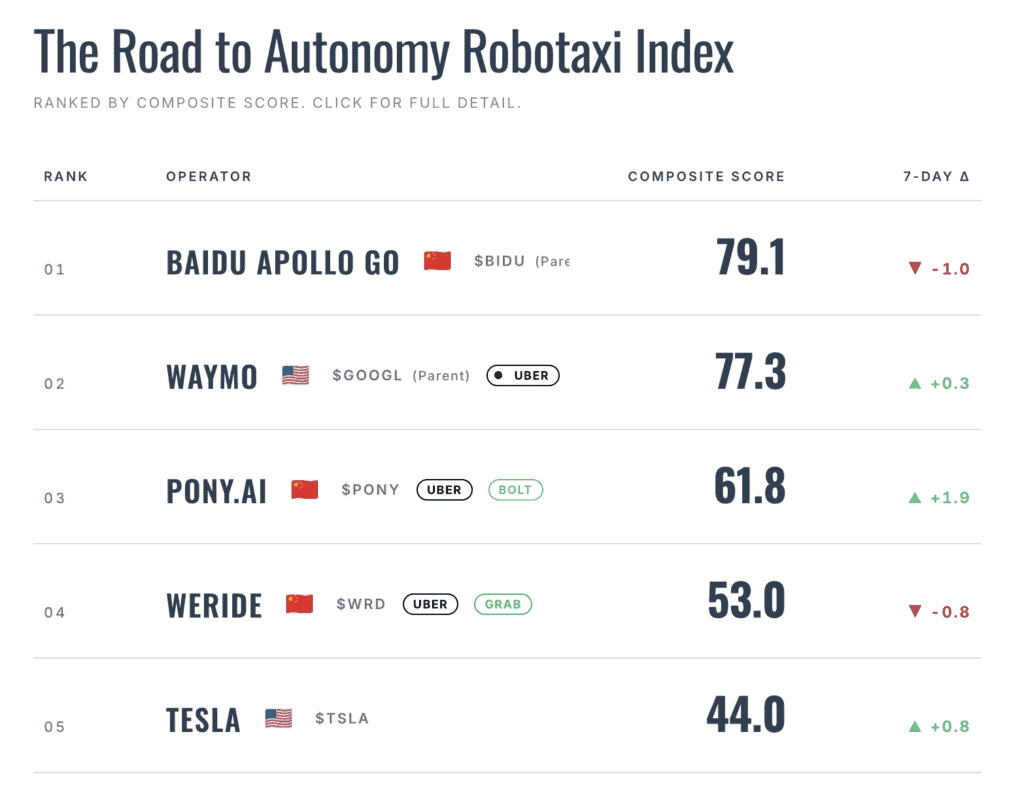
📈 Follow @AutonomyIndices on X for the latest updates on The Road to Autonomy Indices. Updates every 12 hours.
Piquing Our Interest
From $1.2 Billion to $250 Million On July 2, 2025, Bloomberg reported that Moove was close to finalizing a $1.2 billion oversubscribed debt round to fund its autonomous fleet rollout with Waymo. Thirteen months later, on August 5, 2026, Moove announced a $250 million Series C led by Mubadala, roughly 79% less capital than the round reported in 2025.
Wayve Secures TfL Permit, Supervised Rides on Uber to Begin Shortly Uber has taken the first step towards launching a commercial supervised robotaxi service in London with partner Wayve, after Wayve secured a TfL license for a fleet of up to 15 vehicles.
Waymo Opens Dallas Service Waymo has opened service to the public in Dallas. We have ridden in Waymos all around Dallas, and it was a great experience. We even did a Field Report on our experience.
Waymo Begins Fully Autonomous Testing in Denver Waymo has begun fully autonomous rides for employees in Denver as the company eyes a commercial launch later this year.
Is a North Bay Waymo Expansion on the Horizon? First responders from Napa and Solano counties recently attended a hands-on emergency response training session with Waymo. This is a strong signal that a potential expansion could be on the horizon.
Lyft CEO is Upbeat About Waymo Partnership In an interview with Yahoo Finance, David Risher was upbeat about the company’s partnership with Waymo and the role Flexdrive will play in that relationship.
Zoox to Begin Paid Rides on Monday in Las Vegas After 12 years, Zoox is finally becoming a business as the company begins charging for rides in Las Vegas. Now that the rides are no longer free, the wait times are going to have to be sub-10 minutes or the business will not scale as both Waymo and Tesla Robotaxi are soon to enter the market.
Uber is Sticking to their 2027 San Francisco Robotaxi Timeline Within 144 days, Uber is planning to launch a robotaxi service in San Francisco with Nuro and Lucid. The questions are: how long will it be supervised, and will they be able to charge by the end of the year? We measure a robotaxi launch as unsupervised and paid.
Tesla Cybercabs are Testing in San Diego Another day, another city. Tesla Cybercabs equipped with steering wheels have been spotted testing in San Diego as the company gears up for a commercial launch sometime in the future.
Teamsters Sue California over Autonomous Trucking Regulations In a move that should surprise no one, the Teamsters continued their war on autonomous trucking, this time by suing and using and using their unfounded tried and true tagline of public safety concerns.
NXP Semiconductors In Talks to Acquire Ambarella NXP Semiconductors is in discussions to acquire Ambarella as the company looks to expand deeper into the autonomous vehicle market.
Perseverance to Set Off-World Autonomous Vehicle Record On a planet far far away, NASA’s Perseverance autonomous rover is expected to surpass 28.06 miles next week, breaking the off-world distance record previously held by the Opportunity rover.
WeRide Expands Robotaxis to Denmark WeRide has partnered with GreenMobility to deploy WeRide robotaxis in Denmark, with service scheduled to come online in the first half of 2027.
Pony AI Resets Autonomous Truck Ambitions Pony AI has dialed back its autonomous truck ambitions from 10,000 trucks to 500 to 1,000 trucks in commercial operation over the next two to three years in China.
📰 Follow @RoadToAutonomy on X for our latest thoughts and insights on the autonomy economy.
Trending on X
NVIDIA’s grand autonomy ambitions continue to come to light with the release of Alpamayo 2, as the company positions itself as the foundational AI backbone for the autonomy economy. As NVIDIA’s autonomy ambitions grow, watch their Automotive and Robotics revenue.
Our take: NVIDIA’s grand autonomy ambitions are only poised to grow. The only question is what comes next?
NVIDIA’s Grand Robotaxi Ambitions Are Coming Into Focus
This week on Autonomy Signals presented by KPMG, Grayson Brulte and Rob Grant discuss NVIDIA open sourcing its Alpamayo 2 foundation model to capture the entire autonomy stack, WeRide expanding into Denmark through a partnership with GreenMobility, and Aurora sidestepping PACCAR with a Roush retrofit pathway to hit its 200 truck year-end target.
Can Uber’s Robotaxis Scale?
This week on Autonomy Markets, Grayson Brulte and Walter Piecyk discuss Uber’s Waymo hangover, Zoox launching paid rides in Las Vegas, the Teamsters suing California over driverless trucking, and NVIDIA’s Alpamayo 2 open model.
AUTNMY AI IN THE NEWS
Zoox’s regulatory win is a win for Tesla, too – Axios
Axios featured AUTNMY AI co-founder Rob Grant’s policy insights on what impact Zoox’s NHTSA exemption will have on Tesla’s Cybercab.
That regulatory limitation will make it easier for Tesla to self-certify the safety of its camera-only driving system, which has been heavily scrutinized, says Rob Grant, a former exec at Cruise, Aurora and Lyft, who co-leads AV research firm AUTNMY AI.
Read the full article on Axios