


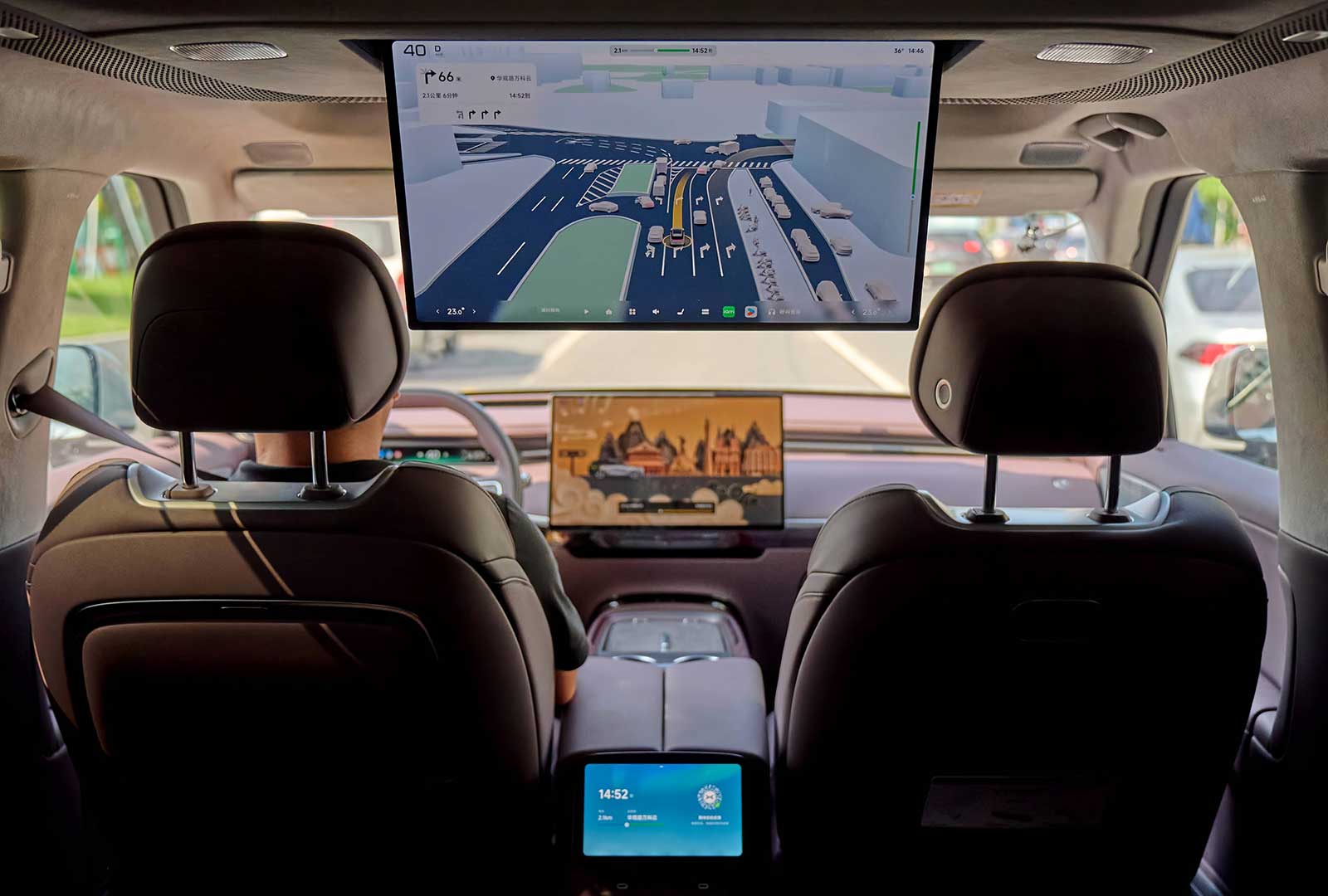
XPENG Introduces YOYO Robotaxi Service
NHTSA has opened a safety inquiry into Tesla’s robotaxi fleet—covering roughly 1,000 vehicles in Texas, Florida, and the Bay Area after video evidence emerged of vehicles speeding in active school zones. Separately, XPENG officially launched its YOYO robotaxi brand in China, pursuing a mapless, LiDAR-free approach and a technology-provider business model that partners with global fleet operators rather than running fleets directly.
Meanwhile, a Føtex supermarket near Copenhagen is piloting Unitree G1 humanoid robots powered by Hive Robots’ Heimdall platform for overnight shelf-stocking, with a target of fully unsupervised overnight restocking by early 2027. All three signals illustrate the regulatory, technological, and economic forces shaping the broader autonomy economy.
Key Autonomy Signals Episode Questions Answered
Why is the NHTSA school-zone inquiry particularly significant for Tesla’s broader regulatory situation?
The inquiry adds to compounding pressure on Tesla as NHTSA simultaneously audits Tesla’s FMVSS self-certification for its steering wheel-less Cybercab. Rob warns that, similar to the conditional operational letter issued to Zoox, NHTSA could attach geographic or speed restrictions to Tesla’s certification approval, and the timelines for both processes converge around December 2026 to early 2027.
How does XPENG’s YOYO business model differ from competitors like Baidu Apollo Go or Pony.ai?
Rather than operating its own fleet, XPENG plans to act purely as a technology and ecosystem provider, generating revenue through hardware sales, software services, and commission sharing while delegating physical fleet operations to local partners globally, a model closer to how Geely supplied vehicles to Waymo than to the vertically integrated approach of most Chinese robotaxi rivals.
What is the target timeline for the Føtex humanoid robots to operate fully unsupervised, and what obstacles remain?
The Salling Group’s Føtex trial is targeting independent overnight restocking by early 2027 with the store closed. Key obstacles include the robots currently operating slower than human employees, a one-to-one human supervision ratio, hardware costs exceeding $100,000 in year one, and Danish regulations that prohibit autonomous humanoid operation around shoppers during regular store hours.
Autonomy Signals Topics & Timestamps
[0:00] KPMG Sponsor Introduction
KPMG works across the full autonomy ecosystem, advising operators, OEMs, suppliers, insurers, and investors as autonomous mobility scales.
[2:44] Signal 1: Tesla Robotaxi NHTSA School Zone Safety Inquiry
NHTSA opened a safety inquiry into Tesla’s Model Y and Cybercab robotaxis after video evidence showed the vehicles speeding in active school zones. Grayson and Rob break down why the inquiry matters as Tesla’s Cybercab certification audit nears a decision, how Tesla’s mapless approach handles conditional speed limits, and whether the outcome could be a software recall or new operating conditions.
[27:00] Signal 2: XPENG Introduces its YOYO Robotaxi Service
XPENG launched its YOYO robotaxi service in China, running on in house Turing AI chips and the VLA 2.0 model without HD maps or lidar. Grayson and Rob discuss XPENG’s plan to act as a technology provider rather than a fleet operator, its exposure to U.S. AI chip export restrictions, and its target of overseas robotaxi trials in 2027.
[49:50] Signal 3: Supermarket Humanoids Hit The Night Shift In Denmark
A Føtex supermarket near Copenhagen is testing Unitree G1 humanoid robots to stock shelves during the night shift. Grayson and Rob examine the economics of the trial, the Danish regulations that keep humanoids away from shoppers, and the goal of independent overnight restocking by early 2027.
Full Episode Transcript
NHTSA Opens Safety Inquiry Into Tesla Robotaxis
RG_AS KPMG ad: the autonomy economy is real. Commercial robotaxi operations, humanless freight runs, AV infrastructure investment measured in billions. The question is no longer whether autonomous mobility scales, it’s who advises the companies building it. KPMG works across the full autonomy ecosystem: operators, OEMs, suppliers, insurers, and investors. At the moment it matters most, when the road ahead is uncertain, we’ve already been there. KPMG, accelerating what’s next in mobility.
Grayson Brulte: I’m out in the field doing field work, riding around in Ojai’s. My phone buzzes, it’s Walt. He’s like, “Did you see it? Did you see it?” I said, “See what? I’m in the Ojai. I see Ojai.” He said, “No, the Tesla’s doing stunts.” I said, “Oh my goodness gracious.” Perhaps the s- the Tesla stunts or the, the show or the showcase or, or Elon Barnum is a reference to the great P.T. Barnum, born and raised in Bridgeport, Connecticut, one town away from my hometown. We can talk about the signals next week, but we got a great show of signals here. As Rob, as I’ve been busy on the road, you and OMEGA, you’re becoming best friends now. You’re keeping track of the signals. And this week, the signals are as follows: Too Far For The School Bell: Federal Regulators Put Tesla’s Robotaxis On Probation. -oh. And then Say Hello To Yoyo: XPENG Moves From EV Maker To Robotaxi Provider. And signal three, Autonomy On Aisle Four. That’s right, we’re not calling Jim Carrey, we’re calling autonomy. Supermarket Humanoids Hit The Night Shift In Denmark. Lots of signals to break down this week, and before we do, as, as every week, a huge thank you to KPMG for being a wonderful sponsor. Where do we wanna start, Rob? I think I know we have to start with signal one, but that, that little show we saw was very, very interesting.
Rob Grant: I don’t quite know what to make of the show. flying cars, what looked like a giant Hot Wheel ramp and you know, special effects flying everywhere. It it’s a spectacle at least, right? It’s, it’s never boring. so y- you gotta give them credit. It’s, you know, come see the egress type of stuff. You never know what’s gonna show up. and thank you, Grayson, for being on the road and being our road warrior and trying everything out. it’s great to get calls from you and as you’re hopping from one ride to another to the next. it’s good stuff. I’m, I’m getting up-to-the-minute updates even faster than OMEGA’s getting them, which is impressive, ’cause OMEGA gets this stuff fast. And what it found for us today is signal one, right? Earlier this week, NHTSA launched a safety inquiry into Tesla’s 2026 robotaxis, both the Model Y and the Cybercab, after receiving numerous reports and submissions of video evidence of the vehicles speeding in active school zones. As you and I have always talked about it, there are a couple special categories of folks that always draw a regulator’s attention. If you put cops or you put kids in danger, that is gonna draw attention, and so Tesla has drawn itself some attention. The potential investigation, and it’s potential because this is a public submission to NHTSA, and NHTSA’s opening an inquiry based upon the evidence submitted, doesn’t mean that they’re gonna take any action. But it’s it’s, it’s, it’s something they have to take seriously and they are gonna take seriously, and in the next 90 so days come back with a decision whether or not this leads to a recall or, or something even grander. But the potential investigation covers an estimated 1,000 autonomous vehicles in the Tesla fleet, which are currently operating across Texas, where you are, Florida, where you came from, and the Bay Area, where I am. Imagine that. No incidents, though, to be clear, no incidents of traffic violations or, or crashes or injuries or fatalities have been recorded in these video evidences. So this is just, “Hey, I’m catching this vehicle speeding,” not that there was a ticket given, but we think this vehicle is going too fast in school zones. All of this adds to the mounting regulatory pressure that, that Tesla’s facing, right? It’s got the pet- not the petition, but its audit query going for its steering wheel-less, pedal-less vehicles in the Cybercab to see if that certification meets the standards of the law. It’s also recently had to rename its Full Self-Driving to Tesla Assisted Driving in Europe, and now we have this potential inquiry as well. For those who follow the indexes closely, the Road to Autonomy Robotaxi Index, which I do every day, twice a day as it updates, Tesla currently ranks sixth. It’s fallen a little bit, and we’ll talk about who’s overtaken them at number five in Signal II, which is XPENG, which means four of the top five spots in the Robotaxi Index are now held by Chinese companies. But Tesla currently ranks sixth on the Road to Autonomy Robotaxi Index. In that index, it’s got a manufacturing score of 95, one of the highest of all the companies. This just goes to show, though, production strength is not the same as showing that the cars can and will obey traffic laws on their own
Grayson’s First-Hand FSD School Zone Experience
Grayson Brulte: Traffic laws are important. You call the kids, I’ll call it children, ’cause then you get C&C, cops and children. See, we got a C&C’s Music Factory, so we can get a little music reference here early in the pod. I, I own a Tesla, as this audience knows, and I use FSD when I drive my daughter to school, and when it goes from 30 to 50 in the school zone, I have to take over manually ’cause it doesn’t stop, and it, and it does not slow down. So that’s my personal experience. Is this robotaxi? No. I’ve not experienced robotaxi in a school zone. I have experienced FSD in a school zone, and it doesn’t work. The other thing, just being a parent here for a moment, it does– It gets out of the carpool lane, and it tries to go around it. I’m like, “No, no, you can’t be that person. That’s not good. I’ll get, I’ll get, I’ll get my hand slapped. I’ll get my hand slapped. We can’t, w- we can’t, we can’t do that.” So there, there is a lot still for this technology to work, and I was talking to Spencer on my way back from dinner, and we had this whole conversation about routing, and so that’s the last word. There’s a lot of things to work through, but NHTSA is clearly taking a proactive approach to safety. Administrator Morrison is doing a fantastic job of promoting safety and putting safety first in all this. So there’s a lot of moving parts here with Tesla. Why does this matter, this, this specific inquiry as they’re going through the FMVSS approval right now?
Tesla’s Self-Certification Process and Regulatory Pressure
Rob Grant: It matters in particular because there is a lot of scrutiny on Tesla’s self-certification process. And what, what I’m saying, and this is not what NHTSA is saying, but if you look at what happened with the Zoox petition, now granted, a different process, right? Zoox went through that petition process. It got its petition granted, and then separately, as part of the process, in what was fairly unique for NHTSA, it sent an operational letter saying, “Yes, we’ve granted your petition, but here are some operating conditions that you have to work under, and there are certain milestones that if you meet, we can expand these operating conditions,” which included geographic locations for the vehicles. It included certain speed limitations for the vehicles, a certain fleet size for the vehicles I am– if I’m Tesla, I’m concerned because, one, it’s never good to be, have to be, explain yourself why potentially you’re putting children in danger. and two, if the certification perhaps can be tied to a similar operational letter saying, “Hey, we’re going to perhaps bar you from operating in school zones until we have further proof that you can do this correctly.” Now, you have to remember, right, these. Tesla operates on a mapless system. It doesn’t pre-map its operating areas, so there are not preloaded maps that have perhaps speed limit signs already in the map on the vehicle. and some of those signs, right, they, they can be conditional. They’re conditional where I live, which is, like, if children are present, it’s 15 miles an hour. If children aren’t present, it’s up to 25 miles an hour. Or sometimes they come with between and PM or and. And you have to wonder if without the preloaded map that already has this information for the vehicle to retrieve as it’s traveling in that area, if they’re having certain issues with either perceiving or understanding what it’s perceiving as it goes by a, a, a speed limit sign or something like that. So I would say the big concern here is that, one, on the investigation itself or the inquiry itself, that it, it leads to a recall of some kind saying, “Hey, Tesla, we’re not satisfied that your software operates up to snuff. Fix it or don’t operate in these areas.” Or two, somehow this gets tied into, like, a conditional operation letter when the self-certification issue is resolved because these timelines are, are starting to line up all towards the end of the year, beginning of next year, right? And we talked about this a couple of weeks ago with the update for the NHTSA rules as well. things are really going to center around that December, January period for Tesla. And so I. If I were Tesla, I’d be concerned that because of the unique nature of the violations accused of here, particularly endangering children, speeding in zones, school zones when children are present in them, right? It’s not just speeding when they’re absent. It’s not speeding at AM in the morning. It’s speeding at AM drop-off time that you could potentially see, you know, either a recall or a conditional letter saying, “Tesla,” like, “until you. We’ve approved your self-certification, but we’re gonna put some conditions on the way you operate because we’re concerned about the way you operate in school zones.”
Grayson Brulte: Could we see potentially or hypothetically these conditions applied in one market and not another market? Or do you think this could be blanket across all 50 states?
Rob Grant: Given that there seems to be nothing unique in terms of the evidence and the request that was sent in, nothing’s particularly unique to Texas, I would be worried that it would apply everywhere if the federal government, if NHTSA were to put a condition on. now, Texas has taken an approach where when it comes to these types of safety issues and safety performance around the software that Tesla is using or anyone else is using, they have taken a step back and said, “That squarely lands with the federal government.” So I would not expect Texas to take any individual action here. Now, if, if a, an incident should occur, if somebody should be injured or, or a really close near miss, you could see Texas step up especially if the federal government is not moving quickly, and they feel like it’s an emergency situation. But generally, Texas has said, “When it comes to the safety of the vehicle and the safety performance of the ADS, we’re going to leave that to NHTSA.” Now, if and when in California, the Cybercabs are allowed or permitted to go without a driver in them, you could see California perhaps take a more aggressive approach than Texas, which I’m not sure anybody on this call would be surprised, to think that California would take a more aggressive regulatory approach. So we could see it differ by state action if the federal government is not moving quickly enough according to certain states. But given that Tesla has not yet received permission to go driverless in California I think we’re not going to see Texas or Florida, both states where Tesla is currently operating driverless, take any action, and they’re gonna defer any action to the federal government
Grayson Brulte: Is there precedent or, or history? Has this happened before to, to another company? And if so, what was that outcome, and could that outcome potentially repeat itself for Tesla if there’s a proven potential fix that did occur?
Historical Precedent: Waymo School Buses and Babcock Ranch Shuttle
Rob Grant: When it comes to active school zones, there have been a few inquiries about performance in school zones. you know, both questions were raised about Waymo’s performance in school zones, particularly as it was caught on camera multiple times potentially not heeding the stop signs that pop out from school buses or the stop arms that sometimes pop out from school buses. That required a recall if I re- if I remember correctly, and, and Waymo did take some actions to update their software for better performance around school buses. it did not require Waymo to stop service. Just like here, Tesla is continuing to perform its services in Texas and Florida. It’s actually growing the number of vehicles in Texas, so that kind of, you know, justifies what I was saying about Texas taking a hands-off approach with this. It’s still allowing more cyber cabs to be added to the Texas DMV registry. I believe a couple of years ago it wasn’t with a robotaxi per se, but it was with an autonomous vehicle operating in Jacksonville, Florida that had an issue with transporting. It was like a minibus that kids used. I’m trying to remember the company. you might remember it. Do, do you remember the name of that company?
Grayson Brulte: So I was there.
Rob Grant: Oh, wow. You were there. Yeah, look at this
Grayson Brulte: I was there. I was not involved with the operation. I was a guest of the owner. It was Mr. Sid Kitson. Sid Kitson is the developer, Kitson and Partners developed Babcock Ranch, Punta Gorda, Florida, and the operator was Transdev, and it was an easy miles shuttle. And if you’ve ever spent time in Punta Gorda, in Babcock Ranch, It’s an eco-friendly community. I believe the top speed limit is 10 to 15 miles an hour, and wanted to move kids in the schools to the homes in this master plan community. Little fun fact, the school was actually designed by Governor Jeb Bush, and so very focused on academics, and they wanted to bring the, the future to these children. Put a lot of really great solar installations, a lot of great things around the community for children to interact with. And then as soon as they wrapped it in a school bus wrapping, they got a letter from NHTSA, and I think the administrator at that time was Dr. Mark Rosekind. You’ll have to fact-check me on that, but I was there the, the day the shuttle got shut down, and it sat in a parking lot, and all it was, was wrapped. And for the record, because we might get somebody that cries, “Oh, safety, safety,” there was a safety operator on the shuttle, and I think it was going 10 miles an hour in this master plan community, trying to expose children to this technology, and I think my daughter might have been six or seven at the time. She rode in the shuttle, not the one that was wrapped like a school bus, but she rode in the shuttle, and she was perfectly fine, and she was happy. So it’s the wrapping, and you wanna bring that full circle to today, Rob. I visited with a company, ’cause we visit with a lot of companies, and they manufacture school buses. And this individual that runs the plant said to me, “What if we made this autonomous?” And then I told that story today. So very good timing to bring autonomy signals to the field work that we’re doing, so well done, and Sid’s done a great job building Babcock Ranch In Punta Gorda.
Rob Grant: Yeah, Babcock Ranch is great. It’s great. But yeah, it just goes to, to show there’s a lot of evidence that when it comes to children, they’re in, like, a special category, right? My legal background brings me to there are different kind of constitutional categories that it’s called scrutiny, what kind of scrutiny is brought to a constitutional law case, right? For certain protected groups, you have strict scrutiny. Then you have this kind of nebulous area called intermediate scrutiny that applied to certain cases, and then you have kind of your, your regular baseline scrutiny that, that goes to most cases that involve issues of constitutional law. So you can put cops and kids, or as you say, cops and children because you like the alliteration better, cops and children into the strict scrutiny standard for federal regulators. And so your story about the school bus, that was just wrapping, but anything that potentially raises the question of is there potential danger? And, and, and, and it’s very much potential danger here, right? Again, we should remind folks that the evidence that was sent to NHTSA that w- for them to open up this inquiry did not involve any injuries or damage or, or, or close calls to, to, to hitting children. But just the potential that it’s there raises that scrutiny level to that strict scrutiny level for NHTSA.
Grayson Brulte: That’s the key word here, potential. Nothing has occurred, which is a very good thing, but it is potential, which brings us to OMEGA’s risk. OMEGA’s uncovered some really good risks here, Rob. Risk one, school zone temperamental and contextual recognition issues produce a defect determination and a recall. That is a good risk because, in my humble opinion, there’s two kinds of recalls. There’s a software recall and a hardware recall, but yet they share the common denominator, they’re called recall. And then our friends in the media, oh, they love to run with things. Recall, recall. No, it’s not Total Recall with Arnold Schwarzenegger, okay It’s a software recall, so just stating that there For the record
Rob Grant: For sure, right? And it, it– and this risks goes to exactly what I was talking about before. There’s the, the temporal potential issue here, right? It doesn’t understand the times at which the speed limit applies. And then there’s the contextual potential issue here as well, which means it doesn’t understand that what the sign says, if it’s like one of those signs that has just specific hours or that kind of w- only when children are pleasant present line to it. And so these are potential perception issues, right? As well as planning issues things of that nature. And so this could lead to a defect determination and a recall. And, and again, that’s not necessarily a death knell for Tesla, but it does continue to pile on more and more concern about Tesla from the federal perspective as it’s looking to finish its audit inquiry into the Tesla self-certification, as it’s exploring how it’s updating the rules around steering wheel-less and pedal-less vehicles that clearly affect Tesla, and then obviously trying to determine the safety performance of the vehicle ADS separate and apart from the certification question and the safety issues that come with certifying a vehicle regardless if it’s an ADS-driven vehicle or a non-ADS-driven vehicle. So it, it just, it just. it piles up. I’m sure whoever’s working the Tesla department at NHTSA you know, is staying up late but at least they have some job security. they’re not going anywhere for, for the next couple of months
Grayson Brulte: Now, in what we saw tonight, and you know there’s somebody in NHTSA that’s– I’m gonna use the old term from Phil Rizzuto, The Scooter, “Holy cannolis” or “Holy cow, there’s somebody sitting there waiting.” This thing’s not going on a public road. You and I both know somebody probably said those exact words, “This is not going on a public road.” So they have their work cut out for them. And let’s get to the risk, too, that OMEGA has uncovered here. Additional adverse crash publicity prompts Texas or federal action limiting the geofence or authorizations. That’s true. Th-that is true, and as we see here, I’m currently in Houston right now. Just to put this into perspective, and this is Houstonian traffic, so I want to put that in perspective. From where Tesla is operating in Katy to where it is downtown, 55-minute drive. But f-fifty-five minutes, and it’s operating in a very small area. Is downtown Houston necessarily the, the busiest, most populous? No. When the Astros play, it’s a lot busier. But still, it, it, it’s operating, if you wanna call, th-the suburbs. So this is a-another really good risk Omega’s pointed out
Lessons from Cruise: Death by a Thousand Cuts
Rob Grant: It is, and it makes me think back to my time at Cruise, right? We had a, a series of incidences, right? With, with cars that stalled or outages that caused the vehicles to stop in the middle of the road for a period of time. you know, things of that nature that you know, these little things as they start to pile up, what it does, right, is when the big thing happens, and a big thing will happen it will happen to all of these players eventually because it’s just, that’s just math. It’s the law of large numbers, right? The, the, the uniqueness of the things we see on the road, something bad will happen again. and if you’ve had all these kind of little things that have really chipped away at the regulator trust and the regulator patience there’s less patience for you when you trip into that big issue. And I think Waymo is the counter example. I think Waymo did a really good job and still does a really good job of addressing issues very quickly of getting ahead of them, of even kind of slowing their rollouts down to ensure these issues don’t occur. I would say, you know I, I loved Cruise, very loyal to Cruise and GM. We, we were moving at a faster pace but it created these kind of small cuts at the regulators’ trust. And ultimately, when the big issue comes, the regulator is just out of patience with you. and so Tesla may seemingly be headed in that direction. That’s not a direction that, that can. It’s not a one-way door, as they say here in Silicon Valley. They can reverse it. but I think they’re, they’re going to need to address these issues Kind of forthrightly and as quickly as possible, particularly around the issue of safety around children. Because I, I think regardless of where you stand on autonomous vehicles, if you’re pro-autonomy, you’re concerned about it, you, you want it in your city, you don’t want it in your city there’s zero tolerance. There’s strict scrutiny applied across the board when it comes to performance around children. And so, you know, this risk is spot on. I, I call it a death by a thousand cuts, right? You, you continue to have these issues it, it, it erodes that trust, and it- that trust is really critical in that moment of need when, when a much bigger issue occurs. And so I say kudos to Waymo. I, I think, you know, Tesla, I, I think, it– Like I said, it’s not a one-way door. They’re not on this kind of like inevitable downhill slide towards regulators you know, not trusting them. But I do think it’s this type of issue that you really wanna see them jump on top of and get ahead of and really address the issue proactively
Grayson Brulte: You have to address it proactively and you have to manage risks. I mean, risk management, r-risk abatement, wh-whatever term you want to use, they’re going to have to do it, and building trust takes time. It takes decades, and it takes a minute to crush, decades to build. So we’ll be watching it, and we wish all parties involved success. I mean, and, you know, for the children out there, autonomy is for the children. Like, there’s that, you know, there’s that great X account, Wu-Tang is for the children. I’ll just go on here and say, “Autonomy is for the children,” because this happens. A child runs after a, a ball in the street, the robotaxi is going to stop when there’s a 50/50 chance that a human’s not gonna stop. And unfortunately, we see those statistics. So autonomy is for the children. That’s my PSA today, which brings us to OMEGA’s take. “Tesla now faces two separate gates to scaling, whether the vehicle design is lawful and whether the automated driving behavior is lawful. Having permission to operate in a state does not settle federal deficit questions. The developments to watch are the petition decision, any recall filing, and any dated restrictions on unsupervised FSD or Cybercab operations. Those would change the success trajectory of Cybercab operations more than any other city launch would.” That is a good take, and it is concise, and OMEGA’s been eating her Wheaties
Rob Grant: She has, right? OMEGA is for the children. Since we’re, we’re talking about who’s for the children, OMEGA’s for the children. And for all the adults out there, if you want or need to talk to us or use OMEGA or have access to OMEGA, reach out to us at you know, Rob and Grayson. You can reach us at [email protected], or reach out on LinkedIn or wherever you find us. We’re, we’re ready and willing to engage and you know, support you as well as support the children
Grayson Brulte: Thank you. And I will say, our data is ground truth verified, and we’ve uncovered some very interesting things, which I’ll tease here for our subscribers who will get access to it in just OMEGA. The numbers publicly reported by the Texas DMV are not the actual number of vehicles on the roads. So I’ll tease that for you. We got the real numbers. They’re in OMEGA and they’re for subscribers. Rob’s signal two, XPENG. YoYo. I remember YoYo when we were kids. I could never get that stinking thing to go up and down, up and down, but yet XPENG, they’ve got the YoYo Robotaxi brand. What do we know about this signal?
XPENG Launches YOYO Robotaxi Brand and Commercial Operations
Rob Grant: Yeah, I was terrible. I, I always tried to– I wanted to walk the dog or whatever that trick was, and I, I think I smacked myself in the forehead more times than, than was necessary. And, and that may show in some of these episodes. You know, I have been smacked in the head a few times. so be patient with me, audience. But here, XPENG has officially named its robotaxi service XPENG YoYo, and it opened online registration to the public in China, transitioning the service from technical testing to commercial operation. XPENG YoYo is China’s first fully in-house developed, mass-produced robotaxi. It relies on four in-house Turing AI chips delivering three thousand TOPS of compute, and the Vision Language Action 2.0 vision model operating without HD maps or lidar. Sounds familiar, right? XPENG is very much taking a Tesla-like route. Vehicles rolled off production lines in Guangzhou in May 2026, began automated pickup and drop-off in July, and secured driverless road test qualifications in late August, early September. And initially, they have started to run paid internal trials before opening registration to external users. So about the vehicle itself, go online, take a look at it. it features customizable cabin pre-settings, including fragrance and temperature. I, I’ve never seen one that allows you to set the fragrance in the vehicle. I thought that was pretty cool. Zero gravity massage seating and a second-row entertainment screen. I mean, you have to go online, check it out, Google XPENG YoYo. These screens are huge. Huge. I mean, it is like going to a mini IMAX as you sit in a r- a robotaxi. and so it’s fully integrated with rich content services. Now, XPENG selected the short name YoYo for global brand recognition and plans to generate revenue as a technology provider via hardware sales, software services, and commission sharing while partnering with local fleet operators globally. And we’ll speak a little bit more about, you know, what this means, but the name YoYo was chosen because it appeals, they believe, to foreign markets, right? It is not a name chosen because it is a name popular in China. It is a name chosen for Europe in mind and for the Middle East in mind and for the US and North America in mind. So I f- I think that’s very interesting. We’re gonna hear a lot more about XPENG in the, in the coming year, I believe. Now, XPENG ranks fifth, just ahead of Tesla, who we just talked about, on the Road to Autonomy Robotaxi Index. They also have a manufacturing index in the nineties. and so they are they are moving up the ranks fast. And, and the YoYo, like I said, beautiful vehicle so check it out online. I can’t wait to get in one
Grayson Brulte: Yeah, no, they’re doing beautiful things and our friends Spencer and David Moss were recently in XPENG vehicles. They’ll be releasing field reports on, on those and what they experienced there over in Paris. But it’s very clear, and you and I have talked about this for a long time offline and online here on the show, China’s autonomous Belt and Road Initiative is, is real, and you’re seeing it play out in Europe, and now you’re seeing the Chinese EVs going to Canada, and it’s my prediction here. I’ll make a prediction here. It’s just a matter of time till Chinese robotaxi companies start operating in Canada, and it, it is globally, globally expanding. So what is the signal in the P- in, in the PR release here for XPENG? Because you and I, we put on our inspector hats. I don’t travel with costumes, so I don’t have the inspector hat. I have the field inspector hat that comes out in the, in the field, but I don’t have the, the general inspector hat on right now. But press releases tend to get bolstered on headlines, but what is the real signal in these announcements that XPENG has made?
XPENG’s Business Model: Technology Provider, Not Fleet Operator
Rob Grant: Yeah. There, there are two things that really drew my attention out of this press release from XPENG. The first is that it is now qualified to do testing without a safety operator on certain roads in China. So we always talk about how the key thing in determining progress is, do you have a safety operator in the vehicle or not? Are you truly driverless? And XPENG is now qualified to go driverless on certain roads, and so that’s a big step for them. And I think because of that, once they go driverless and we see some of those results made public, you’re gonna see them rise in our robotaxi index I’m pretty sure coming up. And the second, and I think this is probably more valuable for our audience, the second is the business model and how they spoke about how they’re going to make revenue. XPENG says it will not operate the fleets. It won’t be a fleet operator. It will act as a technology provider and ecosystem enabler, earning from hardware sales, services, and commission sharing, and handing offline operations to global partners, right? And, and so that’s really interesting, and, and I think it’s really interesting ’cause you mentioned the, the spread of Chinese vehicles. If you look at the US right now, right, we have Chinese vehicles in the US. We don’t have Chinese fleet operators. We have the Ojai. Waymo is running a Chinese vehicle in the US. So is it too long before we see an XPENG, maybe not run by XPENG as a fleet operator, but maybe you have a different fleet operator. You could see them partnering, you know, perhaps with an Uber or a Lyft or somebody else, right who wants to be the fleet operator with their vehicle and, and kind of take that approach that Geely did with getting its vehicles into the United States in the, in the Waymo operations. And so I think these are the two big things that I walk away with, which is they’re going driverless, and their business model is a little bit different than, say, a Baidu, Apollo Go, or a Pony.ai, some of the bigger competitors, or WeRide, some of the bigger competitors that we see in China
Grayson Brulte: It’s very interesting. It seems that XPENG, and this is my personal opinion, is studying the market. They’re taking the best of Tesla with no lidar and no maps, and then they’re taking the best of Waymo with having third parties manage the fleet and putting it together, and it’s called, this is called XPENG YoYo ’cause that’s really what it is, and they’re putting all the pieces together, and they’re studying the market. And if they are successful in this, it’s a buckle up and watch out moment
Rob Grant: Agreed. It’s, it’s gonna be really interesting, and what you’re starting to see is where can folks, one, add value to the chain, but two, where can they offload cost from the chain? And we’re seeing people take different approaches, and I think this is what makes the robotaxi market so interesting. Who wants to own the vehicles? Who doesn’t want to own the vehicles? Who wants to operate the vehicles? Who doesn’t want to operate the vehicles? Who wants to be the leaseholder on depot? Who doesn’t want to be the leaseholder on depot? And what you’re seeing is different approaches taken by some of the bigger players. And it’ll be fascinating ’cause it’s unclear. We have a sense, and OMEGA certainly has a sense that helps us inform it, and we’re happy to share that with everybody. It’s unclear how this all plays out, but in the meantime, there’s opportunity everywhere for everybody in the chain to find value. and, and I think that’s what’s really interesting about what XPENG is doing here is they’re– they think they’ve found value in a different spot along the chain than perhaps a Tesla or a Waymo or even a Baidu from their own home country. So I think that’s what makes it great. we’re going to see different approaches, different business models, different opportunities for people from outside the autonomy economy or the traditional kind of operators, I should say, but inside the autonomy economy to find opportunities to engage and, and to make money.
Grayson Brulte: There’s a lot of opportunities, there’s a lot of competition. You use– You said earlier you have WeRide, you have Baidu Apollo Go, you have Pony AI, now you have XPENG, all, all competing on the mainland, in my opinion, soon to compete in Hong Kong. And then the next competition market is going to be Europe. It’s gonna be very interesting to see how that resonates on the European continent. And you said the most important thing earlier, brand. Whose brand is going to resonate most on the European continent? I think that’s something to really, truly pay attention to. In my opinion, for the Chinese robotaxi providers, it’s not gonna come down to technology. It’s gonna come down to brand and brand awareness, and that’s something to pay attention to and really Watch.
Rob Grant: I think you’re right. I think y-y. the other vector that I would look at is just what is the service like? What, what is the expectation of a robotaxi service, right? I think it’s unclear to a lot of consumers that haven’t engaged with them. Is this a premium product? Is this a luxury product? Is this a regular everyday product? I think it’s, you know, when I talk to my, my family, and sure this is anecdotal, but they don’t live in Silicon Valley. They’ve never engaged with a autonomous vehicle They’re not quite sure what to make of it. Is it, is it for just the rich and the famous? Is it for everybody? and I think it’ll be interesting how the brands start to identify with the consumer at that price point. And, you know, th- this XPENG looks pretty luxurious. you know, the it- it’s– it could be a luxury vehicle, but the Yoyo I think is meant to signal that it, it is a kind of fun, open type vehicle, right? that it’s not just a luxury item. You don’t call something a Yoyo knowing what the, that means in different languages if you’re, if you’re looking for a premium type of brand. So it’s, it’s, it’s really interesting. we should also mention just real quickly here as to get, you know, back to more of the nuts and bolts instead of just branding. XPENG does have some exposure to the US AI training chip restrictions, right? And we did mention that it has its Turing chips, but that’s the– for the vehicle edge and inference, right? That’s protected by their Turing– proprietary Turing silicon. But it’s cloud training, right? That remains exposed because they, they are– their cloud training relies on high performance Nvidia anchored in CUDA optimized compute. So while I think it’s, it’s pretty unique, their Turing proprietary silicon, but that’s for inference and edge compute. It is not for cloud for the cloud training which is where their foundation model is, is going for, for high performance in pre-training and post-training, things of that nature. so a lot of the work is being done in the cloud. And so I think anytime we talk about a Chinese company, we have to understand kind of where it has its advantages and then where it might be hamstrung a little bit. And so in this sense XPENG, as I said, it’s, it’s not fully insulated from the US AI training, training chip restrictions. And so that’s something to watch as well because they may have hit a certain level where they feel that their cloud compute can now move to the edge, and the edge compute is strong enough and the inference strong enough to operate driverlessly. But that’s only for certain roads, and they haven’t done it yet. And so that, that signals to me a little bit that while they’re getting ready for commercialization with this brand change, that they’re not quite there technologically. They’re close, but they’re not quite there
Grayson Brulte: They’re trying. It’s the Wu-Tang Clan saying, “I’m on the Wu Tang now.” It’s like dolla, dolla bill, y’all, and for XPENG it’s like dolla, dolla chips, y’all. Dolla, dolla chips, y’all. Or if you wanna get really technical, dolla, dolla GPUs, y’all. That, that’s truly what’s needed. They need, they need Jensen to get chips, but obviously you, you have export restrictions which are going to slow this down, and to Huawei and others i- in the Chinese market catch up. We don’t know what the black market is. I’m not gonna comment on the black market there. Do we have any in- inclination or, or any public announcement of when XPENG potentially could look to export the robo technology to the global market from the mainland?
Rob Grant: I think yes. OMEGA has surfaced from its vast array of intelligence sources including, you know other Wu-Tang members RZA and Method Man. they may begin overseas robotaxi trials in 2027. So I, I, I think that’s the date to look for is sometime in the first half of 2027 for an overseas trial
Grayson Brulte: OMEGA’s the genius, the jizza, because I was listening to Liquid Swords on my drive from San Antonio to Houston. But, you know, when you, when you get in a sword fight, there’s risks in sword fights. And in, in shell and shadow boxing, there is risk. Which brings us to OMEGA’s risk, Wu-Tang style. driverless daily robotaxi operations without safety officers slip beyond early 2027. Okay, that’s a possibility
Rob Grant: That is, and and that’s what I mean. Like, they are announcing that commercial operations are coming, right? Hence the, the branding of the Yoyo, and all of the campaign around it drew our attention, drew OMEGA’s attention. and rightfully so. It’s a big step for one of the major players in the robotaxi race. However, what we didn’t see is an actual driverless operation. and so they’re still working towards that. they have the authority to do that on certain roads. They haven’t done it yet. And this risk is all about, okay, put your money where your mouth is now. Are you going to meet those expectations? It’s one thing to say you’re ready to go driverless. It’s another thing to actually go driverless. And I have that experience in multiple AV operators that I worked with. It’s a, it’s a big deal to take that final step. you get closer, you get closer, you get closer. You feel the excitement. You feel the worry. And then you actually have to commit to it which is a big thing. it’s a big step. And so we’ll see if, if whether internally they are delayed for some reason because they don’t feel properly ready yet, and that’s okay, right? We want people to be safe and feel like they’re ready to, to put their physical AI on the road in a safe manner. Or, or it could just be that you know, they, they, they haven’t solved everything that they feel like they need to solve, whether that’s an environmental condition, or they just wanna make sure that you know, as they go overseas, that the, the vehicle can make that transition to maybe a different hand drive or to different weather conditions or different road grades, things of that nature
Grayson Brulte: We’ll watch and see how it evolves, which brings us to risk two here. Tightening US restrictions on advanced computing chips delay XPENG and VLA 2.0 model training. That’s real. That export risk is very, very big, especially we see the massive sell-off in AI chips in, in the whole sector here in the US
Rob Grant: Yeah, it’s interesting. So I’ve been doing a lot of kind of talking to folks that are using different types of models, right? This is a VLA, vision-language-action model, which is a little bit different than some of the other models out there. right, you have your large language models, you have your world models. I think what, what will be interesting is that the US kind of chip restrictions are n- are geared towards, like, the language models in terms of parameter counts and the power of the model capacity, which now runs in the trillions of parameters. and so those really advanced chips are needed to run those super huge parameter models. And what we’re seeing from vision-language-action models, of which China is, is, is a leader in this, right? They just– they consume and they have so much access to video data, right? It’s not only data, you know, from you know, the DJI drones or from TikTok or from you know asking factory workers to, to wear phones on their head and, and video what they’re doing. It’s just, it’s just been part of their culture to be much more ahead on ingestion of video data. and as those models start to scale, meaning you, you, you put more data in and you add more compute to it, the scaling laws for VLA models are potentially steeper than they are. Meaning, like, they will achieve higher outputs in, in capacity and achievement at lower parameters than what the large language models are doing. So it’ll be interesting to see as XPENG and others really start to, to, to turn up the volume on their compute, so to speak, and get those parameters up, if they even need the compu- co-compute in the chips that are under restriction to get a really efficient output from their model. Meaning they could potentially use chips that are not under restrictions to achieve the advances they want in their VLA model which could then put the vehicle on the road with a higher – Efficiency and capacity to, to do the things it’s being asked to do, and ultimately with you know, the powerful inference chips on the compute itself. So it’s gonna be really interesting to see how that all plays out. It’s potentially an issue for XPENG, depending on how VLA models go up the scaling laws with the number of parameters it needs and the compute it needs to achieve those. but it’s possible that they don’t run into it as well, and that’ll be a really interesting thing. That’ll be a moment, I think, that, that kind of really resonates in the US when the US government wakes up and says, “Hey, we, we put all of our tariffs on preventing China from running ahead on certain models.” And you’re gonna be like, “Yeah, that’s great. You did it for large language models, but there are all these other models out there as well.” And perhaps they can achieve the types of gains in physical AI at lower parameter counts with less powerful chips than, than we originally thought
Grayson Brulte: And you and I know, and the world knows, China’s not gonna sit around and, and wait for a restriction to be lifted. They’re going to try and figure out another way how to do it. Point blank. I just– I said the quiet part out loud. And, and as Rob elegantly said, there’s a lot of moving parts, so we’re gonna have to watch and see how it evolves and, and we all know that China is not going to stop, and they are gonna continue to try and build a product to, to move ahead any which way that they see a competitive advantage. A-and XPENG if– is, is surfing that wave and, and moving there, and we’re looking forward to testing their technology when it scales in European continent, which brings us to OMEGA’s take. “XPENG’s launch of the XPENG YoYo.” Every time I hear the YoYo, Rob, I’m going from hardcore hip-hop to Yo-Yo Ma, the great cellist. I mean, that’s what I think of, of YoYo, with Yo-Yo Ma here. “Robotaxi service marks a strategic shift from EV manufacturing to becoming an ecosystem technology provider that partners with global fleet operators rather than managing fleets directly. By leveraging proprietary turning silicon and the VLA 2.0 vision-only model without lidar or HD maps, XPENG is pursuing a Tesla-style approach to autonomy. Key constraints include heavy reliance on NVIDIA-anchored cloud training infrastructure and the execution hurdle of achieving driverless daily operations by early 2027.” That is a very good, I’ll just use the term compact summary of everything that we packed into this segment
Rob Grant: It’s great. I, I’m gonna need to get like an agent with OMEGA’s brain to summarize everything I have to say in such a compact and wisdom-filled manner because I, I, I think everybody who talks to me would benefit from it. my conversations would be a lot shorter, and maybe I’d miss out on a few things, like all the Wu-Tang references. But, you know, we’ll leave that to the listeners to decide if, if, if, if they’ll miss that in the future
Grayson Brulte: I think they will ’cause I love the banter back and forth personally. I think it, it adds character to this show. If you compact it, I read the great book Ari Manny W- Wall’s book, which is phenomenal by the way. He, he’s the founder of Endeavor or co-founder, if we use that term. Roll the calls and he just cut the call off and dropped four letter words which we’re a children’s rated program, I’m not gonna drop the words, but I love the banter. So the banter’s gonna stay. The, I have one vote, you have one vote, but my vote’s to keep the banter stay. And if you don’t agree, okay, well then we have a tie or little secrets, we have an audience so maybe they have a vote. But hopefully the audience agrees that the, that the banter stays to adds really great in color, which is signal three. This one’s awesome. This one’s gonna get banter. Now on aisle four, humanoid in Denmark. This is cool. Lights out, humanoid out. Okay, there we go, banter time. What do we know about humanoids in the grocery stores in Denmark after hours?
Humanoid Robots Begin Night-Shift Testing in Danish Supermarket
Rob Grant: This is great. th- th- th- I love these type of stories. a Fotechs supermarket near Copenhagen, Denmark is testing humanoid robots to handle repetitive, time-consuming retail tasks like picking up items and stocking shelves. The primary focus of the test is to assist staff during night shifts and perform tasks away from customer areas. The robots currently work at a slower pace than human employees and still require close human supervision. and under Danish regulations, the humanoid robots are not permitted to operate autonomously around shoppers during regular store hou- hours. But I mean, this, this is a credible retail automation experiment, right? This is great. the real signal is that a major retailer has given an actual workplace to test data collection and integration. and so I, I really think this is the beginning of where we can see some utility out of humanoid robots. I mean, stocking shelves after hours and checking barcodes is a great use case for them. And yes, here they’re slower than humans right now, and there’s a lot of kind of one-to-one supervision going on, but this is a real use case, right? This could provide actual utility to people and hopefully, you know, maybe even lower grocery prices as the cost of operation. Look, I– my, I guess, first job when I was 13 years old was at an A&P in Brewster, New York. And I, I– they did not allow me to work the cash register, which is a good thing because I’m functionally illiterate at math. so they had me stocking shelves. and, and that was awful. I was in the, in the back room of a grocery store, which is dark and, and dank, just, you know, moving things into boxes, moving them out into the shelves. And, you know, I was 13, I was fairly spry, but I was sore after a long day. and it was also super tedious. It’s– I think the point of my parents getting me that job is, was to show me that, like, look, there– if you don’t work hard at times, like, you’re gonna work hard. and so it was, it was a, it was a difficult job, and would I have loved a humanoid to do it for me? Yeah, of course, you know? I think and particularly if you’re talking about after hours, late at night when the store is closed this is a real, a real use case, and I love to see the things that we talk about and people banter about whether or not humanoids have a real utility or not. Here, we’re, we’re seeing one in practice.
Grayson Brulte: Yeah, what it did for you is gr- character, and that’s truly what it did. And hopefully the regulation at some point, I’ll get to say, gets toned down where a human’s in the grocery store, “Excuse me, humanoid, what aisle can I find the sugar in? What aisle can I find the crackers on?” ‘Cause you forget things. Different grocery stores, different aisles, different layouts. You can ask questions, really, really helpful there. Do we have any insights or signals to how big this potential deployment could get there?
Rob Grant: Yeah, it’s small right now and that’s intentional so, intentionally so. But Føtex is, is owned by the Salling Group, which is Denmark’s largest retailer, which has more than 2,000 stores across six countries. and so it’s a trial run at the Føtex store now, but it could, it could expand to many more stores in the future. And, you know, something to call out here, because folks are gonna, they’re gonna wanna know, like, what kind of, whose humanoid is being used. In this case, it’s a Unitree G1 humanoid. and the Danish startup Hive Robots supplies the Heimdall intelligence platform, whereas Unitree then supplies the hardware. So the, the shape of this is a European customer, Føtex, a local integrator in the Hive Robots with their Heimdall intelligence platform, and a Chinese hardware supply chain. And I think this is, this goes to your quote earlier about the, the Belt and Road Initiative. This is– We’re going to see more and more of this because China’s lead in robotics and humanoids is growing. The number of humanoids deployed in China, the number of humanoids being built in China, the number of humanoids then being exported out of China is unparalleled right now. And what you’re seeing is, you know, yes, maybe you, you partner with a local integrator, but you know, these European stores and retailers are not having any issue using the Chinese hardware
Grayson Brulte: And the other thing with China and robotics, they have the raw materials to make them. And, and that is a key thing and, and obviously the part of the raw materials, one of the most important things that OMEGA, when we first started this journey, you and I had a deep dive on was magnets, the importance of magnets. And, and China also controls that. Do we have any i- in- insight or projections around when these humanoids might go unsupervised in the grocery stores without having to have a, a human, I’ll use the term overlord sitting there to, to monitor them? They’ll be able to stock the shelves fully autonomously, unsupervised on their own?
Rob Grant: Yeah, the, the, they have a target date. The goal is independent overnight restocking by early 2027 with the store closed. And so you know, with that, they’re, they’re hoping that they can reduce, as you said, the human operator supervision and the kind of staffing ratio needed if you were to put additional humanoids into service there. But they are targeting by early 2027 independent overnight restocking with the store closed. now the Danish law would have to be changed if, if the, the humanoid were to work autonomously among the shoppers. I don’t anticipate that changing by 2027. but I do think overnight use will, will happen in just a, you know, what? Two quarters from now, three quarters from now. and I will, I will say, I’m sorry, my Danish is not that good. I’m saying Heimdall and that may be pronouncing it incorrectly. I’m recalling this from Marvel movies. And so that may not be the p- correct pronunciation, so please forgive me if, for all of our Danish-speaking friends out there. Eh, by the way, we were talking about Copenhagen earlier. Beautiful city. I enjoyed my time there. Wonderful place to go and visit, so I encourage folks to go there and go to the Fotech store and ask them, “How’s your humanoid doing?”
Grayson Brulte: Ask how, how, how the human was doing. I’m really curious. When you were in that store, could you find out how much it cost? I’d love to know that. Do we have any insights on what the operational costs are or any insights into the economics here?
Economics and Timeline for Humanoid Grocery Deployment
Rob Grant: So yeah, we, we do have a little bit of insights. you know, OMEGA has uncovered that the– it believes the hardware price, so the, the price for the Unitary G1 was a, a little above $50,000. and that the year one total cost of ownership is going to exceed over $100,000 once integration, licensing, safety engineering, and tooling are included. And so with the throughput being slower than human speed right now and the continued human kind of oversight for it this is not a, a super profitable venture at this point, but I don’t think that’s the point of it. I think the point of it is really to understand as the robotics get better in terms of, you know, things like gripper and navigation and need less su-supervision, as the cost of the actual hardware goes down and the ability to do more tasks, right, other than just stocking shelves, such as maybe check expiry dates, right, empty shelf detection, finding misplaced goods things of that nature, things that you can do in a store when, when it’s closed overnight I think you’ll see the economics improve. But I, I think the real economics here are, are not really the goal of this because they don’t, they don’t suggest that this is something you’d want to scale at the moment. But what they’re trying to do is learn as much as possible, because a lot of those costs will come down pretty quickly over time
Grayson Brulte: Costs are gonna come down, and we both agree, and this probably majority always agrees, that humanoids are going to scale and they’re going to scale globally. But as they scale, there are risks, and OMEGA has surfaced two quick risks here. Risk one: Danish regulation continues barring autonomous operation around general shoppers. That’s a real risk because we know the Europeans love regulation. All you gotta do is dial 1-800-GDPR. That’s all I’ll Say
Rob Grant: They do. And it– but in this case, it might not be a bad thing to have somebody at least put a, a marker down about how humans and robots should interact in certain environments, right? I, I think that may not be where the mark is set forever, but I do believe this conversation needs to happen and it needs to happen quickly in many places because the humanoids are advancing, whether that’s in the home, in the factory, in grocery stores. And a better understanding of what our expectations are on what liability is, where that liability falls, right? Because even in this instance, you, you have, you know, the folks that make the hardware, you have the folks that are actually putting the intelligence into it, and then you have the folks that are operating it. There, there’s three different potential places along that, that chain that you know, fault could lie. and so I think I would credit any state that takes a first stab at that. it may not be right, and it’s certainly not going to be where, where I think it needs to be 10 years from now or five years from now when there are many more humanoids out there. But I would love to see this discussion get going because I do believe that regulation is going to be one of those long poles for humanoids and their consumer use
Grayson Brulte: And we’ll continue to watch it ’cause it’s, it’s an evolving market, which brings us to the final risk of the show here. One-to-one robot ratio and slower than human speed limit productivity gains. That is true. It’s something to, to watch. And then as Elon said, and he is correct, it goes back a lot of it to the dexterity. So that’s something to really watch. And what is the key with dexterity that we highlighted earlier? Magnets
Rob Grant: For sure. For sure. That is clearly an issue, right? and then secondly, it is, it is the learning and the training o- of the robot for those situations, right? Understanding how do I recognize that a shelf is empty? How do I recognize what goes into that shelf? How do I recognize that you know, what I’m picking up is a can which can be dropped, you know, with, from a certain level as opposed to a glass that can’t be dropped from that same level. And so a lot of this has to do with, you know, is the, is the training of the robot and what’s where is that done? Is it based on the physical world? Is it based on a visual world? Is it a large language model? We saw Astra, right, come out and show that it had done some pretty unique things with the robotic arm and sorting. So a lot of this will, will actually, in addition to, you know, the, the, the production potential for slowdown with the actuators and the magnets, how are these embodiments of physical eye being trained, and are they succeeding in the tasks that they’re being trained for? Or is it the task specific, right? Or is it a more general purpose training that allows the, the human way to maybe respond and react to different situations it might find in the store? So that, that’s gonna be a really fascinating thing because I do think personally, and I’ll make a prediction, I, I do think in the next 12 months we’re going to see just un- unheard of advances in terms of the capabilities of humanoids because of, of so many smart folks working on those types of issues
Grayson Brulte: Humanoids are going to scale. They’re going to do repetitive tasks. They’re gonna do dangerous tasks. They’re gonna make our world safer, they’re gonna make our world more efficient, and it’s just part of the overall autonomy economy. Each and every week, Rob and I are going to be here breaking down the signals in the autonomy economy. And if you’re interested in the work that we do, our, our ground truth intelligence, our, our OMEGA service, which is our general subscriptions that we’re offering to subscribers where they get constant real data, proprietary data, reach out to us at [email protected]. That’s [email protected]. The future is bright, the future autonomous, the future is great shows with musical references. Rob, I don’t know how we’re gonna top this next week, but we are gonna have to get something else cooking
Rob Grant: Oh yeah. I mean, I’m, I’m gonna go put on some Wu-Tang right now. you know, I’ve, I’ve got my 17-year-old in the house. He’s a big fan, and I think we’re just gonna have a little dance party
Grayson Brulte: Rob is going to enter the 36 Chambers. Great show.
Discalmer: Opinions here are as of the recording date, may change without notice, and do not necessarily reflect the views of AUTNMY AI Incorporated, its affiliates, or any speaker’s employer. Content, including the road to autonomy indices, is for informational and educational purposes only. AUTNMY AI is not a registered investment advisor or broker-dealer and does not give investment, legal, accounting, or tax advice. Nothing in our public or gated content is investment advice, a recommendation, an offer, or a solicitation to buy or sell any security or financial product and should not be relied on to evaluate any transaction. This program may contain forward-looking statements. Investments involve risk, including loss of principal. Past performance is not indicative of future results. Hosts, guests, and affiliated entities may hold long or short positions in securities mentioned. Content is provided as is without warranty. We disclaim liability for reliance on this information. Consult your own investment, legal, and tax advisors before making any financial decision.
The future is bright. The future is autonomous. The future is The Road to Autonomy.
Subscribe to This Week in The Autonomy Economy™
Join institutional investors and industry leaders who read This Week in The Autonomy Economy every Sunday. Each edition delivers exclusive insight and commentary on the autonomy economy, helping you stay ahead of what's next.