


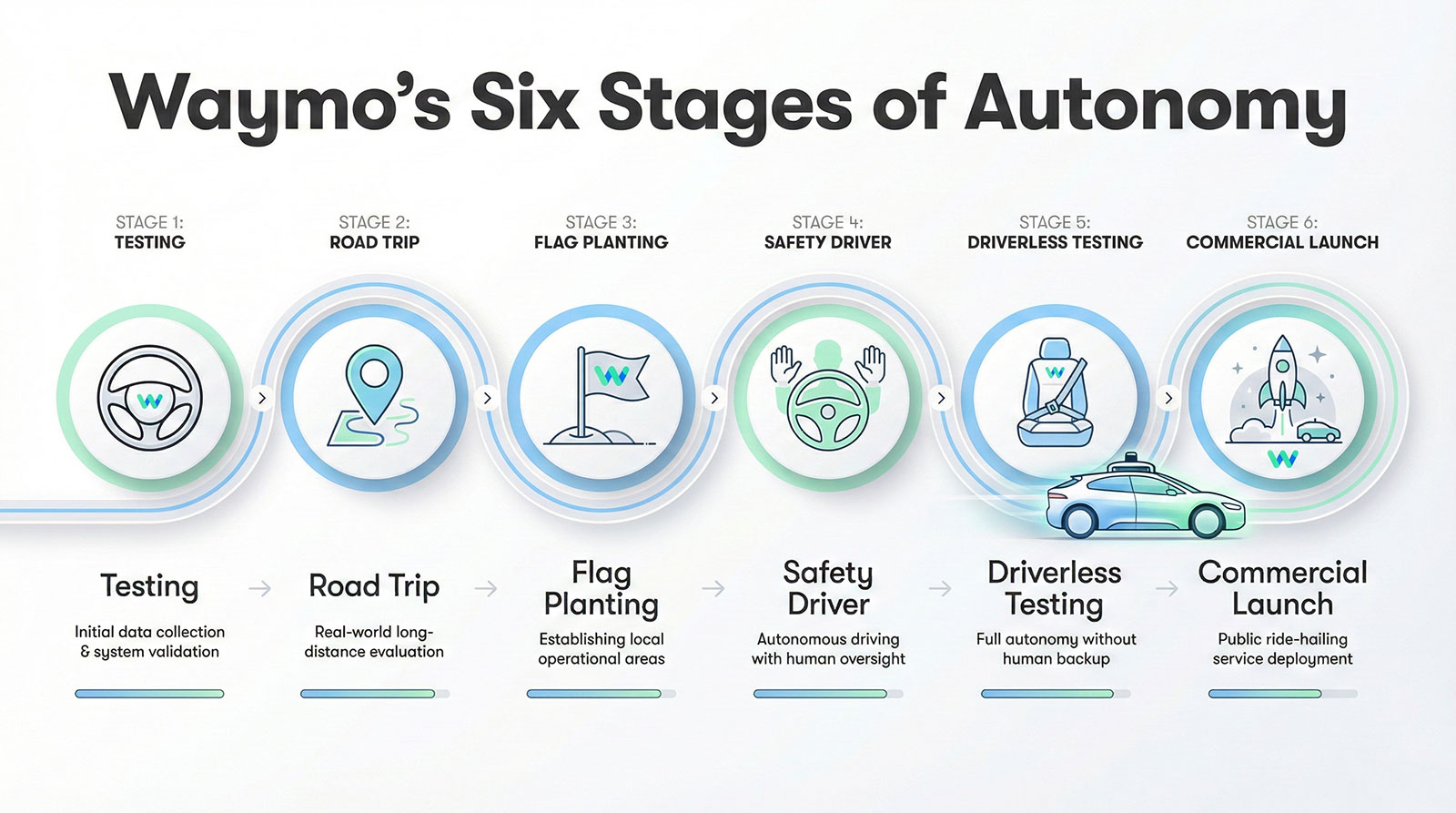
Waymo’s Six Stages of Autonomy
Executive Summary
In this episode, Grayson Brulte and Walt discuss Waymo’s aggressive expansion across the Sunbelt alongside the regulatory headwinds forming in progressive cities like San Diego and New York, while introducing and defining our newly coined term “Six Stages of Autonomy”.
Key Autonomy Markets Episode Questions Answered
What are Waymo’s Six Stages of Autonomy?
According to Grayson Brulte, Waymo follows a specific six-stage pattern when entering a new market:
1. Testing Announcement: A blog or post on X announcing intent to test.
2. Road Trip: Vehicles arrive in the city, often interpreted as an insinuation of future deployment.
3. Flag Planting: Manual testing begins with a human driver to demonstrate presence and prepare for scale.
4. Safety Driver Mode: The vehicle drives autonomously but retains a human safety driver behind the wheel.
5. Ghost Rider: Testing with no driver behind the wheel (driverless), but not yet open to the public.
6. Commercial Launch: The service opens to the public for rides
Why is Waymo launching in Dallas earlier than expected?
Waymo is launching in Dallas in 2025, ahead of their original 2026 projection. This acceleration is likely due to effective execution by their local fleet partner, Avis, and competitive pressure from Uber and Avride, who are also planning launches in the Dallas market using Hyundai IONIQ 5 vehicles.
What regulatory challenges is the autonomous industry currently facing?
Despite favorable laws in Texas and Florida, the industry faces headwinds in progressive cities like San Diego, New York City, and Seattle. Local leaders in these cities, such as the head of the San Diego Taxi Advisory Committee, are actively opposing autonomy and attempting to introduce bans or strict regulations, even in states where preemption laws exist to protect autonomous vehicle deployments.
Key Autonomy Markets Topics & Timestamps
[00:00] Introduction: Waymo Expansion Overview
Grayson and Walt kick off the episode by highlighting Waymo’s continued momentum, likening it to a steam engine fueling up for expansion. They briefly touch on the upcoming “autonomy battle” in Dallas and contrast Waymo’s progress with Zoox’s smaller-scale announcements in San Francisco.
[00:40] Waymo’s Minneapolis, Tampa, and New Orleans Expansion
Grayson and Walt discuss Waymo’s latest press releases announcing expansion into Minneapolis, Tampa, and New Orleans, though Walt raises concerns regarding vehicle supply. Grayson points out significant regulatory hurdles in Minneapolis, noting that current laws prohibit full driverless operation in both the city and the state of Minnesota.
[03:33] Walt Disney World Partnership Speculation
Walt speculates on a potential non-traditional partnership between Waymo and Disney World, suggesting autonomous vehicles could connect resorts and hotels. Grayson counters this idea by revealing Disney’s unique historical requirements for autonomous vehicles, such as the necessity for Mickey Mouse to fit inside the vehicle and lidar sensors shaped like mouse ears.
[07:51] Waymo’s Six Stages of Autonomy
Grayson breaks down the lifecycle of a Waymo market launch into six distinct stages: Testing Announcement, Road Trip (insinuation of deployment), Flag Planting (manual testing), Safety Driver Mode (autonomous driving with a human monitor), Ghost Rider (driverless testing), and finally, Commercial Launch.
[14:54] Waymo’s Dallas Launch is Ahead of Schedule
Grayson and Walt analyze the surprise announcement that Waymo’s Dallas launch has been moved up to 2025, a year ahead of the original 2026 schedule. They attribute this speed to the successful execution of the partnership with Avis and the increasing competitive pressure from Uber and Avride in the Dallas market .
[20:00] Regulatory Challenges: San Diego, New York, Seattle
Grayson details the growing opposition to autonomy in progressive cities, specifically noting the San Diego Taxi Advisory Committee’s desire to ban autonomous vehicles despite California’s preemption laws. The discussion extends to New York City, where local council members are attempting to introduce bills to block autonomous vehicles to protect taxi medallion interests.
[24:51] Sidewalk Delivery Robots and Scale Challenges
Walt pivots to the sidewalk delivery sector, noting that even the largest player, Starship, has a fleet of only roughly 2,700 robots. He cites a DoorDash executive to illustrate the immense difficulty of scaling manufacturing from hundreds to tens of thousands of units, emphasizing that low volume remains a critical bottleneck for the industry.
[27:41] Zoox’s Limited San Francisco Launch
Grayson and Walt critique Zoox’s recent launch in San Francisco, which is limited to a very small geofenced area despite the company’s massive financial backing from Amazon. Grayson questions the disconnect between Amazon’s history of scaling businesses (Prime Air) and Zoox’s slow, limited deployment.
[31:46] Foreign Autonomy Desk: Chinese Robotaxis Continued Expansion into Europe
On the international front, Grayson reports that WeRide has received a driverless permit for Zurich, Switzerland, following Baidu’s recent similar achievement. This marks a continued trend of Chinese autonomous vehicle companies expanding their footprint into European markets.
[32:56] Tesla FSD Update and Performance Review
Walt shares his personal experience with the latest Tesla FSD updates (moving toward version 14.2), noting that while the drive is smoother, “phantom braking” and mapping errors persist. He concludes that while the system is improving, it still struggles with basic navigation tasks like identifying correct grocery store entrances.
Full Episode Transcript
Grayson Brulte: Walt another week, another Waymo expansion. Waymo’s gearing up putting gas in the engine. If they had an engine and they’re going full steam ahead. Well, Waymo expands. I know. I know. You’re very excited for the big game this weekend between the Eagles and the Cowboys down in Dallas. While you’re excited for that, I’m excited for the autonomy battle that’s emerging there. While the battle emerges in Dallas, the robo market’s also emerging around sidewalk delivery. They’re measuring whose robots bigger, no pun intended. And then they’re zoox. They announced a tiny little section of San Francisco. I could probably hit it with my driver and then at the same time, 10,000 cars, they’re now that they said they could produce. But let’s start with Waymo and the ongoing expansion.
Waymo’s Minneapolis, Tampa, and New Orleans Expansion
Walter Piecyk: What do you make of it? So the expansion specifically is where we just have a slew of additional releases, again from Waymo, Minneapolis, Tampa, and New Orleans. So to me, you know, the question is always gonna be on supply. Like press release after press release, do they have the supply, um, to provide there? But I think there’s also some regulatory issues that exist in Minneapolis.
Grayson Brulte: In Minneapolis today. You cannot legally operate, and this also applies to the state of Minnesota. You cannot legally operate a full driverless vehicle. In the city or the state. And that law has to change and, and we saw the elections in Minneapolis, very progressive city council. And we’ve seen through Boston, we’ve seen through Seattle, other progressive cities and New York, they don’t necessarily like autonomy. So Waymo’s got some policy issues to overcome. Yep. So we’ll see. I mean,
Walter Piecyk: these are again, press release announcements. They’re still a lot of things not announced. You know, first one we’ll deal with is the partners. I know this is something that we’ve rehashed. Many times in recent week, we had our big, you know, podcast a couple weeks ago where we referenced a divorce. Um, with Uber, obviously Uber’s not in again, in any of the announcements. We’re not gonna rehash our concerns about Uber, Uber, and a VO. Um, but you know, I guess it should we even consider it odd because there’s never been. Now, this is not part of their process to announce partners when they talk about, Hey, we’re gonna go into these new cities.
Grayson Brulte: I gotta tell you, I don’t have the Cusso hat on today. I got the autonomy hat on, but something doesn’t add up here. I’ll use the kids term. Something doesn’t smell right. Here is how I would describe it.
Disney World Partnership Speculation
Walter Piecyk: The other thing I wonder about is like Waymo, especially if you’re talking about Orlando has an opportunity for a non-traditional partner. I mean, Disney’s got a massive. Complex there, Reedy Creek and, and Disney is about 25,000 acres, 134 miles of roadways. Can you imagine some, I mean, some, William was already in limited supply. You put some, you wrap them with some Disney characters and have them, you know, connect all of the different hotels owned by Disney with all the different resorts as, as an added service. It’s obviously very futuristic, right? It fits with kind of the Tomorrowland thing, I mean. And, and they can again, additionally fragment the market in individual markets where they don’t necessarily become reliant on one major partner. And this fits in with what I like to call the grace and specials. You love partnerships as it relates to autonomy.
Grayson Brulte: You are right, but you know what? There’s one rule if you’re gonna deploy, and I’ll tell you after this, that one rule, if you’re gonna deploy a Thomas vehicle at Disney World that you have to meet, that Waymo cannot meet today. You ready for this? Mickey Mouse has to fit inside the vehicle. Mickey Mouse cannot fit inside of a Jaguar or I pace.
Walter Piecyk: Why does Mickey Mouse have to fit inside one of these vehicles? Because you can just have it for the guests to get around. And by the way, why couldn’t they send some zuckers down there? You don’t think Mickey could fit in into a zeer vehicle? That’s that’s, that’s pretty sizable, potentially.
Grayson Brulte: But then let’s look at politics. Putting a Chinese made vehicle at Disney World, you think Governor DeSantis. If it’s the, the next governor, Brian Donalds, that’s gonna go for that. It’s gonna be the really creek show all over again.
Disney’s Requirements for Autonomous Vehicles
Walter Piecyk: But what’s the, what’s the issue though with the size of the car in Disney? Like why do they care about you think with about the mouse getting in there? I like you think so let’s go back in history here.
Grayson Brulte: Voyage long time ago when Oliver Cameron founded Voyage. This is pre-acquisition from Cruise. Was actively in discussions with Walt Disney World to deploy it there. Really another interesting requirement outside of Mickey Mouse fitting in the vehicle. They wanted to take the lidars on the left and right side of the vehicle and make ’em look like Mickey Mouse ears. ’cause you have to remember, it’s about the magic. It’s about the experience. And then there is another company that’s no longer in existence today. Use your imagination. They were in discussions as well with Disney World and Mickey Mouse did fit inside that vehicle, even though that vehicle was never massively produced.
Walter Piecyk: You know what’s pretty magical? Grayson getting into a car that doesn’t have a driver. You would think that that’s enough. Again, you wrap the car. Sure. Put some, you know, some stuff over the lidar if they can still remain functional that way. I don’t know. I, I still think it’s, it’s, you know, a large organization, Disney, huge company. I know they’ve looked at getting into the mobile business, historically, looked at buying spectrum, all because of leveraging the brand and the plot. I mean, this would be an obvious. Type of partnership, not that Disney would wanna service vehicles on a nationwide basis, but from a branding standpoint, if you, you know, you have the vehicles in Disney, Disney World, and you wrap a couple of vehicles in these other individual cities and there’s again, a partnership opportunity there. I don’t know, just a thought.
Disney’s Past Autonomous Vehicle Explorations
Grayson Brulte: Okay, so you, you’re going down the right trek now. You gotta remember the old Walt Disney thing plus it. That’s what Wal Disney always say to, to his imagineers. Plus it make, make it better. And I’ll give you an example that Disney did look into, they did not commercialize it, but they did actively look into it was picking up passengers at, at MCOs and, and Disney, they call it Mickey’s corporate office because when you’re going to Disney World, you’re gonna spend a lot of money where you would get picked up, you would use your, your, your magic band, and you have a profile and that vehicle. When you get inside the hole, the hole inside the vehicle is augmented. If you’re going to Star Wars Hotel, which is now defunct, it would take you there and you’re in one of the Galaxy Cruisers, you’re not actually in a vehicle to have that whole interactive experience. So one, they wanted to do that to control the guest experience. And then two, it’s a way to optimize rev power, which is revenue per available room, so they, they know when you’re coming and going to optimize the room flow. So they’ve looked into it, but it’s just truly, I, I don’t, it’s sad that they haven’t gone forward. And I can also tell you. That inside of, for Camp Wilderness, Fort Wilderness, they looked into doing Mickey Chippendale inspired delivery robots. Again, they never went forward. Disney has, they go nine steps forward, and then they never take that 10th step. And so it’s been an ongoing process. And you, you, you could say that I’ve had a lot of interesting conversations with a lot of individuals that you call cast members.
In-Car Experience and Gemini Integration
Walter Piecyk: I would say this though, I mean it’s, Google’s already talked about putting Gemini in the car. The in-car experience is clearly important to them. There’s been plenty enough comments about that. It’s not necessarily a volume driven type of thing that they need to do here, right? They can do it with a handful of cars for these high-end attendees, people that are gonna get the, you know, the private tours and things like that. And it can mean early, an early version of how they can drive an ad business, you know, from what’s interior to the car and exterior to the car. So, I don’t know. Seems like a, seems like an obvious partner, but. I guess, uh, we’ll have to see how things play out there. So in addition to those, those three cities, there was other press releases and I know Waymo loves to issue and there’s, you know, tons of press releases and.
Understanding Waymo’s Six Stages of Deployment
Walter Piecyk: Waymo said they’re going driver out in Miami, Dallas, Houston, San Antonio, Orlando. You know, these markets are ones that we’ve clearly heard of before and I also find it funny to say that you’re driver out like isn’t Waymo, at least in my mentions, everyone always tells me Waymo’s the one that’s driver out, not Tesla. But I guess, you know, there are stages where you know, Waymo’s aren’t driver out. So I get a little confused with this. Can you help me understand all the different stages? From, you know, whatever the earliest stage is to, you know, the final stage, which is commercial launch.
Grayson Brulte: Let’s break it down, Walt. We’re gonna go back to autonomy, kindergarten. We’re gonna break down the six stages of Waymo autonomy. 1, 2, 3, 4, 5, 6. That’s six stages of, of Waymo autonomy. Stage one testing, Waymo puts out a, a post on x. Or sometimes a very small one line post on their waypoint blog said, Waymo will begin testing in the city as we consider or explore an active deployment. The city, the most commonly affiliated with that today is your
Walter Piecyk: beloved New York City. So testing, but they always announce it. There’s never been a situation where. That you can recall whether it was Waymo’s just showing up in the city and, and Waymo had not yet announced it.
Grayson Brulte: There was, and I’m gonna have to be fact checked on this. There was an incident where a photo went on, excerpt went on Reddit before the Waymo release came out. So there was a time that I remember. Somebody did get ahead of it, but the majority of the time there’s an announcement and then hours later or sometimes a day later, you see the vehicles.
Walter Piecyk: So can I assume that stage two is road trip and and are we sure that New York is not technically a road trip city and like what’s the difference between testing and road trip?
Grayson Brulte: Well, if I’m gonna put on my political hat here. So you have No, but I have political hat on. Maybe we should get one of those. The Abe Lincoln hat. To me, a road trip to a certain city, a certain population could be considered insinuation, where it is saying that Waymo is going to deploy in this city where testing is not, ’cause they’re testing in Buffalo winter testing, they’re testing in Kirkland, Washington and haven’t deployed there. But in the, uh, road trip cities, they’re saying that they’re going there.
Walter Piecyk: So our stages one and two sound pretty, pretty similar. It sounds like it’s just some perhaps wording issue to deal with local politicians. But what, what do we have for stage three?
Stage Three: Flag Planting
Grayson Brulte: Stage three, the flag planting. The vehicles are there, and I’m gonna estimate. Say, uh, 10, 20 vehicles were in that city and they begin manually testing in that city. So the vehicles are physically there and they’re manually testing. That’s the flag planting Waymo saying, we’re here, we’re preparing, we’re getting ready to scale.
Walter Piecyk: Okay. So in that case, there’s still, we’re, we’re still in the flag planning. You still have a driver behind the driver’s seat. It’s not no driver out or anything, it’s just. It’s an announced city that you’re doing testing. I mean, honestly, these first three stages sound very similar.
Grayson Brulte: They are, there’s a common denominator in stage two, in stage three manual driving. The testing in certain applications they have done in supervised driving. So just to clarity there, but there are a lot of similarities between stage one, two, and three. I know it’s a lot to digest, but you gotta stay with me. I’m trying my best. Now what? What happens in stage four? Stage four? The safety driver, the Waymo vehicle is driving itself with a safety driver. Behind the wheel.
Stage Four: Safety Driver Mode
Grayson Brulte: That’s stage four. Now, this doesn’t seem
Walter Piecyk: like, as opposed to a manual driver, so someone not touching the wheel. So this, I don’t recall seeing many press releases about this, so, so stage three and four, meaning the flag planning are probably the, it is just another mode within the same city. It’s just now we’re picking things up on, on Reddit or from friends that are sending us pictures saying like, oh. This guy doesn’t have his hands on the, on the wheel. That, is that the difference or am I wrong in, in, they’re actually issuing press releases when they go from testing with a manual driver to, to using a safety driver.
Grayson Brulte: You are correct. And sometimes there is an an, you know, formal press release. There’s just most likely a post on next, but yes, you are correct.
Stage Five: Ghost Rider (Driverless Testing)
Grayson Brulte: Stage five, what’s that? Stage five ghost rider. And that’s what they announced in Miami. They’re, they are testing. Not commercially operating yet, but they’re testing with no driver behind the wheel. This is the first time that I’ve seen them acknowledge that publicly in a long time, and that they said that they’re gonna be opening service soon, but they’re currently testing with, with no human in the vehicle. So
Walter Piecyk: how did they, how did they I didn’t miss it. It was a busy week for me. A lot going on, obviously with warm pros and, and what have you. They issued a press release and, and they basically said, what? We’re going driver out in Miami, Dallas and Houston. And this was a press release worthy item for them?
Grayson Brulte: Yes. And don’t forget, they also announced San Antonio Orlando as part of that release as well. I mean, so this company
Walter Piecyk: is basically a press release machine every minor edition to how they’re, they’re moving through these markets. No wonder we have so much to talk about our autonomy markets. And then obviously stage six is, is commercial launch the most important thing?
Commercial Launch Timeline Predictions
Walter Piecyk: So, so I guess the, so the relevance in for Miami is we’re close to the end, right? Where they, they’ve finally taken the driver out. I, how long do you think this, this stage five process where you do not have a safety driver in there, the final leg of what I would call testing? How long do you think that occurs? Um, before we receive service, and let’s, let’s focus on, you know, your home state in, in, uh, and specifically in Miami.
Grayson Brulte: I wake up every day. I open the way mail app to check if I can ride in the vehicle. It’s not, it’s not listed on the map. Uh, next week, as you know, is Thanksgiving and the week after that is Art Basel. I’ll make a prediction here. The service will open sometime before December 5th when our Basel opens, so the next two weeks it’ll be open,
Walter Piecyk: but I don’t think you have to wait for your app to, to show that. I mean, I think they’ll, they’ll, you’re gonna see since they’re a press release happy company. You’re gonna see some, some tweet going out saying, Hey, we’re live in Miami now.
Grayson Brulte: And then you put on Will Smith play the Miami song. See, that’s when it happens.
Sunbelt Cities and Regulatory Advantages
Walter Piecyk: I guess my other question on this, these, you know, these cities now that have gone on to driver out testing kind of this last stage before commercial. All Sunbelt cities, do you see any kind of relevance to them kind of bundling that in the same announcement, either from a political perspective, weather perspective, anything from a
Grayson Brulte: political perspective? Texas and Florida have two of the greatest laws on the books as it relates to the deployment of driver route commercial vehicles. So from regulatory standpoint, it makes a lot, a lot of sense. Also, from a weather standpoint, it makes a lot of sense when in the dry season in Florida, so you don’t have to deal with the hurricanes and the monsoons. And then in Texas, you’re in the dry season as well. So you have dry seasons in both states, great regulatory environments. So those two things make it a really great time to launch. I also have in my notes that one of these cities.
Dallas Launch Ahead of Schedule
Walter Piecyk: Um, Dallas, which you mentioned that, you know, is important to me at least for this Sunday. By the way, people of Dallas are great, as much as, as the Cowboys, uh, you know, are the enemy of the Eagles. People are from Dallas, are among my favorite in the country. But I think there was some indication that they’re gonna launch in a few weeks. So a 2025 launch. First of all, where did that come from? Was that a, was that an announcement from them? Did we hear this on Reddit? Like, where are we getting that from?
Grayson Brulte: Drum roll please. Waymo press announcement. There’s another one for you. I, so we’re gonna call this stage 5.5, I suppose, where they say something’s gonna launch in in a few weeks.
Walter Piecyk: Putting that aside again, props that, by the way, the Waymo PR team, I think this is the way to do it. More information in this regard is always better than less. Get getting. Local press hyped up about the arrival of these cars. Um, but for Dallas, I think if you went back to the initial announcement, which was not long ago, right? July of, of this year, the, the plan was to launch in 2026. There was no, I don’t think specific timeline of that. Even if they said early 2026, it’s kind of surprising in a positive way that they can launch in 2025, like delivering. Ahead of schedule, they will talk about, um, you know, oh, this is the generalization, right? This is ai. This enables us to do markets faster. I get that. That’s a great part of the narrative. To me. The other part of the narrative is like, you know, we’ve been kind of harping on the supply and yet here they are able to actually launch a market in Dallas hopefully with enough supply, which in my mind’s gotta be. At bare minimum 50, quickly getting to a couple hundred in that market for it to be a real market.
Grayson Brulte: For Dallas, the most impressive part of this, they’re ahead of schedule. Waymo was launching a city ahead of schedule. That’s impressive. If you stay within the Texas triangle, do some of those cars come out of Austin Potentially since it’s just a hop, skip and a jump away to get that inventory up there?
Avis Partnership Success
Walter Piecyk: I don’t know. I wish there’s a better way for us to track this, whether they’re reallocating inventory to launch. To launch new markets. I’m not sure what’s going on in in Austin. Obviously we’ve got plenty of questions there. On the flip side and the questions that we have in Austin, this is also a good sign about Avis and it because if, for our listeners, if you might not remember. Uh, or you might not recall, Avis was the partner for Waymo in Dallas and like this was their first market in this partnership. So maybe this speaks to how quickly Avis can ramp their capabilities in being a good partner for, uh, for Waymo.
Grayson Brulte: I’ll tell you point blank, if Avis played a large role, which we assume and we do not have any facts to back that up. If Avis played a large role in Waymo, able to launch ahead of schedule, to me that’s a positive catalyst that could potentially open new markets to Avis as they scale.
Competition in Dallas: AV Ride and Mobileye
Walter Piecyk: I can’t imagine we won’t see additional markets with Avis that again, we’ll see how they execute. This is a good sign of for execution that they’re willing to launch earlier than expected. Um, so again, I important leg in the stool that we’ve talked about many times in this podcast. Finally, the other fascinating thing about this and perhaps. The real driver of why you accelerate this in this market is there’s competition there and there is plans with, um, AV ride long-term plans to launch with Uber in that market, which we’ve talked, you know, and question friend or phone and AV ride is rely reliant upon Hyundais, right? And the Hyundais are the exact car that we’re waiting for in terms of Waymo to help expand the capacity. So for. For Waymo to launch in Dallas, perhaps ahead of AV ride. And Uber has, I think multiple, if you’re really getting your competitive juices flowing. Multiple, I think benefits from them within the kind of the tech, you know, people that follow. And also, by the way, you’ve got Lyft with mobile, I, people have, you know, we’ve all fallen asleep on mobile. I, to a certain extent ’cause their, their business strategy is focused on dealing with the OEMs. But in this case. Lyft with mobile. I can you remind, remind me which car that’s with, but they will also be in Dallas.
Grayson Brulte: We don’t know. Again, press release from Lyft. It, there was no details in the, in the press release. It said 2026. We, we don’t know Q1, Q2, Q3, Q4. We don’t know. But I’ll tell you something. It’s fascinating that that Wayco potentially launched before Uber, an AV ride. They’re gonna start competing head to head at some point in the next three to four weeks in that market. And just the audience to clarify. Spoke with AV Ride. That AV ride will be launching with a safety attendant, not a safety driver. Very similar to what Tesla’s doing. And also just wanna point out the little caveat there,
Walter Piecyk: Grayson, hopefully this works out for perfect timing for Forward Fort Worth, which is a great conference. Great people, um, you know, so we can test all these things. Sounds like maybe Lyft and Mobile I and the av Well, we’ll definitely see some version of AV ride while we’re there. Maybe it won’t be commercial yet, uh, with Uber, but we’ll, we’ll certainly get a sense of where they are with Hyundai at the time. But, you know, cue us up for a, for an exciting march to come up.
Grayson Brulte: Perhaps if Hillwood Ian, Kenny, and Mr. Perot have their way, those Thomas vehicles can make their way to Fort Worth you, you never know. It’s gonna be an exciting time down there.
Regulatory Challenges: San Diego, New York, Seattle
Walter Piecyk: Yeah, I mean, I love Fort Worth as well, but a great area and I can’t wait to see what happened in Dallas, but obviously fascinating and maybe that was. The driving force. We’ll have to do some more work. And for our listeners, if you have any, you know, good insights on, you know, Dallas and Avis or a vmo, just let us know. Meanwhile, you know, so these are great things that are happening for Whamo. There are other, on the flip side, we’ll talk about the challenges, you know, which are not really of their design, but they have to deal with, and you’ve got, you know, San Diego, New York City, and Seattle. Why don’t you run us through what’s going on there, Grayson?
Grayson Brulte: So, in San Diego, you’re the head of the San Diego Taxi Advisory Committee at the Metropolitan Transit Systems. He has come out against autonomous vehicles, wants to ban them in San Diego. They’re trying to overturn California law, which thank goodness had happened, where there’s preemption. It’s a very good thing where San Diego cannot enforce policies around autonomous vehicles. Mayor Bass, the in famous mayor Bass in la, she tried the same thing. It failed. So look for this, this scuttlebutt in San Diego to kind of fail. However, the interesting thing is San Diego is the closest city to the US Mexico border. In California and there’s also right over that border, A BYD dealership. And we have photos of the Gilly Zuckers all in San Diego, and that’s got people all riled up is BYD next. So that’s something to watch there in San Diego.
Walter Piecyk: And then what about New York and Seattle also? Similar problems there.
Grayson Brulte: Yes. Oh gosh. New York. Where did the, where do the problems begin? We don’t know.
Walter Piecyk: Where do they end? I think where I think you meant where do the problems end?
Grayson Brulte: I’m gonna stand where, where do, I don’t even know where they begin or where they end. Who knows? Right now we know the mayor of New York is currently in the Oval Office with the president, so we’ll see where that goes. And then back in New York, you have a local council member by the name of Justin Brandon, who was introduced to Bill to local level, and they don’t have preemption in New York to ban autonomous vehicles in New York City. I told you, and we talked about this, that it was gonna be a problem. And so what else did this local council member do? He bailed out the medallion fund. Do you remember that? Walt, you cover Wall Street that’d go bail out those banks that funded the medallions. And then he wants to ensure with the Uber and Lyft drivers have all these benefits and perks. So isn’t this funny how everything is starting to turn, oh, Uber and Lyft are bad. Oh no. We gotta protect them. The, the tides turn, we almost got a lot of policy issues bubbling up here.
Walter Piecyk: Well, in New York City. Maybe it’s a blessing. I, I was in the city, I drove in the city to see Wicked, the Premier and, um. You know, the streets there are literally like a third world country. It’s amazing how in one of our biggest cities in the country, they can’t have basic infrastructure. So maybe it’ll, it’ll save Waymo on their, on, uh, replacing a couple of their shocks in the, in the suspension system on their cars until we go through a cycle where maybe we get some infrastructure investments. Um. But look it, you know, new York’s gonna take a long time for a variety of reasons. Seattle, you know, same, same issue. I think, uh, I’m not concerned over the long haul. I mean, obviously in on the AI front, there’s discussion of preemption there. On a federal level, I think that obviously should at some point apply to autonomy. But there’s enough forward thinking states and cities that exist in this country that. You know, it’s not gonna stop progress and, you know, to just continue to, to drive this theme home and to continue to pick at the scab, like scale is the big issue, right? And volume. So we don’t even have the volumes. Like, you open up New York tomorrow, you don’t have the, the cars that you need. Um, to really launch in that city.
Progressive Cities and Autonomy Opposition
Grayson Brulte: I don’t understand why nobody’s reading the tea leaves. Boston, a progressive mayor, New York City, we all saw the polls. Progressive mayor, Seattle progressive mayor. What do these three progressive mayors in these three cities want? They want to ban autonomy. Why poke the bear this early on in the process when you clearly have a vehicle shortage?
Walter Piecyk: Yeah, I don’t know. I mean, there’s, you’re speaking to your constituency. Like people vote. They, they want a certain thing, there’s. Definitely concern about jobs like this. This week we had, this is not, shouldn’t have been a shock ’cause it was, um, proceeded by a change at the CEO position of Verizon. They, they, they’re gonna fire 13,000 people for a company. They, that’s gotten local franchise, uh, local franchises. AI is not the reason they’re, they’re having to fire these people, but it is a tool. Right. So I think, you know, they are, they are doing what their constituency wants. I think there’s obviously, we, we would all agree to long-term benefits, all those that listen to this podcast and we’ll just have to see, you know, how that plays out. My, again, my point is like, who cares? Like, these are important cities, but there’s other cities where we will ramp volumes. We’ll see the benefit both to the economy and to the people and the safety of their citizens and, and those things will happen. But, you know, getting back to the scale issue. In a completely different industry segment, you know, food delivery, which is part of autonomy. Um, you have a company, Starship, which, which claims that it’s the largest autonomy delivery fleet.
Sidewalk Delivery Robots and Scale Challenges
Walter Piecyk: And how many, if you’re the largest autonomous delivery fleet, fleet for food, how many robots do you think that that would encompass?
Grayson Brulte: I know the number, but I’ll answer it if I didn’t know the number. 10,000? 15,000. 20,000. It’s 2,700. It
Walter Piecyk: is. 2,700. This, these 2,700 robots with props to Starship have done 200 million row crossing, 9 million deliveries. That’s great. And they’re targeting 12,000 robots by 2027. For context. Also, Serve Robotics. Public company obviously does stuff with Uber Eats here. They expect to deploy 2000 by the, by the middle, or excuse me, by the end of the year. And that should get into like 60 to $80 million of revenue. Tiny, right? I mean, it’s good for them, but like tiny, 2000, 2000 robots. So it’s funny, like, and I’m gonna link this because you know, from time to time as analysts, we get on, you know, calls with management teams and they had a, DoorDash had a group call today and someone asked about autonomy and the guy like basically scoffed, he’s like, oh yeah, I’m looking on my board here of total deliveries. And autonomous deliveries are nothing. And he’s, and so then he was further asked about supply, and he’s like, here’s the quote. There are physical constraints to how fast you can roll out. Like how many can you build? And building thousands of thousands of robots is hard. And, and, and it’s, and they have to learn how to do it. And we have to learn how to build hundreds efficiently before you build thousands efficiently. And then you gotta build thousands before you build tens of thousands. And those are the types of numbers. This is DoorDash for Tommy here, right? Leader in, in food delivery. Obviously Uber Eats it being another one. These, this is, they’re talking about tens of thousands for supply before it is relevant for their business. And this, this is the same issue that, that you and I have been discussing and we’ll continue to discuss, um, as it relates to. Um, autonomy as well, like getting to that scale. And, and this is why while, you know, Waymo’s got obviously the best product in the market, they still have to get the operational ability to scale that while other companies, you know, are developing their technology and some of those other companies that are developing their technologies might be able to ramp faster. So, so the point is, ’cause there’s been a lot of debate about our moat comment from last podcast. Like 2,500, which is almost the exact number that Waymo has, right? Is not a moat, it’s just not a moat. And like, you know, whether it’s for food or whether it’s for, for humans, like, so we are in early stages, it is exciting that they’re launching these cities and we are confident that they will ramp that volume. We just are, you know, we wanna see it happen yesterday. We, we get less success, or at least that I, my case. I get less excited now by the incremental cities and, and, and more and hopeful to get volume ramp.
Grayson Brulte: And then what we have to watch on the robot side is the manufacturing relationships serve has a manufacturing relationship. With Magna, they’re ability, the ability to scale does to Starship or somebody else get a relationship with Foxcon. There’s something really important to watch ’cause. I don’t see these companies hand building these things. They’re gonna need mass manufacturing capabilities to truly scale.
Zoox’s Limited San Francisco Launch
Walter Piecyk: Speaking of volume, you know, our good friends at Zoox are aiming to produce 10,000 vehicles annually at a facility in the Bay Area. So here’s a company talking about in the types of numbers that could matter. And Grayson, they open service to select members of the public. I don’t think you’re one of them. Sorry. Um, in San Francisco. The service area, however, is about 22 blocks long and 15 blocks wide. Now, I’m not familiar, I’m familiar with New York City Streets. I don’t know how long are these, are these three mile long blocks? Like what are, what type of service area are we talking about here?
Grayson Brulte: It’s like the painted ladies on full house. We’re not talking a a large distance. We’re talking an average walking distance. The thing that I cannot understand. You have for all practical purposes, unlimited resources. With Amazon, you’ve spent billions upon, billions upon billions upon billions of dollars building this company, and you deploy in this minuscule little area. Furthermore, Walt, I’ve had several friends that have been in Vegas over the past couple weeks. They can’t get the service. It doesn’t run all the time. I gotta ask what the heck is going on? Yes. Is it great to talk about ramping 10,000 vehicles? Yes. But if you’re gonna operate in a grandma zone, you don’t need 10,000 vehicles. Where’s, where’s Andy Chassis saying we, we’ve got a competitor in Waymo that they’re, they’re scaling and they’ve got the same financial resources that we have, and then, then here we are. I just, I I don’t get
Walter Piecyk: it. Yeah, I don’t know. I mean, look, Vegas is a market. I, I mean, I’ve seen Zoox there, you know, at C-E-S-C-E-S is coming up soon, a little more than a month away. Um, so we’ll see what Zoox has going there. Hopefully they’ll flood the market with some additional cars to show off what they can do there since they’ve been testing there. If, if it’s, if it’s limited there, that, that will not be a good kind of poster shot. By the way, for our listeners that go to CES. We will be at the Cosmo. We’ll have a suite there doing a bunch of meetings. Uh, light Jet has an event, uh, Tuesday night. You’ve got, um, Grayson and I will have a smaller event on, on Wednesday night. So let us know. If you’re at CES it would be great to see. Any of your company’s technologies in the autonomy space, and you know, that’s right around the corner. I know Thanksgiving’s coming up, but man, it’s gonna be New Year’s fast. Um, let’s go back to Zoox though. 10,000 vehicles annually. When do you think they get to that point?
Zoox Manufacturing and Amazon Integration Questions
Walter Piecyk: Who’s gonna, who’s gonna crank those out for them? They’re
Grayson Brulte: manufacturing them themselves. They built a facility and the bay already manufactured themselves when they get there. I don’t know. I’m not even gonna begin to speculate when they get there, they have the financial resources to do it. They have the talent to do it. But if you cannot deploy in a large ODD, you can not deploy in certain traffic conditions that have been rep widely reported on Reddit, by the way. WW does it matter how many
Walter Piecyk: vehicles you have? So Elon’s talked about the compute that’s gonna be in Teslas and they can put out 10,000 vehicles annually. Obviously Amazon is, is interested in this space as well. Is there any, you think, cross fertilization that might be existing within that organization to try and utilize these cars beyond just, you know, the, the ride share that we’re, that we’ve talked about?
Grayson Brulte: I, I’ll say this. I have a lot of questions around the corporate structure of how Zoox is run internally inside of Amazon. And I, I say that because look at, uh, prime mobility. Look at all the success that they’ve had scaling. Why is Zoox not on the same trajectory when Amazon has been successfully able to incubate businesses, which prime mobility areas and, and scale it, and then this business has not been able to. Just a question.
Walter Piecyk: Yeah. I don’t know.
Foreign Autonomy Desk: Europe and China Expansion
Walter Piecyk: But let’s move on to our final segment. Listener favorite, the Foreign Autonomy Desk. What do you have for us on the Foreign Autonomy Desk this week,
Grayson Brulte: we Ride, which continues their European expansion, has received a driverless permit to expand it, a part of Zurich, Switzerland. So last week we talked about Baidu getting a permit to deploy in Switzerland. [00:32:00] This week it’s, we Ride, so the Chinese AV companies continue to expand in Europe.
Walter Piecyk: Switzerland’s one of my favorite countries, although I wouldn’t say Zurich is my favorite city within Switzerland, I prefer to be. In the mountains, but maybe I can gimme an excuse to get back to Switzerland this winter, and I’ll pop over to Zurich to check out some, uh, some wee rides. If they’re running,
Grayson Brulte: I will join you, and after that we’ll take a hop, skip, and jump to the Middle East, which was one of the fastest growing markets in autonomy. And each and every week, you and I are here to break down the autonomy markets. I know next week is Thanksgiving. What else do we need to look for besides yummy Turkey nap time and really great wine.
Tesla FSD Update and Performance Review
Grayson Brulte: I mean, we
Walter Piecyk: got pony AI and we got, we ride reporting. Um, I literally just saw that my, my Tesla is gonna do is moving on to 14.2, so this is, we were 14.123 up to eight. I think I got, I will say, you know, last week I said I was gonna give an update because there are people on YouTube that continue to claim, oh, this is the best ever and it’s so smooth. It is definitely better or has progressed. I’m not talking about 14.2 now. I’m talking about 14.1 point, whatever number I was on, which was eight. But I do do still get some random breaking, you know, for things that it ne necessarily shouldn’t break for, and that just does exist. And my other, my other complaint about this in terms of like pressing a button, going from point A to point B, why that’s not fully happening yet is. It’s the mapping. Like if I have a grocery store and there is an entry point that should only be for trucks that are going to their depot. It doesn’t yet know, no, take the first right into this parking lot to go to the grocery store. It’s going. So those, those mistakes which have nothing to do with like how it operates autonomously and safely, but have to do with like figuring out the dropping points at the end. And still in my driveway, there are times when it just goes past my driveway. So I think there are still. Some edits that have to occur before you get to, you know, this full thing. Now that doesn’t mean like, I think we’re all mostly at that point where I’m not saying I do this, but being able to text and not look at the wheel. I mean the, the smoothness of it, um, is certainly much better than 14.1. We’ll see what I mean. The fact that they actually literally went to the number 14.2, I think should mean something. I looked in the notes, it didn’t say anything. Dramatically different. But next week, um, you know, I’ll, I’ll have some more miles under my belt and I’ll be able to, to tell you what the, what, 14, two looks like. And just as a reminder, I think what Elon said is, I think it’s 14.3 that we need to get to before you’re really kind of, you know, eyes off. And at least in his mind, who knows how long that’s gonna take. We could be 14.2 0.1, you know, 1, 2, 3. The iteration of software upgrades has been at a very rapid pace. I wouldn’t say that every time I hit the next decimal point, there’s a notable change, like it is steadily getting improvements. Sometimes it feels like it’s improving, even in between software uploads. Um, but just f just wanted to give kind of, you know, my impressions because again, a lot of times you, you get a lot of feedback online and, and it’s been, you know. Not my experience. Very glowing. And these reviews have been the same since 14.1. And I’m like, I invite anyone that wants to, you know, that lives in the New York City area. If you wanna hop in the car with me, you can experience it for yourself.
Closing Remarks and Thanksgiving
Grayson Brulte: Well, I, that’s very kind of you to invite our rods into your car, but I have one question, which I consider the most important. Guess it’s not me. The fish store owner. When are you gonna take the fish store owner for a ride? What does he have to do? What does the car have to do? When are we gonna do it
Walter Piecyk: and are you gonna videotape it for our audience? It’s, no, it’s the farmer’s market that’s, that’s, that will be the test. And the farmer’s market’s crazy. ’cause those people that go to the farmer’s market, they may wanna support local business and organic food, but they drive one way, the wrong way. It’s, it’s kind of, that is a big test for, for the Tesla FSD,
Grayson Brulte: Big test ahead to our audience. We’re thankful for you. Have a wonderful Thanksgiving drink, lots of great wine. The future is bright. The future autonomous. The future is scaling. Autonomy Walt. Until next week.
The future is bright. The future is autonomous. The future is The Road to Autonomy.
Subscribe to This Week in The Autonomy Economy™
Join institutional investors and industry leaders who read This Week in The Autonomy Economy every Sunday. Each edition delivers exclusive insight and commentary on the autonomy economy, helping you stay ahead of what's next.