


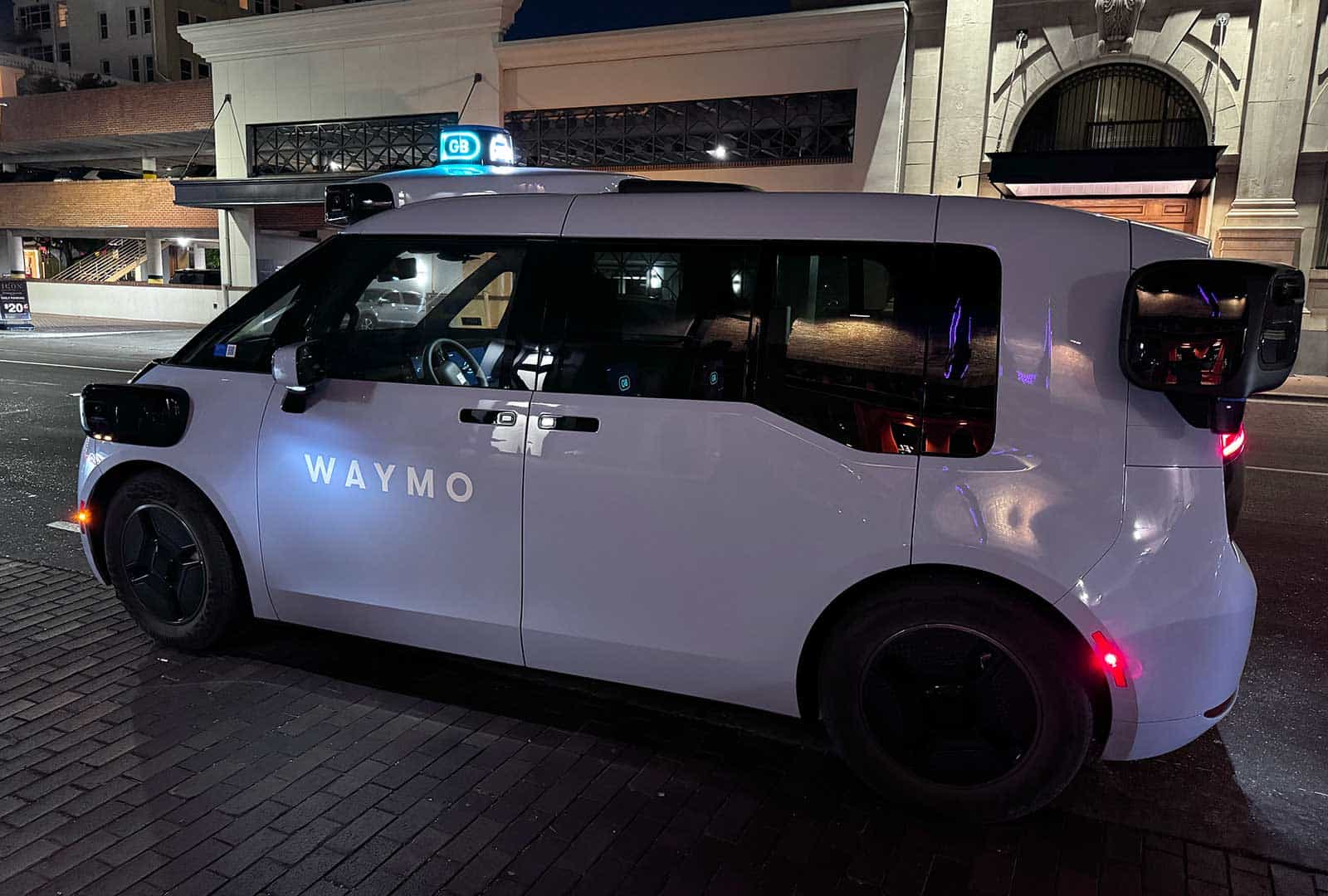
Waymo Scales, Neolix Goes Global, GM Bets Big on 2028
Waymo is aggressively scaling its robotaxi fleet from roughly 4,000 vehicles today to a target of 20,000 by end of 2027, backed by a $5 billion loan and earlier equity raises, while expanding commercially into Madrid and Toronto and adding to existing London, Munich, and Tokyo plans.
Chinese autonomous delivery company Neolix raised nearly $400 million in a Series E round, the largest single AV fundraise in China in 2026 and signed a distribution partnership with Malaysia’s Sunway Group to deploy its L4 delivery robots across Southeast Asia.
General Motors announced plans to bring fully self-driving personal vehicles to consumers by 2028 under Chief Product Officer Sterling Anderson, targeting premium ICE and EV lineups including the Cadillac Escalade IQ with a sensor-redundant architecture featuring 40x current vehicle compute. OMEGA, the show’s proprietary intelligence system, rates GM’s on-time delivery at 50/50 odds given the company’s history of starting and stopping major technology commitments.
Key Autonomy Signals Episode Questions Answered
How large does Waymo plan to grow its robotaxi fleet and by when?
Waymo plans to grow its global robotaxi fleet from roughly 4,000 vehicles today to approximately 8,000 by the end of 2025 and 20,000 by the end of 2027, supported by a $5 billion loan and $16 billion in earlier equity raises. However, OMEGA estimates that at current Mesa integration throughput, Waymo may reach only around 14,000 vehicles unless the pace quickens significantly.
What makes Neolix’s Malaysia entry strategically significant and what are the key risks?
Neolix’s partnership with Sunway Group provides built-in distribution demand, a regional operational template, local government relationships, and a harsh monsoon testing environment to advance its hardware and software. Key risks include Sunway’s closed-campus settings not validating performance on public arterial roads, and Malaysia’s pending AI and personal data protection framework potentially forcing costly country-by-country data stacks across Southeast Asia.
How does GM’s 2028 autonomy strategy differ from Tesla’s approach, and what is OMEGA’s assessment?
GM is explicitly rejecting a Tesla-style vision-only architecture in favor of sensor redundancy using LIDAR, ultra-high-resolution radar, and cameras, with a liquid-cooled central compute unit delivering 40 times current vehicle compute, and plans to deploy across both ICE and EV lineups including full-size SUVs and pickups. OMEGA puts the odds at 50% that GM delivers customer-available eyes-off highway autonomy on the Cadillac Escalade IQ by December 31, 2028, citing GM’s history of identifying but failing to fully execute on technology visions.
Autonomy Signals Topics & Timestamps
[0:00] KPMG Sponsor Introduction
KPMG works across the full autonomy ecosystem, advising operators, OEMs, suppliers, insurers, and investors as autonomous mobility scales.
[1:45] Signal 1: Waymo Is Scaling
Backed by a $5 billion loan and $16 billion in equity, Waymo plans to grow its fleet from roughly 4,000 to 20,000 vehicles by the end of 2027 while expanding into Madrid and Toronto. Grayson and Rob share field observations from Nashville, Dallas, and San Antonio, where depots are growing larger and sitting closer to airports, and explain why integration throughput in Mesa, not capital, is now the binding constraint.
[23:35] Signal 2: Neolix Goes Global
Neolix raised nearly $400 million in the largest autonomous driving funding round in China this year and partnered with Sunway Group to deploy delivery vehicles across Malaysia. Grayson and Rob discuss how monsoon season will test its technology and unit economics, and how Malaysia’s pending data protection framework could raise the cost of expanding across Southeast Asia.
[38:37] Signal 3: GM Bets Big on Personal Autonomy
GM plans to sell personally owned eyes off vehicles by 2028, using lidar, radar, cameras, and a liquid cooled central compute unit across both its EV and combustion lineups. Grayson and Rob weigh how the strategy reaches GM’s most profitable buyers against competing capital priorities and the risk that Tesla’s L4 ambitions make the feature look dated on arrival.
Full Episode Transcript
Waymo’s Three Big Announcements: Fleet, Vehicles, and Global Cities
KPMG Ad: The autonomy economy is real. Commercial robotaxi operations, humanless freight runs, AV infrastructure investment measured in billions. The question is no longer whether autonomous mobility scales, it’s who advises the companies building it. KPMG works across the full autonomy ecosystem: operators, OEMs, suppliers, insurers, and investors. At the moment it matters most, when the road ahead is uncertain, we’ve already been there. KPMG, accelerating what’s next in mobility.
Grayson Brulte: Rob, the road goes on forever and the, the signals keep on trucking. That’s how we work here this week you and I were on the road. I was in Nashville. We met in Dallas and met with the leadership team of a client, giving us some really in-depth happenings on what’s happening in the depot markets. A lot of stuff happening there. And a huge, huge thank you to KPMG. The hat is back. Last week I didn’t have it on the road, sorry about that. But the, the hat is back, and for the audience, a little teaser, Rob’s got a hoodie. Yes, he does. He’s got the KPMG sweatshirt on. And so Rob, this week we got some good signals. Yeah, this one I thought you were going back to the ’90s with the first signal here. Mo, mo money, mo cars, mo places, Waymo scales up. I was like, “Yep, here we go. You’re back to Bad Boy with me. Same old company.” Two, monsoons and mega rounds. Deal goes global. And oh boy, oh boy, GM bets big on 2028. I’m gonna give a little teaser and a little hint. It’s not the presidential election. Rob, let’s start with a 10,000 pound gorilla. Yep, that’s Waymo. Well, they’re raising debt and they’re raising up and they’re scaling because they got mo money and mo cars coming
Rob Grant: Yeah, I got 99 problems, but Waymo ain’t one of them right now. So in the last couple of days, Waymo has announced three big, big advances. So supported by a recent capital raise, including a $5 billion loan and earlier this year, 16 billion in equity, Waymo plans to grow its global robotaxi fleet nearly fivefold, scaling from roughly 4,000 vehicles today to 20,000 by the end of 2027. Waymo is shifting as well from its legacy discontinued Jaguar I-PACE fleet to more Chinese-built Zeekr Ojai electric vehicles. To navigate these high tariffs and regulatory restrictions, Waymo imports hardware-only vehicles and installs them, as many of you know, at its facility in Mesa, Arizona Where are they gonna put those vehicles? Well, Waymo is adding Madrid to its European rollout alongside London and Munich, with plans to begin manual mapping in Spain immediately and carry its first commercial passengers in Madrid in 2027 as well. And then as we also called here, similar to Madrid very early, Waymo has announced a target for commercial driverless rides in Toronto, one of my favorite global cities in the whole world, right along Lake Ontario, marking its first entry into Canada in partnership with Element Fleet Management for local operations, charging, and vehicle maintenance. And so, you know, this is a strategic global push by Waymo. It’s facing strict regulatory frameworks in Europe and challenging winter driving conditions in Canada, but it’s saying, “We’ve got this. We can take it. Our technology has advanced. Our understanding of markets has advanced. Our understanding how to launch into markets has advanced, and we’re ready to really take this aggressive expansion across the US into major global capitals.” Mind you, we didn’t even mention Tokyo, where they’re already starting with their vehicles. And so they aim to secure market share and regulatory relationships ahead of autonomous competitors like Tesla and many of the Chinese AV developers as well
Grayson Brulte: The one thing is clear, Waymo’s firing on all cylinders. Yes, I know it’s an electric vehicle, but they are clearly firing on all cylinders and they’re s- they’re scaling globally. And it, it’s super impressive how they’re scaling and individuals might be wondering where the vehicles coming from. Well, there was an article in Semfor this week where they talked about all the vehicles they’re getting. What were those numbers that were shared in that article?
Waymo Fleet Ramp: Ojai Imports, Mesa Integration, and the Million-Rides-Per-Week Goal
Rob Grant: They were, in that article, talking about growing their vehicles from about 4,000 now, though you and I know it’s a little bit more than that given the number of Ohais that have been continually moving into the fleet over the last three or four months. So they project 8,000 by the end of this year, and 20,000 by the end of 2027, with the roughly 5,100 Ohai imports going through the Mesa integration plant by year-end. And that, that’s a real big shift and a real big test for, for two reasons, is from what we can see, Mesa is ramping up how quickly they can integrate the vehicles at their plant, right? And two, how heavily the deployed fleet is being used. What we’re seeing is higher throughput on both of those metrics, how fast the vehicles can be integrated, and then how fast those integrated vehicles can be deployed in the fleet. And we’ve talked about this going back to June, is that’s gonna be the real question for this year in order for Waymo to hit its stated goal of a million riders per week. It would really rely on that throughput at the Mesa facility, and then the throughput from the facility to deployment. Right now, Waymo is hitting all of its paces, and that’s a really good sign, especially given their new goal of 20,000 vehicles by the end of next year
Ground Truth: Waymo Density in Nashville and Dallas Markets
Grayson Brulte: Waymo’s not just hitting their paces or, or, or hitting their stride, they’re scaling up rapidly in markets that they’re already in. We were in Nashville this week. Well, everyone’s like, “Oh, Nashville’s a new market.” The, the general, what’s it called, the chattering class saying, “Oh, it’s a limited number of vehicles, Rob.” No. You look north, you look south, you look east, you look west, Waymos were everywhere. I was in a caravan of four Waymos, ha, in, in one part of, of, of Nashville. They were everywhere. Individuals in, in honky-tonk on, on Broadway using Waymos. Look at how cool that is, taking photos. I’m gonna go on the record here and I’m gonna state that I think that there are m- over 100 vehicles in the Nashville market, more than most individuals suspect, and Waymo has more vehicles in markets than in general other markets reporting. And that also goes for Dallas, where you and I were there, and Waymos were everywhere. I’ll use this term, there was way mo, Waymos, in these markets than the market is currently pricing in
Rob Grant: I agree, and I can see it even in my home market here in the Bay Area, right? The Bay Area is, is spread from San Francisco all the way down to San Jose, and that’s about 40 miles of territory to cover, and the wait times everywhere are fantastic. They’re super competitive with the Ubers and Lyfts down here. They and as we all know, wait time is key for both consumer stickiness as well as for utilization in terms of getting as many rides as possible in those vehicles while they’re out. It, it, it has become so convenient to call a Waymo given the wait time and given the pricing, which, which I also think is becoming more consistent. Now, the great thing is you add that to what has been a consistently good experience. I think the Ojai’s have improved in their experience. I know for a while, at the beginning, there was some feedback, both anecdotal and I think admitted in, in certain press releases that it needed to improve a little bit. It has improved. So you add consistency, competitive pricing, and low wait times, and you have a service that is super competitive. and I think all of that is a little bit of a function of more vehicles on the road. it’s kind of these scaling laws that you see in many other areas. The more vehicles you have, the more competitive you get on various other metrics, and the more consistency in those other metrics leads to more reliability in terms of meeting the goals that you set, whether they be measured in rides, measured in revenue. Still, as all of this also is a little bit of a function of an improving kinda infrastructure as well. we n- the folks who listen to us and watch our field reports know we’re hitting basically every depot that we can. I believe you and I, we’ve estimated we’ve hit about 80 to maybe 85% of depots in the United States of all the major carriers. And what we’re seeing is improved performance and throughput there, all of which is why I say, you know, Waymo’s ambition here is, I think, backed by a confidence that all of the aspects of their operations, from vehicle supply all the way through depot as a service, so to speak, have improved
Depot Trends: Growing Footprints and Strategic Airport Proximity
Grayson Brulte: They have, and w- we’ve noticed a growing trend in Waymo depots in particular. Now we’re starting to see it with Tesla depots. They’re getting bigger. They initially started 60,000 square feet, 70,000 square feet. Then you had the Avomo Austin depot, which was an outlier, which we would estimate about 80 to 90,000 square feet. And then we were just in San Antonio two weeks ago. We visited the Waymo depot there, 110,000 square feet. So what does that mean? That means more cars. Mo’ cars. Way-mo cars for, for Waymo. I’m gonna stay in that Way- with that Waymo trend here. So you’re starting to see that ramp up, and the trend from the early days is holding. These depots are strategically placed near international airports, and that’s gonna get very, very interesting ’cause Waymo has the ability to send large amounts of vehicles to international airports with little wait times. Put that into perspective. My wait time at the Nashville International Airport this week, six minutes to get a Waymo. Why? The depot literally touches the property line. So that’s something to watch, too
Rob Grant: For sure. And look, they, you know, clearly Waymo is developing an advantage in repeatable local operations combined with what was already a high quality kind of regulatory execution, right? As we’ve talked about, the open liability around Waymo has, has been around vehicle supply and financing exposure for that vehicle supply. Well, they’ve answered that second question this week with the, the $5 billion that they have access to now to pay for more of these vehicles. Now, there are still things to watch for, particularly on the international side, right? Rollouts are going to be different and differently timed for lots of local reasons. So things to watch for include Ontario operating permissions, a named Madrid, Madrid fleet partner, the debt financing terms, right, and dated disclosures of deployed fleet and paid rides that separate their growing capacity, right? Growing capacity in terms of vehicle supply from productive service, which all goes back to it’s now about throughput in some of these international markets from regulatory approval to increasing your vehicle supply in that market. And I think we’re going to see, and I would expect to see, given my understanding of the regulatory markets, having worked in many of them, it’s just going to be a little bit of a longer timeline than in the United States from when you get that first approval permit to when you can actually have a robustly deployed fleet that has wait times that we see in many of the places that you and I have just been to. I think that will be the challenge going forward for Waymo, is how do you pull that time in? How do you make that time less so that you can make that market more productive sooner?
Grayson Brulte: It’s tough to watch, and I’m gonna sound like a broken record here, ’cause seemingly every week, or you and I talk every day, is we talk about the APS permits in London. That’s gonna be something for the audience to w- to watch, and watch the London market for competition because Baidu with FreeNow/Lyft has started testing vehicles in London. They put reporters in. So that market’s heating up, so watch that. But then here’s another interesting market: Kazakhstan. Baidu’s getting ready to deploy there. We’ve talked on past episodes around the manufacturing that happens in Kazakhstan. This week, NVIDIA announced they are investing in Kazakhstan, and I’m gonna give a little insight of a secret here that you and I know, but the audience doesn’t know. Special field reporter Spencer, who’s on the team, he’s visited Kazakhstan. So perhaps we have to send Spencer back to Kazakhstan to get a ground truth report on, on what’s happening with all these press releases coming out of Kazakhstan
Rob Grant: Well, 100%. I think what our folks and our clients can expect from us is we get on the ground and we find information that is valuable for whatever purpose they need, right? Is it how much is it costing for the infrastructure there? Who are they partnered with? What are the financing terms? How many vehicles are there? What are the supply chain risks in every area? What are the regulatory risks? And so we’re out there hustling for you and for, for anybody who’s interested in modeling costs and understanding where the next market’s gonna be, where we might be strategically valued to, to get ahead of a growing robotaxi market give us a shout. You know, look us up on LinkedIn. We’re, we’re out there as Rob and Grayson on LinkedIn or, or give us an email at [email protected]
OMEGA Risks on Waymo: Partner Dependency, International Pre-Revenue Phases, and Mesa Throughput
Grayson Brulte: Yeah, send us a note. As, as we discussed this week with, with a client in the Dallas area, is that the press releases aren’t necessarily telling you the full story. And as we shared with this client, the details of actually what’s happening on the ground, and that’s what we make a, a big deal about, of going around and doing the field work and putting the data into OMEGA and also sharing it with clients. So as Rob said, you’re interested, reach out because we have the largest database of real ground truth intelligence on the autonomy economy. Which brings us to OMEGA’s risk, ’cause these risks are real, and when you do field work, you uncover the risks. OMEGA has surfaced the following risks, Rob. Partner-dependent operations through Element and Magnus slow depot and maintenance scaling. That is an issue because as we’ve seen, Tesla says, “Nope, we’re gonna vertically integrate.” Waymo’s taken the partnership route. So two different models, but there is inherent risk there for a variety of reasons
Rob Grant: For sure, right? Particularly if you look at the element and fleet managers, fleet as a service providers. Going to these foreign markets, there is a host of issues that, that we’re aware of, that they’re very aware of, that maybe, maybe not a lot of our listeners are aware of. You have everything from zoning issues to space issues to design dynamic issues in terms of dealing with older cities and older grids. You have not only the power issue, but you have fire protection issue, water issue. What are you gonna do with maintenance of the vehicles, and where can you do those types of things? So understanding where in these more heavily regulated, more locally dominated markets particularly in, like, London and Madrid and Munich, where you can set up your bigger, what we call colloquially here, mothership depots where you can do a host of activities. And then where you’re gonna find kind of more of your staging, charging hub– not hub, but spoke-like depots, that’s a real issue. And how quickly you can do that, how big they are how many vehicles they can accommodate, how many– what’s their throughput and their uptime and things like that, that’s really gonna determine a lot about how quickly you can scale and how quickly you can get to those desirable metrics of wait time and price and reliability that we talked about earlier. And then on the Magna side, they’re seemingly doing a really great job of maintaining the pace of integrating the Ojai vehicles and upfitting them at the Mesa plant and then getting back out into the field. But that pace needs to quicken. At its current pace, they’re not going to meet 20,000 vehicles, so that pace has to get even faster. Otherwise, you know, we would estimate them maybe hitting 14,000 vehicles or so. So unless that, that pace picks up, that scaling is going to be a little bit deterred because they won’t get to the vehicle supply numbers that they stated for the end of next year
Grayson Brulte: There’s a lot of, you wanna say, moving parts and when you go internationally, the regulations are different. The environmental laws in some countries are different. As we’ve learned, and we discussed with our client this week, fire retardants in some countries play a big role in depots. So there’s a lot of moving parts that we’re looking at, if you wanna call the nitty-gritty details that we look here at AUTNMY AI, and that’s one of the things that separates us from the market, in my opinion, which brings us to risk number two. International markets remain in testing, mapping, or entity-only phases extending pre-revenue capital deployment. We’ve seen early hints of this risk in Sydney, Australia with Waymo. This is a very good risk that OMEGA uncovered
Rob Grant: 100%, and we’re, we’re seeing some of that potential risk play out in London as well. I think with the government changes that have occurred in the UK in the last, you know, 12 to 18 months, we’ve seen sort of a, a hurry up and then slow down type of pace from the government there. Not that they’ve, you know, turned against robotaxis fully, it’s just the pace is now more measured given where the government values the rollout of robotaxi fleets. And I think this is very much a different risk than we see in the United States because in the US, we have less likelihood of snap elections and things like that, where governments change, reform, new leaders come in on these kind of non-standard period of times, or at least non-standard from the US perspective, right? Obviously, if you live in the UK or the EU, you’re like, “Hey, this is just a part of life. This is the standard way of doing things.” So I understand I’m taking a Western US perspective on that. But for many of our listeners, those type of swift changes can really lead to a little bit of whiplash on the pace of moving from perhaps testing and pilot phase to moving to commercial phase. And so there is always a little bit more of a risk, particularly in the UK, in Europe. less so you know, when you’re looking at some of the Asian countries. They tend to be a little bit less dynamic in their reevaluation of current governments. not to say that they, they couldn’t. Many of them have the similar forms of, of government structure, but they tend to invoke those type of changes less, so there’s a little bit less of a, of a, of a whiplash likely there. But yeah, this is something to watch in terms of you may have formed an entity, you may have gotten the official okay to start testing with a driver in, maybe even been assigned a small pilot area to go driverless. But by the time you do all that, there may be a new government in place that says, “You know what? We’re just not comfortable with you going to commercial driverless.” And so that’s what this risk is, is that it’s a risk that it keeps you in these pre-revenue stages, which Waymo goes through of its own volition, right? This is the kinda traditional Waymo path. This is not so much the Tesla path but the Waymo path. So it’s, it’s not necessarily a risk that is felt right now as they begin to enter these markets. What it is, is the risk that these periods of time extend beyond what Waymo would normally use to, to test, develop, and feel confident that they’re ready to move to the next stage.
Grayson Brulte: Simply said, time is money, money is time. It’s something to watch, and we pay attention to the regulatory environment very closely. We pay attention to the international political environment because we wanna say there’s a lot of cooks in the kitchen and a lot of moving parts, which brings us to OMEGA’s take. “Madrid and Toronto extend Waymo’s geographic option set on supervised validation-first timelines, while London and Munich remain pre-commercial towards the end of 2027, and Toronto targets 2028. Alphabet has assembled funding for a fleet above 20,000 vehicles, but important and fit-out evidence does not yet show the throughput to deliver that fleet by the end of 2027, making vehicle supply, not capital or engineering capacity, the binding constraint.” That is a very good take by OMEGA, and perhaps we could see a Waymo factory somewhere in the EU because, drum roll please, EU type certification would come with those vehicles, would speed up the timeline, and reduce the potential regulatory hurdles
Rob Grant: Yes, I think that’s quite a possibility. Waymo’s ambitions is not going to stop at 20,000 vehicles, right? We know that figure will have to be 10X that within a few years, and then 10X that figure in a few years to the point where you have millions of vehicles that are in the Waymo fleet, you know, within the next 10 years. They are going to need more vehicles built on their behalf, and can the Hyundai Motor Group deliver all those? We shall see. Will it be some other partner, or will Waymo look to go into the car-making business itself? we– That– Those are questions that are much longer horizon. We love to pontificate about them. That’s a word that I used on my son last night when I got home, and he was like, “Stop using big words. It’s 11 o’clock.” But we will think deeply on these issues. They’re not near term, but as you look out, the ambitions are huge, and the vehicle supply has to be huge to meet those ambitions.
Grayson Brulte: They do because Waymo’s ambitions are only growing, their competitors’ ambitions are only growing, and autonomy is going global, which brings us to signal two. Monsoons and mega rounds: Nio goes global. See? The global trend continues here on signal two. What do we know about this, Rob?
Neolix Raises Nearly $400M Series E and Signs Malaysian Partnership with Sunway Group
Rob Grant: Yeah, Neolix, great company. They’re doing autonomous delivery robots. They raised nearly 400 million in a Series E funding round, making this the largest single fundraising deal in China’s autonomous driving sector so far in 2026, and bringing its total cumulative funding past 10 billion RMBs. 10 billion, that’s a big number, talking about big numbers. Neolix also signed a memorandum of understanding with Malaysian conglomerate Sunway Group to distribute its L4 autonomous delivery vehicles across Sunway’s property, healthcare, retail, and hospitality ecosystems in Malaysia. Proceeds from the new funding round will be used to build fulfillment service hubs in key global markets and further train its vision-based end-to-end AI large language model to boost vehicle safety while reducing maintenance costs. Neolix is further nearing its completion of its three-month autonomous vehicle sandbox testing in Malaysia and is advancing toward vehicle type approval stage alongside local partners like SF Express and Tiong Nam Logistics, big, big names in Malaysia for those who aren’t familiar with those names. So supported by favorable Chinese central government policies for unmanned logistics, Neolix currently operates a global fleet of over 30,000 robo vans, robot delivery vans, and robot delivery services across 320-plus cities and 20-plus countries spanning Europe, East Asia, Southeast Asia, the Middle East, and Australia, with over 260 million autonomous kilometers driven. So for those that aren’t familiar with Neolix, get familiar. This is a very powerful up-and-coming player in the delivery space, particularly autonomous delivery space, who, by the way, has deliberately avoided a US entry. And if this is all backed by our Road to Autonomy Index, where Neolix currently ranks number one on our delivery bot index
Grayson Brulte: The proof is in the pudding or, or the data’s in the index, any, any term you want to use there, which highlights that, that our global reach is that you and I fundamentally both believe autonomy is becoming an economy called the autonomy economy, and it’s going to become global. It’s not just going to be US-based, and the Southeast Asian market is a very, very important market. You hi- highlighted Malaysia, which is great. You have Grab there. You have Singapore there. You have a lot of mo- moving parts, and the Sunway partnership that Neolix has is pretty impressive. Why does that partnership matter? What does that partnership unlock for Neolix?
Rob Grant: Yeah. So a, a township partner like Sunway can aggregate delivery demand and offer repeatable deployment settings for Neolix, as well as its local support makes the vehicle more usable for buyers. The risk is an export business where after-sales obligations grow faster than the gross profit on each vehicle. However, Sunway allows for a kind of maximal utilization within its properties and is really supportive of having Neolix test in these very difficult conditions that arise in Malaysia. And so Sunway is just a really perfect partner for Neolix in this sense because it allows them to get on the ground it gives them kind of a regional template as to how to work, right? You can find maybe a campus or a kind of full-in facility that Sunway provides in terms of live, work, play type of scenario. and it gives you an automatic kind of distribution channel within those facilities as well as kind of local support with their relationships with local government. So Sunway is a very strategic partner for, for Neolix
Monsoons as a Real-World Testing Environment for Neolix in Malaysia
Grayson Brulte: Well, that’s wonderful and, and fine and dandy. There’s a little thing called weather. And what do they have in that part of the world? Monsoons. Ha. And they call it a monsoon for a reason, because it comes down in buckets. What impact is monsoons going to have on this rollout?
Rob Grant: I think this is the really interesting aspect here is that Neolix is going to get a very harsh test about how it deals with extreme weather. And for folks that have not been in that area of the world, this is not just any ordinary rainstorm. These monsoons are impressive, the type of thing where you can see where ancient civilizations thought this was the wrath of God. That’s how heavy they come down. but being able to, one, understand the limits of your capabilities with your vision system understanding maybe how to tell the signs of what could potentially be a flash flood coming and then understanding, w- does that force heavier human-in-the-loop oversight because of these extreme conditions? And if so, how do you make those ratios workable? is, do you have to move the human ratio to deployed autonomous delivery bots in advance of monsoon season, expecting greater intervention during monsoon season and then roll it back? So is it a seasonal type of hiring? And what type of downtime can you expect during moun- monsoon season, and can you then build your kind of unit economics around maybe the seasonal effects of longer downtime as well as greater intervention during monsoon season? And so while all along testing your hardware and software to see can we advance them so that that intervention rate continues to go down despite the consistency of the harsh weather and that downtime goes down as well. So I think it’s a, it’s a great kind of testing environment, real world testing environment for Neolix to learn how does this all work together? How does this advance my hardware and software? How does, what does it mean for my unit economics? What does it mean for downtime, uptime, human intervention? so it’s a, it’s a really great test and a learning environment for Neolix
Grayson Brulte: It’s a learning environment that can potentially be exported to Europe, as we’re seeing companies, a lot of these Chinese companies are going to Luxembourg and using it as a, as a base to expand into Europe. So it’s something to watch. Be curious to see how this grows, and you and I have, have seen in the data, we, we’ve seen it in the field that delivery bots are, I wanna say, making a comeback. They’re starting to get more and more popular. Obviously, a lot of the growth is coming in the Asian markets, not necessarily the US markets, but that market is really starting to, to heat up. While this is all fine and dandy, there’s still a lot of risks with this. We talked about Waymo with their partner risk. Perhaps, Neolix has a partner risk here as well because OMEGA has highlighted the following risks. Private site operations like Sunway may not validate performance or authorization for arterial public roads, artillery or public roads. That’s a valid point because as you talked about with snap elections, obviously the politics in Southeast Asia is a little bit different, but there’s something to really truly watch there
Rob Grant: I think going forward with a private site operation certainly has its advantages that we talked about, but it, it, it comes with risks as well. I think the one that you mentioned is valid in terms of political risk if, if Sunway, for various reasons, some associated with Nulix, probably m- many that would not be, runs, you know, gets on the wrong side of a government or the government changes. But it’s also that, that Sunway’s facilities, right? They, they are kind of closed-off facilities. They have limited speed limits, limited types of vehicles on there. They are certainly less chaotic than the general public roads in Malaysia. So it allows kind of the obverse of what we were talking about with the weather. You go to Malaysia, and you learn a lot about the weather because it’s an extreme difficult testing environment. Kind of the obverse is that is when you go to a, a Sunway type of facility, you are reducing kind of your chaotic testing environment for your delivery robot in terms of what it will encounter on the roads and what type of roads that’s in there. So if, if they ultimately plan to serve a greater population, which they do in Malaysia once they get their type approval, they will need to be able to navigate much more difficult arterial public roads in terms of speed, chaos, the types of vehicles on there, the number of people that are on there, things of that nature that are a little bit more controlled in these Sunway facilities. So it’s a little bit of a plus and minus, but I think given the fact that they needed type approval from the government, they wanted to test in a very difficult weather environment, and you had a sort of built-in distribution center for multiple different types of deliveries, Sunway was still a really good strategic partner to choose.
Grayson Brulte: I agree. And now here comes perhaps the biggest risk. These are two risks into one that OMEGA’s uncovered because I gotta tell you, the way that you program the policy brain of OMEGA, Rob, this is really, really impressive. So this risk is all you, sir, ’cause you programmed it here. Malaysia’s pending AI and personal data protection framework imposes cross-border transfer or teleoperation rules stricter than edge anonymization alone, followed by other Southeast Asian jurisdictions adopt divergent localization mandates forcing country-by-country data stacks rather than one regional architecture. Holy cannolis, that is the, the, you wanna say, that can open a can of worms. There’s no other way to say it. That can, boop boop, here comes the can of worms. That’s a Risk
Rob Grant: For sure, right? And all of this is a risk because every part of this just adds potential cost of operations, right? It– If you have to have kind of very strict visual blurring of faces and anonymization of the activities that are going around the robot that are being captured by its vision system, that, that brings on additional cost, whether or not you can do that on the edge. I’ve seen some companies that can blur on the edge. I’ve seen some companies that cannot blur on the edge. that could come with additional cost. It could come with cost of where you keep the data from that, whether it’s on the edge blurred or, or uploaded to the cloud. If they have a local mandate, then you have to build a data center for that. You have data processing rules that might come along with that as well that add cost. You want, you know, given the markets of the nations in Southeast Asia, some of which are huge in terms of potential given the, the population sizes, some of which are much smaller, if you have local dataization requirements, right? And mandates that the stacks have to be kept in each country instead of saying, “Okay, I’m going to keep most of my data in Indonesia, and that will serve for all of my Southeast Asia hub or Singapore,” choose a, a country that, that allows you to say, “Okay, I’m gonna go into Vietnam. I’m gonna go into Cambodia. I’ll go into some of these important but smaller markets.” if you have to have a data stack or a data center and folks on the ground in each of those places to, to man and, and process the data in each one, you may never get to any of those markets because of the cost. The cost, the risk/reward there might just be too high. And so, this is a really important moment in terms of how far does Malaysia’s pending, and it is pending, it hasn’t passed yet, AI and personal data protection framework move into kind of these adjacent fields of autonomy, right? The, the, the AI and personal data framework rule’s not necessarily written for somebody like a Neolix, but if it brings them in and it brings them in in such a way where it really fragments each market into its own set of rules, that’s just gonna add a lot of cost and make Neolix and others really think hard about which markets are worth it and which ones aren’t.
Grayson Brulte: That’s a lot of, there’s a lot of risk there, and blurring on the edge is not cheap. Just, just wanna put that out there. Blurring on the edge is not cheap, and it is complex. ‘Cause we blur, we blur faces in our videos, and it’s a complex process we do for privacy purposes. We do it because it’s the right thing to do. But when the government mandates it, you have to meet all that. Perhaps it’s the blur level, the intensity. There’s a lot of complexities that come around with that, which is gonna create a lot of cost and a potential, I have to say potential, time delay. Which brings us to OMEGA’s take. “Nioox is building a business that sells and distributes vehicles and backs them with local service infrastructure. The October 21st announcement ties together three things: new financing, overseas fulfillment, and a Malaysian distribution channel. The commercial test is whether regional partners can turn vehicle deliveries into repeat orders without Nioox absorbing uneconomic maintenance, support, and deployment costs.” Again, it comes down to cost. It’s all about dollar, dollar bill, y’all
Rob Grant: Look, around the globe, doesn’t matter if you’re in Malaysia or Massachusetts, you’re looking to make money with your efforts here, and that is a, at a very fundamental level, and I know we have very sophisticated people who listen to this, but at a very fundamental level, it comes down to what do you charge for your product and how much does it cost to deploy that product? If, if there’s a significantly negative ratio between those two things for a longer period of time, you’re in deep water. Monsoon level water, I would say
Grayson Brulte: Monsoon of water. And boy, oh boy, when that comes down, it comes down. There’s a lot of things changing here in the United States. 2028, which brings us to signal number three, GM bets big on 2028. No, it is not the presidency. GM is betting big on something else. What do we know about this signal coming out of Detroit?
GM Bets on Consumer L4 Autonomy by 2028 with Sensor-Redundant Architecture
Rob Grant: For sure. And look, I can tell you the GM team on the policy side will be playing in the presidential election, but this is not what we’re talking about today. So General Motors this week kind of went on a, a little bit of a, a press blitz talking about its plan to put fully self-driving personal autonomous vehicles on the road for consumers by 2028. Under Chief Product Officer, Sterling Anderson, a, a really good person that I know, I worked with him at Aurora, and I’ve met him many times since my departure from there. GM aims to bypass traditional step-by-step driver-assist evolutions, and directly leapfrog rival automakers in the consumer autonomous mobility space. While GM’s Cruise division, rest in peace, previously focused primarily on commercial robotaxi fleets and ride-hailing services, this strategy expands GM’s self-driving technology into directly sellable privately-owned personal vehi- vehicles. GM plans to integrate advanced– these advanced L4-capable self-driving software and hardware into its consumer EV and com– and combustion vehicle lineups, which is really of note here, utilizing unified software architecture across its global brands. So right now, GM’s target by 2028 puts it in direct competition with Tesla and its planned unsupervised full self-driving rollout, as well as tech rivals, signaling a broader industry push from commercial fleet testing towards retail autonomous passenger cars
Grayson Brulte: There’s a lot to unpack there. I love that you say Cruise rest in peace. It is Halloween. Perhaps somebody will go dressed around as a Cruise Origin or something funny out there. You never know what people are gonna do for Halloween. As GM makes this push, obviously we publicly know they’re starting on highways. Why does this matter?
Rob Grant: This is a big deal i-in terms of how GM is positioning itself to remain competitive in the field that is increasingly moving towards autonomy, AI-driven software-defined vehicles. And, and GM, I give it– I always give it credit. It has been very open to technologies very early, and we saw it with EVs, we saw it with AVs. And so GM, while its execution, people can argue about in those areas, it does have a history of being able to kind of see how the road is moving in a few years’ time ahead of it. And so what I take away from this is, you know, one, you could argue this is out of necessity to stay competitive, but two, I also think they honestly see, and they have a good track record, personally autonomous– personally owned autonomous vehicles are coming, and they’re gonna be part of our future. And if you look at the– GM’s history of kind of identifying where the future is going, to me, they, they are a good little canary in the coal mine of, like, if GM believes that this is going to be the future they have likely hit upon something here that the future is, is coming in terms of personally owned vehicles. Now, will, will GM be the one that owns that? I have my doubts. not because I doubt anybody over there personally, but they have a history of, of maybe failing to see through some of the vision that they capture ahead of time. But when they see it, I have no doubt that they, they have hit on something here that personally owned autonomous vehicles are coming and perhaps coming sooner than many expect.
Grayson Brulte: The interesting thing in all of this is the sensor redundancy and the in-house compute. I know I harp on this every time we get a chance, but there was no clear definition or terms of clarity of what in-house compute means. What do we know about that initiative?
Rob Grant: Yeah. So what, what we learned is this is the first time GM has put some numbers on its kind of next logical architecture. They said it’s an in-house liquid-cooled central compute unit with 40 times the current vehicle compute. 40 times. they will have one core consolidating autonomy, active safety, chassis, and propulsion system. They will have zonal hubs on high-speed Ethernet, moving 36 times more data and cutting wire length and mass from the vehicle by 30%. Now, they haven’t named a silicon vendor, right? And so that leaves open whether this is a GM’s designed packaging around merchant ships or GM built in-house silicon. That was not answered. But what we’re seeing here is a little bit more detail as to how GM is going to produce a personally-owned vehicle and what’s going to be powering it. We will also say, just to be clear, GM is explicitly rejecting a Tesla-style vision-only, vision-heavy, lower cost architecture in favor of sensor redundancy. Its personal autonomy rollout will begin with premium full-sized vehicles using LIDAR, ultra-high resolution radar, and cameras cross-referenced in a single perception layer, backed by this liquid-cooled central compute unit
Grayson Brulte: The market for, if you want to say personally owned or L2 plus, I know Sterling does not like to use the term L3, but that’s basically what they’re building. Sorry, Sterling, I had to say it. Is that global automakers are trying to find their alternative to Tesla FSD. That’s becoming pretty obvious. Stellantis has to deal with Wayve. Nissan has to deal with Wayve. But the interesting thing is GM’s saying, “Okay, we’re gonna load this thing up with sensors.” Stellantis is saying, “Nope, we’re gonna go a leaner path.” Nissan is saying, “We’re gonna use part of the ProPILOT architecture, a leaner path of what we know.” And then Tesla obviously vision only. It just seems like there’s all these di- diverging paths of where these automakers are, are going. The only data point we have in the market now is that Tesla’s vision works and it’s scaling
Rob Grant: That’s true. That’s true. you know, like I said, some of this may be of necessity to find a way to compete with Tesla going forward. And I think that’s also what brings us to what I found as maybe the most interesting thing was the ICE, internal combustion engine for those who don’t know, an ICE plus EV architecture is the commercial lever here, right? A- as many who follow the auto industry know, GM’s profit pool is full-size SUVs and pickups, which are almost all uniquely gas-driven ICE vehicles. So a s- a compute stack and autonomy stack limited to just the Ultium EVs would reach the wrong customer, so to speak, or would just not reach enough of their own customers. So their backbone across both powertrains is, is how this new L2 plus plus, L4 features reaches the Tahoe and the Silverado buyers, right? it’s also making it eligible for the ICE architecture and for the ICE consumer is how GM spreads that cost, whether it’s the central compute unit and potentially their own silicon or maybe someone else’s designed silicon, across their full volume of vehicle production, which is something that, that Tesla obviously does right now because all of their vehicles are electric. And so it, it is, it is a way to stay competitive with Tesla, to offer something different in terms of the ICE architecture. And that, to me, if they can be successful in that, there is a, a potential path for, for GM to own a segment of the market that nobody right now is going after because in the robotaxi world, at least, every robotaxi is designed with an EV architecture or a hybrid EV architecture. There are none that are specifically designed in the robotaxi field for the internal combustion engine that you see where GM makes all of its money in the bigger, bigger lineups of vehicles they have.
Grayson Brulte: ICE vehicles, and particularly in the large-scale SUVs, are cash cows. Let’s just call a spade a spade. Ford has the Ford F-150, the pickups that are cash cows. GM has the Yukons, the Denalis, the Escalades, and those are absolute cash cows for them. And there is a segment of the market that is going to want to have, in my opinion, a Tesla FSD-like system, but they’re gonna want it on a big SUV. I can hear certain individuals crying over here saying, “How dare you put it on a big car?” But there’s a certain percentage of the market that wants it. How the technology is going to evolve, how the technology is going to roll out, unsure. And the question that most people should watch is how conservative will GM be of where they will let the technology go. As we see with Super Cruise, they’re only allowing it to go on mapped roads. And at the end of the day, as you and I know from experience, they’re gonna want to be able to take the children to the hockey game, to the baseball game, to the hamburger stand, and use this system as they can in FSD, and it’s something that GM, in my opinion, is going to have to match. Which brings us to OMEGA’s risks. OMEGA’s uncovered the following risks here. Internal autonomy funding competes with, with core vehicle platform capital priorities. And why am I highlighting that? ‘Cause OMEGA did this. You have the $20 billion buyback, which has ignited Shawn Fain and the UAW, and that comes up in 2028, so there’s gonna be a lot of, I’ll say, competing parties, as OMEGA has uncovered, as GM looks to build and scale this coming, in the future
Rob Grant: For sure. And for, for GM and I think for all of the US Big Three automakers and for, for many of the European automakers, they are under tremendous pressure, right? They are, they are fighting for their lives in markets where they’re competing with the Chinese, and, and they are– There’s no other way to put it. They’re losing against the Chinese automakers in markets where they compete. They just, they cannot compete on price. They’re getting beat on software and efficiency as well as consumer expectations for, for the types of software-defined vehicles that are out there. So China is just beating the pants off of them. And, and you can argue whether that’s for a host of reasons, right? but, but they are losing ground. and so they’re consolidating, you know, some of their firepower to defend against this growing kind of monster from, from the East in terms of Chinese-made vehicles. At the same time, you know, EVs, while growing somewhat in terms of consumer adoption in the United States, that adoption has not necessarily been from the vehicle lineups produced by The Big Three. And so they’re, they’re stressed from the EV side as well. and then they’re looking at a very big mountain here to compete with the likes of Tesla and the Waymos of the world and, and the Wayves quite honestly, and those that are into L4 licensing, right? We have a whole index that tracks that. They’re competing with all of those. and, and that is a, a capital-intensive, priority-intensive competition. And so they have these three fronts. And so all this risk is saying is there’s a lot of pressure on GM. And when push comes to shove, where is that, that last dollar gonna move to? Where is the most value for each dollar going forward? Where should that be put? And, you know, I’ve seen this firsthand with my experience in GM and Cruise and, and it was not a negative one despite where Cruise wound up. These are just very hard decisions for a company that has, you know, a large workforce and a long history to, to keep in mind. And so it, it comes back to what we were talking about just a minute ago, which is a lot of times GM sees the vision, but it’s really hard for them to execute over a long period of time to that vision given the other pressures that they face in their immediate you know, day-to-day operations.
Grayson Brulte: But the bottom line is GM’s facing competition and pressure from both domestic and foreign competitors at the end of the day. The market’s evolving. The market is moving towards a software-first, different architectures, different consumer choices. You’re, as you’re clearly seeing at the end of the day, consumers want an FSD-like system. You’re seeing it in China. You’re seeing the growth of FSD with Tesla’s latest print. It, it’s coming, which brings us to OMEGA’s final risk here. With Tesla selling fully capable L4 vehicles potentially as soon as the end of 2026, will consumers be looking for an eyes-off, hands-off limited use feature two years from now after they can access full autonomy? That’s a good risk ’cause Tesla has said, that’s what they said, I’m not saying it’s gonna happen, that they will potentially sell a Cybercab to an individual here in the United States. But that is a very good thing. Two years is a, is a long way off, especially as this technology rapidly accelerates
Rob Grant: Yeah, I think this risk ultimately is the fear that even if GM is successful in executing everything that it laid out in the last few days, consumers just give it a big, “So what?” Right? “That’s great. That was a, a cute trick five years ago.” I can, I can go fully hands-off. I– Whether it’s Tesla I can buy, and they can just drive me everywhere. I could. You know, there are others that, that are on our Robotaxi instance, like Tensor. I can have the steering wheel disappear, and maybe that drives me everywhere. You know, Stellantis and Wayve are working on L4 vehicles, and Wayve and Nissan are doing the same thing. They, you know, in two years’ time, it may be that consumers have a choice of, you know, a variety of vehicles that can do much more than what GM is proposing here. And so that, to me, is, is, is somewhat of a big concern, right? That consumer’s just like, “And? And?” Like, what else? It’s, it’s, it’s kind of like saying, you know, potentially, “I made a really great VCR,” when everyone’s moved on to streaming.
OMEGA’s Take: 50/50 Odds on GM Delivering Eyes-Off Highway Autonomy by December 31, 2028
Grayson Brulte: Where do you go? Or did you build a really great laser disc or a DVD? It’s like, womp, womp. Market has moved past that, which brings us to OMEGA’s take. OMEGA puts the odds at 50% that GM launches customer-available eyes-off highway autonomy on the Cadillac Escalade IQ by December 31st, 2028. The commitment is credible enough to take seriously, but not validated enough to make a, an on-time launch more likely than either the commitment being withdrawn or dropped altogether for a significant delay timing. That is very plausible because there’s a lot of competing factors that are going to emerge over the next two years, both inside of GM and outside of GM
Rob Grant: Yeah, and just look at, at, at what commitments that, that GM, and we’re not picking on them, I think many other automakers have gone through the same thing, particularly the, the Western automakers. If you look at the press release from two years ago or three years ago about what was a priority for them and how they were gonna go about it, and you look at where they are today, you’re, you’re going to see a, a, a big swing in, in changes. And that’s really what this OMEGA’s Take is, is getting across, is like what they’re positing, we should take seriously. it’s, it’s not as if they’re putting out something they don’t believe or don’t wanna happen. But given the history, they give it a 50/50 chance that it, it’s successful and a 50% chance that it’s either dropped altogether and we never hear anything about it in two years’ time, or that it’s significantly delayed. And that’s, you know, that’s why we call it a big bet. It, it is not a sure thing. If this were a sure thing, I, I would’ve titled it differently. But this is a big bet on 2028, and you know, we’ll see if it if GM lands in the black, in the red Time will tell. We’ll follow it closely. I think I think it’s a really good call-out from, from OMEGA that this is, this is a, a, a very significant moment for GM in trying to figure out how it competes in the future of autonomy for personally owned vehicles
Grayson Brulte: It’s a huge bet at, at the end of the day, and we’ll be watching to see where it goes. And I agree with OMEGA, the odds are 50/50 because GM has started and stopped before, and there’s no guarantee that GM is going to follow through and do this. But one thing I do know, each and every week, Rob and I will be here breaking down the signals in the market. And if you’re interested in, in going, but all behind the signals or beyond the signals, feel free to reach out to us at [email protected]. That’s [email protected]. The future is bright. The future is autonomous. The future is scaling globally. Rob, we went all over the map from hip hop to monsoons. Great show, sir.
Rob Grant: Fantastic. Always a pleasure to, to sit across from a legend and an icon like yourself, my friend
Grayson Brulte: You’re too kind.
Discalmer: Opinions here are as of the recording date, may change without notice, and do not necessarily reflect the views of AUTNMY AI Incorporated, its affiliates, or any speaker’s employer. Content, including the road to autonomy indices, is for informational and educational purposes only. AUTNMY AI is not a registered investment advisor or broker-dealer and does not give investment, legal, accounting, or tax advice. Nothing in our public or gated content is investment advice, a recommendation, an offer, or a solicitation to buy or sell any security or financial product and should not be relied on to evaluate any transaction. This program may contain forward-looking statements. Investments involve risk, including loss of principal. Past performance is not indicative of future results. Hosts, guests, and affiliated entities may hold long or short positions in securities mentioned. Content is provided as is without warranty. We disclaim liability for reliance on this information. Consult your own investment, legal, and tax advisors before making any financial decision.
The future is bright. The future is autonomous. The future is The Road to Autonomy.
Subscribe to This Week in The Autonomy Economy™
Join institutional investors and industry leaders who read This Week in The Autonomy Economy every Sunday. Each edition delivers exclusive insight and commentary on the autonomy economy, helping you stay ahead of what's next.