


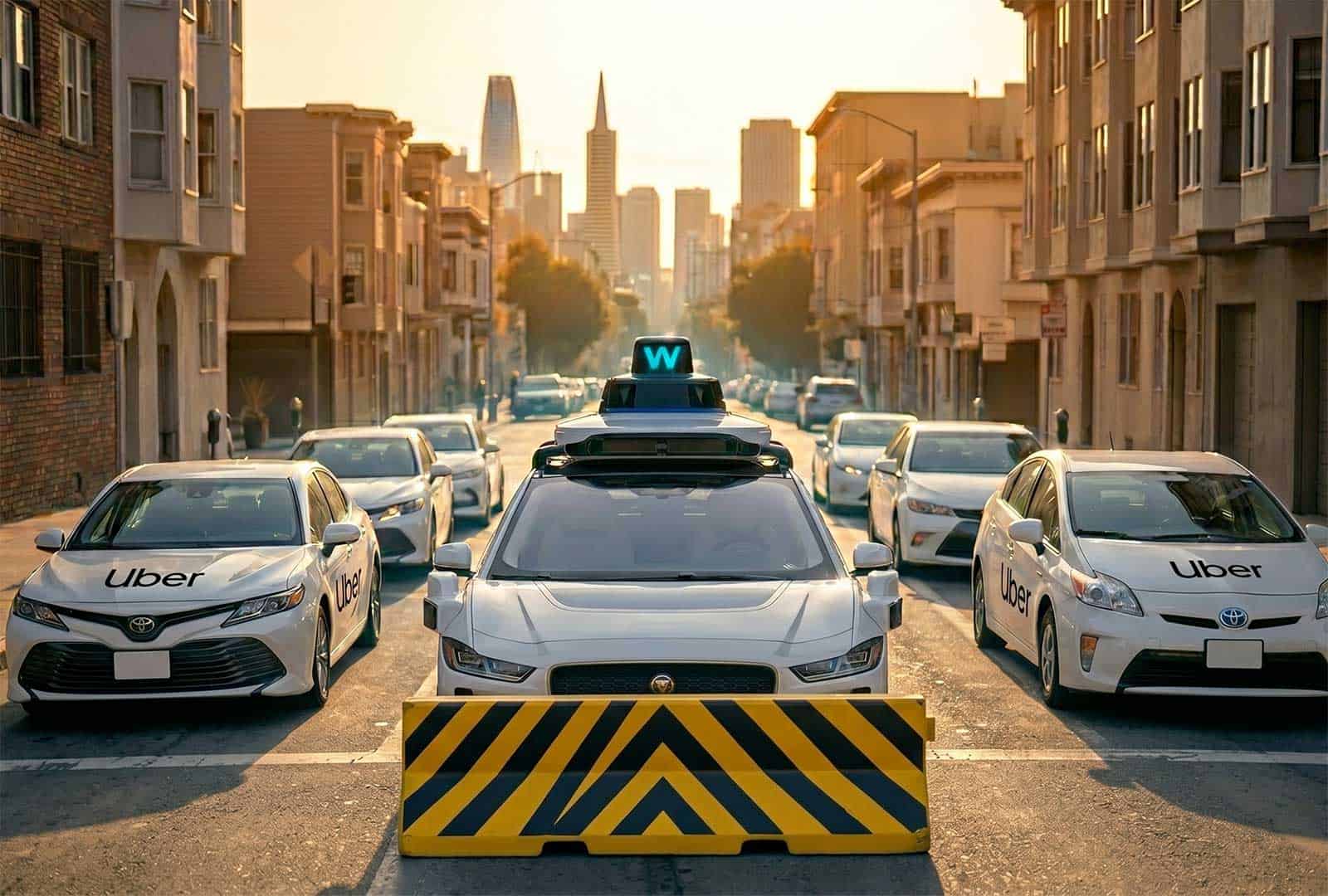
Uber’s Policy Play to Slow Robotaxis, BYD’s Costly Market Share Grab, Unitree Goes Sci-Fi
Executive Summary
This week on Autonomy Signals, Grayson Brulte and Rob Grant analyze Uber’s strategic policy push to try and mandate hybrid networks, potentially slowing down pure-play AV competitors Waymo and Tesla. Grayson and Rob break down BYD’s aggressive integration of premium L2+ hardware into a $13,000 subcompact EV, which is forcing Western OEMs to reevaluate their global competitiveness. Finally, the hosts discuss the implications of Unitree’s new transformable humanoid robot as a strategic engineering flex ahead of its highly anticipated IPO.
Key Autonomy Signals Episode Questions Answered
Why is Uber advocating for a hybrid autonomous vehicle network?
Uber’s policy whitepaper argues for a slow transition to a hybrid model where human drivers and robotaxis share the platform. This strategically protects their highly profitable human-driven business and positions them as the responsible aggregation layer, potentially creating regulatory headwinds and utilization caps for pure-play AV operators like Waymo and Tesla.
How is BYD pressuring Western automakers with its L2+ hardware?
BYD’s God’s Eye Level 2+ driving system, complete with roof-mounted LiDAR, on its Seagull EV retails for just $13,000. Shattering Western price expectations, effectively commoditizing premium autonomous hardware and forcing legacy OEMs to reevaluate how they compete on cost and technology globally.
What is the strategic purpose behind Unitree’s new transforming robot?
The $650,000 GDO1 transformable robot is primarily viewed as a calculated spectacle and strategic engineering flex ahead of Unitree’s targeted $7 billion IPO. It signals their massive capability in embodied AI, rapid prototyping, and structural engineering to out-engineer Western competitors, though the platform faces regulatory scrutiny regarding unauthorized data telemetry.
Autonomy Signals Topics & Timestamps
[00:00] AUTNMY AI
Autonomy Signals, is a show co-hosted by Grayson Brute and Rob Grant. Each week they cut through the noise and deliver the most important signals in the autonomy economy.
[01:31] Signal 1: Uber’s Policy Play to Slowdown Robotaxis
Uber’s new whitepaper advocates for a phased “hybrid model” that forces human drivers and robotaxis to share the same platform. This policy push is a strategic effort to build a regulatory moat that penalizes pure-play AV competitors like Tesla and Waymo.
[36:57] Signal 2: BYD’s Costly Market Share Grab
BYD is disrupting the industry by equipping its $13,000 Seagull EV with advanced Level 2+ LiDAR hardware. However, this aggressive pricing war is severely compressing margins, leading to a 55% drop in Q1 2026 net profits and a reliance on risky seven-year vehicle loans.
[55:41] Signal 3: Unitree’s GD01 Man Transformable Mecha
Unitree revealed a $650,000, 1,100-pound pilotable robot that transforms between a bipedal and quadruped stance. This launch acts as a calculated engineering flex to attract investors ahead of a $7 billion IPO , despite facing regulatory scrutiny over unauthorized data telemetry.
Full Episode Transcript
AUTNMY AI
AUTNMY AI: Billions and soon trillions in value will be created in the autonomy economy. By the time a trend becomes consensus, the alpha is already gone. The gap between uncovering signals and reading headlines is widening fast. When it’s a headline, it’s no longer a signal. Enter AUTNMY AI. We decode signals before they move markets, giving you conviction in the autonomy economy. AUTNMY AI, your models, our intelligence. Visit A-U-T-N-M-Y dot AI.
Grayson Brulte: Rob, you and I know we have some exciting news to share with the audience. To the wonderful audience of Autonomy Signals, Autonomy Signals is now presented by KPMG. Thank you so much to KPMG for being the exclusive presenting partner for Autonomy Signals. Lots of great content brought to you by KPMG.
Signal 1: Uber’s Policy Play to Slowdown Robotaxis
Grayson Brulte: Rob, pricing powers are starting to emerge globally. We’re seeing some interesting signals there. Then we’re starting to see some regulatory signals, good, bad, indifferent. We’ll break into that. And then humanoids, they’re trying to become transformers. Lots of signals emerging this week. This week, the signals are Uber asserts platform is king as they seek regulatory leverage to put autonomous vehicle competition in the slow lane. BYD amps up pressure on Western OEMs with low-cost autonomous vehicle hardware pricing. And Unitree goes sci-fi production-ready transformers. No, this is not the kids’ cartoon. This is real life. Rob, let’s start with the Uber regulatory signal. Sir, this is your wheelhouse. What do you uncover through Omega?
Rob Grant: Great to see you as always, Grayson. I appreciate being here, and thanks to KPMG for becoming our presenting sponsor. On May 8th of last week, Uber shared with Joann Muller of Axios a new policy whitepaper entitled “Unlocking the Promise of Autonomy.” The paper is a call to action for lawmakers and governments arguing the move to autonomy is already underway, which all of our listeners would agree. But that approval, expansion, and adoption should move more slowly, and in a phased, hybrid model approach, where mixed fleets, not pure play AV operators, are the linchpin. This policy paper outlines how Uber plans to take a different approach with robotaxis. In their own words, they want to be honest with jobs. They say some drivers will inevitably be displaced, but Uber favors a long transition to a hybrid model, with drivers and robotaxis sharing the platform for many years. They say they want to serve all communities. Robotaxis, in many iterations from those pure AV players like Waymo and Tesla, are typically confined only to dense urban areas to maximize profits, and that only a hybrid network that includes human drivers and AVs can ensure anyone can hail a ride from anywhere. And they want to partner with cities. They say AV companies need to collaborate with local planners to manage congestion, infrastructure, and safety. They state that poorly managed deployments by these current AV pure-play operators have strained local systems and are creating new tensions. The quick take is that this regulatory framework proposed by Uber poses a significant structural and economic headwind for pure-play autonomous vehicle operators like Waymo and Tesla.
Grayson Brulte: Rob, to me, I feel like hitting the rewind button and going back in time. This seems like a complete 180 from where Uber came from. It was never deploy with cities, it was deploy ADAS. That’s historically, I’m not saying this under this management team, but historically. It seems that Uber’s trying to do a delicate balancing act here. “Let’s not tick off the drivers. We’ll admit it’s coming here.” And I also feel that they’re signaling to the world that, “Hey, we have all these drivers, yet we have autonomy, so we have to champion the word hybrid.” It just seems that the paper, I’ll say it very bluntly, is very self-serving, not necessarily where the future is going.
Rob Grant: Yeah, it’s really interesting. I thought of the same thing. Uber has gone from revolution to evolution to maybe at some point stationary, as it tries to embed itself as the single layer for which AVs and ride hail should happen. The hybrid network that they’re proposing really is to their advantage. I think that has been called out by anybody who’s read this paper, and it’s publicly available. Let’s get into this a little bit further. What is this hybrid network about? Really what they’re trying to do is position Uber’s hybrid approach as the “responsible path.” Uber is effectively lobbying for a regulatory environment that penalizes the standalone fleet-only business model favored by Waymo and Tesla. They have a few reasons they think this model is better that they point out. One of them revolves around utilization and congestion penalties. Uber argues that pure AV fleets lack a natural constraint of human drivers logging off when demand drops, and therefore risk flooding cities with empty cruising vehicles. Their recommendations have been known to include things like congestion pricing, curb management, and strict fleet utilization standards. Which, if adopted by cities, would put pure AV operators under increased operational costs and face potential caps on fleet size, directly undermining their unit economics. Furthermore, by framing Uber’s hybrid model as a public good, it says that Uber’s hybrid model relies on its existing platform of human drivers to observe surge demand, which they claim is much more efficient than building massive, underutilized AV fleets to handle peak loads. In this sense, Uber is encouraging regulators to view pure AV networks as a potential source of urban strain, thereby creating even further potential regulatory barriers to entry for companies that do not have a human driver layer to balance their network. Lastly, their talk about labor and accessibility mandates. The white paper calls for dignified transitions for workers and mandates that accessibility be treated as a core design principle rather than an add-on. If these become regulatory requirements, pure AV operators would face higher compliance costs and potential mandates to serve lower density or complex neighborhoods that they might otherwise deprioritize to maximize vehicle utilization. This is really a policy to say the Uber approach, this hybrid approach, is the responsible one. Others have asked us why Uber has 25 AV partners. The answer as to why they are being the dating app for AV operators lies within this policy paper. What they’re arguing for are constraints on the growth of pure AV players, and they’re trying to commoditize the technology and say that it is the platform that is the king, and only the platform can do this responsibly. If you are not part of this hybrid platform, you are not a responsible operator.
Grayson Brulte: When you say this elegantly, a few things go through my mind. Paging Secretary Duffy, Secretary of Transportation for the United States, who by the way, for the record, has done a phenomenal job. Secretary Duffy, thank you for your leadership at DOT from the aviation side and the ground vehicle side, sir. You’ve done a really tremendous job. And if you remember, Secretary Duffy absolutely went bonkers against Governor Hochul of New York over the congestion pricing, saying it’s not good. I’m like, “Okay, so Uber’s saying congestion pricing. I’m saying paging Secretary Duffy. Hello. We got a copycat here.” As we went through the paper, and Omega assessed it for us and gave that really great analysis, a few things went through my mind outside of congestion. One, this is another signal that the relationship with Waymo is fragmented, strained, and it’s on the verge of an end. Two, they want to slow down Tesla. Waymo’s accelerating the geofences, and Tesla’s ramping up Cybercab. It says, “Wait a second. Don’t forget about Uber.” The old narrative that Uber publicly put into the market, they said it on multiple earnings calls and in multiple supplements to the earnings releases, was that Uber is the demand network. Waymo blew all that out of the water when the California Public Utilities Commission data came out. Turns out that wasn’t true. It went from, “We’re the demand aggregator, you need us for demand” to that not being true. Now it’s saying hybrid, and “we have a policy to back that up now, and we’re not going to get caught flat-footed again.” It seems that Uber, in my opinion, is trying to use the regulatory environment to slow the competition down till they get to a point where their partners can catch up. I will state this here for the record, as I’ve said this many times on Autonomy Markets: it is not a robotaxi if there is a safety driver. I repeat, there is not a robotaxi if there’s a safety driver. It is supervised. Outside of Atlanta and Austin, Uber does not have a partner in the United States operating fully autonomous. They do in the UAE with WeRide, but not in the United States.
Rob Grant: Look, I think your observation that what Uber is attempting to do here is to put Tesla and Waymo, who threaten to undermine Uber’s very successful human-driven business, right? We’ve seen the last seven, eight quarters continued profitability and increasing profitability from Uber’s platform. As that continues to grow with the human-based drivers, there is a risk ever present in Waymo’s growth and Tesla’s growth that they’re going to be disintermediated from the customer, and that their platform will have seen its best days behind it rather than ahead of it. While the policy prescriptions in this paper have some value to it, the issues that they point out are very difficult issues. The issue of labor is a difficult issue, and Uber has an approach. Does that approach happen to align with their interests? Yes. But does that necessarily say that that conversation has become any easier? No. What I find really interesting is what does this say about their relationship with Waymo right now? We know Waymo and Uber have had a partnership. They’ve launched in Atlanta, Phoenix, and maybe one other. But what I found really interesting in this public paper put out by Uber is that while it doesn’t necessarily call out Waymo by name, the way it frames certain issues and references AV services in San Francisco can’t be read any other way but to mean Waymo. They call out Waymo in negative circumstances in this way. One instance is they call out Waymo’s failure to serve all communities. I’ll read you a direct quote from the paper on this : “AV services tend to launch and concentrate in well-resourced areas with predictable traffic patterns and strong demand, while deprioritizing transportation deserts or communities with more complex operating conditions. In San Francisco, for example, AV operations have expanded into some of the wealthiest neighborhoods while remaining absent from nearby cities like Oakland. Some of these choices reflect technical constraints. Some reflect business decisions aimed at maximizing vehicle utilization.” It also goes on to call out Waymo and Baidu for their recent fleet-wide outages. “Recent fleet-wide outages in San Francisco and Wuhan highlighted how AVs can be challenged by sudden disruptions that alter the streetscape in ways systems were not trained to participate or anticipate.” I read those quotes because if you’re a close, valued partner, do you publicly shame them, particularly saying Waymo refuses to go to Oakland? They basically throw up their stance and say maybe there are technical limitations, but come on. Waymo is not serving a traditionally underserved community because they’re prioritizing wealthy neighborhoods. That, to me, is not a sign of a healthy relationship or a strong bond between two partners. For me, I find it really interesting what this paper says about the potential status of the Waymo-Uber relationship. Ultimately, regardless if these policy prescriptions are adopted, the policies within them, particularly as they relate to Uber’s own AV partners, can already be put into play by Uber. Uber here is saying, “I would love for you to put fleet caps perhaps on Waymo or require Tesla to have a hybrid network in order to operate. And if they don’t, they’re not responsible.” But for the Nuros and AVride of the world who have signed up with us, Uber can already tell them, “Your fleet growth is going to be limited or subservient to Uber’s priorities, because I have already claimed that’s the socially responsible way to expand.” If you’re Motional or somebody else, Uber might be telling you, “You can only operate certain hours. You can’t operate during surge demand pricing. You can only be in certain neighborhoods. I don’t want you running downtown between those wealthy neighborhoods in the financial district. You can only have so many number of cars out there at a time because we think this is the socially responsible way because a hybrid platform is the only way forward.” It’s a really interesting paper, not only for what it proposes others to do, but what it also signals that Uber may be doing on its own with its own partners.
Grayson Brulte: The Oakland call-out I find peculiar because if you look at the very public data, In-N-Out Burger put out a public statement of why they pulled out of Oakland. I’m not going to say what was in the In-N-Out statement. All I will say is that you can look up In-N-Out statement Oakland. There’s a public statement of why they left Oakland. From a sports perspective, the Raiders are no longer there, and the Athletics are no longer there, so you don’t have sporting demand on top of what was stated in the In-N-Out statement. I’ll leave that to the audience to decipher any which way you want. What I will offer a comment on, limiting where the vehicles can go and limiting the hours is, as you know, I was in Las Vegas last week, and I rode in several Motional vehicles, and I was only able to get paired with those vehicles during certain times of the day. Is that a coincidence that perhaps Uber limited the times that the Motional vehicles were available? Potentially. I don’t have proof of that, so I’m just making an assumption that perhaps that could’ve been. When I wanted to go to certain destinations, the Motional vehicle wasn’t available, and when I wanted to go to other destinations like Resorts World or the Luxor, it was available. To me, it seems that what is in the paper, there could be a pattern emerging here. If that pattern emerges to other cities such as Los Angeles, San Francisco, where they’ll be launching with Nuro, that gets a little concerning from a consumer standpoint.
Rob Grant: It does. I think it’s an interesting position that a lot of Uber’s AV partners are in. No doubt by plugging into Uber’s massive user base, 150-plus million monthly active users, AV partners avoid the prohibitive capital expenditure required to build their own consumer networks and dispatch systems from scratch. It is a capital-intensive process to acquire consumers, build your own app, build a dispatch route. We’re seeing it. Waymo has its own app. Tesla has its own app. But in exchange for this capital relief, you’re entering into a bit of a Faustian bargain with Uber. Uber’s paper is detailing exactly how Uber will dictate AV scaling that best serves Uber’s hybrid platform needs. Dictating when, where, how many, and at what price AVs will be utilized by its consumers. Consumers are opening the Uber app here. They’re not opening a Motional app or a Nuro app or an AV ride app. This carries a certain risk for its AV partners on the other side, which is that you are losing your ability to determine the rate at which you scale, and you are losing the ability to make that connection with the consumer. You are foregoing your ability to create an independent platform mode and subordinating your scaling priorities to Uber’s priorities under its hybrid model. But at the same time, not every company can build the next Uber platform. It’s a really interesting dynamic. What I’m interested to see is as multiple partners perhaps get engaged in the same city, how does Uber then determine its priorities? I’m reading into this paper that the number one priority will always be Uber’s own needs. But if you then have a Nuro and Motional in Las Vegas that are being subjugated to Uber’s needs, who’s number two? Who’s number three? How do you determine where they go and how many they have? All this is why I think the title of this section, “The Platform is King,” is what Uber is trying to put in place, is to say it is the current hybrid model platform that should be king, that should be trusted, and everybody else should either sign up with us or shouldn’t be trusted.
Grayson Brulte: That’s from the business side. And then, the consumer side, life is like a box of AVs. You never know what you’re gonna get. I had to improv the Forrest Gump line there because you never know what you’re going to get. I personally don’t like the anxiety or the stress of opening and canceling, opening and canceling. The first time in Vegas, I got paired Motional right away. The second time, open, cancel, open, cancel, and your credit card keeps getting charged for it, and then the drivers get ticked off. I think that’s something to watch. As cancellations to the drivers go up, do they get ticked off? If you look at the history of aggregators, Amazon, Booking.com, and DoorDash, they cut it out and they end up controlling it. Omega had a really great assessment on this here. I want to read this to you and get your opinion on this. Omega assesses the AV companies partnering with Uber are operating under a Faustian bargain. Building a consumer-facing ride-hailing network from scratch is incredibly capital-intensive and fraught with friction. Uber offers a frictionless bypass. However, the price of this bypass is permanently subordinating their business model to Uber’s. They will never reach the trillion-dollar platform scale envisioned by early autonomy investors, instead settling for a role as a high-tech margin squeeze fleet provider. The last line stands out to me, a high-tech margin squeeze fleet provider. Uber’s going to set pricing, and suddenly, if you have a Nuro, Motional, and Zoox all operating in Vegas, I’m just going to go out and say it, it’s a race to the bottom. I don’t see any which way to expand the margins here because you’re not Netflix. You can’t say, “We have all this great programming, we have all this great reach,” and expand your margins. You can’t do that in this model.
Rob Grant: No, you can’t. When what Uber is saying through its policy paper is, “If you try to do it outside of our model, we’re going to paint you as socially irresponsible.” I really do think this is a really big deal. I never think that policy should wag the dog on a company. I do think this is reflective of where the company is positioning itself going forward, which is basically, “I’m going to go directly after Tesla and Waymo through this avenue,” which is the policy avenue. What we’re going to see eventually play out is what happens in New York. Hochul pulled her support. I don’t know why that is. Did Uber weigh in on that? I don’t know, that’s pure speculation. But moving forward, if New York says, “We’re going to start with only driver-in for testing purposes or commercial purposes. You can’t go driver-out,” Uber may say, “That’s great. Take your time. We got five, 10 years to get there.” I don’t think Waymo and Tesla are going to find themselves in the same position. Or if you’re Nuro, do you say, “I would love to get my vehicles in New York sooner than that without a test driver in there.” But if Uber’s calling the shots, they may say, “The socially responsible path is that we don’t get driverless vehicles in New York City for 10 years.” I know Uber has put out a lot of things recently saying this whole notion that there are super cities that are more valuable in their network than others is nonsense, and 70% of our rides come from outside of these big cities. Trust me, they’re not fighting about Schenectady, New York. They’re not worried about Cooperstown. They’re worried about New York City. That’s one of the reasons they directly call out the labor costs issue here. That they’re not going to squeeze their drivers, that they are going to be aligned with the unions that represent their drivers. They sound awfully more like the unions in New York than they do the AV advocates in New York, that’s for sure.
Grayson Brulte: They do, and need I remind the audience and the folks at Uber, there was an election. It seems that a lot of the socially responsible stuff is the Biden era. You have a Trump administration now, 47, that doesn’t necessarily follow the same policies. I’m just going to ask you the popular culture question. Who the heck is going to stand up and be John Wayne and say, “Enough’s enough. Let the free market go”? If enough commentators take a hold of that Uber’s trying to strangle a free market, Uber’s going to have a bigger problem because the political headwinds, as you and I know, have dramatically changed across the United States. The political headwinds are changing. Which brings us to Omega’s risk. Omega had some really good risks here. The risk for AV developers. Omega says that, “The immediate operational risk is algorithmic starvation and irreversible brand atrophy. Because Uber controls the routing logic, it can prioritize its human drivers during political disputes or shift volumes to cheaper AV competitors, leaving multi-billion dollar robotaxi fleets idle and destroying return on invested capital.” Bingo. Omega’s right on that one. To me, that’s the biggest risk. What do you think?
Rob Grant: 100%. I don’t think that this risk comes as news to those AV developers. Some of them have made the bargain that in order to access the customer base and to get utilization up and customer feedback, associating themselves with Uber is the way to go. Some of these folks are lesser capitalized. They’re on a longer timeline for development. Some of them may be thinking this is only a temporary measure. This is where I think Waymo might find itself at some point. My instinct and everything I read says that temporary run is going to come to an end relatively quickly. I think Omega is spot on here. In particular, this algorithmic starvation is really interesting because if Uber is controlling the dispatch, they’re controlling the pricing, they’re controlling the matching, your ability to move on from Uber becomes harder every day that you’re with Uber.
Grayson Brulte: And Omega goes on to say, “Furthermore, because consumers interact exclusively through the Uber app, AV hardware providers build zero brand equity, making it nearly impossible to launch a standalone service later.” That’s a very good point, because you and I know it’s the touch point, and if you’re going through the Uber app, you’re not building that brand quality or brand trust there.
Rob Grant: No, right. Just look to see who’s advertising in the airports to give you a sense of how important your brand equity is. When you walk into SFO, you see a huge advertisement that says, “Download the Waymo app.” That doesn’t have the same impact as a huge advertisement that says, “Download the Uber app,” and in small writing say, “And maybe get a Waymo.”
Grayson Brulte: So that’s a valid point. As you know, last week when I was in Las Vegas, I get off the plane, I was actually on the phone with you. First thing I notice, Zoox advertising throughout the entire Las Vegas Airport, and then you get to the baggage claim where they have the digital advertising, all Zoox. Zoox is going to be operating at some point on Uber as well in Vegas. It’s a lot of confusion there, but it’s very interesting. It says, “Yes, we’re going to do a deal with Uber, but by the way, we’re going to protect our brand integrity.” That’s what it seems like to me.
Rob Grant: Yeah. It sounds like they’re trying to create a hedge. Uber may be providing them with greater utilization, which could help feed their improvement for operating in Las Vegas. It sounds like in some ways maybe that extra utilization that the Uber app offers has helped Zoox. But at the same point, Zoox wants to create its own brand, and Las Vegas is its ground zero for its brand. In Las Vegas, they have a partnership with the Vegas Golden Knights hockey team out there. It’s all over the boards on the hockey rink. They’re in the airport. I think Zoox is trying to preserve its ability to separate. What’ll be interesting is, can it do so? Can it stand on its own? I think what Waymo has found is we actually probably do quite well on our own. We may even be doing better on our own. That’s why I think we haven’t seen any expansion in quite some time on the Uber-Waymo partnership.
Grayson Brulte: Which brings us to Uber’s risk, because Omega broke this risk down for Uber. Uber faces its own vulnerabilities in this architecture, primarily the risk of a Trojan horse AV supplier mutiny. That was a good one. Or a winner-take-all technological breakthrough. Partners, or perhaps soon to be ex-partners such as Waymo, may simply be using Uber’s massive network to achieve the utilization rates necessary to perfect the models and map cities profitably. Once the technology is superior and manufacturing scales, a dominant AV developer could terminate the partnership, aggressively subsidize its own application and disintermediate Uber entirely. That’s true, and you have partners such as Zoox that have the Amazon balance sheet that could easily do that. So that is a very big risk. You and I don’t know what’s in the contractual relationship. Let’s not forget Motional’s a partner. Hyundai’s stock has been on a tear this year. They have the balance sheet to do it, not to mention they have a great executive team in Korea that has the willingness and wanting to invest in autonomy. At the end of these contracts, that could get very interesting potentially.
Rob Grant: 100%. And this is why I think we highlighted and started with the policy paper, because what Uber is saying to both Tesla and Waymo, who they see as probably their biggest potentials for disintermediation, but also to its partners, is anyone who goes it alone as a pure play operator, you’re going to be labeled as socially irresponsible. We’re going to use our political might, our newfound kinship with some of the labor concerns, and our ability to throttle you on our network in ways that are beneficial to us and the political stance and regulatory outcomes that we want. That’s why I think this paper is so interesting because it really is a line in the sand that says, “If you’re going to go it alone as a pure AV operator, moving straight to autonomous vehicles without drivers in them, or have any hybrid network effect where you can balance certain demands with driver-based vehicles, you’re socially irresponsible.” I’m not one to say that the policy is leading the company here. I think this is more of a reflection of where the company is at and deciding to use policy as another means to achieve its end.
Grayson Brulte: Which brings us to Omega’s take, and Omega’s take is aligned with yours. Omega’s take says, “The Uber white paper is a strategic masterstroke that uses public policy to build a competitive moat and slow down its main competition by arguing for slower adoption and approval of pure autonomous vehicle services, especially in core high labor cost markets.” New York, Chicago, Boston all called out by name in the paper. The writing’s on the wall, sometimes you have to connect the dots.
Rob Grant: Yes. Ultimately, this phased hybrid approach, which is the clearest through line and clearest policy ask, aligns directly with Uber’s commercial interest in remaining the aggregation layer rather than being disintermediated by these first-party pure play AV operators. Let’s just say this isn’t without self-interest, but hey, that’s the policy world we live in. That’s part of what makes America so interesting is that you can have a purely commercial self-interest and have a voice in policy outcomes. People may not like the weight of the voice that you have, and we’re seeing that debate play out every day. Given where we are today, Uber’s got a big voice. They’ve got deep pockets. They’ve got a position that is not without reason. It’s not like any of these things that they talk about are without controversy or haven’t been discussed widely before. It just happens to be that their approach aligns quite closely with their best commercial interest.
Grayson Brulte: You said it beautifully. And Omega goes on to say, “By framing the hybrid network as the only socially responsible path, Uber is attempting to force pure autonomous vehicle operators to abandon their goal of disintermediating ride-hailing platform.” Omega’s spot on on that. “And if regulators adopt this logic, the autonomous dividend will be captured by the platform that controls the dispatch layer, Uber, rather than the companies that own the autonomous technology.” I’m going to go in the way back machine here. This sounds like this was written by the taxi companies in the early years, not by Ubers. It seems that, 180, we’re coming full circle here.
Rob Grant: Everything old is new again, as they say.
Signal 2: BYD’s Costly Market Share Grab
Grayson Brulte: That brings us to our next signal. Signal two: BYD amps up pressure on Western OEMs with low-cost AV hardware pricing. We’re getting signals now. The Detroit executives are out there saying, “No, no, no, Mr. President, he’s in China right now. Please don’t allow Chinese vehicles into America.” And we got BYD pressures. What are we learning about BYD and the signals?
Rob Grant: I found this signal to be eye-popping. Given some of the numbers that I’m about to throw out here, you can see why the big three here in Detroit are so nervous. BYD has updated its Seagull EV offering with an optional God’s Eye system, which is a roof-mounted LiDAR for as low as $13,000 US dollars, obviously in Chinese yuan, I think it’s roughly 75,000 or so over there. The Seagull is BYD’s best-selling purely electric vehicle last year. It sold as the Dolphin Surf in Europe and the Dolphin Mini in other overseas markets. It’s an electric hatchback, it ranked as the fifth best-selling EV in the world last year with nearly 450,000 deliveries. BYD’s God’s Eye is a mid-tier smart driving system typically reserved for higher-end vehicles. The system is a roof-mounted LiDAR. It supports ADAS features like navigation on autopilot or NOAA in cities on a highway. It runs on the NVIDIA Drive Orin chip, delivering a peak computing power of 254 TOPS. This is the first subcompact vehicle in the world to be equipped with this premium autonomous hardware. This is an advanced LiDAR system that allows Level 2+ driving, and at a price that they sell the vehicle for $13,000. That completely shatters industry Western price barriers. They’re aggressively integrating advanced autonomous tech into these super budget-friendly cars. You have to contrast that with what we’ve seen BMW and Mercedes-Benz do in the last year or so, which is retreating from deploying Level 3 lidars, a little bit more advanced than the Level 2 system here, but they were in their flagship $100,000-plus sedans. Here is a Level 2+ system in a $13,000 car. The Western OEMs have to be agape at that price. It is just unheard of, and positions BYD to be a real dominant force in shaping the global economics for automotive hardware going forward.
Grayson Brulte: What it does, it validates Tesla’s approach with autopilot now FSD supervised and soon FSD unsupervised. The $13,400 price point is wow. If the much speculated Tesla Model 2 comes out anything sub 30,000, that will be the US equivalent of that. To me, it seems that it’s becoming very clear globally automakers are rushing to put an L2+ product in the market for two reasons. One, to compete globally with Tesla as Tesla ramps up global sales. Two, they’re strategically not using it, calling it L3 because of the potential legal and insurance liabilities. Those two signals that we have uncovered very early are seeming to accelerate globally.
Rob Grant: 100%. I find it super fascinating that this ability for BYD to effectively commoditize what was previously considered premium technology just really speaks to BYD becoming the dominant force in deployment velocity in the global economics around autonomous hardware. Obviously, BYD is greatly utilizing its domestic supply chain leverage here, including partnerships with Desai Technology to integrate these sensor hardware into budget-tier vehicles. But if Level 2 technology at a budget price is the new consumer expectation, it is going to be really hard for Western OEMs to compete at that level with such premium technology and budget pricing, as if they weren’t under enough strain to compete. Further to your point, in order to stay competitive, I see that these Western OEMs are going to have to go to China to get the technology. Not only has China forced them to reevaluate how they compete on pricing and on what technology gets put into budget vehicles, but then in order to compete, they have to go to the same person that put them in this very difficult position. Because they just cannot build at the same cost and at the same volume this technology as the Chinese can.
Grayson Brulte: What you described is what we’ve written about, which I’ve coined the autonomous Belt and Road Initiative. Saying, “We’re going to do with L4 as we deploy robotaxis to the world through Baidu and WeRide. We’re also going to deploy L2+ technology, and we are going to force you to license our technology.” Obviously the Chinese autonomous driver technology, they have grand ambitions of licensing it. In the United States, we have restrictions. Why do you think that we haven’t seen the licensing path really open up in America for L2+? We’ve seen it in Japan, where Nissan has licensed Wayve for the ProPILOT Plus. We haven’t really seen a deal here in America. Do you think that is because the traditional American OEMs are gun-shy after the billions of dollars they’ve lost going into EVs while they subsequently abandon AVs? It seems that the wrong bet was made at the wrong time.
Rob Grant: I think the American OEMs have found themselves in a difficult position. Those that had presence in the Chinese market, that market has shrunk drastically on them. That deflates air out of their balloon in a great way in terms of their revenue and their ability to sell vehicles en masse to one of the fastest-growing markets. Secondly, they had, for good reason, made a big bet on the transition to EV. You had all these tailwinds as to why you should make the transition to EV, including from a very friendly White House. They had a subsidy, $7,500 per vehicle. You had subsidies for infrastructure build-out. You had what seemed like a growing demand from the consumer based upon their quick and vocal support for Teslas. The bet not necessarily was a bad one. I just think the assumptions on which that bet was made are different. Then you throw in the defense-level spending it needs to build a full autonomy stack. While these can be very solid companies that bring in what to you and I are ungodly amounts of money every quarter, compared to an Alphabet, compared to an Amazon, what GM is bringing in or what Ford is bringing in every quarter and what they’re holding on their balance sheets in terms of cash is relatively small compared to their competitors. I think all those pressures lead to this, but I also think it’s a question of without unending dollars to support each of your capital ventures that the Chinese government is providing to dominate the auto industry. That is a specific industry that the leadership in China has said, “We want to be the world’s number one.” They support it that way. They have the ability to go both deep and wide in terms of the types of technology they support. That’s battery technology, that’s lidar technology, that’s EVs, that’s EV infrastructure. Our capital markets are built to be more efficient. I don’t think it’s a constraint, it’s just that our markets dictate based upon return, efficiency of spend, ROI, all sorts of metrics, that perhaps going both broad and deep from L2 to batteries to L4 is not the right play for each company. In particular, I think the OEMs have found themselves having to make some really difficult decisions, some of which I think they were bold in their decisions and just haven’t come to play in the way that they thought they would when they made them. What we’ve seen then as a result, to protect their markets, is this defensive posture of price taking and tariffs. It’s less now about how do I expand into China or keep my base in China, it’s how do I protect my home. That’s where the OEMs are at now. That’s why you see this great push for tariffs, for limiting software-defined vehicles and the technology that comes with it from China. There are other considerations with that too that are legitimate, but mostly it’s a defensive posture that the Chinese have put the OEMs in here in America.
Grayson Brulte: You can say, and I’m not saying this is factual, I’m merely giving an opinion. You can clearly say that the Chinese automotive industry is out innovating and out maneuvering the U.S. auto industry outside of Tesla. I was watching the news this morning that the president arrived in China, and one of the commentators on the news was talking about how nice the EVs were in China, how spectacular they were. You’re watching President Trump, president of the free world, come off Air Force One and the commentator’s talking about the Chinese EV market and the different license plates. To me, that was a very interesting signal during that historic moment. It’s very clear that China has grand ambitions for autonomy and grand ambitions for their automotive sector, which brings us to Omega. Omega’s uncovered quite a few very important risks here. One, margin compression. The aggressive commoditization of advanced hardware comes at a steep financial cost. BYD’s 55% drop in Q1 2026 net profit and a 67% collapse in operating cash flow indicate that the ongoing price war is severely compressing margins. To maintain volume and manage surging inventory levels, BYD is resorting to seven-year loans. This artificially inflates sales while exposing the company to massive consumer default risk if the Chinese macroeconomic environment further weakens. That’s very, very important data there.
Rob Grant: I read that as, hey, even at some point the Chinese manufacturers, in this case BYD, have a breaking point. There’s only so low they can go. They can’t give away the cars for free and still make money. So they may have hit a breaking point and one that maybe they’ve overextended themselves is what Omega is saying. Should macroeconomic conditions in China continue to worsen, particularly with tremendous strains from a housing collapse, this could really leave BYD exposed. But for now, I think what we’re saying is this shows the ability of the Chinese to really set the economic pace, the consumer expectation and the economic pricing for premium autonomous hardware technology.
Grayson Brulte: Then, there’s no surprise to the audience, there’s a geopolitical risk. Geopolitical friction is creating a hard ceiling on BYD’s global expansion as BYD attempts to build a plant in Mexico to target Western markets. It faces severe pushback, including US lawmakers and Homeland Security probing the cybersecurity risk of its connected vehicles and grid components. This dynamic threatens to leave BYD with stranded assets and excess inventory. This forces the company to rely even more heavily on a saturated domestic market, where tax breaks and subsidies are expiring.
Rob Grant: My sense is that there is going to be little give on allowing Chinese automakers to sell their goods in the US. However, conversations are literally happening as we record this between Trump and Xi, where I think Trump was asked before he stepped on Marine One that nothing was off the table in terms of what they could discuss in order to build more economic bridges as some of the geopolitical tensions around the world have frayed. If I’m any Western OEM from Germany to Detroit, I’m watching for any breadcrumbs and all signals of what is being discussed as we sit here today, because that could have huge impacts on the future viability of these OEMs within their own domestic markets, which is where they’ve been putting its defenses into.
Grayson Brulte: And another interesting signal is if you look at the list of executive CEOs that are joining the president on the trip, there’s only one auto CEO, Elon Musk. No Mr. Farley, no Ms. Barra, just Mr. Musk. That is potentially an interesting tell sign of something in my humble opinion the audience should watch, which brings us to the final risk from Omega uncovered here. Quality control and public relations. Quality control and public relations missteps are undermining BYD’s technical narrative. The recall of over 115,000 vehicles for steering and battery defects, combined with reports of battery fires and flash charging systems overheating, directly challenges the safety profile of its hardware. By threatening legal action against critics, that’s never a good idea, rather than transparency addressing these engineering flaws, BYD further risks eroding consumer trust globally. That is a risk that we’re going to have to watch.
Rob Grant: 100%. BYD is a name that’s familiar to us and to many of our listeners. If I went downstairs and I talked to my eldest son who just got back from college, 21 years old, I don’t think he’d have any idea what I was talking about. He might ask if that was some kind of K-pop sensation. However, I think as the Chinese OEMs, BYD and others included, continue to sell more vehicles into foreign markets, even markets adjacent to the United States like Mexico, folks will become more familiar with their name. The first impression that they’ll get will be determined by what they read in the news. Is it a series of mishaps, technological mishaps, hardware-led issues or recalls? Or is it what a lot of people who experience some of the Chinese-made vehicles experience when they get into them, which is like, “Wow, this is high-end. This is a real pleasure to drive.”
Grayson Brulte: Only time will tell, which brings us to Omega’s take. Omega assesses the most critical structural conclusion is that the technological moat Western automakers believe they possessed has been challenged. BYD has transitioned from a budget fast follower to a primary entity dictating the economics of the global autonomy transition. By outskilling the industry in the development of next-generation intelligent vehicle hardware, BYD is forcing a revaluation of cost structures across the global automotive sector. Couldn’t have summarized it better.
Signal 3: Unitree’s GD01 Man Transformable Mecha
Grayson Brulte: Which brings us to signal three, which is the most interesting one for the kid in me. Unitree has gone full-blown sci-fi and they’ve introduced a transformer. What signals did we uncover with this one?
Rob Grant: I absolutely love this story. I was a huge Transformer fan growing up. I loved Optimus Prime and all those guys, as well as if you go and see what this Transformer looks like and look it up on the internet and see the images, it also reminds me of one of my favorite movies, which is Aliens and Sigourney Weaver as Ripley at the end of the movie taking on the mother of all aliens in that outfitted Transformer humanoid getup. In the world of robotics, Unitree is known for moving fast, but it launched just the other day what it’s calling its GDO1 Man Transformable Mecha. This is an interesting pivot, a spectacle into high-end sci-fi territory. The GDO1 is a mid-sized pilotable robot designed for a single person. Unlike the massive Gundams of fiction, this is a more human-plus scale machine, weighing roughly 1,100 pounds and standing roughly nine feet tall with a pilot inside. It has this transformable design. Its standout feature is its ability to switch between two modes, which is this bipedal mode where it stands upright and walks on two legs. In this mode, you can use its mechanical arms to interact with the environment. Think about smashing through walls. And then its torso folds down into quadruped mode, and it can walk on four legs like a dog. This provides a lower center of gravity and better stability for traversing rough terrains or slopes. The pilot sits in this specialized torso cage, an open-air cockpit, and the operator controls the machine’s movements. Now, it’s not cheap. It’s approximately 650,000 US dollars. One last thing to keep in mind about this is that Unitree is currently preparing for an IPO on the Shanghai Star market, and it’s targeting a $7 billion valuation. I think that’s important because I really see this as a strategic engineering flex, a calculated spectacle before the IPO.
Grayson Brulte: So do you view this as an engineering prowess? It looks like Unitree is now the largest developer and supplier of humanoids, saying, “We can do humanoids, and we can also go bigger.” Is there something else emerging there saying that we’re this engineering powerhouse?
Rob Grant: Like I said, I think this is a flex and a calculated spectacle. Releasing a fully functional shape-shifting transformer is a massive demonstration of engineering and actuation technology. I think many robotics experts do see this as a breakthrough in embodied AI and structural engineering. Balancing a 1,100-pound frame while keeping it agile enough to walk and transform without collapsing is an achievement. A high-profile launch guarantees global visibility and signals unmatched mechanical prowess to investors as the company prepares for its IPO. In some ways, it serves as a business card to prove that they can out-engineer competitors like Tesla Optimus or Boston Dynamics in the realm of complex heavy-duty machinery. Do I think this is going to open up a whole new mobility platform for them? I’m highly skeptical of that. Is there a need for human-amplifying mobility platforms? Maybe. They did offer a few use cases: search and rescue, hazardous environment applications, construction. But is that really the future of Unitree? Probably not. They have a really solid lead in terms of the humanoid that we most know them for. But to engineer this, to get it to work in the way it does, to do the transforming and the balancing and the actuation, and to do it quickly, and to do it at production grade, that is an achievement, and it shows the world, “We can do so much more. You’re already impressed by what we do on our day-to-day. Look what we can do in a short period of time that’s pretty amazing as well.”
Grayson Brulte: Yeah, and if you look at it this way, Semaphore has been reporting that there’s been upheaval at Boston Dynamics. We saw the shakeup there, but Semaphore reported that the shakeup was partly due to the board’s perception that Boston Dynamics was falling behind. Boston Dynamics is falling behind, where the leaders in the industry say, “Watch this. We got this transformer.” If you look at the other timing, putting on my political hat here, the President of the United States going to China, it reinforces that China is a manufacturing powerhouse and these are using alloy metals. Saying, “The president, you want to build this in America, but look what we can build.” I think there was a lot of indirect messaging, if I’m reading that right. What is your take on that?
Rob Grant: I think there’s a lot of truth in that. My assumption and my starting point is that there are no coincidences that happen in China. A flex of this kind, a spectacle of this kind, is intentional. It really just demonstrates this enormous ability of China to scale embodied AI, to rapidly prototype and commercialize hardware manufacturing and embodied AI combined together. I think it is both a flex for the markets there and for the broader world to look and say once again, “Wow, we are in awe of what China can do and how fast it can do it, and the high level of technology that it’s using to do these things.”
Grayson Brulte: That’s well said. While the use cases for the transformer today are limited, the signals are very bold and very clear, which brings us to the risks. Omega’s uncovered the big risk here. Distraction as opposed to entering a new market. There’s some truth to this because the GD01 complicates Unitree’s narrative as a scalable, low-cost manufacturer. Pivoting R&D into a high-cost specialized vehicle may be viewed by some investors as a distraction from the company’s core autonomous humanoid business. Furthermore, the company must demonstrate that it can support the maintenance and safety requirements of heavy machinery. Good points there.
Rob Grant: 100%. I know for the many startups that I worked for that have had success and grown exponentially, in some form or another when it comes to putting in the values of the company, the word focus was always in there. You really want to become great at the thing that you set out to do. Unitree is certainly one of the folks in the robotic space to have to watch from China. This seems like, from a more casual Western view, a distraction, like why do this? But as you and I have just talked about, there are some valuable signals that they’re trying to send in doing something like this, both to the markets and beyond in terms of geopolitics. Ultimately, this does seem like a bit of a distraction. I don’t think a year from now you and I will be talking about how many of these GDO1 Gundam-type mega transformers we see around the world. That being said, I think it’s still worthy of our attention because it does offer insights and signals, and that’s what we’re here to do for our listeners, about what is going on with Unitree specifically and with some of the geopolitics around embodied AI more globally.
Grayson Brulte: It signals ambitions, which brings us to our last risk, because while you have ambitions, you have regulatory risks. Beyond the distraction, the GD01 Unitree faces regulatory scrutiny regarding its software stack. The discovery of the Unipawn flaw and unauthorized telemetry transmission exposed the company to security concerns. As regulators increasingly monitor dual-use technologies, these vulnerabilities could lead to increased oversight or potential market restrictions. The transformer could be used for military applications, so a very good risk to point out there. Even though the CCP controls it in China, that’s still a really good risk to point out.
Rob Grant: 100%. The concern that was found in that Unipawn flaw, the unauthorized telemetry transmission, is exactly the type of stuff that gets US regulators and Western regulators on high alert. This is the ultimate fear, that Chinese technology in the United States is embedded with the ability to transmit information back to China that is of value. That’s the one that stood out to me. The unauthorized transmission of whatever, in this case it was telemetry data, but it could be any data. That is really at the heart of the concerns of the Western world when it comes to whether it’s BYD entering with their vehicles that we talked about, vehicles that have more advanced technology on it, or whether it’s embedded AI like this robot or any of the Unitree robots.
Grayson Brulte: All the listeners and viewers have to do is go look at the Huawei cases around the world, what the UK did and other markets did. There’s lessons there. Which brings us to Omega’s take. Strategically, Western robotics and autonomy developers must recognize that the competitive moat in hardware is eroding faster than anticipated. Chinese firms are no longer merely producing cheaper alternatives to Western robots. They are leveraging their domestic manufacturing ecosystems to pioneer entirely new form factors. Investors and industry leaders should watch Unitree’s star market IPO closely, as the success will accelerate capital deployment into advanced Chinese hardware platforms. It’s a good take. What are your thoughts on Omega’s take?
Rob Grant: I think Omega has highlighted exactly what our audience should be paying attention to. I’m sure many in this audience are already highly attuned to the potential IPO that Unitree is undergoing. But the continued after effects of a successful IPO are what Omega is very cogently pointing out. This could lead to further investment, further advances in hardware platforms coming out of China. You set up these ecosystems where a company has grown and has been successful and has generated wealth and jobs, and then it spins out all sorts of apples from the tree. And that cycle, once it gets going, is so beneficial to so many things, whether that’s the products that wind up in the consumer’s hands, the price of those products, jobs, or further investment. I think the Chinese advancement in robotics should also be watched from that point of view. Is Unitree going to be the mother of robotics, so to speak, and generate lots of offspring from this successful IPO?
Grayson Brulte: We will find out. Each and every Thursday, you and I will be here to break down the signals in the autonomy economy. And to the listeners, if you’re interested in learning about the proprietary AI algorithm that Rob and I wrote that powers this show, please send an email to [email protected]. That’s [email protected]. And a huge thank you to KPMG for being the presenting sponsor of Autonomy Signals. The future is bright. The future of autonomy is the future of scaling autonomy globally. Rob, I can’t wait for next week.
Rob Grant: Looking forward to it as always.
The future is bright. The future is autonomous. The future is The Road to Autonomy.
Subscribe to This Week in The Autonomy Economy™
Join institutional investors and industry leaders who read This Week in The Autonomy Economy every Sunday. Each edition delivers exclusive insight and commentary on the autonomy economy, helping you stay ahead of what's next.