
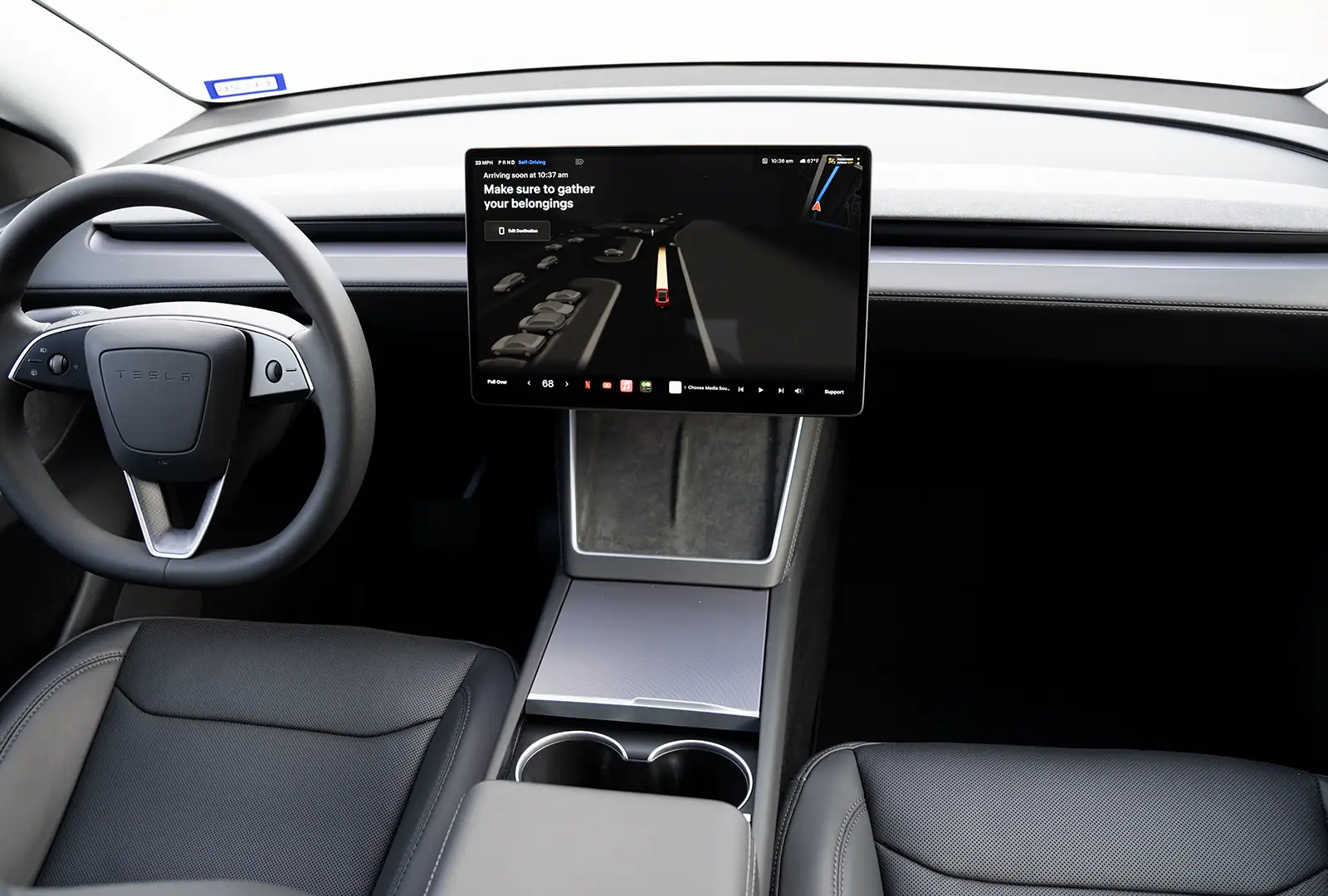
We Rode in a Tesla Unsupervised Robotaxi and Walked the Cybercab Line
Executive Summary
This week on Autonomy Markets, Grayson Brulte and Walter Piecyk discuss their first unsupervised Tesla Robotaxi ride and tour of the Cybercab production line at Giga Texas. They also break down a flurry of Uber partnerships, most notably a surprising deal with Zoox, and discuss the US DOT’s newly announced AV 3.0 guidance that aims to accelerate autonomous vehicle adoption by removing outdated regulatory barriers.
Key Autonomy Markets Episode Questions Answered
Why is the Uber and Zoox partnership surprising?
It is highly surprising because Zoox CEO Aicha Evans had previously stated multiple times that Zoox wanted to control the entire end-to-end experience and did not want to be a feature on someone else’s platform.
What is the US DOT’s AV 3.0 guidance?
AV 3.0 is a new regulatory framework announced by Secretary Duffy and Administrator Morrison aimed at accelerating the adoption of autonomous vehicles in the US. Notably, it removes outdated requirements like steering wheels, pedals, and windshield wipers for autonomous operations.
What charging standard will the Tesla Cybercab use?
The Tesla Cybercab will use the SAE J2954 standard for wireless charging, which is the same standard that Zoox intends to utilize.
Autonomy Markets Topics & Timestamps
[00:00] Riding in a Tesla Unsupervised Robotaxi
Grayson Brulte and Walter Piecyk discuss their first experience riding in a completely unsupervised Tesla Robotaxi on the streets of Austin.
[5:45] Robotaxi Ride Experiences (Both Supervised and Unsupervised)
Grayson and Walt share dicuss their unsupervised Tesla Robotaxi ride while noting that their other supervised test rides felt noticeably more cautious and hesitant.
[11:25] Tesla’s Austin Depot
After putting on their inspector hats, Grayson and Walt discover a massive Tesla depot in Austin filled with Cybercabs, Cybertrucks, and substantial charging infrastructure, indicating imminent scaling is on the horizon.
[19:58] Walking the Cybercab Production Line at Giga Texas
ouring the impressive, three-story Cybercab production line at Giga Texas reveals Tesla’s clear focus on manufacturing scalable, highly durable, and cost-effective autonomous vehicles equipped with global wireless charging standards.
[26:43] Waymo in Austin
Walt expresses his frustration over attempting to hail a Waymo in Austin through the Uber app, only to be repeatedly matched with human drivers instead.
[29:24] Uber Needs an Autonomous Vehicle Tier
Grayson and Walt argue that Uber urgently needs to add a dedicated autonomous vehicle selection tier to its US app, questioning why the feature exists in overseas markets Dubai and Abu Dhabi, but not domestically.
[31:07] Uber’s Big Week of Partnership Announcements
Uber’s big week of AV announcements kicks off with Wayve launching safety-driver Nissan Leaf robotaxis in Japan and Motional going live in Las Vegas with a limited footprint along with Zoox later this year.
[42:52] Zoox’s Sudden Change in Narrative
Grayson and Walt highlight a stark contradiction in Zoox’s strategy by contrasting the CEO’s past adamant refusals to join a third-party platform with their newly announced Uber integration.
[51:53] Wayve Partners with Qualcomm
Wayve’s new partnership to embed its Level 2 driver system directly onto Qualcomm Snapdragon chips offers a fascinating business model shift, especially given Nvidia’s existing investment in the company.
[53:34] U.S. DOT is Embracing Autonomy
The US Department of Transportation signals a strong pro-autonomy stance by announcing AV 3.0 guidance aimed at removing outdated regulatory barriers such as the steering wheel requirement to maintain American technological leadership.
[56:44] Autonomous Trucking
Reporting from Dallas, Walt details his smooth ride in a Kodiak autonomous truck and argues that AV trucking startups will scale faster by retrofitting existing cabs rather than waiting on sluggish OEM integrations.
[1:02:00] Foreign Autonomy Desk
International updates include Nuro beginning testing in Tokyo, Pony AI expanding its partnership with Tencent, and Geely producing bespoke robotaxis for WeRide.
[1:02:43] Next week
Looking ahead, Grayson and Walt preview potential major news from the upcoming Nvidia GTC event and anticipate more real-world Tesla Robotaxi feedback emerging from South by Southwest attendees.
Full Episode Transcript
Grayson Brulte: Walt, This week we hit the road and we went to Austin in search of Robotaxi unsupervised into the audience. We found it. We went for a ride. When Walter Piecyk and I were busy doing field work around Austin, Uber had the press machine going, Bing, bing, bing, bing. Firing off Pressley. He says, well, they were doing that lucid hosted investor. David, Walter Piecyk, let’s start with our fantastically awesome trip and a huge shout out to you and Rich, the team at Lightshed fantastic dinner. Thank you very much. What did you think of our trip to Austin?
Walter Piecyk: Grayson, there must be something about Austin because one of my favorite past podcast clips is when you said, we found you when we were driving by that big Avomo depot for Waymo. So I love the sound of the, we found it and we’ve got a lot more things. To find in 2026. And I think we did find some other things in Austin, which we will get to later. But let’s, yeah, let’s start with unsupervised. Took about a dozen rides, um, which we’ll talk about those in a second. But let’s, let’s, you know, we got, we finally got one. It was like we were right about to end the day before we moved on to our, to our first meeting. So it took a while. Um, the experience was, was felt the same. And I think we’re one of the few, although I will say this, you know, a lot of people use, including us, the Robo Tracker app, which was a great job. Um, you know, that that’s a great app to have, but I didn’t log any of my rides into the robotaxi Robo Tracker app, nor did I ride this unsupervised. And I just wonder, you know, while there’s a lot of investors, I think broadly that are using this thing that, you know, it’s maybe not capturing all the data ’cause you’re requiring people to actually, uh, plug this in. But, but back to the, back to the actual news, which is, you know, look, the unsupervised ride. Was great. And you know, as a result, the, the route on it was a bit circuitous in locations. I thought at one point it was trying to avoid, certain turns, but then the weird turn it made actually made it more difficult for itself, um, to do an unprotected left. What were your impressions of the unsupervised ride?
Grayson Brulte: It was the moment of joy that we had in the coffee shop and we’re having the cup of coffee waiting for it, and we did use the Robotaxi tracker rack. Whoa, we got it. And then you and I are going back and forth. Is it going to be, is it not gonna be?. And then when we saw this moment of glory unsupervised, rolling up, we high-fived each other, made a video, which we’ll play for you now. Off racing. Walter Piecyk, what do you think our chariot has finally arrived? Let’s hop in. We did it. No safety attendant.
Tesla Robotaxi: Welcome, Grayson, to your unsupervised. Okay, Walter Piecyk. It is our first unsupervised FSD. You ready to start the ride? I’m ready to start the ride. Let’s do it.
Grayson Brulte: Walter Piecyk. We’re back in Austin, what? Roughly six months later. And lo and behold, we got unsupervised. There’s nobody in the front. We’re gonna show you here. Look, nobody’s in the front. What do you think? What have you noticed? Well, the, the fact that it, we came here to do some primary research and we obviously have seen that unsupervised is, is operational. Taken plenty of supervised rides today, but you know, clearly unsupervised is, is operational in Austin, unsupervised is operational and the route, it’s been a little different versus supervised. But this is awesome overall. Yeah, I mean it feels the same. It feels comfortable speed-wise. It’s not any slower, but you’re right. Routing’s a bit different. Um, look that the Tesla in front of us, clearly his robo taxi just squirted its back camera. That’s funny. Um, but yeah, I mean, I don’t know. The Tesla ride is relatively consistent, I guess, no matter whether you’re an FSD or, or in the robo taxis with or without the, the, uh, safety driver, or excuse me, the attendant. I do not have my inspector hat on, but I will honor her. Put my hat on. I noticed something in our ride. There’s no mad Max. There’s no hurry. There’s just self-driving mode in unsupervised. That’s interesting. That is true. ’cause we’ve been noticing that it’s on standard mode and we’ve been wishing. For the supervised rides that it might be flipping to, um, you know, mad Max or Harry, but this one you don’t even see it, but it feels like it’s basically doing standard. It feels great though. It’s really a smooth experience and you really can’t tell the difference if there’s a human in the passenger seat or not. Do you see any chase cart behind us? No. Let’s see. For the audience, look no Chase car. No chase car autonomy markets out on the road doing the primary work. We’re doing the work. So we we’re able to get in one, it didn’t take us 50, whatever ride that could took our, our, our poor friend David. Um, not a hundred ride. Not a hundred rides. We do have to take plenty of rides to get this, to get in here.
Speaker: But, um, we’re completing our first unsupervised Robo Taxii. Hopefully they continue to expand quickly.
Speaker 2: They continue to expand quickly, and every Saturday, Walter Piecyk and I will be here to bring you the latest and autonomy markets, including field work, live from the field.
Grayson Brulte: It was great. It it, it was so much fun to be in there and remember that one point we thought it was gonna make, it wasn’t gonna make an unprotected left. And then it did make an unprotected left. And it worked flawlessly. And you and I noticed from our rides with the, you wanna call it the supervised, with the safety attendant? The safety attendant could not have been in there. And it would’ve been the same experience. It was a really, it was fun is what I’ll say. It was, it was fun. And I’m really thankful that we did it together.
Walter Piecyk: And we’re one of, one of, I think, uh, the few, but hopefully that that changes ’cause it’s been several, several months now that we want more PE to people to get it. And we’ll maybe we’ll get some more feedback at, at South by Southwest, which is just starting now. I know our, our good friend David Moss is out there. I think he may have already gotten an unsupervised ride or I think there was someone else I was following on Twitter. Um, so hopefully they’ll get, we’ll get more data points that way. But let’s talk about the other dozen rides, because the experience there, I think, for me, felt more conservative than the last time we were there, including the fact that we had situations where the car basically just stopped and we had a call for support. Now what’s what’s interesting to me, um, is the car, when it stops and it’s in a situation that it, that it doesn’t want to handle, can’t handle however you want to describe it, um, because it’s being, in my view, too cautious. It doesn’t automatically go to the remote person. You literally have to hit the button in order for that to happen. And, and the remote, you know, or the person in the safety attendant isn’t the one that hits the button. You have to hit the button. Um, and you know when that happens, the person basically drives you outta the situation and you go back to where it was. In the case that we had, there was actually two, one that was like basically many lanes of traffic. And it could have turned into a right turn lane only, but I think there was so much traffic, it was just too hesitant to go out there. Part of the reason is this thing’s on standard mode and not on Med Max mode. I think that’s part of the, the, the challenge here. But also maybe there’s an issue where they’re, as they kind of modify the software, just like we’ve seen with FSD, when it goes to a, you know, sometimes it gets overly safe, like 14.1, and then by 14 two or 14 three, or maybe that was at 13, one to 13 2, 13 3, it gets safe and then it tweaks back, um, to not so safe. What were your, what was some of the feedback that you had from, from the dozen or so rides that we had where the safety attendant was in that passenger seat?
Grayson Brulte: Lot more cautious in, in my opinion, and it’s my assumption that it is running an advanced version of FSD and to us, the tell sign will be Walter Piecyk. When we get our update, does our cars at home, do they get more cautious? That’d be something interesting to watch. Very cautious, not overly confident as the systems that that we use. Perhaps there’s a fork or I say it’s an advanced version and they’re working at a bug. The routing was a little odd. The ride was smooth outside of Austin. I’m sorry, you’ve got some bumpy roads. Nothing the Tesla suspension can do for that. You get some bumpy roads, very cautious. It was seems that the, I’ll use the term, the child term, the training wheels were getting ready to come off. We felt like we, we saw the one robotaxi that you and I went in unsupervised. It felt like they were getting ready to expand that where the training wheels were coming off. So that was my overall takeaway from it.
Walter Piecyk: you used the term very cautious twice. I’m so tired. I can’t remember. Maybe I said very cautious. I wouldn’t say it’s, it was very cautious, right? It doesn’t feel like you were in chill mode. It was just more cautious than what it was the prior time we were there and maybe what we’re used to with the FSDs, I think you kind of overemphasized very cautious. But the bottom line is like, the last time we were there, our wait times were shorter. We didn’t have any of these situations where there was, where there was an a quote unquote intervention or where we had to, you know, dial out. And this time we did. And in part, and it wasn’t a situation where the car was doing something dangerous and stopped. It just didn’t wanna take what would’ve been a more aggressive, uh, move in order to continue. The ride. In addition to that, there were dropoff issues and I got a sense that this is kind of the thing that’s holding ’em back because, you know, the remote person was like, look, if the dropoff or not the, the person that was sitting in the passenger seat, like, don’t forget to, you know, tell the app about the dropoff issues. So I’m guessing that part of, you know, getting to the point where they’re, they’re gonna roll out more of the unsupervised is, is cleaning up some of the drop off issues maybe. And again, this is just speculation that also has to do with this, the circuitous routes, so that if you go around the long way, you can drop off on the right side of the road as opposed to having to do a UI in the middle of a road. Right. Because at one point I was dropped off across the road from where my destination is. So I think, and there’s been, I think some, some chatter about this before, but my guess is that that might be some of the issues that they’re, that they’re dealing with before they can go, they can move to the next step.
Grayson Brulte: I know this is not highly scalable, but there is talk and when I served in the government role, there was talks about this of dedicated drop off in pickup zones. If you wanna call dedicated drop off lanes. So the hotel where we have perhaps the, the hotel uploads something to Tesla into, into Waymo, and there’s a dedicated loading zone there. When I was out in Palo Alto two weeks ago, certain places I went to had dedicated drop off in pickup zones. I know it’s very hard to scale, but I think at some point, if you wanna say major tourist destinations, which we’re seeing now at Universal Studios, you’ll have dedicated lanes. But how that’s gonna scale, I don’t know, but I think it’s something that has to be overcome, not just Tesla. But in industry-wide, did this truly become mainstream adoptable?
Walter Piecyk: Now I have gotten questions about like, you know, what’s it like? How much are they running? Are they still running? I mean, again, we got a unsupervised ride, you know? It was one out of, of basically a dozen rides. Noted that if you’re relying on the Robo Tracker app with, again, no, I’m not trying to salt that. It’s a great thing that we use, but there’s probably a lot of rides that are not getting registered. Certainly our dozen rides, um, weren’t getting registered into the app. Just visibly though, we saw, and I thought a lot more Tesla’s, robo taxis on the road. In addition to that, we saw were oftentimes red, but clearly robo taxis with no logo with people in them either. Driving, well, mostly mostly driving. We, we found a location, there’s a Whataburger on, I forget which street that we always seem to see them hanging out. I dunno if they’ve got a special deal for Tesla employees at the Whataburger, but we saw some, we saw a lot of them, , there. But there’s just, you know, look, there are a lot of Tesla employees on the road. Um, testing this product. So for people to say like, oh, you know, or, or for some of the questions that I sometimes get are like, are, are, you know, are they even on the road? Absolutely. ’cause we saw a bunch of them.
Grayson Brulte: The inspector hats on ’cause you and I were waiting to get picked up in a robo taxi at the Whataburger. I mean, they must have good hamburgers. We, we, we kept seeing Tesla after Tesla and we’re trying to say, okay, is it Tesla employee? But the inspector hat went on and I said, Walter Piecyk needs a, he needs an honorary hat. And so we went and saw what did we see? We saw the cleaner in the back hammer and we saw Tesla employee badges. So we’re able to confirm that there. What we also noticed when we were in Austin, there is a lot more testing slash validation vehicles going around that’s been reported. So there, it, it to me, from what we saw on the ground, this is Tesla’s getting ready to scale quickly. Was it slowly, faster than all suddenly at once? It appears that they’re putting that infrastructure in place.
Walter Piecyk: Yeah, I mean, look, and to, to put it in context, it’s definitely not as many of the Waymo’s that we saw there, although. Frankly, I thought there was less Waymo as we saw this time than the last time, which, which kind of maybe supports the thesis that we had months ago that maybe Waymo was flooding the market right when Tesla was launching to really drive home, um, what they could deliver service. Tons of Waymo’s, a lot of ’em empty, a lot of ’em dirty. We’ll get to that later in terms of how Uber allocates rides to, to the Waymo’s. Um, but you know, so, but the Teslas, there were a lot, and, and I think, again, you can put your Inspector CSO hat on again because, you know, we also were able to see a large, um, Tesla Depot that much larger than what we saw with EVO and e vmo as a reminder, is the company that was servicing, um, the Waymo cars that are there and like just a massive supply from Cybercabs to cyber trucks to model wise, um, just a very big presence. Again, to, to the point you were just making that. Prepping and having the volumes ready, but just waiting for that, that kind of switch to happen where they’re happy enough with where the technology is. And again, I just, you can rewind the podcast if you want. There are clearly many issues that they’re still hashing through until they can flip that switch. But when they do, I would suspect that you’re gonna see a lot of these cars hit the road all at once.
Grayson Brulte: The amount of vehicles that we saw at the Tesla Depot. Was significant. You’re right. Cybercabs. Cyber trucks, model wise, very, very large amount of vehicles. That’s one thing, but what did we uncover when we put our inspector hats on? An abundance of energy. That’s right. This location has an abundance of energy, so you have the vehicles and the energy to charge ’em. They’re putting the pieces together.
Walter Piecyk: Absolutely. And, and you know, it just brings up the question, what are they really waiting for? Um, I thought it was the drop offs. Do you have any other thoughts on, on, on this? ’cause at the end of the day, like with everything I saw and, and just the feel of it and we’re x number of months in since the last time we were in, in Austin, I’m feeling less confident about getting to several hundred rides by midyear. With that said, it’s still months away, and again, I feel like this is gonna be a binary event that once they hit it, you know, you’re gonna see that those, those cars ramp up and clearly they have that type of volume available to them in the market today.
Grayson Brulte: The volumes there, I’ll use the term that Aurora uses, that Kodiak uses the plus uses. Is there a safety readiness measure that we do not know about? Perhaps that Tesla’s trying to hit a certain number. Be before we do this? Or is this being done Until they can say, okay, Walter Piecyk, we can drop you off at your doorstep. Okay, Grayson, we can drop you off at the barbecue place. Okay, Sarah, we can drop you off at the hotel. I don’t know, but I believe, and this is just an assumption, that there’s some detail that we’re not connecting the dots. That’s whatever that detail is met or exceeded. Then I just think the bandaid comes off and this thing goes.
Walter Piecyk: If they are trying to do that, you know, again, the way the system works is, you know, if one, for example, if I pulled into, I was going to some type of taco, you know, restaurant and you know, you go into the entrance and the taco entrance, the taco store is at the left and there was like, I don’t know, like a CVS, let’s call it on the right. The car basically went o over to the right rather than to the, to the taco thing, which I gave the feedback about, you know, it not gonna the right location. It’s not, it’s like an extra, let’s call it 15 yards to walk. So not the end of the world. The way the system works is like, it’s not like someone’s gonna map it and say drop it here. Like, it’s just, you know, more of the sentient, um, nature of the, of the product that they, they clearly need to program, um, in order for it to, to go to the right spot, which should be replicatable, you know, to many more locations. And, and I guess the question then is like, I, like who knows how long of a time that takes, like, everything that we’ve heard from anyone in autonomy. I think I just, I, I actually addressed this on the Kodiak call asking Don Burnette about this, is that, and, and not to mention the many other companies that we spoke to on this trip and before that AI is accelerating all these things. Now I don’t know what that, what does that mean? Like, is it a week? Is it a month? Is it three months? Like. What does it mean? Um, but I will say that it’s clear that Tesla is, you know, gonna wait until they’re ready to launch this stuff and they’re not gonna gonna push it forward just to, to hit these milestones that obviously continue to slip, um, in terms of, you know, hitting certain targets for, you know, when they’re, for fully commercial or hitting an additional markets or whatever.
Grayson Brulte: I’ll give you a controversial take on this, but I think individuals will, well, some people will agree with me. They’re simply waiting into whatever metric is when they’re ready and they, you know, the timelines they put out, I don’t think they matter. I think there’s an internal goals that they’re trying to achieve and they’re gonna wait for that. ’cause the last thing that they want to do from a, this is from a brand perspective, a company-wide perspective, they don’t want to put a product out into the market, in my opinion. And they have a, have a major issue, have to pull it off the streets to put it back in because the individuals that go around and chase the cars with cameras will go nuts. So. You said this before on past episodes, and I think you’re a hundred percent right, and I want to emphasize that you did say this. Tesla doesn’t get enough credit for their safety culture, and I think they’re operating out an abundance of caution for a variety of metrics that we perhaps do not know.
Walter Piecyk: I mean, I don’t even, this is not even a safety issue. It’s just like, if it’s a drop off situation, it’s, it’s, that’s like a business decision. Like you want to launch a good business, um, product as well. And again, to get to my earlier point, like the way the system’s designed, like if you fix how it parks, like locations where park, which by the way is an issue that Waymo has as well to a certain extent, um, the pace of launching new markets, hitting those seven markets by the end of Q2 to some extent, is gonna become easier. Every additional market becomes easier. We’re still in this kind of teething market in Austin. I think they’re beyond most of the safety case aspect of it. Again, if it’s anything, they have to tweak it the other way based on the disengagement that, that we experienced. Um. This other part, you know, we’ll see how long it takes.
Grayson Brulte: We will see how long it takes. But one thing became very clear. We were toward giga and we went and walked the Cybercab line. And I’ll say this, I was impressed. My father-in-law said, how was it? I said, pu, you’ve got no idea how incredible this thing is. Three floors. Amazing. My big takeaway from, from walking the Cybercab line, Walter Piecyk, they, they are clearly building to scale.
Walter Piecyk: Yeah, absolutely. And first of all, that Giga Texas is the factory there is just massive, the number of people that they’re employing there, massive, right? That that parking lot was, was teaming. Um, you know, just a great, I think overall experience to see it up front, but on the Y itself, I mean, look, you know, most people know this already, but. There is a clear goal here. Make a cheaper and more durable car that can drive hundreds of thousands of miles and that can drive the cost down to, to create a business model. Um, and there’s, there was, you know, we saw what the lines were. It looks like they should be on track, um, for the April timeline. It, you know, let’s keep in mind it’s gonna take, the line gets turned on and then it takes the time to ramp it up. That’s how manufacturing lines, whether you’re making cell phones or cars like that is how it works. It’s probably gonna take over a year to ramp it to its full capacity. But then beyond that, we literally saw areas and opportunities where additional machinery was gonna be going to add additional lines and to really ramp up that Cybercab volume even further. So, um, it’s, it was great to see kind of the mechanics on how that’s all coming together.
Grayson Brulte: I said this before, and I’ll say this again, I was blown away, impressed, and we talk a lot about the factory integration and building the vehicles, but what, what we saw emphasize that Tesla wants to make this into a business, into a profitable business, and perhaps their manufacturing capabilities, which as I said, like I’ll say again, we’re impressive, becomes a massive competitive edge as they scale.
Walter Piecyk: And the technology that they’re using to lighten the car. Some of the stuff that we saw is, is, is kind of pretty amazing, including the wireless, the wireless charging aspect where that you have that port in the back where currently it’ll plug in, but then you’ll have the wireless where the car pulls over and charges that way, which is something I’m familiar with. Again, what I said in the past podcast from electricity. I’m not sure what Tesla is using. Probably their own tech. Um, but certainly, you know, interesting. I don’t know. There, there’s gonna have to be another infrastructure investment, right, because. If you don’t have a plugin, then you can’t go to all these Tesla charging stations and plug in the Cybercab. So there will be some, some infrastructure, um, required there. My impression of like, that was the first time I was able to actually get in a Cybercab. I thought overall though it was, you know, it’s a small car. I’m a big guy. I am typically gonna prefer the model Ys that are available to me, just like I’m not getting Uber Xs, I’m not getting into some Honda in terms of the size and my, and my comfort level. Um, but in terms of the economics of the business, getting something cheap, like every single part of that car, which we literally saw as it was, as it was un. Un unboxed, I guess. Um, and by the way, you know, the cameras with cleaners on them as, as we’ve seen with these, these new models, y as an example, very well thought out for, you know, a mass ride share market. And that’s, that’s, that is really what they’re targeting.
Grayson Brulte: the good news. On the wireless charging, it’s SAE standard J2954. It’s an, it’s a global standard that’s being adopted hypothetically, and this is hypothetically, the Tesla can go on any charging pad because it all meets a global standard. The great news for the entire industry that is going to go wireless charging. The days of the J plug versus the NACS plug are over on day one. Everybody’s agreed. So there’s a clear path to scale that there, and for example, Zoox is going to use the same standard when they build their charging infrastructure out on on the Cybercab. The other thing, when we got to see the unbox that you wanna call it, the tear down that I wanna highlight to the audience, this thing is a cocoon of safety. This thing was built for a horrendous situation to make sure you walk out alive. It was impressive. There’s no other way to say it. It’s just absolutely impressive.
Walter Piecyk: So, just one other thing I wanna throw out there is just, you know, this thing doesn’t have a steering wheel, or even the stuff that they’re making, there’s probably, you know, a minority of them that have steering wheels. We saw them on the roads of Austin. Um, you know, driving around, the vast majority are not gonna have a steering wheel. That’s, and maybe this is where you can fill in with, with listing off the specific codes and regulations, but you, you can make like, I think it’s 2,500 of them, zoox is going zoox switch also, as you, as you probably all know, does not have a steering wheel, um, or pedals. So it has the same type of issues that they’re getting through. We fully expect that those issues will be resolved and frankly, Zoox can do Tesla a big favor by being on the bleeding edge of, of getting that. Um, I guess would it be an exception? Why don’t you explain to us what the rules are Grayson?
Grayson Brulte: So it’s going to be an an exemption. And I just wanna point out for this audience that that’s actively on x, I know a lot of you are, there is a viral post going around X today because an individual took a, a picture from inside of the Cybercab that showed an F-M-V-S-S certification sticker in there. That is self-certification. That is not a US DOT approval, as Walter Piecyk clearly stated. As of today, the way the law is written, you can put, apply for an exemption for 2,500 vehicles without a steering wheel or pedals on public roads, which we’ll get to a little bit later. Secretary Duffy and Administrator Morris made remarks this week about removing that process and moving to, to a period where you no longer have a human driver. So as of today, Tesla can file for an FMVSS exemption for 2,500 vehicles. Then if they would want to charge, they would’ve to fire for a part 5, 5 5 exemption to be able to charge. When the secretary and the administrator roll out the new rules and they are adopted, that will go away. What those rules look like, we don’t know, but we’ll get into that a little bit later. But as of today, 2,500 vehicles when you get the exemption. Long-winded way of saying it, Walter Piecyk, but there you have it.
Walter Piecyk: Yeah, that was long-winded. Was did Brandon Ross take over this, uh, my friend over at, uh, Lightshed Take Over? That was a really long explanation for a small point for what is a long podcast for us today, grace. And so our listeners, if you, if you just sped your, your speed listening speed up to one seven, you can come back down to one three or whatever it is. But thank you for that, those, those details. Grayson, why don’t we, can we now move on to Waymo that does not get a clappy hat?
Grayson Brulte: Okay, fine. So then I’ll just put on there. So I was thinking about in the memory of Elizabeth Reed, so I could have went on for 30 minutes, like the Allman Jam does.
Walter Piecyk: Exactly that felt like, that felt like a, uh, definitely like a dead jam that went on forever. Anyway, so let, so we also, when we were in Austin, did try to get a Waymo, um, Uber kept matching us with human drivers. I mean, you know, I actually ended up tweeting about this. Got a lot of feedback of people agreeing, um, that Uber needs to add an autonomous level. I mean, and it also, the timing of this was like, I’m sitting there trying to get a Waymo doing the Uber comfort, Uber Comfort Electric, whatever it is. And then I see these headlines come across my Bloomberg about Uber’s new tier, Uber Elite, which is something over whatever their highest level is, and you can pick it up, blah, blah, blah. It’s another way to make money. And I’m like, I don’t need Uber Elite. I need Uber autonomy. So I got a lot of positive feedback, but. Our, our friend, uh, Harry Campbell, um, the Rideshare Guy, he tweeted at me the following that would go against Uber’s long-term value proposition. They always have a car available and shoot for a three to five minute ETA in tier one cities. I could see this in the future though, when they have much more AV supply. I mean, I get what he’s saying. I appreciate that and we know that, you know, the relationship in fact with Waymo is probably not great because of this kind of obsession with three to five minute, which we, everyone knows that when they try get an Uber, it says four minutes and then we’ll see how long it actually comes. But that’s beside the point. When I go on the Uber app, Harry, you know, I have 10 different options, like, and if it says, let’s say I wanted like a large SUV or a high-end SUV, a lot of times it says 10 or 12 minutes and maybe the Uber X is three minutes. And then I, as the consumer can make the choice if I want that Uber Electric, if I want the Uber 10 minutes. If I’m a female and I want the female driver that, which in this case there are some parallels in terms of why you might want autonomy for safety, then let me make the choice and like it exists today. Every option in that Uber app does not say three to five minutes. Like, do I need to start sending screenshots about this?. So why is it that you can’t add one more? You can add Uber Elite and God knows however many categories. What’s the deal here, Grayson? Why are we not getting an autonomous category in Austin and I guess in Atlanta, where in, in the other place where, where you can only get a Waymo, um, when youre using the Uber app as opposed to a Waymo app?
Grayson Brulte: Uber’s based in California. So originally when Uber launched and then rolled X out, they wanted to be in and out broker. Basically three choices. Now it’s a McDonald’s menu. It’s got choices for everybody. I was going back and forth months ago on X with Andrew McDonald Mack, their COO, and he said to me that it’s coming. Okay, so where does it show up? Walter Piecyk in Abu Dhabi in Dubai. So it’s not technical. I don’t wanna hear that excuse anymore. You can have the tier available in Abu Dhabi. You can have the tier available in Dubai, but yet you can’t have it in America. So that’s a question there. So it’s not clearly technical. And if somebody like me and somebody like you and a lot of our audience, they wanna just order an autonomous vehicle, is this Uber saying, Nope, can’t do that in America because of the drivers and, and we might have a rebellion from the drivers. To me, it, it seems that this is a driver issue, not a technical issue because as I said, it’s being done overseas.
Walter Piecyk: There’s just no logical answer for this. There really isn’t. And again, like you have things like Uber Share where the whole point of Uber share is like I, I’ll wait longer. For lower price. Maybe some people wanna wait long, wait longer for safety, reliability, consistency. Like, it, it, there’s there’s just, I’ve yet to hear an argument where this makes, makes sense. So let’s not, let’s not repeat ourselves. My wife gives me a large hard time if I ever repeat myself. Let’s move on to the, to the next thing in terms of Uber. So I would consider that by the way, like it’s been, it’s been long enough now Uber, like enough just put the autonomous, um, stack in there. In the meantime, Uber, um, did have a lot of press releases out in autonomy. Obviously this is a major focus of the company to continue to, to sign up and it and push forward with existing relationships, um, to get on their apps. So we had a bunch of releases that came out this week. Way emotional. Um, and we’ll get to Zoo ’cause that’s the bigger one. A lot of people, we, we had a little group on the trip. They were joking us. Is there coincidences? Because like, you know, Tesla’s doing these investor trips and at the same time we’re seeing a bunch of Uber announcement. I know. Grayson, you like, you say there are no coincidences. What, what, what, what did you make of all these releases coming out of Uber? Is this just, this is just, I think maybe Uber’s par for the course right now.
Grayson Brulte: Perhaps we don’t know, but the hunch, this is a hunch and I think I got a good chance of being proven right on this. Waymo’s got a major announcement coming. That’s what this says to me. Perhaps Waymo’s got a major announcement. I’ll go out on a limb. Is it Toyota or it’s gotta be something big.
Walter Piecyk: I mean, that makes a lot more sense. ’cause I doubt that Lightshed would trigger Uber to make announcements or whatever other trips are, are existing here or Texas or, or the Valley. Um, but look, we’re gonna get to the, the one that moved Uber stock the most, which was the deal with Amazon Zoox. But there were other announcements. Let’s start with the first one, which was Wayve where they’re gonna launch the Nissan Leaf, uh, robo taxis with Uber and obviously Nissan in Japan by late 2026. Um, the service is gonna have safety drivers, no timeline for removing the safety drivers. What were your, what was your thought of this announcement? And this also comes on the heel of what we talked about last week when I was in London and I couldn’t find a way, a Wayve anywhere. So maybe some positive signal. Finally on, on things happening at Wayve.
Grayson Brulte: I’m gonna ask a question and, and I don’t know the answer to this in the audience, feel free to put it in the comments. I like know, does Uber have a taxi license in Japan? And if not, who is going to be the the taxi operator for this? ’cause you have to have a taxi license to operate in it. Positive step for Wayve backwards step for Uber safety drivers, Waymo has set the, the, the table stakes. You launch your market, you launch without safety drivers and safety attendance. It’s, if you wanna call it, it’s the Waymo standard Positive for way for getting into a market For Uber, it says, okay, wait, we’re behind, we’re partner. We, we have or had a partner who’s obviously not expanding with you, that has no safety drivers. And now we’re going back to safety drivers. And you’re gonna see this narrative continuous. We break these announcements down.
Walter Piecyk: I mean, am I wrong in, in that Isn’t, wasn’t the Wayve business model more about like, let’s license to a manufacturer. So that, that people can privately own cars, whether it’s, you know, level two to level four to ultimately autonomous driving and like, what is, how does Uber really play into this? I mean, I know they, they have this, their relationship, but is, this is Wayve like pivoting now in terms of how their business model is working?
Grayson Brulte: We’ll get into another announcement from Wayve later, which goes to their core. What we know today is that Wayve is, is a licensing technology, but this Uber press release was extreme light. We don’t know who’s gonna own the asset. We don’t know how the economics are gonna work. We don’t know. Is Wayve licensing it to Nissan and the Nissan’s gonna own the asset and put it on Uber?. We don’t know. What we do know is that there is a contractual agreement between. Wayve a Nissan to integrate for the pro pilot, two for an ADAS system. But, but we, and this is the first news on an L four system. It’s just you read these press releases and they’re very, unfortunately very light on details. And I’m gonna keep asking questions until I get answers,
Walter Piecyk: Again, like you, well, you want companies to talk about what they’re doing in autonomy, like, you know, and provide milestone sets. Would you rather them not issue a press release? So it’s fine, I think for press releases to not have all the details just to show like that these companies are active. That’s what press releases are about.
Grayson Brulte: but, Okay, so now I’m gonna put on my annoying hat, memorandum of understanding. A memorandum of understanding is a lot easier to break than a contract.
Walter Piecyk: I mean, I, I, I hear you on that. Um, I hear you on that. So get something signed. That’s true. That’s fair. But look, Waymo did the same thing with that, whatever they had with Toyota in the past, which we’ve heard nothing about since the other announcement that Uber made was with Motional, um, I guess they launched, I don’t know whether it was today or yesterday, but this week, let’s call it in Las Vegas. I mean, unfortunate that we couldn’t get an emotional car in Vegas only three months ago. But congrats, I guess, on launching. I’m not sure I can fly out to Vegas. So any of our listeners in Vegas, please hop in and, and tell us what your experience, uh, once again available on UberX electric and comfort tiers. So good luck in trying to get one of those things. I don’t know. How many do you think they have in the market, and is it gonna be what we experienced in it? In Austin where there’s clearly hundreds of Waymo’s and still for whatever reason, hard to get a Waymo assigned to us. Um, when we were, uh, selecting comfort tiers.
Grayson Brulte: If you look historically when the joint venture between Hyundai and Aptiv was at its full strength, I would estimate when they hosted us, it was probably a couple hundred vehicles after the, the joint venture and Hyundai became the primary owner. Uh, I’m gonna go and say sub hundred vehicles in the entire fleet. Probably, I’ll give you a ballpark estimate, 25 to 35 that they’re gonna operate in this Robotaxi. But again, safety drivers and you can only go to limited locations, resorts, worlds, Encore, Westgate. So you’re at that north end of the strip, but you can’t go very many places there. The goal that they stayed in the press release was to go drive her out by the, the end of the year, but this feels like it’s another zoox like Vegas launch.
Walter Piecyk: Right. That sounds a lot like Zoox. If you’re just talking about point to point locations where I can’t, you know, get in one of these things and go wherever I want to on the Vegas strip, I mean, is it it just that they’ve, they’ve mapped out certain routes. I mean, this sounds more like glide ways than it does like a true autonomous service.
Grayson Brulte: It does, and it goes back to your tier again. You don’t have the ability to pick the tier to get autonomous vehicles. It seems that Motional is obviously working very hard with Hyundai to revamp the program to to bring it back at scale, a robo taxi service. But it seems to be what if they waited three or four months until the tech was further along and they had more vehicles, then rolled it out.
Walter Piecyk: Again, the bottom line is it’s another company that’s developing technology. Uber’s helping, I guess, demand, but in this case, like. I don’t even know if they would’ve needed Uber to generate enough demand to get the miles that they needed, even if ultimately that’s, that was gonna be their distribution. But you’ve got Wayve, you’ve got Al, you’ve got Zoox. I mean, the 10,000 foot question before we get to talking about Zoox is if you’re like one of seven players on the platform, are you getting enough volume to actually generate a business model, um, that can generate you a profit? Like even if the vast majority of the miles go autonomous, which we believe it is, is it, does anyone think or believe that, you know, five years from now that there’s gonna be six or seven autonomous types of vehicles going on there? I don’t know. I think it’s maybe possible, but does that seem likely?
Grayson Brulte: At the rate is going today, it seems like Uber’s gonna take anybody. You can have Walter Piecyk autonomy and they’ll put it on there the way that they’re going. That’s what it seems like to me. But if I put my consistency hat on. It’s an inconsistent experience and we know at some point this year we do not have a date, but we do know, ’cause Waymo has put a blog post out and an next post Waymo is launching in Las Vegas, not on Uber. That’s gonna be a really interesting statistic to see where consumers gravitate towards. So they want the consistent experience. Am I right in that or do they want whatever I’m gonna get. That’s gonna be really interesting to see as that rolls out.
Walter Piecyk: Well, they’re gonna gravitate to a car that can actually take them to more than three or four destinations. I suppose that that would probably be a key factor. Um, I, I don’t, I don’t know. I, I, I just don’t know. I’d have to think about it more in terms of the economics, but I just feel like. The amount of money that’s going into each of these individual companies, if they’re all effectively relying on robotaxi as opposed to the business model I referring to earlier where Wayve would license it and build a business model that way, if you’re fragmented on a guy that who themselves, Uber may only have a percentage of the market, ’cause maybe Waymo and Tesla have another slice of the market is the, you know, share of share that you’re gonna get, um, enough to generate enough miles, um, to pay back your investors and to get to, to positive. I mean, we’ll have to look at that map. The bull thesis would be, again, miles are gonna be so huge that if we’re, if rideshare miles are 1% of total miles driven, going to 30%, let’s call it, even if Uber Share goes from whatever it is, 80% down to 20%, that’s still huge. But then if you’re the autonomous guy in there. You are a fraction of the 20% that, that Uber has then does your, you know, let’s call it 10% of 20%, your 2% of that market, is that enough, um, for, to, to have these these companies survive?
Grayson Brulte: You’re right. It’s something that we’re gonna have to watch, and as our audience knows, and we know it costs billions of dollars to build the autonomous driving technology, and Zoox has spent billions building their autonomous driving technology. I call it the toaster. I think they believe they call it the carriage. And this week they announced a partnership with Uber, where lo and behold, the go it alone is not happening anymore. Zoox’s vehicles are gonna be available in Las Vegas on the Uber app, and next year, late next year in Los Angeles. And the Uber app, interested in caveat here in the fine print. They’ll be available also on the Zoox app, but nevertheless, very interesting to not see this deal coming.
Walter Piecyk: Yeah, and it obviously moved. Uber’s stock several percentage points on this, so people pay more attention to this. Versus Wayve or emotional because it’s owned by Amazon, right. And am And you mentioned the billions they’ve already spent, and Amazon has the ability to spend billions more now early in the year. You know, both of us, and I’ve actually made this on the Lightshed of prediction, assume that there was gonna be some restructuring in there, maybe that that, you know, they bought some additional au autonomy technology to try and advance something That hasn’t been great. I mean, we were both in this zoox, um, at CES more recently, and then even prior to that, it hasn’t in my mind, just based on my personal experience with it, really been progressing. It was, I was, you know, there was limited stops as we just talked about with, with what Motional was gonna be doing. There was, it’s a, like a windowless situation. It was like nauseating in terms of the herky jerkiness of it, um, that existed. And, and we saw several breaking down. So. Like, if anything we were more worried about or concerned about, you know, what Zoox is next step. And then on top of that, like the CEO of this company, which has been around for a while, has been vociferous in not doing a deal with, um, with Uber or any type of platform company. And why don’t you, for our listeners who may not know this, review some of the past comments by Zoox’s, CEO, um, about doing a partnership, which they just did with Uber.
Grayson Brulte: So we’re gonna run, run the gauntlet here and run you through some quotes that Aicha Evans, the CEO of Zoox has made in, in public forms. And we’re gonna source those public forms for you in March, 2021. On the Verge Decoder podcast, Ms. Evans stated the following in quote, to give the writer the experience we want. We have to own the end to end. If you’re using someone else’s app, you’re a commodity. We aren’t building a taxi, we’re building a service that service lives in our app. And we got more here. December, 2022 on the, on the Greylock podcast, Ms. Evans stated the following end quote, if you wait until you need to scale to actually build the infrastructure, the app, and the customer interface you’ve already lost. December, 2023, the Stanford Business School View from the top podcast. Ms. Evans stated of the following, we are not a component provider. We are not a software provider for someone else’s fleet. We’re a full stack service. The moment you split the app from the vehicle, you lose the ability to guarantee the safety and the magic of the ride. November, 2025, Washington Post Live. Ms. Evans, say the following end quote. We are building the vehicle, the AI and the service. When you control the entire stack, you aren’t just giving someone a nice ride. You’re providing an environment. Our app is the gateway to that environment. We don’t want to be a feature in someone else’s platform. We want to be the platform. And that brings us to this week, Walter Piecyk March, 2026 and the Uber press release. A announcing the deal. Ms. Evans stated the following and quote, this partnership is an opportunity to continue advancing the use of autonomous mobility in daily life. Through our collaboration, Zoox will provide a differentiated rider experience to those who already know and love the convenience of riding with Uber. And quote, what happened?
Walter Piecyk: It was definitely differentiated when I was, when I was using it in Las Vegas to the point where I didn’t feel so well. But, um, I mean, look, hopefully the next time she is interviewed, someone’s gonna ask her the tough question. We invite anyone from ZOOX to come on autonomy markets on the road to autonomy and try and square up what happened from November 25th or November of, excuse me, of 2025 to March of 26 in terms of not being on a platform. On one hand you could say like, maybe this is just a short term thing and they’re gonna go back to that. We’ll have to wait to hear what, what their comments are on another hand, on another, you know, hand. Maybe this is reflective of what she said back in 22, which they’ve lost, which goes back to the prediction I had that they need some restructuring and this is like, Hey, I’m the CEO of the subsidiary. Someone finally made the call like, what is going on? And you know, you do this deal with Uber. The problem with that is like, while it pro provides some validation that Uber goes in there, although Uber seemingly does deals with everybody, there is clearly some validation that doesn’t change the fact, it doesn’t make the product work better. The fact that I’ve created demand doesn’t change the fact that it’s going to a limited number of, of locations and it’s, and they’re having, you know, technical difficulties and from Uber’s standpoint, like, yeah, I get it. I get why investors are excited. ’cause it’s Amazon in one hand. And it may be, it’s like some indication that, well, if Amazon, this big company flipped and said like, we can’t do it on our own, then that is the inevitability of Google with Waymo. That Waymo, at some point will, will, even if they, and by the way, Waymo never said all these things that Zoox has said about not wanting to be the complete act. They have never said that, right? They’re just testing all these different things. But maybe people think that like, now Waymo is gonna shift, they, Zoox and Waymo are miles apart in, in terms of what, you know, what are the decision factors that, that would decide what strategic decision they have to make given the 3000, you know, Waymo’s that are in the market with only 70, you know, remote safety drivers, millions and millions of miles and stuff that we’ve written in and, and other people, thousands of people have, have, have ridden, um, written in and can feel what a true autonomous quality ride feels like versus what. Zoox is delivering in the market today.
Grayson Brulte: Waymo is the global benchmark for autonomous driving technology. You are right, right about what you said about that. And furthermore, Waymo is generating revenue. The vehicles are driving millions of miles generating revenue. Zoox has yet to generate one single dollar from a commercial ride. If you wanna know why they don’t have the part 5, 5, 5 exemption, the rides in Vegas are free. Waymo, you could do the simple math, I’ll make very simple for you, has generated more than $1, and they’ve generated a lot more than $1. Zoox hasn’t generated any dollars, and I saw headlines across the terminal, across this. Uber has their new Waymo, no, I’m sorry, headlines. This is not their new Waymo. This is another pure autonomous vehicle partner in their overarching, let’s fragment the market strategy.
Walter Piecyk: You know, who could be The new Waymo for them is, is Nuro Nuros got a path to thousands of cars. They’ve got a partnership with another company that really needs this to work in Lucid, you know, lucid had an investor day where they’re showing new products that are replicating, you know, what, uh, Tesla is doing, you know, with the Cybercab. Like, that’s the stuff to, to fundamentally, I think get excited about. But look, it is what it is. Right. All we can do is say, share with you our experiences. We, we get in most of these cars, like I said, we were just in the Tesla, um, unsupervised car. We’ve been in Zoox, you know, we’ve been in, in a lot of these things. So we will see which develops. Um, and again, I still, I still from backing up, like I’m still fine with, with the press release, I think you want to continue to push this industry forward, but at some point, like, and we saw this a little bit with Nvidia, like doing deals, you know, and like getting up on stage with Jensen is always positive. So at some point then investors do say, okay, what actually happens in terms of volume? What does it generate in terms of profitability for these autonomous companies? Can that get them to raise the next capital? Can that fund the next 30,000 cars? Um, and you know, we’ve got different proof points on, on that. And in terms of which companies are, are perhaps doing better or worse. But you know, certainly great to, to see a lot of news coming out of Uber this week
Grayson Brulte: I want to go back to what you said about Lucid. It’s very interesting. The company, as you mentioned, had their investor day. They announced a mid-size vehicle. We do not have a rendering of that. And they also announced the lunar roboto taxii. What was interesting about that? There’s a lot of interesting things. One, it’s a two seater, and I’m gonna take my creative artistic here and say it looks very similar to Cybercab. Yes, I know it’s different, but the design factor looks different. It also looks similar to the Verne, so this will be the third if, if produced, and manufactured will be the third robotaxis with two cedars and with the inspector hat on. I noticed something very interesting. There was a photo of the interim CEO mark of Lucid and Andrew McDonald, COO of Uber, posing for a press photo. What I was missing from that, JZ, Dave Ferguson, Andrew Chapman, none of the Nuro executives were in that photo. Matter of fact, I didn’t see any autonomy executives photographed in any of those press photos put out. Very interesting.
Walter Piecyk: I guess so, but I guess we’ll find out more over time. You know, lucid, there’s a limited number of resources. So if you’re, if you’re speculating that Lucid is gonna bring in additional autonomy partners dealing with maybe an Nvidia on the Nvidia on their own, like, uh, I, um, I’ll be skeptical, like, let’s, let’s get the, let’s get the Nuro relationship going and cranking out some cars. And I think that will obviously. Expand the opportunity for Nuro to be their technology partner.
Grayson Brulte: Well, and I, and I have to go on the speculation because also they at Lucid Investor did, they announced a personally owned lucid vehicle. We do not know the body frame. We don’t know the design. 2029. No announcement of who’s going to power that. However, lucid did announce, so they’re building an in-house autonomy program, so that’s something interesting to watch.
Walter Piecyk: It is. And, and obviously Rivian has got something similar. And, and again, you’re just adding to the numbers of companies that are out there that are developing autonomy and, and you know, even with the help of Uber creating demand for them and even with an expanding market, does, is it gonna create demand for 5, 7, 10, whatever the number is of people to generate revenue, um, to sustain that business model.
Grayson Brulte: And that’s something we clearly don’t know, but you’ll want to know what’s really interesting this week, staying on the business model standpoint. We gotta go back to Wayve. Wayve announced a partnership with Qualcomm where the Wayve driver is going to be embedded on the Snapdragon chip sold directly to OEMs. It’s an L two system, but it’s very interesting that a, that an OEM that has a Qualcomm relationship could buy that technology directly from Qualcomm. That’s very interesting this week.
Walter Piecyk: Sure. It’s interesting, it’s talk, it’s narrative. It, it gets back to the earlier thing, like why are they bothering with the whole robotaxis stuff or, you know, unknown numbers of volumes. This is more consistent with, I thought what the narrative was. Um, so we’ll see. Like it’s good to, I guess to, to partner with multiple, um, you know, vendors that are out there in order to try and get adoption of your, of your technology. It’s also odd because isn’t Nvidia investor in Wayve.
Grayson Brulte: Yes, and that’s what I found very odd because in the fine print of the announcement, they clearly stated and publicly stated that they’re going to pursue level four together. But if you watch Jensen, L4 is his jam.. So that’s interesting.
Walter Piecyk: Grayson, we split some duties this week. Um, I did some work on the trucking guys out in Dallas. Which I’ll get to in a second. Um, but you spent some time, you know, understanding what was going on at this big, um, event that was held in DC from the Department of Transportation. Tell us more about that.
Grayson Brulte: was great. Secretary Duffy and a, and Administaor Morrison and hosted a group of individuals including the CEO of Zoox, Aurora, and the co CEO of Waymo. At the US Department of Transportation where they announced some pretty big things. Secretary Duffy announced that their, the department is working on a autonom vehicle 3.0 guidance, which for the audience very simply, that is going to pave the way forward for the adoption acceleration of autonomous vehicles in America. Very bullish for the industry. NHTSA announced that they’re implementing a three pillar strategy of proprietized, the, the safety of ongoing road operations. And here’s the kicker, Walter Piecyk removing outdated regulatory barriers to allow the commercial scaling of autonomous vehicles. What does that mean? In hindsight, NHTSA has come to the conclusion when you operate an autonomous vehicle, you don’t need windshield wipers. You do not need side view mirrors, and you do not need pedals or steering wheel. For the audience. That’s not policy wonks. It’s required by law today. So thank you Minister Morrison for moving that forward. So there’s a very clear desire coming from the federal government, secretary Duffy and Administrator Morrison, of Moving America forward on autonomy. And in his opening remarks, secretary Duffy, secretary Transportation said something very interesting, which I wanna read here for you, Walter Piecyk, and quote, this is from Secretary Duffy. American technology must come first around the world. This is not only about the economics, it’s about national security. The autonomous vehicle race is one we must win. I want to see the technology developed in America. I want the rest of the world to use American technology. I do not want a foreign competitor, a foreign adversary, or the Chinese Communist Party to beat us in this race. This is a national security issue. This is an economic issue and this is a safety issue. That’s a big statement that goes a lot into what we talk about from the secretary.
Walter Piecyk: Yeah, I mean we, we talk about this issue on a, on a variety of fronts. One is the zuckers that Waymo is about to start, um, ramping up volumes on another is, you know, Uber’s relationship and, and driving Chinese, um, vendors outside of the US and an American company helping them do that. So. We’ll see how much this, this kind of rhetoric, um, gets stepped up in action that can impact some of these things, um, that are out there. There’s obviously other, uh, AV startups that we’ve talked to that, you know, we suspect have a lot of technology from China as well. And, and, you know, I think that, you know, it’s, it’s likely that someone like Duffy and, um, secretary Duffy and, and others within the administration, you know, could spend some more time, um, taking a look at this and, and guiding a path that’s gonna be positive for US companies, um, to, to, succeed in this AV race. And, you know, look, we’re both super bullish on autonomy and it’s, it’s the physical manifestation of ai. And, and I’ve seen this kind of, I’ve seen this happen before in terms of 5G and, and how the government can get active.
Grayson Brulte: And you’ve seen a lot of things. You were in Dallas. What did you see when you met with the trucking companies?
Walter Piecyk: I mean, it was great. We spent some time with Torc, Kodiak and Bot Auto. Um, there’s others that are there that we weren’t able to schedule time with. Rode in a Kodiak, um, truck, which is a class eight. It had the whole, you know, trailer on it. I don’t know all the exact terms of the trucking industry, but I had been in those, those trucks before. It definitely, um, felt better in terms of the ride itself. And last time I had, there was like, I think the driver had taken control at one point. This, this, this time was a much longer ride in Texas, in this area. This is a major trucking lane. So it was more, I think, realistic than, than maybe what’s what I experienced in, in California. Also saw the operations that they’re doing there. So really got a sense of how the trucking and, and continue to get a better sense of how this trucking industry is gonna work. We’re gonna spend more time at down back and down in Fort Worth. At at Fort Worth. Fort Worth with, with Hillwood. To spend more time with this. I, I’m personally, you know, again, open to it. I know that a lot of the existing autonomy companies believe that integration with the OEMs, um, is important. I’m increasingly not in that camp in, in that the OEMs maybe long term, but in the near term, and there’s demonstrable evidence of this, that the OEMs have slowed down the development of some of these autonomous companies and it’s been more of a liability. And then you see what Kodiak does in terms of making it modular, where they take these sensors not on the top of the truck, but they clunk ’em on the side, and you can change whatever tractor trailer or whatever you’re called, the cab that they put it on, whether it’s a pack car or a Volvo or whatever, you know, military truck or, or whatever to, you know, to broaden out. Now it’s not coming off the line, but when you make it that modular, you can crank out a fair amount of trucks to try and ramp the revenue. We also like spending time in their, in their center. When you see it on the map and you see this route from Dallas to Atlanta, which is like 800 miles, I think a truck with gas obviously can, can get you over a thousand miles. But the problem with humans is like, because of how regulations work and the number of hours that they allow a trucker, thankfully, to drive before they’re required to take a, to take some sleep. And this is beyond Kodiak and this is any anyone, whether it’s Aurora or Bot Auto or Plus or whoever Torque, um, you’re having to have two humans, which we already have a labor shortage on in those, in those cabs. So the revenue on, so the cost of those miles goes up prohibitively. So you’ve got these, these routes, these lanes as they call them, um, that are low hanging fruit where there’s an opportunity and frankly like. You know, this market I think is more easily fragmental between some of these, um, the trucking guys that are out there. There is, there is an opportunity and a, and a revenue opportunity for all of them. I just think that I’m increasingly of the belief that you, you can’t let these OEMs hold you back. You need to move forward. And look, Aurora has already made that pivot going to Roush and doing Upfitting, um, themselves, that it just feels like it’s, it’s, it’s been, it’s a bit more of a liability than anything. What I also saw with Bot auto, how, if you’re the carrier themselves, if, again, in the early days, it’s not necessarily scalable, but there’s a situation like you, you get a low cost lot somewhere. You have this autonomous truck pull into this lot where you’re not paying a lot of money for, you have the human driver come in, unhitch the cab, like, ’cause that person’s local. They’re not driving the 200 miles. Unhitch the cab, right? Or the autonomous thing. That thing goes back autonomously to whatever, pick up the next, the next haul or maybe take something else there and then that human drives it to the final destination. This is not, you know, ’cause I think people have criticized maybe Aurora for, oh, do you have to build this big infrastructure? I saw it firsthand. It doesn’t have to be a massive, expensive infrastructure to get those early signs of revenue ramp, you know, for some of these trucking things to work. So I think there’s, there’s some opportunities now how customers pay for this, for these trucking things. Do they pay, you know, does UPS, Amazon, FedEx, are they gonna pay a super high price for it?. Are they gonna pay residuals? Those things are gonna, or will, you know, will figure themselves out. Like, so if one company tells you, I’m gonna get a lot, a big residual, and another company tells you No, I’m gonna charge a lot for the car. Like, the customer will ultimately determine that there’s a lot of different ways to generate revenue. And you can always switch that. It’s always goes back to the technology. And again, I think, you know, to move the technology forward, you need to kind of put the OEMs behind you, get it out there, ramp the revenue, and then put pressure on the OEMs to come back to you in a panic to say like, how do we integrate you? How do we give you this redundancy and, and crank this stuff off the line? Make them scared that if they don’t do something with you, um, that they’re gonna be lost and they’re gonna lose, lose out on, on truck sales in the future.
Grayson Brulte: And we’re looking forward to meeting with more autonomous trucking companies in two weeks when we’re attending forward Fort Worth. So Ian, thanks for the invitation. I’m looking forward to moderating the panel, the Business of Autonomous Trucking. So looking forward to that. Which Wal, which brings us to the Foreign Autonomy Desk This week. We had some news out at Japan. Nuro has begun testing in Tokyo as they prepare for. Their global expansion pony AI has expanded their relationship with Tencent in China. So now available through the Tencent app. Interesting fact here in China on the mainland of a billion people, uh, have the downloaded the Tencent app. Geely is producing 2000 bespoke robotaxis for Weride. So that relationship continues, which brings us to next week. We covered a lot this week. What’s on the docket for next week? Or perhaps are we gonna get a giant Waymo announcement? Was the precursor for it?
Walter Piecyk: I dunno, it could be another good week for, for um, Uber, because Nvidia GTC starts and so they’re gonna push, you know, their autonomy stack. I suppose that’ll be part of some of some of the comments, you know, some of the presentation and to the extent that, um, investors believe that Nvidia can commoditize the market through their own autonomy, you know, that is perceived positively for Uber. So that starts on Monday and we’ll see what type of comments and announcements that they will make over the course of the week. On the, on the opposite side, you have south by south, uh, west. Tesla, you know, obviously is in that market in Austin. So for better or worse, you’re gonna see more posts. Um, maybe you’re gonna have, it’ll be bad, positive for uber, bad for Tesla. If people have, um, you know, situations where they have to call back and, and get out of a, of a tight situation that, that the car’s not operating. Or maybe you’ll see a bunch of, you know, posts that’ll be unsupervised like we experienced and everyone’s gonna be like, oh, shit. Like, here comes, here comes Tesla. So who knows? You never know with Tesla what, what you’re gonna get. Um, in terms of the terms of the news flow. Um, you kind of know what you’re gonna get with Nvidia and like, I don’t know, like Uber’s been on a, on a press release, like the run must be running out of ink on the printer. So I expect two or three more press releases out of Uber, especially if it’s during video week.
Grayson Brulte: Watch for that. The one thing that I’m watching for, and this is pure speculation, does Nvidia at GTC, open source and autonomous driving stacking contractually tie it to Nvidia chips? I say that because they’ve done that with several versions for physical AI where they open source it, but you must use their chips. That’s something to watch ’cause that could be a potential game changer. And each and every week, Walter Piecyk, and I’ll be here breaking down the autonomy markets. The future is bright. The future autonomous. The future is an autonomous business. Walt, until next week.
The future is bright. The future is autonomous. The future is The Road to Autonomy.
Subscribe to This Week in The Autonomy Economy™
Join institutional investors and industry leaders who read This Week in The Autonomy Economy every Sunday. Each edition delivers exclusive insight and commentary on the autonomy economy, helping you stay ahead of what's next.