


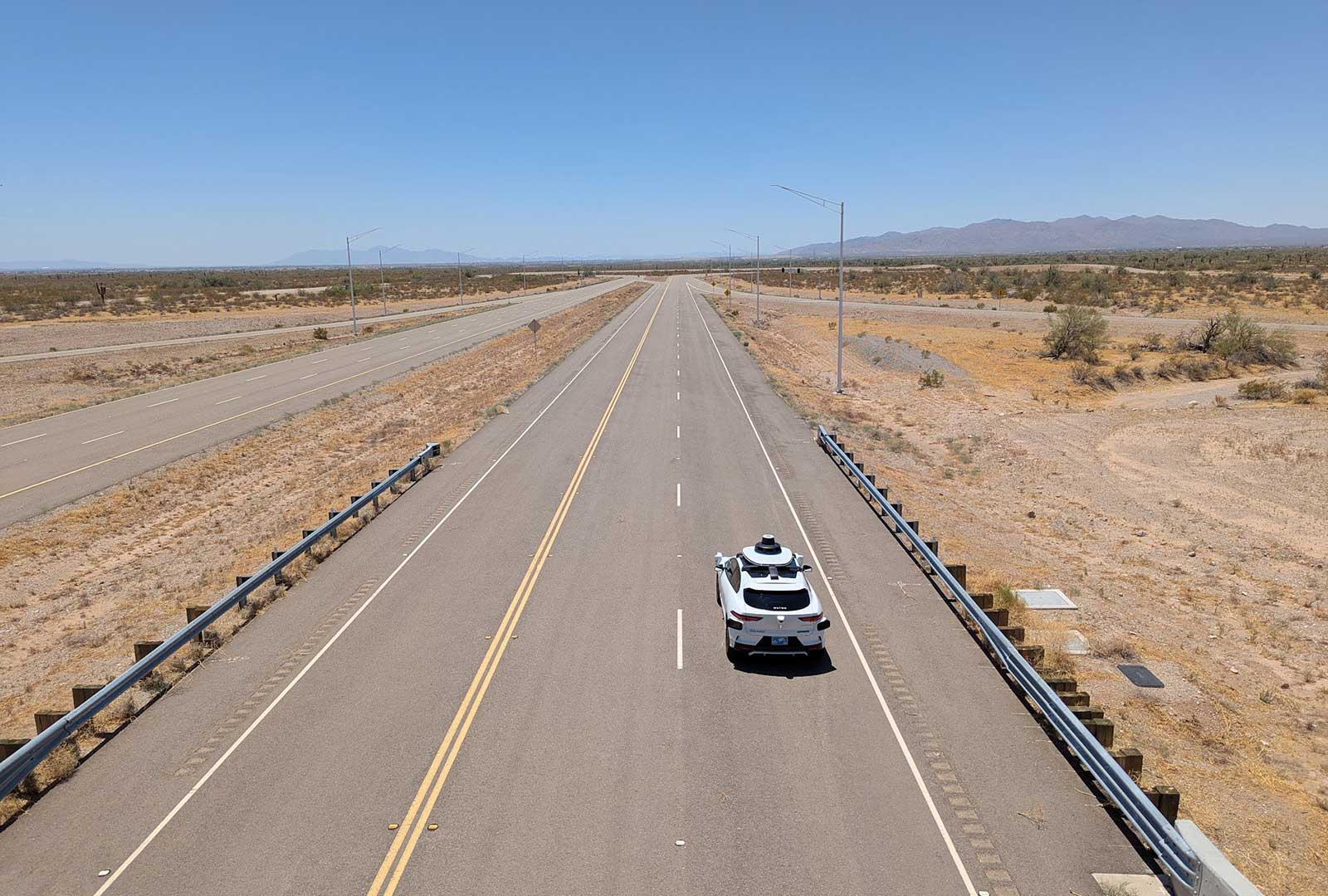
Tesla Bets Big on Las Vegas as Waymo Buys Apple’s Proving Grounds
Executive Summary
Tesla has expanded its unsupervised robotaxi geofence across all 245 square miles of Austin while filing to operate up to 5,000 robotaxis in Clark County, Nevada, but analysts note the active Austin fleet has contracted to roughly 20–25 vehicles, revealing a gap between regulatory ambition and software readiness.
Waymo purchased Apple’s former Daimler Chrysler proving ground for $220 million, creating a vertically integrated build-to-validate pipeline adjacent to its Mesa manufacturing facility as it targets one million weekly rides by year-end. Meanwhile, Neolix and Singapore-based QuickBot announced a partnership to deploy an end-to-end autonomous delivery solution that eliminates the last-meter human handoff, with the Singapore pilot serving as a regulatory sandbox for a broader global interoperability standard.
Key Autonomy Signals Episode Questions Answered
Why did Tesla file for 5,000 robotaxis in Las Vegas if it has no vehicles there yet?
According to Rob Grant, Tesla does not have to deploy all 5,000 vehicles even if approved, the filing is a future-looking market saturation signal and a way to secure regulatory and operational infrastructure so that when software readiness is achieved, everything else is already in place.
What makes Waymo’s $220 million proving ground acquisition strategically significant?
The site is larger than Waymo’s existing California and Ohio testing grounds combined and sits roughly one hour from its Mesa manufacturing facility, creating a tightly coupled production-to-validation pipeline. Rob Grant argues it will compress Waymo’s vehicle release cadence and accelerate software validation at a velocity unseen in the industry.
What problem does the Neolix-QuickBot partnership aim to solve, and why is it significant?
The partnership addresses the last-meter delivery problem—getting a package from a delivery bot through secured doors and elevators to a customer’s front door without human intervention. Rob Grant describes it as potentially the first commercially viable human-free continuous delivery chain, which could redefine competitiveness in urban last-mile logistics away from fleet scale toward permissioned-access network control.
Autonomy Signals Topics & Timestamps
[00:00] Signal 1: Tesla’s Big Austin Expansion and Las Vegas Robotaxi Ambitions
Tesla expanded its unsupervised geofence to cover all 245 square miles of metro Austin while its active fleet contracted to an estimated 20 to 25 vehicles, then filed with the Nevada Transportation Authority to operate up to 5,000 robotaxis in Clark County within 12 months. The filing reads as a market saturation signal rather than an operational commitment, with software readiness remaining the critical bottleneck to commercial scale.
[22:47] Signal 2: Waymo Buys Apple’s Former Proving Grounds
Waymo purchased Apple’s former proving grounds in Wittmann, Arizona for $220 million, a site larger than its California and Ohio testing grounds combined and an hour from its Mesa factory. By collapsing the build to validate loop into a single Arizona corridor, Waymo is converting capital into validation velocity as it targets one million weekly rides by the end of the year.
[44:07] Signal 3: Neolix Partners with Quickbot to Solve the Last 50 Meters
Neolix partnered with Singapore-based Quickbot to pair its Level 4 logistics vehicles with a platform that manages secure entry through doors and elevators without human intervention. The alliance creates the first commercially viable human-free delivery chain from road to door, redefining competitiveness away from fleet scale toward permissioned access network control.
[56:42] AUTNMY AI
AUTNMY AI is an applied intelligence firm whose mission is to develop a field-tested, ground-truth understanding of how the Autonomy Economy is being built and translate that understanding into the intelligence, foresight, and counsel that help the world’s leading institutional investors navigate the most consequential industrial transition of this century.
Full Episode Transcript
Tesla Expands Austin ODD and Files for 5,000 Las Vegas Robotaxis
Grayson Brulte: Rob, lot of great signals in the market. I felt like I had a flashback this week as we’re going through the data from OMEGA. Lo and behold, Apple and autonomy came. I said, “Oh, this, this signal can’t be right. What’s going on with the algorithm?” But lo and behold, Waymo purchased Apple’s old proving grounds, which originally was the Daimler Chrysler proving grounds. Yes, Daimler and Chrysler were once a company. So we’re gonna dive into that signal. Another signal is Tesla has expanded their ODD in Austin for unsupervised. Oh, and by the way, they did file with the state of Nevada to potentially look to go into Las Vegas. And Neolix, the Chinese autonomous bot delivery company, is expanding into Singapore. So lots of signals to break down. But before we do that, a huge thank you to KPMG for being an incredible, incredible sponsor for Autonomy Signals. Now, Rob, let’s get into the signals. What do we know about Tesla and their ambitions?
Rob Grant: Yeah, this is great. There’s a lot happening with Tesla right now, and we’re gonna kinda sort the wheat from the chaff, so to speak, about what is going on in all the news that they’re creating. So on June 3rd, Tesla expanded its unsupervised robotaxi geofence to cover the entire 245 square mile Austin metropolitan area. Yet analysts and other open source reports, including our own proprietary OMEGA, says that the active fleet of robotaxis has contracted to approximately 20 to 25 vehicles. Yet at the same time, Tesla also filed an application this week with the Nevada Transportation Authority for an autonomous vehicle network company permit, AVNC permit for short, to operate up to 5,000 robotaxis in Clark County, where Las Vegas sits, within the next 12 months. For comparison sakes, it’s estimated that about 6 to 7,000 Uber and Lyfts roughly serve Clark County right now and about 3,500 taxis. So we’ve got some interesting data coming in about Tesla. It’s expanding its ODD in Austin, yet its fleet is contracting, and it’s asked for authority to go up to a materially huge number in Clark County, yet doesn’t have any vehicles on the road there. So some interesting facts on the ground and, and we’re here to help you sort them out.
Grayson Brulte: I would say grand ambitions and Tesla’s looking to hit the jackpot. Maybe they went all in on red. And why do I say all in on red? ‘Cause the majority of the, of the unsupervised robotaxis that I have personally rode in have been red. So perhaps that’s where they’re going. But Rob, if you get the, let’s I’m gonna use the quotes here, the authorization to deploy 5,000, do you have to deploy all 5,000 or can you deploy a smaller amount and then you can reserve that right at a later time? Why go for such a large number?
Coverage Narrative vs. Operational Reality
Rob Grant: So the, the easy answer to your question is no. If they get authorization for 5,000, they certainly do not have to put 5,000 out there, nor do they ever have to achieve that 5,000 number. So this is like a, a request that I think they’re trying to signal something here in terms of they are using the application and the ability to basically ask for however many vehicles you want as a, as a, as a way to signal that at one point in the future they plan to saturate the market. So it’s, it’s a future-looking market saturation signal to me rather than a near-term operational commitment. and I think when combined with their ODD expansion, geographically at least, in Austin, I think all this together reads that Tesla is optimizing for a coverage narrative rather than an immediate localized density or operational narrative
Grayson Brulte: There it is, the narrative. That’s why we always harp on this show and on the road to autonomy in autonomy markets, the fine print and the detail matters. So Tesla’s sitting here trying to control the narrative. Look, we’re, we’re going to put thousands of vehicles. That’s hypothetical. That’s what the filings says, put thousands of vehicles into the market. So now I’m gonna go to the other side of the table because that’s what we like to do. Does this become a, a game of brinksmanship where Waymo, when we were out there doing field work a few weeks ago, I noticed the Zeekr. Does Waymo say, “Okay, well we wanna put 10,000.” And then Moschel says, “Oh no. Hey, hey, hey, hey. No way, Jose. We want 15,000.” Does this become a game of brinksmanship? Is that what they’re doing?
Rob Grant: It could lead to that for sure. But I think, I think if you’re a Waymo or you’re Motional, you are basically reading this in the sense that Tesla is not ready yet with its software. It’s not ready yet to operationalize these requests. So you’re looking at it as they have yet to reach a maturity in their software threshold. Yet, if I’m Waymo, I’m like, “I have a definitive advantage here. I feel like my software is ready to go. I feel like my paid trip volumes suggest that consumers find me useful in the markets that I’m operating in, and my operational infrastructure build-out is getting ready for me to scale.” And so what you wind up seeing, I think, from some of Tesla’s competitors, is your traditional autonomy rollout playbook, which is you’re scaling your vehicles and your geofence simultaneously, along with your operational footprint. Tesla is kind of inverting that here. it, it’s sort of a high-risk, high-reward inversion of the traditional playbook. And so rather than scaling vehicles and geofences simultaneously, Tesla is securing kind of operational domains and regulatory permits such that when the software is ready, everything else is kind of built out around it. And so it is definitely a different approach. I don’t think it necessarily, if I’m Waymo, puts me on the defensive. If anything, it says, ” Hey, there is a reason that they are taking this approach,” and that reason is they don’t feel their software is ready to expand into markets as quickly as everything else in their business is ready to expand, which means their operational footprint, their regulatory footprint. So I, I don’t think you’re gonna see an arms race. I also should mention, you know, it’s quite possible that the Nevada Transportation Authority which has 30 days, if they find the application of Tesla is complete, right? So if they look at all the elements that are in the, the law and they say, “Tesla, you’ve submitted everything correctly,” they basically have to approve within 30 days if that’s the case. And so, you know, I, I think Waymo is willing to say, “Sure, go out there, put out whatever public narrative on market saturation you want. I’m actually in the position to saturate the market because my software is on par with the other parts of my business.”
Key Procedural Signals to Watch in Las Vegas
Grayson Brulte: Those are all valid points, and I’ll point out to the audience, if you wanna look for signals from, in the market outside of, of, of the filing with the state, look for a Harry Reid International Airport airport code LAS a- approval and application. And furthermore, look for any signals or signs that Tesla has entered into a contractual agreement with the casinos. And you may ask, “Well, why is that important?” Tesla legally cannot operate a robotaxi service on casino property without a license. Zoox had to do it early on in their thing, so that’s something to watch there as well. So there’s a lot of, if you wanna say, procedural elements, Rob, that have to go into place here before Tesla can actually turn on the the light
Rob Grant: For sure, right? Las Vegas is one of the more unique markets in the sense that every casino property is its own fiefdom. right? So, you know, when you’re driving around Miami or Phoenix or Los Angeles or Nashville, wherever else you see Waymos if you’re outside of a casino property, you just wanna go to the mall or you wanna go to McDonald’s, you don’t have to negotiate special entrance or permission to go onto that property. You do for airports, right? That’s consistent across the country. But not for general access to commercial businesses, except in Las Vegas, where, as you mentioned, you have to basically negotiate with MGM and, and Sands and the Winds. you, you know, you may be able to negotiate for multiple of their properties that they own at one time, but you still have to go to each individual casino owner and say, “Where can I access your property? Where can I pick up and drop off? Do I get the front door? Do I get you know, in the back by the parking lots?” And you can see how those negotiations have gone for Uber and Lyft. Some of them have premium spots right in the front of the casino, which is great. Others, you gotta, it’s a maze. You gotta walk through the casino floor, past the bathrooms, down past the food court, out through an elevator, up an escalator, into a dark garage. And that’s because the, the, the negotiation process perhaps it didn’t go as well for Uber and Lyft, and they’re like, “Yeah, you, you can, you’re welcome here, but, like, good luck anybody finding you.” and so that, that’s pretty unique in terms of Las Vegas, but I do, I do think you mentioning airports is really important, right? Airport trips are so vital to any mobility service, any city. they provide concrete kind of density, utilization new customers. you know, generally if somebody is downloading your app for the first time, it is likely to be at an airport. and so Having access to Harry Reid International Airport is gonna be super critical for all the players in that space. And then as we move through potential additional expansions, whether that’s in Austin, Dallas, Houston, where Tesla currently is, you’ve gotta look for special negotiations to access, you know, Love Field or IAH or DFW. and so those are always key signals to watch. but again, I think here what we’re seeing is, is a, is a narrative approach that is trying to project maturity in Tesla’s operations writ large, when really I think it’s, it’s kind of a cover for the fact that their software is just not ready to expand at the pace that the rest of their business is ready to go.
Thin Fleet Depth and Dallas Market Observations
Grayson Brulte: That’s a very valid point, and there’s a, a gentleman, Spencer, who’s a fan of the show. Hi, Spencer. he lives in the Dallas market, and he’s been posting every day publicly on X about how Robotaxi’s been unavailable for several days. And we did have drone footage and several reports that it was a s- a small amount of vehicles in the Dallas market, not a, a, a large amount of vehicles in the market. It seems to me, based on consensus and a tr- a track record of the market, that Tesla’s putting two, three, five, 10, 10 unsupervised there saying, “Okay, look, we’re in this market, we’re in this market.” And obviously we experienced unsupervised in Houston, and we had a interesting scenario which you can watch on our YouTube channel. And, and on the Vegas front, let’s not forget, there’s a lot of M&A activity happening. Vegas is in an economic slump. Caesars, Harris, which just, was just bought by the owner of Lowery’s, so perhaps new management, new ownership’s gonna bring a change there, so that’s something to watch there. Then also, watch the, the downtown market in Las Vegas. If you happen to turn left and you happen to turn right, I wasn’t your tour guide, but you could say I was your tour guide. There’s a very good chance that you will see an unsupervised motional vehicle there. You didn’t hear it here first, but you did hear it here first. Let’s turn to the risks here, Rob, ’cause OMEGA uncovered quite a few interesting risks. Let’s start with this one. The NTA permit review delays or conditional approval imposes operational restrictions on fleet size or geography. So OMEGA’s saying, if I’m reading this right, the NTA can say, “Okay, you’re approved for 10 vehicles. You’re approved for 100 vehicles.” Is O- Is OMEGA reading that right, and is that something possibly that could happen?
Rob Grant: It is a possibility. I find it unlikely that it will happen. Generally, the permit review process from the NTA on these AV and C permits is you submit it. If it’s everything that we requested in the detail that is required we approve it. now, this is a first time that somebody has come in and said, “Give me five thousand vehicles.” So we’ll see if they continue the history of, of basically approving a an application that is sufficient for them. I do think if they believe that Tesla’s software maturation is there and Tesla would have had to self-certify this in the application, I don’t believe that they’re going to impose any restrictions. Now, if they do have concerns, particularly about maybe airport access, right, or special circumstances along South Las Vegas Boulevard, where, you know, the bulk of the, the tourism occurs, they could geographically, you know, maybe suggest, and that would be the term they would use, you know, come back with a modified application, suggest that you start in a smaller area, perhaps outside of the South Las Vegas Boulevard. But again, I believe that given the history of my experience there and what I’ve seen from others, including Zoox, AVride and others operating in the market, that despite the large volume requests, that they’ll, they’ll likely approve the, the application as is if they find it sufficient.
Grayson Brulte: And not to add salt to a wound, but Las Vegas is a very complicated market with, I’ll say it very nicely, a lot of cooks in the kitchen. There’s no other way to say it. There’s a lot of cooks in the kitchen. And if you’re ever bored and you’re on the south end of the strip, you can see the Area 51 plane. It’s the white plane with no windows. Again, I’m not your tour guide. But let’s go on to the next risk here. A 5,000-vehicle deployment targets proves operationally unachievable in 12-month window, exposing scale claim as signaling rather than substance. You called it a signal. What’s the Teslarati crowd gonna say if this number is not achieved?
Rob Grant: Look, I think, I think the, the key thing for Tesla is the maturation of its software, and I think it– I think you and I firmly believe that will get there, so, you know, please don’t read into what I’m saying as it will not get there. I think it is just requiring additional validation and Interaction with certain variables in terms of speed and operating conditions, weather conditions, things like that. And so I think this is what you’re seeing kind of happen in Texas, right? Which has a– Particularly Austin, has a very similar weather pattern to Las Vegas as well where rain is not a tremendous everyday concern, but when it happens, it leads to, to flooding and conditions that are probably in the long tail of the risk exposure for what Tesla sees in its everyday operations in Austin. So I do think what Tesla is preparing for is the ability, like we talked about earlier to have everything in place to get to a larger scale than what anyone has seen for its initial forays into a market. so right, what we’ve traditionally seen from the players out there, whether it’s Waymo, Zoox anybody else, is you start relatively small and you build up, right? You start at twenty-five, then fifty, then a hundred, then two hundred and fifty. I think what Tesla is doing is w- i- is inverting that, is saying, “Okay, we’re gonna get everything else ready, and if we think that software validation is sufficient to meet our safety and other operational benchmarks, why wait? Why, why wait for us to go fifty to a hundred to two hundred? Let’s just go as big as we can.” Now, some of this will depend on how many Cybercabs are ready and what the potential federal government decision on the use of that vehicle without a steering wheel or brakes comes down to. it may be that they have an interim ability to put a steering wheel or brakes into a Cybercab-like vehicle to get out there faster, or it may be that they just have enough Model Ys to, to, to, to bridge a market. So I wouldn’t read four thousand nine hundred and ninety-nine vehicles in Clark County as a failure. I wouldn’t expect it either. I would expect it to fall considerably short of the five thousand figure within the next twelve months. But if they get a thousand vehicles in the next twelve months in Clark County, including Las Vegas serving LAX, I would say that’s a huge win for Tesla. I, I, I would, I would imagine everybody from Elon Musk down would be thrilled with that.
Grayson Brulte: Would be thrilled. I think a- as Tesla does go unsupervised robotaxi and, and, and owning a Tesla, I will tell you that each iteration of FSD that I’ve gotten has gotten much better. However, they still have to figure out routing, and I truly believe at some point that Tesla is going to fully, truly crack unsupervised. It’s just a matter of time. But the, the routing issues are, are going to have to be fixed. And you brought up Cybercab, and that’s OMEGA’s last risk here. OMEGA goes on to say, “Cybercab production delays e- delays extend model Y dependency compressing per mile unit economics versus purpose-built competitors.” That’s a very good risk. And then I look at this, because I’m the weirdo in the room, say, okay, Las Vegas for the most part is a destination. Perhaps that potentially could be the first Cybercab market
Rob Grant: You know, I wouldn’t put it past your judgment there. I think that could be pretty accurate. I think it is a, a market that fits well with the Tesla identity right? It’s, it’s, it’s loud, it’s brash, it stands for something. it has a little bit of risk involved with everything, right? I mean, risk is basically the economy there. So there is a lot of synergy between the Las Vegas brand and the Tesla brand, and I think Cybercab would be a really good fit for an initial launch city in Las Vegas, particularly because of the, the weather as well. you’re, you’re just not gonna get a lot of extreme weather outside of heat. And so I think it, it fits both in terms of its brand reputation, but also in terms of the operational design domain and keeping Tesla as safe as possible in an environment in which it can succeed as much as possible
Grayson Brulte: So are you saying that Sin City could become Cybercab City? Is that what I’m reading between the lines there?
Rob Grant: It very much could be. It very much could be, right? I, I think you know, we, we see it in, in Austin with Gigafactory, right? It’s kind of becoming part of the identity of Austin. I could see the Cybercab sort of becoming the, the, the black cab like it is to London or the yellow cab was to New York or is to New York and the Cybercab being the visual mode of transportation of, that you associate in Las Vegas
Grayson Brulte: Like that. Unfortunately, Nevada’s the Silver State, but people do go to Las Vegas trying to strike it rich and find their gold. Whether from the one-armed band or the tables, they go there trying to find their gold, Cybercab’s gold. So perhaps the two of us are onto something. Which brings us to OMEGA’s take here. OMEGA’s got a good take here. ” Tesla is aggressively securing the regulatory framework and geographic footprint for a massive robotaxi network, but a severe disconnect between its expanding service areas and its contracting physical fleet reveals that software readiness remains the critical bottleneck to commercial scale.” You’re right. You’re right. You’re right
Rob Grant: Yeah. I, I, and look, I mean, as we mentioned, I think both you and I believe that they will be able to unlock true level four driverless driving through its approach right now. part of that is, is a, a, a compute issue which they’re constantly working on particularly for edge cases that involve glare and difficulty seeing in certain driving conditions. And then others is just a validation issue. and, and look, that is not a knock on anybody. Everybody has to validate their software. and that is just part of the engineering process and being in a safety critical industry. Validation is key, as we’ll talk about in the next single. validation is a real potential bottleneck on throughput. But once you solve that issue, it can really be an accelerant as well
Waymo Pays $220M for Apple’s Former Proving Ground
Grayson Brulte: Ken, and it’s standard validation theme jingles the signal too. Waymo made a purchase. They bought the old Daimler Chrysler proving ground for $220 million from Apple, which I will point out, no surprise to Apple, Apple made money on it. It was a profitable transaction. So that brings the proving grounds in the United States that we know of to two. You have the Whitman, Arizona one, and you have the, the Castle one just south of San Francisco. What signals did OMEGA uncover on this transaction?
Rob Grant: Yeah. ju- just to go back real quick, I mean, I– to give you a size of the scale of what Waymo bought in Whitman from Apple and its secretive, not so secret Project Titan, which I always found hilarious, was, like, the, the worst kept secret of all time. this site is huge. It is larger than Waymo’s existing California and Ohio testing grounds combined. It features 115-acre city course, a 35-acre vehicle dynamics area, a four-mile high speed oval, and a dedicated freeway loop. It also sits roughly an hour away from the Mesa facility that that 240,000 square foot facility that they’re u- using Magnet to upfit and, and build their cars at no longer upfit, but integrate their cars with. And so, you know, to give you a sense of, of some of the things that will be important here, I also wanna mention that Waymo is targeting a million rides, weekly rides, by the end of the year, and up to 20 additional cities by the end of 2026. so the, the, the strong signal here, right, I think the, the, the primary one is that this acquisition Marks a definitive transition for Waymo from a localized robotaxi R&D to industrial scale fleet deployment. By securing a closed loop validation pipeline adjacent, as I just mentioned, to its manufacturing hub, Waymo is vertically integrating the testing layer to de-risk its aggressive target of a million weekly rides by the end of this year. and as we just talked about a second ago the L4 scaling curve is, is not linear. It is constrained by physical infrastructure and localized operational bottlenecks. providers who control hard assets like Waymo’s proving grounds and solve for this localized density will outcompete those just relying purely on software. And so what you’re seeing here, this vertical integration, is really a way to accelerate validation and software validation at a velocity that, that is unseen in this industry right now. And it will compress, I believe, will materially compress Waymo’s driver release cadence from build at Mesa to validation at Whittington or Whitman, sorry, to what you see on the Road. and it will not only allow for that to move faster, but it will all keep it in-house and all in the same location which is a state that is materially cheaper to operate in, materially more friendly to operate in than California
Grayson Brulte: Now the question becomes how long until somebody, it’s not gonna be me and I’m not gonna be the tour guide and suggest a tour guide for this one, till somebody sits there with a drone and a camera outside the Magna factory and watches what vehicles go up there. That’s gonna be something interesting to, to watch. ‘Cause you’re right, it could c- almost become an assembly line for testing there, or perhaps, and I have to say this perhaps, there is a new vehicle format in the works because Apple being Apple, when we did the due diligence on this years ago, why did they buy the proving ground originally out there? It’s in the middle of nowhere. It is highly secure. You cannot see over it with cameras. If you fly a drone, that’s your responsibility. I’m not suggesting that. It’s highly, highly secure. So perhaps there’s something in the works here, and that’s why they did it. But why, outside of what potentially could happen, why add a third proving ground, do you think? Why is this so important?
Three Strategic Reasons Behind the Proving Ground Acquisition
Rob Grant: I, I mean, that’s a great question. and this is something as soon as I read it, I started to really think, like, what, what are kind of like the three main reasons I could think of as to why buy this additional proving ground? And I, and, you know, came up with some ideas. I, I ran it through OMEGA. We had some discussions so to speak. And I think really what it comes down to are three things. one, it solves the validation bottleneck. So doubling your weekly rides, they currently are saying they’re giving about 500,000 weekly rides to a million will require validating new vehicles. You’re going to need to add more vehicles to your fleet to reach a million weekly rides. And we know these vehicles are new Ohi’s that are basically being made at maybe 300 to 500 a month in Mesa. So you’re gonna have to validate these new vehicles, validate their software builds at a pace that public road testing may not safely sustain. And I think key to this validation bottleneck is the facility’s freeway loop and a high-speed oval which to me s- specifically signals preparation for higher speed and highway domains, right? Which we know over the past eight weeks or so has given Waymo some real issues, and they’ve really struggled with this, including at some point pausing highway access for consumer use of their vehicles. So one, it’s that validation bottleneck. Two, I think it is this collapsing of the build to validate loop, right? As we mentioned, the proving ground is geographically approximate to Waymo’s Mesa, Arizona, manufacturing factory, and it creates a, a tightly coupled production to validation pu- pipeline. an Ohi can now be built, calibrated, validated, and then within a single Arizona corridor, corridor, and then eliminate the kinda logistical coordination that some of its competitors have to go through when they build a vehicle in one place, have to ship it to another, and then validate it there. And then I think what we’re also seeing here is, is that it, it is a material kind of cost advantage. This is– The third thing here is that this is Waymo flexing its cost advantage. You know it recently raised $16 billion. It obviously has the Alphabet backing. But look, Waymo is, is buying a purpose-built AV validation assets that another trillion-dollar company spent years building out. And they’re shifting from software iteration to hardware industrialization, utilizing this massive capital advantage, and it’s putting its competitors on uneven ground. So I think those are the three reasons, competitive advantage, software validation, and closing that build to validation loop.
Waymo’s Arizona Corridor and Office Expansion Signal Scale
Grayson Brulte: And to me, it signals even more because we learned this week that Waymo has signed an- another lease in Tempe, Arizona for eight floors of an office building. a lot of people. So it says, okay, you’re, you’re, you acquire this facility. You, you get a new office building on top of your other existing operations. To me, it signals that something big’s coming. It clearly signals that Waymo is investing, one, in Arizona, which is great for the Arizona economy, but two, they’re getting ready to scale something. The question is, what are they getting ready to scale?
Rob Grant: Yeah. To your point, right, I mean, we’re seeing the introduction of their sixth generation hardware, but we know there will be a seventh generation hardware. We– You and I firmly believe that the, the Zeekr-based Geely-made, shipped-from-China vehicle we don’t believe is going to be the ultimate scaling vehicle in the United States for, for geopolitical reasons, tariff reasons, all of that. So we believe that it will likely be another vehicle type. it could be the Hyundai IONIQ. We’ve heard that, right? Maybe 50,000 Hyundai IONIQs due in ’27 or ‘ 28. But could they be building towards a seventh generation hardware on a new vehicle type where you can manufacture that vehicle or at least build most of it in Arizona, validate most of it in Arizona and then have perhaps maybe some of your best engineers located in Arizona with the new facility that you mentioned. So I, I think it could portend something really big for the seventh generation hardware build and a potential new vehicle build as well.
Grayson Brulte: I’ll give another signal to watch for. United broke this down at their investor day this year, and they talked about Apple and the amount of routes that Apple bought first class tickets on from SFO to China, and how they added different, different segments be- Apple prepaid for that. The question becomes, do we start seeing more flights on United from SFO to PHX? Okay, that’s to me becomes an interesting tell sign because we have a cadence w- what, what Apple did. Obviously, California’s where, where the software is developed, if you wanna use the term, Arizona’s where the metal’s bent. What do we know about, if you wanna call it the corridor, the technology, you wanna call it the technology corridor? What, how, how is Waymo utilizing that?
Rob Grant: Yeah. I mean, I, I, I think that’s gonna be something to follow. look, I mean, there are many reasons that companies would choose to put their physical manufacturing facilities outside of California. just land cost acquisition alone, taxes regulatory hurdles, the ability to do work with local governments, state governments all of it is materially, materially easier in Arizona. You know, I, I, you know, I think workers’ rights laws down there are different as well so you’re not dealing as much with the unions or at all with the unions. it just is a much easier place for them to do business, to scale business, to think about growing a business without some of the material cost friction, and material headaches that come with trying to build, literally build something in California, right? It’s no longer just about the software which they’ve been able to do very successfully in California, as many companies have. But the hardware, the manufacturing process is just much easier outside of California, and you’re seeing this, right? You’re seeing folks that have heavy manufacturing process leave California, I think, right? All the oil companies have left California now. you’ve got a few other manufacturing companies in the r- in the humanoid space that are looking to build their v- humanoids outside of California because it is just more cost-effective that way
Grayson Brulte: It’s happening, and one thing that you and I know and the majority of this audience knows, politicians love manufacturing jobs because they’re sticky. And those are good things, and it’s clearly that Waymo’s investing there, and obviously AI, as, as as Martin Briggs at BofA has said, AI has, has left the chat and it’s be- it’s becoming physical, which brings us to the risks. That while this is a very, very good strategic move for Waymo, I applaud it. It’s a drop in the bucket for Alphabet’s balance sheet. It gives them a secure facility to test. There are risks, and I’m gonna give some covers and risks that we’re gonna break down. Risk one, software validation bottleneck. If Whitman’s testing throughput is insufficient to validate updates at scale, software development velocity slows and the one million ride target slips. That’s interesting. That’s interesting
Rob Grant: It is, and, and this is one of the, the areas that we know the least about in terms of what condition that facility was left in what might they have to either refurbish or rebuild what is the capacity to test? I mean, it, in terms of acreage and the, the description of what is there from what we know it is unmatched in its scale, and you would think throughput would not be an issue. But until you actually start to put large amounts of vehicles and different builds with different versions of software on there to, to validate, right? You not only have the different versions of hardware you have to validate, but, you know, Waymo’s stack is not static. you know, at any given time, I remember at Cruise, we maybe had five or six different versions and various levels of testing, including what was on the road, what was gonna be next on the road, what could be third in line to go on the road, what we were testing out as completely experimental all sorts of things. So you have multiple versions that you’re gonna wanna put on there, including, at some point, how all of the calibration will go in validation with a completely new vehicle as well, with the Ionic. So you’re, you’ve got all the software versions, you’ve got the Ojai, you’ve got the Ionic, and then you put all those software versions on the Ionic as well. You’re talking maybe, you know, 10 different or more iterations of things that you could run through that facility. and we’ll see if it’s ready to go, if it’s plug and play. but until they start operating it, it’s gonna be really hard to narrow down what is the throughput velocity there. And then if there is a, a demand constraint on it what is the priority, right? Is it prioritizing the Ojai so you can get as many of those out by the end of the year to hit that one million ride mark and, and particularly, you know, flooding those Ojais into the newer markets so you can get the fleet density needed to, to maintain the utilization required to get to a million rides? Or will it be, “Hey, the Ojai is a temporary bridge vehicle because we cannot get through this intractable tariff issue, which makes the economics of the Ojai very difficult”? Is it, we’re using this facility to really put our efforts into validating the Ionic as fast as possible, and as soon as those things are ready to go, putting them out en masse? And so we’ll see what, what the, the kind of balance of the weight for Waymo is in terms of how much they wanna prioritize getting to that million rides per week in 2026, or how much they have to kind of play a longer game to realize the economics of the business they want to achieve, which right now I think our estimate is they cannot achieve that with the Ojai as the main vehicle.
Grayson Brulte: Let’s not forget, the Ojai is one truth post away from extinction in the United States. That’s right. One truth post, the Ojai, for all practical purposes, could go the way of the dinosaur. And so it, it is a big risk there, and obviously Waymo needs more vehicles in order to scale. The other risk that OMEGA didn’t uncover, but we talked about this a lot, is that what happens when the American public starts crying a- a- in an outrage and calling their local politicians about riding around in a Chinese car? So a lot of risk there as it relates to the Ojai, which brings us to r- the risk number two that OMEGA did uncover. The Mesa factory ramp under-delivers. Manufacturing capacity fails to produce enough vehicles to reach one million rides regardless of Whitman’s role. The, the Mesa factory is something to watch. Obviously, there’s a gentleman on X who posts drone photos that we, we, we look at and we analyze all the time. And if you look at the latest drone drop, there’s not a lot of vehicles sitting out there. Like I I know it’s, it’s over 100 degrees there, but that number is dropping out there
Rob Grant: Yeah, look, I mean, ultimately what this signal is saying is that this is a great part of the process. It could speed up a, a process that can at sometimes slow down scaling, but it is not the, the equivalent of scaling itself, right? The Whitman facility cannot directly put out a million weekly rides, right? It accelerates a deployment cadence that makes that potentially possible. But, but in the end, it has its limitation. It’s a, it’s a closed course validation campus, purpose-built for edge case simulation, motion control calibration, and, and training of the, of the fleet for certain operational design domains like highway speeds and things like that. But it’s not– it doesn’t have fleet charging, staging or maintenance or any of these things, and it is in one locale. It is not in Nashville, it is not in Orlando, it is not in Tampa, it is not in San Antonio, Denver, Chicago, all these places that Waymo has identified as new markets that will lead them, they believe, to achieving that million weekly rides. And so again, manufacturing is also part of that process. This is not the manufacturing facility. If the Mesa manufacturing plant either cannot, through its own hurdles, achieve the building velocity that it wants, or if it’s somehow delayed by the number of Zeekr shells it’s receiving straight from China. And what I mean by shells is kind of what we understand is that the, the Zeekr/Ojai is coming over not as a fully built vehicle, but as basically a, a shell, meaning the, the, the kind of s-structure, the bones, so, so to speak, of the vehicle are being shipped. A lot of the Chinese-made s-electronics and things are being stripped so that it doesn’t further vi- it doesn’t violate, I wouldn’t say further, but it doesn’t violate some of the federal laws that have been put in place under Biden, carried forward under Trump, about Chinese software and electronics in American vehicles. But if there’s a delay in that process of getting those vehicles from China to Arizona, that could also harm how quickly the Zeekrs can be built. So it’s not only what happens within the plant, but what happens before it even gets to the plant, that could all wind up kind of making the Mes- the, the Whitman facility sit idle until that volume is ready to be, you know, moved an hour up the, up north from Mesa to Whitman.
Grayson Brulte: That’s correct. And furthermore, we do not have any public confirmation if the Ionic 5s are coming from Savannah, which we believe, and we don’t– Or they’re coming from Singapore, which w- we don’t know, and we do not have confirmation. We have con- conflicting reports that either they’re coming off the line fully built or they’re gonna be upfitted. So that’s another thing to watch. There’s just a lot of uncertainty and a lot of questions that still remain in the market as it relates to Waymo’s physical strategy for the asset, w- which is the robotaxis. Which brings us to OMEGA’s take here. OMEGA’s got a really good take here, Rob. “Waymo is structurally widening its competitive moat,” yep, “by converting capital into validation velocity. One of the hardest constraints of safely scaling L4 autonomy while rivals struggle with cash runways or pivot to licensing models, Waymo is deepening its ownership across the entire stack: manufacturing, validation, and operations. The acquisition of Apple’s abandoned infrastructure is not merely a real estate play. It is the physical internalization of the validation process required to deploy 50,000 new vehicles and hit national scale.” Good take there
Rob Grant: I think it’s, it’s absolutely spot on. I think as we talked about, this has some real advantages to Waymo. but as you just mentioned, there are a lot of things that are opaque when it comes to understanding Waymo’s overall trajectory going forward, which I think will be very positive. But yet you know, our audience wants to know more granularly rather than just positive or negative, what are the things that could help it? What are the things that could hurt it? How is that gonna affect timelines? What are the, the, the, the things that they should be looking out for and anticipate being either a future problem or a future accelerant? And, and I think this is where our discussion here and what OMEGA has surfaced is super valuable for those who are listening
Grayson Brulte: And then for our institutional clients, you know, they get the granular, granular detail. And if you’re institutional and you’re interested, send an email to [email protected], ’cause Rob and I do offer institutional advisory services. Let’s move on to signal three here, Rob. It’s, it’s a company that you and I have been following because there’s something, news coming in a few weeks around this. Autonomous sidewalk company Neolix has partnered with QuickBot to do indoor integration. What do we know about this?
Neolix and QuickBot Partner for End-to-End Autonomous Delivery in Singapore
Rob Grant: This is a really interesting story because I think what we might be seeing here the signal, at least as I read it, is a new kind of benchmark potentially moving forward in last mile delivery in terms of consumer expectation, in terms of understanding how to grow that market through some of what has been seen as intractable problems from how do you get an item, whether it’s food or an order of screwdrivers, whatever it might be, out of the delivery bot, up the stairs, into an elevator, into your front door, right? That, that has been the intractable problem. At some point in that process, you either require the ultimate consumer to have to come down and meet you, or you have to have human couriers take it from that last 50 meters, so to speak. So what happened here? on June 3rd, Neolix and Singapore-based Quickbot announced a strategic partnership to co-deploy an end-to-end autonomous delivery solution. Now, the integration here stitches together two distinct autonomy domains. Neolix provides L4 autonomous logistics vehicles, and Quickbot provides– What they’re bringing to the table is what they call their ambient permission plane and autonomous final mile delivery. I’ll say that again, it’s a, it’s a mouthful. Ambient permission plane and autonomous final mile delivery. It’s a platform. I mean, that’s basically what you need to take away. It’s a platform that manages indoor navigation without human intervention. So that means it allows bots, in this case, delivery bots or, or robo vans, however you wanna describe them It allows them to get secure entry into doors, elevators, and things of that nature without any human intervention. And so the initial pilot of this partnership is anchored in Singapore in, in the, in the Punggol Digital District. and it’s deliberately timed to capitalize on the country’s regulatory transition from just allowing sandboxes to ultimately allowing full commercial operations under a new framework that it’s going to release soon. So I think the interesting thing here is that even in the press release, it mentions that, yes, it’s, it’s testing of this integration is gonna happen in Singapore, but its real target are the clients that they see potentially in, in the Asia-Pacific, Middle East, and other places outside of Singapore. And so it’s really this, I call it a platform as a service, is the new thing here. It’s that combination of delivery bot combined with this last 50 meter solution that is the, the real innovation here.
Grayson Brulte: If you look at innovation in Singapore, DHL has a facility there as well, testing different types of deliveries. What we’re seeing with this partnership, do you think that potentially is a signal for the future of what is to come?
Rob Grant: I think so. I think so, right? I think, I think this seamless workflow between, right, just imagine you open your app, you want something from one of the hawker markets down in Singapore, and you say, you know, “I want,” I don’t know, whatever, Singapore Sling. That’s a, that’s a famous drink down there. “I want my Singapore Sling.” You can op- order on your app, Neolix will, will get it for you, move it all the way through, and deliver it to your door with its integration with Quickbot’s AFMD platform here. and so I think that is the next frontier for urban logistics, and I, I think this road-to-doorstep gap potentially is solved here. And so this alliance, I believe, creates the first commercially viable human-free continuous delivery chain, which will alter unit economics and procurement models for that urban last mile delivery, and I think put real pressure on other folks in that urban delivery bot space
Grayson Brulte: It delivers Singapore Sling. I only want it from one place, Raffles. Can you ensure that the bot’s gonna go to Raffles and get it for me?
Rob Grant: I mean, that’s the ultimate goal here, right? You go to raffles and you get it delivered. and so I think, I think if this works, again, this is gonna put a tremendous amount of pressure on other folks operating in this market who cannot provide that type of continuous road to door service. And that road to door service has been, I believe, the key as to why folks like DoorDash and others Grab Grubhub have done so well. It is because you can order it from your favorite restaurant and get it right to your front door. it’s different. If I gotta, if I gotta go out and meet the guy on the curb and I’m sitting there, you know, trying to watch the Knick game, I’m a little frustrated. I’m like, “Dude, I’ve gotta, I’ve gotta watch, you know, OG or Brunson hit that shot. I don’t wanna go talk to my driver,” who I’m sure is very nice. I just, I just don’t want that inconvenience
Grayson Brulte: As the kids say, notgood.com. You, you, you don’t wanna to miss that game where OG body slams Wemby and teaches him a lesson. You wanna you don’t wanna miss that. You don’t wanna watch it in the highlights. You wanna watch it in real time. That’s the beauty of autonomy and I, and I love this line you did, road to door. So we own road to autonomy. Perhaps we gotta start the next company, Road to Door, you’re giving ideas here.
Rob Grant: Oh, that’s right. I didn’t even think about that.
Grayson Brulte: Let’s go on to OMEGA’s first. OMEGA’s uncovered some, some good risks here. OMEGA says that QuickBot integration complexity delays last meter deployment, undermining end-to-end service narrative. What do you think of that risk?
Risks: Integration Complexity and Incumbent Replication
Rob Grant: I think it’s a valid risk, right? I you, you can see the promise of this alliance, but we don’t know how it’s actually gonna work you know, and if it will work, right? There, there are potential snafus across the spectrum, both in terms of how do you integrate the two technologies together, but also in terms of, you know, as you take this service potentially outside of Singapore, what are the interoperability mechanisms and standards for the platform in places like the UAE, Japan, and South Korea? There’s not only that technical aspect to that issue, right? Will the platform as a service that QuickBot provides, you know, what signals is it running on in terms of spectrum signals is it running on? What are the ability to interface with hundreds, if not potentially thousands of different interfaces at doors and elevators, right? It’s, it’s one of the problems that Uber and Lyft faced early on and still face, like in places like Phoenix, Arizona, where there’s a lot of gated communities, and each gate works on a separate relay signal. now you’re talking about visiting potentially every door in Dubai and every high-rise or in every high-rise in Seoul. There are going to be interoperability issues. does this integration solve those issues so that you can scale it as promised? and then you also have the actual just engineering integration issues between who’s the dominant platform, how does the architecture work between you know, when the order comes in, delivery bot goes out knowing when it needs to activate its platform in terms of its access and integration. What happens if you, if you say, “I want access to this garage door,” and then next thing you know, the entire street’s garage doors open. Which I mention because that has happened on my block before. I don’t know what somebody– I think somebody signed up for that Amazon process where you can allow them to drop your packages in the garage door, but every time the damn person hit the button, all the garage doors would open. And so I’d continually come home to my garage door being open, which was very frustrating
Grayson Brulte: That’s not good. That, that, that technology has to be fixed, and there, there’s a lot of complexities, and you reminded me what you were saying with Cruise. Well, Voyage, which you guys acquired, Oliver Cameron hosts me at the villages and, and each village has its own gate, and you gotta figure out that. So a lot of complexities together brings us to OMEGA’s final risk here. Incumbents rapidly replicate permission access via their own acquisitions neutralizing alliance differentiation. That is a very real possibility because if, if at scale this works, there will be a lot of capital coming here to consolidate it and, and end the 50-foot problem
Rob Grant: Yeah, no doubt, right? I mean, we just talked about some of the challenges with each gate and everything, but that’s why there’s such an opportunity here. If you, if you can solve that issue, and QuickBot says it, it, it has the capability to solve that issue you’ve really unlocked a tremendous convenience for a ton of potential customers. And so not only for the consumer end, but from those who want to serve that consumer demand through delivery bots, you’re gonna see those companies and others rush to either develop their own in-house technology or just go out and acquire the technology as well. I’m sure QuickBot is– will be like, “Hey, don’t waste your time. License it from us.” but we’ll see how that goes.
Grayson Brulte: We’ll, we’ll be watching ’cause that’s what we like to do. We like to monitor things. Which brings us to OMEGA’s take. Here’s the final take of the show from OMEGA. “The Nuro-Luxe Quickbox partnership is not a geographic expansion play or a hardware-to-service pivot. It is a structural bet that controls the digital building access infrastructure. The ambient permission plane becomes the new margin-defining layer of autonomous delivery, rendering hardware capability a commodity. Nuro-Luxe’s RaaS model is a service veneer over a capital-intensive hardware business, and the partnership’s real significance is that it redefines competitiveness away from the fleet scale or unit cost towards permissioned access network control. The Singapore deployment is a regulatory sandbox,” that’s a very good point there, “for exporting an interoperability standard, not a target market, and the bottleneck to global scale is the last-meter technical integration, not fleet capacity or regulatory access.” I know it was a mouthful. There was a lot there
Rob Grant: There is, but, but there is a lot of potential in this, and it’s one of the reasons we wanted to bring it to our audience’s attention. This is a– could be a real step change for the delivery bot industry
Grayson Brulte: Could be a, a major step change and it’s something that we will continue to watch here. Our OMEGA algorithm will continue to watch as well. And each and every Thursday, Rob and I will be here breaking down the signals in the autonomy economy, and if you’re an institution and you’re interested in learning more about our advisory services that Rob and I offer to institutions around the world, please send an email to [email protected]. That’s [email protected]. The future is bright. The future is autonomous. The future is infrastructure. Rob, another week, another great show.
Rob Grant: You can’t beat it. This is the place to be. If you’re missing out on this show, you’re missing out on a lot
Grayson Brulte: We’re not missing out on the Knicks tonight
Rob Grant: Go New York, go New York, go
Grayson Brulte: Go, go,
AUTNMY AI: Billions and soon trillions in value will be created in the autonomy economy. By the time a trend becomes consensus, the alpha is already gone. The gap between uncovering signals and reading headlines is widening fast. When it’s a headline, it’s no longer a signal. Enter AUTNMY AI. We decode signals before they move markets, giving you conviction in the autonomy economy. AUTNMY AI, your models, our intelligence. Visit AUTNMY.ai.
The future is bright. The future is autonomous. The future is The Road to Autonomy.
Subscribe to This Week in The Autonomy Economy™
Join institutional investors and industry leaders who read This Week in The Autonomy Economy every Sunday. Each edition delivers exclusive insight and commentary on the autonomy economy, helping you stay ahead of what's next.