


From 50 Brands to 5,000+, Scaling Coco Robotics
Coco Robotics has grown from roughly 50 brands to over 5,000 in approximately two years, operating on both DoorDash and Uber Eats simultaneously across multiple U.S. cities and internationally in Finland. The company’s next-generation Coco 2 vehicle is entering mass production, targeting tens of thousands of units by 2027, and adds hybrid sidewalk-and-road capability at up to 15 mph.
Coco is actively expanding across Europe, citing dense city layouts, driver supply shortages, and regulatory complexity as tailwinds for robot delivery. The company’s cost structure already undercuts human couriers, and its sidewalk mapping data is being shared with cities and accessibility platforms to improve community infrastructure.
Key The Road to Autonomy Questions Answered
How did Coco Robotics grow from 50 brands to over 5,000 brands on its platform?
Coco scaled by making merchant onboarding extremely frictionless, starting every new partner with a simple product experience and adding advanced controls only for high-volume users. It also worked closely with platform partners like DoorDash and Uber Eats to drive broad merchant adoption across its operating markets.
What is the Coco 2 vehicle and how does it differ from Coco 1?
Coco 2 is Coco’s next-generation vehicle, unveiled earlier in 2025 and now entering mass production, with tens of thousands of units targeted for 2027. Unlike Coco 1, which operates exclusively on sidewalks, Coco 2 is a hybrid vehicle capable of using roads and bike lanes where legal, traveling up to 15 mph, and features larger tires, more ground clearance, and improved reliability in harsh weather.
How does Coco operate simultaneously on both DoorDash and Uber Eats without favoring one platform?
Every robot in all of Coco’s markets is available on both platforms, with the company maintaining service-level agreements with each and jointly optimizing pickups and drop-offs across both. Rash notes this approach also benefits merchants, who want a single streamlined solution rather than separate systems for each platform.
The Road to Autonomy Topics & Timestamps
[0:00] Growth of Coco Robotics
Coco is growing fast across restaurants, QSRs and grocery. Tip fatigue is driving more customers to opt in to robot delivery.
05:48 Out-of-Home Advertising (OOH)
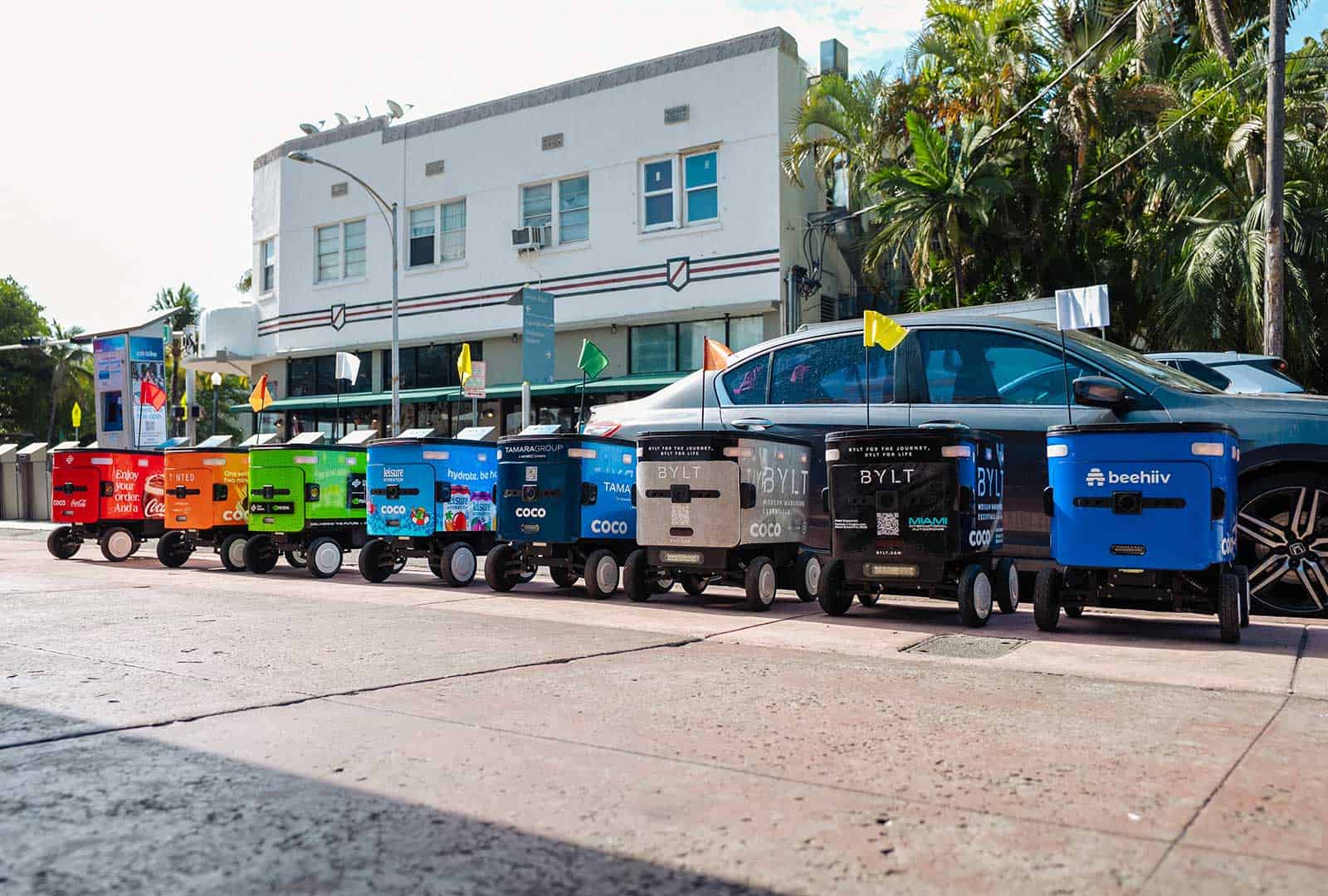
Movie studio, CPG and beauty brands wrap Coco robots, as restaurant brands are kept off the robots so the shared fleet stays neutral.
[08:30] DoorDash and Uber Eats Partnerships
Every Coco robot runs on both DoorDash and Uber Eats, with SLAs on each platform. Merchants get one system for all their orders.
[13:15] Scaling from 50 to 5,000+ Brands
Coco went from roughly 50 merchants to more than 5,000 brands in roughly two years. Simple onboarding was the key, and the fleet is built for short urban trips of about a mile and a half.
[21:07] International Expansion into Finland
Coco has delivered with Wolt in Finland for over a year and now launches with Uber Eats there. Winter demand spikes while couriers stay home, which makes the Nordics a strong fit.
[26:51] Coco 2
Coco 2 runs on heated batteries and studded snow tires and has more ground clearance. It can leave the sidewalk for roads and bike lanes at up to 15 miles per hour.
[31:45] Ralf Wenzel Joins the Board
The Foodpanda founder brings deep experience scaling delivery companies to Coco’s board. He is helping Coco localize the product as it expands abroad and moves assembly and repairs closer to each market.
[39:23] Infrastructure Data
Coco’s onboard AI models map sidewalk conditions. That data goes to the city of Helsinki and to BlindSquare to make cities safer and more accessible.
[43:34] Unit Economics & Cost Efficiency
Low cost vehicles, high autonomy and rising utilization keep Coco well under the cost of a human driver. The cost structure works today.
[46:29] AUTNMY AI
AUTNMY AI is an applied intelligence firm whose mission is to develop a field-tested, ground-truth understanding of how the Autonomy Economy is being built and translate that understanding into the intelligence, foresight, and counsel that help the world’s leading institutional investors navigate the most consequential industrial transition of this century.
Full Episode Transcript
Why Restaurants Are a Strong Product-Market Fit
Grayson Brulte: Zach, it’s been too long. You were last on the show in June 2025. A problem, that was over a year ago. The good news is, all your business has done is grown, grown, grown. As you know, and the audience knows, we track Coco on The Road to Autonomy autonomous bots index, and your performance has been really healthy since you’ve been last on. How has the business grown?
Zach Rash: Well, thanks for having me. Good to see you again. yeah, it’s been, it’s been fun expanding to a lot of new markets. We have a lot more coming internationally, which I’m sure we’ll talk about. And yeah, you know, never, never a, never a boring day running a growing robot fleet
Grayson Brulte: I think it’s awesome. You’re like the wizard of controlling of where you’re going to put your, your robots. Is, is part of the growth, what role has restaurants played in that growth?
Zach Rash: Restaurants is still a lot of it. restaurants is just a really good fit for the product because you know, they’re short distance deliveries. They’re really hard to do with humans just because you know, they’re so perishable. It’s just, it’s, it’s random point to point perishable deliveries that have a lot of unpredictability in how long it takes for the food to be ready. and, and so that’s been a place where we’ve found really good product market fit, where I think we can both dramatically improve on the quality of the experience, both for the merchants and for the and for the end consumer and, and for our platform partners, because I think those deliveries are, you know, either heavily batched or really expensive. And so I think the r-robots end up improving that experience quite a bit. we’ve started going more and more into some of the kinda QSRs and enterprise brands. that’s been a really good fit. They deliver to a very small, tight radius because they have stores all throughout the city. they’re, you know, care a lot about operational excellence, the consistency of that delivery experience. and of course for a lot of these brands, there’s a really big value play for the consumer. And as everything gets more and more expensive autonomous vehicles can really help maintain the affordability side
Grayson Brulte: Yes. I mean, if you, sounds like you were at my dinner last night. I had a friend over from the QSR industry, and no surprise to you, we had a whole conversation around tip fatigue, and how he’s starting to see it in the QSR world, but then you’re extending it out. He’s like, “So I order a coffee to go and you want 35% tip.” It’s like, no, this is not how this works. Your robots are autonomous. It do- there’s not a giant sign that says, “Tip me or I’m gonna go back to the past here,” in Home Alone where he’s, he’s in New York at the Plaza. It was Home Alone 2, actually, and the guy goes like, “Mm-hmm, where’s my tip? Mm-hmm.” The robots aren’t doing that. Are you seeing the, the growing f- l- phenomenon of tip fatigue helping to drive growth in your business?
Tip Fatigue and the Affordability Value Proposition
Zach Rash: Yeah, I mean, you know, one of the first experiences we rolled out with our marketplace partners was, you know, opt in to robot delivery, and you don’t have to pay a tip. And that was a, you know, that was a big part of the, the, the selling value prop. I, I mean, ultimately, like, a, a huge part of using these autonomous vehicles is to drive down the cost and make it a lot more affordable. So I think at first it’s, it’s it’s, you know, reducing the fees by not needing to tip the robot, but over time, I think we can bring the fees down pretty dramatically. which I, which, you know, is great for everyone, right? It’ll drive more repeat usage from customers, it’ll drive more business to the merchants, it’ll ultimately make it a more affordable channel for them. and and it helps bring the convenience of delivery to more people. so I think all that’s really good. The prices have kept going up on kind of everything, and then tip fatigue’s kinda one last thing on top of it. So from what we’ve seen today, like most people opt in to robot delivery. you know, even if you’re in a high rise and you have to come down, we– like today in most buildings, right, we can’t go up and use the elevator yet. of course, that was something we’d like to work on. but people are still willing to come down just to save on, on, on tips. So that’s clearly been pretty effective at getting people to, to try their first robot delivery, and then once they try it then I think they have a pretty good experience and, and, and stay opt-in.
Grayson Brulte: You’re right about that. It’s like, oh, it’s, it’s, it’s like the get comfortable. It’s like the first time I put somebody in AV, this is the scariest thing, and then it goes to the coolest to, oh, this is normal. And with your robots, oh, okay, I tried it. Oh, it’s cool. So it accelerates that ’cause the, the Fed raised interest rates. We probably got. They’re, they’re signaling another, another hike as well, so the cost of everything’s going up. And if you can lower the cost of delivery, I can sit here and make an economic argument, in, in some cases it’s cheaper to eat out if you don’t have to pay all the fees than it is going to the grocery store where we’re seeing massive inflation. And one of the things that Americans love to have delivered is pizza. Pizza’s great. It’s delivering, and pizza, pizza. You just got the Little Caesars partnership. That’s cool. So the Coco bots are, are they gonna say pizza, pizza when they deliver it?
Little Caesars Partnership and Multi-City Rollout
Zach Rash: Well, they could. We haven’t done that yet, but they could. Little Caesars has been great. and it’s a great fit, right? I mean, they have that whole hot and ready concept where they’re trying to make things make, make you know, the experience of getting one of their meals really quick and efficient. and I think the robots have fit into that workflow for them really, really well. so yeah, we started in Los Angeles with them and then that’s since expanded across, you know, multiple plat. mult- multiple delivery platforms, multiple cities. So it expanded to, you know, a number of stores across Los Angeles, but now it’s, you know, broadly rolled out across you know, multiple cities in the US. And so that, that partnership’s been great. That team’s awesome. they’re very innovative. They, they, they really like saying, “How can we use the technology to really change the customer experience,” and, and, and kind of you know, have a, a, you know, increased value prop for our customers. So that’s been a lot of fun.
Grayson Brulte: One of your, your growing businesses is your out-of-home advertising. When are we going to see a Little Caesars wrap bot going around?
Out-of-Home Advertising: Movie Studios, CPG, and Beauty Brands
Zach Rash: You know one thing we’d like to work on, of course, is to make the, the branding on the robots more dynamic ’cause the fleet right now is shared across thousands of merchants, multiple platform partners and you know, we wanna be sensitive to delivering somebody’s, you know, meal with kind of a competitor brand on the vehicle. So so therefore, most of our, most of our out-of-home campaigns have been with a lot of the movie studios, CPG brands. we started doing some beauty beauty brand campaigns. yeah, na-naturally it started with the movie studios just ’cause we’re based in Los Angeles, and that seemed like a natural fit. We could have, you know, a bunch of robots go and swarm a premiere in Hollywood as part of the campaign, which creates a cool viral moment. but yeah, it started to branch out more and more. I would love to work with our restaurant partners on that but I think we need to have a really good way to make it you know, respectful to all, all the different partners that we deliver for.
Grayson Brulte: That’s a valid point, ’cause you have to stay neutral. But let’s just say there’s a QSR, and their, their volumes justify a dedicated fleet. Let’s say a dedicated fleet of 15. Could we ever see a scenario where those, let’s just use Wendy’s for example. Wendy’s could get 15 of your bots branded that only operates out of that store if the economics makes sense?
Zach Rash: Yeah, it could if, if the economics makes sense. I think one of the challenges is even if you do a lot of volume as a restaurant you’re still peaky, right? You still do a lot of your deliveries at lunch and dinner. and it depends on the restaurant. Some are, some are kind of more spread than others. But if that fleet was shared across grocery and parcel and retail it’s just gonna be a lower cost. So if having dedicated fleet’s important to you, there’s definitely ways to make that work. But the lowest cost version of this for any brand is always gonna be, you know, having the fleet be more utilized with more brands other than yourself. So there, there’s, there’s, there’s both kind of paths and models you can work with, but it just comes down to what your goals are.
Grayson Brulte: I like that approach because at the end of the day, you have to stay neutral, and my daughter thought it was the coolest thing in the world. We’re in Miami, and she sees the Minion bots, which were your bots, but they were dressed up as little Minions. She thought it was the coolest thing in the world. And we went and saw the movie a few days ago, “Oh, Dad, look, the robots are Minions.” So you got her attention, and she’s super, super interested in it. But at the end of the day, you’re neutral as a platform because if you want to work with Wendy’s and you want to work with McDonald’s and then you want to work with Chipotle, you’re, you, you can’t have them branded. And on the neutrality front, I don’t know how you’re doing this, so I’m gonna ask you. You’ve got a public partnership with DoorDash, and you have a public partnership with Uber Eats, and I can tell you from my seat they don’t like each other, but yet they both work with you. How the heck are you pulling that one off?
Zach Rash: Every robot in, in all of our markets are on both, both platforms. and you know, we, we, we just treat both of them very fairly. It’s like you both have access to the fleet send us orders we’re– you know, and then, and then we can kind of optimize what’s the right thing to pick up and drop off for. But we, we have SLAs with both platforms, right? And so we have to be really accurate at like if, if we say we can do a delivery, we actually do it. We have a very high rate of, you know, accepting the delivery and completing the delivery across both platforms. So you have to do some of the joint optimization here. But I mean, ultimately, it’s good for– ultimately, like the, the merchants care a lot about this too, right? They don’t want different systems for different platforms. They want, they want a really streamlined solution. and if you were only doing, you know, a fraction of their orders, it makes it a little bit more challenging. So I think that’s been really important to– for, for the, for the merchants. And then, and then it helps drive more utilization from the fleet, so it– that helps reduce cost and, and, and make the service a lot more affordable. yeah, and then on the, on the Minions campaign, by the way, that’s been I think probably my favorite campaign because I mean, who doesn’t love the Minions? And I think the best advertising campaigns we do are ones that actually approve– improve the brand affinity for both parties right? Because Minions has such a great brand, and Coco’s got a great brand, and, and they’re both kind of referenced as being these kind of cute animated figures. And when you combine them together, I think it actually strengthens both of them. So I think that’s like a, a great example of a, of a, of a you know, like our ideal kind of campaign
Grayson Brulte: I think it’s awesome. I mean, I just think it’s great. And I’m not just saying that as a parent, I’m saying that as an adult. I think it’s great. And then putting on my business hat, I think from the business standpoint, it’s also great. So I’ll call it a win-win all, all the way around. I’m really curious, ’cause we get a lot of inbound around depots and logistics. When you say accept delivery, so Coco accepts a delivery, let’s just say from Little Caesars, where’s the bot coming from to go pick up that order?
Zach Rash: So the, the, yeah, the fleet’s shared across– I mean, we work with many thousands of merchants, both across grocery, retail and, and restaurants. and so we’re trying to position the fleet to maximize the utilization of the fleet for everybody, you know, within certain quality guardrails. So we work very closely with the platforms and with the merchants to understand their their workflow, their kinda quality guardrails. Some brands are really consistent at how quickly they make the food, how quickly they get it into the robot, and that’s a huge part of the value prop for them. and so and then other brands, you know, SMBs get they might get really busy, and they might have someone call out on their shift and, you know, your, your pickup time can be estimated to, like, plus or minus thirty minutes. so you have to take all these things into account and figure out how do I optimize the, the kind of quality and cost across the entire fleet. and that’s, that’s, that’s– it’s challenging and we will we will be evolving that and working on that for the entire life of this company. that will be a never-ending optimization. but it’s a really important thing to get right both for the customer to have the best delivery experience for, you know, us and all of our partners to have the best pricing and to make sure that the food’s arriving in good condition.
Grayson Brulte: Have you seen any interesting patterns in your data in terms of what you’re delivering? Is it burritos? Is, is it pizza? Is it grocery? Have you seen a segment where you’re seeing more, more demand in a certain segment of the market than versus others?
Zach Rash: You know, I believe a, a big chunk of our volume is grocery. and, you know, it depends by time of day, right? Different, different categories peak at different times of the day, and so then it depends on how we’re supplied in that market. I don’t know if there’s anything interesting to share. I mean, we deliver kind of like a pretty wide range of things at this point. Like, we have like pet supply stores, you know, you have more traditional retailers, you have. I, I think we have over, you know, five thousand different brands on the, on us- using Coco on our platform. So there’s, there’s, there’s a, there’s a pretty wide, pretty wide variety. and also like what’s getting delivered is a little bit less important to us than it is to our marketplace partners. You know, we care about it in that we want brands that drive demand at different times of the day. but really our job’s to pick up here, drop off here, and do that as consistently as, as, and efficiently as possible. and so we, we, we really, you know like expanding into non- non-food categories just ’cause everyone eats around the same times, so that’ll improve the utilization of the fleet a lot
Grayson Brulte: It’s smart. I call it diversification strategy, but I wanna highlight on something. 5,000 brands, that’s a lot of brands. How did you get that many brands onboarded onto the platform? ‘Cause to me, that’s an accomplishment into itself.
Scaling from 50 to 5,000+ Brands: Frictionless Onboarding
Zach Rash: It starts from making the onboarding experience really frictionless. I mean, for the first few years of the company, it was, you know, a small team at Coco going into the restaurant, spending like a whole day with them of, “Let’s get through your first few orders. Let’s make sure your tech’s all enabled properly,” and you know, all the different settings and how to go and open it and, you know. You have to go outside and scan something, and then when you leave the store, you lose your Wi-Fi signal, but it doesn’t turn off, so it just doesn’t load. You know, there’s all of these like little corner cases that just took us forever to get really consistent. And, you know, every minute matters a lot on that handoff experience. I mean, think about Chicago in the winter. That– If that restaurant staff goes outside to put food in the robot and it’s, you know, negative fifteen degrees and it’s snowing and, you know, and they struggle for a second you know, they’re just gonna go inside and be like, “I’m not touching those things the rest of the day.” So it needs to be really, really, really efficient. now there’s a lot of pain points from couriers coming into the store too. And so they, they want to use it, but you have to make it very frictionless otherwise it’s, it’s making their life harder. and so yeah, scaling to that level of merchants, and we did that pretty quickly. I mean, I think probably two years ago, we were probably at like fifty merchants. so the, that– the first step was just making sure that the onboarding experience of how you work with the robots is like really frictionless. and then adding more complex features as they get used to the robots, right? So if you get onboarded, you walk outside, and it’s very easy to identify the robot and put the food into the robot. If — But if you d– if you have, you know, if you do two hundred orders a day with us at your facility for example it’s a little bit of a different workflow. You’re like, you’re a power user now, right? You might actually want to be able to reassign which robot’s doing which delivery and we might wanna give you a little bit more control over it. But we start everyone with like a really simple product experience. That’s kinda step one. And then step two is, is working very closely with our platform partners to to, to get kinda wide, wide adoption and, and, you know, an understanding across all the merchants of why, why are we, you know, why should you use robots? What’s the benefits? and at the end of the day, right, the platforms become you know. They’re, they’re, they’re being the good stewards of, of you know, these brands. Like we’re gonna, we’re gonna make sure that we’re sending a courier to your store that has– that is the best courier for that order. and the brands trust the platforms, of course, to, to, to make that decision given all the, all the complex variables in the system. and so working really closely with those partners on how do we, how do we kind of make that really frictionless and smooth and, and scalable.
Grayson Brulte: It’s impressive, 50 brands to f- five, over 5,000 brands in two years is growth, and that’s really impressive. I can’t wait to have you back. It’s not gonna be over a year, you’re warned. But before you come back, I can’t wait to see how that number grows. W- what distances are, are your bots going from a, a, a retail location to a delivery? What is the, the distances that they’re going?
Zach Rash: Depends on what we’re delivering, but for your typical restaurant, like your a- your average restaurant is gonna be sub two miles. It’s, it’s usually, usually about a mile and a half. for your QSR it might be sub a mile, and then for a grocery it might be slightly longer. For retail it’s really up to the brand and it’s up to, you know, what time of day it is. If it’s off-peak we might be fine doing a three-mile delivery. if it’s on peak, that’s probably not the best time to really stretch the radius if we have a ton of demand that’s within a mile. So a- and so th- that’s our optimization. Now there’s obviously what the merchants and what our partners also want and they might have different calculus. They might say, we, we you know, this dense downtown area the pickup complexity is really hard for a human driver ’cause there’s nowhere to park and there’s a ton of orders that are sub one mile, and so let’s get really tight and dialed on how to do a huge portion of those one-mile deliveries so that the couriers can do the higher earning like further distance deliveries, and they can kinda get out of that dense commercial zone. that’s really where we shine, and that’s where couriers struggle the most, right? But then we’re not as good as a human courier at doing a five-mile delivery that has to go on the freeway obviously. so a, a great example of this is like the Third Street Promenade in Santa Monica. It’s a walking street. There’s a lot of restaurants and brands on there. and so, I mean, the pickup complexity for a courier is enormous. and w- we work very closely with the city of Santa Monica to actually put robots on the promenade so we can go pick it up like a, you know, like a, like a pedestrian. and and that’s been a really good partnership between those brands, the platforms, and the, and the city
Grayson Brulte: It’s truly wonderful your scaling. When you look at a city, Santa- Santa Monica for the others knows it’s an independent city in- inside of LA County, and you’ve recently expanded to DC. When you’re looking at new cities for expansion, how do you determine the service area? Is it a mixture of how many businesses are there, how many potential customers are there, or is it how many brands are there? How do you choose that service area? And then on the backside, how do you expand that service area over time?
City Selection Criteria and European Expansion Strategy
Zach Rash: Yeah. So we are really focused on major cities because lots of population, lots of population density, merchant density, right? All the things you could imagine from a logistics standpoint. We want a very tight density of pickup locations and drop-off locations. And so that ends up being, you know, major urban centers. but we also like these major urban centers because cost of living’s really high, so there’s more of an affordability crunch than there is in, you know, more rural or suburban communities. that like pickup complexity, like I’m saying, with parking becomes a really big value add for, for Coco. they usually have pretty good infrastructure, so traveling along the sidewalks is fairly easy to do. They might be– They’re wide, well-maintained. and so all those variables are, are– kinda go into our selection criteria of where we expand to. but then also working with our partners to say, “Where do we have the most acute supply shortages?” Right? There’s a lot of like– I mean, ev-everywhere, but there’s some markets that are very acute with they just can’t get enough drivers. And so if you wanna keep growing, especially competitive markets, you wanna keep growing your demand, of which they see basically unlimited demand in these markets if you could keep supplying it at lower and lower costs. those markets are really interesting to us. so we wanna be able to go in there with our partners and say, “We are incremental supply.” We’re not coming in and saying, “Hey, why don’t we swap out this human courier with a robot?” we’re, we’re coming in and saying, “How do we help drive the overall growth of the ecosystem where you need more human couriers, you need more robots, you need more of everything because you’re gonna generate a lot more demand by properly supplying the market?” And that’s, you know, if you actually look internationally, you look globally, there’s a lot of markets that have this kind of acute supply pressure and and, and I think that’s really interesting for robots. And that’s, that’s where I think the cities and the communities are also interested in robots because it’s, it’s, it’s kind of net new adding, adding kind of more value to that market that’s struggling to grow without it
Grayson Brulte: Yeah, and it’s good for the merchants at the end of the day. If the merchants are selling more goods or selling more food, they’ll generate more revenue and put it back into the community and hire people. So to me, it’s a, a win-win all around. One of the international markets is Helsinki, Finland, home of, we all had one, yes we did, Nokia. At some point, I think everybody who- had a Nokia, and then we all went on to RIM, Research In Motion, BlackBerry, and then obviously we all know we’re on the iPhone. Sorry, Android fans, we’re all mostly on the the iPhone here. In Helsinki, you’re deployed, first robot deployment with Uber Eats. How’s that deployment going?
Helsinki Deployment: Wolt, Uber Eats, and Nordic Supply-Demand Dynamics
Zach Rash: Yeah, it’s, it’s great. It’s our first international expansion with Uber. we’ve been in Helsinki for well over a year now working with Wolt which is a subsidiary of DoorDash. and they’re headquartered in Helsinki. The company’s from Helsinki, so they’ve been an awesome partner. and we’ve been working Helsinki. We’re actually in a few cities in Finland. we more, more recently expanded to a city called Turku, which is you know, a few hours from, from Helsinki. so been working there with Wolt for, for over a year and then just expanded there with Uber. Uber actually just laun- Uber Eats just launched Finland in general. so they just expanded into that market and then you know, brought us there with them as a as a courier partner from the get-go. the, the Nordics are actually a really good fit for, for robots in ways that I didn’t really appreciate until I was there. great infrastructure lots of delivery demand like great, great density as most of Europe, right? People, people– There’s not, there’s just really not sprawl. Everyone lives pretty close, close together. but there’s this incredible supply-demand imbalance that happens given the weather. So in the summer you know, it’s, it’s fairly fairly pleasant outside. and and so, a-and a lot of people take summer vacation. But in the, in the winter months everyone wants to order everything for delivery because it’s so miserable to go outside when it’s freezing and snowy and raining. but then nobody wants to get on an e-bike or a moped and go deliver the, go deliver the goods. and so that supply and de- and imbalance is a really good fit for robots. and so I think, I think markets that have that kind of characteristic are end up being a really good fit for us
Grayson Brulte: Interesting tidbit on Finland. Do you know Finland has one of the highest concentrations of underground bunkers of any country in the world? And they’re massive. Some of these even have, some of them even have go-kart tracks, swimming pools, churches. They’re, they’re massive, built for the Cold War. Now, I’ve gotta be my dad and ask, will your robots eventually go in the, in, in these tunnels and, and these underground environ- environments if something were to happen?
Zach Rash: I didn’t know these tunnels exist, so I don’t know. but but I do think– I mean, similar to the weather example, I do think areas where it can be dangerous for a courier is also a really good fit for robots, right? I mean, robots. If a robot can do the job of a human, where that human is at, you know, increased danger or, you know, any of these really dangerous jobs, I mean, it’s a, it’s a really great fit. So we d- we experienced this a bit in LA. I don’t remember if we talked about this last time, but when we had the, all the fires here in Los Angeles, we, we tried to be very precise of where we are comfortable delivering and where we’re just gonna, like, cause more problems and add to the chaos. so, like, on– in Santa Monica, right on the edge of the Palisades fire we actually wanted to make sure we are, like, very consistently deployed over there because the air was so bad to breathe, so everyone needed to get delivery. And then, you know, couriers also don’t want to be working in that weather. so any of those situations I think are times for us to, you know, as long as we can do it reliably and safely, I think those are areas where we can step up and then people start seeing, you know, some of the benefits you get from robots that aren’t, you know, the obvious economic part of it. It’s like this actually is gonna help keep the community a lot safer.
Grayson Brulte: No, it’s, but it’s doing good in society. I mean, that’s the, you don’t wanna breathe the toxins that were coming off that unfortunate fire. you just, you just don’t want it. I’m curious w- since Finland, it gets cold. And when I mean cold, I mean cold, cold. Does it get to a certain point where it goes I’m sorry, it goes n- the temperature starts going, eh, negative, where the robots f- no pun intended, freeze to death? Like, w- how do you operate in such cold temperatures?
Zach Rash: Temperatures the temperature is okay. we have to heat the batteries, so you have to keep the, b-the, you know, the batteries above certain temperatures. So We have heating pads on all the batteries. same with Chicago, right? Chicago gets very cold. the bigger, the bigger thing we monitor is just, like, snow buildup, and then it really depends on the neighborhood. So some neighborhoods are really well-maintained. Some places have heated sidewalk infrastructure and then some areas, you know, like Goose Island, for example, in Chicago it’s very industrial. so it’s not as– the sidewalks are not as well-plowed and maintained during heavy snow as the rest of the city. so we have to be very thoughtful about, like, where are we actually gonna be able to navigate from a traction standpoint because if you have, like, feet of unplowed snow, it’s just you know. At least not yet. Maybe in the future we can add a, a little snowplow and we can help out with this problem as well as, and solve it for ourselves. But so we mainly look at, like, areas that build up snow. We have a map of, you know, where, how historically how much snow gets built up there and what’s our probability of being able to route down that. we have snow tires in all the winter markets, so there’s studs on the, on the tires. our next-gen vehicle has a little bit bigger of a tire too that, that’ll have more traction. It’s got more ground clearance. So, you know, we’ve, we’ve built it to be able to handle quite a bit of snow pileup, but there, there are limits to these things, of course
Grayson Brulte: What y- you’re building for, when you, when you say next vehicle, would that be the gen three vehicle?
Zach Rash: Coco 2 the, the, yeah, the new vehicle we announced you know, earlier, earlier this year
Grayson Brulte: Oh, fantastic. So in a post on X, Uber Eats said for robot delivery, there’s eight more European Union markets coming online soon. Will those be Coco markets?
Zach Rash: We are doing a big Europe Europe expansion right now with with, you know, with all of our partners. I think Europe is really interesting for us for a number of reasons, some of which I’ve already said. it definitely is facing a lot of the supply scarcity problems. There’s a lot of the major cities across Europe that do not have enough drivers to continue to grow. so that makes it a good fit. and just the city layout of Europe, it’s just so much denser. You have like I said, like in the US we’re just, you know, we just sprawl. We just sprawl out everywhere. even our cities, I mean, I, I’m, I’m in Los Angeles, right? And it just, there’s, there’s all these pockets, but the city just keeps going. the European layout, city layouts just aren’t this way, right? Even if you go to a tiny city on the outskirts of like lots of parts of you know, lots of countries in Europe, everyone still kind of lives right next to each other, and then, and then there’s nothing, and then it’s like farmland. And so that layout’s really good for our type of vehicle. and and, and so lots of expansion plans in Europe. Also, cost of living in Europe started to go up a lot. there’s a lot of reg– you know regulation that’s been introduced that’s, that’s increased kind of the complexity of hiring couriers. You know, some countries, they have to be employees instead of contractors. and that doesn’t just make it more expensive, that, that also makes the, it more challenging for these marketplaces to manage supply and demand, right? I mean, as, as I’m sure you, you guys follow closely, like the average delivery driver works very part-time. and so if you put more restrictions around the type of work you know, it can, it can be difficult to, to, to continue to grow, especially if you’re already supply constrained from, from, from the first place. so I think robots can be introduced to complement the human fleet there really well, and then that becomes a win-win, where the drivers get a really good job. They can keep investing and growing that, but then we can also complement it in a way that’s really healthy for the ecosystem
Grayson Brulte: Europe has more regulations than the word regulations was invented to cover. There’s no doubt about that. But on the robotaxi side, robotaxis are expanding in Europe. I mean, I view Europe as a dramatic, dramatic growth market. I think that for all forms of autonomy, the EU is going to be a battleground where East meets West. And when I say East meets West, it’s the US versus China. The technology is going to meet in Europe. For a while, it was the UAE, and now it’s working its way into Europe. As you expand internationally, how should we think about manufacturing? Should we look for signs of Coco manufacturing perhaps on the European continent or somewhere in Southeast Asia, or will you keep the manufacturing centralized?
Zach Rash: Yeah, we’re de- we’re definitely gonna start spreading it out more. like today, all of the Coco Ones get built in Los Angeles in our office. So we do all the assembly here. We all, we do, we do a lo- we do all the R&D here, and then we actually do all the assembly testing and then it ships out globally from Los Angeles. but as we start expanding to more continents, both, both Europe and Asia we will want to start manufacturing more locally. both from a supply chain perspective and, and, you know, cost shipping perspective, but also yeah, there can be different kind of tax and financial reasons that you, you, you might wanna not wanna keep shipping and importing everything between countries. So so yeah, we’re, we’re definitely gonna localize it more. It won’t be like extreme– it won’t be localized to each country, obviously, but we will do assembly Closer to where the bots are are, are going. and and we do repair. We’re gonna start doing repairs more and more the same way, right? Where you have some repairs, which is wipe down the robot and fix the flag or replace this camera lens or something like that replace the wheel. and then you have some repairs, which is like you have you know, a short in your electronics, or you have water damage that got in somewhere, or you have some connector that broke, right? You, you might have some of these more advanced repairs, and those we also wanna regionalize with specialized teams, so each city doesn’t need to be an expert in how to, you know, repair electronics. and and then that also simplifies a lot of the supply chain strategy where we can have depots of like major components and then we can kinda run service out of those, and then it expands to all the kinda regional markets.
Grayson Brulte: I like it ’cause you can scale faster. I mean, obviously you have the tax implications, you have the geopolitical implications, tariffs. We, we can go down the line of what you have, but to me the bottom line is your company can scale faster. In April, you appointed Ralph Wenzel to the board. He is an individual who has deep, deep international experience in delivery. Is this a sign that what you said in, in the, in the appointment of Mr. Wenzel to the board that international is gearing up a little bit bigger than you’re alluding to?
Zach Rash: Yeah, Ralf is, Ralf is incredible. Ralf has had a lot of experience scaling up delivery companies very, very, very quickly. started Foodpanda was in that got merged into Delivery Hero and was involved with the Delivery Hero saga for a very long time, and now he’s the, you know, founder of a company called Joker which also went through a rapid series of expansion. So he is both an expert on scaling complicated logistics businesses and and, and internationalizing the product. all those companies were very global. I mean, Delivery Hero off- obviously operates, like, a very global portfolio. And so yeah, a lot of the conversations Ralf and I have is that how do we, how do we make the, the product and the company and the culture able to rapidly expand to very different markets? How do you localize the product for each of those markets, and how do you do that as a system rather than a bunch of one-offs? That, that is part of our product and part of our offering is, is, is, is localizing the product. And that’s everything from the, you know, the basics of setting up in that country and being a good partner in that country working with the local governments to, you know, how does the robot interact with people? How does it drive? How does it, how does it how does it look? You know, how does, how does it actually interact with the public? these markets all are very different. and and we want to make the f- the, the product and that team feel very local and, and true to that market. And that requires you to build out, you know, a global team with, like that, with that local expertise. So yeah, he’s been helping a lot on that
Grayson Brulte: That’s fantastic, ’cause I’m sure, I mean, he’s talked to you probably dozens of times about this, but local customs and culture. And the, in, in certain countries around the world, it is just my opinion that bots will have to be deployed differently just because of their cultural norms than perhaps the LA market. So it’s really wonderful that you have that international experience. And I’ll just say it, that I think there’s big international growth coming on, and you’re coming back when you make it public to, to, to discuss the international growth in depth, and along with those potential eight Uber Eats additional markets, I think there’s something bigger a- brewing there. Okay. So that’s where I think you’re going. How big’s the fleet today?
Coco 2 Vehicle: Mass Production, Road Capability, and Fleet Scale
Zach Rash: So the Coco One fleet is still, you know, on, on the order, let’s call it on the order of 1,000 vehicles. Coco Two, which is our next gen vehicle we unveiled earlier this year that’s that’s going to mass production right now. and that’s the vehicle we’re ramping up. so that’ll be on the order of tens of thousands in twenty twenty-seven. and those are starting to roll out now. so they’ve been in R&D and testing, and you maybe have seen them testing in certain markets, but you’re gonna see it as a bigger and bigger part of our fleet throughout Q4. and then next year it should become, you know, most of what you see. and yeah, we’re, we’re really excited to roll out that vehicle. We’ve been developing that vehicle for a long time. It’s been the– We– It’s taken all of the many, many learnings from Coco One on how to create reliable hardware. you know, there’s all these cool features to talk about, but at the end of the day, a lot of it comes down to, like, you need a vehicle that s- like, sits outside all day, every day, and gets rained on, hailed on, snowed on, frozen, heated up and it, it is able to deliver with precision in all those conditions. and it makes it very easy to manage and clean and service. And so lot of, a lot of effort went into making that across all of our different teams. so the, the, and the big things we’re getting with Coco Two besides just incredible reliability in harsh markets is the ability to start doing more and more road driving. So Coco One exclusively operates on sidewalks. it was designed as a, as, as a sidewalk vehicle. Coco Two is also designed to be a sidewalk vehicle that can, you know, be a hybrid vehicle that, that leaves the sidewalk and uses roads where that’s legal and where that’s appropriate for, for the vehicle design. So you could think markets that have you know some markets that don’t have sidewalks or markets that have really good bike lane infrastructure there’s an opportunity to get off the sidewalk, increase the speed, which increases the range we can deliver from and increases the kind of types of, types of things we can deliver. so that, that’s, that’s like probably one of the biggest feature improvements that you’ll start seeing r- roll out on that, on that fleet
Grayson Brulte: What’s the speed that the Coco 2 can go up to?
Zach Rash: It’s about 15 miles an hour. So, you know, it’s designing it to, to be sort of like an e-bike
Grayson Brulte: And do you view that when you eventually do generation three, that’ll kind of be the cap in terms of how fast the vehicle will go? Or do you adapt them if you’re gonna go more road than sidewalk in the future?
Zach Rash: I think that’s probably about the speed we want. I mean, we want this to be– we want this field to address, you know, a majority of the orders that exist in these cities. We, a-again, we’re an urban company, so we don’t need to build something that’s, like, really well-suited for the suburbs. That’s not really the area we want to play and we don’t think it’s the most important area for us to focus on. We think others will have good solutions for those markets. so we really wanna be a great urban vehicle. And so to be a great urban vehicle, you want to be the most efficient vehicle, which means you need to be low cost, you need to be really low, low weight like low energy use. and, and you wanna be the safest vehicle on the road, right? Which again comes down to speed and weight. So we wanna play in that sweet spot where it can, it can go a little bit faster than it does today when that’s safe, legal, and inappropriate but still maintain those, those same principles, right? So about sh- human shoulder width, so you don’t take up the whole sidewalk, you can easily yield and, and move out of the way and can go inside buildings and you can be more creative on the pickup and drop off side of the deliveries. in terms of Coco three I think that will be an evolution in the same direction. So how do you, how do you kind of become a more and more useful and frictionless product in the cities? and again, really focused on those, those, those urban markets. And I think there’s a lot of ways we can use you know, the, the evolution of hardware and how good the AI models are getting. I think there’s a lot of ways we can adapt that into removing friction for our customers
Grayson Brulte: I can tell you from being a customer of yours and having used it and just interacting with them on sidewalks, your bots are polite. And, and this is common in, in some, some cities where their telephone poles are in the middle for whatever stupid reason they put them there. They’re in the middle of the, the sidewalk, and your bot w- st- stood behind the telephone pole when my wife and I walked. It was very polite. My wife goes, “Oh, it’s a polite robot.” I said, “I’m gonna tell Zach you said that.” And so I’m telling you publicly, she said that you have very polite robots.
Smart City Data Sharing: BlindSquare and Helsinki EU Partnership
Zach Rash: That’s very deliberate. w-we want to be– Like, there’s a balance, right? We, we want to take s- we want to take routes where there’s not a lot of people, so we can get to, from point A to point B as efficiently and quickly as possible. but when we are interacting with other sidewalk users, it’s very important that everyone feels that the robots are yielding and kind of the least important pedestrian on the sidewalk. I just think that’s really important for the, for, you know, the community acceptance. I think if it’s any other way, people are just not gonna, not gonna appreciate these being in their, in their city. So we put a lot of thought into. And we’re not perfect, but we put a lot of thought into how we, how we make the robots feel very yielding and respectful and, you know, good, good, good neighbors, good community members. I don’t remember if this was public last time we talked, but we’re– we’ve started doing we did a, we did a a partnership with this company called BlindSquare. We also have a grant and partnership that we’re doing with the city of Helsinki with the, the city of Helsinki and the European Union to say, how can we take data that the robots collect about infrastructure, and how do we actually feed that back into different parties who can do something about it? So in, in, the, in Helsinki and with the EU, we actually use sidewalk condition data and we share it with the city so that they can go fix things like potholes or understand, you know, where’s the best place to have pedestrian crossings and how should we tr– how should we trigger the lights. So a lot of really cool, like, smart city type projects we can do there. And then with BlindSquare, we actually send this accessibility data that we have to collect ’cause we need to know where we can roll. We actually share it with the number one is a company called BlindSquare, the number one app for the blind and vision impaired. it’s an audio app, and it alerts them if there’s a tripping hazard or what route to take to avoid these objects. And so we have that in real time, so we’re like, how do we. It would be really cool if we could make that data useful to, to other parties ’cause we already have it. so there’s a lot of things like that that we do just to try to be really good members of the community and make the, you know, the city being safer, more pedestrian friendly and more accessible is all good for us, and it’s good for everyone that lives there. So there’s a really good aligned set of interests to do that.
Grayson Brulte: It’s beautiful. I mean, you’re, you’re doing good by society. You, you, you talked about on the cost standpoint, you’re saving money, and then on, on the accessibility side, you’re doing really good. Are you able to do that because of the computer vision architecture that you built? Or how are you able to detect this? ‘Cause sometimes, you know, there’s a, a pothole or, and on some unfortunate circumstances after a heavy rainstorm, there’s sinkholes. And is it the computer vision system that you built that’s en- that’s enabling you to gather this data and then share it with the appropriate parties?
Zach Rash: Yeah. So the, the AI models running on the robots can detect these things and put them on a map and then keep that map updated and iterate with that map as you know, as the, as the robots keep driving around the neighborhood. and then we also have humans in the loop, right? If a, if a robot gets stuck, the human can come in and annotate you know, here’s exactly what’s going on here. you know, an example might be if a robot encounters a construction zone you know, it automatically stops. The human can then say, “Is this a construction zone I can drive through or not?” Right? “Is there a lane for pedestrians or do I need to reroute?” And so we can then have a, a human layer of annotation to make sure that we have you know, the, the right information attached to each of these obstructions.
Grayson Brulte: Which is great because you’re, you’re gathering more data and is that being accelerated? We talked about this last time, but it’s been a while unfortunately. I gotta keep digging you on that. Unfortunately, been too long since you’ve been here. Is this being accelerated by the investment and partnership that the company has with OpenAI?
Zach Rash: No, th-this is all of our own models that run on the device. so that’s all being run locally and then put onto our maps. I mean, this is like a core part of our technology stack, right? It’s like part of getting from– Knowing how to get from point A to point B as fast and efficiently and safely as possible requires you to have a pretty good ability to understand what’s happening in that city, right? Like, if, if you’re, if you’re a car-based delivery system, you’re, you, you have your own features that you might care about, but it’s built on top of a lot of great driving technology and infrastructure like Google Maps or OpenStreetMaps or any of these sort of mapping technologies. That just doesn’t exist for sidewalks. You know, and it exists to an extent for bike lanes. There’s a lot of things to look at the, you know, safety of biking on a certain route. And so you’re basically building that for the sidewalks. we’re building this, like, accessibility graph of what is the best, fastest, safest way to navigate around the city, and that I think is useful to a lot of people. Some cities have pretty good data that we can import. Some cities have great accessibility ramp data some have nothing. And so we can start from any place, and then we’re happy to share this with the cities and be good partners at you know, improving their, their kind of smart city infrastructure
Grayson Brulte: Good partners, y- you’re scaling. Now it comes down to economics. How are the economics looking for the business as you, as you ramp up? Are you achieving profitability yet? Are you close to profitability? BOM cost coming down? What is the economic picture look like?
Zach Rash: Yeah, the, our vehicles have always been really low cost, so we haven’t, you know, the, the goal hasn’t really been to. In fact, we’ve added things to the vehicles over time rather than I think everyone else kinda takes them off. We really understand which again, if you’re a full-size AV, right, you, you want to be able to see in every direction, in any situation really far. And so then you can do this kinda cost optimization. For us, we’re, we’re moving at slow speeds and so we don’t need you know, relatively slow speeds, so we, we don’t need as much redundancy to be safe. and so over time, we’ve learned, like, what are the things that we can add that can improve performance, and we’ve, we’ve added those. Obviously, the models keep getting bigger, so you kind of always want more and more compute. but the big thing is, like, our, you know, the, the vehicles are highly autonomous today. A lot of the driving’s done fully autonomously. the- that’s just continued to improve really rapidly. and and then utilization. As you get more merchants and more demand, your utilization’s gonna go up a lot, right? So working with multiple platforms, m- working with a wide set of restaurants across categories, like, those are your two equations, right? If it drives autonomously, if you have a low-cost vehicle that’s highly autonomous that gets used all throughout the day your cost will keep coming down. And we’re, we’re today way under the cost of a, a human driver. and I think that’s, like, the really important metric is you know, ’cause then it’ll, it’ll keep coming down from there. But we’ve– Like, long ago, we’ve crossed this threshold of, like, we can be much more affordable already. It’s not some, you know, in the future we’ll be able to get the cost down. The cost structure works today
Grayson Brulte: Well, I’ll summarize it this way: you’re running a business. You’re not running a robot company. You’re, you’re running a business. And Zach, putting this entire conversation together, what is the future of Coco Robotics?
Zach Rash: We want to bring the, the best service to more and more markets around the world. So really focusing on what cities can we bring the most amount of benefit to stack rank, stock ranking those and, and, and setting ourselves up to expand and and, and really localize the product to more and more markets. And then I think over time, we create this platform for each of these cities where we can be useful to more and more merchants, more and more customers, more and more use cases, right? Where it’s getting into some of this kind of smart city type business rather than just pure delivery. and so if we do that well, I think we can be the most important last mile platform in each of those urban markets. And I think that’ll be really good for the merchants. That’d be really good for the customers. and I think it’d be really good for the city itself
Grayson Brulte: I think it’d be really great for all the parties involved, so I’ll, I’ll say go autonomous, go Last Mile. Zak and the team at Coco are working on solving last mile and delivering you food without tip fatigue, at a lower cost, so you can enjoy the local community and support your local business. That’s what Coco’s building. The future is bright, the future autonomous, the future is Coco. Zak, once again, sir, thanks so much for coming on The Road to Autonomy, and it’s not gonna be as long next time till we have you back.
Zach Rash: Yes, sir. Thanks for having me. Good to see you
AUTNMY AI: Billions and soon trillions in value will be created in the autonomy economy. By the time a trend becomes consensus, the alpha is already gone. The gap between uncovering signals and reading headlines is widening fast. When it’s a headline, it’s no longer a signal. Enter AUTNMY AI. We decode signals before they move markets, giving you conviction in the autonomy economy. AUTNMY AI, your models, our intelligence. Visit AUTNMY.ai.
Discalmer: Opinions here are as of the recording date, may change without notice, and do not necessarily reflect the views of AUTNMY AI Incorporated, its affiliates, or any speaker’s employer. Content, including the road to autonomy indices, is for informational and educational purposes only. AUTNMY AI is not a registered investment advisor or broker-dealer and does not give investment, legal, accounting, or tax advice. Nothing in our public or gated content is investment advice, a recommendation, an offer, or a solicitation to buy or sell any security or financial product and should not be relied on to evaluate any transaction. This program may contain forward-looking statements. Investments involve risk, including loss of principal. Past performance is not indicative of future results. Hosts, guests, and affiliated entities may hold long or short positions in securities mentioned. Content is provided as is without warranty. We disclaim liability for reliance on this information. Consult your own investment, legal, and tax advisors before making any financial decision.
The future is bright. The future is autonomous. The future is The Road to Autonomy.
Subscribe to This Week in The Autonomy Economy™
Join institutional investors and industry leaders who read This Week in The Autonomy Economy every Sunday. Each edition delivers exclusive insight and commentary on the autonomy economy, helping you stay ahead of what's next.