


Solving the Last 50 Feet of Package Delivery With Legged Robots
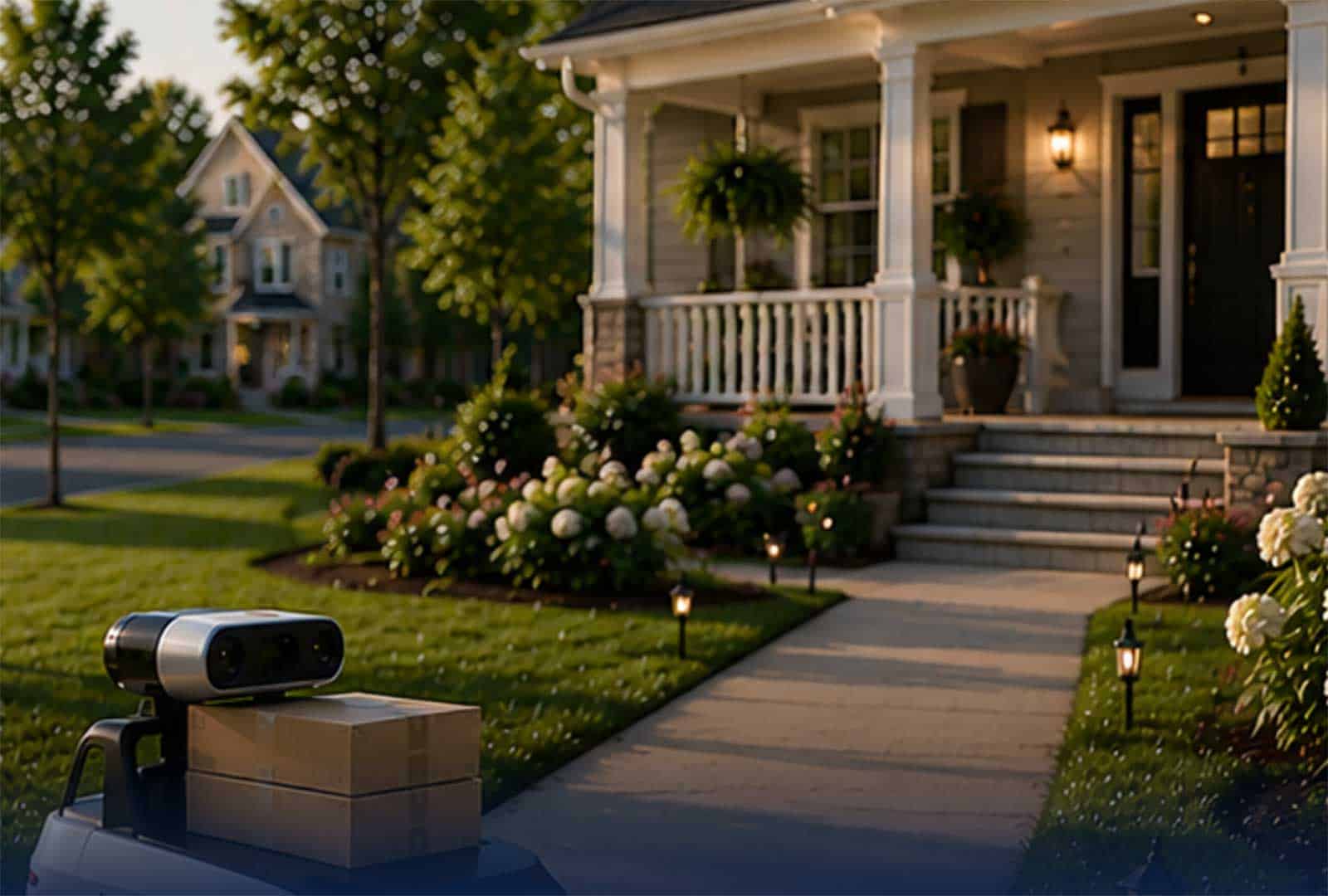
Lee Redden, co-founder of Blue River Technology (acquired by John Deere), returns to The Road to Autonomy to discuss his new venture, LastFeet, which is building a custom four-legged robot designed to handle the final 50 feet of package delivery. The robot features legs with wheeled feet, rides shotgun in delivery vans, and is trained in simulation to navigate steps, grass, sand, and uneven terrain.
Redden envisions partnering with major carriers such as UPS, FedEx, or Amazon, offering an upfront robot sale plus service contract, with a modular ‘custom top’ design that can adapt to groceries, climate-sensitive goods, and other use cases. The company currently operates a one-robot, one-van fleet in Palo Alto and is rapidly iterating toward commercial readiness.
Key The Road to Autonomy Episode Questions Answered
How does the LastFeet robot physically deliver a package?
A human loads the package through the top of the robot while it rides shotgun in the delivery van. When the robot reaches the door, it performs a deep bow and the package slides down a plane onto the steps. Redden envisions future auto-load and auto-unload mechanisms to remove the human loading step entirely.
What are the robot’s current payload capacity and battery life?
The current version handles packages up to 15 pounds, with plans to expand to 25 pounds. Battery life is approximately two hours, supported by hot-swappable batteries so the robot does not need to shut down for a battery change.
How does Last Feet plan to handle safety around children and dogs?
When the robot detects something within its safety perimeter, such as a child or dog, it immediately freezes completely and turns rigid, functioning like a table. Redden noted the team plans to develop smarter interaction behaviors over time.
The Road to Autonomy Topics & Timestamps
[0:00] Why Lee Redden Is Building Again
After selling Blue River Technology to Deere, Lee is back to build robots that go out and do useful work, starting with the delivery robot that will be the first robot many people see at their own door.
[02:41] How the LastFeet Robot Works
The robot has four legs to climb the high steps of box trucks and wheels on its feet to roll quickly and steadily to the door. It is custom built for delivery rather than an off-the-shelf robot dog.
[04:56] How to Build a Robot in 2026
3D printing, laser cut metal and motors that are easy to get running now do much of the work that hand-calculated kinematics used to, and the robot learns to walk over steps, gaps and grass through large amounts of GPU time in simulation.
[07:27] Testing in Snow and Ice
Lee expects the robot to excel on ice because it turns into a stable table if it slips, which could keep people from falling on icy walks when they go out for their packages.
[10:00] How the Robot Delivers to Every Doorstep
A human loads the package through the top, and at the door the robot takes a deep bow to slide it onto the step. It reasons on board and phones home to a human when it is unsure, and existing doorstep datasets make this much easier than agriculture was.
[12:43] Riding in the Jump Seat of a Delivery Van
On day one the robot rides in the jump seat next to the driver, so the cargo area stays fully loaded. Later, as vans become autonomous, an arm could load packages onto the robot, and LastFeet plans to partner with delivery networks rather than run its own.
[15:00] Manufacturing at Scale
The design is simple enough that parts ship in about three days today, and LastFeet will turn to a contract manufacturer once volume reaches the thousands. The first robot carries 15 pounds, which covers most packages, and a 25 pound version is planned.
[18:46] Building for Rugged Delivery Vans
Lee applies the Blue River approach, where you should be able to hit the robot with a hammer. It is built to handle shock, vibration, rain, sand and a hose down, and it runs on an NVIDIA Orin AGX, which he expects to be enough for the first thousand units.
[22:54] LastFeet Business Model
LastFeet plans an upfront sale of the robot plus a yearly service contract. The core platform stays the same for every customer, and custom tops, such as a climate-controlled one for grocery delivery, keep it from becoming a bespoke business.
[29:32] Battery Life and Charging in the Van
Two hot-swappable batteries give the robot about two hours of runtime, and it stays in the van overnight to charge, possibly on a charging pad built into the van floor.
[32:11] What Lee Learned Shadowing 50 Delivery Drivers
Lee ran time studies with drivers he calls sleeper super athletes. The robot’s role is modeled on the runner, the second person carriers send out on busy routes to take packages to the door while the driver keeps driving.
[37:28] Safety and Building Trust With the Public
When a child or dog comes near, the robot freezes and becomes a table. LastFeet plans to earn public trust through friendly, respectful engagement, especially with people who are skeptical of robots.[
[40:18] The Future of LastFeet
Next up are more deliveries, delivery partners to help shape the robot’s requirements, and a robot people enjoy interacting with, all in service of moving goods from point A to point B as efficiently as possible.
[43:11] AUTNMY AI
AUTNMY AI is an applied intelligence firm whose mission is to develop a field-tested, ground-truth understanding of how the Autonomy Economy is being built and translate that understanding into the intelligence, foresight, and counsel that help the world’s leading institutional investors navigate the most consequential industrial transition of this century.
Full Episode Transcript
Why Lee Redden Is Building Again
Grayson Brulte: Lee, it’s awesome. I gotta say it’s awesome to have you back here on the Road to Autonomy. Last time you were on you were running Blue River with Jorge. You- it was acquired by Deere. You were solving that agriculture problem for the See & Spray. Job well done. I can’t go to CES and not see the product that, that you created, so job well done on that. And now you’re- said, “Okay, I wanna build again. I’m gonna build Last Feet. I’m gonna solve that last 50-foot problem.” Why did you decide to build again?
Lee Redden: Yeah, I, I took some a little bit of time off in between the two companies. and I just can’t not build. I think right now is one of the greatest times to build robots. and having spent all my life building robots, I am so excited to come in and start to build again. The tools are amazing. I think it’s what you can do as far as like. I mean, I, I– Like a, a little brief history of like why I got into entrepreneurship, it was so that I make robots that actually go out and do things useful in the world versus make robots that are cool and sit on my shelf and collect dust. And I’m just very, very excited to get back into the– throw my hat back in the ring and, and start to build again. And one of the reasons why I chose this market and this area is because I think that this is gonna be one of the first robots that show up at many people’s houses. This can be a robot that actually people go and they see, they interact with. you know, I have a young kid now, and the garbage truck is super exciting every time it comes about And I think that this can also be something like the garbage truck that comes by that people people have an attachment to, and people are building just excited to see automation and progress and, and advances coming out.
Grayson Brulte: That’s a very great point from a father’s perspective. It’s like the garbage truck is the friend, or any truck that goes by. Oh, that’s cool. This is neat, ’cause you can hear all the, all the noise, and if you had a really good party, I’m not saying who, but you know who. Clunk, clunk, clunk, clunk, clunk. You know that was a, a good night. So you get sound effects with the garbage man. So I’m, I’m curious from a robotic standpoint. You, you’re right, useful robots make a big difference, and you have a great track record of building useful robots. Walk us through the Last Feet robot. How does it work? What does it look like?
How the Last Feet Robot Works
Lee Redden: We have a– It’s a, it’s a really cool platform. it starts with four legs. and so the four legs allow it to walk up and down steps. It allow it to walk in and out of vans. we’ve done a custom geometry of these four legs so that it can walk up and down very high steps because vans, like a, a standard box truck van that comes by, has a very high step to begin with and some unique geometry that isn’t in normal steps. And it also has wheels on the ends of the feet, and what those allow it to do is just scoot along really quickly and very stably from place to place. And so it makes a, a unique platform that can just get out and scoot around. And some of the unique things about our robot is actually we’re tailoring it for this application. And so a lot of times people have bought a commercial dog robot, and they’ve taken and they’ve deployed it, and what– it doesn’t fit in the truck in a unique way. It is built just as a general purpose one. but we think because this is a game of like the operations have to happen fast, logistics have to happen fast, you have to have high uptime the robot needs to work in the scenarios that it, like, really, really needs to work in. And this allows us to actually make the custom-designed robot for that application. And this application in particular deserves a custom robot because there are you know, several hundred thousand of these robots that could be deployed throughout the US to be doing the, the last fifty feet of delivery. And so any application that has even a, a modest number much smaller than that of unique robot deployments can deserve its own custom robot to come out
Grayson Brulte: I’m gonna ask a question my daughter would ask you because it’s curiosity. We’ve been playing with the Hugging Face, the pollen robot. Clem, really great job in that. It’s a great activity to teach kids about co- coding. I am curious, my daughter would say, “Okay, Lee.” She’d say, “Mr. Redden,” because we’re proper in this house. How do you build a robot? I’m asking for my daughter ’cause she, she watches this show. So how do you build a robot?
Building Robots in 2026: Simulation and Machine Learning
Lee Redden: By the way, is a really, really cool robot that they’ve, they’ve come back out with. And the answer in 2026 has a lot of machine learning in it. and where if you would’ve asked me, you know, at the, at the beginning of the Blue River days or when I was on before, I’d, I’d have a different answer around it. But some of the coolest tools out there are 3D printing, laser cut metal taking motors, and actually being able to get the motors to, to spin is nowhere near as hard as it used to be, and then you train it to do things in sim. and so I think that platform is actually really great to get people interested and excited to take their robot and to train it in sim. And that’s what we do, is we take our robot, and we put it into sim, and we take it through a bunch of different iterations of environments that it’s in, different configurations, different lengths, different weights on it. And we teach it how to walk and how to walk up steps and how to walk when there’s gaps in areas and how to walk when it goes over grass and how to walk when something is on top and it’s moving around a little bit. And if you. But it’s, it’s a lot of it’s a lot of GPU time and a lot of sim to, to have it learn how to do these things. and it’s very funny because if you would’ve asked me, like, at the, you know, when I went to grad school, it would– I would’ve said, “You would sit down, and you would take trigonometry classes, and you would calculate the rotation angle of the joint here and how that corresponds to the joint there and go into the forward kinematics and then do the back dynamics.” But luckily, none of that is needed now. it’s, it’s a lot of modeling and a lot of simulation work.
Grayson Brulte: When you look at simulation, have you tried it in snow and icy conditions yet? ‘Cause the packages go in all weather conditions
Lee Redden: We haven’t tried it in snow and ice yet but it is one of the areas where I think this robot is gonna excel really, really nicely. just because it is you know, it if things go wrong, it turns into a table. and because it has four legs and it’s just kinda out there. and so if, if things do get a little bit slippery and stuff like that it’ll, it’ll turn flat on it. But I’m, I’m excited for actually taking it out in snow and driving it around and taking it in icy conditions ’cause I think it’s gonna be one that that just absolutely, absolutely does awesome on those
Grayson Brulte: I look at it from a benefit to society. I, I grew up in Connecticut and I can’t tell you the unfortunate news of how many friends’ grandparents or aunt and uncles slipped and fell on the ice. And unfortunately, in the Northeast it’s common, they’re going to get the mail or get a package, and your robot solves that potentially. That is a huge positive impact on society
Lee Redden: Yeah, this keeps this keeps– this helps move the package right to your door. if the, you know, the robot is. I’m guessing it’s gonna be, like, very stable through through ice, and it’s gonna be much more stable than us bipeds who having grown up in Nebraska, I do, I do know the, like, half-foot shuffle that happens when you get in in snow and ice and the, the conditions where you park your hell on the — or you park your car on the. Our high school had, like, a semi-steep hill and it was, like, one side when it was icy, you couldn’t drive up because the car would just slide back down. and the. But a, a, a robot like this you know, we, we see it actually when it goes through rock when it goes through we– Some of the conditions we do have readily available by me for testing are lots of, like, soft rock and soft sand and grass areas. And it just excels through that. It’s, like, stuff that is, you know, a little clunky for us to walk through these wheels with feet do, do really great through.
Grayson Brulte: How does it work from a package perspective? Does it go on, the package go on the robot’s back? Does it go in its belly? ‘Cause you have to feed it, ’cause robots do get hungry. H- h- how, where does the package go and how does it get in there? Does a human have to put it in there? Can the robot pick its own package? How does that work?
Package Loading and Delivery Mechanics
Lee Redden: R-right now we’re focused on just the robot for the last 50 feet. So we have a human put the package in the package goes through the top and then as the robot gets to the door, it does a deep bow and then the package comes off down a plane and then onto the steps. And one of the really nice things about designing our robot custom for this application is that we can make the unloading very graceful, and we can make the loading fit different sorts of mechanisms. And what I imagine in the future is that we have some sort of autoload mechanism for the package and this, this un- auto unload mechanism at the doors
Grayson Brulte: ‘ with Scene Spray, you built it around computer vision. Every doorstep is practically different. Different stairs, different lighting, different, different everything. How does the, the robot know how to, what stairs to go up, how, how to get there? How does that work?
Computer Vision and Remote Intervention
Lee Redden: Fortunately the models have, like, come out to be really, really great. and some people have put some open source stuff on. there’s never been a better time for, like, big data sets and, and things around this. And so I– and we actually take a similar type of approach to some of the autonomous tractor work, where on the bot, we reason as much as we can. And then if we get into a situation where we’re unsure we just phone home. and we ask the, you know, we ask a person to intervene and say yes, no on it. And so it’s one of the great things actually. but but as far as the generality what I– is actually much nicer about working on the Last Feet problem than on ag is that there– the general models work really well. There’s established data sets. Like, people have taken photos of their their front doors and their houses and neighborhoods and sidewalks and things like this, where in cotton fields that data like, didn’t exist, and it was just us going out going out to collect that data.
Grayson Brulte: From a deployment standpoint, will, will the robot ride shotgun? Will it, will it ride in the back and then will the, the driver delivery truck come and put the package on it on day one, the robot will go do the last thing while he’s just there and, and has a much needed break? Or how do, how does that, how do you envision that from on day one?
Lee Redden: So on day one we’re designing the robot to sit shotgun, to sit jumper seat inside of the big delivery vans. and so there’s a spot where you normally have the driver’s seat, and then there’s a little seat very similar to tractors that folds down and the steps that go down, and they have the door. And so it sits actually in that space just to their right and takes up some of the stair space. and that allows them to have the full back fully loaded, no change to the packages in there. and they’re going to the back, grabbing a package, loading it, and then the robot is doing is doing that delivery
Grayson Brulte: And then that’s today. Tomorrow, when the del- the delivery trucks are autonomous, will there be a h- do you envision a, the delivery company have a humanoid that will put it on your bot or some sort of robotic arm putting it on your bot? How do you imagine that going in the future as things become more autonomous?
Lee Redden: I imagined one where it’s some sort of arm that comes in some sort of arm or specially designed mechanism that, that is taking packages from the back shuttling them onto the robot and then the robot’s going out and scurrying out and doing its delivery and then coming back to the van
Grayson Brulte: Then is the, is the business model where basically you’re just gonna do, develop the robot and then you’re going to deploy it with a, a UPS, a FedEx, a Coke Industries, or do you plan to vertically integrate this delivery service?
Lee Redden: We’re still figuring that out but I would like to partner with folks. I would like to. You know, we’re, we’re, we’re still developing the tech and when we get it to the point, I’d, I’d like to partner with someone and see if we can, we can do that last 50 feet of delivery or be part of their autonomy network to deliver autonomously
Grayson Brulte: When you get to that level, let’s just say you close, you partner with an Amazon and those trucks are UPS or FedEx, they’re in neighborhoods all around the country every day. How, what’s the manufacturing plan? How are you going to manufacture your robot at scale? Are you gonna partner with a Magna? Are you gonna build in-house manufacturing? What’s the scale plan?
Lee Redden: We’ll probably find a good contract manufacturer for lots of the parts. the I, I’ve, I’ve gone the route of making the designs extremely simple right now. and so we can get we can get a company to drop ship us parts in about three days right now. And so when we’re iterating, it goes, it goes really quickly. But I think as we kind of perfect the design of the robot and we get to scales that are in the thousands we’ll have to find a good partner to to take on at least it– I think at, at that scale, it makes sense to have a partner that helps us with parts of the assemblies. I think too, we’ll, we’ll maybe have to take on some of the specialized components ourself. But we’ll cross that bridge when we get there. this is like stuff around motors and other things like that that get you a you know, if you get the right design of it, it gets you a, a 30% boost in robot performance. And so we’re, we’re evaluating if, if it’ll make sense to in-house. But at low quantities, it, it doesn’t make sense to in-house it yet
Grayson Brulte: The beauty of this is that you have the background as a roboticist, and you’re talking as a roboticist, you’re not talking as a pie in the sky. And so I give you a, a, a lot of credit on that. And as a roboticist, weight becomes an issue for these robots. Do you have a weight limit on where you’re looking your robot to, to max, max out at?
Lee Redden: Our first one does 15 pounds, and we’re looking to expand that at some point to 25 pounds. but we’re planning on taking the 15-pound one because the vast majority of the packages fit within the under 15-pound limit and and start to do a lot of deliveries with it
Grayson Brulte: You’re early. The company’s young. Will you purchase, say, a fleet of six delivery vans just to try it, to, to learn what’s working, what’s not working in those early days as you, you revamp the robot to get it ready, we wanna call it commercial grade?
Early Operations: One Robot, One Van Fleet in Palo Alto
Lee Redden: Yes. Yeah, exactly. That we’ll have a, a small fleet and this allows us– This is one of my favorite things of being a roboticist and being an entrepreneur is like, is to actually bridge these two worlds where we are out there in the world having it do operations, figuring out where it’s breaking, what’s working, what’s not working and letting that be the gauge for where we should go next. And so we have a one robot, one van fleet right now and we take it around Palo Alto sometimes and deliver things. And we are in the progress of, you know, upgrading the robot pretty substantially over the next month. but we do have a robot right now that goes out and does deliveries that we– that, that works out really well for it, so
Grayson Brulte: So you’re, you’re rapid prototyping, but when you get to commercial scale, there’s a common denominator no matter who you partner with, from the Amazon to the UPS to FedEx. Those vans, or they get brown vans, they get abused. There’s stuff thrown in, thrown out. They’re, they’re not exactly in the greatest shape, and they vibrate a lot. How do you build the robot for that rugged environment? You have a rugged background, but how do you build the robots to handle this rugged environment of boxes, sorry guys, being thrown around?
Lee Redden: Yeah. I think, I think this is where some of the learnings from the, the rugged background before come in. and we actually used some of those learnings in our current design. So if like you should be able to take a hammer and just go around and hit the robot and it should withstand it. And this isn’t like a robot abuse thing. This is just like materials properties perspective. This is a like are things enclosed properly perspective. Are things actually like, you know, is, is it gonna be able to be like tossed in and out several times and have a bump into it or, you know, something like that, ’cause that stuff happens all the time. And so that was one of the tests that we had for the Blue River robots is like could we go around– I guess in that case it was a wrench. could we go around with a wrench and like hit different parts of the robot? Like would it withstand that? there’s also a bunch of just standard kinda shock vibe liquid and moisture sorts of like you want it to withstand rain, you want it to withstand a certain amount of sand and dirt and shock and vibe. And so just bringing some of those characteristics before from the agricultural robotics to this robot. and a lot of it is actually the, you know, the. For this robot in particular there’s a couple kinda key areas where you need to do that with and then many of the things are easy. So the sensors and the compute you have to get right ’cause you still have to cool them. And the legs are just pr- kind of a, a pretty easy one to, to make robust.
Grayson Brulte: Before we get into the sensors and the compute, there is one test that’s going to happen at some point, probably multiple times, and I’ve seen it for drones. You’re gonna get somebody that’s gonna take out their hose and squirt the you know what out of the robot. Have you tested for the, for the, for the hose yet?
Lee Redden: We’ll, we’ll, we’ll make it robust to the hose for sure. yeah, we’ll, we’ll make it it– Also from just a, like a, a easy livability cleaning perspective that you can take this robot and do a, do a light hose off to, to get it clean. the. And and we’ll, we’ll design in our next iterations able to, able to be hosed off
Grayson Brulte: What type of onboard compute and what is the battery life that you’re projecting of, of the robots when you get to commercial scale?
Lee Redden: So right now we have the the Orin AGX on board. and I think when we– that’s a good compute platform for us up to the thousand units. and then if we if and when we scale past that we’ll look to is that the appropriate size computer? Can we have enough engineers on board to try to downsize to a slightly smaller computer? And yeah, we’re, we’re happy with but we’re really happy with that compute right now.
Grayson Brulte: You have the compu- you’ve got the hose, you got the rock, you’re going to solve the snow. How is it going to work from a business model perspective? Is the plan to lease it to a fleet, the robot, sell it to the fleet, get a per delivery fee? How do you envision the business model evolving when you eventually commercialize Last Feet?
Business Model: Upfront Sale Plus Service Contract
Lee Redden: I think we’d, we’d do an upfront sale of the robot, and then there’s some service contract that comes in yearly on it. and there’s maybe something we do special in addition to that around kind of like global ops of the fleet for a certain company. and so if they have a special demand or a special type of scenario that it, that they’re wanting to deliver because a lot of delivery networks have their own. You know, it’s like each, each one may be delivering and because they’re in the ops business, it’s like the, the, the details of how fast operations happen really matter. And so, you know, if if they’re delivering a certain type of, type of package over and over and over again and their fleet’s big enough, it makes sense to make, make custom things for that
Grayson Brulte: Custom things are smart, but then the only question is if you go too much into customization, you become a bespoke business. We’ve seen it, UBTech doing the humanoids in China. Margins are pushing 90%. They’re, they’re all bespoke, but they’re limited to how much they can scale. So how do you, do you balance the need to build bespoke versus the need to be able to continue to scale and build the business?
Lee Redden: It’s a really good point on. And so I, I see actually there’s this, like, core tech backbone and these are the parts that you don’t wanna change. and you know, to– kind of a throwback to tractors it’s like the tractor is very, very similar throughout. Like, you can get different sized tires, you can get a couple different sized things to it. And then you get to the toolbar, and on the toolbar is where you get just a, a whole different assortment of types of implements, some homegrown, some very professional on there, some designed by the farmers themself. and but I, I think this, this application you know, when dealing– when, when working with fleets, you’re working with like hopefully 1,000 or 10,000 type of units and it makes sense to, to do a little bit of customization, not on the core tech part that you’d wanna have be kind of broadly applicable across all the, the whole fleet but on the, kind of the, the holding or the unloading or the the, for them, the Working part of the robot.
Grayson Brulte: So basically you have what’s called the, the base foundation and Lee, I’m sorry, I gotta do this. So let’s just say you build a custom top for UPS and then you build a custom top for FedEx, then you build a custom top for Amazon. Is that, is that, I know it’s very simple, but is that how we should think about it?
Lee Redden: I think that’s how we should think about it. Yeah. And it’s like maybe it’s actually m- m- the c- top between those three are very similar but maybe there’s a custom top for doing, a grocery delivery for example. ‘Cause like groceries are unique enough compared to box packages. and maybe there’s a custom top for a, you know, a different type of a person who’s maybe, kind of categorically a different top to it. and, and maybe it’s actually it actually has to do with the, the kind of like the vans that they’re using, or it has to do with something else in their operation that, that requires it, not so much the delivery itself. And so this is something where, I don’t know, they’ve chosen to use a slightly larger box, or they’ve chosen to specialize in a, in a package that’s like a little bit different than, than other companies
Grayson Brulte: It’s fascinating that you brought up grocery. I’m starting to see data emerging in conversations with, with retailers and QSRs and grocers. I’m having these conversations, and there is a growing trend across, let’s just use retail as a blanket term. They’re sick and tired of all the fees for delivery, and w- we’re getting inbounds and we’re getting inquiries, “Okay, how do we bring this in-house? How do we bring this in-house?” So hypothetically, you have a grocer that’s bringing their grocery deliveries in-house, and then you put your robot on there. Can, can you build a climate-controlled top for that grocer that. or for all grocers in general? Because in hot environments, you don’t want that ice cream melted. Even though it’s that last foot, it still makes a difference depending on where you are. Let’s just use an example. Phoenix in August, that last 50 feet can melt your ice cream. Okay, do, do you envision something like that potentially if grocery does become a big category for you?
Lee Redden: I think we could do a custom top. or we, we, yeah, could and would do a d- custom top for for things. we have to make sure it kinda like fits with the application ’cause we, we don’t wanna drop the ice cream off and then leave, and then we’re, we’ve kinda it, it melts in place. but the we can do a custom top on top where it’s, you know, it helps helps keep it, keep it fresher. You know, I, I think that, that there, there’s gonna be applications that come out that I, like, I haven’t even quite imagined. and it’s, you know, somebody’s gonna call up about, yeah, like a ice cream style delivery business and that I, you know, I just hadn’t even imagined that that was a big thing, and they’re gonna tell me that they’re, they’re, you know, doing 10,000 deliveries in some short amount of time. And I’m like, “Wow, that’s, that’s first of a- of all amazing.” and then yeah, let, let’s see if, let’s see if this could work for that.
Grayson Brulte: There’s a lot of use cases. So let’s go through a scenario. So the robots have been out there. Let’s just say you have a, a fleet of 100 deployed on 100 different vehicles. They’re out in the field. At the end of the shift, the, the trucks come back. Do your robots autonomously walk off the vehicle into a charging bay, or how do you envision that? Or does the driver pick them up? How do you, how is that gonna work?
Lee Redden: I imagine right now that. So I– you asked a question before of kind of battery life. I didn’t– I, I, I missed it and didn’t answer it. And so we have a-about a two-hour battery life right now and we have hot-swappable batteries which means that you can have two batteries in there, and you can pull one out put a fresh one in, pull the other one out, put a fresh one in, and then you’re at two fresh batteries, and the robot hasn’t had to shut down. And that gets us about two hours right now. we’ll start operations and decide kinda– It’s really easy to scale that number up and lose a little weight payload and scale that number down and and gain a little bit of weight payload. and but I imagine the robot actually just stays in the truck at night, and you’re charging batteries in the truck or the, the robot’s sitting on a charger and charging through the floor.
Grayson Brulte: So I know I’m gonna oversimplify this, but I see them all the time now, the autonomous mowers, and when it needs to get a charge, it just do, do, do, autonomously goes back onto its charging pad. Obviously you’re running shotgun, but hypothetically, could you put a charging pad there in the future to avoid the need for the human to have to move it?
Lee Redden: Exactly. Yeah. Yeah. Yeah, we can put a, a little charging pad. we could modify the van just slightly and add a little charging pad to it to get it to charge in place
Grayson Brulte: Well, you think about that. If you have wireless inductive charging inside there for your robot, let’s say it’s, it’s an, it’s an electric van at the end of a shift it’s plugged in, it’s charging your robot, that is massive, massive efficiency. With that efficiency in mind, and if I’m a delivery company, I say, “Okay, Lee, super cool. You’re solving the problem. My drivers don’t like to get out in the heat, the rain, the cold. This is great, but you know where I’m going. What’s the ROI that I should expect? Okay, if I’m gonna invest in this, when am I gonna see an ROI?”
Lee Redden: Yeah, we, we we are still figuring out kind of like all the numbers of, of how much to charge and how much value we’re creating with with the end customers here. And so we’re, we’re still working on kinda all the, all the ROI back calculations for that
Grayson Brulte: As you’re building and gathering feedback, have you spoken to drivers that drive for a living to get their feedback on how this could be useful or, or, or what to change or what they see in the day-to-day?
Learning from 50 Delivery Driver Interviews
Lee Redden: Yeah, we, we at the very beginning of the company, I, I spoke with around 50 drivers to hear how their operations worked, what they did on a day-to-day. and I, I’d say the first thing to know about these drivers is they are super athletes. Like, I have shadowed these, these these guys and girls that they are like they are like sleeper super athletes, where you’re like– You look and you’re like, “I– They don’t look like they’re in great shape.” You watch them move and wow, they are jumping over things. They are picking stuff up. They’re– have, like, really, really good flow. and and so much kudos much kudos to them. and they. But in their operations they. I, I figured out kinda the, the industrial engineering time studies of how much time do they spend driving? How much time do they spend finding a package? How much time do they spend delivering the package? Which routes are the hardest? which packages are the hardest? which you know, what’s the full day cycle look like? Like, when do they show up at the depot? when do they go home at the end of the night? How’s that changed seasonally? because we’re coming up on a time of year where people get a lot more packages than another time of year. So the the. Yeah, but it– But I, I learned a lot from, from these drivers about their actual logistics. and many of the companies actually if a driver is running late meaning that they’ve maybe loaded them up with too many packages that they’re not able to finish their shift, is that they’ll employ what they call a, a runner. And the runner sits in the side seat while the driver goes from stop to stop, and it’s the runner’s job to take the package, run to the door, deliver it, and then hop back in the seat. And some of the drivers, this was actually a, a piece of inspiration from them on how they do the logistics, is that they would get– Because now the driver was only focusing on, “How do I drive to the next house?” Loading the map up in their brain of how to do that and not having to exert themself to to go to the house and back and all the mental load of that. they were– That’s how they speed up the shifts when people are running late.
Grayson Brulte: And right turns only.
Lee Redden: Right. Turns out like, yeah.
Grayson Brulte: I gotta give a shout to my friend Lee White. He’s now deputy administrator of NHTSA, proud of that, UPS, fantastic guy. And, and Lee, I know you listen every week. Thanks for all those wonderful chats over bourbon of how UPS operated a business. And I gotta tell you, Lee, you both, Lee, is the funniest thing about Lee White now is he would tell me these stories around Christmastime and the holidays where the package had to get there. And so I said, “Well, you had to go play Santa Claus.” He goes, “Yep, packages had to get there. Brown’s gonna deliver.” And they always delivered. P- prior to shadowing drivers, ’cause you learned a lot from that, what did you see in the market where you’re like, “Aha, there’s something here”?
Lee Redden: Part of it is the technology of this form factor is new, and its legs are really capable in a quadruped format right now if you train the right policies and, and you have it learn how to how to have it walk. and so one of it was, like, from that side the, you know, the, there– I’m, I’m actually s- very surprised actually that there’s not more legged quadrupeds out there in the world. And but I, I really came from this from the side of, like, I’m excited for these sorts of robots to be the ones that are going to people’s doors for the, the garbage truck effect. I get e-excited about that that part where it’s like this will, this will you know, this will– there will be emotional attachment between people and robots. And so many families won’t be able to actually afford a robot or have a robot in their house and things like that for, for a very long time. and this will be the robot that actually shows up at their house and that they actually have a like that first connection point with
Grayson Brulte: Robots bring joy, and if you have a little kid and they go up to the, to the, the glass of the door to see how cool this thing is. Now, what happens if a child, gosh forbid, ’cause it could happen, opens the door and goes running out the robot? How does the robot. How are you program it to, to, to handle that, that environment that with a child or a dog and is, is massively, massively unpredictable?
Lee Redden: Yeah. R-right now we just turn into a table. so we go from a robot that moves, and then we have a, a safety perimeter and we just completely freeze and don’t, yeah, don’t move at all. over time, we’ll, we’ll find kind of like maybe smarter ways to, to beep and boop our way around and and interact with with kids and dogs and people. But right now our, our safety approach is just just turn in, turn in turn stiff
Grayson Brulte: I like that. oh, it’s the Disney Pixar movie Up when the, when the old man goes, “Play dead,” and the, and the dog goes on its back and the, and, and its paws go and it play, and it played dead. So I like that. You got a little Pixar a- animation there. Now if you can just animate that little light when it opens up, then you’ve got the whole complete package. ‘Cause pl- playing dead for your robot is a great way to build trust with a parent, ’cause the parent doesn’t have to w- worry about it ha- something bad happening. On that line of thinking, what’s the plan to, to build trust with the general public? Because if a robot comes up to a certain individual’s door, you can insert all your favorite four-letter words in there, you get an interesting experiment. You come up to my door, your door, oh, this is the coolest thing in the world. So there’s gonna be different experiences on both sides. How do you build trust with the public?
Building Public Trust and the Future of Last Feet
Lee Redden: I think we’re gonna have to kinda continuously engage with the public and we’re gonna have to do it in a way that’s, that’s really friendly towards the people and also really respectful towards the people. And I think it’s, it’s one where this is a new paradigm coming out and and it is coming up to their door. And so the– both the side that I’m really excited about of this being the, the first robot that actually comes up to people’s doors I understand that there could be different reactions to it. and and we’ll, we’ll have to, yeah, w-work work, work to win the, the trust of the people who are skeptical of it and, and try to understand more why the why the four-letter words come out their mouth when, when the robot comes.
Grayson Brulte: You’ll overcome that. There’s a path there, and society has shown us that you can overcome the trust issues with robotics, and they’re gonna realize, okay, this is a be- this is a better alternative, alternative because it’s gonna save me money. At the end of the day, it, it all comes down to dollars and cents, where based on with the PPI being so high and inflation picking up again, if you’re able to tell a citizen, “We can save you 15% on your package ’cause it was, the last 50 feet was a robot,” that’s a game changer. All suddenly the public sentiment i- i- is going in, in your favor. And at your core, Lee, you are a roboticist. You built one company that’s changing agriculture. Now you’re building a new company to change the last 50 feet. Putting this entire conversation together, until I come see your robot in a few weeks, what is the future of Last Feet?
Lee Redden: The future of Last Feet is we’ve put together an amazing team to build this robot and we start to do more and more deliveries with it and really get the tech down. and we look for great partners partners who know the delivery space, who can really help shape and hone the the requirements that we will like strive to meet for a really robust robot that will do these operations. And we’ll continuously work with work with the public on making the robot cute and good to interact with and taking a lot of cues from from other robots out there that, that we’ve seen and people who have helped help shape those to, to have it so that the people like to interact with it, or people, people are accepting of it and hopefully, hopefully like to interact with it coming to their doors. And and it also helps it helps run a big basic piece of the economy which is how do you move goods from point A to point B and do that as efficiently as possible? ’cause that’s just a, a backbone thing that helps everything else everything else work in the economy.
Grayson Brulte: Automation is going to drive this and the economy is going to merge into the autonomy economy, and that’s why we, we built this company and that’s what we preach. And if you’re a owner-operator of a fleet, call Lee. If you know me personally, call me and I will connect you with Lee. The track record speaks for itself. Lee is going to solve the last 50-foot problem that has not been solved by giant corporations because they weren’t roboticists. You have a roboticist leading Last Feet. Reach out to me, reach out to Lee. You won’t be disappointed. The future is bright, the future is autonomous, the future is Last Feet. Lee, thanks so much for coming on “The Road to Autonomy,” and I can’t wait to see your robot in a few weeks
Lee Redden: Excellent. Thank you so much. Thank you so much for having me
AUTNMY AI: Billions and soon trillions in value will be created in the autonomy economy. By the time a trend becomes consensus, the alpha is already gone. The gap between uncovering signals and reading headlines is widening fast. When it’s a headline, it’s no longer a signal. Enter AUTNMY AI. We decode signals before they move markets, giving you conviction in the autonomy economy. AUTNMY AI, your models, our intelligence. Visit AUTNMY.ai.
Discalmer: Opinions here are as of the recording date, may change without notice, and do not necessarily reflect the views of AUTNMY AI Incorporated, its affiliates, or any speaker’s employer. Content, including the road to autonomy indices, is for informational and educational purposes only. AUTNMY AI is not a registered investment advisor or broker-dealer and does not give investment, legal, accounting, or tax advice. Nothing in our public or gated content is investment advice, a recommendation, an offer, or a solicitation to buy or sell any security or financial product and should not be relied on to evaluate any transaction. This program may contain forward-looking statements. Investments involve risk, including loss of principal. Past performance is not indicative of future results. Hosts, guests, and affiliated entities may hold long or short positions in securities mentioned. Content is provided as is without warranty. We disclaim liability for reliance on this information. Consult your own investment, legal, and tax advisors before making any financial decision.
The future is bright. The future is autonomous. The future is The Road to Autonomy.
Subscribe to This Week in The Autonomy Economy™
Join institutional investors and industry leaders who read This Week in The Autonomy Economy every Sunday. Each edition delivers exclusive insight and commentary on the autonomy economy, helping you stay ahead of what's next.