


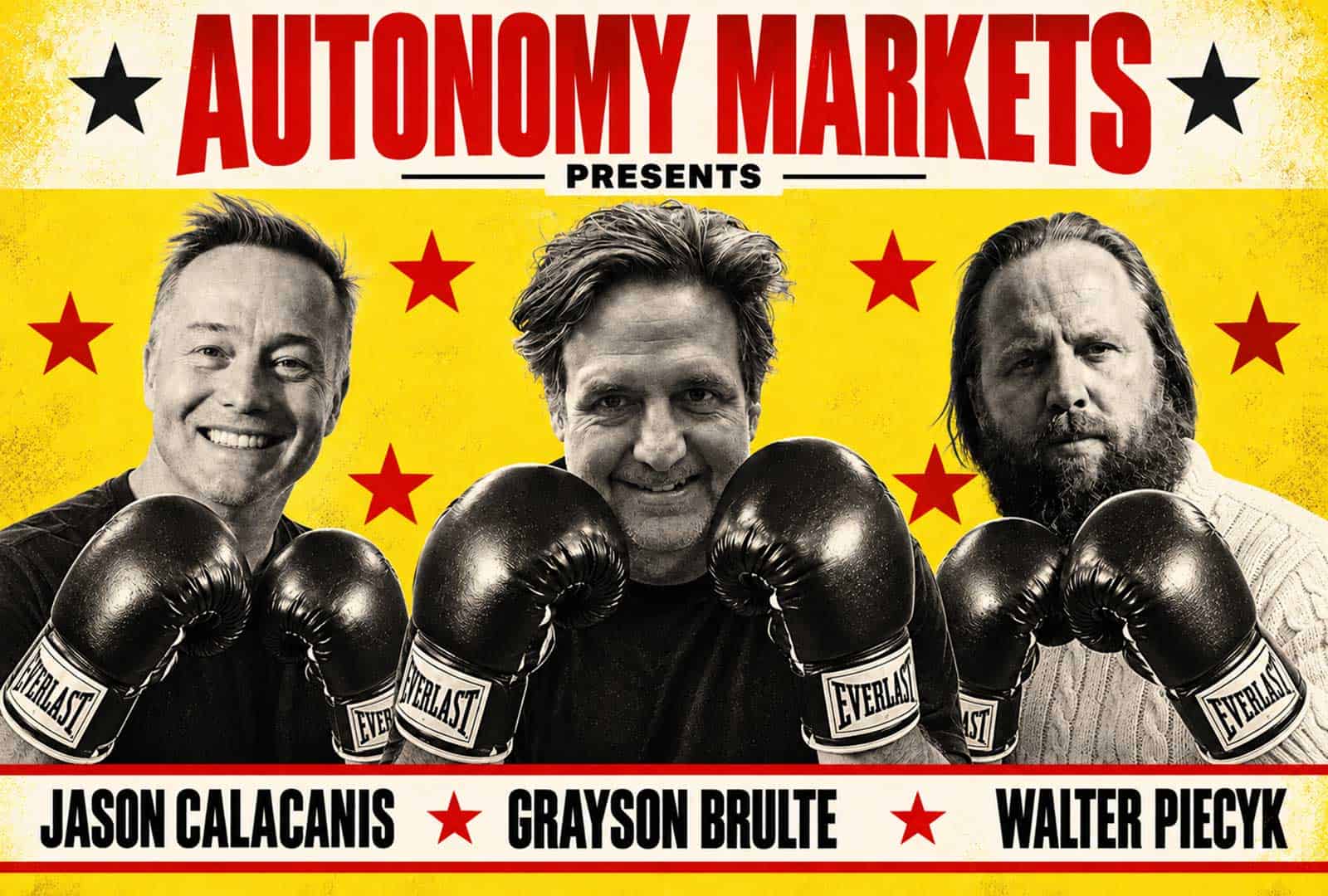
Jason Calacanis on the Robotaxi Endgame
Jason Calacanis, an early Uber investor, shares his bull case that global rideshare miles will grow from roughly 2% to 30% over the next decade, with Tesla taking the gold medal, Uber silver at ~35% market share, and Waymo bronze at ~15%.
He argues the rollout will be far slower than promoters claim, constrained by city-by-city regulatory battles, job displacement politics, and the near-impossibility of building the 100 million AVs needed to serve peak demand. Calacanis predicts massive M&A consolidation, including Waymo buying a car manufacturer post-IPO and Uber converting its 20-plus AV partnerships into acquisitions while warning that a single high-profile accident or wave of visible job losses could reset the entire narrative.
Key Autonomy Markets Episode Questions Answered
What market share split does Jason Calacanis predict among Tesla, Uber, and Waymo in autonomous rideshare?
Jason predicts Tesla wins the gold medal with the largest share due to factory scale, Uber takes roughly 35% by leveraging its existing network and 20-plus autonomous vehicle partnerships, and Waymo finishes third at roughly 15%. He frames Waymo’s long-term position as uncertain and partly dependent on whether it reunites with Uber.
Why does Jason believe robotaxi deployment will be much slower than bulls predict?
Jason argues that AV deployment will be two to three times harder than Uber’s original city-by-city rollout because of stricter safety scrutiny, protectionist regulatory capture, the near-impossibility of building the roughly 100 million AVs needed globally, and the political backlash that will accompany visible driver job losses heading into the 2028 election cycle.
What does Jason think Waymo must do to compete at scale, and when does he expect its IPO?
Jason believes Waymo must acquire a car manufacturer—citing Rivian or Lucid as candidates—because it currently has no owned factory and cannot produce AVs at the hundreds of thousands per year needed to be competitive. He expects Waymo to go public sometime in the second, third, or fourth quarter of 2028, by which point it should have over a billion dollars in revenue and roughly 50,000 cars on the road.
Autonomy Markets Topics & Timestamps
[00:00] Jason Calacanis joins Autonomy Markets
Jason has five Teslas on his ranch outside Austin and drives FSD on Hardware 4 90 percent of the time. He puts the system at 98 to 99 percent of the way to Level 4, up from 90 percent a year ago.
[02:19] Cybercab Fleets
Jason wants to buy 20 Cybercabs for the countryside and outer suburbs, the areas Tesla and Waymo will not prioritize while they chase city infill. He puts fleet sales to operators a year or two out because of regulators, depots and Tesla’s safety bar.
[04:04] Tesla’s obsession with Safety
Incidents Waymo has absorbed would be showstoppers under Tesla, and Tesla holds itself to a different standard. Jason warns that stock promoters posting five videos a day are painting a picture the mundane truth does not support.
[07:27] Everywhere-All-at-Once Fallacy
Uber’s expansion was hand-to-hand combat city by city, and autonomous vehicles will be two to three times harder because of safety fears and job protectionism. Society will not accept twice as safe as a human, and one incident on camera puts an operator in the penalty box for years.
[09:33] Uber Shutting Down ATG Was a Mistake
Uber made two critical mistakes, ousting Travis Kalanick and selling ATG. Jason recounts the CNBC fight over Uber losing $2 a ride and the shift from Buffett’s voting mechanism to the weighing mechanism once free cash flow arrived.
[12:51] The Gap Between Engineers and the Market
Grayson sees a disconnect between what engineers know and what the market prices, with everything about autonomy changing in three to four years. Walt argues story stocks trade on terminal value, so the year it arrives matters less than who owns the market when it does.
[16:37] Jason Calacanis on Why Waymo has to Buy a Car Company
Waymo does not own a factory, and contract manufacturing will not get it to 500,000 purpose-built vehicles a year. Jason predicts Waymo spins out of Google, IPOs and buys Rivian or Lucid now that M&A is back on the menu.
[18:15] Uber’s Surge Pricing Strategy
Surge pricing existed to solve peak demand, and idle autonomous vehicles are extremely expensive. Utilization becomes the critical question at scale, which is why Uber owns stakes in 20 players and will eventually buy some of them.
[19:16] Jason Calacanis’ 40/35/15 Robotaxi Prediction
Tesla wins gold on manufacturing, Uber takes 35 percent and Waymo 15 percent. Taking rideshare from 2 percent to 30 percent of global miles requires more than 100 million autonomous vehicles and a $5 trillion fleet build-out larger than the AI data center build-out, and Jason predicts Lucid and Rivian pivot to robotaxis only.
[25:58] Are Any of Uber’s Partners Technically Close to Tesla or Waymo?
Grayson says no within 24 months, and Walt calls 300 Nuro-powered Lucid Gravity vehicles by June a win against Waymo’s 10,000. Jason counters that no one can afford the $100 to $300 per customer needed to build another Uber-scale network.
[30:23] Uber Eats is Half of Uber’s business
Rideshare is now smaller than Uber Eats, so even 35 percent of the AV market is accretive to half the business. Walt notes that the path from 2 percent to 30 percent depends on autonomy driving down cost, which has not started yet.
[32:18] 100 Unsupervised Robotaxi Benchmark
Jason adopts the show’s 100 unsupervised vehicle benchmark and expects Uber to hit it with Nuro and Lucid Gravity in an Uber Black tier service across Los Angeles, San Francisco, Dallas and Houston. He calls predictions of 10,000 Cybercabs by year end and a million next year impossible under current regulation.
[33:37] Robotaxis in China
Jason argues China is slowing autonomous vehicle licensing to protect jobs and harmony. Walt pushes back with Apollo Go at 300,000 driverless rides a week across 20 cities and new licenses being issued.
[35:31] Regulatory Capture Debate Begins
Jason predicts Boston, New York, New Jersey and DC could ban autonomous vehicles outright and politicians will use robotaxis as job-protection virtue signaling through 2028. Grayson argues federal preemption is coming, citing Florida, Texas, Arizona and the USDOT framework.
[41:31] Steak Dinner Bet
Jason bets local communities win the fight, Grayson bets the federal government does. Drivers will be the first mass unemployment from AI, and Jason argues capping job loss at 10 to 20 percent a year is a reasonable negotiation, while Grayson points to depot jobs and the ATM teller precedent.
[49:02] Personally Owned Autonomous Vehicles Impact on Shared Rides
A $40,000 autonomous vehicle in the garage at $300 to $400 a month threatens the 30 percent rideshare bull case. Jason believes autonomous vehicle software is commoditized within 24 months with 10 to 20 providers and NVIDIA giving away the world model.
[52:27] Waymo and Toyota Moment to Watch in Q1 2027
Grayson expects concrete details on the Waymo and Toyota relationship by Q1 and a dedicated Japanese line as the accelerant. Walt and Jason are skeptical after three years of intent to have a conversation.
[55:30] Puke in Uber, Get a Bonus
Uber’s $150 cleaning fee was meant to retain drivers. Some drivers responded by hunting 3 AM bar pickups with cleaning supplies in the trunk.
[56:28] Travis Kalanick, CloudKitchens and Atoms
Jason discloses his stakes in Uber, CloudKitchens and Atoms and believes autonomy is Atoms’ third pillar. Dara’s $10 million stock purchase is the largest ever, and Jason has been advocating for the return of the king.
[58:08] What Travis Kalanick Would do Differently
Dara calmed the regulatory environment and delivered profitability the way Tim Cook stewarded Apple. Travis would push far more aggressively into autonomous vehicles, and Jason lays out his partnership to purchase theory.
[59:09] PIF, Lucid, Nuro and a Full-Stack Uber with-in 36 months
PIF backs Lucid and backed the SoftBank Uber deal, and Nuro is a pittance against $11 to $12 billion in free cash flow. Jason predicts a full-stack Uber producing hundreds of thousands of cars a year, and Grayson adds Wayve as an acquisition target for an ATG 2.0.
[1:06:16] Atoms Robotaxi Depot Play
CloudKitchens owns its buildings, and those buildings have parking lots. Jason predicts Uber hands the depot business to Travis, Grayson maps Uber’s leased depots in Houston, Irving and London, and Jason and Walt disclose investments in Autolane’s big-box parking lot play.
[1:12:32] If and When Waymo Goes Public
Waymo could float at $100 to $150 billion in today’s market on a few hundred million in revenue. Jason puts the IPO in 2028 once Waymo passes a billion in revenue and 50,000 cars, and calls the current $130 billion valuation massively overpriced.
[1:17:36] Why Japan Needs Autonomy
Germany, the US, Korea and Japan are the last protectionist auto markets. Grayson predicts no autonomous vehicle company scales in Japan without an automaker, with Wayve driver-out in Tokyo in the second half of next year, and Jason points to population decline and a forklift driver shortage as the demand signal.
[1:20:46] The Next 12 Months
Jason calls Uber at 2.5 times sales and Tesla at 12 times sales generational buys, with Uber a $150 stock next year. He would buy Waymo at $50 to $100 billion and hold for a decade.
[1:22:20] The Next Tesla Robotaxi Format
The only thing that matters is safety, and one fatality or one wave of job loss changes the narrative. Jason predicts a larger Tesla robotaxi format within 18 months for airport and family rides and calls a Cybertruck-line SUV a no-brainer.
[1:27:42] Autonomous Regional Travel
Four seats facing each other at $2 a mile against Cybercab at $1 a mile threatens regional airlines. Jason praises Blacklane, now owned by Uber, and Walt already skips the flight to Boston.
[1:29:47] Amazon, Google or Tesla should Buy Uber
Any of the three paired with the Uber network is the clear gold medal winner. Jason argues the Trump administration would not block it and the Lina Khan era cost venture four years of singles and doubles.
[1:31:39] Consolidation, First Dominos, Zipline, Wayve and Nuro
The first domino is Uber pulling the trigger, and nobody wants Lyft. Jason sees Zipline ending up inside Uber, and Grayson puts Wayve and Nuro on the block.
[1:34:52] Framing the Bet
The steak dinner is a $350 Westholme cut. If Grayson wins, Jason wears an inspector hat, and if Jason wins, Grayson wears an Uber hat with clappies on it.
Full Episode Transcript
Jason Calacanis on the Robotaxi Endgame
Grayson Brulte: Walt, I gotta start the show with a clappy hat today, which is not Normal. Today we have the world’s greatest moderator, Jason Calacanis, on the show. So Jason, for joining us, clappy hat. We’re looking forward to getting into your bullish Case on Uber. But before we get to Uber, let’s start with Cybercab. You live in Austin. Have you even taken a ride Yet?
Jason Calacanis: I, I’ve seen them, been around them, but not since the live launch. I live out on a ranch outside of Austin. but I drive every day on self-driving. There are five Teslas here at the ranch. Number 16 of the Roadster, 16th ever one built in the Signature 100, and then I have Signature 00001, the first Model S ever built and sold to the public. And I have those two classic cars in the garage. And then we have two Model Ys and one of the final foundation series of the Model X. So I am all in on Teslas and self-driving.
Walter Piecyk: And when you hop in that Model Y, are you ever driving yourself or are you using FSD the entire time?
Jason Calacanis: On the Hardware 3 version I– would never use it for anything like more than staying in the lane kind of functionality on the 290 here or something. But for the Model– the Hardware 4, I use it probably 90% of the time, and then the 10% I don’t is unprotected lefts, parking, you know, all those kind of edge cases. and I’d say if I were to estimate how close it is to being level four, like you could take a nap in it, 98, 99%. And that’s my personal lived experience. And I would say a year ago it was like 90%. So I think they went from like 90% this time last year to maybe 98.x now, and I’m not sure, and I, I don’t have any inside information. Sometimes people conflate my relationship with Elon. We’ve been friends for forever, 30 years. they, they sometimes conflate that with me having some inside knowledge. I don’t actually know the difference between the robotaxi version and what consumers have, but I’m always in the beta for the latest version on my personal Model Y. That’s my daily driver.
Grayson Brulte: Okay, great. So on X you posted that you wanna get a Cybercab Fleet. I do as well. How do you wanna deploy that?
Jason Calacanis: Well, I, I think there’s an interesting play there. Elon is, a– In, in– Also in addition to being a master of factories and at building products from those factories, is really his skill set is that factory, the dreadnought. he’s also very good at business models and where the puck will eventually go. And the suburbs and the countryside, I’m in the countryside, and then there’s, like, the outer suburbs, suburbs, infill area, and then cities probably not worth them running anytime soon. Cybercabs in the country or even the further out suburbs. Certainly infill in the city will be the low-hanging fruit that Waymo and Uber– I’m sorry, Waymo and Tesla will go after with their autonomy programs first. So why not sell people 20 of them? I think they’re probably a year or two away from giving it to consumers, or, I’m sorry, fleet managers, because they’re gonna have a lot of work to do in cities with regulators, with depots, and they are obsessed with safety. If Tesla were to have one of the accidents that Waymo had, Waymo killed a cat, Waymo hit a child in Santa Monica, and Waymo just clipped a car at about 30 miles an hour. You probably saw the car jut out, and it kind of hit it and kept driving. Those three instances under Tesla would be showstoppers. There would be, you know, folks– A-and Elon has said as much publicly, right? We, we ha- we have a different standards. the Tesla standard will be different than the Waymo standard, I believe
Grayson Brulte: Well, I gotta give Jason his Second clap he had for the show. He said something that you and I, it is a record that we’ve Uncovered when we toured Giga, Tesla’s obsession with Safety. Jason, you’re talking about it, but most folks don’t talk about it. They look at these Grandiose headlines, and I gotta give Governor DeSantis of Florida a lot of credit for Calling bullshit on these things. And you’re saying the Truth
Why Robotaxi Deployment Will Be 2-3x Harder Than Uber’s Rollout
Jason Calacanis: Listen the one thing I’m concerned about is there are a bunch of promoters typically stock promoters who trade in and out of certain stocks and they will paint a picture and they’re incredibly vocal, and they post four, five, six, you know, YouTube videos a day, and they’re all dramatic and, “Oh, you won’t believe this, you won’t believe that.” The truth is much more mu- mundane. For people who don’t know, I was the third or fourth investor in Uber when it was a $4 million company. I’ve known Travis also since maybe ’96 or ’97, 30 years, and I helped raise the first round with him. I got three of the. I, I pitched Uber to 21 angel investors. I got three of them to do it. 19 didn’t do it. It wound up being a 6,000, 7,000X return, not percentage, X. So $1 turned into $7,000. It’s a pretty legendary investment, and what I, watched happen with that company was hand-to-hand combat And what people don’t understand is just how hard it is to get through each city. Each city you have to get through. Y- there’s no federal mandate like, “Oh, everybody has to accept Ubers.” we knew Las Vegas would be the last city to fall, and London, and then in places like the People’s Republic of Santa Monica or like LAX. LAX. has four people you gotta get through. SFO has four or five people you have to get through. There’s somebody in charge of the parking lots. There’s somebody in charge of arrivals And departures. There’s somebody in charge of taxis. Like, it is a regulatory mess, and that was really what Travis’ gift was. He really knew how to scale and to hyper-scale in many cities, and that’s what really built this unbelievable footprint that Uber has today. But this will be two to three times harder. Why will it be two to three times harder? Well, humans and citizens are gonna have two main concerns about AVs that, they didn’t have about Uber. With Uber, there was some safety concerns, but not too much. There were regulatory concerns and protectionism and regulatory capture. Oh, the taxi medallion companies really went after us. They tried to block us. They paid off politicians, all that stuff. there were even, like, mafia-type situations in certain cities. Like, you, you’d think the mafia doesn’t exist, but, like, it does, and, like, they put arrest warrants out for my guy Travis in certain cities around the world. You try to go to Singapore, you try to go to India, very specific regions, it is hard. So the naiveté of the promoters in, you know, this space are that, “Oh, well, you’ve produced a car that can self-drive, therefore, one million will come off the line this year, ten million next year, and 100 million in the third year.” And we all know that’s just not how a deployment like this is gonna occur. And you, you also Grayson, you have a tracker now that shows the number of cars in each city, yeah? I forgot the name of it, but I, I look at it often. maybe you could give me the URL right now, and we could just give it a little plug here. But I think that’s particularly relevant for people to understand. This will be a much slower rollout than people believe
Walter Piecyk: I’m surprised Grayson’s not gonna hop on with his cla- a third clappy hat because this everywhere all At once theme that, you know, you get from the Tesla bulls is just, it’s frustrating. I think it, it challenges, The First thing you started with, which is this Misperception about the safety of culture That’s at Tesla, and I think that, by the Way, extends back to SpaceX if you look at the history of SpaceX. Across the board, there’s always been this, I think, you know, culture of safety there that They don’t get credit for
Safety Obsession and the Cruise Cautionary Tale
Jason Calacanis: Obsession. It would be obsession with, with safety. they do not want to lose an astronaut. It, it’s no problem losing a rocket during the testing phase, but hitting a cat, like we talked about, Waymo killed that cat, and there were protests about the bodega cat. Like, it’s a cat. there’s probably 100,000 cats that get run over by cars, you know, a, a year in the United States. It’s only an issue when it’s a self-driving one. So there’s the regulatory piece, protectionism for job loss, and then on top of it, obviously safety, right? And we are not going to take twice, or society will not take twice as safe as the benchmark. It has to be perfect. When somebody dies or gets dragged by one of these cars, it will be on camera, like it was for Cruise. People don’t remember the Cruise one. A car hit a pedestrian. Pedestrian then ricocheted in front of a Cruise car. Cruise dragged the person, then covered it up, didn’t release the information, then got banned, and then got shut down. Uber, during our safety tests in, I believe it was Arizona, a safety driver decided to play Candy Crush, and a homeless person tragically was walking across, like, an eight-lane dark highway, and combination of early technology, safety driver, you know not doing their duty and playing Candy Crush, the person died. Uber’s program shut down. Now, I don’t think Waymo and Tesla’s programs would be shut down if there was an accident, or Nuro or Zoox, but they could get put in the penalty box for a year, maybe two years, three years and, and so could other people in that City or region.
Grayson Brulte: The Person that you mentioned was Elaine Herzberg, and that Unfortunate incident we saw, which rolled out, which led to the shutdown of the program. And I think the shutdown of the program, looking back in hindsight, and I’d love to get Travis’s opinion on This at some point, I’ve invited him on the pod, It was what a catastrophic mistake. I get selling off Elevate. I understand where they were when they finally shut down ATG, but the debates that you and I have on X, I think would be a completely different de- debate today if Uber kept the program. And the plug is indices.roadtoautonomy.com, so thank you for plugging that And watching it, so clappy hat for you on that. That’s number three. We’re gonna keep this going. I gotta get a Bell here. But what do you think, was it a mistake, looking back and playing Monday morning quarterback? Obviously, a horrible incident with Ms. Herzberg, but Uber’s now behind. I Don’t buy this partnership model
Uber’s Two Critical Mistakes and the Capital-as-Weapon Strategy
Jason Calacanis: Yeah. So the partnership model we’ll get into second. there were two critical mistakes that Uber made. One was ousting one of the greatest CEOs of all time of this generation and, and ultimately of all generations, Travis. The second was selling off that unit. But you have to understand, nobody believed Uber could ever be profitable with this model. I went on CNBC famously and got in it with my friend, Deidre Bosa, and she was like, “Uber lost a billion dollars this quarter.” And I said, ” Deidre, how many rides did they do?” And she said, “Oh, they did five hundred million rides.” I said, “Okay, so let’s divide these numbers.” So they lost two dollars per ride. Let me ask you a very basic question, and she interrupted me. We got into a little kerfuffle. And I said, “Well, you had me on the show. Let me just ask you basic math. Losing two dollars per ride, how many rides do you think they would lose if they took– they added three dollars to the cost of a ride and made it one dollar profitable, and they made a billion dollars in free cash flow?” And she’s like, “Oh, I never thought about it that way.” And it’s like, you might lose one, two, three, 4%. People who are taking Ubers or Lyfts at the time, th-there was no difference. The only reason they were being discounted is Travis came up with a very specific strategy, which was capital as a weapon. He knew he was the best at raising money. He raised a war chest, and he said, “The way I’m gonna beat all competitors is I’m gonna take their drivers, I’m gonna give them incentives, and we’ll, we’ll burn a dollar or two a ride and put them out of business. We’ll take the oxygen out of the space.” And that strategy worked, but then when they went public, public market investors are totally different, and you’re seeing this probably in Tesla stock right now. Y-venture investors, we suspend disbelief, and we’re betting on, like, a vision. and I think the way Warren Buffett said this was, it’s a voting mechanism, and then it becomes a weighing mechanism. Uber’s very much in the weighing mechanism, like what is the actual results? What’s the cash flow? And once they got massive amounts of free cash flow, ten billion dollars a year, people fell in love with the stock. Tesla is still in the voting mechanism. They get the Elon premium, the innovator’s premium, and it gets valued like a venture investment, which is to say, I’m not sure if they’re at fourteen or fifteen times sales. Fifteen times sales, not earnings times the top-line number. And so that is incredible for them, but the markets clearly don’t believe that this is gonna scale until maybe five, six, seven years out. And, and I don’t know that the market is wrong. I think this is gonna take longer than People think
Grayson Brulte: I don’t know necessarily know if it’s gonna take longer than people think. I think there’s a giant disconnect between reality of what’s happening when you speak to engineers to what the market’s interpreting. There is a big gap of where the technology is. You have certain individuals in the market that want it to happen tomorrow, and they have the engineers to say it’s right around the corner, when realistically, three to four years, everything that we know about autonomy is going to change, and it’s going to change Rapidly, and it’s going to scale
Walter Piecyk: But hold on, let me, let me inter- let me interject here though. The, you know, the way the markets work for story stocks like this, and I’ve covered many Of them over the past 30 years, it almost doesn’t matter whether it’s year Two, year five, year seven, year 10. The terminal value, whenever they Get to that scale, whatever that future market’s gonna look like, who’s gonna own it? What’s the size of it? And then that’s where all the Ultimate value comes into. And then to, to, to flip that on its head in terms of Jason, your, the issue that you Had with CNBC and Deirdre, I think the same exists today as it relates to Waymo In that when people criticize Waymo, “Oh, it’s a $125,000 Car, it’s a $75,000 car,” and like, okay, but these aren’t the cars that they’re gonna have that’s going to drive them to that profitability. Not to mention the fact that when you amortize that cost over a half a million or a million Miles, like you’re mi- they’re miss- people are missing the point. Like, we are such, such early innings in terms of that Cost structure at Waymo that I think they’re, you know, to your point, like the, the future profitability I think is well Undervalued.
Market Share Predictions: Tesla Gold, Uber Silver, Waymo Bronze
Jason Calacanis: Yeah, if you look at the bull, the Tesla bulls or the Uber maximalists, minimalists, et cetera, or Waymo maximalists, minimalists when they talk about this, they’ll cherry-pick the numbers. So they are stuck on the $200,000 per Waymo car, and then a fantastical $15,000 cost for the robotaxi. And both of those numbers are wrong, right? The, the robotaxi’s probably 30,000 right now, maybe 40. Who knows what the prototypes cost. And they will get down to 20. I, I think that’s probably realistic. the Chinese, of course, are making $20,000 cars already, and you don’t see them in America, so then people are super misinformed. The truth is BYD, if you go to, when I was at Davos, BYD’s everywhere and Ubers were driven almost exclusively by these BYD Dolphins. Mexico City, I saw the same thing. Singapore, same thing. Un- unless you’re in a protectionist country like Korea Japan, or the United States, you, you’re not gonna see these Chinese EVs. The Chinese EVs, and eventually AVs are all sub $25,000 already, and they are already able to produce them at scale. The government there wants to win this so much that they are discounting them. They are losing money on them, and they’re being government su- they’re being subsidized by the Chinese government. The CCP is subsidizing them to flood the market and to kill competitors. That’s what anybody in the automotive industry will tell you. Waymo’s second version is probably sub 100,000 now. Yeah So if they can go from 200 to 100, and what the, these other folks who are making fantastical models that one company wins it all, they’re assuming that the people at Google who define the category of Waymo and who are number one on the indices, is so dumb, they’re so stupid at Google. Google’s the stupidest company run by the stupidest people. Waymo, who has the most cars on the road, has done a magnitude more than any other player with the exception of the Chinese who, who are, who are on their tail, that they’re incapable of understanding, despite the 7,000 videos published every month explaining that Waymo can produce a cheap car, that they don’t know. Management doesn’t know at Waymo they need to produce a two-seat- Purpose-built car? Of course, they’re gonna build that car. Now, Waymo has a problem. They don’t own a car company. They have to use contract manufacturers. My prediction, and this is jumping ahead in our docket is that when they spin out of Google, which will probably happen in the next year or two, and then when they cash up through an IPO which will probably be in two years somewhere in that timeframe, they’re going to pull the trigger and buy a car company, whether it’s Rivian, whether it’s Lucid, you know, et cetera. And they will then own that factory and be able to produce 100,000, 250, and eventually 500,000 cars a year that are purpose-built for self-driving, and you won’t have the attached LIDAR and everything, and those cars will be under 50,000, obviously. This is obviously what’s gonna happen. Uber– I’m sorry, Google bought YouTube. Google bought Android. Google is exceptional at doing M&A, and M&A is now on the menu since Lina Khan left office, and Trump’s like, “Yeah, buy companies.” Tesla bought– I’m sorry, SpaceX bought Cursor for 60 billion and there’s been a bunch of other obvious acquisitions, NVIDIA buying Hugging Face for 12 billion this week. So M&A is back on the menu. We’ll have massive M&A. Waymo has a huge challenge. They are going to need to be able to build cars at scale, and that’s their blocker. And then also, they’re gonna have to build for peak demand. And, and that’s another argument that most people are not aware of. If you worked at Uber or an investor in it, you understood this curve, and that’s why surge pricing came out. And people tried to kill Travis over surge pricing. He said, “Listen, you want somebody to come drive you for, on a Friday night from PM, when you start leaving work to, you know, PM, that driver has to give up their Friday night.” If they’re doing this as a gig, it’s not their full-time job, they weren’t assigned the shift, they have– they don’t have a choice, like New York cab drivers don’t have a choice. They have to just pick which 12-hour shift they’re gonna work. You have to incentivize them, and that’s where surge pricing came in. Having E- AVs sitting around is extremely expensive. Utilization is going to be the next critical discussion when they hit scale, and that’s where Uber has an advantage. And that’s why Uber now owns 10% to 25% of 20 different players, and they’re gonna use their free cash flow to own many more, and then they, too, will buy Nuro, Lucid, et cetera. And Lucid is obviously working. I think that much we know is public. Lucid is working on a two-seater purpose-built AV. So purpose-built AV is coming. Waymo has to buy a company. Uber has 20 partners, and They put their orders in already
Walter Piecyk: Well, there’s definitely a lot to unpack there, Grayson. I think this is a good time to, to shift into the, the adjacent prediction of where do this market ends up in terms of 40% to, to Tesla, 35% to Uber, which I think is a little lower than maybe what you s- what you were th- thinking a year ago. Correct me if I’m wrong on that. But then only 15% to Waymo. So just focusing on the Uber, has, has, has your view on that share changed, and does it matter if it’s only 500 basis points? But more importantly, if Uber’s 35% of the market, even if we hit your super bullish case where total miles of rideshare go from 2% to 30%, which if anyone wants to do the math at home, put it into your AI model, you’re talking about a incredibly significant amount of overall industry booking growth that, so that if Uber share goes from 70 down to 35, you’re still probably delivering booking growth higher than what the street is expecting, right? But, but still a very bullish estimate. But, but then let’s look at the 35%. Like, is there enough? ‘Cause it ma- ’cause that’s not gonna happen overnight. We’re not going from 2% to 30% overnight. And in the interim, a lot of these partners have to raise capital. So is there enough to eat at the table, especially when, and we’ll get to regulatory capture later, where Uber doesn’t seem to be wanting to. I, I, we’ll g- you know, actually, let me just, let’s put a pin in the regulatory capture. Let’s just talk about the, is there enough to, is there, is there enough to feed the 12th Uber partner, and then ultimately, shouldn’t they just own one or two of these as opposed to having them as outside partners?
Jason Calacanis: Yeah. So Uber has to be able to communicate to their partners their intent, right? And the Waymo relationship obviously is a bit strained. and they also have to do what’s right for the business.
Walter Piecyk: Well, it’s so strange that you have 15% Waymo separately, so you’re effectively implying that Waymo will- is not coming back to Uber
Jason Calacanis: I think they’ll TBD. I think it’s like a, that’s a jump ball and it will largely depend on what the gold medal winner– Who’s the gold medal winner? And I believe the gold medal winner is gonna be Elon and Tesla. Why do I think that they win the gold? I think they will have such a significant advantage in producing hundreds of thousands of cars per year and maybe eventually even a million, two million, outside estimate even three million coming out of that factory, you know, every year. If you look at the number of rides I’m saying will move from people driving themselves to being driven in a car, 2% is, you know, one and a half, 2% globally is what ridesharing is. That includes DiDi, that includes Grab, includes Uber, Lyft, everybody else. You take those, that 2% ridesharing, you grow it to 30. 15X is a massive amount of growth in 10 years. That’s my bullest, bullest case. But you could also build this model that goes from 1.5, 2% to 15 to 20% in 10 years. That still is a 10X. That is a massive increase in the total addressable market. But in order to do that, at 25 rides a day, 30 rides a day, which is what these EV AVs are capable of doing between pickups, drop-offs, demand, cleaning, you know, best case scenarios of fleet management, you’re gonna need over 100 million AVs globally. If those cost 30 or $40 million dollars. Now you’re looking at $5 trillion to build the fleet. You know, if, if for some reason the Chinese and Elon and Tesla get it down to 20,000, you’re still talking about $2 or $3 trillion. That is a massive amount of capital. That’s bigger than the AI build-out now that we’re talking about for data centers. That is a gigantic build-out. Who can afford that? Nobody except the finance markets, financial markets creating devices in order to have fleets get built and underwriting them, just like people have underwritten insurance or homes or many different things in the past. So you know, getting to a trillion rides, three billion a day, and, and then who wins that? Well, if you do need 100 million cars, 120, 80 million, let’s just use 100 million as your number. Who’s capable of making 100 million cars? Well, we make 100 million cars today, but we need to make EVs that have autonomy built in or have autonomy bolted on. That means, I think Tesla said they’re at, like, they could conceivably do 500 a week, 1,000 a week. Okay, so they’re at 50,000 right now. Let’s assume they triple that every year. Okay, so they get to 150,000 in 2027 or 100,000 in 2027. 2028, they get to 200, 300,000, then to a half million. It’s still not gonna be enough to feed this beast. People are going to change their behavior from owning a car. And that was the big secret to Uber that nobody anticipated, was it really was an alternative to car ownership for people who lived in cities or suburbs. And most families would have two, two and a half cars, three cars, and then they said, “Well, when we need the third car or we need the second car, we’ll have the kids or the spouse use an Uber. So we’ll just get one car instead of two, or we’ll get two cars instead of three.” That’s what’s gonna happen with self-driving. Young people don’t even get driver’s licenses now. They don’t care about owning a car. so that is the inevitability here. I think Uber plus 20 or 30 partners, including the Chinese partners, which is critical, including Lucid and Rivian, which I believe those two companies will pivot and do only robotaxis. I believe the robotaxi market is so significant that instead of building and selling cars, they’re gonna go right for robotaxis. Uber will take 15%, the financing companies will take some percent, and it’ll be more profitable for them to build cars to drive people. and my core belief is at least a dozen or two dozen people will hit full autonomy in the same 24-month period. The only company that has hit full autonomy in a constrained area is Waymo Tesla has, in a very small area, Austin, Texas hit a relative amount of safety where they have two dozen cars without drivers, a dozen cars without drivers, and then you have China. And in China, they have a different view of accidents and people dying. So in this case, I think Tesla, with the full stack, is gonna race ahead. I think Uber is going to take all the other demand, and those companies, whether it’s Avride, whether it’s Zoox, potentially Waymo, but probably not. Waymo, I think, is gonna think they can do it on their own for a while. but every other car company, Lucid, Nuro Combination, et cetera
Walter Piecyk: But the challenge is all these other partners that l- that Uber has, other than Waymo, which I think again, getting to your 15%, is probably not their partner long term. I would even challenge that I’m not sure some of the foreign partners are gonna be their p- their partners long term. They’re probably gonna go the Waymo route. So if you look at– Let’s just look at the US, like none of these guys are anywhere close to where Tesla or Waymo is in the market today. We’ve been in all these cars. They’re just not, they’re not nearly as good. And in terms of the numbers,
Jason Calacanis: When do you think they will be good though? Do you think they’ll be good in the next 24 months?
Grayson Brulte: No
Jason Calacanis: You don’t think Nuro and AVride will have driver-out in the next 24 months? Of course they will.
Walter Piecyk: I hope so. Nuro, a management team that we obviously respect. They have a great relationship with Lucid. Lucid’s a great car. Obviously, They’ve got some financial challenges. For them, it, it would be a huge win if By June of next year they had 300 cars in any market in the US. 300 Cars. Like, and, And at That point, Waymo’s gonna have 10,000. So then at some point Maybe they can scale up, but Then are we putting our eggs in Lucid scaling up the volumes that they, that They need relative to Waymo’s partner or what Tesla is doing? And in terms of the number of car, assuming They don’t also do the same thing that Waymo did and Leave Uber
Jason Calacanis: Well, Baidu, WeRide, Pony Didi So here’s the difference. Those companies, in order to build an actual network, will require about $100 to $300 Per acquired customer. So in order to build a network that Has 200 million members in it, you are gonna need to spend 300 per member, 100 per member, at the bottom. The only other company that has some advantage here with distribution is Elon, because he can tweet and get a million users and Get earned attention. And if Google decides to put Waymo into Google Maps and other Products, th- they would have an advantage there, and their acquisition costs would go down to $10 per person or, or, even free. There’s no way WeRide, Pony, Nuro, Rivian are going to be able to keep the expense up of making these cars, doing fleet management, and then building a network where it costs 100, 200, or 300, depending on which city you’re in, to acquire new customers and to displace existing customers. So this is where Rob– a lot of my experience comes from Robinhood, which did an exceptional job when mobile came out of beating E-Trade and some of those stock apps. They did some clever things for it, but they were a one of- one, and it is very expensive to acquire customers. Probably they spent 30, 40, $50 by giving a free share to each person. Uber did that same playbook. It’s called give to get. I give you a $25 free ride, I get a 25 free ride. That was one of the secrets to Uber. So there’s just no way somebody else is gonna build another Uber-scale network with hundreds of millions of people and put– who Have put their credit card in.
Walter Piecyk: Baidu
Jason Calacanis: Maybe Sure. Yeah. Baidu Go is a possibility. but they also are gonna look at It And just say, “Do– There’s so much opportunity here.” If it really is going 10X, like I’m saying, or maybe 20X in the next ten years, it– is it easier to just take 80 cents on the dollar, 60 cents on the dollar, and give it to Uber? If they do give it to Uber, and Uber has fleet management, Through their partners or baked in and they take that on either of those are possibilities, or both is the most likely possibility, then they get to make 60 cents on the dollar, 70 cents on the dollar and not have to build a giant network and a brand. And when you see Uber having every ad when you get off the airport in Dubai or Tokyo, that free cash flow gives them a massive advantage and their user base. Uber One, which gets people to do a lot more. And people forget, ridesharing has now Become less than the Uber Eats business. So they have– W- whenever we talk about this, it’s half of Uber’s business. the other half is, getting restaurants to agree to be Part of a network. Again, that’s really hard to do because you have to get each local business to decide to sign up. So this idea Uber goes down to zero, even if they only get 35% of the gains here in AVs- That’s incredibly accretive to half the business
Walter Piecyk: We’ve never said on This podcast that Uber’s going to zero. It’s just How you get from 2 to 30%. And it’s– there’s a catch-22. Like, you don’t get to 30%, in my view, right, on the cost of a human driver. It has to come with the lower cost of autonomy. I mean, ultimately cost will drive, you know, that usage up. And in terms of the numbers
Jason Calacanis: Well, they’re getting 25% now, And I think they’ll take a smaller percentage on AVs.
Walter Piecyk: Absolutely. But in order to get to 30% Of rideshare to of total miles driven, you’re gonna have to see a pretty dramatic reduction driven by the Lower cost capabilities of autonomy. And That’s not even– We haven’t even started with that yet, right? ‘Cause you’re, you have these very Expensive cars and they’re just getting into markets. And on, and on The 100 million cars, I’ve listened to those podcasts. Those were awesome, especially the one you did with AI, Building the model with AI, You know, that was great. I just looked at the US, right? Uber is two million cars. And when you think about the utilization of, of an au- a Autonomous Vehicle, what Dara has said is, you know, top nine.
Jason Calacanis: 99th percentile of Uber driver, yeah. Yeah. 30, 30 rides a day, 25 rides a day, 35 depending on the density of the area.
Walter Piecyk: 12 hours a day, whatever It is, like
Jason Calacanis: 18 hours a day.
Walter Piecyk: If you do the math, like They only need as an industry, as an industry, like A half a million cars in the US and they can get 30 or 40% Share. Now, yeah, you’re not 24/7, you’re not doing the peak hours, but if you’re Getting 30 or 40%, and even if 2% at that point Only goes to 4 or 5%, which is still great growth, It ends up being a Bumpy ride in terms of Uber’s reported results. Because as this is processing through, you can still Say, “Hey, we’re gonna get to 30%,” go back to what I said Before, 10 years, the ultimate value if you have that vision. But in that interim, When you lose share at that degree with Only a Half a million cars
Jason Calacanis: The proof is in San Francisco and Los Angeles right now. and in those market– those markets, Uber continues to grow, but they don’t need as many drivers. And so the, the real question, the test will be when we see. And, And, I think you guys set a really good benchmark, which I have adopted/stolen, which is when do you have 100 cars that are unsupervised, right? So Tesla hasn’t hit that yet. They’re probably at 30 or 40 unsupervised. Is it that many? You guys probably have the latest numbers. Hard to know because the people aren’t disclosing this. But you guys are being pretty good about holding them to that. I think there is a very significant chance that we will see Uber hit that number with Rivi- with, Nuro and Gravities doing Uber Black kinda level service in Los Angeles, San Francisco, Dallas, Houston et cetera. I think that’s fait accompli. And so we’ll be sitting here a year from now, and people will Be looking at Uber’s deployment of that specific vehicle, and then eventually Wayve, AV Ride, Ponys in other cities, Dubai, et cetera. and, and they’ll be a third alongside of Tesla and Waymo in AV Rides. But that also doesn’t take into account how slow this rollout is gonna be. It’s not going to be. I I heard people saying that there’s now, because there’s a dozen robotaxis or two Dozen, that their end-of-the-year prediction is 10,000. So in four months, we’re gonna go from 24 to 10,000, was one prediction. And then people are saying that next year is gonna be a million. I can guarantee you that’s not gonna happen. I’ll take any bet that anybody wants to. Not because Tesla’s not capable of making that many cars they make 1.8 million cars a year, I think, 1.7. And I think they almost hit two one year. And they, maybe they’ll hit two next year with all the Model Ys. The, it’s just not going to be possible to put that many out There, due to regulations, And that’s the next piece of the puzzle. Regulatory is gonna slow this down. and the other thing people are not taking into account is the burn the Waymos, Block the data centers vibes that are going on in America specifically. In China, people are 80% bullish on AI. And in China, they have now, stopped giving licenses for autonomous vehicles. You can look this up. No More vehicle licenses because
Walter Piecyk: No, that’s over. That’s over, Jason. That there was, they stopped it in Wuhan at the at the end of last year, and that was a Wuhan that was Specifically cause Apollo Go Was, like, charging much less in the market, and they were shut down. None of the. Pony and WeRide were not impacted. And then more recently, You had the Wuhan where all the cars stopped, but that has subsequently, I think, been ameliorated, And they are issuing new licenses there. And I know they’re. I mean, look, we- Pony and, And WeRide just reported numbers. They lifted the number of cars they’re gonna do. They’re Still obviously behind Waymo, and I think for Apollo I f- I had this data here. They’re doing 300,000 driverless wa- rides a week across 20 Chinese cities. So I think, yes, that Did happen very briefly In one province in China last year
Regulatory Capture, Licensing, and the Jobs Displacement Debate
Jason Calacanis: Yeah. So that is going to be the trend. in China, they- their number one thing is harmony And employment, and that signal is going to mean they’re gonna slow it down, not for technical reasons And not for safety reasons. In China, they’ll have a totally different view of a child being hit by a self-driving car, and I think there was a video of that happening. They’ll Have a totally different view of cats getting killed and accidents. They look at individuals dying there totally differently than they do in America, and the safety you know, required to even build a car there is totally different than the United States. So even with 80% popularity of AI in China, they love AI. They think it’s great for the world. Here in the United States, it’s like 80% of people think the opposite. They think it’s terrible. If they’re gonna stop it and slow it in China because of jobs, that is going to be exactly what happens in the Northeast and other protected areas, Boston, Jersey, New York, DC. These rumblings are already happening, and this is where this controversy Of regulatory capture, Grayson, that I think you were pretty passionate about is gonna need to be worked out, and we’re gonna need to have a licensing. This is not like what I want. This is reality of people losing jobs. If your premise, Walter, is these things are gonna get deployed fast, and they’re gonna have a negative impact on people’s jobs, which is what you just said, right? You’re not gonna have it, so you believe that. And Grayson, you believe, you know, “Oh my God, Uber’s so evil for wanting to have a soft landing for drivers and have a slower rollout and to work with the unions.” the fact is there’ll be no AVs. It’s completely possible that Boston, DC, New York New Jersey will just ban them completely. They’ll just say, “Yeah, we don’t want these right now.” And if you Don’t believe that, look at Shapiro and What he did with data centers and Abbott. Those are the Two governors who have been the most pro data center, and they flipped, flipped in 60 days to being completely anti-data center, doing press conference with it. The politicians are going to use self-driving cars as their personal virtue signaling, “We are gonna protect jobs into the 2028 election,” is my prediction, and you have To negotiate the rollout of these with those unions and with those politicians
Grayson Brulte: There’s a thing called preemption, so you preempt them at the federal level. We- we’ve did it here in Florida at the state level. You preempted the cities from having any control. Same thing’s gonna happen at the federal level. USDOT last week put out their, their guidelines of what they’re Looking for. So once the preemption’s happening, Sh- Shapiro and Abbott lose all, all control, all local control. So you need to factor that in, not to mention We’re going Into the midterms
Jason Calacanis: So your premise is that local, local politicians are gonna let this happen because the federal government’s gonna tell them? That’s not gonna happen, Grayson. the local governments are incredibly powerful. Incredibly powerful. That flies in all evidence, Grayson. If you look at what happened with Uber when they tried to go into New York, when They Tried to expand, it was regulatory capture all the way down. Same thing with Vegas. The federal government’s not gonna flip a switch and say, “Yeah, everybody can YOLO. You can put Any number of these robotaxis anywhere you want.” and If they do try something like that, they’re gonna get sued to heaven by to, to, by, by all these local communities, and it’ll be total chaos. Look at Flock for an example
Grayson Brulte: Well, flock is, is, we can get into a fl- to a to a flock debate, but states have, Texas for example, preempted local Control. Florida preempted local control Arizona under Ducey preempted local control for autonomy. And if you Read the, the transcripts for the last six months of Secretary Duffy and, and, and, Secre- and Administrator Morrison from NHTSA, there is a clear passion that this, where this White House Wants to go is preemption because it comes down to economics. You’re talking a lot about China a- and controlling the home Market. Yes, they might be controlling the home market, but they’re exporting it To Europe. They’re putting the Kazakhstan, build a factory, get the EU certification, and then Uber’s there Accelerating it. And just this week there was a letter from Secretary Duffy to Jim Farley, CEO of Ford, where he said, “Reliance on technologies from foreign adversaries is Not acceptable.” Well, what’s Uber doing? Uber’s accelerating that Chinese technology, so that’s a risk
Jason Calacanis: So two different issues. Let’s separate them. The first is preemption. I agree, this administration has been bought and paid for by many big tech companies, and they’re more than willing to let you and some of them are friends of mine. they’re more than willing to let you build and sponsor, you know, a ballroom or a crypto ball or whatever it is to get your inroads there. But if you look at preemption, you ever try to stay in an Airbnb in New York City? Doesn’t exist. The local communities will win this battle. The federal government can s- say everything they want about preemption. The state can say it. The local governments in this country are gonna win these debates. It’s just the nature of America. And if you start seeing jobs get lost in DC, and this is why I think DC is, you know, kind of high up on this list of addressing the issue early, when those jobs start getting lost, people are gonna go, “Where’s that money going?” ‘Cause that money used to go to, you know, 100,000 people who drove for Uber and Lyft and for the car companies, the cab companies. Where’s that money going? and they’re like, “Oh, it goes up to the cloud, and then it goes back to Silicon Valley.” That is gonna be completely unacceptable to local communities. They’re gonna like, “Wait a second, those– that paid for drivers. My cousin’s a driver. My, my, my dad drives on the side. I know a local mom who, you know, between picking up her kids from soccer, does a couple of rides.” That’s gonna not, that’s not gonna play, that that money gets sucked out of that local community And sent to Silicon Valley. Guarantee you, and we can debate it all day long. In this case, Grayson, you’ll be wrong, and I’ll be right, guaranteed. And I will put a Bet on it right now. If you, whatever bet you wanna Make that local communities win this fight writ large, I’ll make for the United States. Now, if it’s UAE, you know, or UK, maybe they can do Top-down with those governments. But here in the US, The local wins
Grayson Brulte: I’ll bet you a steak dinner. How’s That?
Jason Calacanis: Steak dinner
Grayson Brulte: Steak dinner? I’ll bet you a steak dinner Because, in Austin, I’ll come to Austin if I lose and steak dinner or vice versa. Fine. Done. Here’s
Jason Calacanis: You don’t know my boa, Bill. I’m ordering that Westholme beef from Australia. It’s like 200 bucks a pop
Grayson Brulte: I’m not Worried because the federal government sets v- s- vehicle standards, and the same thing is going to happen with autonomy. As it relates to local community, what do you say to Transdev or To Element that are creating all these depot jobs, all the construction workers that are building all of these depots, And Voltera that’s employing all these individuals in local communities? There are jobs. being created. Look at the ATM. When, oh, the ATM’s gonna kill jobs, there’s more Tellers today
Jason Calacanis: Not incremental jobs. P- there’s already people cleaning these cars, so I don’t believe it’s incremental jobs. I think there’s no world in which drivers are not gonna be the first group of mass unemployment due to AI. That will be the number one group. It’ll– and and, and I’m not saying that it shouldn’t happen. What I’m saying is you need a plan if you’re in this industry, and I’m a shareholder in all these companies, like I’m a shareholder in Zipline, as an example. Autonomy is coming. These jobs will be going away. They’re hard jobs. Autonomy does it better. We’ll be sitting here in 10 years, and obviously, there’ll be less human drivers than there are today. How you get there and how you manage it as a society is gonna be critically important. So when you see Uber paradoxically trying to balance their massive number of millions of drivers and The possible ban, it’s quite reasonable to say we’re gonna cap the number of people losing Their jobs at 10% a year Or 20% a year for five Years. And by the way, I think the technological rollout will probably be in line With the, that regulatory capture that’s going on or being suggested by the unions
Walter Piecyk: I don’t disagree with that because if you foot the numbers, two, 2 million. It’s 2 million drivers. Let’s just focus on the US. it’s– 2.2 million-ish drivers that are out there part-time. I don’t know how many of those actually Rely on that as their primary.
Jason Calacanis: Does that number include DoorDashers, by the way?
Walter Piecyk: No, this is just what Uber and Lyft use for f- this is not food delivery. This is just peop- rideshare. And look, you know, it’s– we have to foot what we were talking about earlier. How many cars can Tesla even make? How many cars can Waymo make? So if, if on one hand we’re saying they can only do 50,000 cars, by definition, at most you’ve lost 100,000 jobs nationwide, and let’s factor in the lives saved, you know, as an aside, forget about the lives saved from the autonomy. S- so it’s not happening. But we know that none of those actual facts matter because I live in New York, Grayson lives in Florida. I have a little bit more of a front seat to the craziness of how these things are perceived. And it’s. So it’s not about the reality of the jobs lost, it’s just the fear factor of, of ma- them thinking that 2 million jobs disappear overnight, which is obviously Not Mathematically
Jason Calacanis: What pace do you put it at? You think 10% a year, 5% a year?
Walter Piecyk: I mean, it depends what the model is. Let’s get Waymo to contract manufacture. I mean, things are happening faster than we expect. And obviously Tesla, if Tesla can get it right and get the tech right, you know, it obviously happens a lot faster. My concern though with Uber is y- you’re effectively opening that door to allow. You’re, you’re giving these local politicians a method to co- to clamp you down effectively forever. And in the meantime, Waymo has been successful. Like you go back to California market share, Waymo doesn’t have nearly enough cars in California to really see what the impact they are gonna have on Uber. They’re gonna go market by market for their own regulatory capture to try and deal with this stuff. And if like New York and some of these cities don’t wanna have it, that’s fine. They– These guys can still grow significant volumes in, in these states and cities that have them, and then you march two, three years down the road. You know, politics are a pendulum. We’ve Had different mayors, you know, in this city. When people see the lives saved and the better service and the lower prices that exist in other states of the union, At some point that is not gonna be palatable.
Jason Calacanis: They will demand it. That’s true. That’s what we saw with Uber and ridesharing is people demanded it, and the public pushed the politicians. You know, it- the Airbnb the, the Airbnb experience is, is pretty illustrative. They were allowed, and then they were constrained. They were allowed, they were constrained back and forth. Hawaii right now Dallas, a, a lot of different areas are constraining them and licensing them. I think. And, and again, this isn’t, like, my wish. I’m just telling you the game on the field as I see it. The game at, on the field as I see it is these are gonna be licensed, and they’re gonna be capped, and then it’s gonna be who’s willing to pay 10 or $25,000 a year for a license. I won’t call it a medallion because it’s not like an independent party’s gonna be able to buy it. I know, Grayson, you don’t like this concept. I don’t like it either necessarily, but I think that’s what’s gonna happen. The same way Wuhan said, “We’re gonna give out licenses,” this is gonna be a licensed. And, and that’s what Vegas did, right? They just announced, like, they’re giving a certain number of licenses to folks. It’s gonna be licensed just like Airbnbs are. In Lake Tahoe, where I have a home, They limit, they cap the number of them. People line up to get them. They auction them, And only a certain number of people can get it. that that’s the likely scenario here. It’s not that I’m endorsing it or I think it should happen. I think everybody sh- will want these but we’re gonna have Some responsibility as an Industry to negotiate with local politicians and unions to deploy them intelligently.
Grayson Brulte: It seems to me that, and, and I’m not being rude, but like he got the Sean O’Brien talking points. And even within his Own union,
Jason Calacanis: Who- who’s Sean O’Brien in this? Sorry.
Grayson Brulte: He’s the president Of the Teamsters, he’s the head, head of the Teamsters. And they listen, by the Way.
Jason Calacanis: Oh, got it. Okay. Yeah. I’m, I’m not, I’m, I’m not In good standing with the Teamsters after my Uber investment
Grayson Brulte: Okay, so good. So then we’re, we’re aligned on that ’cause I’m not in good standing either. But this technology is Going to have a fundamental positive impact on society. One of the key things that we can agree on, and I think one of the greatest strategic moves that Travis ever made at Uber, was introducing The X tier. When the prices came down, it changed everything, and then We saw data from Cox Automotive, we saw data from Experian, where that two to three car household went down to one to two car. And the way that people dramatically changed, we saw the incredible, despite, and there was, you can go back and look at the archives. Despite public data, DUIs went down. the out- some cops cried and people got pissed off ’cause the money loss, but the positive impact that Uber had on that from a road safety standpoint, autonomy is going to do the same thing. It’s not going to be capped. It is to become an economic engine That moves America Forward
Jason Calacanis: Your position is local governments and countries around the world will not Cap The number of AVs. That’s your position, Grayson
Grayson Brulte: The United States, no. Around the world, yes. Certain countries, different Jurisdictions, but the United States will not cap
Jason Calacanis: Isn’t Vegas already? Capping them? So aren’t you wrong already?
Grayson Brulte: There is no preemption yet. We do not have a national federal framework. When we get a federal framework, caps are going to go away
Jason Calacanis: Okay. Yeah. Walter, you agree? Where do you stand? Will it be capped in most cities or many cities in the United States?
Walter Piecyk: Well, right now it’s banned. I mean, right now we had a governor in my state of New York that Was open for business, and then everything was good, And then she shut it down. So like right now it’s capped at zero,
Jason Calacanis: So we– There’s the hope, I think, Grayson, you’re channeling hope, Walter is channeling reality, and I’m channeling negotiation. Like, I think we’re all fans of the technology. We all wanna see people not die. And the crazy thing about the– just as a total weird aside, we got less drunk driving and we got more distracted drivers. So now we have the same number of road deaths, 30,000 a year, despite drunk driving going down. Why? Because these teenagers are on their fricking phones, and adults too, and that’s, the number one cause. And that’s actually, I think, Tesla, it may be a good pivot, Walter to one of your premises you’ve talked about on the show before. Sorry to take over as moderator, but, you know, will people just own a self-driving car, take it to work, and then say, “Yeah, go circle,” or, “Go be part of the fleet,” or, “Go park yourself back at my house and let the next Person at my house use it, and hey, I’m gonna be leaving work at. Be here at waiting for me”?
Walter Piecyk: Yeah. I mean, that, and that’s, that is the question, and that even threatens, I think, your bull thesis on the 30% Share for rideshare. ‘Cause if everyone can get a $40,000 autonomous vehicle that sits In their garage, forget about whether I plug it into the network to earn me money. I have $40,000 for that car to, to go get my food, take me to the Airport, or whatever it is, then would I ever need rideshare again?
Jason Calacanis: $300 a month is what you’re describing. maybe 400 all in. The insurance will go down ’cause it’s safer. And then if B– I don’t know if you saw this, but there was a congresswoman, I think, who just this week said part of Xi’s visit in two weeks, Trump’s gonna open up America to Chinese auto manufacturers. I don’t think that’s true, but it certainly sounds like the Chinese are asking for that. And if that happens, and we can buy 20K, 15K BYDs and Xiaomi and all this other stuff, like, I think it’s just gonna be a crazy world where these cars are so cheap, and I believe AV is gonna be commoditized. I think 24 people– 20– in 24 months there’ll be 10, 20 providers, and this doesn’t even take into account NVIDIA and what they’re doing. NVIDIA’s giving the world model, the technology, And they just wanna sell chips. I think that’s gonna be open source commoditization of the space. And then Waymo and Tesla and Nuro, they’re gonna be looking at a world in 24 months where maybe they’re not– Their, their self-driving software is maybe not that special or unique. I’m not saying that’s guaranteed to happen. I’m saying that’s a possibility on the table here
Walter Piecyk: A Lot of this requires capital, right? And a lot of those Companies, some of the companies you mentioned, Nvidia for sure, but it’s not Nvidia. They’re offering a Stack, but they have to get an OEM that actually deploys it And does it well. Mercedes is their first. Stellantis, you know, if those companies succeed, am I gonna Put a lot of faith in Ford, in Stellantis, in GM? No, I’m definitely not. You know, some of the other tech, and the other tech companies out there Basically have to survive, right? And Right now, Uber Has committed a lot of capital to buy their cars, to pay for their Technology, and, and the question is like, can they get over the hump to that 24 months where they can be, you know, there as, as one of these many competitors in the market, whoever that might be? And then where is Waymo at that time? Does Waymo have 10,000 cars, 20,000, 30,000? and that first mover advantage, as we’ve seen Uber benefit from with their 70% market share, is pretty critical
Grayson Brulte: But here’s the thing, the thing for you to watch. Here’s the big moment, which I believe is going to come By Q1 next year when we get concrete details on Waymo’s Toyota’s relationship and what those vehicles look like. Because don’t forget, Toyota, Former Tesla investor, one of the early Tesla investors, they can pump out cars faster than anyone in the world, including Tesla. If that relationship comes to That and there’s a dedicated line in Japan, this is just going to accelerate it
Jason Calacanis: You would know better than me. I saw that press release three years ago, I think. Is it like 20 or 30 months ago? They said, Waymo said, “We’re gonna w- we have a understanding with Toyota that you’ll be able to buy a Toyota Prius with Waymo software in it.”
Walter Piecyk: It was an intent to an intent of intent.
Jason Calacanis: Intent to have a conversation to consider.
Walter Piecyk: It was a complete bullshit release.and nothing’s happened.
Jason Calacanis: Yeah, it felt like BS to me, but I do think that is another possible endgame, is that, a- and Elon’s kind of, again, really smart go-to-market guy. If he says Toy- Toyota or to, you know, pick your company, “Hey, you can have FSD for free and if people subscribe to it, we’ll take 50 bucks a month. You take 50 bucks a month.” Why wouldn’t he take that deal? And he just says, “As part of that, if they wanna be part of a network, they gotta be part of the Tesla network, not anybody else’s.” Might be antitrust issues there, competition issues, but that’s a- another possibility here. but in 24 months, no less than. I, I, I, wonder in 36 months if you’ll be able to buy a car that doesn’t have Level 4 Autonomy in it. like, you’d have to be, like, purposefully. It’d be like buying a car without airbags, you know?
Walter Piecyk: But, but Jason, if, if that, if that happens, like if you can buy a self-driving car, even if it’s Geo-fenced. Let’s say I’m gonna buy a Waymo, I can w- use it in San Francisco, but If I drive to whatever Vegas, it stops and you have to take over the Wheel. Is Uber stock up or down on the day that, that annou- that’s announced?
Jason Calacanis: I, I think Uber still goes up because they have many different businesses, and I think the number of people who will still wanna own and house a car, this is why my bull case stops at 30% of rides, one in three, ’cause I think a large number of people, paradigm shift-wise, can afford their own car and will prefer to have their own car. Then there’s a- another group of people who like to– who either can’t afford to have their own car or don’t like the overhead of it, right? It’s like almost like being a renter versus owning a home. I have many affluent friends who are like, “I don’t ever wanna own a home. I, I, I just wanna rent an apartment. It’s a better deal for me.” So that’s where the devil’s in the details, and I don’t actually have the answer to that. That’s also generational. I think people who are over 40 or Over 30 years Old, they’re just gonna want their own car. They wanna leave their kids’ stuff in it. They don’t want anybody else puking in it and then there’s another group of people who just will not Want to have the overhead or even Put the $5,000 d- down payment. or have the $500 payment. They just wanna use it on demand
Walter Piecyk: But we know there’s 2 million Americans that are willing to, to have that asset available as a Shared ride and let people potentially puke in their cars, and they have to clean it themselves now, and with Autonomy they wouldn’t because it would be sent to a service station, so
Jason Calacanis: You wanna hear a funny story about puking in cars?
Walter Piecyk: God, yes.
Jason Calacanis: Okay, so this was like a major issue inside of Uber in the early days. Oh. my God, we’re losing drivers because somebody puked in their car, and they’re like, “Fuck this, I don’t wanna be an Uber driver or a Lyft driver anymore.” Travis had a great idea. If you puke in a car, we charge you 150 bucks, and it’s part of the terms of service. You know what some Uber drivers did? They started going and picking up people at bars at and AM in order, in the hopes that they could get the bonus, and then they had the cleaning materials in their car, and they would make an extra, you know, 300, $500 a weekend picking- And now I’m not saying they drove aggressively in order to induce an upchuck. I’m not saying they didn’t. There were people who were experts at finding Drunk enough people to Puke in their car to get the $150 bonus payment. Is it crazy, right?
Walter Piecyk: So Travis Is your bud. First of all, have you, have you water ski- have you water skied with Him?
Jason Calacanis: Yeah, Adams. Yes, many times, many times. We- he’s just, you know, like a hop, skip, and a jump here, and I full disclosure, investor in c- not only Uber, but CloudKitchens and an investor in Adams. CloudKitchens became part of Adams, and now he’s got Anthony working with him, and he said on All In, I asked him directly and then told him, “Do you want me to take it out of the podcast if it’s too confidential?” are you buying Pony AI or licensing it for the rest of the world, like outside of China? ‘Cause obviously we’re not gonna have Chinese self-driving cars in America anytime soon. I think that’s something the Dems and the Republicans can agree on. And I think there’s a non-zero chance, there’s been a lot of rumors about what are the pillars of Adams. Clearly, delivering food is one, CloudKitchens. Number two is The construction stuff they’ve talked about And number three, I believe, is being involved in autonomy in whatever way the founder of Waymo, Anthony yeah prepares them to do. And then, you know, how long does Dara Stay CEO of Uber is another question. He’s had an amazing eight or nine-year run. He bought $10 million in stock this week, I think, where he Announced it. Today, 10 million stock Purchase, largest one ever. You know, I wouldn’t be surprised if the Return Of The King is not just the title of of a Lord of the Rings.
Walter Piecyk: It. Steve Jobs Returns.
Jason Calacanis: I’ve been saying it for years. I’ve been, I’ve been advocating for it, and I — and that would Be great. I will be very excited day when Travis asks me to join the board of Uber and combines it with Atoms. That would be my dream scenario.
Walter Piecyk: You preempted my question. If Travis took over today, What would, what would, he do differently at Uber that they’re not doing right now?
What Travis Kalanick Would Do Differently at Uber
Jason Calacanis: Well, he’s hard driving and Dara has been incredible at calming things down with regulatory environments and got us to profitability and has been an incredible steward of the brand. I think in a way, like maybe Tim Cook was an incredible steward of Apple. And now you have John in, who’s an engineer. Maybe they’ll release a new product. I think if Travis were back, you would see it in a very, very aggressive an even more aggressive push Into AVs. Now, I don’t know what that would be, but I think big M&A is on the market and maybe
Walter Piecyk: Owning or p- more, more partnering?
Jason Calacanis: You know, this is my inside theory. My inside theory on Uber is place a lot of bets, and many times i-in my career, and I’ve only been an angel investor for 12 Years, I’ve seen partnerships turn into purchases, and I, I coined that term in our industry, partnership to purchase. And So if you look at the group of partners, Lucid, is Backed by the Saudi PIF. Who was the Big backer of Masa Yoshi Son and the Uber deal? PIF. Okay, now we’re getting some footprints. How much is Nuro worth? Two billion? Three billion? What’s Uber’s free cash flow next year? 11, 12 billion? It’s a pittance. And so
Walter Piecyk: And Nuro is Nothing too. No, no offense to the management team, but relative to what Uber would, it would cost Uber to buy it
Jason Calacanis: So if you could buy Lucid, Rivian, and Nuro and AVride, Let’s see, you know, maybe there’s some redundancy there, and Maybe, hey, throw in, throw in Volkswagen. I don’t know what, What’s Out there and available that people wanna spin Out. Volkswagen ID seems to have been a bust. It was a cool car. I rented One once. You know, now we could be talking about a full stack Uber that is able to produce hundreds of thousands of cars a year exactly like Elon is and exactly like Waymo isn’t. That’s what I believe is gonna happen in the next 36 months.
Grayson Brulte: Jason, number four. You Get a clappy hat number f- number f- number four.
Jason Calacanis: I’m setting records here.
Grayson Brulte: I know, but now, now, here’s a
Jason Calacanis: You believe in partnership to purchase?
Grayson Brulte: Do, but here’s the most important thing. When, when Brunson can get four rings, then we’re cooking, so I’ll put That there for the
Jason Calacanis: Now you’re talking my language. I was there for every closing game of every series. I was there. I cried at Spurs or 75 minutes away. I mean, I cried. I was right behind the Knicks bench, sixth row. Courtside f- with my friend Ben Stiller for the winning game in Philly. Courtside for The Atlanta game where we were up by 50. Courtside in Cleveland where they blocked us From having courtside. I was third row ’cause Dan Gilbert blocked us. But I Went to maybe nine of the 16 wins. Nine of 16 wins. I was– The, the Knicks are my big passion obviously
Grayson Brulte: It was a hell, a hell, of a run, and you’re right about bringing the, the partner to Buy. So I agree with the, the PIF theory, ’cause we all know based on publicly available documentation, the PIF has aspirations for Autonomy. They just did the HUMAIN deal with Applied Intuition for the trucking and and obviously they’ve been investors in Uber. So that is a very plausible Theory to, to basically roll up. Or so here’s the question, the PIF has the bank to do it. Do they restructure it with a Nuro acquisition, and then Uber potentially acquires it? And but then there’s Another company lurking out there, Wayve. That’s another potential acquisition target for Uber, ’cause I agree with you Travis comes back, he’s going to vertically, vertically integrate and, and build ATG 2.0. The only difference this Time, it won’t be based in Pittsburgh, and he won’t get Hell for robbing Carnegie Mellon of all their engineers
Jason Calacanis: You know I think Dara will also pursue this playbook. He’s got a pretty good Sarfraz is the gentleman running autonomy now. Andrew’s really good. New CFOs, kick ass. when you have $10 billion, $12 billion in free cash flow, it gives you a lot of optionality. Lots of optionality
Walter Piecyk: I think they’re afraid of their investors though, because, You know, a lot of these things would Be capital intensive. I think they’ve been easing them into, into that. but yeah, I think that’s a gr- I think that’s a great take, whether it’s Dara Or Travis, I hope they go that route
Jason Calacanis: I still own a significant portion of my Uber stake from the seed investment but I, I, I’ve cleared a lot of it. Obviously, it was like 98% of my net worth at one point and so I had to slowly diversify like you’re supposed to. but I still have a big piece of it, and if they told the market today, nothing would make me happier than them saying, “We’re gonna be break even for the next three years, and we’re gonna pour $10 billion a year, not into stock buybacks, but into building AVs.” I would be so happy, and if the stock went down to 50 on that announcement, I would be fine with it, ’cause the amount of stock I have remaining, I would hold for 10 years. And all that matters for that half of the business is that they get the bronze or silver medal. We talked about this a lot when we were doing international expansion at Uber. And when I say we, like, I was a very de minimis player in all this, so I don’t wanna exaggerate it, but I was involved in a lot of the conversations, or I was witness to a lot of them. In every market, Travis said, “We’re going for the gold. We will accept the silver, but if we’re gonna be bronze, we’re selling and taking equity in the gold place winner.” Didi, they did that Grab, they did that, and those stakes collectively became worth, like, $10 billion, which was the total amount that had been invested into Uber from the beginning. and this is the thing, when you have a big chip stack, I think Tesla’s got $40 billion right now they’ve got a big chip stack. They’re gonna be able to do creative things like that. That’s why I picked Tesla as gold, Uber right behind them with silver, And then Waymo third. And to our earlier question that I didn’t answer, I think the Waymo-Uber dynamic is a little rocky right now because Waymo got tweaked that Uber was doing so many partnerships. I think Waymo realizes Uber can have five, six partners in a market, and those five or six partners that aren’t Waymo are gonna be fine with it. But Waymo’s going, “Wait a second. Aren’t we the, the leading category, or shouldn’t we get exclusivity in Dallas, Houston, New Orleans, whatever?” And I think Dara just said no. And they were like, “Well, that pisses us off.” And then plus, you’re gonna throttle in these northeast markets, and you’re gonna work with the unions to do this. That pissed them off a little bit. But if the two of them see Tesla run away with it, which I think is probably the default in the US at least, is that Tesla’s gonna make a very strong showing, ’cause I think they’re at ninety-nine point something or ninety-eight point something in terms of safety. And competing against Elon is like, you’re gonna lose. It’s just the nature of it. I think that may make them strange bedfellows, where they go, “You know what? We need each other.” Maybe it’s a third of a chance, 30% chance, that they come to that conclusion, that we’re stronger together. Waymo will have their own app, and you can get a Waymo in an Uber. And the reason you guys debated this, why can’t you get a dedicated AV in the Uber app that was because I believe the contract with Waymo was, you know, we’re gonna abstract you or they didn’t want to be selected, you know, as the default and have a long wait time. Uber’s obsession is wait time. Yeah. But I think now the market has proven there’s a group of people who will wait 10 minutes to Be in a self-driving car cause they don’t wanna have a driver, whether that’s because of the hygiene of the driver is what like some people say, The consistency, privacy. I wanna make out with my Girlfriend. I don’t know what the two of you guys are doing when you do your inspections of different areas. I don’t know If you guys are holding hands back there. I don’t know what’s on your playlist. “Don’t Go Breaking My Heart.”
Walter Piecyk: Safety. Don’t forget safe-
Jason Calacanis: What’s on this– What’s on your mutual playlist? What are you guys playing? A little Kiki Dee and Elton John? “Don’t Go Breaking My Heart”?
Walter Piecyk: No, he always does the hip hop. I’m more of a dead fan.
Grayson Brulte: I’m eclectic. Our, our, our rides Become eclectic
Jason Calacanis: Oh, okay. All right. Well, Ripple. There we go.
Walter Piecyk: What about Owning infrastructure? Do you think– ‘Cause first of all, I love the Take and, you know, current– They’re, they’re talking about fragmentation. I think that would be a Great way for Uber to go, so I agree with you there. But What about, they also are against owning and a lot of their partners on the infrastructure side, people that, that charge and clean these cars, which is an important element to make all this stuff work.
Jason Calacanis: I’ll make a prediction. Travis. You know who’s really good at hard stuff in the world, like the puke in the back of the car? Travis. I think they’ll give that entire business to Atoms
Walter Piecyk: And then let him scale it up and then acqui-hire
Jason Calacanis: The people don’t understand what CloudKitchens were– was after he raised. ‘Cause he spent six years in silence. They actually bought all their buildings. Very few of the buildings are rented. They own the buildings. He bought the cheapest, most rundown buildings in the weirdest location that nobody wanted to own, gutted them, and put in CloudKitchens. CloudKitchens, for people who don’t know, like imagine a 600 square foot, 800 square foot, 1,200 square foot kitchen that if you wanna start your own, you know, I don’t know, po’boy sandwiches in you know, New Orleans, you can just get a room, and they have a refrigerator and a sink and a front desk that takes all the orders And gives them to the drivers. So all you gotta do is make po’boys. And if you need salt, you ran out of salt, they have a commissary. You can go buy a pound of salt at cost. They own that. infrastructure. A lot of that infrastructure has a parking lot already. What could that parking lot be used? Hmm, wonder what they use the parking lot for. Who’s capable of buying and managing atoms in the real world that we trust? That’s why I think Uber put money into this round, and I think That’s why they’ll continue, is because they see Travis as a way To do that. Now, you could also go with Enterprise or Hertz. I hear those guys are gonna Try to get into the business, but I don’t believe those people will ever compete with somebody like founder-level Travis.
Grayson Brulte: It’s fascinating
Jason Calacanis: He’s just too good
Grayson Brulte: Because I agree with that. It’s fascinating because those, you know This, those areas are zoned for commercial operations. You can have vehicles coming and going, so you can do that. The question now becomes Floodplain And access to energy. But your theory’s right, ’cause Uber just built a 50,000 square foot depot for Nuro in Hughes Switchability now, Which they don’t own, they’re leasing It. They have a 20,000 square foot which they’re, they’re leasing For AVride in Irving, and they’re gonna build one for Wayve in London, but they’re leasing It. But you’re right, if Adams comes in here and has all this existing real estate ” That’s properly zoned, they get the energy, That becomes really, really interesting
Autolane, CloudKitchens, and the AV Infrastructure Opportunity
Jason Calacanis: You know who else has big parking lots and no neighbors? Big box stores. Big box stores. And we have an investment in a company and they are doing the Autolane is the name of the company. Second time entrepreneur. It’s the second time I backed him. We incubated his company, Autolane.and Ben is just a tremendous entrepreneur. He is doing traffic control. So if you were at The Domain, and Waymo’s and Tesla’s are already picking up there, I believe both are in The Domain here in northern Texas. Now you got a bunch of stores. The Domain wants to control their parking lot and the experience. Now they say, “This is the way you get picked up,” or, “These two areas, the north part of The Domain, and south part of The Domain, these parking spots are where you get to pick people up.” And they tell Waymo, “This is our private property. This is where you gotta pick up. Robotaxi, Avride, Zoox, this is where you’re picking up.” And we have this new opportunity for all the stores here. If the Apple Store would like to let people send their Model Y, their own personal Model Y, imagine this, the Model Y goes and picks, parks your Model Y, parks. An Apple employee runs to parking spot three, badges their code or types in a four-digit code into a keypad, and your trunk opens, and they put your laptop in it, and your car drives it home. Or you are let’s say, Pizza Hut, and Pizza Hut says “You know what? We want to have our own fleet of Model Ys, and we need a software layer to manage that.” They could create and exclude DoorDash and Uber Eats from this. you just come, and you buy five Model Ys, and you coordinate them. That’s a really interesting vision of air traffic control at a big parking lot. And if they wind up getting H-E-B or Buc-ee’s or Target or, you know, pick your poison, Walmart. Walmart’s got room for 20 cars to be cleaned in the back corner of their parking lot. They have more than enough space, with the exception of during Thanksgiving and Christmas rush, you know? There’s plenty of spots in those places, and those places will not annoy the frack out of the citizens in Santa Monica who are losing their minds over cars, beeping and backing up and whatever. You gotta put these things where they don’t bother people is the key.
Walter Piecyk: And the other good thing about Autolane Is, you know, th- these autonomous vehicles have had problems with pickups and Drop-off locations, so it’s gonna help to Solve that. And just for our listeners, for full disclosure, LightShed Ventures is Also an investor In Autolane, so we are very, we are very bullish on that model.
Jason Calacanis: Hmm. Oh, look at that. Grayson, you gonna get in on this? Grayson, you got 10 dimes? Grayson, you got 10K? I know you got that big sponsorship. Who’s sponsoring this now? You got some big fancy KPMG sponsoring you?
Grayson Brulte: Yeah, we have a KPMG sponsor. Yeah, I, I’m happy to write a check
Jason Calacanis: All right, so why don’t you get 10K and join Walter and I on the cap table? Are you opposed? Are you opposed for, to get 100X,
Grayson Brulte: I am not opposed to join you and, and For full disclosure, Ben will be on The pod- The Road to Autonomy Podcast on Tuesday so we’re bringing this full circle. But no, I’m not opposed
Jason Calacanis: I’m just trying to Let you Wet your beak. Grayson. You know, being a podcast host is great. Trust me, I do it for a living and I make a nice pretty penny. I get some good coin from being a podcast host. But it’s nothing like being an angel investor. Get in there, Grayson. Chip off 5K of your KPMG sponsorship and wet your beak. take a swing for you. Wet your beak. Wet your.
Grayson Brulte: All right, let’s do it.
Jason Calacanis: Okay, great. I got Grayson down for 5K. All right. Well done, done. I mean, listen, no conflict, no interest.
Walter Piecyk: I Do wanna just, you know, You’re pretty in tune With the Markets. Waymo, when- what do you think it takes to, for Them to go public? And, and is, is Dmitri and Tekedra the right CEOs To kind of take them to that next Level? Do they need a d- do they need Tim Cook to come in And take this company to the next level?
Jason Calacanis: I think Tekedra’s pretty. I know Tekedra very well. She’s, she’s awesome. you know, They’re good at what they do. They have the optionality to go public whenever they want. There would be market appetite for it. I think it would be put into the category of Tesla and Palantir, which is to say people would look at it like a venture investment, and there’s enough public demand for you know, like The, Robinhood traders. I think they would keep the stock at 130 or 40 billion, which is a ridiculous market cap for a company that’s making so little money. Like, what are they making right now, Grayson? What’s the Number? Couple of hundred million a year?
Grayson Brulte: Yes, growing.
Jason Calacanis: It’s, I think it, maybe they’re making 250 million a year or something. If they’re worth Do you realize the multiple on that company? you know, like 100. It’s like 50X
Walter Piecyk: Do they need, Anthropic and OpenAI to be Successful, or do they, do They kinda get wrapped up in the physical AI, and if those things don’t go well, then they have challenges?
Jason Calacanis: One thing I learned is that when people– when consumers can touch a product and enjoy it, and they get behind it, like Tesla, they will suspend disbelief on the valuation for a little Bit. SpaceX, another example. Like, SpaceX probably trades at 30 times top-line revenue and I think Palantir was 100 times. If it’s a high-growth company and a legendary product and/or CEO, you get that premium in today’s market. So the public markets Will, as you pointed out Walter, at times suspend disbelief and give a a great valuation to something. I think the public generally gets it right. I’ll take GameStop and AMC out of it because I think those are pure manipulation and, like gamesmanship and, you know, just
Walter Piecyk: Check out where they are now. I think the market ultimately did figure those out.
Jason Calacanis: Ultimately, the market figured it out. But like, you know, people have been saying, “Oh my God, Tesla’s gonna be valued like Ford.” And It’s Like, that comparison is ludicrous. Like, one has self-driving, one has like an you know, a Finance company, like, and makes bad cars, you know?
Walter Piecyk: No, I know. People. That’s the thing that drives me crazy the The, the most, which is Citing Market shares or numbers Today. That’s- stocks trade on the Future. They Do not trade on the past, right?
Jason Calacanis: Yes, it’s a predictor. I mean, it’s a– there is still, you know, the weighing and the Voting mechanism, and in a hot market like today, I, I do believe Waymo could float at $100 billion to $150 billion, no problem. The question is, would that benefit Them? Would it benefit them to tip their cards and say what they’re doing or not? If you got big daddy Google behind you, and my understanding is Google did like 80% of the, or 90% of the round, the only reason they took outside investment in that company was the CFO of Google, from my understanding back in the day, said to all the crazy projects in the, like, Google’s, like, X Lab that Sergey was running, friend of mine, they just said, “We need to have these founders not just be building Loon,” like their zeppelins or, or their balloons that did low Earth orbit internet, and this life extension and Waymo self-driving. These things need to sink or swim and get a public valuation so that we can give equity in those companies to the management teams, and the management teams are not just answering to Sergey and Larry and Eric Schmidt And whatever. They have to, like, actually sing for their supper. But I think they could just operate independently for another two or three years, get to a billion or two billion in revenue, get to maybe 50,000 cars on the road, and Then make a Significant push to go public
Walter Piecyk: You’re a couple years out then?
Jason Calacanis: I would say two years. I would say I would be very surprised if they weren’t public by the end of 2028. I would be very surprised if they were public in 2027. So somewhere between the next 30 months is where I put the bogey. I think, you know, second, third, fourth quarter of 2028, they will have enough cars on the road. They’ll be over a Billion in Revenue. They’ll Probably have answered this ridiculously stupid Question of Like, Are the people at Waymo too dumb to build a Two-seat purpose-built taxi Where the lidar’s Inside the bumper? Like, are they just too stupid to do that?
Walter Piecyk: Don’t you, think part of that is OEMs basically circling the Wagons and they’re Afraid of Google? We don’t wanna do a deal with Google,
Jason Calacanis: That’s an interesting theory. I never thought about that. Yeah
Walter Piecyk: They just have to build this on their own and contract manufacture it
Jason Calacanis: Yeah. What’s, what’s the one? Geely? Is that the name of it? Geely?
Grayson Brulte: Geely, aka The Zeekr
Walter Piecyk: Geely, that’s China, but you could. Foxconn, I guess, or what’s the Vietnam one, Grayson?
Grayson Brulte: Yeah, VinFast,
Jason Calacanis: Yeah. I always forget that one, Well, if, if they were located in you know the United States and they were building them in Atlanta or somewhere, would that be okay? If They’re building them in Europe, would that be okay? I really think people are not looking at this as a global market. That’s the other big problem here is like Europe has already YOLOed into anybody can share, sell anything. The Middle East and India, Malaysia, Singapore, Australia, you can get whatever car you want. the only protectionist markets left, I think, are Germany, US, Korea, Japan that don’t let you import cars and give you a Massive Tax on them. Like, I met a guy in Singapore when I was there. He had a Jeep Wrangler, And I was like, “Oh, that’s a cool Jeep Wrangler.” He’s like, “Yeah, it Only cost me like 140,000.” I was like, ” What?” He’s like, Yeah, 100%, Tariff to bring a Jeep into Singapore.” “100%,” he told me. I was like, “Whoa.” In Japan, I think it’s 50%, right? If you get a Tesla there, it’s really hard, expensive, so
Grayson Brulte: It’s very hard in Japan and what you’re Going to see, it is my prediction, you will not see, any AV company scale in Japan without a auto manufacturer. So I’m gonna I’m gonna pin it On Waymo will go maybe 150 Jags and it’s gonna get Cut. Those will be Toyotas. Uber, your, your, your buddies will be Wayve with the Nissan LEAF. That’s coming. I would say by the second half of next year, Wayve will be driver-out in Tokyo, And that gets Really in- really, really interesting this is going to roll out.
Jason Calacanis: Tokyo’s gonna eat this up. You know why? Population decline. They need workers, and they’re just desperate to get more cab drivers and factory workers there. They’re doing a Huge project for autonomous robots in Japan. They’re, the government is backing, I think, Five I think it might be, like, a trillion or 500 billion right now, like some incredibly large number to build more robots there And try to own that they Need robots that take care of their citizens and do the jobs there
Grayson Brulte: They do because the, the, Japanese government has the age in place policies, And that’s why you started to see Early on Going, SoftBank had a division called SB Drive were doing the shuttles in re- in remote Japan to bring those elderly individuals into the cities to get the medical care and Bring them back. And not to mention, this is crazy statistic I learned a while back, Japan Has a forklift shortage. They can’t get enough Drivers to drive forklifts. the the declining population and the aging of the population is creating a big problem, which Creates basically the perfect Opportunity for deploy autonomy.
Jason Calacanis: Yeah, it’s, it’s the perfect use case. They’re also the One of the wealthiest societies, so, You know, all these rich people, Tons of wealth in the country. And When I go there and I go skiing, like in Hokkaido, They don’t have Anybody to live in the houses. All the Young people Wanna live in, like, the three top cities. So literally you can buy a house there if you’re willing to pay the taxes on it. They’ll just. the Town will give you the House for free or For $10,000 If you agree to maintain it So it Doesn’t fall apart. Really, Like, interesting case. I spend two, three weeks a year there. It’s a amazing country
12-Month Investment Outlook: Uber and Tesla as Generational Buys
Grayson Brulte: You get the incredible Siberian with the Snow. So here’s the big question for you, Jason. Next 12 months, Anywhere in robotaxi, w- w- where are you putting The dollars on? What’s the big bet that You’re Looking to make in the Next 12 months?
Jason Calacanis: You know, I, I think right now Uber at a two and a half times revenue price to sales and then Tesla is at maybe twelve right now. They were as high as sixteen. I think those are generational buys. if my thesis is correct that we’re going to ten X the number of autonomous rides, both companies will. I think Waymo at a hundred and thirty billion is massively overpriced. But, you know, I would certainly buy it at fifty billion or a hundred billion and hold it for ten years. I think SpaceX is a generational buy as well just based on the cloud computing piece to it. but I, I am particular– I think when you see the CEO and CFO and the president of Uber all buy millions of dollars a share when it hits like seventy, generational buy time. Even in the worst-case scenario, they’re, they’re growing so quickly it’ll be a hundred and fifty dollar stock next year is my belief. and you know, it– Tesla I still believe will be the gold in the United States and then maybe silver in most other countries. silver or bronze, right? It’s not– I, I– This was one of my I mean, it’s– The question is, how much safer are they? Re- we– If it turns out, I– There’s a non-zero chan- there’s a non-zero chance that people will demand they hit 10X safety of humans. And if that happens, you know, when it rains or there’s fog and maybe if LiDAR helps slightly just no accidents. And this, that, that’s my overall thing, is like we need to have a methodical rollout here to avoid an accident where somebody dies, which is gonna happen, but we have to avoid it for as long as possible because the second somebody gets hit, man, this whole narrative changes. Yeah. And the second we have massive job loss, whole narrative changes. Those are the two things I obsess over, and that’s why I admonished and got into a big kerfuffle last week with some of the promoters who are just manipulating stocks. Like, let’s just call it what it is. They’re just buying and selling the shares. They’re manipulating stocks. I’ll call them out on it. It’s fine. They’re allowed to do it, I guess. but what they’re doing is putting these companies in a, at a pace or pushing them towards a pace that they shouldn’t be put at. The, the only thing that matters is safety, and the second thing that matters after safety is safety, and the third thing that matters is safety. And then maybe four or five on the list is, like, job displacement. the cost clearly doesn’t matter. Waymo’s charging a premium. Tesla will charge a discount. People will pay a range of prices for a range of products. I’m not getting into a two-seat car when I have you know, a four-seat an SUV option. Sorry, I have enough money that I wanna be higher up and I want more room and I don’t wanna be in a small car. it’s just my choice. and obviously t- I wouldn’t be surprised if Tesla, this would be another prediction, I don’t have inside information, but wouldn’t be surprised if Tesla had a different format robotaxi in the next 18 months that debuts that would be similar to the Alfred in Japan. Alfred, if you’ve ever taken an Alfred, which is my favorite car to be driven in. they kinda need another option for airport rides. I, I think this idea that, like, you’re, we’re all gonna take, like, fi- a family of five goes to the airport and we take five different Cybercabs or, you know, two and a, three of them and we s- try to fit our bags into three different ones, that’s not happening.
Walter Piecyk: He needs to modify that Cybertruck line. Give us a nice big SUV.
Jason Calacanis: Totally. The Cybertruck line with a SUV would dynamite. It’s a no-brainer, yeah. I think, you know, one of the things Elon, I’ve seen him do is set very. He, he sometimes sets incredibly hard challenges for his team, like, “We’re gonna do this robotaxi, and it’s not gonna have a steering wheel.” And I t- I asked him and I told him on the All-In podcast, like, “Brother, I would buy two of these if they had steering wheels. You, you would– The Model 2 that was supposed to be released at some point at 25 or 30K would sell like hotcakes for $200 a month.” And he’s like, “You know what? Nobody wants to drive themselves.” And I was like, “All right. I’m an idiot. You’re right.” The truth is he’s, he sees where the puck’s going, and he’s like, “Why sh- why should I waste my time with this interim stuff?” But they would’ve sold conservatively, they would be selling a million. They’d be on a one million run rate for a Model 2, a two-seater, maybe a two-seater with a little bit of a back seat similar to the robotaxi they would have million of those Format would’ve they a sold They would sell a, a shit ton of those as well Oh my God. Yes. If they put– If they get rid of the flatbed and made it three row car, that’s what everyb- I, I want a three row car, and I bought another X, which, you know, ’cause I was like, “That’s my only choice.” Right. but I was tempted to buy the Gravity, but I didn’t. I’m such a loyal Tesla guy. I didn’t wanna show up to dinner with Elon in a Gravity. No, I’m dead serious. Like, I’ve been a supporter since his 16th road trip. He’s my best friend, like, well, one of my best friends. Like, I, I don’t wanna show up in a Gravity, so please make a three row. Right. Make a three row. It would sell like hotcakes. I also like the, the their their van be also concept I, think is gonna a big winner. I mean, just I I, am obsessed with the idea of having a chauffeured autonomous
Walter Piecyk: You know, already,
Jason Calacanis: Yeah. but for, but for, like, a mobile office, like those people who get mobile offices, which is what the Alfred is in China. And then this new company– Or not this new company. There’s a new One that has the suicide doors. Did you see that one? Where the car, the. Who makes it? Genesis
Grayson Brulte: The new Hyundai H- Hy- Hyundai
Jason Calacanis: Yeah, G90 or something. That is the self-driving car. That’s the autonomous holy grail. Four seats facing each other, beautiful plush. If that cost a buck 50 a mile, or let’s say two bucks a mile, and Cybercab gets down to a buck a mile, which I think is the price they are gonna wind up on, a buck a mile. Because anything Less than that, they’re gonna prove to the market that it’s not a profitable Business. So this idea that it’s going to 50 cents a mile or 25 cents, that’s another weird farce little thing like
Walter Piecyk: About taking one of those, those cars, two facing each other, rather than flying to Boston, I, I go in one of these autonomous Regional airlines are now gonna get Negatively impacted.
Jason Calacanis: Yes, three hours And when I lived in LA, a lot of people were like, there, there was always this big debate, fly to San Francisco or fly to Vegas and deal with the weather- Right. and deal with the wait time or drive. And all my friends Were just like, “I like, driving, And get there within plus one hour, and I don’t have to rent a car when I’m there.”
Walter Piecyk: So imagine now you’re in comfort not even having to drive. Even no Oh. Privacy, security. I leave when I wanna leave. Oh. I do that now, I’ll be honest, like
Jason Calacanis: I obviously have money Now. No, shout out Uber and Robinhood. I use Blacklane, and I never publicly talked about Blacklane because I didn’t want to tell people ’cause I’m a big investor And supporter of Uber. But now that Blacklane’s purchased by Uber, Blacklane, chef’s kiss. It’s 50% more Than Uber Black, but it’s like the Best drivers, the best Cars, super consistent. You always get a Mercedes, And when I’m traveling with the Family, like going from San Francisco to Tahoe, it’s 1,000 bucks, and I’m like, I drive or I spend 1,000 doesn’t mean anything to me- Right. at this point in my life. It’s like I’d rather just sit there and watch a movie with my kids for two and a half hours over the San Francisco to Tahoe, And it might be 1,500, which if you had a family of five, did LA to San Francisco, Same thing, 1,500 bucks. I, I think that’s the same as flying.
Walter Piecyk: Can’t wait until Jason, you do that ride autonomously. Whoever, what, what, Grayson, what is the first company that’s gonna give Him the ability to go from San Fran to Tahoe An autonomously?
Jason Calacanis: In a nice big van type
Grayson Brulte: No, to- the to- the toaster can’t get You That, that
Walter Piecyk: Oh, God.
Grayson Brulte: That thing’s an I haven’t Been one You guys are down on Zoox, Have You been in one? Puking in Carsick
Jason Calacanis: The name of this episode is AVs. Chugging. I, I wish they would. That’s why I thought when I did that tweet, Amazon, Google, or Tesla would be smart to buy Uber now, is because, man, if they just, if, if that partnership existed with any of those three companies, then that’s the clear gold winner. That’s the gold medal, right? If, if you had the Uber network
Walter Piecyk: Yeah, I think Trump’s for it. The problem is you have, you know, Bonta, You’ve got the name of the, the woman in New York that would get involved and try and block these things anyway
Jason Calacanis: I wonder if Google tried to buy Uber if- Oh. Trump administration would block it. I don’t think so. I don’t think so. They, I think they’re all for champion
Walter Piecyk: They wouldn’t, but the states the states Might, the States would step in though
Jason Calacanis: The states can’t stop M&A too easily. I think Europe be
Walter Piecyk: They, have to sue. t-Mobile. T-Mobile. won. They got sued
Jason Calacanis: Yeah.
Walter Piecyk: Paramount’s dealing with now, to deal with the nuisance lawsuit, and then just win it, and they’d win it
Jason Calacanis: Yeah Which people are increasingly doing now. the EU I think would be the, the finer. Yeah. Yeah. I mean, it’s a different era. Once we got Lina Khan out of there, she was the worst. The wrath of Lina Khan. That was like really hard on our venture business. It was like four years of no singles and doubles. Like single. It was like getting rid of layups. Like, we need to hit some layups here, you know? Like give us some chippy shots here so that we can keep the venture business alive and keep America thriving. She’s like, “Yeah, no we’re gonna block Roomba from being bought by Amazon, kill it, and then let a Chinese company buy it for parts.” It’s like the stupidest m- most. They, they blocked Facebook from buying a GIF company for $200 million. Like really these elections matter, and I’m not like a super Trump fan, but that, really pissed me off
Grayson Brulte: Elections matter. We have the midterms coming up. I think there’s one thing that we can all agree on, consolidation to autonomy’s coming. So Where do You think the first Domino’s gonna fall? Yeah, that’s a good question. I think it’s gonna be Uber pulling the trigger on something. Lyft nobody wants to buy ’cause everybody thinks Lyft is like buying an Anchor. like there’s n- there’s no way out. There’s no asset there
Walter Piecyk: But it’s option value though. It’s like, it’s only a couple of billion dollar- I– Years ago I had a Short or a sell thesis, Not a short, didn’t have a position in it, in this small wireless company, Leap, and then AT&T came in ’cause what I missed was the market cap Was so tiny it was nothing, right? And like is effectively Nothing. Now, obviously they don’t have the global Distraction
Grayson Brulte: It’s the distraction. you need to have a management team that manage that integration. you know, the the Uber acquisition of Delivery Hero and previously Postmates, and then what did DoorDash buy? They bought something. I thought those were interesting. DoorDash has bought a European one. Those are very interesting tuck-in acquisitions. Mm-hmm. I wouldn’t be surprised if the Uber partnership with Zipline resulted in ultimately Zipline being purchased by Uber. I think that’s gonna be a very transformative technology. I don’t have any inside information. I’m investors in both from private, and Uber as a public investor. So I, I, I know both those companies really well. I know Keller at Zipline. That product actually works. They’ve got the right model. Like, delivering anything under 10 pounds, your burrito, any single serve is gonna be z- in, in the suburbs especially, so nice. The Zipline experience is very addicting. People are ordering like, “Oh, I don’t have deodorant. Oh, I need eggs.” Like, “I need a quart of milk.” Okay, yeah, Zipline. Fuck it. I think Wayve’s on the block, I think Nuro’s on the block, and I agree with you on the d- the drone delivery aspect. I think Zipline, to some degree, could be in play because especially when we start looking at their historical Business in Rwanda and Africa, that in remote areas becomes a very interesting business. And I don’t know if it’s Uber that acquires them, but there’s something that’s gonna consolidate there The density of the batteries will, and their ability to go more than, I think it’s like 15-mile cap right now, 10, 15 miles because they have to have the return plus 50%, I think is what the FAA does. But I’m, I’m very impressed that the FAA is so pro-drone. I think we’re going to be sitting in a world where people say drones are much, much, much safer than cars on the road. And that’s a good, that’s good for society too, right? although the Amazon dropping a box in the pool, did you guys see that It was fantastic. I’m like. They’re like, “Oh my God, we can’t trust drones.” I’m like, “Actually dropping in the pool seems like if you’re gonna drop it, dropping in a waterproof thing into your pool sounds like the best possible Solution.” But Amazon got that wrong too. How does Amazon not understand Putting it on a tether and keeping the noise, you know, 100 yards in the sky is a better. How does Amazon not get there? They’re So, so smart
Walter Piecyk: Yeah The noise is a big issue. The noise is a big issue, Not when you’re 100 yards in the sky. It just sounds It’s coming on great It’s all coming together. Jason, we can’t thank you enough for Autonomy Markets Market evolves, we’d love to continue to have You On. Yeah, let’s a check-in we go. Walt, put it the thing. do sixmonth Gotta frame And we gotta, we bet. Somehow I’m gonna get this $200 steak off you Mm. I Mm. Boa. On Cheap. that There A Westholm On Gonna get and an 350,
Jason Calacanis: Gonna be 350. Mm.
Walter Piecyk: It on KPMG’s tag.
Jason Calacanis: Let’s put a
Walter Piecyk: Put KPMG’s
Jason Calacanis: The value of the Steak.
Grayson Brulte: Deal. have a sneaky suspicion I’m gonna win.
Jason Calacanis: But you gotta frame the bet. We need to frame the bet.
Grayson Brulte: All right, so here’s. So I’m gonna make this even better for you If I win the bet, Have to come to dinner In an inspector Hat.
Jason Calacanis: Okay right And if Oh. All then you Lose, You’re wearing an Uber hat. And I have it
Grayson Brulte: Yeah, I’ll even wear an Uber hat. With clapies on It
Jason Calacanis: All right, boys. Great you Appreciate Looking forward to it. The future is bright, the future autonomous, the future is Debating. Jason, looking forward to that steak It’s gonna taste good Oh, yes.
Discalmer: Opinions here are as of the recording date, may change without notice, and do not necessarily reflect the views of AUTNMY AI Incorporated, its affiliates, or any speaker’s employer. Content, including the road to autonomy indices, is for informational and educational purposes only. AUTNMY AI is not a registered investment advisor or broker-dealer and does not give investment, legal, accounting, or tax advice. Nothing in our public or gated content is investment advice, a recommendation, an offer, or a solicitation to buy or sell any security or financial product and should not be relied on to evaluate any transaction. This program may contain forward-looking statements. Investments involve risk, including loss of principal. Past performance is not indicative of future results. Hosts, guests, and affiliated entities may hold long or short positions in securities mentioned. Content is provided as is without warranty. We disclaim liability for reliance on this information. Consult your own investment, legal, and tax advisors before making any financial decision.
The future is bright. The future is autonomous. The future is The Road to Autonomy.
Subscribe to This Week in The Autonomy Economy™
Join institutional investors and industry leaders who read This Week in The Autonomy Economy every Sunday. Each edition delivers exclusive insight and commentary on the autonomy economy, helping you stay ahead of what's next.