


Building, Deploying and Scaling Autonomous Robotaxi Infrastructure
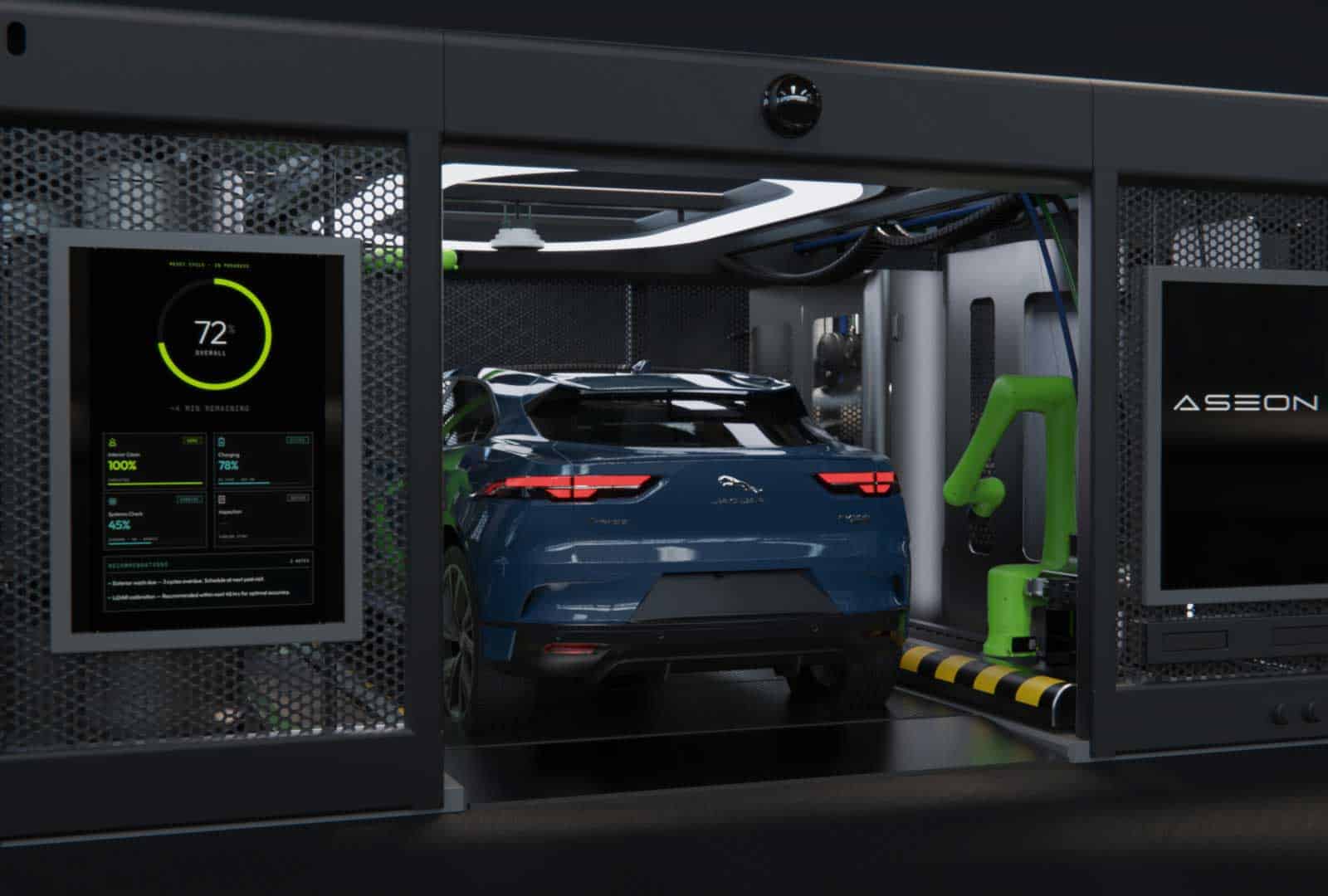
George Kalligeros, Co-Founder and CEO of Aseon Labs believes infrastructure not software is the next major bottleneck to robotaxi scale. Aseon’s portable pods deliver charging, interior cleaning, inspection, and data sync directly inside operating zones, cutting vehicle downtime that can otherwise reach six hours per day.
The pods can be deployed on existing charge-point-operator sites or parking lots within 8–12 weeks using a conditional-use authorization, and relocated within days as demand shifts. Having previously scaled battery-swap infrastructure to 5,000 locations across 40 cities with Push Me, the founding team is targeting Dallas, Austin, and Phoenix for initial pilots funded by a $10 million seed round.
Key The Road to Autonomy Episode Questions Answered
How much daily downtime do current robotaxi servicing models create, and how does Aseon address it?
Under today’s depot model, a vehicle can be taken out of service for roughly two hours per servicing run, up to three times a day totaling as many as six lost hours. Aseon’s pods deliver micro top-ups and micro cleaning inside the operating zone during natural vehicle downtime, potentially eliminating at least two of those three out-of-service pulls per day.
How quickly can an Aseon pod be deployed, and what permits are required?
Aseon can deploy a pod within 8 to 12 weeks using a conditional-use authorization on land already permitted for automotive or EV charging use, avoiding the lengthy permitting process required for a centralized depot. Because the pods are classified as temporary infrastructure, portable, under six feet tall, and removable by flatbed, the interface with city authorities is described as straightforward.
What was the key cost insight that led to Aseon’s decentralized pod concept?
After visiting multiple robotaxi depots, the team found that approximately 40% of daily pit-stop costs are tied to the need to relocate the vehicle to and from a centralized facility, encompassing both direct relocation costs and lost ride demand. This led to the conclusion that depot capacity should be dispersed directly into the center of operating zones rather than concentrated in large industrial facilities.
The Road to Autonomy Topics & Timestamps
[0:00] Why Robotaxis Need Autonomous Infrastructure
Autonomous infrastructure means removing the human from the loop. Today’s centralized, high-throughput depot model is built around people, and robotaxi fleets need a decentralized footprint instead.
[00:47] The 40% Relocation Cost Insight
After visiting depots across the country, Aseon found that roughly 40% of the cost of a daily pit stop ties back to relocating the vehicle, both in the trip itself and in lost demand. The biggest lever in servicing AV fleets is where the depot footprint sits.
[04:28] Lost Utilization and Where Pods Get Placed
A robotaxi can leave service for two hours at a time, three times a day, to reach a depot. Placing charging and reset capacity inside the operating zone turns that downtime into micro top ups and micro cleans during natural lulls.
[05:55] The Core Reset Services
The pod charges the vehicle from 20% to 80%, inspects the interior and exterior, removes trash and lost items, vacuums and wipes the cabin, syncs data, and safely stores the vehicle. Aseon is targeting 95% fully autonomous uptime, with early deployments manned.
[07:23] Commercialization and Deployment Models
Power is the gating factor. Aseon deploys either on top of existing charge point operator sites or converts parking lots into off grid satellite locations, manufacturing, financing, and offering the pods as a service directly to autonomous vehicle operators. Short term the network is single tenant, with a shared third party pit stop layer as the long term opportunity.
[10:14] Depots, Satellites, and Nodes
The long term infrastructure mix is depots, satellite locations, and nodes. Aseon’s nodes deploy in the city center with a minimal footprint and can be delivering pit stops within eight to 12 weeks on a conditional use authorization.
[13:54] Portability and Permitting
Portability is a permitting strategy. Because the pod is under six feet tall and classified as temporary infrastructure, it is certified at the state level and the city interface becomes straightforward, allowing dispersed locations to scale.
[15:22] Lessons from Pushme and Tier Mobility
George and his co-founder Dan previously built Pushme, a battery swap network for e-scooters and e-bikes that grew to 5,000 locations in 40 cities in 18 months before being acquired by Tier Mobility. The playbook was one product that is fast to deploy plus the backend to manage host relationships, and it applies directly to autonomy.
[18:11] Inside the Robotic Reset
The vehicle drives in, a gate secures the space, and the robot opens the charging flap and plugs in first. While charging, the system selects from bespoke end of arm tooling to inspect, move items, and clean the interior. A reset takes about 30 minutes, with 20 to 30 services per pod per day.
[18:54] Deploying the $10 Million Seed
The seed round funds engineering through the first pilots and the first PVT manufacturing run. Dallas, Austin, and Phoenix are the leading launch markets, and Aseon will partner with charge point operators and real estate developers rather than become a land bank.
[24:36] Vandalism and Security
Security is a major cost center for operators. The pod is designed to be as vandal proof as possible, with CCTV surveillance and a backend operations team that can detect abnormal events and respond or notify authorities.
[26:21] Infrastructure Over the Next Decade
After the AI driver, infrastructure is the next frontier to conquer. With roughly 15 Western robotaxi markets live against Uber’s 15,000, thousands of markets remain to open, and Aseon’s ambition extends beyond shared fleets to servicing consumer owned autonomous vehicles.
[29:51] AUTNMY AI
AUTNMY AI is an applied intelligence firm whose mission is to develop a field-tested, ground-truth understanding of how the Autonomy Economy is being built and translate that understanding into the intelligence, foresight, and counsel that help the world’s leading institutional investors navigate the most consequential industrial transition of this century.
Full Episode Transcript
Why Robotaxis Need Autonomous Infrastructure
Grayson Brulte: George, individuals talk about software, robotaxi, BOM cost, but there’s a little thing below the surface called infrastructure that matters more than most individuals talk about, and you have a company building this. So the question for you to kick things off, George: Why do robotaxis need autonomous infrastructure?
George Kalligeros: It’s a great question, and it dives right, right into the heart of why we exist. autonomous infrastructure basically means removing the human from the loop. today’s model is very much built around the human, centralized capacity, high throughput facilities. With autonomous infrastructure, you can deploy decentral footprint, decentral infrastructural footprint, and this is exactly what robotaxi fleets need
Grayson Brulte: So that’s what they need, but how do you build it? How do you get there?
The 40% Cost Insight from Depot Visits
George Kalligeros: There’s many ways to do it. our our conclusion from having visited multiple depots is we, we initially wanted to spin up an operator company. and we defaulted to looking at obviously the depot model and visited a lot of depots. The key insight was that about 40% of the cost of today’s pit stops, these are the daily high-frequency service tasks, ties to the need to relocate the vehicle. That is both in the cost of relocating the vehicle and the lost demand. So the biggest lever in servicing AV fleets is correctly locating that depot footprint. So the way we think it needs to be done is you need to take that depot footprint, effectively chop it up, and disperse it or sprinkle it directly across the center of the operating zones where vehicles already operate
Grayson Brulte: So I, I have a, a hat, I call it the inspector hat. I consider myself an honorary inspector, and I go around and I inspect depots, and I stay on public, public right of way. I don’t go on private property unless I’m invited to really get a good understanding of these depots. Is reading between the lines in this, George, did you put your honorary inspector hat on and go inspect all these depots as part of the inspiration for the company that you’re building?
George Kalligeros: Yes, we did. we, we were invited and, and some were some were trying to infer things from the outside. But yeah, we did visit a lot of depots and derive interesting insights from all that
Grayson Brulte: You devised these insights, then did you go to a whiteboard? Is that how you came up with the pod design? How did you come up with that pod design?
George Kalligeros: Well, the core insight from– it, it wasn’t just visiting the depots, it was understanding what is the, the set of– the, the full set of operations an, an autonomous vehicle needs over its entire lifetime. and we realized that first of all, a subset of those tasks, A, can be automated, and, and a lot of AV developers and operators are working towards automating a number of those tasks, like, like charging, like cleaning, inspection, and what have you. The second thing was understanding the frequency of those tasks. We realized that the vast majority of the operating lift ties around that daily high-frequency servicing of the vehicles. So the focus then became how do we, how do we focus, how do we serve exactly that specific subset of operations directly where the vehicle needs it? And that became the foundation for the idea for Aseon
Grayson Brulte: When you look at w- the foundation of where the vehicle needs it, is that based on demand? Is that based on available infrastructure? W- w- w- how would you frame that?
George Kalligeros: Well, I think simply put the vehicle operates within sort of like a demand zone, and its job is to be placed in points where it can effectively capture a ride and maximize how many rides a vehicle can deliver in a day. So the vehicle remains within the zone trying to seek and service demand for as long as possible at which point eventually it, it runs below a certain threshold either in cleanliness or in state of charge or something else. At which time it needs to call home and, and go to a depot or a pit stop location and get serviced
Grayson Brulte: No, it has to. It’s interesting, Waymo hosted me in the Bay Area last week, and I learned about. They wouldn’t tell me the number, but I learned that once a certain battery threshold is hit, the, the, the vehicle automatically has to go back to the depot. Very interesting there in terms of the range of, of where it can go. So in visiting various depots around the Bay Area, around the country, do you envision the pods being strategically placed in, in parking lots co-located with larger depots? Or where do you envision these pods being placed?
How Pods Eliminate Up to Six Hours of Daily Downtime
George Kalligeros: So the pods, ideally this, this charging and reset capacity needs to be placed as close to where the vehicles already operate, and that is to reduce the time out of service. So right now the level of sophistication operations, let’s say, is table stakes. So the vehicle runs low battery, and then it needs to travel to a depot, be processed in a depot, and then return to service. That, that sometimes takes the vehicle out of service for two hours at a time, and that can happen three times a day. Now, a significant portion of those six hours are happening during times that the vehicle could be generating rides, so that is lost utilization. The opportunity here is if you place the ability to, to replenish that vehicle, either with energy or provide a clean or other services right in the heart of the operating zone, there is natural downtime during the day of that vehicle that you can effectively service it. So instead of effectively saying, “Oops, battery out, you gotta, you gotta be out of service for a couple of hours,” you can deliver micro top-ups and do micro cleaning during the day, such that you even eliminate the need to even entirely take the vehicle out of service at least two or two, two, two out of the three times a day
Grayson Brulte: You’re, you’re going to a key metric in robotaxis is uptime. Walk us through the services that the pod can provide. What are the services that it can provide?
Core Reset Services: Charge, Clean, Inspect, Sync
George Kalligeros: Yeah. So we’re focusing on what we call the core reset. So the, the foundation is you obviously charge the vehicle. typically you would take a vehicle from 20% to 8% state of charge. You can also do an interim an interim charge, during which time our robotic system inspect the vehicle, removes items left behind, either trash or lost and found items and, and then it delivers an interior clean. So we vacuum the floors, we wipe the seats, we inspect the inside and outside of the vehicle to make a refleet and decision. we data sync, we safely store the vehicle. This is kind of the core set of services.
Grayson Brulte: So it’s fascinating then what you’re able to do. So you charge the vehicle, you clean the vehicle, you inspect the vehicle. To me, it’s a home run. And how much of that is fully automated and how much does it have to have human oversight?
George Kalligeros: It’s a good question. So we’re in development. We’re aiming for at least 95% fully autonomous uptime. the initial deployments will be manned because obviously we want to guarantee operators that they’ll be able to get a full, a full charge guaranteed in one of our locations, at least initially. But I see, I see no reason why we’re, we wouldn’t be able to tackle the vast majority of edge cases within our system within the next few years
Grayson Brulte: You’re building for the future. I’m curious from a commercialization standpoint, obviously if you look at the Bay Area, there’s a lot of real estate owners. There’s not that many lots, but there’s a lot of parking garages. Hypothetically, could an owner of that garage or owner of that real estate buy one of your pods, put it in there, and then charge a Waymo or charge a Tesla to use it? Or how are you thinking about the commercialization aspect of this?
Two Deployment Models and the Path to Multi-Tenancy
George Kalligeros: Yeah. So the key the key kind of gating factor here is power, right? So our pods depend on externally provided power. there’s two primary deployment models for us. So we either work with charge point operators, so these are companies that already have installed DC fast charging capacity across the center of key cities. Some of them happen to be well-placed to service AV demand. Some of them happen to be underutilized. So by effectively deploying our product on top of existing charge point operator locations, we’re able to offer a full micro depot with all its pit stop services directly where the vehicles already operate. So this is one deployment model. The other deployment model is to work with effectively real estate developers and deployment companies to turn parking lots into full dark satellites satellite locations, or otherwise called pit stop locations. So we take over a parking lot, and we can turn it using off-grid power into a full depot, again primely located. So with regards to our product we’re gonna be manufacturing it, we’re gonna be financing it, and we’re gonna be offering it as a service directly to the AV operators
Grayson Brulte: And then do you envision this as multi-tenant where Waymo could use it, AVride could use it, Tesla c- could use it? Or is this, do you envision it saying, Waymo, for example, says, “Okay, I want an exclusive 12-month lease on this one,” and then Te- AVride says, “I want a 12-month exclusive on this one.” H- is it gonna be single tenant, multi-tenant? How do you think about that?
George Kalligeros: In the short term, I think it’s going to be single tenant. from the conversations we’ve had the key concern and priority is guaranteed access on-demand access to the network of stations. So you need a very robust orchestration layer to allow multiple operators to compete for the same pods during the same times of peak demand. So initially, we’re gonna be deploying proprietary capacity, but as you say for example, in Austin, we could be servicing, could be servicing Waymo, let’s use for instance, but within the same city with a proprietary network. Within the same city, we can service Avride, right? It’s the exact same product. It’s two different operators with proprietary, with proprietary capacity. Eventually, there’s gonna be a third and a fourth operator. It gets to a point where you could argue that everybody benefits if that network were to be shared. So we see a, a huge opportunity in building a, a, a shared third-party operator for the pit stop layer
Grayson Brulte: Could your solution, your pods act as a stopgap where, let’s say you put a few in downtown Dallas, you put some in uptown Dallas. Sorry, Douglas, I’m gonna say it. You put some up in Highland Park, and you strategically place these until the permanent infrastructure is built out to, let’s just say, AVride or Uber, whoever it might be, says, “Okay, George, I wanna lease this for a year, and these are the locations that I need,” and you go deploy it until they build up their permanent infrastructure?
George Kalligeros: The long-term mix of infrastructure will be depots, satellite locations, and nodes, which is what we do. So deployments of depot capacity with two, three, four servicing bays. And as you correctly mentioned what we’re able to do with our product is not only deploy in the center of the city because our, our infrastructural requirement is relatively minuscule compared to that of a massive industrial zone depot. the main benefit is we can deploy really, really quickly. So our product is portable. With just a conditional use authorization, we can deploy on top of existing automotive permitted or electric vehicle charging permitted land, and effectively start delivering pit stops within a period of anything between eight to 12 weeks
Grayson Brulte: Okay, so let’s stay on that eight to 12 weeks. So Uber calls you up, Amy Wright calls you up and says, “Okay, George, we need here, here, and here.” 12 weeks goes by, rocking and rolling. You’re up, they’re happy. And let’s fast-forward six months, 12 months, 18 months down the line, and they say, “Hey, we’ve noticed in, in this part of Dallas,” for example, going towards Fort Worth, “an overwhelming amount of robotaxi demand. We really need one of these here. Can you move one of those pods there, or do you have to ploy a new one? And if so, what does that timeline look like?”
George Kalligeros: It’s a great question. We have in fact designed our product to be movable, and we can move our product within effectively a few days’ notice, if that makes sense. we strongly believe that it is, it’s very difficult to plan the optimal locations for depots or servicing locations upfront. I think cities are gonna change as time goes by. There’s even seasonality in where the locations of that ideal locations of the depot footprint should be. So the benefit of our, of our product is the fact that we can move to another location provided that the power either comes with or there’s another power supply in that location
Grayson Brulte: So staying on this, this moving theme, I’m putting on my honorary moving hat here. You’re moving from downtown to uptown, for example. W- w- walk us through it. Does it, does the, does the, how does the pod expand? How does it get off the trailer? How does it get put into its position, and is there any permitting or regulatory issues that you have to deal with?
Pod Design: Portable, Expandable, and Permit-Friendly
George Kalligeros: Yeah. So let’s look at how the product itself gets delivered into the market, right? So the job starts with so the products get mass manufactured with a contract manufacturer, and then they go on the back of a flatbed truck. they get delivered on site. They roll off the back of a truck so that they actually feature wheels, and then they, they come in a compressed form factor that expands and opens up and occupies that single parking bay, about 10 feet. This is how we deploy product. Now, the reverse process of this is it folds back up, flatbed truck comes and picks it up and relocates it. on the power side, we either rely on existing on an existing DC fast charger installation, and we use the existing harness to feed into the pod. and effectively, we are a customer of the existing charge point operator when it comes to power consumption, and then we, we recharge the vehicle or we simply use off-grid power. You can think renewable propane generators battery energy storage systems, all sorts of systems
Grayson Brulte: When you were designing the pod, th- there’s a theme that’s emerged here, is portability, where you’re not– I w- I’m not gonna say you’re permanent infrastructure, you’re portable infrastructure, which is extremely valuable because, for example, let’s say there’s a music festival or there’s a concert or there’s a high demand somewhere, you could theoretically deploy– forward deploy these things so when the event comes for that three or four days, and then you know there’s demand, that’s valuable. Why d- was the decision to made to make the pods portable?
George Kalligeros: The portability actually ties a lot to the permitting. So we see immense value in building a product that is very easy, quick, and lightweight to deploy from a permitting standpoint. So when you have to permit a centralized depot it might take a very long time, but once you have it set up, you can service hundreds of vehicles at a time. We have to manage multiple locations dispersed across the city, so we need a very scalable way of managing the permitting side, and this is why the product ended up being developed such that it can be deployed as temporary infrastructure because, because it is. The– You’re not putting a permanent building on the ground. It’s not more than six feet tall. There’s another, a number of other conditions. So you kind of certify it on a, on a state level, and then what– the, the interface with the city becomes very straightforward
Grayson Brulte: This reminds me of pods, the moving pods that you see all over the place. Similar thing, you drop the pod off, you, you fill it up, and you go. What. Was that pod business any inspiration to your pod business?
Founders’ Prior Experience: 5,000 Locations in 40 Cities
George Kalligeros: No, but actually Dan and I have built a very comparable business prior. it’s a business called Push Me, where we built battery swap infrastructure for e-scooters and e-bikes. And the company grew to 5,000 locations got acquired by Tier Mobility, which is backed by SoftBank and Mubadala. And we were effectively tasked with, we want to allow users of micro-mobility vehicles to swap batteries in exchange for a free ride. We’re obviously gonna be putting that infrastructure across the city. What is the quickest way to actually go and deploy that network? And we did 5,000 locations in 40 cities within a year and a half. The only reason that we were able to, to do this as quickly is because we built a single product that was extremely quick and easy to deploy, and then we upfront built the infrastructure to be able to manage all of the host relationships and the operations within. So Dan and I have done something very similar before, and I think there is direct application to autonomy here
Grayson Brulte: It’s experience, and you, you have the experience of one scaling, successful exit and, and moving quickly. So I’m, I’m curious, on the day of a pod, let’s call it a day in the life, what are your estimates on how many robotaxis per day can go through these?
George Kalligeros: It depends on the mix of sort of like full charges from 20 to 80% or above, or whether you’re doing partial charges. But the, the charging is what drive, primarily drives the downtime of the vehicle within the pod. So, you know, you need 30 minutes to charge. you need another 15, 20 minutes for the vehicle to do a, a full reboot and data sync with the station during which time you’re also delivering all of the other operations that physically touch the vehicle or you’re doing your inspection. So what I’m trying to say is a reset takes about 30 minutes and then depends on what sort of utilization of your network you’re modeling across the city. So th-there is, there is a tension here between us as an operator and then the, the the, the AV developer, which is that the best economics for the fleet is when you run a very sort of like low utilization, really widely distributed network because the vehicle can hail a pod within a minute, go get a quick pit stop and a recharge, and that, that, the fleet is continuously hitting high 80s low 90s utilization, which is right now impossible. But I don’t know if that answers your question. we’re targeting. A, a day, a day in the life is probably anywhere between 20 to 30 sort of like services.
Grayson Brulte: Okay, so you’re gonna have high throughput. And then when we think about it, since there is robotics inside the pod, should we think that a robotic arm will plug the charging cable in?
George Kalligeros: Yeah. This is the first operation we perform. So the vehicle drives in, there is a gate. We fully secure the space, which allows the robots to move. the first thing we do is we open the charging flap, and we plug the vehicle in to charge. And that kicks off sort of like a stream of operations that happen be-between pod and vehicle. And whilst the vehicle is charging and these operations are taking place the robotic system picks from a range of bespoke end of arm tooling, and then does a bunch of physical operations on the car. like inspects, moves items, it cleans the interior and a number of other things
Grayson Brulte: ‘ Cause what you’re building is the ability for robo-taxis to scale without the, let’s say, the 18 to, to 24-month drag that’s currently happening with infrastructure permitting electricity, ’cause you’re using preexisting infrastructure. And to scale the business, the company recently raised a $10 million seed. How are you planning to deploy that capital?
George Kalligeros: So the vast majority of the, of the round goes on, on engineering. So we’re developing the product to the point that we deploy the first pilots and then we, we prepare for the first manufacturing run for our PVT level build. So this, this existing round goes towards proving that A, the product exists it works in field and it’s ready to be scaled. So this is what our seed round gets us
Grayson Brulte: Beautiful. What market are you targeting to be, if you wanna call it the prototype market, the seed market, what market are you targeting for that?
George Kalligeros: Yeah. So we’re, we’re, we’re in discussions for the market. I think the three most interesting markets for us are Dallas, Austin, and Phoenix currently. But obviously m- th- there, there’s many factors that play into it,
Grayson Brulte: So you’re targeting the, the right markets. Obviously, you have the right regulatory environment there. You have the right demand there. When you’re looking at these markets, what have some of the conversations been like with the business owners and the real estate owners in this market say, “Hey, we have a potential revenue-generating operation coming to you”?
George Kalligeros: So we’ve actually received substantial inbound demand from real estate developers that, that came across the concept. it’s, it’s frankly something that we, we haven’t gone out and developed the real estate. We, we haven’t done the real estate capture in the cities yet because the immediate next step is to deploy the pilots directly with the AV operators and developers to prove out and mature the core workflow, right? But once that’s in place, then of course the idea is to go and, and deploy at scale with effectively strategic partnerships that one can strike either with charge point operators or real estate developers. So I don’t see ourselves for the first three cities going out, developing sites, acquiring sites, effectively be- becoming a land bank at all. I think these are tasks that there’s other companies that are much better placed in doing
Grayson Brulte: Well, to me, you’re staying disciplined. You’re staying on what your core strength is, is design, building, and deploying the pod, not, as you said, acting as a l- land bank. I’m, I’m curious just from, from a design standpoint, from the, the inside of the pod, the, the robotics aspect is robotaxis are different. You have the Ojai Zeekr, you have the Hyundai IONIQ 5, you have the, the Jaguar, which probably in two years will start fading out. So you have different vehicle form factors. How do you design your pod to handle the- these different form factors so you’re not limited into who you could strike a partnership agreement with?
Handling Multiple Vehicle Form Factors with Bespoke Tooling
George Kalligeros: Great question, and actually a key consideration to design of our product. So we, we’ve, we’ve designed our product such that we can cater to pretty much every autonomous vehicle model that exists today. And if you look at it, it’s actually a relatively small subset of cars. So we’ve designed it to be able to do the biggest with the much– the most awkward spaces down to the smallest and, and all, all kinds of ranges of or sort of like we need the robot to be able to reach all the charging ports and all the different nooks and cr- crevices. We, we effectively use bespoke end-of-arm tooling customized to each and every vehicle, and that allows us to use sort of like a more generalized robotic system and a perception system but still deliver very much sort of like human-like quality of of, of reset
Grayson Brulte: Do you have to train each robot for each different type of vehicle?
George Kalligeros: Yes. Yes, you do. So a portion of the robotic system is sort of like classical robotics, but then, yeah, the portion is vision-only did trained on specific view
Grayson Brulte: You’re putting the pieces together now. the, the, the wonk in me comes out. A vehicle shows up to one of your pods with damage. What does that process look like? How do you notify the AV operator? What do you do in a circumstance like that?
George Kalligeros: In our early deployments, we wanna have a, a, a lightweight sort of inspection layer. So we have already a perception rig cameras inside our pod. So the first thing we do when a vehicle rolls in is we inspect and assess the condition of the, both the exterior and the interior of the vehicle. Now, depends on the damage. If, if it’s, if it’s reported from the from the operator or if it’s something we detect ourselves o-on a first level, we’re gonna allow the operator to kind of dial into the pod and look at what the damage is and what it looks like. and there is kind of three outcomes if you think about it. Either it’s something unsubstantial, the vehicle can continuously continue to operate for the rest of the of the shift. Or the vehicle, it can safely be routed to a, to a depot for further inspection, or s-someone needs to come and pick it up. I-in which case we can safely store it. But the idea is once an operator needs to defleet a vehicle one of our pods will be much closer to where the vehicle currently is and can be safely stored and inspected
Grayson Brulte: I’m liking what I’m hearing. I, I just wanna get a clarification, if you don’t mind. When, let’s just say I’m AV operator, I can have a camera that can be outside the vehicle so I can actually see the outside damage if there is damage there, and then I, me as the operator can make a decision of where I wanna route that vehicle?
George Kalligeros: Yeah, yeah. That is, that is exactly what I’m describing, yeah
Grayson Brulte: Okay, so that goes back to the operational efficiency then, because to me it’s just y- you’re another tool in the Swiss Army knife of deploying robotaxis, which is, which is a huge benefit to me. And unfortunately, I ha- I do have to ask you this because we have seen many documented cases where humans do bad things to AVs. They attack the machine, they rage against the machine. How do you prevent that? Does, does the door of the, of the pod close so a bad actor can’t go in there and say, “Ha ha, I got a hammer. Watch this.” H- how do you prevent vandalism on site?
George Kalligeros: Yeah. security is a big concern and actually a major cost center for a lot of the operators. we’re designing the pod to be as vandal-proof as one can get it to be, right? So if you give a person enough tools and enough patience and they keep trying, they’ll, they’ll eventually break into anything in practice. But we’re, we’re very much designing the pod to be extremely difficult to break into and, and access the the AV whilst it’s being serviced.
Grayson Brulte: Then I’m assuming from y- your side, from the Aseon side, that there is a command center monitoring these depots or some sort of sensor if something was to happen, it was to notify your global security team?
George Kalligeros: Yeah, yeah. So of course there is, there is a substantial backend to running a distributed network. from a teleoperation standpoint, you need to have your own operating teams to go and not just service, service the stations, that there is, there, there’s consumables that need to be topped up. There’s all sort of things that you need to do. But as part of this, yes, we, we actually have sort of like CCTV cameras around the pods, and we’re gonna have a security surveillance of the pod itself. So if, if there is sort of like an abnormal event that we detect, we’ll be able to sort of act on it or at least info- inform the authorities or do something.
Grayson Brulte: Okay, perfect. I mean, that’s the, I mean, that’s all you can do at the end of the day. Unfortunately, individuals are going to, in some cases, act as bad individuals. Not, not con- not saying it’s a good thing, I’m condemning that, okay? That’s a very bad thing, but you’re putting the pieces there. I, I’m curious from your perspective, you’re, you’re building these pods. You have deep experience in, in micro mobility. Now you’re, you’re building robotaxis, and now you- for the pods. How do you see the relationship between robotaxis and infrastructure evolving over the next decade as we hit this major scale inflection point in autonomy?
Infrastructure as the Next Frontier for Global Robotaxi Scale
George Kalligeros: After the AI driver, infrastructure is the next sort of like frontier to conquer to allow robotaxis to scale, right? So today, at least across the Western markets, we have probably, what, 15 markets currently operating. If you look at the scale of Uber Uber’s operating in 15,000 markets. So even if you assume a 50% EV penetration, there is 7,500 markets to open here. So infrastructure is, is, is the big bottleneck. And I think the future of infrastructure will change as, as time goes by in each and every market. you need to, you need to look at how a market gets launched. It needs i- an immediate, an immediate capacity to operate the fleets on, on a pilot size, on a scale-up size, and then eventually you need a depot to carry out so the, the, the heavy lifting of the maintenance operation. So I think it’s gonna be a mix of solutions over the long term in every market, but I think we definitely need more sort of like deployment speeds and efficient solutions to allow us to launch these thousands of markets over the next decade
Grayson Brulte: There’s the key. Thousands of markets over the next decade. What you’re building, George, has the potential to be a very large part of robotaxis enabling, enabling them to scale globally. And as we look to wrap up this insightful conversation, what is the future of Aseon like?
George Kalligeros: The ambition here is to build a very significant part of physical operations for autonomous fleets. And when I say autonomous fleets, not just shared fleets, but also consumer autonomy. I think we’re, we’re building towards a future where owned vehicles will be default autonomous, and they’re gonna need servicing, cleaning, charging. They’re gonna need groceries being put in the, in, in the trunk. And I think a form of ASIAN ASIAN pods is what’s gonna be doing the servicing. So I think the opportunity is, the opportunity is massive, and the market’s untapped
Grayson Brulte: What George alluded to, I’m gonna put on my infrastructure hat, done a lot of work in infrastructure, and this is a hypothetical statement, not a factual statement. I could see a scenario in the future where the Acyon pods are put as part of a, an HOA, built into the HOA, and where your personally owned r- autonomous vehicle can go in there, get cleaned, go get serviced. That is a very, very big potential untapped market outside of the robotaxi market. And to the audience, don’t discount infrastructure, because without infrastructure, point blank, robotaxis do not scale. The future is bright, the future is autonomous, the future is Acyon Labs. George, thank you so much for coming on The Road to Autonomy, sir. We can’t wait to have you back on again.
George Kalligeros: Thank you, Grayson. Thank you for having me
AUTNMY AI: Billions and soon trillions in value will be created in the autonomy economy. By the time a trend becomes consensus, the alpha is already gone. The gap between uncovering signals and reading headlines is widening fast. When it’s a headline, it’s no longer a signal. Enter AUTNMY AI. We decode signals before they move markets, giving you conviction in the autonomy economy. Autonomy AI, your models, our intelligence. Visit AUTNMY.ai.
The future is bright. The future is autonomous. The future is The Road to Autonomy.
Subscribe to This Week in The Autonomy Economy™
Join institutional investors and industry leaders who read This Week in The Autonomy Economy every Sunday. Each edition delivers exclusive insight and commentary on the autonomy economy, helping you stay ahead of what's next.