


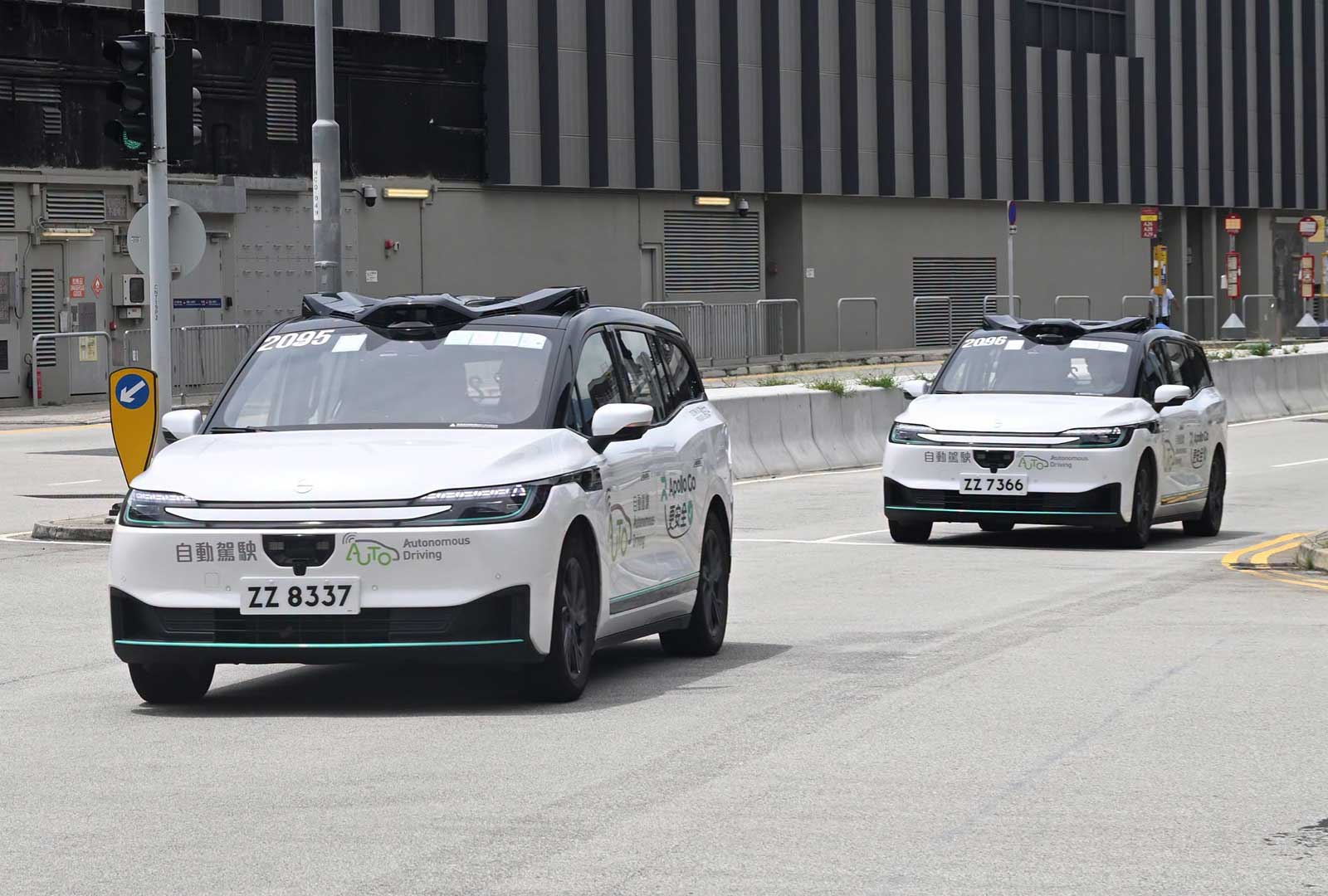
Baidu’s Hong Kong Expansion Unlocks Right-Hand Drive Markets
Executive Summary
Baidu Apollo Go has received three of seven pilot licenses in Hong Kong covering 50 authorized vehicles, positioning Hong Kong as a credential-issuing jurisdiction for right-hand drive autonomous vehicle markets including Japan, the UK, and Australia.
The US military executed its first-ever combat strike using unmanned surface vessels, deploying three Saronic Corsair USVs against Iran’s Bandar Abbas Naval Base, signaling a doctrinal shift toward autonomous maritime warfare. Researchers at the Technical University of Munich deployed autonomous drones on the Italian island of Volcano to generate 3D tomographic maps of volcanic gas concentrations, demonstrating autonomy’s life-saving potential in GPS-denied and hazardous environments.
Across all three signals, Grayson Brulte and Rob Grant and AUTNMY AI’s OMEGA identify a common thread: the autonomy economy is expanding rapidly across commercial, defense, and scientific domains.
Key Autonomy Signals Episode Questions Answered
Why is Baidu’s expansion into Hong Kong strategically significant beyond the city itself?
Hong Kong’s right-hand drive, left-side traffic system serves as a proving ground for other international markets including Japan, the UK, Singapore, Australia, and Malaysia. If Baidu can validate its technology under Hong Kong’s rigorous regulatory framework, it gains credibility to enter those much larger markets, effectively functioning as what the hosts describe as China’s autonomous Belt and Road Initiative.
What was the Saronic Corsair USV used for, and why does it matter for the defense industry?
Three Saronic-built Corsair uncrewed surface vessels were deployed by US CENTCOM on July 12th to strike a submarine and ship maintenance facility at Iran’s Bandar Abbas Naval Base, marking the first-ever combat strike using unmanned surface vessels. Grayson and Rob describe this as a defining transition from prototype testing to scaled doctrine-driven procurement and a fundamental shift in the cost calculus of maritime conflict.
What did autonomous drones accomplish at the island of Volcano, and why is it significant for autonomy?
Researchers at the Technical University of Munich used an autonomous drone system to generate 3D tomographic maps of volcanic gas concentrations, operating at altitudes up to 10,000 feet and distances of nearly five miles while avoiding corrosive plumes. The hosts note this validates that autonomy can operate in GPS-denied and extremely hostile environments, and that the measurements would be physically impossible for humans to take safely.
Autonomy Signals Topics & Timestamps
[0:00] KPMG Sponsor Introduction
KPMG works across the full autonomy ecosystem, advising operators, OEMs, suppliers, insurers, and investors as autonomous mobility scales.
[01:34] Signal 1: Baidu’s Apollo Go Expansion in Hong Kong
Hong Kong has issued pilot licenses allowing Baidu to test 50 of its 6th-generation RT6 robotaxis up to 50 km/h in dense, right-hand drive environments. They break down Hong Kong’s fully remote-controlled L4 regulatory framework, the geopolitical strategy of using it to export tech to other left-side traffic markets (like Japan and the UK), with OMEGA forecasting a Baidu pilot in Singapore, Australia, or Japan within 18 months.
[18:55] Signal 2: First Autonomous Maritime Combat Strike
Rob and Grayson discuss US Central Command’s (CENTCOM) first-ever kinetic combat strike using three Saronic-built Corsair uncrewed surface vessels (USVs) against an Iranian naval base. They analyze the doctrinal shift in naval warfare toward lower-cost autonomous swarms, evaluate how traditional defense primes are investing in software integration rather than acquiring hardware startups, and highlight OMEGA’s risk warning regarding potential congressional or public backlash if an autonomous strike results in an unintended civilian casualty.
[37:16] Signal 3: Autonomous Drones Mapping Volcanic Gas Clouds
At the Technical University of Munich, researchers deployed autonomous drones off the coast of Sicily to create 3D maps of volcanic gas concentrations. They praise the tech as a force for good that eliminates the need for humans or hardware to enter hazardous, corrosive plumes. However, they contrast this with OMEGA’s ultimate takeaway: defense capital is so heavily eclipsing civilian drone funding that environmental use cases currently serve primarily as regulatory proof-of-concepts rather than standalone commercial businesses.
Full Episode Transcript
Baidu Apollo Go Expands in Hong Kong
KPMG Ad: The autonomy economy is real. Commercial robotaxi operations, humanless freight runs, AV infrastructure investment measured in billions. The question is no longer whether autonomous mobility scales, it’s who advises the companies building it. KPMG works across the full autonomy ecosystem: operators, OEMs, suppliers, insurers, and investors. At the moment it matters most. When the road ahead is uncertain, we’ve already been there. KPMG, accelerating what’s next in mobility.
Grayson Brulte: Rob, it never ceases to amaze me that autonomy continues to expand globally. Baidu’s going to Kazakhstan, more military uses for autonomy, and then it’s just becoming this global economy that you and I have called and termed the autonomy economy. So lots of signals to break down this week. We’re gonna go back to our roots, where we’re going away from robo, and we’re going into all sorts of interesting uses around autonomy. This week, the signals are: Baidu Apollo Go ramps up robotaxis in Hong Kong. Aha, we’re still gonna have a little robotaxi again there. Second signal: In a first, the US military uses Saronic Seaborn drone attack on an Iranian port. Go, US military. The third signal: autonomous drones measure volcanic gas clouds offering clear eruption warning signs. So that’s cool. We got science here. I love science, and we love our sponsors. So a huge thank you to KPMG for being a wonderful sponsor for Autonomy Signals and making all this happen. Rob, let’s dive into the first signal, sir. Baidu, Hong Kong ramping up the miles. What do we know?
Rob Grant: Yeah, this is great. I mean, this is just another brick in the wall that robotaxis are going to be transforming mobility around the globe, right? We see it in San Francisco, near where I live. You’re out on the streets of Miami, and you’re seeing it every day. Those are just a few of the places that get to enjoy this technology and benefit from it in 2026. But this technology is gonna get everywhere, and I mean everywhere. And so today we’re, we’re going all the way around the globe. We’re, we’re, we’re taking a look at what’s going on in Hong Kong because just at the end of last month, the Hong Kong Transport Department announced that it had issued seven pilot licenses covering 63 autonomous vehicles. Now, Baidu holds three of these licenses, accounting for 50 of the authorized vehicles that are allowed on the streets of Hong Kong. In the news release, the Hong Kong Transport Department also said that Baidu had been authorized to conduct cross-district driverless trials connecting Airport Island, Sunny Bay, and Tung Chung, which are, are very important districts on this very small, very dense island. And the government has increased the vehicle limit for Baidu up until 50, and then raised its speed limits to 50 kilometers per hour, which is roughly, if my math is correct, about 30 US miles per hour. And so now testing for Baidu on the island is encompassing complex urban environments, and they’re using Baidu’s sixth-generation R26– RT6 robotaxis. The next step in this evolution, as announced in the press release, was that Hong Kong regulators are actively transitioning toward driverless operations under a dedicated code of practice, so they’re developing an AV framework. Now, in that framework, for those who are gonna follow closely, and I know there are some that really do, driverless operations are called fully remote-controlled in the Hong Kong regs. So while we are not necessarily getting to a global taxonomy, we are seeing global expansion. and I think this is a really big signal for Baidu, as we’ll talk about in a minute, for what it portends, not only in Hong Kong but for other markets in the region that are similarly situated to Hong Kong and that perhaps offer a real chance for international expansion ahead of Waymo
Grayson Brulte: I love this. You start the show off with, “All in all, it’s just another brick in the wall.” Bob Ezrin, sir, if you’re listening, you did a hell of a job for producing The Wall from Pink Floyd, so I, I love that and, and, and Bob is a, is a, is a wonderful human being on a, on a personal level. So I love this line, “Fully remote controlled.” That is a heck of a line. Now, because you and I are sticklers for fine print and doing all this stuff, and we’ve got the wonderful OMEGA algorithm that, boy she does a lot of work for us. When I s- when I hear this, and we haven’t asked OMEGA this yet, when I hear fully remote controlled, am I to assume that this is a one-to-one, one-to-two re- re- remote operator? How should we think about that? And do you think that we will get clarity in the regs over time?
Hong Kong’s ‘Fully Remote Controlled’ Regulatory Framework
Rob Grant: I think we will get clarity, but for now, the way to read that is that it is relinquishing the driver tasks to the vehicle itself, and that, that’s what they mean by fully remote controlled. The vehicle is being controlled by the driverless system, and so that, that’s what they mean by remote controlled. It’s not direct control by the human operator. It’s remote controlled by the compute stack. and fully meaning that you don’t have some kind of Level 3 fallback system, right? That it is a true Level 4 driverless operation. So it is a bit of a unique construction of the term, and to be fair right, Hong Kong is a, a unique place to begin with, so I’m not surprised. But it is, I think, a signal that Hong Kong is transitioning from these small supervised pilots that existed to a more structured cross-district commercial readiness form of testing, and there is no doubt that Baidu is the primary beneficiary of this regulatory evolution. And so I think this really helps Baidu because it gets to utilize the city’s very complex, very dense right-hand drive urban environment as a strategic proving ground. And to me, it is that right-hand drive urban environment that is the key learnings that Baidu is going to get. it also has, you know, to, to be fair, this has benefits to Hong Kong itself, right? they, they are looking to gain credibility as a credentialing hub in terms of providing a validated pathway for L4 technology to come to the island. but then also as a way for it to signal that if you can pass our validated testing and deployment framework you should be able to gain credibility in other global markets
China’s Autonomous Belt and Road: Geopolitical Strategy Behind Hong Kong Testing
Grayson Brulte: To me, and I’m gonna put on the, the wonky geopolitical hat that we’ve discussed quite a bit here and we, we’ve written about it. At some point we’ll probably release a paper on it. It just emphasizes China’s autonomous Belt and Road Initiative, where now you’re doing right-hand drive on the left-hand side of the road. That opens up more of a global market where it becomes another, if you wanna call it incubation hub, testing hub to, to export Chinese autonomy to the world. To me, it is more of a, a strategic initiative than anything. Yes, is it, is it good for the city-state of Hong Kong? Yes, autonomy is good for city-state of Hong Kong. But to me, it’s more of a geopolitical positioning to further ramp up the exporting of this technology, and then that gets very, very interesting because that opens up the Japanese market potentially. That potentially opens up the UK market because if you look at that, and we’ve seen all the exports of the vehicles go to those markets, it opens up a lot of new potential markets and is a testing facility very practically close to home
Rob Grant: I think you absolutely hit the nail on the head with that, right? It, it is– It provides a learning environment unlike any other, right? I, I, I don’t know, for those folks who haven’t been to Hong Kong, it is maybe the most populated vertical place full of people that I’ve ever been in my entire life and, and I’ve been to a lot of places. And I grew up on the, on the, in, in right on the outskirts of New York City, so I’ve been around big cities my entire life, and there’s almost nothing like Hong Kong, right? Tokyo, different because it’s a different scale in terms of just how massive Tokyo is. but Hong Kong is small, and it is dense, and it is an environment unlike any other. And to your point, the right-hand drive, left-side traffic system is a perfect place to train and certify models for other international markets. You hit the nail on the head. It’s Japan, it’s the UK, it’s Singapore, Australia, Malaysia. They all share these same traffic patterns. And if you can prove in– that your technology works there under a viable framework, which is why I emphasize the framework to begin with, this is not anybody and anything goes, right? This is going to be a very sophisticated framework. You are going to have a large amount of credibility, and you’re gonna set yourself up well for export into these much larger markets, right? Japan and Malaysia the UK, th-these are significantly larger markets than Hong Kong itself despite the density in Hong Kong. and so I think this really does provide Baidu an advantage and I think it’s very intentional, as you point out as well.
OMEGA Predicts Baidu Commercial Pilot in Singapore, Australia, or Japan Within 18 Months
Grayson Brulte: We’re not the only ones reading the tea leaves here. OMEGA made a prediction. We didn’t even prompt for a prediction, but she came out with a prediction here. I mean, she’s getting smart. She’s eating those Wheaties here. I’m gonna read this one to you. O- O- OMEGA predicts that Baidu will announce a commercial Apollo Go pilot in Singapore, Australia, or Japan within 18 months, citing the Hong Kong validation data as a regulatory proof of concept. You and I said it. She’s saying it, and looking at the data, I think that’s, th- that is 100% spot on. Which one of that, we, I won’t make a prediction on that. But it reinforces what you and I have said forever since we started this company, is that autonomy is going global. And it is going to be a global race, and that’s why we collectively created the road to autonomy indices, the robotaxi indice. Every 12 hours, fully sealed updating it. You and I have seen a pattern here, and, and we’re, and we’re gonna release more of that data in the coming weeks. There’ll be a subscription service for it. Is Baidu and Waymo have been playing a game of ping pong for that number one leader spot ’cause the data is there. Baidu is much further along than I think most individuals truly, truly realize. And what’s happening in Hong Kong, the data that OMEGA’s gathering, is further validating that point of their grand global ambitions
Rob Grant: A-agreed. And, and look, we already know as, as, you know, we’ve uncovered at The Road to Autonomy that Waymo has already set up legal infrastructure in Australia. It already has legal infrastructure and some testing in Japan. And so these are two of the markets through which validation in Hong Kong will make accessibility into those o- markets, Japan and Australia, much easier. And so there is no doubt in my mind that, that, that Baidu is targeting the same markets that Waymo is, and I think is trying to advance its technology i-in a pace and a fashion that will give it an advantage to not only get there as the first mover, but also get there and show that it’s more sophisticated in ability to handle the right-hand drive scenario. right? We, we, we, we here in the US don’t drive on the right-hand side of the road. Our vehicles aren’t structured for right-hand drive. you know, Waymo’s vehicles, when they– what we’ve seen from the, the few Jaguar I-PACEs that have moved over to Japan, th-they are still the Americanized version. They are not built for the roads in Japan per se, for the traditional driver. so it’s going to be really interesting how much this Hong Kong effort accelerates Baidu’s efforts to continually either meet or exceed what Waymo is doing.
Grayson Brulte: That’s a great point, Pete. And, and OMEGA points out a risk there. Bef- before we get to the risk, I, I almost wonder if OMEGA uncovered Baidu Apollo Go filings in, in Singapore and Australia and Japan. Perhaps we, we have to look out of that and put it public on X because perhaps she uncovered some filing data there. She’s really good at that. Which brings us to the risk, and we’re gonna stay on this OMEGA trend here. So OMEGA uncovered this risk as it relates to this Baidu Hong Kong expansion. Hong Kong regulatory environment tightens for autonomous vehicle operations, invalidating the proving ground thesis and delaying the international rollout. As we all know, and I’m not playing politics, that regulations and policy in China, which is de facto Hong Kong, could literally change in an instant. So to me, that is a very real risk that’s based on purely on geopolitical history, nothing more
Rob Grant: I think this is a significant risk, right? Hong Kong is moving in a very deliberate yet progressing fashion. The press release that I mentioned only refers to seven licenses granted in a total of 63 vehicles. So it is not as if they have opened up the entire city state and entire market to level four vehicles at this moment. But what they are doing is methodically moving towards that position being guided by a, a developing yet assumed to be stricter framework one that is not as permissive as some of the frameworks that we’ve seen in other countries or other US states. And you add to that what we know of the pause in mainland China when there was a series of braking incidences with, with Baidu vehicles, to be fair where they paused the issuance of new licenses for an indefinite period of time as a result of those instances. So I think what we see or what we can expect to see from Hong Kong is a very strict adherence to safety guidelines, a very quick and swift and heavy response to safety incidents. I think Baidu is not unaware of those challenges, having seen it from being the recipient of such swift and severe penalties in mainland China. But I also think on the other end, as somebody who believes that regulation can be validating for innovation, that if that is the path that Hong Kong is moving, and if that is the path that Baidu is willing to accept and to go down, and that is the path that Baidu succeeds on, that will only help it in terms of its ability to say to other markets, “We are ready for your unique driving circumstances unlike anybody else.”
Grayson Brulte: It’s, if you wanna use the term, it’s a dual validation point. Left-hand drive, right-hand drive. Mainland Hong Kong, and if you go on the mainland, yes, you, you do have some denser environments, but you do have some more residential, rural environments. And if you go into Hong Kong, it’s only one, actually two words, dense and denser, is how I would describe Hong Kong from that standpoint. And so it’s a very, very, I’ll use the term good proving ground for them. This brings us to OMEGA’s take here. OMEGA’s take is Hong Kong is deliberately positioning itself as a credential issuing jurisdiction. Oh, boy, we know that. By establishing a rigorous i- internationally recognized regulatory framework, the city provides a seal of approval that carries weight beyond mainland China. Baidu, as the first mover capturing this credential, is not merely testing technology. It is building a regulatory and data-driven moat. The move towards fully remote controlled operation signals that the jurisdiction is committed to unlocking the cost structures necessary to transition autonomous vehicles from subsidized experiments, and here’s the kicker, to profitable commercial services. Let me emphasize again, profitable commercial services. That’s the name of the game. Well done, OMEGA
Rob Grant: It’s great work. It’s great work. And I think, look the one additional thing I’ll add is Hong Kong is still very much a crossroads of the world. so having folks from all over the world come and see this technology working in such an environment is also gonna be additive towards the process of making Baidu a profitable commercial service
Grayson Brulte: And I wanna emphasize what Rob said about gateway to the world. Let’s not forget, that is a major hub for Cathay Pacific. So if you wanted to go to New Zealand, Australia, and that part of the world, and going to different parts of Asia, it is a stopover hub. And there’s a lot to see culturally and a lot to do. Plus, if you have little kids, there’s a Disneyland there, so it’s an excuse to take a, to take a Baidu to a Di- to Disneyland, so it’s an all in all cultural e- experience there. It is a very prominent market that will continue to be a prominent market. Well, let’s get on to signal two here, because Saronic had an autonomous vessel used by the US military. It went and blew up an Iranian port. It went kablooey. I mean, I mean, a- a- autonomy’s going everywhere. So we’re from robotaxis, now we’re on, on, on autonomous vessels for the US military. What do we know about this signal?
US Military Deploys Saronic Corsair USVs in First-Ever Combat Strike
Rob Grant: Yeah, this just happened a few days ago. you know on July 12th, US Central Command, CENTCOM as it’s known, executed the first ever combat strike using unmanned surface vessels. Three Saronic-built Corsair uncrewed surface vessels were deployed to strike a submarine and ship maintenance facility at Iran’s Bandar Abbas Naval Base. the strike was part of a broader campaign to degree- degrade Iran’s ability to threaten commercial shipping in the Strait of Hormuz. As everybody is probably following, this is a period of escalating tensions after the collapse of the ceasefire between the US and Iran. Now, the Corsair, just so folks know, it’s a 24-foot autonomous vessel capable of 35 knot speeds. It’s pretty fast. A thousand nautical mile range, which is pretty far, and a thousand pound payload, which is a lot. Its modular architecture allows for rapid reconfiguration between intelligence, surveillance, and reconnaissance roles, but also, as used here, kinetic strike roles. And so a little bit more about Saronic. They just announced that they’re building this huge shipyard in Austin, Texas. Congratulations to them. Congratulations to Austin. That’s gonna bring a lot of jobs. and it’s also currently fulfilling a nearly $400 million production contract awarded by the Navy in December of 2025. And this use of their Corsair vehicle marks a very defining transition from prototype testing to scaled doctrine-driven procurement and use. And so this is, this is, I think, a really big deal
Grayson Brulte: Do you think this is a sign of things to come? ‘Cause we saw the Department of War budget Secretary Hegseth made public and put out there, and if we get the Dep Sec that answered Secretary Hegseth, they are putting very pro-military statements out, but at the same time, they’re putting out very pro-automation statements, where in sitting here as a civilian reading the statements from the Department of War and some statements from the White House, it seems that this administration and this Department of War are fully engaged in ramping up all sorts of automation for all sorts of combat activities
Doctrinal Shift: Autonomous Swarms as Core Maritime Strategy
Rob Grant: Yes. I, I, I think there is a, a doctrinal shift in warfare generally, but also naval warfare in particular, right? Y- you’re seeing this transition from experimental surveillance and rescue roles. You, you might remember just a few weeks prior to this, it was a Saronic vessel that were rescued two down folks from a helicopter in the strait as well. Right now, we’re seeing this used in kind of an offensive kinetic strike. And so I think what we’re seeing is from the US perspective, and, and look, there are many parallels that we’ve already talked about when it comes to Ukraine, right? And what Ukraine is doing. But from a US perspective, we’re seeing autonomous swarms and autonomous vessels of all kind as a core component of multi-domain power projection going forward. And I think this is gonna fundamentally alter also the cost-exchange calculus of maritime conflict, because I think what all powers are trying to balance is If you have an autonomous drone or vessel that is much cheaper to produce than these large human-driven, operated, capable of mass destruction vehicles and weapons, right? From a, a battleship to a fighter jet. If those types of things can be taken down or, or made more difficult to operate due to a, a vehicle, an autonomous vehicle or weapon that is much more cheaply produced, you run into issues about how much are you willing to spend, how do you defend against that, what is your cost calculus? And I think it is only natural given what we’ve seen in Ukraine and now what we’re seeing as, as a continuing shift over to autonomous technology in military warfare, that the cost calculus is, is self-evident. that you can achieve tremendous strategic effects at a fraction of the traditional crewed cost from where we were just a decade ago
Grayson Brulte: To me, it is a huge positive step for the finances, but it’s also a, a huge positive step for the, the men and women that risk their life to protect this country. blow up a robot, okay, fine, the robot doesn’t have a family. You blow up a human, oh, you know, you’ve got a tragedy. It is a very extreme positive, and I believe that you are gonna see more and more companies go into this, and more and more companies will talk about the cost benefits that Palmer Luckey was in Japan, and he gave a talk the other day about the cost and, and why they’re building the bombs they’re building. And next week on The Road to Autonomy, very honored, we have the CTO of Shield AI talking about their grand autonomous ambitions, m- maritime and, and ground of what they’re doing. And defense stuff for autonomy is something that we’re going to ramp up our coverage ’cause it’s such a, a hot, im- important market that’s something that truly is not discussed enough, I believe. And I’m so proud that you and I can sit here to have these conversations as you and I focus on, I wanna call it the new emerging class of, of defense companies that eventually become the big primes. How do you see, because you have a lot of experience i- in this world, how do you see the traditional tier one primes reacting? I’m not gonna name names, but if I’m sitting there in a boardroom, and you told a funny story about getting chewed out in a boardroom, and I’m a tier one prime, I’m like, I’m sorry to swear, I’m ha- I’m having one of those O-S-H-I-T moments. It’s wow! W- w- what’s going on? How do they react?
Defense Primes vs. Neo-Primes: Acquisition Strategy and Market Bifurcation
Rob Grant: Yeah, I think so far I have found it very interesting that the, that tier one primes are not racing to acquire these hardware startups, right? They, they are repositioning themselves as mission integrators, treating autonomous hulls, in this instance, as expendable peripherals to their proprietary combat systems. And so I think the, the dominant competitive mechanism emerging from all this is so far not a wave of full-scale M&A targeting hardware manufacturers, but rather a hybrid model where primes use targeted acquisition, right, such as Ultra Maritime’s ASW sensing stack and strategic minority investments such as investment that was recently made in the Saildrone, to own the integration layer while leaving attributable hull production to well-funded neo-primes. And so I think this is going to kind of bifa- bifurcate the market into integration dominance held by incumbents and innovation velocity held by startups like Saronic and, and others like Kraken Technology
Grayson Brulte: I’ll tell you something. It’s going to be fascinating and, and interesting to watch, and I’ll m- I will make a prediction here, without naming names, ’cause I don’t think that’s appropriate at this time. A large tier one prime will make a strategic acquisition of a certain dollar amount, and they will integrate it, reap the benefits, and then it will start a series of dominoes from an acquisition standpoint. And I don’t think that’s gonna be your tier one startups. I think it’s gonna be your, your middle emerging defense startups. But at some point, that, that domino effect is going to go, and when that domino effect goes, it’s gonna be interesting, because that’s gonna be your middle tier. Because in your upper tier, they’re already winning all the contracts, and they’ve got the cash flow to support it. And so at some point, one of these larger startups could become a very big competitor to one’s traditional primes. And if they wanted, they could get to a point where they could acquire that prime, then all of a suddenly turns it upside down. And so I think that’s why you’re going to see some primes make those, the, the, you know, that, that, that middle level. If you’re a baseball nerd like I am, the double-A, triple-A purchase. They’re gonna go try and find that Ken Griffey Jr, that Tino Martinez, that Derek Jeter at, at, at, at double-A, triple-A. It’s, it’s gonna happen. It’s gonna be fascinating to, to see it unfold.
Rob Grant: Yeah, I, I, I mean, I could very well see that playing out in that manner. I could also see it being just in an adjacent manner, strategic investments in those double A and triple A players, right? Such that they are aligned and, and, and have a relationship where the integration layer is important, but that it, it keeps the market fragmented so that there isn’t a consolidation of one of those neo-primes into a, a true competitor to our current primes. And so I could see maybe using both strategies at the same time, right? Finding which ones that you wanna acquire, finding which ones that you wanna invest in and invest in maybe just enough of them to keep that market fragmented so that you don’t see a true competitor really develop
Grayson Brulte: I’m gonna let the audience in on a little secret. You pay very close attention to the robotaxi market. So the audience, Rob pays very close attention to that because what he elegantly described, this is my opinion, and I’ll let him answer this, is Uber’s strategy for defense. Okay, so let’s go invest in this autonomy company, let’s go invest in this autonomy company. Oh, by the way, you’re a missile launcher company. Yeah, we’re gonna acquire you, just like we acquired Deliveroo. It, it just seems that somebody you think might take that Uber strategy there. Next thing you know, are we gonna get Defense Labs and that, and that, or Defense Labs AI and try and get a higher multiple
Rob Grant: I could very well foresee that happening, right? And, and we just had a discussion, right, on road to autonomy with the AAL, right? The Army Applied Laboratory. And, and that’s really their role is to philis- facilitate those conversations, right? So we even have the structure in order to facilitate those conversations. And, and then you add in the DIU and other things, and the fact that a former Uber person is sitting over at the Department of War as well, right? So it’s some really interesting future that’s, that’s gonna play out. I think it’s gonna play out in a, in a much quicker timeframe than people expect. and I think that’s largely driven by the escalating geopolitical tensions that we see in the world
Grayson Brulte: Rob’s connecting the dots. That’s the bottom line. He’s connecting the dots. Well, Rob connects the dots, OMEGA’s got some risks here. Let’s start with the first risk OMEGA uncovered here. Congressional pushback on autonomous kinetic roles could freeze USV mission expansion and force USVs back into routine ISR, reversing posture shift. That is a risk, and I’m gonna go back to civilian clothes here. Is that potential a, a change in Congress, a, a change in Senate, or change in administration? Is, is that really kind of that risk that OMEGA’s alluding to?
Rob Grant: I think it certainly plays along party lines potentially. but I think it also plays with what happens if either intentionally or unintentionally, one of these unmanned, uncrewed vessels hits the wrong target, right? You already see this with, with air campaigns and strategic you know, air campaigns that we’ve had in the, in the recent Middle East history where, you know, a, a, a dropped bomb from a human-crewed vehicle lands in the wrong place, right? A school, a hospital, something of that nature, and unfortunately, there’s large civilian casualties. What happens in the same scenario when an uncrewed vessel does that? Or what happens when the autonomous system navigating the uncrewed vessel makes a mistake, right? these do bring up legitimate questions of, of use of force, morality of autonomous weaponry, how it’s targeting folks, things of that nature. So I could see both along party lines as well as along, you know, incident response lines, is what I’ll call it the use of autonomous weapons in these kinetic in- encounters at some point coming under question. And I think that that is almost inevitable given what we just talked about, which is the trajectory of the use of these types of weapons or these types of systems in kinetic warfare, is a doctrinal shift that we’re seeing from the current administration and the Department of War. So I, I, I would anticipate that this, this does come up, that th- this question is almost unavoidable at some time in the near future. I just think what it’s in response to will determine the impact of such congressional pis- pushback. If it’s, if it’s a standard type of party line hearing because the Democrats now control the Senate in twenty twenty-eight, I don’t think that that forces any type of doctrinal shift from the administration. if it’s in response to a really bad incident, it could force a doctrinal shift, right? and, and you see this, I think, you know, we’re, we’re in the realm of parallels today. you, you kinda see this, some of, of what’s going on with ICE and the encounters with ICE and, you know the back and forth between the aggressive use of it and then pulling back and then aggressive use of it again. I think we could, we could sort of see some of that play out potentially here.
Grayson Brulte: We know in the history of politics in this country, it’s a seesaw, back, forth. One party’s in power, other party’s in power. One party’s in power, other party’s in power. So it’s, it’s definitely something to watch, and it’s a, it’s a big risk in, in what you said, if there is an unfortunate incident and it involves a casualty, it involves a civilian. Oh boy, oh boy. So that’s something to watch. The n- the next risk here is not nearly as material as that, but is, is important enough for, for us to highlight here. VC capital concentration in a few winners leaves mid-tier maritime autonomy startups underfunded, reducing the innovation pipeline available to primes for partnership. Hence, here comes Uber Bank AKA Military Autonomy Uber Bank. That’s what that says to me.
Rob Grant: Yeah. I, I, I think, I mean, right, this is more of a parallel to perhaps what’s going on with AI, right? You have a few companies that are just soaking up unheard of amounts of money each round. and if, if VCs, you know, follow the similar horde mentality towards, you know, Adderall and a few other select folks you could see less money going to these mid-tier maritime autonomy startups You know, look, I mean, there are, there are a few players in this space, right, that we know of that, that we’ve, that we follow pretty closely, and there are probably more that, that, that are just starting out. But, you know, you have Blue Water Autonomy, you have Saronic, you have a few others. I, I think it’s a pretty, pretty solid appetite for this type of mixture of physical AI and defense use technology right now. and I think this is a potential concern, but I to your point, I don’t see this as, as a nearly as high of a risk as the first risk that we talked about. I think VC money can move in, in herds at times, but there’s generally enough of it around that, that, that I don’t think it’s gonna severely diminish the innovation pipeline in this area. And look, I do think one of the primes could easily step in as well and create, like you said, you know, its own little startup, right? Or you have Incatel or others fill in the, the market
Grayson Brulte: There’s a lot of opportunities in the market, which brings us to OMEGA’s take. “The combat debut of the Corsair USV serves a single event for the defense industry. The shift from sensing to striking validates the investment thesis for the autonomy economy. We anticipate a rapid acceleration in procurement volume as the US Navy moves to industrialize these platforms with Task Force 59 and broader fleet operations. The success of this mission provides the necessary operational data to refine autonomy software, communications reliance, and manufacturing capability, effectively de-risking the sector for future capital allocation.” Good take there.
Rob Grant: I think it’s very sophisticated. I think it, it has a real good finger on the pulse of where this technology is going
Grayson Brulte: Yeah, I mean, every- as we say all the time, OMEGA gets smarter and smarter every day as she ingest publicly available data, proprietary data, and licensed data. She always is getting smarter and she’s always learning things. I mean, the fact that OMEGA uncovered signal three here, this blew my mind. I said, “What are you reading, Science Magazine? I don’t know. Are you reading National Geographic or reading Weather Today? I don’t know.” She’s r- she’s reading something here because the signal three is autonomous drones measure volcanic gas clouds offering clear eruption warning signs. I mean, this is, this is amazing. We’ve got robotaxis t- to maritime combat autonomy to weather autonomy. This is, this is truly great. What do we know about this signal?
Autonomous Drones Map Volcanic Gas Clouds at the University of Munich
Rob Grant: Yeah, th- this is another thing where it’s just like it, it speaks to me in terms of the inevitability of the use of this technology for good, right? I think there are so many things that autonomy can fill in the gaps or create new knowledge that help to advance society and civilization. Help it not only in a commercial aspect or in a military aspect, a national security aspect like we just talked about, but also just in terms of saving lives, right? and, and I think what we’ve seen from the story that OMEGA uncovered, that there is a tremendous indirect connection between what this technology did and, and the ability to perhaps save lives in areas of the world where volcanic eruptions are a real possibility and a threat to, to human safety. So researchers at the Technical University of Munich successfully deployed an autonomous drone system on the Italian island of Volcano. Volcano, as it’s called, which I thought was great. The Volcano is off the coast of Sicily, by the way, which is where my family is from. Shout out to Santa Giuseppina, a little town where my grandparents emigrated from. To generate. They used this drone system to generate 3D tomographic maps of volcanic gas concentrations, so measuring the CO2, SO2 ratios. The system utilizes a ground-based laser on the crater rim with the drone serving as a mobile reflector. And so by operating at altitudes up to 10,000 feet and distances of nearly five miles, the system achieves a 5% margin of error. And here’s the thing: This architecture eliminates the need for drones to fly directly into corrosive plumes, thereby avoiding hardware degradation and rotor downwash interference. And what goes left to be said here is that none of this would be possible without the autonomous drone, right? Humans cannot physically get close enough to make these measurements or safe enough, high enough to take these measurements or to consistently find other means through which to take these measurements. and so, you know, this literally is not possible without autonomy, and I think that’s really what, what to me stands out as, as really why OMEGA said, “Hey, guys, take a look at this story. You’re gonna wanna know the signal out of it.”
Grayson Brulte: The signal to me as, as a human is it’s removing the danger signals. So you look off the, the coast of Sicily, but then if you go into Italy, you have Mount Vesuvius. I mean, it also unfortunately happened in Pompeii. And if you go to Hawaii and you go to other parts of the world where there’s, there’s active volcanoes. Me, me, me, I don’t think a lot of it’s studied enough. And if there was some, if you wanna call it some autonomous permanent infrastructure w- that would not damage the ecosystem, that could live there and act as an early warning system. Think about the lives that saves. You, you live in California. I lived there half my life. The early warning systems for earthquakes and how many lives that saved, especially l- this is going post Northridge. If you look at the advancement technology post Northridge in California earthquakes, and the San Andreas fault, the lives that saved. Then imagine you take this technology that OMEGA uncovered and you put it in underwater volcanoes. And p- perhaps that could, you know, uncover something that really become, to me, becomes this incredible early warning system that autonomy enables because if put an individual up there, it’s very, very risky. You can’t do it every day ’cause it’s hazard pay and all sorts of other things. But autonomy can do that. And, and, and, and I’ll summarize it this way. Sicily’s awesome, but autonomy is a force for good. That’s the reason. I, I wanna go visit there just to see the technology, but also eat some great food, I gotta say that. And we’re gonna eat village food. Not fancy, but we’re gonna eat village food. This is awesome. You know, I don’t know any other way to say it besides this is awesome
The Danger Removal Thesis: Autonomy as a Force for Good
Rob Grant: Yeah, it’s great, right? I mean, it, it just really just validates the danger removal thesis of a lot of these things that autonomy can do, right? I mean the highest human ROI for an autonomous system is, is found where the alternative is human exposure to hazardous environments, right? In this case, corrosive plumes and toxic zones and things of that nature. right, no less the danger of just being around a volcano or an active one in that matter. And, and then so it’s just like another example of this danger removal thesis, this early trigger warning thesis, the things that it can do to really benefit you know, humanity in the sense of, of, of, of, of really that word in its highest sense, right? This is not, this is not a technology, to be fair, that is going to earn the inventors of this and the users of this a tremendous amount of money. This is– The signal here is not necessarily in the commercial application, right? The signal here is yes, there are still things of technical progress, and yes, there are still things with how do we work in a hybrid society between, you know, the integration of humans and autonomy that need to be developed and worked on, and progress is being made in there. But it’s not straight line. Nothing ever is. But this is the stuff where it’s like, hey, you know, sometimes we have to take a step back and realize, you know, the ultimate goal of a lot of these things is to make the world a safer place, and this technology in this instance is achieving that goal. It’s not only set out to do it, it is achieving that goal
Grayson Brulte: It’s achieving that goal and it’s also validating that autonomy can work in GPS-denied environments and extremely hostile weather environments. It, it is validating that and it, it is positive all around. There is no way else to say that, but it’s positive all around. But as we do every section, OMEGA uncovers the risk and, and here’s the risk for this one. The autonomous drone volcanic monitoring story is a Rorschach test revealing a sector in structural transition. The underlying hardware and navigation science is real but commercially immature. The regulatory architecture is mig- is mitigating safety authority from onboard sensors to ADSP intermediaries, and defense capital has so thoroughly eclipsed civil applications that environmental use cases like volcanic monitoring now function primary as a regulatory proof of concept rather than a standalone commercial thesis. That’s the business side of OMEGA. The humanity side of me, which is not OMEGA, says this risk shall pass because no matter what, as you said, it won’t become a trillion-dollar business, no, but it’ll become a business that could save potentially millions of lives. So risk may be, but very positive for society
Rob Grant: Yeah, and I think, I think it’s really interesting the, the, the kind of second part, right? after the, the Rorschach test of, you know what you see and what you don’t. the, you know, beyond just this particular story and use case, there was that interesting note that defense capital for drones is eclipsing civil applications for drones. that may be worth a discussion for a whole different autonomy signals, but I do think even when OMEGA is not intentionally trying to draw out a larger narrative it has done so here. I think that really stood out to me as like, you know what? That, that is very true whether with regards to this particular s- civilian application or generally. And I think that that’s something that we should look into in, in the future as well.
Grayson Brulte: Well, we’re gonna make it a future episode there. See, this is on the record, so we’re gonna bookmark that here publicly for a future episode, which brings us to OMEGA’s take. This ties into what, really what you said. “In the drone market, the primary market driver has migrated to artificial def- offensive swarms, loitering munitions, and counter-UAS systems as evidenced in the fiscal year 2027 Department of War budget’s 24,000% DAWG increase in the 100 million DIU Orchestrator Challenge. Civil and environmental drone applications are now economically marginal re- relative to defense capital allocation, which is operating on compressed procurement timelines driven by real world conflict deployment. The autonomy economy has entered a defense monopolized industrial cycle where expendable platforms define R&D priorities, talent flows, and supply chain investment.” That’s a really good take because the, potentially with this volcanic technology, that could potentially be deployed into theater into a combat zone
Rob Grant: Yeah, I, I, I think, I think what OMEGA is saying is like, in the moment, given the moment we’re in with the geopolitical tensions that we have, whether it’s in the ongoing conflict in Ukraine, the on-again, off-again conflict in Iran the potential conflicts that, that, that we’re s- you know could be ahead, hopefully won’t be ahead, but could be ahead, whether that’s continued Russian aggression towards NATO countries, whether that’s something in, in, in Asia that right now the attention of the investor world in terms of drone applications is very much focused on defense. and I think that is very true. I, I, I just m- think that OMEGA is, you know, under selling a little bit the civilian applications because we know that’s growing as well, and that’s why I think we wanna reserve another conversation for it. I don’t– I think it’s very true in this context, and I think OMEGA, as always, is on the ball. But I also think this is one of the reasons why folks may wanna talk to you and I at times, right? There, there, there, there’s the in the moment context, and there’s the future context, and I think only people who really understand the, the market, who understand the technology, who understand what it’s like and where it’s going can give you that additional layer. So that’s a fancy way and a fancy pitch to say, if you wanna use our advisory services, please reach out to Grayson and myself at alpha[at]autnmy.ai we are happy to have a conversation with you let you know all about the different products and services that AUTNMY AI offers, and just get a chance to know you, have a good conversation, and we’ll see where, where those conversations lead
Grayson Brulte: Yeah, reach out. We’re, we’re a hybrid shop. We have the AI technology, but we also have the human brains, and we augment it, as Rob said. You know, reach out. We have a lot that we can offer the market. And Rob and I will be here every Thursday as we are e- each and every week, breaking down the signals in the autonomy economy. And to KPMG, thank you for being a wonderful sponsor and making this show happen. The future is bright, the future autonomous. The future is autonomy for humanity’s sake. Rob, great show again
Rob Grant: Always love it
The future is bright. The future is autonomous. The future is The Road to Autonomy.
Subscribe to This Week in The Autonomy Economy™
Join institutional investors and industry leaders who read This Week in The Autonomy Economy every Sunday. Each edition delivers exclusive insight and commentary on the autonomy economy, helping you stay ahead of what's next.