


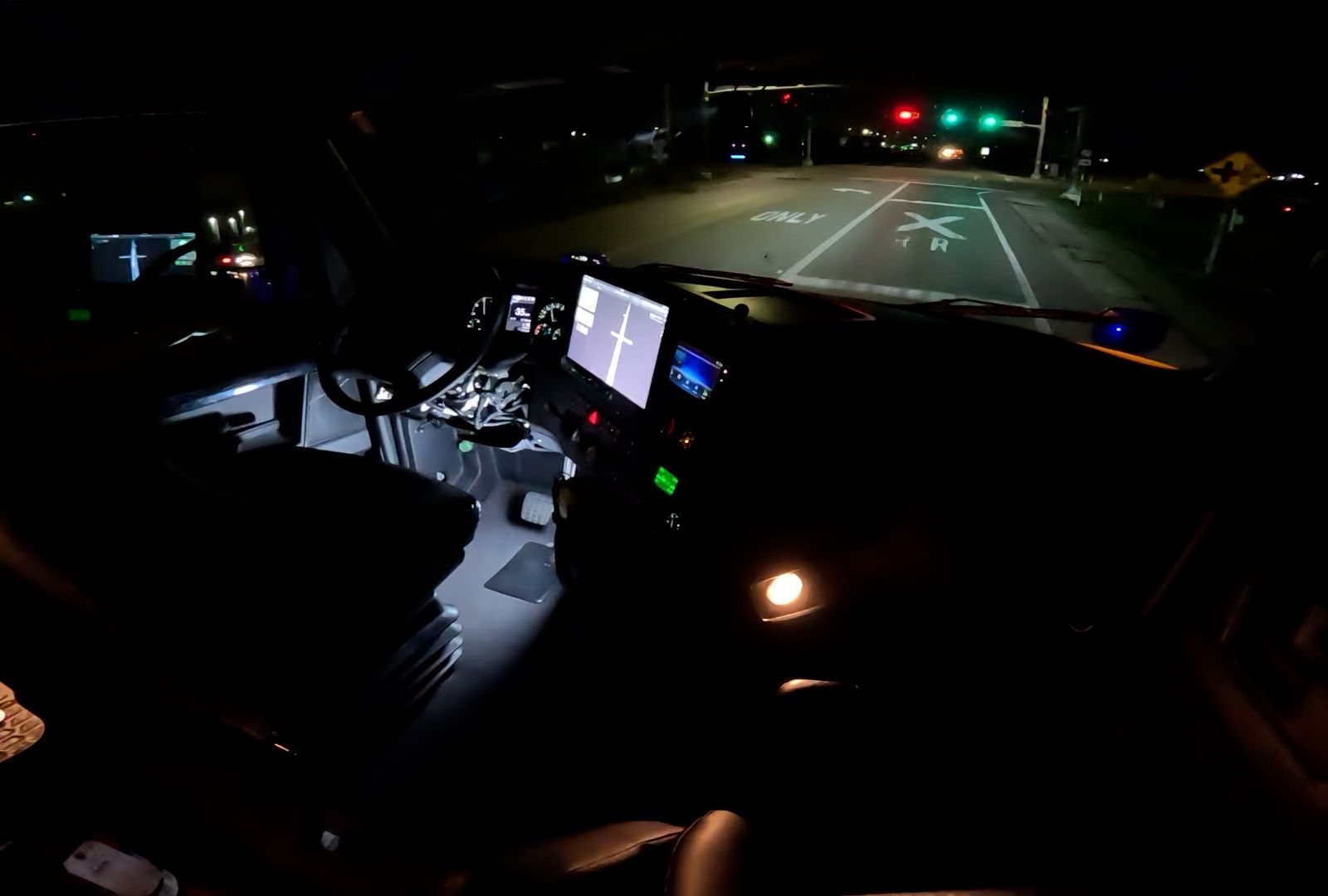
Autonomous Trucking’s Watershed Moment: Bot Auto Proves Less is More
Executive Summary
In this episode of The Road to Autonomy podcast, Grayson Brulte sits down Chuck Price, President, AI Kinetics to discuss Bot Auto’s successful 40-mile, fully driverless run with no human in the cab or operating the vehicle remotely.
Chuck calls this a “watershed event” as it was accomplished in under two years with less than $45 million in funding, a stark contrast to the budgets of competitors. The success of this run was driven by a lean, OEM-free strategy, is poised to create significant ripple effects, forcing a re-evaluation of technological roadmaps and commercialization strategies across the industry.
Key The Road to Autonomy Episode Questions Answered
How did Bot Auto achieve a fully autonomous run so quickly and with so little funding?
Bot Auto’s success is attributed to several key factors: their core engineering team had prior experience with a driver-out project, they used a “clean slate” architecture, and, most importantly, they intentionally avoided OEM partnerships to maintain speed and agility. This allowed a small team to work in a tightly integrated fashion, leading to a “stunning” result with less than $45 million in funding.
Are OEM partnerships a good strategy for autonomous trucking startups?
According to Chuck Price, early-stage OEM partnerships can be both a help and a hindrance, but they often slow down innovators. OEMs are conservative and have complex processes that can create “headwinds” for fast-moving tech companies. He suggests a better model is to prove the technology and its profitability first. Once a profitable business model is established, fleets will create demand, putting the tech company in a much stronger position to partner with an OEM.
What are the next steps for Bot Auto after this successful “proof point”?
The next major step is to open their first commercial lane. This phase is less about new technology development and more about mastering logistics. It involves negotiating endpoints with customers, mapping routes, and handling the operational details of picking up and dropping off loads. Chuck believes they can achieve this next milestone in “months,” not years, which would further accelerate Bot Auto’s path to commercialization.
Key The Road to Autonomy Topics & Timestamps
[00:45] How Bot Auto Achieved a Driverless Run in Under 2 Years
Chuck Price explains that Bot Auto’s success came from an experienced core team, a new architecture, and a lean strategy that completely avoided OEM interference to move faster.
[03:52] Are OEM Partnerships a Hindrance or a Help to Innovation?
Chuck Price argues that while OEMs can be helpful, their conservative nature and slow, consensus-driven processes often act as a hindrance to innovators trying to move quickly.
[09:40] The Next Steps: From “Proof Point” to Commercial Lanes
After establishing its technological “proof point,” Bot Auto’s next step is to open its first commercial lane, a move focused on mastering logistics and customer negotiations rather than overcoming new tech hurdles.
[13:45] Focusing on the Bottom Line, Not Just Top-Line Revenue
Unlike competitors focused on top-line revenue, Bot Auto’s CEO Xiaodi Hou is laser-focused on the bottom line, building a business model designed for profitability from the start.
[17:05] When to Bring in an OEM: A New Model for Partnership
The ideal time to partner with an OEM is after the technology is proven and can generate a profit, as this gets the attention of fleets who will then demand the product from manufacturers.
[21:00] The Potential for Contract Manufacturing in Trucking
The discussion explores the possibility that a contract manufacturer like Foxconn, who may be more aligned with an innovator’s mission, could emerge as a competitor to legacy OEMs in the trucking space.
[27:00] Ripple Effects: How Bot Auto’s Success Will Impact Competitors
Bot Auto’s success is expected to cause major ripple effects, as investors will now question why competitors are spending billions with little to show for it compared to Bot Auto’s lean and efficient model.
[30:30] The Power of AI as a Cost-Saving Unlock
Bot Auto utilizes a foundational, end-to-end AI approach not just for driving but for all business processes, which serves as a major unlock for reducing costs and increasing efficiency.
[38:00] How Tesla’s Semi with FSD Fits into the Competitive Landscape
Elon Musk and the Tesla Semi are always the competition in autonomy, but their near-term focus on shorter-haul electric trucks differs from Bot Auto’s long-haul diesel approach.
[43:45] The Current State of the Autonomous Trucking Industry
The autonomous trucking industry is showing tangible signs of maturation and is on the verge of commercial operations, but investors must now decide if they are backing the right players and strategies.
Full Episode Transcript
The Road to Autonomy Introduction: Welcome to The Road to Autonomy, the podcast shaping how Wall Street and industry executives think about the autonomy economy for today’s executives and investors. Simply following the headlines is not enough. That’s why our clients go beyond the podcast and the headlines. To get exclusive market intelligence and industry briefings, see what they see. Visit roadtoautonomy.com. That’s roadtoautonomy.com.
Grayson Brulte: Chuck, it’s great to have you back on the road to autonomy. Every time there’s big news, I get out my phone. I say one 800 call, Chuck, because you give really great analysis and insight into all things autonomous trucking from your decades of experience in this industry. And Chuck, we had big news this week, bought auto, pulled the driver, and I wanna say when they pulled the driver truck, I wanna say this for the audience, human list, there wasn’t a single soul May, maybe an an or two, but there wasn’t a soul in the driver’s cab. They did this under two years and under raising $45 million on a 40 mile run. I’ve been in that truck and I believe you have on the same run. Impressive. How the heck did they do this?
Chuck Price: Well, and I, I will extend the, uh, you know, the no humans. They also didn’t have a mission control with a remote, a remote driver, you know, poised, either, they were monitoring of course, as I understand it. Um, but. But there was no, there was no remote driver at all. So no humans involved in this, in this, uh, event. Um, and how they did it, , you might look at it and say, you know, come on, they’ve only been around two years and they only spent, you know, 40, $40 million. But you have to understand that this was the same core team that did the same. Project four years ago. , They, this is the second time they’ve pulled the driver out on public highways. While the company’s only been around for two years, that core team has been thinking about this problem for, uh, eight years. , And in the intervening years since they did it before, they’ve still been thinking about the approaches. And these are some of the best. Engineers, uh, in the industry, they’re superstars. , So they decided in that intervening time to use a new architecture that’s better than what they, what they did before. They did a, a clean slate approach, learning from, you know, their lessons from before to have a better hardware plan, a more robust system. And more and importantly, they didn’t have any OEM interference. When they, when they decided to do this, they said, you know, the last time we did it with OEMs involved, it slowed, it slowed the process way down. They knew what they needed to do. They knew how to modify the trucks. They had already done it in the past, so they said. Let’s keep it extremely lean. Only the best superstars on staff. It’s a small, tightly integrated team, so they didn’t have a bunch of departments doing different things. They all did it together in one room, and the result was stunning.
Grayson Brulte: it’s big news and you highlighted OEM interference and I wanna highlight for the audience, ’cause you come on, every time there’s big a autonomous trucking news, the last time you were on, we had a whole conversation around PACCARs, no statement on Auroras driver out. We saw they had to put a driver back. And the time before that you were here when Waymo shut, shut down Via So you have a clear understanding on this and you were on that original team. Does the OEM interference? This is a controversial question for you. Is the OEM hindrance or a help or when it comes to scaling autonomous trucking?
Chuck Price: it can actually be Both, but there’s, if you’re trying to move fast, there are a lot of headwinds involved in trying to get a major, highly conservative partner, , to be on the same page with you. , There are contractual terms that you have to negotiate. There are. Uh, processes you need to follow that are unrelated to making the system, in inherently unrelated to making the system safer. It’s just, it’s the process are, are more about getting a much larger organization to consensus and that’s very slow. , Taking this approach, removing the OEM from the equation and going with a retail truck. And just doing the modifications, means that you don’t have to go through those hurdles. You’re not planning to sell these trucks. These trucks are being used by you, , in your own, trucking as a service model. So it does make it far more efficient. That doesn’t mean you’re cutting any corners in terms of, , safety or engineering robustness. It just means you’re not having to bring along a thousand plus member organization, that is, that doesn’t have the same goals that you have, and has different priorities.
Grayson Brulte: And I wanna highlight and reemphasize a point outside of the Zeekrs for Waymo, the Jaguars, which are currently the only ones available publicly on the road. Those are upfitted very similar to what Bot Auto did. And I also want to go back because there’s a gentleman and, and he’s a friend and he is a wonderful gentleman and he gets a lot of crap is Don Burnette , the, the founder and CEO of Kodiak or Mr. Burnette early on, and you know this very well, said, We’re gonna bill this. We’re not gonna be, we’re not gonna be reliant on an OEM. To me, what Bot did, and the way the market’s reacted and the way that it it’s happening is a clear validation in Mr. Burnette’s strategy where. Build the, build the product. And that’s exactly, it seems like what Bot did.
Chuck Price: Yeah. And, , Kodiak is, , probably the, the only other company that took this lean approach. It did create, you know, challenges that, that they had to, to wrestle with. But I think they’ve been quite successful in, you know, picking, picking a market aggressively, attacking it with a very lean team. And, and they did a good job. So that Permian Basin work that they’re, they’re doing is, is great. Um, so yeah, so I think it, it does validate, you know, um. Uh, an idea that, that Don had, , I wasn’t on the same page when I was doing this before. , but, you know, looks like, looks like he’s, he, he’s right. And, and Xiaodi, he’s right with, with Bot.
Grayson Brulte: And to, to highlight that they’re operating half a dozen trucks, no human there in the Permian Basin, generating real revenue. So Kodiak has demonstrated from a commercialization standpoint that scaling without an OEM is possible and you could build a revenue generating business on that Bot has demonstrated they went 40 miles. And I wanna highlight that there was service, roads, highways, and also as I’m gonna put my little kid hat on. Little roads, main roads that went right to. The terminal. So Bot has achieved this 40 mile. It was a validation test, as they clearly stated in the release. Where do they go from here?
Chuck Price: Yeah, so it was a sort of a, we’ll call it a soup to nuts, uh, run. , It, they started in a parking lot. They were launched, you know, from a parking lot. , They started on small surface streets. They went through, uh, a little bit of a neighborhood, you know, so it was, it was all the stuff that you might expect, , you know, in, in the full spectrum of, of driving. So, so it was, it was a, a really good proof point that they had. They had met. Their safety case. Now, I would, I would argue personally that the word validation was probably a poor choice because they weren’t validating at that time. They were establishing a proof point. This is done. The validation happens on test tracks and happens under supervision because, , you’re during the validation, you are, you’re confident that it’s gonna work, but you’re, but you’re proving it out. They did all that, and then they wanted to publicly demonstrate that they had had essentially completed validation. So, so this was really a, a completion, uh, statement rather than the validation itself. Uh, so this, this run, I would not personally, I wouldn’t call this run a test run because that implies they didn’t know what the result was gonna be. , I call this, I like to call this a proof point, , but that’s why I’m not a marketing expert. You know, that’s probably not the right, those words probably don’t work well, uh, in the public. , But I think it does. The words either one distinguishes it from a commercial launch and the commercial launch is a future. You know, that that’s in their near future, I think.
Grayson Brulte: I think we can all agree, Chuck, that terminology in the autonomy economy is all over the map. It’s alphabet soup
Chuck Price: Yeah.
Grayson Brulte: there. There, there’s no general consensus, or I’ll use the term very loosely. There is no standard to what the terms mean. So I’m gonna use, let’s call it Chuck terminology. Proof point. Let’s check the box. They completed the first proof point. What’s the next proof point?
Chuck Price: I think the, the next work they’re going to need to be doing is opening up a, a first commercial lane, , now to, to operate the truck commercially. That has a number of elements. Uh, they do have partners while they, while they didn’t formally sign a contract with an OEM partner, they do have hardware partners. I’m sure they’re collaborating closely with them to make sure that everyone is comfortable with going to a, a commercial, uh, operation. Because, you know, things change when we’re going commercial, you know, money’s changing hands, and that, you know, that, that gets people’s attention. So I, I don’t know, I don’t have an insider’s view to know, you know, what that might look like, but I’m sure some of those things are going on in the background. They must be. , But also a, a, a real challenge is the logistics of opening a first run. It’s not just, you know, how many miles are you, are you, are you driving? That’s, that’s really the easy part. You know, you map it out, you run it, uh, you know, it works. What’s hard is the end points. , You have to negotiate with your customer. Where are you gonna pick up and drop off? Uh, are those suitable routes? Is it possible to get into their lot? Or do you have to do a, you know, a drop off, you know, a hub type model? That’s dependent, you know, Bot has proven that they can do surface streets, so they aren’t dependent on a hub, but it may turn out that the place they’re picking up. Their trailers from is not really accessible, , or, you know, safely accessible. Maybe it’s next to a school zone or a church or something. And they don’t, they don’t want to be operating in those kinds of areas. , But if it’s not, if it’s accessible, they’re, they have to work out, okay. How does the customer deal with the fact that there’s, uh, you know, a robot coming into their driveway? Do they have segregation of human traffic and. And automated, you know, those are, those are details that take time. , So, but they’re not, they’re not technology details, they’re logistical details. So Bot has proven with their, with their, uh, proof point that they have substantially de-risked the technology. So investors now who are looking at this, uh, should be looking at it with an eye towards. Can they build the business? You know, the technology is, is not completely de-risked, but it is, uh, it has now been shown to be greatly de-risked. So if you’re an a new investor investing in Bot, , your money is not going to speculative innovation. That hasn’t been proven out. They’ve proven out the innovations. , So now the bet is closer to. How are we developing, you know, investment in developing the lanes and in and in starting the initial processes of scaling, you know, building, building the business?
Grayson Brulte: What goes into building an autonomous trucking business? Is it mastering the logistics? Is it mastering the technology? Is it getting the loads? What goes into that?
Chuck Price: Yeah, it’s, it’s all the above. , And I believe they have good partners around getting, getting loads. You know, they’ve, they’ve already signed, one deal with, uh, Stevens that they’ve, they’ve announced, uh, they have, I’m, I’m sure they have other deals in the works that they’ll be announcing. So there’s plenty of business for them to, to take on. Uh, the, the work is, as I said before in, in negotiating the routes, the timing, the. Entry exit strategies. , Those take time, but don’t require millions of dollars to develop. They do need more trucks. But Xiaodi has done something that I think is, masterful in this approach, and that is he is laser focused on the Bottom line where every other. Uh, player so far has been focused on top line revenue. , And so part of what he’s investing in is, is getting that Bottom line, , you know, met so that he can actually build a profitable business, not just a money losing revenue generating business.
Grayson Brulte: What is owning and operating the service, that’s what Bots clearly publicly stated they’re gonna do. What does that unlock from an economic business model standpoint?
Chuck Price: it reduces the resistance to getting these trucks on the road with some level of scale if you decide that your business is to build the technology. Then sell the, sell the trucks to others for them to operate. There’s a lot more process involved in, getting the, receiving the acquiring companies trained in how to operate autonomy, , and, and aligning with their particular businesses, starting the business by saying, we are just gonna do it and we’re gonna do it profitably says. That, that, that opens the door for them to move more quickly to establish how it is done as a revenue generating and profit creating business, , you know, becoming an efficient operation. And then once they’ve done that, perhaps they have opportunities then to open other doors to bring in an OEM to, uh, turn this into. A product that others, other fleets could also acquire. , I, I think that is also on their long-term roadmap, , that it’s, it’s not just about them building a fleet, although they could do that. If they can make that profitable, they can do that and self fund, you know, with that fleet for four years. , And then, you know, if they, if they see an opportunity. Open it up for other fleets to, to buy in.
Grayson Brulte: You said something to me that stood out. There’s a lot of stuff to unpack there, but you said bring in an OEM that’s 15 minutes ago. We’re talking about the advantage he has is that bring in OEM now because it’s a level playing field, or why would you explore, bring it in now?
Chuck Price: I think you’d do it later. I think you’d do it after the technology is. Is a hundred percent, you know, established and proven in the market to be able to make money. , It’s not enough to be in the, in the market to make revenue because anybody can, anybody can, uh, burn revenue. Uh, our friends at Aurora announced publicly that they spent $5 for every dollar they earned in revenue. That’s not a business. If you, if you reach a point where you can say, this can be done profitably, that’s going to get the attention of fleets and those fleets are going to then be asking the OEMs to consider building these trucks, , you know, from the factory so that they can buy them. At that point, it might make economic sense for Bot to talk to an OEM and say, okay, we have a stable. Profitable technology. If you’re ready to, to build this in a factory as, as opposed to us doing the upfit ourselves, we’d be happy to work with you. I don’t know if that’s what they’re gonna do, but that certainly is, is a potential future. It brings in the OEM at a time when Both players are are ready as opposed to spending a lot of time having to prove to an OEM. That this might work in the future.
Grayson Brulte: this is Monday morning quarterback or, or 2020. Hindsight, do you think, and you have experienced this, going back to Peloton, that, do you think that autonomous trucking companies in general, not particular, anyone in particular and general rush too fast to get an an OEM deal instead of building out the business case, building out technology and validating it? So I use a poker terms so they have a better hand of cards.
Chuck Price: Yeah, I think, I think we were all, uh, pretty naive. And thought that signing an OEM would secure, uh, a better future for the technology. , In the end, OEMs are very efficient at a, at assembling trucks. , It, it turns out, for the most part, they aren’t that efficient in innovating. That’s, that’s not their business. Their business is to build very stable, highly reliable. Vehicle systems that require a minimum of field support. Truck fleets measure OEMs on, , how reliable the vehicles are, how few times the vehicles have to pull over on the side of the road ’cause they couldn’t complete a mission. Um, so OEMs are, are rightly very conservative when it comes to new technology. We didn’t anticipate that when we were signing OEM deals and didn’t anticipate how difficult it would be to, , to move an OEM to a, a very significant new technology, in, in such a way that they could continue to meet their re reliability metrics. So I think we all. , You know, had had to deal with that in, in a variety of ways.
Grayson Brulte: So, let me put it to you this way. If you look at the PassCar side, which have a lot of experience in the Robotaxi PassCar side, there’s a, an emerging trends been emerging for a few years. One, OEMs are not very good at building an autonomous driving stack or when they acquire a company. Let’s look at Argo with the. The Ford and vw, they shut it down. They’re not very good at integrating it and, and building it. And now they’re looking at, you’re seeing the emergence of the licensing model where you have the Nuro Uber deal that’s been licensed and now you’re starting to see the emergence of contract manufacturers ’cause Foxconnn has purchased a Nissan plant in Japan. Do we get to the point in trucking where similar trends emerge where any autonomous trucking company, let’s say, goes to, to Acme Truck OEM says, okay. I need a thousand trucks and they build them for ’em with with no string attacks and it starts to open up this contract manufacturing. ’cause in my opinion, when you get contract manufacturing, you can scale a lot faster without the restraints. Could you imagine, you’re good at this, you live in the valley. Could you imagine if Apple had all the restraints on the iPhone that the autonomous trucking companies have, or what you can and can’t do? We wouldn’t be having an iPhone today. So does that open up contract manufacturing?
Chuck Price: it’s possible. , The OEMs are incredibly efficient at manufacturing. You know, they have, long established supply chain relationships that are hard to build up. , But if you get a company, you know, you can get a Foxconn type company who also does that well. You know, there’s a possibility that this could create competition for the, the legacy OEMs. And I have to say all of what I’m saying about the OEMs is not to disparage them. They have a mission and it’s an important one, and they’re very good at building highly efficient vehicles that meet all the regulatory approval, you know, processes that have highly reliable supply chains. That will have parts availability, you know, for, for 10 years, uh, after the, after the truck is, is launched or more. So, so they do a great job, but their mission, it turns out, is different from the mission of an innovator in technology. And, uh, it may be the case that a contract manufacturer like Foxconnn may be more aligned with an innovator. And that may create future competition for the legacy, uh, suppliers. But I think time will tell on that.
Grayson Brulte: I read an interesting book a a few months back Gambling Man. It was the biography of Masa Son by Lionel Barber, the former editor of The Financial Times. And if you read that book, I’m about to say to you, you won’t think it’s so crazy. So I’m gonna tell you, read the book if you wanna laugh at what I’m about to ask. Chuck here. Masa Controls Stack AV Bryan Salesky’s New Startup Stack AV, the autonomous trucking company, which. They’re on a media blackouts since day one. There’s nothing to analyze. There’s nothing to discuss. It’s on a complete media blackout. Does Masa wake up one day? And this just happened, by the way. This was well documented in the WeWork stuff and say, you know what? I don’t want to deal with an OEM anymore. Masa’s gonna go buy a contract manufacturer. Let’s go stack, and if that happens, it seems to me the entire economics change. The cost per mile goes from here to here. What do you think about that scenario? It’s plausible. I know it’s out there, but you read the book, you’ll understand it’s plausible.
Chuck Price: Of course it’s plausible if he’s. He’s, he’s one of those who has the resources to do such a thing. You know, Massa Son, , you know, Musk, you know, these people can make radical change and, and cause that to ripple through the, through the industry and change the industry. We’ve already seen that with, with Tesla and, and, uh, Elon’s approach. Massa Son could do the same thing. would marrying, , a contract manufacturer with a stack developer, of, of any, any strike, whether it’s Stack AI or Bot, or anyone else, would that change how they, uh, would it change their pace? Would it change their cost? I don’t, I don’t know. And, and I. , Yes, you could potentially bring costs down, but there’s a lot in, there’s, there’s a lot that happens in building a truck that you’re going to sell to others. , And I think that’s a, that’s a key distinction between, , you know, what some of the others are doing and what Bot is doing. , And I don’t know what Stack wants to do, and I don’t know what Massa Son wants to do with Stack. So, , I think, I think, you know, the jury is out. I think we could get surprised again, you know, Bot was, was a huge, very positive surprise. And I used huge, I, I, on LinkedIn, I said, I said huge when I, uh, when I posted about it. \ And I used that word for a reason. . It’s huge because by doing what they did, they, they established that they have proved their safety case, which is one of the hardest things to do in, uh, developing an autonomous vehicle. They secured regulatory approval, that is hard and, and important of course. So all of the re the regulators, federal and state. Knew about this and approved it. That’s hard. , They lapped their competition. , Xiaodi was the first to do it four years ago, long before any of the competition, did it, and now he’s done it again. So he’s now twice gone, driver out, gone through this process. So he has proven, without a doubt. That this team can do this, repeatedly and he did it with so much less money, so much less resource. This is gonna have ripple effects through the industry. ’cause I can guarantee you investors are looking right now at their investments and going to the leaders of the other companies and saying. Why have I invested so much money and gotten so little in all this time when this upstart has come out and, and done it with less than a hundred million dollars. In fact, less than $50 million. Others are spending 600 million a year or more and not delivering
Grayson Brulte: what are the ripple effects? Is it having new technology overhaul is, or I’ll give you an example. This is a very interesting example. I’m going back and chuck history here. So sorry, Chuck, I gotta go back and chuck history ’cause you have experience with this and there’s a great story about this. You were at Oracle. For years, Oracle was just viewed as the database company. You know, they do hospitality software, they just do big databases. And then Mr. Ellison, he said, oh, he got, he rode that AI train and boy, oh boy, we saw him. What that’s done to Oracle. It’s completely changed. The company is one of these older companies that are, I say older, older than Bot. And this industry, as you know, is very young. So they start to pull Larry Ellison and start to shift the company towards newer technology. What are the ripple effects do you see that are coming?
Chuck Price: Yeah. I, I think, I think we will see, , some, some. Consideration of the current approach, Isuspect investors and boards are today asking questions, you know, why are you continuing this approach? This approach is not bearing fruit in, in the, you know, at the, at the pace we need. Why are you building up so much, you know, digging such a deep hole. I mean, if you’re spending billion. And have no path to profitability in, in any foreseeable future. All you have is a path to revenue. You know, scaling a business that is by process, losing money, hand over fist with every mile you drive. That’s not a business. And investors will see that. And you know, one thing, so. \ I’m not keen on sharing private conversations, with, with individuals, but, , it sank in deeply, , to me when Xiaodi talked about Bottom line is all that matters cost per mile. You have to be able to, to deliver, at a cost that justifies. Doing the work for profit. And, , and he’s, he’s on a path to do that. And he’s, he’s focused on that. And he’s the first one that I’ve heard say that. And I think as a result, he, he is gonna raise money, but one of the things that he’s also said is all the money he raises from investors goes to research and development, not. To running the operational business. , And I think that’s important. If you’re an investor, you don’t want your money going to, , the $4 it takes to raise $1 in revenue, that’s, that’s dumb investing. , So he has no intention of doing that. , He intends the money only to go to the, to the technology portion of it and what it costs to get to the point of, of doing that commercially. He intends to, you know, to use other means that aren’t tapping investors, , to, to fund the operational business. And then he intends to, you know, to pay that, pay that back with, with profits. So it’s an in, it’s an incredibly refreshing, , take on how to do an autonomous business. And he is, he’s the only one that said this.
Grayson Brulte: is this able to achieve because of the model where he’s gonna own and operate the fleet? Is that how Bot’s gonna be able to un unlock this? Is this a different model that’s currently out there in the market?
Chuck Price: Yes. , If you sort of go under the covers a bit, it’s not just the technology, it’s also all of the processes around running a fleet business. He’s integrated. AI approaches to everything. , You know, the logistics side as well. So there’s innovation that is not yet being shown. It was demonstrated in the run, but they didn’t, they didn’t talk about every, you know, they didn’t public talk about every aspect of what they were doing, but there’s a lot more under the covers, uh, in their model that reduces costs. Their, their, uh, dispatch reliability is surprisingly high. It’s un unlike, you know, other autonomous fleets that I’ve, you know, , been able to see, including my previous one. , Dispatch reliability is, is a huge cost, and with autonomy it’s hard to get high because you’re developing technology, but, Xiaodi’s numbers as revealed to me, and I won’t share the actual numbers. They’re stunning. They’re in line with commercial fleets using production trucks, and that’s shocking at this stage to be that good.
Grayson Brulte: Are we seeing, at Bot Auto, what we’re seeing in the public markets with some of the largest companies in the world where AI is the great cost savings unlock.
Chuck Price: AI is a big unlock. He is using, using a, you know, a gen ai, a foundational ai, approach. , It is, it is not, I, I would say. It is not just pure, you know, show it a bunch of pictures and teach it to drive. Uh, there is, there is more depth to it than that. And a lot of, a lot of sort of redundancy in the software and self supervision, uh, self-diagnosis that’s also at play,, in this, in this system. So, and, and that’s required when you’re building a, a safety. Safety technology. So yes, it is the big unlock. They’re able to move very quickly, Both in their development processes, which are very heavily, very heavily AI driven now, and the, the operational, uh, system,
Grayson Brulte: Is it an end-to-end system?
Chuck Price: yeah. You would, uh, and Xiaodi talked about this. It is a, it is, uh, an end to end, Mostly ai. I think, you know, if you dive into the details, it might not be a hundred percent pure end to end when you look at some of the, the, you know, diagnostics and, you know, other stuff that goes on, uh, there are certainly some, there’s some certainly some di discrete programming, , in that, but it is essentially an end-to-end AI approach.
Grayson Brulte: So AI is allowing Bot to accelerate the, the, the business faster, the, the technology faster. So let’s get down to brass tacts. You have, you have a 40 mile proof point, as you called it, with, with humanless, no human in, in the, in the cab. How do you get from, say, a Houston to San Antonio run that’s 273 miles, about four hours and 10 minutes with no traffic. How do you get to that proof point and does that become proof point number two? And if it is. What’s proof 3?
Chuck Price: so proof point 2 then is building the first, commercial ready lane. , And as I said before, that requires negotiating, negotiating with the customers. Where are you gonna pick up and drop off? What’s the timing? You can do it daytime, nighttime, you know, what frequency, can you do. That’s a big part. Another part is of course, mapping the lane and making sure you can. You can do that, but Bot has gotten that down to, , a science. You know, they can do that very quickly. Their ODD is, is quite broad. , They’re handling construction. They handle night, they handle, weather, and they’ve already demonstrated that. So, , you know, it’s, it’s. As much as anything. It’s a matter of, of, you know, resource, you know, getting the, getting the trucks on the road. , There’s, there are costs involved, \ and, and logistics. I think largely the tech part, part of it is solved, but they’ve gotta map the lane. They’ve, , they’ve got to, uh, you know, do some. Verification runs with safety drivers, , and they’ve gotta negotiate with the, with the customers.
Grayson Brulte: So with Proofpoint two, are we looking at 12 months, 24 months, 36 months? When do you think they’ll be able to achieve realistically Proofpoint two.
Chuck Price: Oh, I, I, I couldn’t, I, I don’t have insight into their schedule, but I think it’s months. I think it’s, it’s, it’s months. It’s not a year. I think it’s my personal belief.
Grayson Brulte: wow. So, okay. So that, that’s a shocker to me. That’s, that, that’s aggressive. I, I like this. Chuck, you’re, you’re on a fire today, buddy. Okay. So let’s say we’ll stick to your timeline of months for proof 2. Now what’s proof 3? Is that Commer commercial true commercialization, or is that something else?
Chuck Price: I think they’re probably going to want to open more than one lane to prove that it’s not just a one off. To establish, you know, confidence with their, with their customers. So I, I would guess they do a lane and then they do an additional lane. , In, in the meantime, , there are the details that they have to work through, you know, on the technology side with their suppliers to make sure that the, you know, the suppliers and there are some, some key suppliers. Even though they haven’t signed with an OEM, they have certain, they have key suppliers that I’m sure have their own, you know, requirements before they go. They do it commercially. And I, you know, it’s always the case when you’re talking with any of your partners that there’s a difference between development stage and commercial, operational stage. When money starts changing hands, liabilities start, you know, developing. And they wanna make sure that they’re, that they’re right, uh, before they say yes. And that’s mostly, uh, business and risk mitigation, you know, and, and perhaps even, you know, if they’re generating revenue, there may be some, some, you know, money exchange with partners kinds of discussions as well. Although I, I, again, I have no insight into. Into any of that. , I just know that that’s, that’s sort of what happens behind the scenes. You know, one of their suppliers may say, well, we want a penny per mile, you know, if we’re gonna be a part of this, well maybe, maybe they’ll get a penny per mile. , Or, or not. Maybe none of that’s going on. But I think that’s, that’s part of the hitting, you know, flipping the switch and saying, this is now commercial.
Grayson Brulte: Is there even enough room in the, in the margin to support a penny per mile? What type of numbers are are we looking at to put that into perspective?
Chuck Price: I’m not trying to open a can of worms there. , Uh, so I, I don’t even, I don’t know if even such a negotiation is happening. I’m just saying in theory, I could imagine a partner who’s supplying something to the vehicle saying, Hey, I should get a piece of this too. . I would imagine Xiaodi is trying his best to bat down, things like that because he’s laser focused on cost per mile. , And he doesn’t want any tax that he can avoid, uh, on that.
Grayson Brulte: Do you know another individual who’s, who’s laser focused on cost? Always has been. He gets beat up all the time for Elon Musk and Chuck. I don’t wanna say, you know what Froze offer this week we had a press release from Uber. The Tesla semi will be available on Uber Freight. That gives it a clear path to scale. You and I Both know. At some point, FSD supervised will be available on semi and at some point in the future, FSD unsupervised will be available. Uber freight’s giving them a lot of freight to haul. Is, is, is, should we, and from an autonomous trucking standpoint, not overlook this press release because based on who’s running the show, based on the ability to scale and manufacture? Yes, I know it’s complexities. But Tesla’s got manufacturing down pretty good now.
Chuck Price: Tesla, you’re absolutely right. Elon is cost focused. I shouldn’t say Xiaodi is the only one. Elon is the, is the other one. , And, and to a degree Don as well at, at Kodiak. , But, I think the big differentiator, , between, Elon’s approach with the semi and a company like Bot is that. Bots doing it on diesel trucks, which have, have much longer range. So the kind of moves that you’ll, you’ll be able to do with a semi will, of course be limited in the near term by range. I think Elon’s gonna work through that, uh, and have solutions for that. That some of which will probably be, you know, as, as is his want. , Highly innovative and surprising. , So I can imagine, , you know, intermediate charging stops where trailers are automatically exchanged somehow, uh, between trucks while one goes off to charge and the other continues to minimize the delay. You know, the dwell while you’re, while you’re going to a charger, who knows? So, so I never bet against Elon, uh, is my first rule. Uh, I always like to bet with. Elon, , I do think that the market is a little different between, you know, long haul diesel trucks that are autonomous and shorter haul electric trucks, which are, is still gonna have a great business. And it’s going to scale. Proba, you know, once he gets to the point where this is autonomous, his ability to scale is, is already established. , He, he can build these trucks and he can build them, uh, uh, cheaply. So, so I, I’d say he, he is and always is the competition. Whenever you’re doing something autonomous, he’s the competition.
Grayson Brulte: What happens when he turns on FSD supervised? In semi, how does the industry react?
Chuck Price: I’m not sure that’s going to be a, a large effect if it’s supervised. Um, I think drivers will appreciate it. It, it should reduce accidents. But it’s not going to reduce costs because the driver is still present. So this logistics industry is, is driven by costs. So what’s going to flip the switch for this industry is when he goes unsupervised and that’s going to be huge. , Just as it is, you know, with Bot. , So, so I think it will have an effect. I think drivers will appreciate it. , It might attract drivers to, to driving the semi. But I don’t think it will be the, you know, the industry changing, changing event. I, I’m looking forward to seeing it though.
Grayson Brulte: It’d be great. So when this is, I’m gonna parallel this now with the car side. When Tesla semi begins testing, FSD supervised, and then they lay out a plan to go to unsupervised, just like you and I see in the car side, you have the, the, the pro-Tesla people. The, I want nothing to do with the people and the people in the middle. Do we see the same thing happen on the truck side that we’re seeing on cars where if you want to call it, there’s a great divide
Chuck Price: You mean in terms of opinion?
Grayson Brulte: in terms of opinion because there’s individuals on the car side. It’s never gonna work. It’s going, you and I know we test it all the time. It works end of the day.
Chuck Price: yeah. Of, of course there will be. I mean, this will go on forever. , There are certain institutional. Players who, uh, don’t want to see this, , and are fighting, fighting in some cases irrationally, uh, against, against this, uh, I won’t name them, but you can imagine who they are. They have large power, , , you know, organizations that are, are deeply tied into the government, , that don’t want to see this happen. , But it’s going to happen. And it will, you know, it, it will certainly change the industry, I think for the better. , But you know, time will tell how these players, you know, continue to react.
Grayson Brulte: Putting this, this whole conversation, which is, I love having you on here when there’s big news to talk about. ’cause you give honest opinion and really great analysis on. So putting this all together, what are your current thoughts on the current state of the autonomous trucking industry? Do you feel it’s healthy, it’s it’s growing. What, what are your thoughts on the current state of the industry?
Chuck Price: I think we are now seeing, uh, glimmers of proof that the technology is reaching. A level of maturation that that means we’re going to see commercial operations, , in trucking. , We’re also seeing glimmers of this in, in cars. I think that’s, that is healthy. That means we’re actually making, tangible progress. What I think is less than healthy are, , you know, some of the players. Who are operating with, you know, one might say dinosaur, uh, stacks that, um, that need, they need to rethink what they’re doing, , and they need to make real changes to, to move the ball forward and can they survive such a thing. You know, there are massive investments that have gone in into these companies. At some level, an investor might say it’s too big to fail, so I’m gonna push them to, you know, making a change. Others might say, you know, these guys aren’t getting it done, and, you know, I’m, I’m walking away from it and, and investing elsewhere. ’cause the industry’s going to happen. This, this is now, I think it’s mature enough that, that with confidence, I can say autonomy’s going to happen. , And it’s going to happen in the near term. , Those investors who are, you know, wanting to be a part of it, now they have to ask, you know, am I investing in the right, in the right play? Do I need to move to a different play? , Or other investors who’ve been waiting, sitting on the sidelines, maybe now’s the time to strike,
Grayson Brulte: Bob Dylan once famously sang, Chuck the times. They are a change. The autonomous trucking industry is changing as Bot Auto has proved that you can take the power of AI and make a truck successfully. Drive itself with no human. Now the next step for Bot is to prove and to validate. You just have to use that word to validate to the market that you can, that they can scale it on multiple lanes in multiple routes. And when they do it, we’re gonna have ’em here on the podcast. And you know what’s gonna happen, Chuck? You’re gonna come back as the in-house autonomous trucking analyst to break it down for us. What do we need to look for in the autonomous trucking market?
Chuck Price: Well, I think takeaways, , from what, what’s happened, I think what Bot did is a watershed event. , They have demonstrated that you can do much more with much less. , And, and have a big accomplishment. They’ve, they’ve proven that commercialization is within reach, and this is going to have, I think, significant impact on how investors view this market. It’s Both positive, especially for the innovators who are advancing the ball, and it’s gonna be negative for those who have been sort of dragging their feet. , In Bot’s case they’ve shown. If you, if you lean forward with the most advanced, most efficient, technologies, and you focus on the Bottom line instead of the top line in, in how you’re sort of moving your business forward, then you can have a success far beyond what, what people thought. So I’m, I’m very bullish on, on the future, given this development.
Grayson Brulte: I’m bullish on the future ’cause we’re on the road to autonomy. I would say embrace ai, build the future. The future is bright. The future autonomous. The future is autonomous trucking. Chuck, as always, sir, thank you so much for coming on The Road to Autonomy today.
Chuck Price: Thanks for having me.
The future is bright. The future is autonomous. The future is The Road to Autonomy.
Subscribe to This Week in The Autonomy Economy™
Join institutional investors and industry leaders who read This Week in The Autonomy Economy every Sunday. Each edition delivers exclusive insight and commentary on the autonomy economy, helping you stay ahead of what's next.