


Tesla Cybercab Launch Day Field Report
Field Report · Austin · Tesla · Robotaxi Ride Analysis
Filed By: David Moss on September 9, 2026
Field Verified
Key Tesla Cybercab Austin Launch Day Field Report Findings
How many Cybercabs are on the Austin network?
45 Cybercabs are registered on the network. Tesla has 420 Robotaxis in the state of Texas. Waymo remains ahead at just under 1,000, but the gap is closing daily. Public access was gated during launch week, with rides restricted to media until 5:00 PM on September 4 and from 6:30 PM to 10:00 PM on September 3.
Is the Cybercab a real purpose-built robotaxi or a Model Y without a steering wheel?
Purpose-built. Two connected front seats with first-class airline legroom, no steering wheel, automatic doors that open on approach and close when the rider walks away, braille on the emergency door latch and pullover button, and a wheelchair-height entry sill. The vehicle stopped opening its door mid-swing when a blind passenger walked into its path, then finished opening once he cleared.
Where does the experience fall short?
The software layer trails the hardware. Grok cannot change the destination from the cabin and instead pushes the request to the rider’s phone. Starlink is not installed. Climate will not go below 66 degrees in 100 degree Austin heat. The seats have no heating, no ventilation, and no bolstering. The turn signal chime is gone.
Tesla Cybercab Austin Launch Day Field Report
Special Field Correspondent David Moss was in Austin for the Cybercab launch night and first rode minutes after Tesla opened the network. Over roughly six rides across two days, including three or four at night, the Cybercab proved that Tesla’s purpose-built robotaxi hardware is ahead of its in-cabin software. The vehicle is quiet, spacious, and thoughtfully designed for accessibility.
Cybercabs are built in Austin and operate across the full Austin ODD (operational design domain), including the newly expanded service area.
Cybercab Launch Night at Austin City Limits
Tesla held the launch event downtown at Austin City Limits, a 2,750-person venue. The room was far from full. Employees outnumbered media. Sawyer Merritt described it as an employee appreciation event rather than a launch, and that reading matched what we saw on the floor.
The program ran roughly 20 minutes and started late. Ashok Elluswamy, Head of Tesla AI, was the main speaker alongside Eric Early, Robotaxi Engineering Leader, and two other Tesla employees. They spoke for about 15 minutes, declared the Cybercab open, and sent attendees out to ride around Austin.
Accessibility was a deliberate theme of the event. Megan Smith, Staff Program Manager, Robotaxi, personally sought out Gary Moss, David’s dad, who is blind to answer questions and stressed that the team wants the vehicle to work for anyone with a disability. The entry height of the Cybercab is designed to match a standard wheelchair seat so a rider can slide across into the cabin.
The ride departed from 2nd Street directly in front of the venue. The pickup was smooth. The ride lasted 63 minutes and cost $35. We rode out to the northern edge of the service area and back downtown.
Ordering a Cybercab
Ordering a Cybercab was quick. One morning a ride arrived in 52 seconds from booking to unlocking door. The typical wait time after testing Cybercab for two days was sub-5 minutes. While these times are amazing, we treat them as an outlier based on Robotaxi’s historical track record.
Cybercab Interior
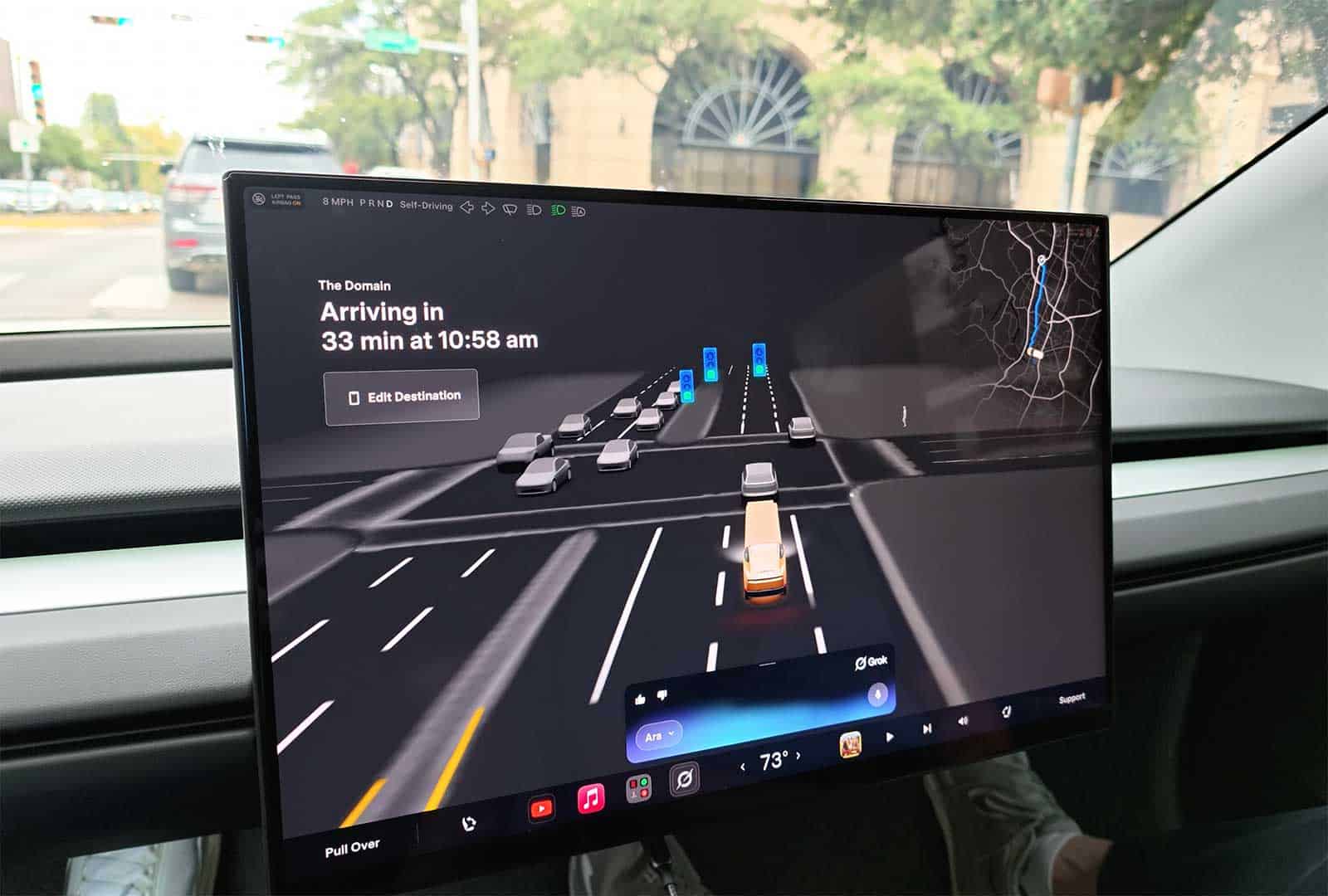
The Cybercab doors open automatically as the rider approaches. Once seatbelts are on the door closes on its own. To start the ride, you simply tape on the center screen as you would do in the Model Y robotaxi.
With no steering wheel, the cabin feels larger than the exterior suggests. The two front seats are connected and slide as a unit. Reclining the seatback moves the seat forward to preserve room. At full recline a five foot ten to five foot eleven rider cannot touch the front bulkhead with his feet and cannot reach the screen, which pushes controls to the phone app. The seats are lounge seats with no bolstering, so riders slide in turns. Legroom compares to first-class airline seating.
Accessibility details are physical, not marketing. The emergency door latch and the emergency pullover button both carry braille. A blind rider can find the latch by feel and exit unassisted. The single interior light activates from either side. The door sensing stopped the door mid-swing when a pedestrian was in its path on a tight street, then completed the motion once he moved. That behavior had nothing to do with the rider’s disability. It is the default.
The interior camera lens is three to four times the size of a standard Tesla cabin camera. There is no glass roof and no rear glass. The cabin still reads bright because of the large front window.
The trunk can hold two large suitcases, enough for an airport run. Doors and trunk auto-close when the rider walks away with a locked phone. Before exit, the screen shows three camera feeds, left, rear, and right, so the rider can confirm the door path is clear.
Cybercab In-Vehicle Software
Grok is integrated but limited in Cybercab. Grok answers ride questions accurately, including distance and arrival time, and voice selection works. Grok runs on Tesla’s account rather than the rider’s, so it does not consume rider credits and does not save to rider memory. NSFW and storytelling modes are absent and Grok cannot start the ride, yet.
Grok cannot change the destination. A voice request to reroute to a coffee shop produced a push notification to the phone rather than a reroute. Destination changes made in the app are instant. The vehicle repriced to $15.02, updated the arrival time, and began a lane change within seconds. The app allowed unlimited destination changes until another rider hailed the vehicle, at which point it locked.
Media is cloud synced. A YouTube Premium account signed in on one robotaxi was already logged in on the next. Netflix, Hulu, YouTube, Apple Music, Spotify, and the arcade are available. The Dune buggy racing game is gone. Starlink version 5 is not live and these vehicles do not have the Starlink dish installed. Connectivity is cellular and was reliable across the service area.
Cybercab Climate and Comfort
There are no heated or ventilated seats in Cybercab. The climate floor is 66 degrees on a day Austin exceeded 100. A Model 3 goes to 60 and then to low. Model Y robotaxis have the reverse limit and would not go above 71. Fan speed, vent split, and direction all work normally.
Ambient lighting is fully RGB adjustable from the app and syncs to music at night. USB-C ports and window switches are present. There is a center armrest and a coat hanger that does not hold much.
Cybercab Ride
The Cybercab is unbelievably quiet. The glass is thin single pane, not double pane acoustic glass, yet road noise is low. The one exception was a loud sport bike on a night ride whose exhaust frequency cut straight through the cabin. Everything else was smooth.
The turn signal chime is gone. Tesla removed it across the unsupervised fleet roughly a month ago. Gary Moss, a blind individual who regularly rides in robotaxis described the difference from human drivers plainly. No hard braking, no last-minute turns, no shouting at the driver next to us. He compared the automatic doors to a chauffeur opening the door, a meaningful upgrade over the flush Model Y handle he struggles to operate.
Cybercab Outlook
Tesla is building the Cybercab in Austin and operating it in Austin. 45 Cybercabs and 420 Robotaxi vehicles in Texas put Tesla within range of Waymo’s just under 1,000 vehicles, with a lower cost purpose-built platform now in public service.
The launch event was small and internal. The vehicle is not. The hardware, accessibility engineering, and ride quality are ahead of the software layer. Grok, climate limits, and connectivity are the items to watch on the next update.
The future is bright. The future is autonomous. The future is field reports.
Subscribe to This Week in The Autonomy Economy™
Join institutional investors and industry leaders who read This Week in The Autonomy Economy every Sunday. Each edition delivers exclusive insight and commentary on the autonomy economy, helping you stay ahead of what's next.