


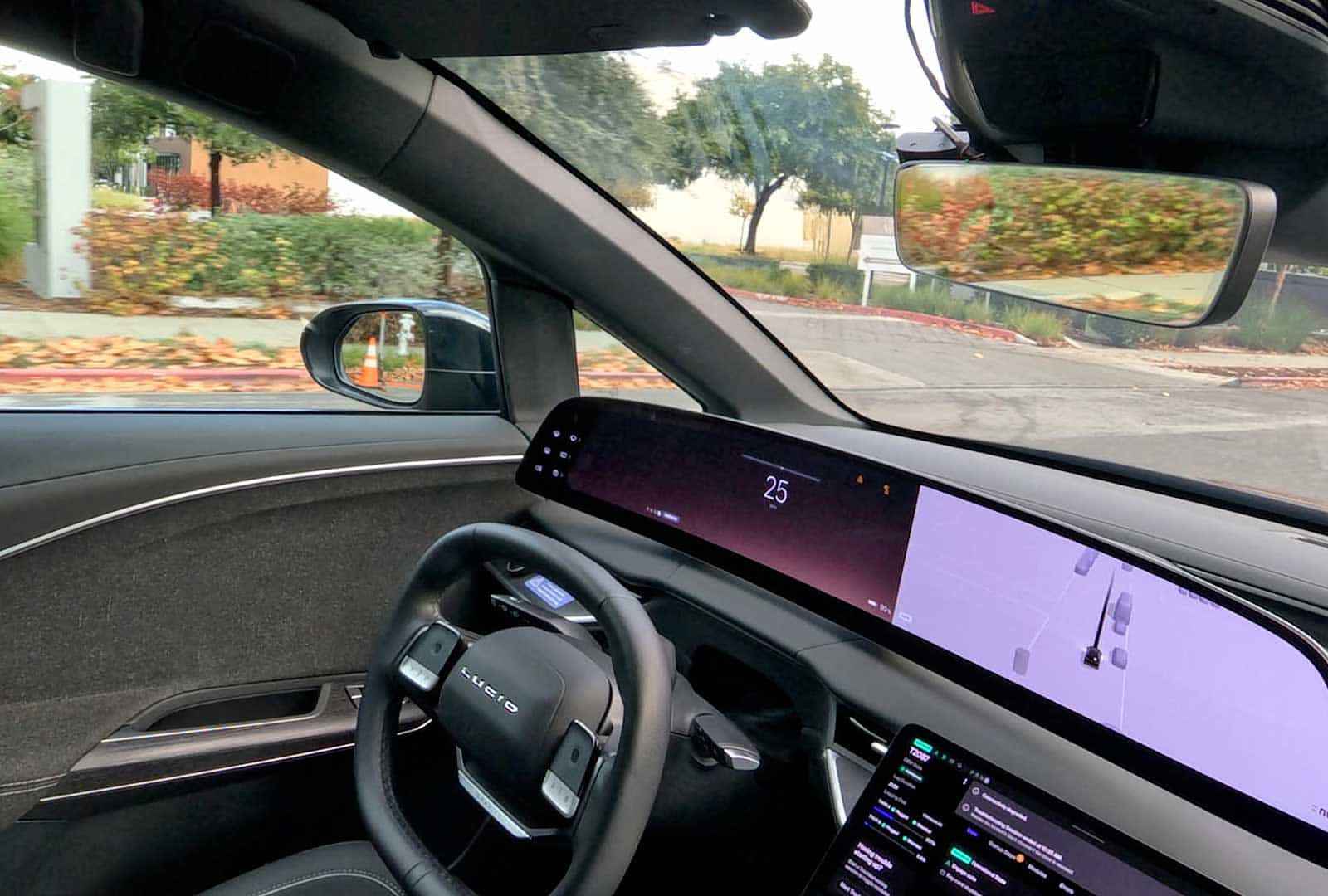
Nuro/Lucid/Uber Go Driverless, But Paid Rides Are Still Months Away
This week on Autonomy Signals presented by KPMG, Grayson Brulte and Rob Grant discuss Nuro/Lucid/Uber pulling safety drivers in four San Francisco Bay Area cities, WeRide’s international robotaxi expansion and Q3 performance, and Doosan Bobcat’s autonomous manure-handling demonstration with Maum.AI.
Nuro/Lucid/Uber have begun driverless public road testing in Palo Alto, Mountain View, Los Altos, and Sunnyvale using over 100 upgraded Lucid Gravity vehicles, roughly six months after Nuro secured its California DMV driverless testing permit.
While employee rides are coming soon and a commercial launch has been floated for Q1 2027, Rob notes that Nuro still needs CPUC driverless pilot and deployment approvals, a suburban-only footprint, and a 45 mph cap make paid fares in California unlikely before mid-to-late 2027.
WeRide is leaning heavily into overseas markets as its global Level 4 fleet reaches roughly 4,100 vehicles across more than 60 cities and 13 countries, including about 600 robotaxis across Abu Dhabi and Dubai and a national operating permit in Spain ahead of a Madrid launch. Even as WeRide posts positive unit economics in Guangzhou at 21 trips per vehicle per day, fierce domestic pricing wars and the strain of operating across distant markets mean international execution and eventual profitability remain key tests.
Doosan Bobcat and AI partner Maum.AI demonstrated a driverless skid steer loader clearing and loading manure inside a cattle barn in South Korea without human intervention, using vision-language-action AI to read the workspace and plan paths on the fly. The demo highlights how physical AI can tackle hard-to-staff, hazardous chores, though Rob and OMEGA point to animal startle and barn safety risks as well as limited 18-month ROI on smaller farms under 500 head.
Episode Chapters
- 0:00 KPMG Sponsor Introduction
- 01:45 Signal 1: Nuro/Lucid/Uber Go Driverless in the Bay Area
- 38:01 Signal 2: WeRide’s Overseas Expansion
- 01:02:53 Signal 3: Doosan Bobcat and Maum.AI Move Manure
Key takeaways
- Uber, Nuro, and Lucid began driverless testing of Lucid Gravity vehicles in four suburban Bay Area towns six months after Nuro received its California DMV driverless permit, but paid public rides remain blocked until Nuro completes multi-step CPUC pilot and deployment approvals, making a Q1 2027 commercial launch unlikely and pointing closer to mid-2027 or later.
- Nuro's initial footprint is limited to four suburban peninsula cities with speed and road restrictions and faces a 24-to-36-month expansion lag relative to Waymo, compounded by Nuro ranking seventh out of eight in the Road to Autonomy licensing index (21.2) despite Uber's roughly $500 million investment.
- WeRide scaled its global Level 4 fleet to about 4,100 vehicles across 60-plus cities in 13 countries—including roughly 2,300 active robotaxis and 600 robotaxis across Abu Dhabi and Dubai with overseas operations driving over 90% of robotaxi revenue (up 204% year-over-year to over $14 million in Q3) and positive unit economics reported in Guangzhou.
- International markets including the UAE, Saudi Arabia, and Europe are emerging as the key growth and margin battleground as domestic Chinese pricing remains brutal, though expanding across many regions and embodiments (robotaxis, buses, sweepers, ADAS, AI infrastructure) risks spreading engineering, capital, and operations thin.
- Doosan Bobcat and Maum.AI demonstrated a fully driverless skid steer loader using a vision-language-action model for autonomous manure scraping and loading in South Korea within five months, highlighting physical AI's fit for labor-short jobs alongside risks of startling cattle, misidentifying obstacles or animals, and weak 18-month ROI on farms under 500 head.
Questions answered in this episode of Autonomy Signals
- Why is a Q1 2027 commercial robotaxi launch for Uber, Nuro, and Lucid in California unlikely?
- Although Nuro holds a California DMV driverless permit and began driverless testing of Lucid Gravity vehicles in four peninsula cities, it still has to go through sequential CPUC driverless pilot and deployment approvals that involve public comments, hearings, and a five-commissioner vote. Because those CPUC processes have not yet been completed, paid public rides are more likely to arrive around mid-2027 or later.
- Why did Nuro get the California driverless permit rather than Uber?
- California requires the manufacturer or the entity operating the autonomous driving system to hold the permit, rather than a rideshare platform or fleet owner. As a result, Uber must wait for individual AV partners to secure their own permits in California.
- What is driving WeRide's recent momentum and where are the main risks?
- WeRide scaled to roughly 4,100 Level 4 vehicles across 60-plus cities in 13 countries, with overseas operations generating over 90% of its robotaxi revenue and 600 robotaxis running across Abu Dhabi and Dubai. However, brutal pricing competition in mainland China weighs on domestic results, and stretching across many regions, vehicle types, and AI embodiments risks spreading engineering, capital, and operations thin.
- Why does the Doosan Bobcat and Maum.AI manure-handling demo matter, and what challenges remain?
- It shows a vision-language-action model translating real-time visual perception directly into hydraulic and driving actions for a strenuous, hard-to-staff barn task without relying on pre-programmed routes. At the same time, it faces unproven safety cases around startling cattle or misreading barn hazards and animals, and it is unlikely to deliver a positive 18-month ROI on farms with fewer than 500 head.
Operators in this episode
Presented By

The future is bright. The future is autonomous. The future is The Road to Autonomy.
Subscribe to This Week in The Autonomy Economy™
Join institutional investors and industry leaders who read This Week in The Autonomy Economy every Sunday. Each edition delivers exclusive insight and commentary on the autonomy economy, helping you stay ahead of what's next.