


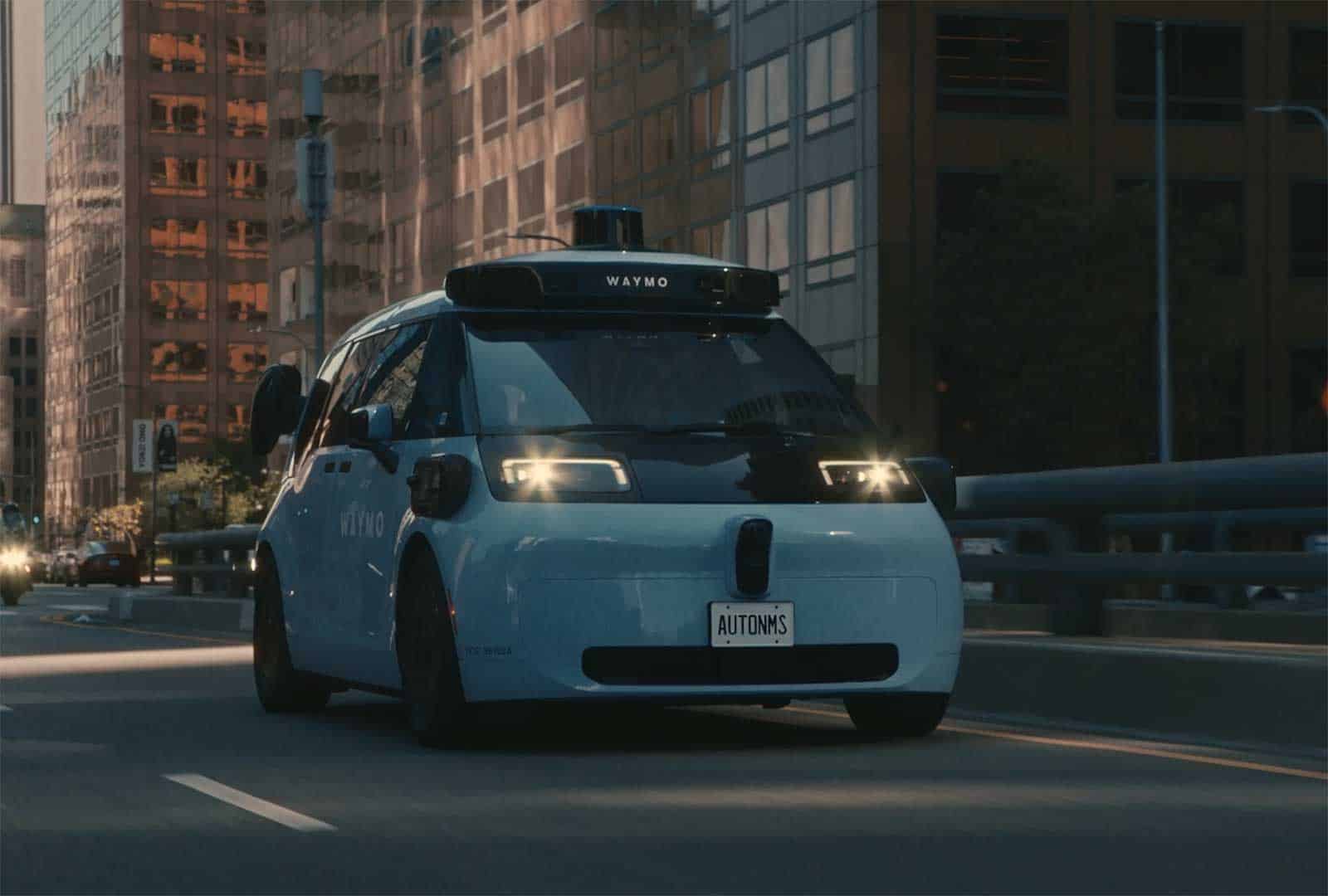
This Week in The Autonomy Economy™
100% of California’s Paid Robotaxi Rides Belong to Waymo
This Week in the Autonomy Economy, Waymo’s golden advantage grew like a gold deposit entering Fort Knox, Nevada opened the door to scaling fully autonomous robotaxis on the Strip, and Tesla put a date on the board.
That date is September 3, and it appears to be the day Tesla puts the Cybercab into commercial service on the streets of Austin. Once the Cybercab enters commercial service, the era of scale will be upon us, and the spotlight will turn to supply.
Tesla owns the factory, controls the costs, and is vertically integrated. Waymo has the most mature stack, but does not own the factory. Could this lead Waymo to further pull back the curtain on their Toyota relationship, or to announce a larger order from Hyundai, which is increasing output at its Metaplant America in Georgia?
Only time will tell what Waymo does to secure hundreds of thousands of vehicles. No matter what Waymo does, we are now entering the scale phase. Very few companies will be able to compete with Waymo and Tesla at scale, which could lead to market consolidation sooner rather than later.
📰 Need to Know: This Week in the Autonomy Economy
Does anyone else operate a paid commercial robotaxi service in California besides Waymo?
No. Waymo holds a 100% share of California’s paid commercial robotaxi market. While headlines often lump competitors into the paid robotaxi conversation, every other permit holder, including Nuro, Tensor, WeRide, and Zoox operates under CPUC Pilot Programs. By law, pilot programs are prohibited from charging passenger fares. Tesla operates under a traditional charter-party carrier (limousine) permit with safety drivers.
What makes Waymo’s CPUC Advice Letter No. 4 approval a milestone for scaling?
The California Public Utilities Commission (CPUC) extended Waymo’s fare-collecting authority across 18 California counties. Covering 40,000 square miles and 25 million residents, it represents the largest single regulatory expansion of a commercial robotaxi service in U.S. history. Waymo is cleared to operate paid rides day and night across freeways, highways, and rural roads, positioning its California paid trip run-rate to cross 2 million monthly by Q1 2027.
Why is Tesla’s Austin launch date significant for the broader autonomy market?
Tesla’s targeted September 3 commercial launch of the Cybercab in Austin marks the transition of the autonomous industry from a regulatory phase into a scale and supply phase. Unlike operators who rely on partner automakers, Tesla owns its manufacturing facilities, controls production costs, and maintains complete vertical integration. This capability enables high-volume fleet deployment on day one and forces hardware-light competitors to solve supply chain constraints.
How is Waymo addressing hardware control and vehicle supply constraints as it enters the scaling phase?
Waymo is targeting both silicon and vehicle manufacturing:
Custom Silicon: Waymo unveiled a custom 5nm ASIC chip designed to handle front-end sensor fusion with over 1,000 TOPS of compute, reducing system latency and hardware costs.
Fleet Vehicles: Waymo is expanding public access to its custom Zeekr-built Ojai vehicle while scaling production with partners like Hyundai at its Georgia Metaplant to secure the volume needed for global expansion.
How are global markets expanding commercial robotaxi deployments outside the U.S.?
Nevada: Granted commercial permits to Tesla, Waymo, and Uber’s Aviari subsidiary for paid driverless operations in Clark County (Las Vegas).
Dubai: Uber and Baidu Apollo Go launched fully autonomous, paid driverless robotaxi services.
South Korea: Seoul expanded its late-night autonomous taxi fleet count from 7 to 19 while expanding service throughout the Gangnam district.
Europe: Uber deployed supervised robotaxi services with Pony AI and Verne in Zagreb, Croatia, while launching sidewalk robot deliveries with Coco Robotics in Finland.
What’s Moving the Markets
100% of California’s Paid Robotaxi Rides Belong to Waymo
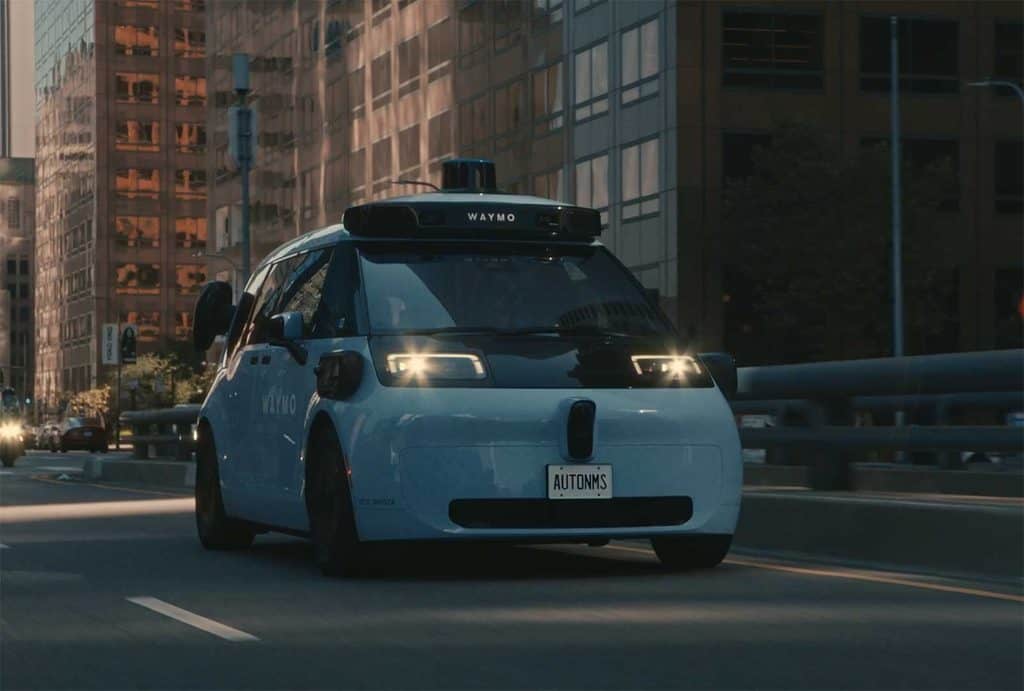
On August 14, 2026, the CPUC (California Public Utilities Commission) approved Waymo’s Advice Letter No. 4, extending its fare-collecting authority across 18 California counties.
The territory spans roughly 40,000 square miles and 25 million residents, and it covers freeways, highways, rural roads, and rail crossings, day and night, in rain, fog, and hail. It is the largest single regulatory expansion of a commercial robotaxi service in U.S. history.
Within a week, that approval was sharing a news cycle with coverage of Zoox’s first paid rides and Tesla’s Bay Area service, and the three stories blurred into a narrative that California now has multiple paid robotaxi operators. It does not. Only one company operates a paid commercial robotaxi service in California. That company is Waymo, and its share of the state’s paid commercial robotaxi market is 100%.
In June, Waymo completed 315,000 weekly paid trips in California, a 1.37 million monthly run-rate, with an average trip length of 3.9 miles. Every other robotaxi operator holding a CPUC permit, including Nuro, Tensor, WeRide, and Zoox, is operating under a pilot program. Per CPUC regulations, companies operating under a pilot program, either drivered or driverless, are barred from charging fares.
This is the distinction the headlines keep missing. Here is where every operator actually stands today, according to OMEGA by AUTNMY AI.
- Tesla | Tesla holds no California DMV autonomous vehicle testing permit and no CPUC autonomous vehicle passenger-service permit. Its California rides operate under a standard charter-party carrier permit, the same license a limousine company holds. As CPUC Deputy Executive Director Pat Tsen stated in March, Tesla “is not operating an autonomous vehicle service” in California. A charter-party permit carries none of the safety reporting, public data transparency, or quarterly filing requirements that apply to Waymo.
- Zoox | Zoox holds DMV driverless testing authority and reports to the CPUC as a Pilot Program participant. Its San Francisco rides remain free. The July 30 NHTSA Part 555 exemption that cleared Zoox’s purpose-built vehicle for commercial deployment of up to 2,500 units per year is a real and significant federal milestone, but a federal exemption is not a California commercial authorization. Zoox’s first paid rides launched in Las Vegas this month, not in California.
- Nuro | Nuro secured a DMV driverless testing permit in May 2026 for Lucid Gravity SUVs, limited to 45 mph, in Santa Clara and San Mateo counties. Its CPUC standing is a Drivered Pilot Permit. It holds no paid driverless passenger authority.
- WeRide | WeRide holds DMV driverless testing authority and a CPUC Pilot Program permit covering both drivered and driverless passenger service, effective through August 2, 2027, in San Jose and surrounding areas. The permit prohibits fares and rides for the general public.
- Tensor | Tensor holds DMV driverless testing authority and a CPUC Drivered Pilot Permit. It holds no driverless passenger authority and no fare-collecting authority.
- May Mobility | May Mobility holds a drivered-testing permit only, tied to the Martinez CCTA micro-transit zone. It holds no DMV driverless deployment permit. Its commercial robotaxi launches are in Atlanta, Georgia, and Arlington, Texas.
- Avride | Avride holds no California DMV driverless testing or deployment permit and no CPUC passenger-service authorization.
Then there are the headlines. On August 10th, The Los Angeles Times ran the headline, Zoox to begin paid rides following first-of-its-kind regulatory approval. The headline was accurate for anyone who read to the paragraph about Las Vegas and ignored the featured photo of a Zoox in San Francisco.
Headlines such as this one are not isolated. They are widespread. San Francisco local news station KRON 4 ran a July 22nd headline that said, Tesla Robotaxi service now goes to SFO.
Tesla’s Bay Area service is not a robotaxi service. It is a ride-hail service with an employee in the driver’s seat operating under a limousine permit, which allowed the company to secure an SFO limousine permit granting access to the airport.
The headlines will not tell you that. We will, as we go beyond the headlines. No matter the headlines, the fact remains that Waymo is the only company operating a paid robotaxi service in California.
Every day that passes, Waymo’s competitive advantage grows in the Golden State as competitors remain on the outside looking in. That includes Uber which has grand hybrid robotaxi ambitions, but does not currently have a partner with the proper permits to operate a paid driverless commercial service in California.
The longer it takes for one of Uber’s autonomous vehicle partners or Tesla to secure every permit required to operate a paid commercial driverless robotaxi service in California, the larger Waymo’s advantage becomes. Even when the right permits are secured, they could be geographically limited as to where the operator can operate and under what conditions.
In the meantime, Waymo keeps racking up the trips. Waymo’s weekly paid trips in California have climbed from roughly 122,000 at the end of 2024 to 315,000 in June 2026. With freeways restored and the legal ability to operate in 18 counties, we project California monthly paid trips crossing 2 million by Q1 2027.
One company. One permit stack. 100% of the paid robotaxi rides in California. As we have said many times, he who holds the permits holds the power. While we focused on California today, pay very close attention to which companies control the Automated Passenger Services (APS) permits in London.
Control the permits, control your own destiny. Waymo clearly understands this, and the company is operating one of the most sophisticated playbooks in the autonomy economy.
Our Take: Alphabet never listened to Sir Christopher Hohn, TCI Fund Management and his infamous November 15, 2022 letter to Sundar Pichai where he wrote “Unfortunately, enthusiasm for self-driving cars has collapsed and competitors have exited the market” citing Ford and VW. Mr. Pichai was right, Sir Hohn was wrong. Two years prior, Uber “sold” ATG to Aurora and exited autonomy. History can be a harsh judge, but looking back at it, Mr. Pichai has been right more than once.
The Road to Autonomy Robotaxi Index
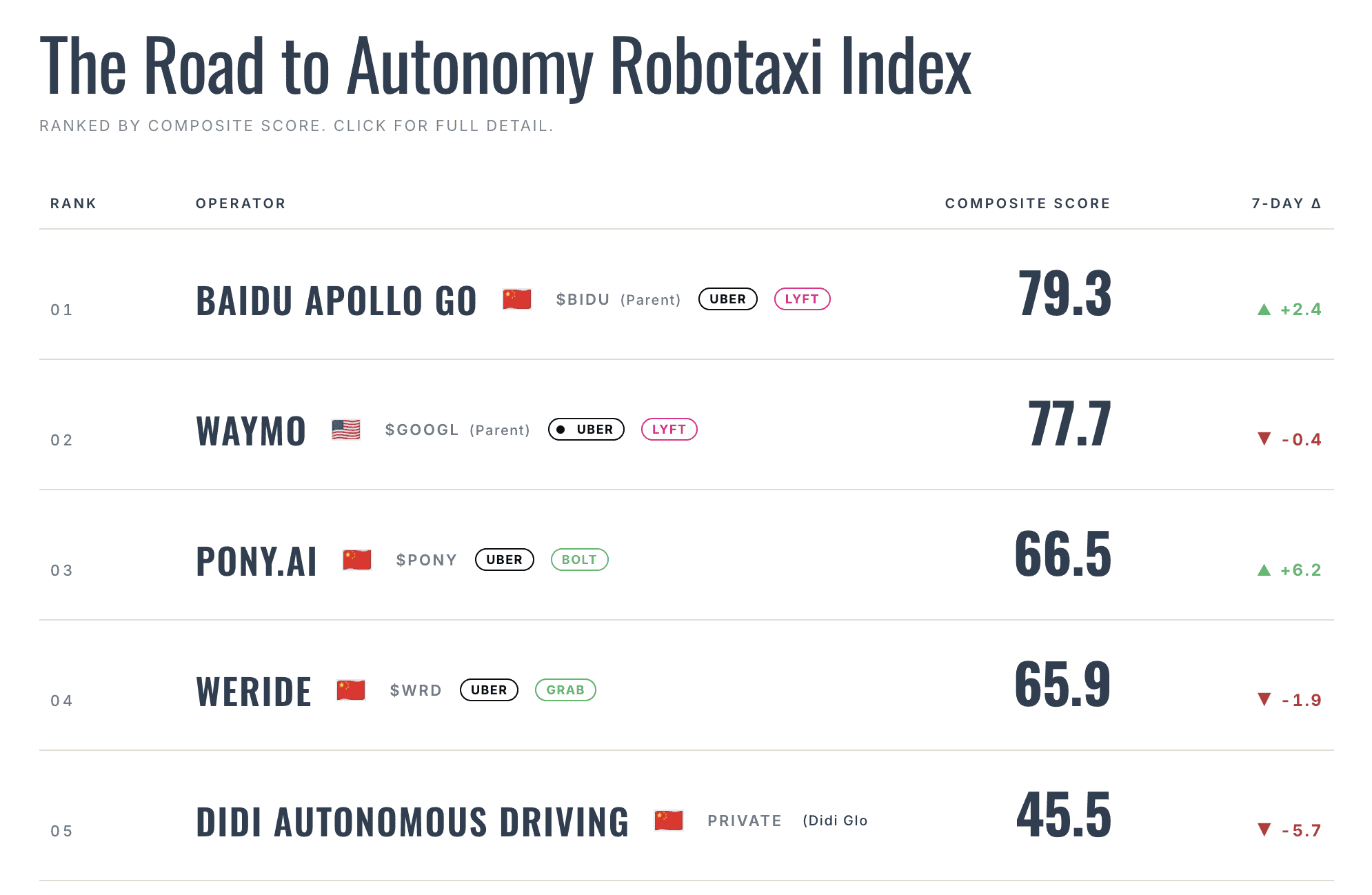
📈 Follow @AutonomyIndices on X for the latest updates on The Road to Autonomy Indices. Updates every 12 hours.
Piquing Our Interest
Waymo Secures Further CPUC Approval Waymo now holds the legal authority to operate a paid, fully autonomous robotaxi service across 18 California counties, covering roughly 75% of the state’s population after the CPUC granted approval for expansion.
Waymo Unveils Custom Chip Waymo’s new purpose-built 5nm ASIC chip processes sensor data with ultra-low latency. This custom silicon provides greater architectural control and reduces overall hardware costs as Waymo prepares to enter the global scaling phase.
Waymo Doubles Lobbying Spending Waymo doubled its U.S. federal lobbying spend to over $1 million in Q2 2026, intensifying a policy battle against Uber which is advocating for hybrid networks.
Waymo Opens Ojai to All Riders in Los Angeles, Phoenix, and San Francisco The Oh-Hi (Ojai) era at Waymo has officially begun, as the company has opened paid service in the Ojai vehicle to all riders in Los Angeles, Phoenix and San Francisco.
Waymo Opens Public Service in Houston Back in April, we visited Houston and rode around Space City in a Waymo. Now, the service is officially open to the public, making Houston Waymo’s 10th public market.
Waymo’s San Diego Service Coming Online in a Few Months In just a few months, Waymo will begin operating paid commercial service in San Diego according to NBC 7 San Diego.
Waymo’s Denver Service Coming Online “Very Soon” “Very soon” Waymo will begin paid commercial service in Denver according to The Colorado Sun.
Nevada Approves Tesla, Waymo, and Uber to Launch Paid Robotaxi Services in Las Vegas The Nevada Transportation Authority (NTA) has granted commercial permits to Tesla, Waymo, and Uber’s Aviari subsidiary (Most likely for Motional) to operate paid fully autonomous robotaxi services in Clark County.
Serve Robotics Expands Post-Uber As Serve Robotics says goodbye to Uber, the company has expanded their partnership with DoorDash, announced a new partnership with Grubhub and introduced Beacon, their new countertop hardware device designed to streamline restaurant pickups.
Uber Eats is Now Delivering via Coco Robotics in Finland In partnership with Coco Robotics, Uber Eats has launched autonomous robot delivery in Finland, marking its first market in the EU.
Uber Launches Supervised European Robotaxi Service with Pony AI and Verne Uber has launched supervised robotaxi service in limited parts of Zagreb, Croatia with partners Pony AI and Verne.
Uber and Baidu Apollo Go Launch Fully Autonomous Service in Dubai Uber and Baidu Apollo Go have launched a paid, fully autonomous (unsupervised) robotaxi service in Dubai. Passengers can book rides through a dedicated Autonomous tier or play autonomous roulette when requesting a ride on the UberX or Uber Comfort tiers.
Robotaxis Are Scaling in Dubai In Dubai,robotaxis have collectively driven over4 million kilometers (2.4 million miles) and completed 7,613 passenger trips.
In London, Cabbies are Planning Skulduggery First no Uber, now it’s no robotaxis! London’s famous black cab drivers are planning a skulduggery strategy to slow down the growth of robotaxis in England’s capital.
Momenta, XHEART, and QNX Partner to Build ISO 26262 ASIL D Certified Autonomous Driving Platform Momenta has partnered with chipmaker XHEART and BlackBerry’s QNX division to launch a fully integrated, ISO 26262 ASIL D certified driving platform.
Seoul to Triple Late-Night Autonomous Taxis in Gangnam The Seoul Metropolitan Government is expanding the number of late-night autonomous taxis that they allow to operate. The vehicle count will grow from seven to 19 as the government increased the service area to cover all Gangnam roads, including previously restricted school zones.
📰 Follow @RoadToAutonomy on X for our latest thoughts and insights on the autonomy economy.
Trending on X
It’s happening September 3rd in Austin. Cybercab is about to go commercial. This isn’t just a huge moment for Tesla; it’s a huge moment for the autonomy economy, and one that will accelerate the supply debate.
Tesla can crank out hundreds of thousands of Cybercabs. Waymo has Alphabet’s balance sheet, a new chip, and a Hyundai relationship, so it doesn’t have a supply issue either.
As we enter the next phase in the robotaxi industry, supply will be one of the key metrics to watch.
If you’re wondering how Tesla will be able to deploy Cybercab on public roads, AUTNMY AI co-founder Rob Grant gave a master class this week on Autonomy Signals presented by KPMG. You can watch the Tesla’s Cybercab Self-Certification Strategy segment on X.
Our take: Never bet against Elon.
No Wheel, No Pedals, No Driver, Cybercab Launch Is Imminent
This week on Autonomy Signals presented by KPMG, Grayson Brulte and Rob Grant discuss Tesla preparing to launch the steering wheel-free and pedal-free Cybercab in Austin, Waymo unlocking commercial driverless service across 18 California counties, and SoftBank leading a $200 million Series A in Gravis Robotics that values the company at $1 billion.
Can Uber’s Robotaxis Scale?
This week on Autonomy Markets, Grayson Brulte and Walter Piecyk discuss Waymo’s California regulatory moat, Cybercab’s pending commercial launch and Uber’s series of supervised launches in the UK and Europe.