


This Week in The Autonomy Economy™
The Great Butter War Comes for Autonomy
This Week in the Autonomy Economy, the great butter war of the late 1880s appears to be re-emerging autonomously, Uber continued to accelerate their global autonomy plans, and we launched The Road to Autonomy Indices.
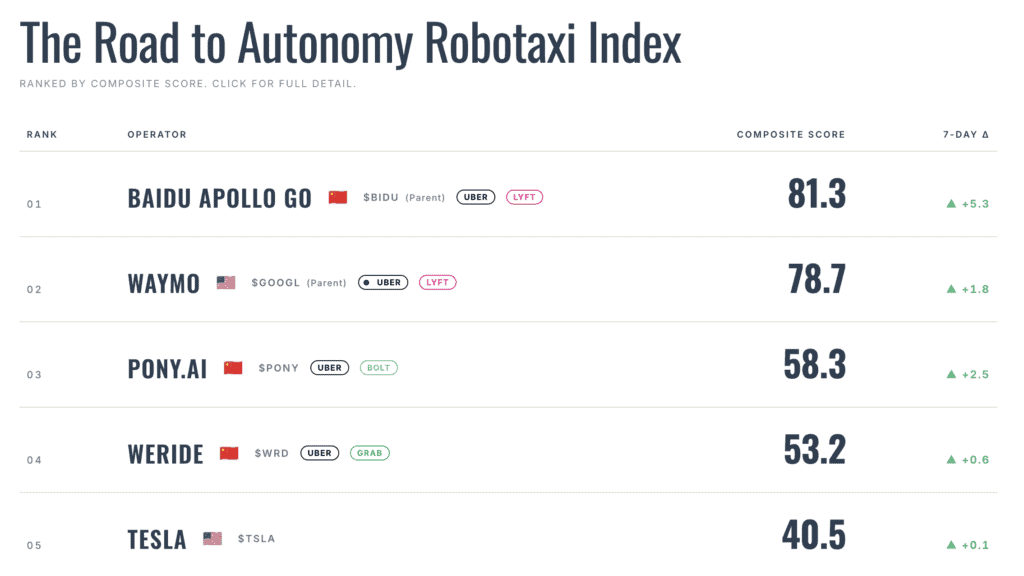
The Road to Autonomy Indices are comprised of four indexes, Robotaxis, Autonomous Driving Licensing, Autonomous Trucks and Delivery Bots. Each index is capped at 100, refreshed every 12 hours, and cryptographically sealed and stamped by independent timestamp services to RFC 3161, the Time-Stamp Protocol.
The goal of the Indices is to measure the commercial viability of each company indexed. Each company’s composite weighting is broken down into six categories: Operations, Scale, Revenue, Commercial, Manufacturing and Safety.
Every 12 hours the composite score is updated along with an OMEGA’s Take explaining why the score changed. All data that goes into OMEGA comes from publicly available sources and licensed data only. There is no scraping and no MNPI in the algorithm.
Over time, as the Autonomy Economy continues to expand, we will be adding more indexes to The Road to Autonomy Indices.
📰 Need to Know: This Week in the Autonomy Economy
What are The Road to Autonomy Indices, and how do they evaluate companies?
The Road to Autonomy Indices serve as a newly launched, real-time benchmarking system engineered to measure the commercial viability of autonomous vehicle operators. This framework tracks four distinct indexes: Robotaxis, Autonomous Driving Licensing, Autonomous Trucks, and Delivery Bots, with each index capped at a composite score of 100. Every 12 hours, the scores are refreshed and cryptographically sealed using independent RFC 3161 Time-Stamp Protocol services to ensure complete data integrity.
A company’s composite weighting is calculated using six core metrics: Operations, Scale, Revenue, Commercial, Manufacturing, and Safety. To ensure strict compliance and objectivity, the underlying algorithm relies entirely on publicly available and licensed data, completely avoiding web scraping or Material Non-Public Information (MNPI).
Why is the industry talking about a Great Butter War re-emerging in Washington, D.C.?
History is repeating itself in the nation’s capital through a classic display of regulatory capture. In the late 1880s, the powerful U.S. dairy lobby weaponized the legislative system by pushing for the Oleomargarine Act of 1886 and passing anti-color laws in over 30 states to ban margarine companies from dyeing their product yellow, effectively protecting their own market monopoly.
Today, Councilmember Charles Allen’s Autonomous Vehicle Deployment Authorization Amendment Act of 2026 appears to use the exact same playbook. Industry insiders argue that an entrenched local incumbent is leveraging lobbyist money to draft a highly restrictive deployment framework, constructing a defensive moat that stifles free-market competition at the direct expense of consumers.
Exactly how expensive would it be for a robotaxi operator to launch in D.C. under this proposed bill?
Under the proposed D.C. framework, an autonomous vehicle company faces an administrative paywall surpassing $6 million before it can even facilitate its first paid passenger trip. To start, an operator must participate in the local Autonomous Vehicle Testing Program for at least 180 days and log a minimum of 250,000 testing miles within the District.
Financially, the bill demands a staggering, nonrefundable $1,000,000 application fee for an initial commercial permit, followed by an additional nonrefundable $5,000,000 fee immediately upon permit approval. Even after launching, companies would be subjected to heavy ongoing operational taxes, including a $0.15 fee for every single vehicle mile traveled alongside a $10,000 annual registration fee per vehicle.
What is the Airbnb clause in the D.C. bill, and how does it hit everyday Tesla owners?
Buried within the 24-page legislation is a restrictive statute mirroring the New York Local Law 18 playbook, which effectively decimated city Airbnb listings in the early 2020s by imposing impossible registration hurdles. In this bill, the so-called Airbnb clause mandates that an autonomous driving system can only be legally engaged on public roadways if it is operated by a permitted commercial fleet or a licensed tester.
By explicitly limiting autonomy to these two categories, the statute creates a de facto ban on personally owned autonomous vehicles. Consequently, even if Tesla successfully achieves full FSD Unsupervised capabilities, everyday consumers would be legally prohibited from engaging the system on D.C. streets or adding their personal vehicles to a shared autonomous rideshare network.
What other major moves are shifting the global autonomous market right now?
The broader autonomy market is experiencing rapid acceleration across multiple global fronts, highlighted by recent regulatory filings and major corporate alliances. A recent EPA filing leaked the official specs for Tesla’s Cybercab, confirming a highly efficient powertrain featuring a 3,113-pound body, 219 horsepower, and a 48 kWh battery for a vehicle already certified and in production.
Simultaneously, Stellantis, Wayve, and Uber have signed a joint memorandum of understanding to deploy Level 4 robotaxis internationally, targeting major hubs like London and Tokyo starting this year. Furthermore, Mobileye is executing a massive structural pivot by transitioning from a technology supplier to a vertical fleet operator, aiming to launch its own driverless service in a U.S. city by 2027. This Western momentum matches aggressive overseas expansion, as China’s Baidu has officially exported its driver-out commercial operations to the Jumeirah area of Dubai.
What’s Moving the Markets
The Great Butter War Comes for Autonomy
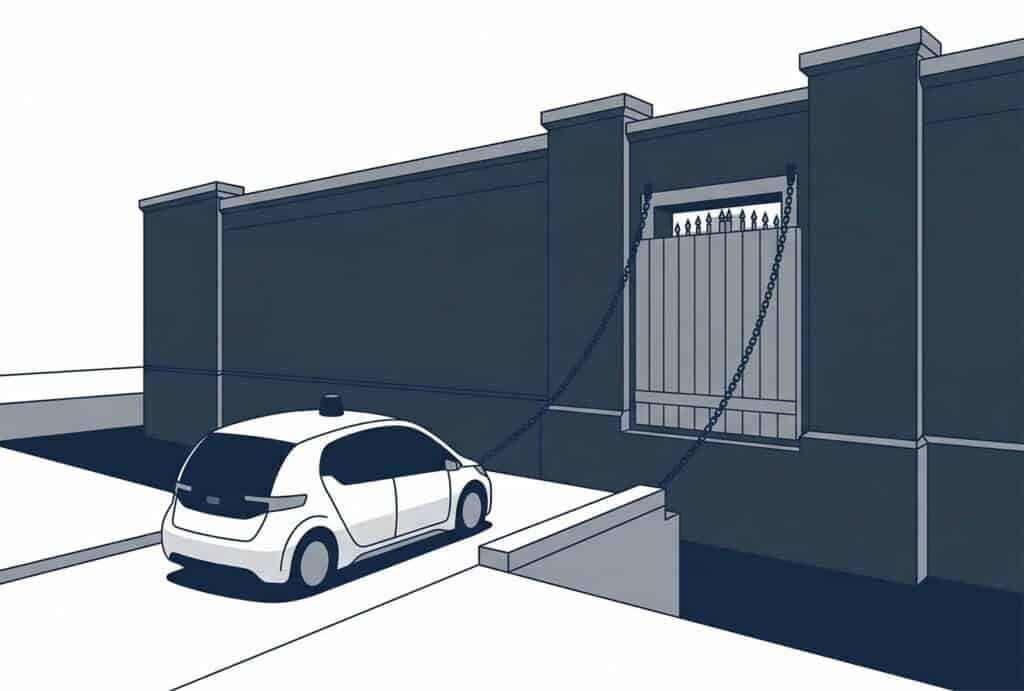
Something smells in DC and it’s not the swamp nor the algae in the reflecting pool. Instead it’s a fresh coat of lobbyist money that appears to be using regulatory capture to block competitors.
Councilmember Charles Allen’s Autonomous Vehicle Deployment Authorization Amendment Act of 2026 reads less like a deployment framework and more like a scene from The Great American Butter War, where the U.S. dairy lobby lobbied to ban dyeing margarine yellow to protect their moat.
First, they lobbied for the Oleomargarine Act of 1886, which slapped a steep federal tax on margarine and forced manufacturers to pay exorbitant fees just to be in business.
Then the dairy lobby went to the states to ban margarine companies from dyeing their product yellow. It worked as over 30 states passed anti-color bills. Over time, the bans were overturned, but when there is a moat and a competitor or competitors for that fact feel threatened, they stop competing and start turning to lobbying.
In DC, it appears that history is trying to rhyme once again. This time we know it’s not the U.S. dairy lobby, but who is it and how far are they willing to go with their tactics? Do they want the We Win, They Lose Act of 2026? Is that the ultimate goal?
If the bill is passed and signed into law, commercial robotaxis would be able to operate in The District, but it would come at a steep cost to both companies and consumers and the We Win, They Lose Act of 2026 would become an unfortunate reality.
The proposed fee structure is as follows:
- Application Fees: $1,000,000 nonrefundable for an initial commercial Autonomous Vehicle permit and $500,000 for any subsequent permit.
- Permit Fees: $5,000,000 nonrefundable on approval of an initial permit and $1,000,000 on renewal.
- Ongoing Fees: Operators would pay a $0.15 tax on every vehicle mile traveled (VMT), plus a $10,000 annual registration fee.
But before a robotaxi company even gets to this point, they have to participate in the Autonomous Vehicle Testing Program for 180 days and have driven 250,000 miles in The District.
Add up all of these costs, and it costs north of $6 million before a single paid robotaxi trip can occur in The District. And those are just administrative costs, not operating costs.
Then there is what we call the Airbnb clause buried in the 24-page bill. The bill would effectively ban consumers from using Tesla FSD Unsupervised or any personally-owned autonomous vehicle in The District as the bill states:
No autonomous driving system shall be engaged on public roadways in the District except as described in subsection (b). “(b)(1) A permittee or the permittee’s agents may engage a covered autonomous driving system in any autonomous vehicle for which the permittee has a commercial AV permit issued as described in section 3a. (2) A test operator or remote operator may engage a covered autonomous driving system or covered semi-autonomous driving system if the AV testing entity employing the operator has received an AV testing permit or is testing without a permit as described in section 3a(d) of this act. (3) A person may engage a Level 1 or Level 2 autonomous driving system.
The way the statute is written, an autonomous driving system may only be engaged under two situations, 1) a commercial permittee operating a fleet, 2) or a licensed tester. As this is written, if and when Tesla cracks FSD Unsupervised, consumers will not be able to add their vehicles into the fleet.
This is the New York Local Law 18 playbook that was deployed against Airbnb in the early 2020s. In the years leading up to the bill being passed in 2022, the Hotel and Gaming Trades Council lobbied relentlessly and won a de facto ban that never used the word ban.
In order for individuals to put their apartments on Airbnb, they had to register and be physically present, while whole-unit rentals under 30 days were prohibited. Listings collapsed from roughly 38,000 to about 3,000, enforced with fines of $100 to $5,000 per violation.
The Autonomous Vehicle Deployment Authorization Amendment Act of 2026 differs from Local Law 18 in name only. The AV Authorization Amendment Act of 2026 would restrict autonomous driving deployments to permitted commercial fleets and price entry with multi-million dollar nonrefundable fees.
A pattern has emerged here and history is our guide. First was the dairy industry that was threatened by the French invention of oleomargarine, an affordable shelf-stable alternative to butter made from vegetable oils and animal fats. Then it was hotel unions and now it appears to be an incumbent currently testing in The District.
In all three scenarios, a connected incumbent deployed a regulatory capture strategy to benefit their own interests. While the incumbent might have won in the short term, over time they lost. But the damage caused during the periods of instability only ended up hurting the consumer.
Autonomy will have a positive benefit on society and the free-market should decide where and how it is deployed, not lobbyists.
Our Take: Decades change, but the playbook does not.
The Road to Autonomy Robotaxi Index
Piquing Our Interest
Tesla Cybercab Specs Revealed in EPA Filing Tesla’s Cybercab EPA filing revealed the robotaxi’s specs. The vehicle weighs 3,113 lbs, has 219 HP, and a 48 kWh battery, confirming a powertrain built for efficiency on a vehicle that is certified and in production.
Stellantis, Wayve, and Uber Form a Robotaxi Ecosystem Stellantis, Wayve, and Uber signed a non-binding MoU to develop and deploy Level 4 robotaxis in London, Tokyo, and ten other cities around the world starting this year.
Uber, Nuro, and Lucid Choose Houston as Second Robotaxi Market Uber, Nuro, and Lucid chose Houston as their second robotaxi market, targeting a mid-2027 launch.
Mobileye Goes From Supplier to Operator Mobileye announced a vertically integrated robotaxi business that will see the company own and operate its own robotaxi service in a US city in 2027, starting with roughly 100 vehicles and targeting about 17,000 over five years.
Waymo Partners with Element Waymo has partnered with Element for end-to-end fleet management and operational services to support Waymo’s growth beginning in the San Diego market.
Waymo Launches New York PAC Called Upward NY As Waymo eyes a deployment in the Big Apple, the company has registered a New York PAC called Upward NY, signaling it wants to make it in New York.
Momenta Targets $1 Billion Hong Kong IPO Chinese autonomous driving company Momenta’s IPO plans has been approved by the China Securities Regulatory Commission as the company prepares to list on the Hong Kong Exchange.
Baidu Goes Driver-Out in Jumeirah (Dubai) As we have written about in this newsletter and spoken about in-depth on our podcasts, China’s Autonomous Belt & Road Initiative continues as Baidu has launched driver-out commercial services in the Jumeirah area of Dubai.
📰 Follow @RoadToAutonomy on X for our latest thoughts and insights on the autonomy economy.
Trending on X
Applied Intuition Expands Self-Driving System to Japan
Applied Intuition has brought their Self-Driving System (SDS) to Japan less than a year after launching the automotive platform in North America and Europe, bringing camera and radar based intelligent parking, active safety, and urban driving to one of the world’s most demanding automotive markets and laying groundwork for future L3 and L4 deployment.
Our take: We have been saying it for years and we will say it again. Applied Intuition is the most interesting company in autonomy.
How the U.S. Army Acquires Autonomy
Zachary Harrell, Director of Insights and Analysis, Army Applications Laboratory, joined Grayson Brulte on The Road to Autonomy podcast to discuss how the U.S. Army acquires autonomy and brings cutting-edge technology into the hands of soldiers as fast as possible.
Why Is Mobileye Suddenly Building Its Own Robotaxi?
This week on Autonomy Signals, Grayson Brulte and Rob Grant discussed the launch of The Road to Autonomy Indices and break down Mobileye’s pivot from licensor to robotaxi operator.
AUTNMY AI In The News
Robotaxi rankings show Waymo lead, China’s rise – Axios
June 17, 2026 | Axios covered the launch of The Road to Autonomy Indices, AUTNMY AI’s proprietary indices that benchmarks Robotaxis, Autonomous Trucking, Autonomous Driving Licensing, and Delivery Bots.
“Chinese companies are scaling,” said Grayson Brulte, who, along with former Cruise executive Rob Grant, cofounded Autnmy AI. “I don’t really think it’s well-recognized how far along the Chinese are in robotaxis,” he said. “To me, it’s a wake-up call.”
Read the full article on Axios
____________________________________________________
Tech Waymo recalls about 3,900 robotaxis after some drove into freeway construction zones – CNBC
June 18, 2026 | CNBC quoted AUTNMY AI co-founder Grayson Brulte on Waymo’s freeway construction zone recall, stating that the company’s expansion velocity stays constrained until the patch is deployed and validated.
Grayson Brulte, a co-founder of AUTNMY AI, which tracks autonomous driving, applauded the company’s proactive decision. “However, until the freeway patch is deployed and validated, we believe Waymo’s expansion velocity is fundamentally constrained.”
____________________________________________________
A new robotaxi scorecard shows China’s dominance
June 19, 2026 | TechCrunch Mobility led with the launch of AUTNMY AI’s The Road to Autonomy Indices, the 12-hour benchmarking system that put Baidu Apollo Go ahead of Waymo, with co-founder Rob Grant emphasizing the firm only uses publicly available, licensed, or Creative Commons data.
Advisory and research startup Autnmy AI has developed a generative AI platform to create a benchmarking system that evaluates and ranks autonomous vehicle companies in an effort to answer that question in real time. And this week, the startup released its Road to Autonomy Index, which searches relevant global public databases, including federal and state reports, SEC documents, public exchanges, and other data.