This Week in The Autonomy Economy, presented by Koop Insurance, Waymo opened commercial service to the public in San Antonio, San Diego, and Tampa. Uber drivers protested Uber’s partner Wayve in London, and Baidu Apollo Go was granted the first autonomous vehicle testing license in Hong Kong.
While the headlines continue to pile up, we continue to keep our bags packed as we keep on truckin’ autonomously from city to city. Our coverage is beginning to change as we spend more time on the road and uncover the ground-truth for what is really happening, and we have started to notice a trend.
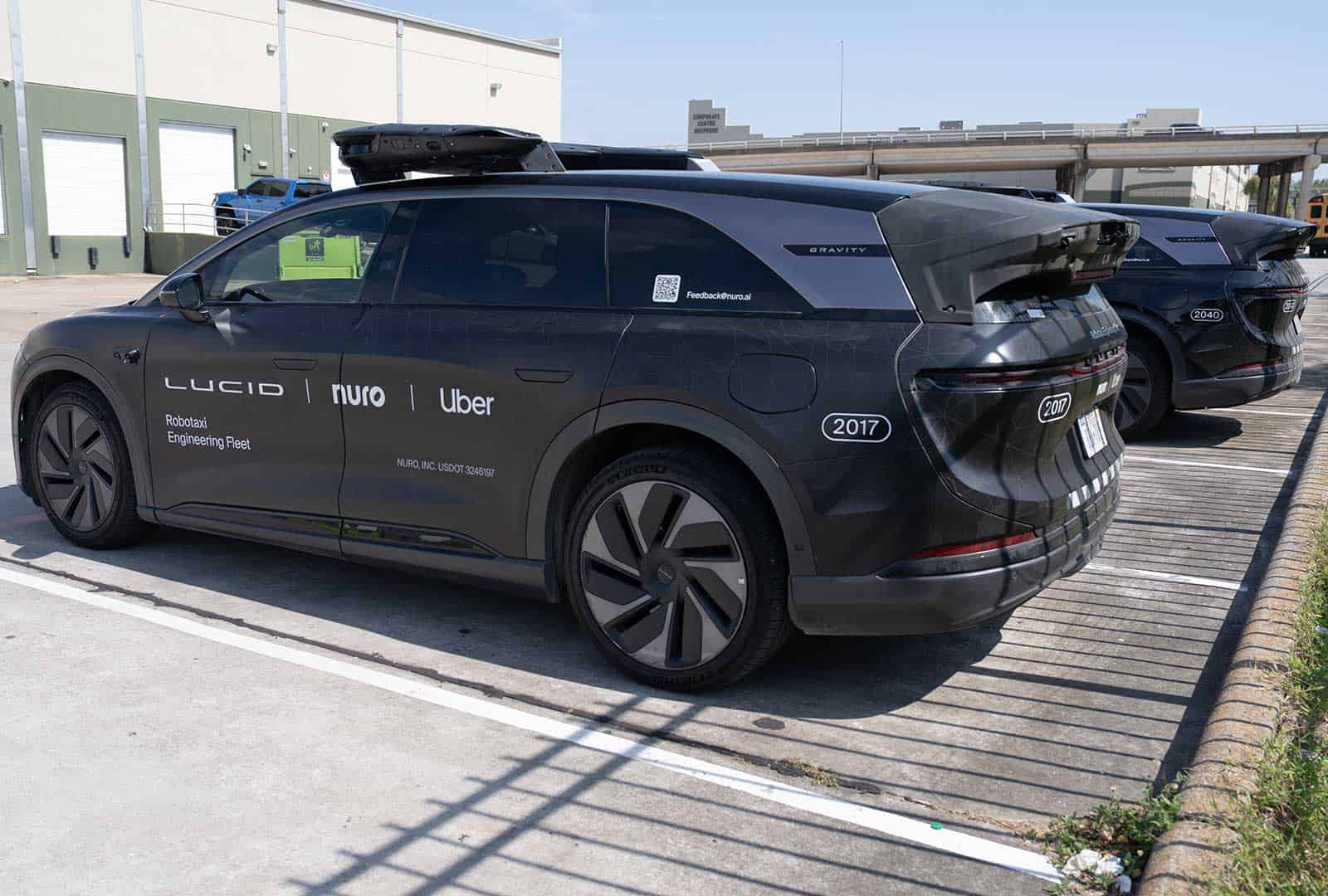
The headlines are not necessarily telling the whole story. What we see on the ground from visiting depots and doing field work sometimes tells a different story with different timelines. This week we were in Houston and we counted more Nuro/Lucid/Uber robotaxis than we did Zoox Highlanders or Toasters.
In fact, we did not see one Zoox Highlander or Toaster in Houston, and we drove all over the city. But we saw six different Nuro/Lucid/Ubers and visited a depot that had cars and was active, but not buzzing with activity.
The Zoox depot, on the other hand had no activity, no cars, and no visible construction. We will release the high-level findings in upcoming field reports, and OMEGA subscribers currently have access to the full dataset.
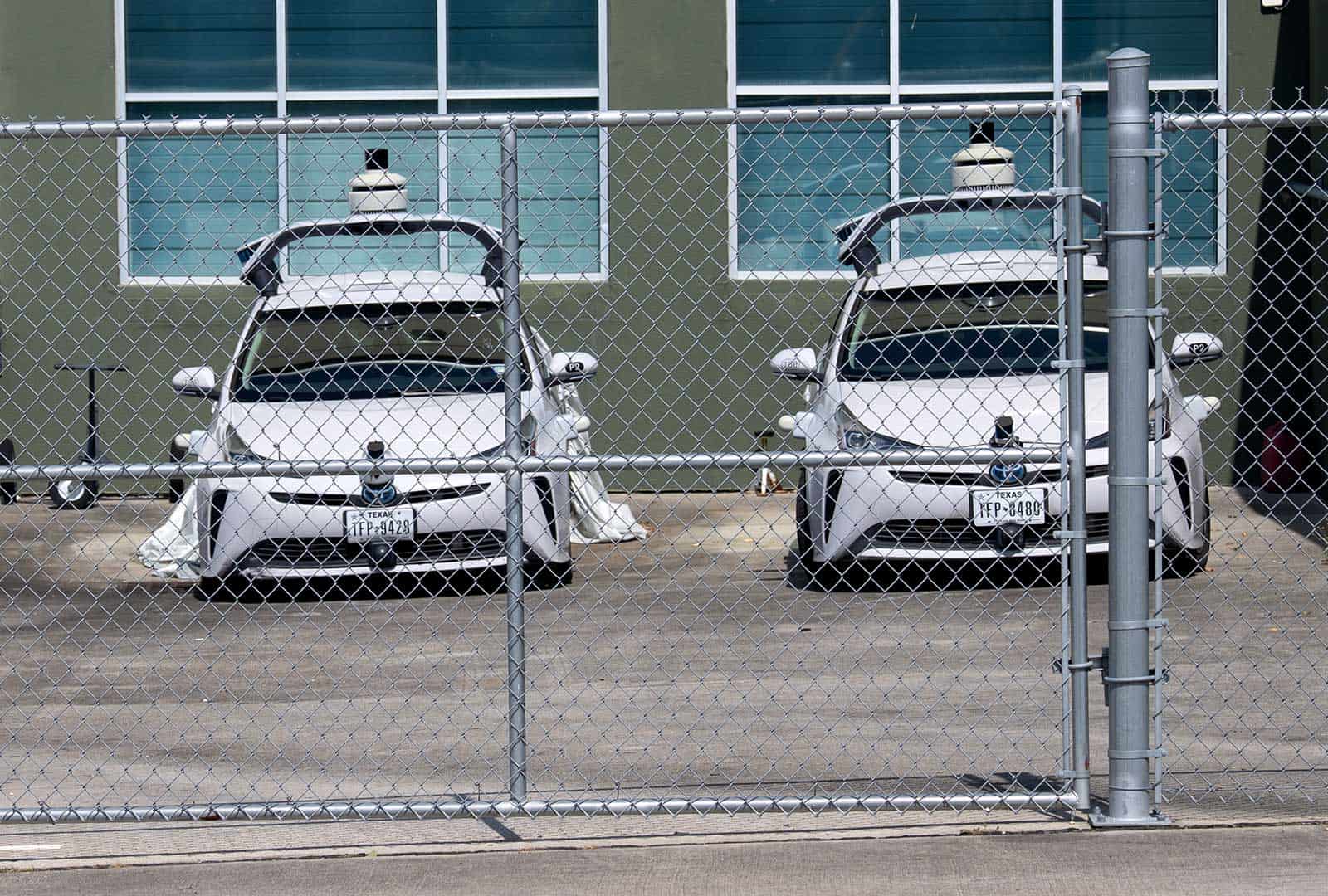
In a blast from the past, we spotted two of the old Nuro Toyota Prius vehicles at their Uber-managed Houston depot.
Nuro Toyota Prius Vehicles
From what we see on the ground, both Nuro/Lucid/Uber and Zoox have a long way to go before launching commercial service in Houston. While they test in Space City and build out their depot infrastructure, Waymo is scaling in Houston, and the service is working well with low wait times. The Waymo depot was buzzing with activity and cars.
While Tesla does operate robotaxis in Houston, it is in a limited area which, in traffic, is 45 minutes from the Museum District. We produced a Field Report in May on our experience. Waymo is Houston’s town now, and hopefully service will soon connect to the IAH (George Bush Intercontinental) Airport.
All of the data gathered from our field reports are available exclusively to OMEGA subscribers. If you are interested in becoming a subscriber, please send an email to alpha [at] autnmy.ai.
Next week, the trend of keeping our bags packed, cameras rolling, and note-taking devices working overtime continues as we keep on truckin’ autonomously.
📰 Need to Know: This Week in the Autonomy Economy
Where is Waymo launching and scaling commercial service?
Waymo has expanded commercial service to the general public in San Antonio, San Diego, and Tampa, including direct airport service to and from San Antonio International Airport. In Houston, Waymo is actively scaling with low wait times and a high-volume depot, while also expanding early rider access to Nashville International Airport (BNA) and aiming for a 2028 commercial launch in Toronto alongside Element Fleet Management.
What does The Road to Autonomy ground-truth fieldwork reveal about robotaxi deployments vs. public headlines?
Field reporting reveals a stark disconnect between media announcements and actual on-the-ground reality regarding market timelines. In Houston, field inspections spotted zero Zoox vehicles (Highlanders or Toasters) and an inactive depot with no visible construction. Conversely, Nuro, Lucid, and Uber had six vehicles on the road and an active depot featuring legacy Nuro Toyota Prius models, though both platforms remain far from launching commercial service compared to Waymo’s dominant, fully operational footprint.
What operational resistance and regulatory developments are surfacing internationally?
Labor and regulatory dynamics are accelerating globally. In London, Uber drivers organized protests outside Wayve’s headquarters calling for a slowdown of robotaxi deployments. Meanwhile, Baidu Apollo Go secured Hong Kong’s first autonomous vehicle pilot license under a new regulatory regime to test 10 vehicles in North Lantau, and an Uber, Pony.ai, and Verne partnership expanded testing to Manchester without releasing commercial timelines or permit details.
How are hardware stacks and autonomous trucking systems evolving?
Autonomous heavy freight is making tangible hardware strides to lower production barriers. Bot Auto selected Lenovo’s AD1 domain controller powered by NVIDIA Hyperion as the production computer for its Class 8 autonomous trucks. This strategic hardware selection targets a commercial stack cost of $50,000 per truck starting in early 2027.
How can institutional investors and industry leaders access complete fieldwork datasets?
While high-level summaries and observations are released across weekly field reports and podcast episodes, the primary ground-truth datasets are kept restricted. Full raw data, depot tracking, and continuous market intelligence are provided exclusively to OMEGA subscribers, who can request access by emailing alpha [at] autnmy.ai.
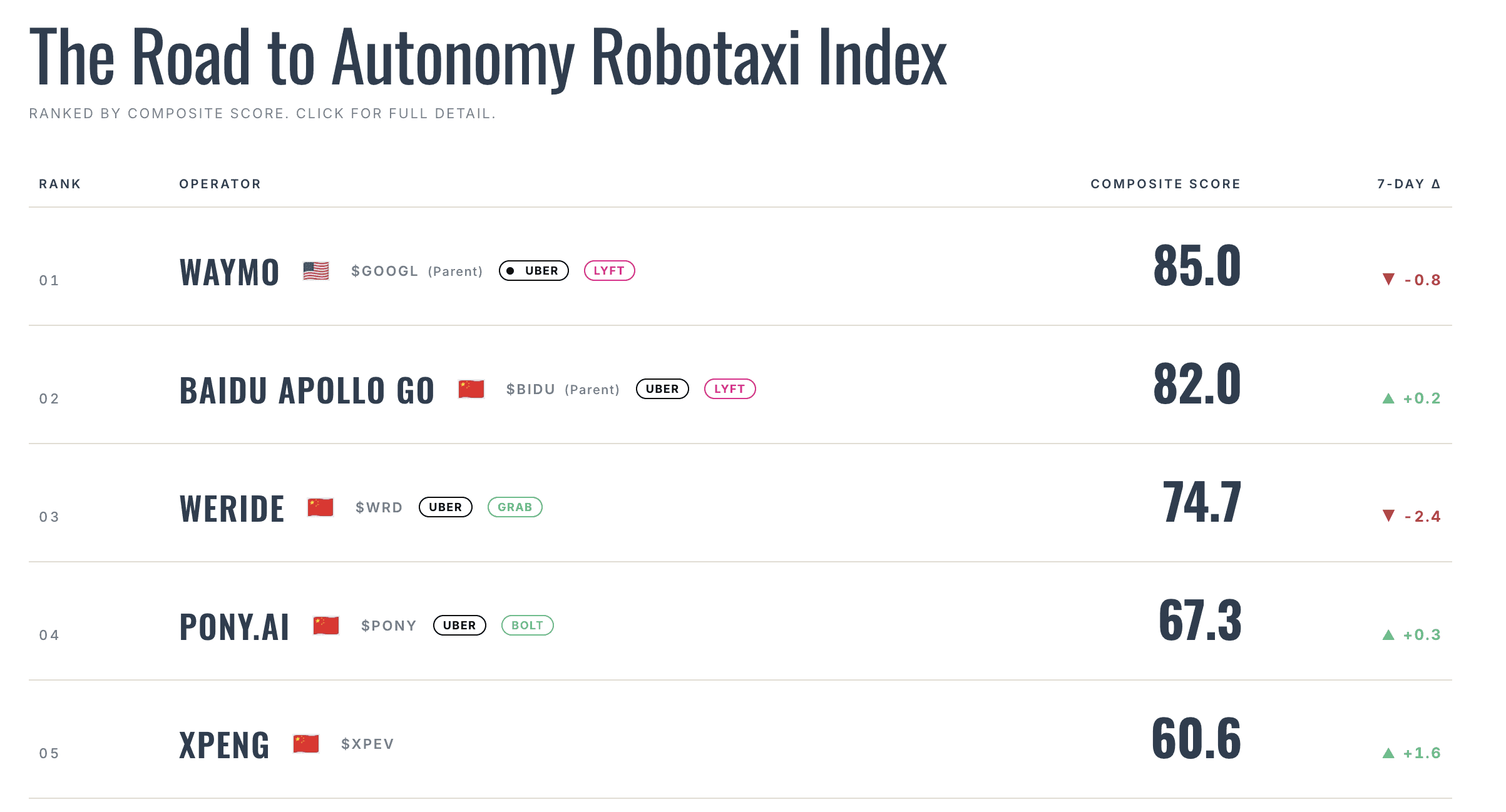
📈 Follow @AutonomyIndices on X for the latest updates on The Road to Autonomy Indices. Updates every 12 hours.
Waymo Dallas Avis Depot & Active Operations Field Report
Special Field Correspondent Spencer headed to Dallas, Texas to inspect Waymo’s infrastructure expansion, examine active fleet operations, and evaluate the 24/7 autonomous ride-hailing experience. This is the Field Report.
Waymo Grand Hyatt at SFO Pickup Field Report
Grayson Brulte headed to San Francisco International Airport (SFO) to evaluate Waymo’s airport pickup operations, examine strict permit regulations, and assess the drop-off and pickup experience at the Grand Hyatt. This is the Field Report.
Piquing Our Interest
Waymo Expands to Toronto With regulations still to be finalized, Waymo has announced a goal of launching commercial service in Toronto in 2028, with Element Fleet Management Corp. as its fleet management partner.
Waymo Opens Early Rider Nashville International Airport (BNA) Service In Music City, select riders can now ride to and from the airport into the city. We are one of those early riders, and we are heading to Nashville next week to produce a Field Report on the experience.
Bot Auto Picks Lenovo and NVIDIA for Autonomous Truck Hardware Stack Bot Auto has selected Lenovo’s AD1 domain controller, powered by NVIDIA Hyperion, as the production computer for its Class 8 autonomous trucks, targeting a hardware stack cost of $50,000 per truck starting in early 2027.
Uber Drivers Protest Uber’s Partner Wayve in London In London, Uber drivers protested outside Wayve’s headquarters, calling for a slowdown of robotaxi deployments in the Big Smoke. We have previously visited with the Wayve team there and taken a ride in their vehicle, which you can watch here.
Uber, Pony.ai and Verne Expand Testing to Manchester A partnership that is light on details, but strong on headlines, has expanded testing to Manchester. Still, there are no public statements on when unsupervised commercial service will launch or which company will hold the Automated Passenger Service (APS) permit.
Baidu Apollo Granted First Autonomous Vehicle Testing License in Hong Kong Baidu Apollo Go has secured Hong Kong’s first pilot license under its new regulatory regime to begin testing a fleet of 10 autonomous vehicles in the North Lantau region.
📰 Follow @RoadToAutonomy on X for our latest thoughts and insights on the autonomy economy.
Trending on X
San Antonio, San Diego and Tampa Come Online
Starting today in San Antonio, San Diego and Tampa, anyone can hail a Waymo, including at San Antonio International Airport.
Another week, another expansion for Waymo as the company continues to fire on all cylinders, accelerating its growth.
In San Antonio, San Diego, and Tampa, any member of the public can now book a ride, and in San Antonio, you can take Waymo directly to and from the airport. We tested it out, and it’s great. On Monday, we will be releasing our Waymo San Antonio Airport Field Report.
Our take: The faster Waymo scales, the larger its moat grows. It is not just the vehicles or the service, it is the infrastructure. That moat is a lot larger than the market currently realizes.
This week on Autonomy Signals presented by KPMG, Grayson Brulte and Rob Grant discuss NHTSA opening a safety inquiry into Tesla robotaxis speeding in active school zones, XPENG launching its XPENG YOYO robotaxi service, and a Danish supermarket testing humanoid robots on the night shift.
Robotaxis Go Curbside at Airports as Uber’s Robotaxi Boss Heads for the Exit
This week on Autonomy Markets, Grayson Brulte and Walter Piecyk discuss new field reports from San Antonio and Dallas, management turnover at Uber, Tesla’s Cybercab progress in Austin and upcoming Dallas expansion, regulatory shifts across the US and Europe, and Wayve’s momentum in securing major OEM partnerships.