This Week in The Autonomy Economy, presented by Koop Insurance, we hit the road and headed to Texas for field work, Mercedes-Benz is surfing the Wayve, and Kodiak announced that the Dallas-to-Houston corridor will be its first commercial, unsupervised over-the-road lane.
In Texas, we rode in a Cybercab, Robotaxi, and a Kodiak autonomous truck while visiting several depots. Over the coming weeks, we will be releasing a series of Field Reports from our journey.
There is a lot happening as we head toward the end of the year, but one of the most important trends to watch is just how fast autonomy is scaling globally. While California might have the largest concentration of deployments today, followed closely by Texas, international markets are rapidly catching up and have grand ambitions of their own.
The future of autonomy will not be decided by who has the best sensor suite or who is moving the quickest. It will be decided by the consumer, and at the end of the day, the consumer always votes with their wallet.
Some market share might go to a premium product, and some might go to a more affordable option, but ultimately, the consumer will decide the winner. There is a very good chance that someone emerges as the Apple of robotaxis, but who that is today is anyone’s guess.
As the market evolves and more companies launch unsupervised services, we will be in the field to try every single one of them, and it won’t just be robotaxis.
Next week, we are back on the road.
📰 Need to Know: This Week in the Autonomy Economy
What major real-world operational milestones were recently set in Texas?
Texas is serving as a primary proving ground for both passenger and freight autonomy. Waymo has begun rolling out freeway access in Austin, while Kodiak announced that its Dallas-to-Houston corridor will launch by the end of the year as its first commercial, unsupervised (no human in the cabin) over-the-road freight lane.
How is autonomous vehicle safety performing relative to human drivers?
Waymo’s latest safety data across more than 271 million rider-only miles demonstrates significant outperformance against human benchmarks, recording 95% fewer serious injury crashes and 82% fewer airbag deployments.
What key OEM and commercial partnerships are driving vehicle automation into production?
Mercedes-Benz signed a definitive production agreement to integrate the Wayve AI Driver into future vehicles within two years. In commercial freight and industrial transport, Aurora reaffirmed its goal to deploy 30,000 autonomous trucks by 2030, while Volvo Autonomous Solutions surpassed 3 million tonnes of material hauled across European mining and quarrying sites.
Is autonomy scaling outside of core U.S. markets like California and Texas?
Middle East: Dubai is constructing a dedicated autonomous test track to support its target of 25% autonomous journeys by 2030, while Applied Intuition and Echelon are scaling physical AI across Saudi Arabia.
Europe: Volt Premium Taxi and Tensor plan to deploy 200 robotaxis in Sofia, Bulgaria.
Global Footprint: WeRide’s fleet now exceeds 1,800 robotaxis operating across 13 countries and over 60 cities.
What factor will ultimately determine the commercial winner in the robotaxi market?
Market adoption will be decided by the consumer voting with their wallet rather than simply who has the best sensor suite or fastest timeline. As unsupervised services launch, market share will split between premium and cost-effective solutions, leaving open the opportunity for an industry leader to emerge as the Apple of robotaxis.
Waymo Begins Opening Freeway Access in Austin After playing a game of autonomy roulette, if you are paired with a Waymo, you could possibly go on the highway, as Waymo has begun rolling out highway access in Bat City.
270M+ miles, Safer Roads Waymo’s latest safety data reveals that they are significantly outperforming human benchmarks, demonstrating 95% fewer serious injury crashes and 82% fewer airbag deployments over 271 million rider-only miles.
Surfing the Mercedes-Benz Wayve Wayve and Mercedes-Benz have signed a definitive production agreement to integrate the Wayve AI Driver into future Mercedes-Benz vehicles within the next two years.
Aurora Targets 30,000 Autonomous Trucks by 2030 At its Analyst and Investor Day in Dallas this week, Aurora reaffirmed its 2030 goal of deploying more than 30,000 autonomous trucks.
Kodiak to Launch Dallas to Houston as First Unsupervised Lane Kodiak announced that the Dallas-to-Houston lane will be its first fully autonomous, over-the-road freight lane (with no human in the cabin), targeting a launch by the end of the year.
3 Million Tonnes and Counting Volvo Autonomous Solutions (VAS) has hauled more than 3 million tonnes of material autonomously in the mining and quarrying sector across its European customer sites.
Echelon and Applied Intuition Partner to Scale Physical AI Across Saudi Arabia Applied Intuition and Riyadh-based Echelon have formed a strategic partnership to deploy Applied’s physical AI platform at national scale across Saudi Arabia, spanning robotaxis, ports, mining, manufacturing, agriculture, construction, and trucks in the Kingdom of Saudi Arabia.
Tensor and Volt Premium Taxi to Deploy Robotaxis in Bulgaria Volt Premium Taxi has partnered with Tensor to deploy an initial fleet of 200 fully autonomous robotaxis in Sofia, Bulgaria. No timeline has been shared.
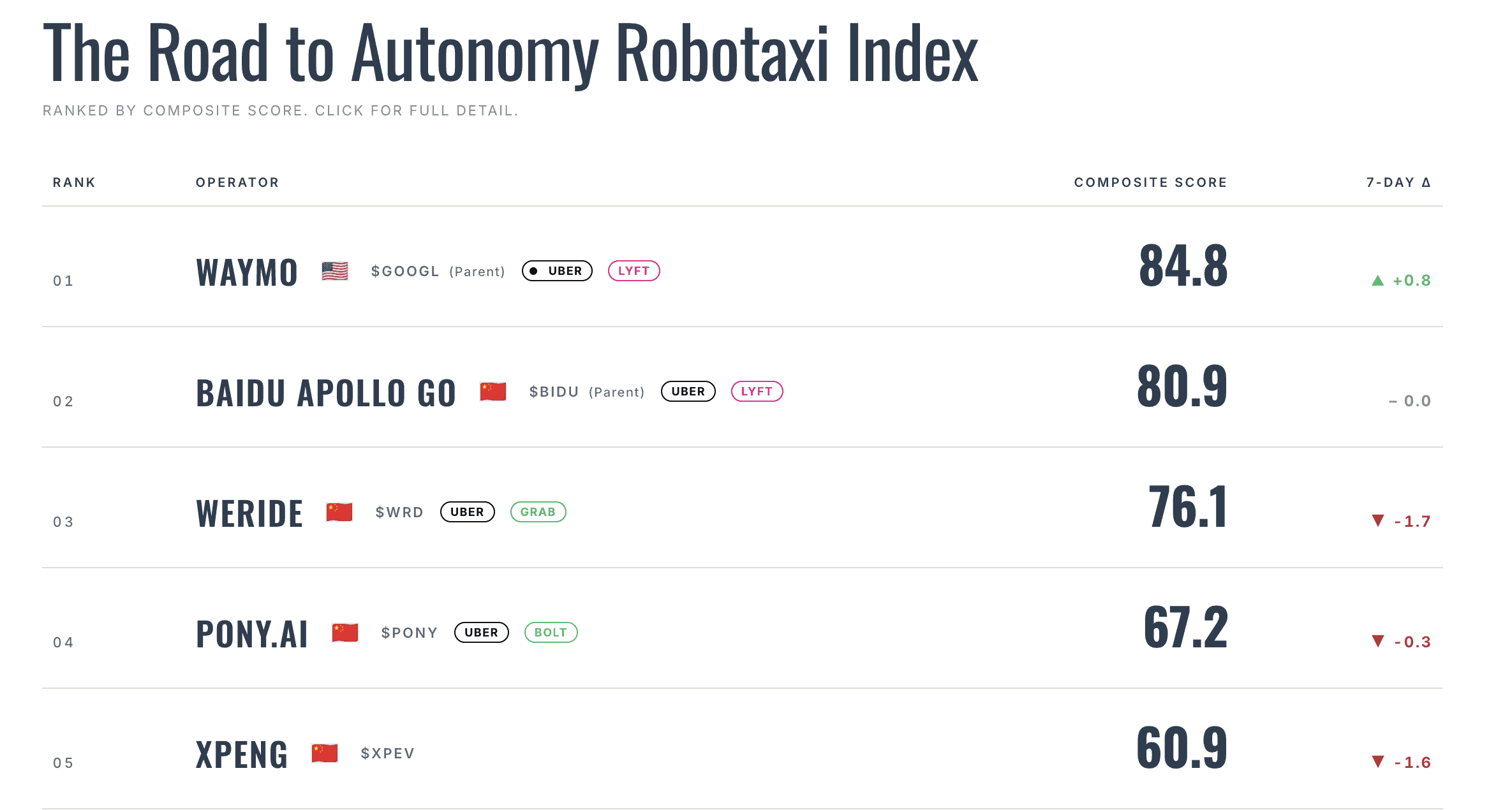
WeRide’s Robotaxi Fleet Surpasses 1,800 Vehicles WeRide has deployed more than 1,800 robotaxis across 13 countries and over 60 cities. While its global footprint is vast, an even distribution would mean an average of 30 vehicles per city.
📰 Follow @RoadToAutonomy on X for our latest thoughts and insights on the autonomy economy.
Trending on X
#RTA, in collaboration with the Dubai Integrated Economic Zones Authority (DIEZ), inaugurated Dubai Mobility Labs at Dubai Silicon Oasis — the smartest integrated ground-testing of its kind in the Middle East, dedicated to testing autonomous and future mobility technologies. The… pic.twitter.com/XUGFbOEksK
Dubai continues to embrace the autonomy economy, developing a dedicated autonomous vehicle test track to support its goal of making 25% of all journeys in the emirate autonomous by 2030.
Our take: The future is being deployed in Dubai. The question now is whether Dubai will become the first city in the world to achieve 100% autonomous journeys.
Solving the Last 50 Feet of Package Delivery With Legged Robots
Lee Redden, Founder of LastFeet joined Grayson Brulte on The Road to Autonomy podcast to discuss solving the last 50 feet of package delivery with a custom-built legged robot designed to ride in the jump seat of a delivery van and carry packages from the curb to the doorstep.
May Mobility’s SPAC and the $93 Million Question
This week on Autonomy Signals presented by KPMG, Grayson Brulte and Rob Grant discuss May Mobility filing to go public through a SPAC merger with an estimated $93 million annual cash burn, Mercedes-Benz adding Wayve as its third automated driving software partner, and Figure AI’s Helix 2.5 taking on household chores across 30 homes it had never seen before.
The Robotaxi Reality Check You Won’t Get From an Investor Deck
Grayson Brulte and Walter Piecyk spent 48 hours in Texas riding and inspecting autonomous vehicles across Austin and Dallas, including Cybercab, Robotaxi, Waymo, Avride, May Mobility, and Kodiak and Aurora autonomous trucks.