This Week in The Autonomy Economy presented by Koop Insurance, Waymo launched on Lyft in Nashville, Slovenia approved Tesla FSD, and China unveiled its grand plans for robotaxis on the mainland.
Make no mistake about it, China wants to control the global deployment of robotaxis. Homegrown companies Baidu, WeRide, Pony AI, and Momenta are all expanding abroad, and in some cases those expansions are being accelerated by both Uber and Lyft.
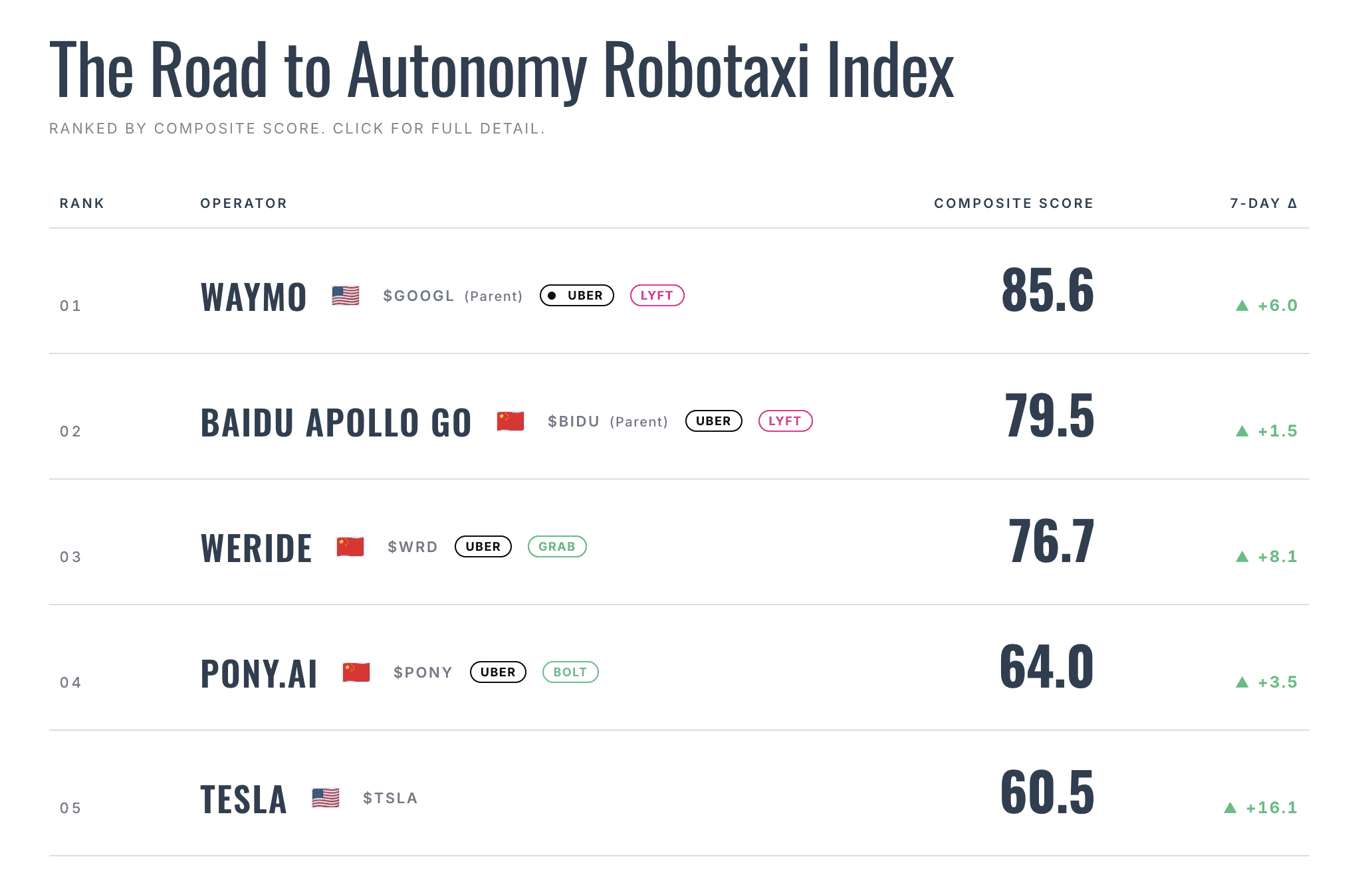
On The Road to Autonomy Robotaxi Index, three of the top five companies are Chinese, with Waymo and Tesla the only U.S. operators in that group. While Chinese robotaxi companies cannot deploy in America, they can deploy in Europe, and they are actively doing so as Waymo begins to inch into the market.
Europe is going to be a critical market, and one that should be watched closely. It could hold clues to how robotaxis scale globally. First Chinese robotaxis, next Waymo and Wayve, and then soon Tesla’s Cybercab.
📰 Need to Know: This Week in the Autonomy Economy
Is Waymo available on Lyft in Nashville?
Waymo has launched its robotaxis on the Lyft network in Nashville, with fleet operations managed by Lyft’s Flexdrive. However, because Lyft does not offer a dedicated robotaxi tier in the U.S., riders seeking an autonomous experience are forced to repeatedly request and cancel rides until they randomly match with a Waymo.
What is Autonomy Roulette and why is it causing app bans?
Autonomy roulette refers to the frustrating process of cycling through ride requests on Uber or Lyft in hopes of being paired with an autonomous vehicle. Without a dedicated option to select a robotaxi, users who employ this workaround are having their ride-hailing accounts disabled for excessive cancellations, as recently experienced by a rider in Nashville.
How is China accelerating its global robotaxi deployments?
China recently introduced a national roadmap for large-scale autonomous deployments by 2030 with the goal of controlling the global robotaxi market. Because Chinese operators cannot deploy in the U.S., companies like Baidu, WeRide, Pony AI, and Momenta are aggressively expanding into Europe and the Middle East, a move actively supported and accelerated by partnerships with Uber.
Why is Europe considered a critical battleground for autonomy?
Europe holds the clues to how robotaxis will scale globally and is quickly becoming a competitive proving ground. Slovenia just became the sixth European country to approve Tesla’s FSD Supervised on public roads, paving the way for a market where Chinese operators, Waymo, Wayve, and Tesla’s Cybercab will all actively compete.
How did the Tesla Cybercab launch change the rider experience in Austin?
Tesla officially launched the Cybercab in Austin with 45 vehicles operating across its full service area. By scaling a dedicated, consistent autonomous network, Tesla has eliminated the need for riders to play ride-hailing games of chance, allowing consumers to opt directly for a purpose-built robotaxi experience.
Roulette is a Casino Game, Not a Robotaxi Experience
Roulette is a Casino Game, Not a Robotaxi Experience | Source: The Road to Autonomy
In the United States, there is no dedicated robotaxi tier on Uber or Lyft. Overseas, it exists. Uber is actively accelerating Chinese robotaxi deployments abroad, even as U.S. Transportation Secretary Sean Duffy publicly warned Ford against embracing Chinese technology and manufacturing over national security concerns.
That warning does not appear to matter to Uber. In America, the company continues a regulatory-capture strategy designed to slow autonomy. Why? Simple. Uber’s U.S. robotaxi partners technology is not ready yet, minus Waymo who will will soon be an ex-partner.
Uber’s American playbook is clear, deploy regulatory capture, slow the market, and force riders into autonomy roulette when they try to get paired with a Waymo in Austin and Atlanta.
Overseas in the UAE, Uber already offers a robotaxi tier. When we asked Andrew Macdonald on X when a dedicated tier was coming to the Uber app in America, he replied; “we are looking at the best way to do this consumers definitely want it!”
That was 446 days ago. Still no dedicated tier in America, as riders who want to experience the future still have to play autonomy roulette. In Austin, we used to play it before Tesla scaled Robotaxi. Now that Tesla has scaled Robotaxi in Austin, we no longer have to. There is a consistent experience we can opt for instead.
While we were never had our app disabled for ordering and canceling multiple times, friend of The Road to Autonomy and special field correspondent David Moss’ Lyft account was disabled after he played autonomy roulette in Nashville trying to get paired with a Waymo.
Roulette is a casino game, not a robotaxi experience. Both Uber and Lyft should implement a dedicated robotaxi tier if they truly have grand autonomous ambitions.
Only time will tell how this plays out. But we can tell you from decades of experience that roulette is a game of chance, and playing roulette to ride in a robotaxi is a game most Americans will not want to play. They will seek alternatives.
Perhaps that is why Waymo and Uber are getting divorced, and why Tesla gave the Heisman to demand aggregators. Both companies know it is all about the experience.
Special Field Correspondent David Moss rode in Cybercab at launch with his father Gary in Austin. 45 Cybercabs were on the network at launch operating in the full service area. This is The Road to Autonomy Field Report.
Piquing Our Interest
Waymo Hyundai Robotaxis are Coming in Q4 2026 Hyundai will begin delivering Waymo IONIQ 5 robotaxis in the fourth quarter of 2026.
Waymo Enters the Mile-High City with Only 26 Robotaxis The Autonomy Markets launch metric for a new market is 100 vehicles. In Denver, Waymo appears to have launched with only 26, according to local media outlet Denverite.
Waymo is Now Available on Lyft in Nashville You can now get paired with a Waymo on Lyft in Nashville. As part of the partnership, Lyft’s Flexdrive is managing the Waymo fleet in Music City.
Robotaxis are Becoming a Religious Debate in D.C. As Washington, D.C., considers legalizing commercial robotaxis, several Baptist pastors and religious leaders are lobbying against the legislation, arguing that autonomous vehicles eliminate meaningful human connection and unfortunately using labor talking points. You can’t make this up.
Kodiak is On Track for Launching Year End Fully Autonomous Operations Kodiak’s Autonomy Readiness Measure (ARM) has reached 93% as the company reiterates it is on track to launch fully autonomous over-the-road operations by the end of the year.
Pony AI, Verne and Uber Begin Limited Fully Autonomous Operations in Croatia Invited passengers can now ride in a fully autonomous vehicle along a 13.67-mile pre-planned route connecting Verne’s HQ with a business district and the airport. Despite the media coverage, this is not a launch. It is a fixed-route demo.
WeRide, Uber and AVOMO Receive Spain’s First National Permit for Level 4 Autonomous Passenger Vehicles Slow down robotaxis in America with regulatory capture, and accelerate it overseas with Chinese partners. That seems to be the Uber playbook these days, as Uber and partners WeRide and AVOMO have been granted Spain’s first national permit to deploy commercial robotaxis.
Slovenia Approves Tesla FSD Supervised Slovenia has approved FSD Supervised on public roads, becoming the sixth European country to do so.
China’s Autonomous Belt & Road Initiative Starts at Home China’s industry ministry recently unveiled a new roadmap for autonomous vehicles that calls for the large-scale deployment of autonomous vehicles by 2030.
Neolix Eyes Japan Expansion Chinese autonomous delivery company Neolix has begun testing its autonomous delivery bots at the Tokyo Ryutsu Center as it prepares to launch commercial service in Japan.
📰 Follow @RoadToAutonomy on X for our latest thoughts and insights on the autonomy economy.
Trending on X
😂 no way
I got kicked off the @lyft app just now trying to get a @Waymo ride
I have been trying for last 50 min & have so far paid gladly 6+ cancellation fees + a pink membership
Tried to get a ride all over downtown 3 separate locations miles apart each for pick up & many… pic.twitter.com/l0KduRNaqh
In Nashville, David Moss played autonomy roulette for 50 minutes and was eventually banned from the Lyft app after repeatedly canceling rides in an effort to get paired with a Waymo.
We haven’t experienced Waymo on Lyft in Nashville yet, but we’ve played the same game with Uber in downtown Austin, trying to get paired with a Waymo. It took more than ten tries, it was a miserable experience, and when we finally got paired, our phone died, so we ended up walking.
Offering robotaxi rides inside Lyft and Uber without a dedicated robotaxi tier is a bad user experience. Soon we’ll be in Nashville to try it ourselves, and we’ll share our findings in a Field Report.
Our take: Roulette is a casino game, not a let’s try and ride in a robotaxi game.
Building, Deploying and Scaling Autonomous Robotaxi Infrastructure
NHTSA Audits Cybercab While Waymo Launches With Lyft in Nashville
This week on Autonomy Signals presented by KPMG, Grayson Brulte and Rob Grant discuss NHTSA opening an audit query into Tesla’s Cybercab self-certification hours after commercial launch, Waymo launching in Nashville on both the Waymo and Lyft apps with Flexdrive running operations, and XPENG commissioning a dedicated humanoid production facility in Guangzhou, China.
Jason Calacanis on the Robotaxi Endgame
This week on Autonomy Markets, Grayson Brulte and Walter Piecyk are joined by special guest Jason Calacanis, one of the first investors in Uber, to debate his bull case on Uber, who wins the robotaxi endgame and whether local governments will cap the deployment of autonomous vehicles.